

ASTM F1939-15(2020)
(Test Method)Standard Test Method for Radiant Heat Resistance of Flame Resistant Clothing Materials with Continuous Heating
General Information
- Abstract
SIGNIFICANCE AND USE
5.1 This test method is intended for the determination of the radiant heat resistance value of a material, a combination of materials, or a comparison of different materials used in flame-resistant clothing for workers exposed to radiant thermal hazards.
5.2 This test method evaluates a material's heat transfer properties when exposed to a continuous and constant radiant heat source. Air movement at the face of the specimen and around the calorimeter can affect the measured heat transferred due to forced convective heat losses. Minimizing the air movement around the specimen and test apparatus will aid in the repeatability of the results.
5.3 This test method maintains the specimen in a static, vertical position and does not involve movement, except that resulting from the exposure.
5.4 This test method specifies two standard sets of exposure conditions: 21 kW/m2 (0.5 cal/cm2s) and 84 kW/m2 (2.0 cal/cm2s). Either can be used.
5.4.1 If a different set of exposure conditions is used, it is likely that different results will be obtained.
5.4.2 The optional use of other conditions representative of the expected hazard, in addition to the standard set of exposure conditions, is permitted. However, the exposure conditions used must be reported with the results along with a determination of the exposure energy level stability.
5.5 This test method does not predict skin burn injury from the standardized radiant heat exposure.
Note 4: See Appendix X4 for additional information regarding this test method and predicted skin burn injury.
SCOPE
1.1 This test method rates the non-steady state thermal resistance or insulating characteristics of flame resistant clothing materials subjected to a continuous, standardized radiant heat exposure.
1.1.1 This test method is not applicable to clothing materials that are not flame resistant.
Note 1: The determination of a clothing material's flame resistance shall be made prior to testing and done in accordance with the applicable performance standard, specification standard, or both, for the clothing material's end use.
1.1.2 This test method does not predict skin burn injury from the standardized radiant heat exposure, as it does not account for the thermal energy contained in the test specimen after the exposure has ceased.
Note 2: See Appendix X4 for additional information regarding this test method and predicted skin burn injury.
1.2 This test method is used to measure and describe the response of materials, products, or assemblies to heat under controlled conditions, but does not by itself incorporate all factors required for fire hazard or fire risk assessment of the materials, products, or assemblies under actual fire conditions.
1.3 The values stated in SI units are to be regarded as standard. The values given in parentheses are mathematical conversions to inch-pound or other units that are commonly used for thermal testing.
1.4 This standard does not purport to address all of the safety concerns, if any, associated with its use. It is the responsibility of the user of this standard to establish appropriate safety, health, and environmental practices and determine the applicability of regulatory limitations prior to use.
1.5 This international standard was developed in accordance with internationally recognized principles on standardization established in the Decision on Principles for the Development of International Standards, Guides and Recommendations issued by the World Trade Organization Technical Barriers to Trade (TBT) Committee.
- Status
- Published
- Publication Date
- 30-Sep-2020
- Technical Committee
- F23 - Personal Protective Clothing and Equipment
- Drafting Committee
- F23.80 - Flame and Thermal
Overview
ASTM F1939-15(2020), established by ASTM International, specifies the Standard Test Method for Radiant Heat Resistance of Flame Resistant Clothing Materials with Continuous Heating. This international standard provides a procedure for evaluating the thermal insulation properties and radiant heat resistance of flame-resistant fabrics used in protective clothing. The method is crucial for industries where workers face radiant thermal hazards, such as firefighting, oil and gas, electrical utilities, and industrial manufacturing. By simulating real-world continuous heat exposure, ASTM F1939 helps manufacturers, safety professionals, and regulators assess and compare the protective performance of clothing materials.
Key Topics
- Radiant Heat Resistance Testing: The standard outlines a method to measure how well flame-resistant clothing materials resist heat transfer when exposed to a controlled, continuous radiant heat source.
- Standardized Exposure Conditions: It describes two primary radiant heat flux exposures–21 kW/m² (0.5 cal/cm²·s) and 84 kW/m² (2.0 cal/cm²·s)–as reference points for testing material performance.
- Specimen Preparation and Mounting: Specimens are positioned statically in a vertical orientation to ensure consistent exposure and reduce the influence of variables such as air movement.
- Heat Transfer Measurement: A copper slug calorimeter is used to record the rate and amount of heat passing through the material, providing a quantifiable radiant heat resistance value.
- Test Limitations: This method does not predict skin burn injuries or overall fire hazard and is only applicable to materials pre-qualified as flame-resistant by other recognized standards.
- Reporting Requirements: All exposure conditions, test procedures, and relevant calibration data must be thoroughly documented to ensure transparency and repeatability.
Applications
- Protective Clothing Evaluation: The standard enables manufacturers to rate the thermal resistance of flame-resistant fabrics, supporting the development of garments for firefighters, industrial operators, and personnel exposed to high-temperature environments.
- Material Comparison: By providing a quantitative, standardized measure of radiant heat resistance, ASTM F1939 allows organizations to compare and select the best available fabrics for their specific hazards.
- Regulatory Compliance: Compliance with this test method is often required for meeting occupational safety regulations and supporting risk assessments in hazardous workplaces.
- Quality Assurance: Regular testing according to ASTM F1939 helps ensure consistent production quality and safety performance across batches of flame-resistant clothing materials.
- Research and Development: Material scientists and textile engineers use this standard to innovate new fabrics and layering systems offering improved heat resistance for protective garments.
Related Standards
- ASTM D123 – Terminology Relating to Textiles
- ASTM D1776/D1776M – Practice for Conditioning and Testing Textiles
- ASTM D1777 – Standard Test Method for Thickness of Textile Materials
- ASTM D3776/D3776M – Test Methods for Mass Per Unit Area (Weight) of Fabric
- ASTM E457 – Method for Measuring Heat-Transfer Rate Using a Thermal Capacitance (Slug) Calorimeter
- ASTM F1494 – Terminology Relating to Protective Clothing
ASTM F1939 is developed in accordance with the World Trade Organization (WTO) Technical Barriers to Trade (TBT) Committee principles, ensuring broad international recognition and harmonization with other textile and protective equipment standards.
Adhering to ASTM F1939-15(2020) assures safety stakeholders and end-users of the reliability and quality of flame-resistant clothing, promoting worker protection in hazardous thermal environments.
Relations
- Effective Date
- 01-Feb-2020
- Effective Date
- 01-Jul-2019
- Effective Date
- 15-Jul-2017
- Effective Date
- 01-Mar-2017
- Effective Date
- 01-Jan-2016
- Effective Date
- 15-Sep-2015
- Effective Date
- 01-Sep-2015
- Effective Date
- 01-Jul-2015
- Effective Date
- 01-Apr-2015
- Effective Date
- 01-Feb-2015
- Effective Date
- 01-Jul-2013
- Effective Date
- 01-Jul-2013
- Effective Date
- 15-Jun-2013
- Effective Date
- 15-Jun-2013
- Effective Date
- 15-May-2013
Get Certified
Connect with accredited certification bodies for this standard

CIS Institut d.o.o.
Personal Protective Equipment (PPE) certification body. Notified Body NB-2890 for EU Regulation 2016/425 PPE.

Kiwa BDA Testing
Building and construction product certification.
Kmetijski inštitut Slovenije
Agricultural Institute of Slovenia. Soil testing, plant health, agricultural product analysis.
Sponsored listings
Frequently Asked Questions
ASTM F1939-15(2020) is a standard published by ASTM International. Its full title is "Standard Test Method for Radiant Heat Resistance of Flame Resistant Clothing Materials with Continuous Heating". This standard covers: SIGNIFICANCE AND USE 5.1 This test method is intended for the determination of the radiant heat resistance value of a material, a combination of materials, or a comparison of different materials used in flame-resistant clothing for workers exposed to radiant thermal hazards. 5.2 This test method evaluates a material's heat transfer properties when exposed to a continuous and constant radiant heat source. Air movement at the face of the specimen and around the calorimeter can affect the measured heat transferred due to forced convective heat losses. Minimizing the air movement around the specimen and test apparatus will aid in the repeatability of the results. 5.3 This test method maintains the specimen in a static, vertical position and does not involve movement, except that resulting from the exposure. 5.4 This test method specifies two standard sets of exposure conditions: 21 kW/m2 (0.5 cal/cm2s) and 84 kW/m2 (2.0 cal/cm2s). Either can be used. 5.4.1 If a different set of exposure conditions is used, it is likely that different results will be obtained. 5.4.2 The optional use of other conditions representative of the expected hazard, in addition to the standard set of exposure conditions, is permitted. However, the exposure conditions used must be reported with the results along with a determination of the exposure energy level stability. 5.5 This test method does not predict skin burn injury from the standardized radiant heat exposure. Note 4: See Appendix X4 for additional information regarding this test method and predicted skin burn injury. SCOPE 1.1 This test method rates the non-steady state thermal resistance or insulating characteristics of flame resistant clothing materials subjected to a continuous, standardized radiant heat exposure. 1.1.1 This test method is not applicable to clothing materials that are not flame resistant. Note 1: The determination of a clothing material's flame resistance shall be made prior to testing and done in accordance with the applicable performance standard, specification standard, or both, for the clothing material's end use. 1.1.2 This test method does not predict skin burn injury from the standardized radiant heat exposure, as it does not account for the thermal energy contained in the test specimen after the exposure has ceased. Note 2: See Appendix X4 for additional information regarding this test method and predicted skin burn injury. 1.2 This test method is used to measure and describe the response of materials, products, or assemblies to heat under controlled conditions, but does not by itself incorporate all factors required for fire hazard or fire risk assessment of the materials, products, or assemblies under actual fire conditions. 1.3 The values stated in SI units are to be regarded as standard. The values given in parentheses are mathematical conversions to inch-pound or other units that are commonly used for thermal testing. 1.4 This standard does not purport to address all of the safety concerns, if any, associated with its use. It is the responsibility of the user of this standard to establish appropriate safety, health, and environmental practices and determine the applicability of regulatory limitations prior to use. 1.5 This international standard was developed in accordance with internationally recognized principles on standardization established in the Decision on Principles for the Development of International Standards, Guides and Recommendations issued by the World Trade Organization Technical Barriers to Trade (TBT) Committee.
SIGNIFICANCE AND USE 5.1 This test method is intended for the determination of the radiant heat resistance value of a material, a combination of materials, or a comparison of different materials used in flame-resistant clothing for workers exposed to radiant thermal hazards. 5.2 This test method evaluates a material's heat transfer properties when exposed to a continuous and constant radiant heat source. Air movement at the face of the specimen and around the calorimeter can affect the measured heat transferred due to forced convective heat losses. Minimizing the air movement around the specimen and test apparatus will aid in the repeatability of the results. 5.3 This test method maintains the specimen in a static, vertical position and does not involve movement, except that resulting from the exposure. 5.4 This test method specifies two standard sets of exposure conditions: 21 kW/m2 (0.5 cal/cm2s) and 84 kW/m2 (2.0 cal/cm2s). Either can be used. 5.4.1 If a different set of exposure conditions is used, it is likely that different results will be obtained. 5.4.2 The optional use of other conditions representative of the expected hazard, in addition to the standard set of exposure conditions, is permitted. However, the exposure conditions used must be reported with the results along with a determination of the exposure energy level stability. 5.5 This test method does not predict skin burn injury from the standardized radiant heat exposure. Note 4: See Appendix X4 for additional information regarding this test method and predicted skin burn injury. SCOPE 1.1 This test method rates the non-steady state thermal resistance or insulating characteristics of flame resistant clothing materials subjected to a continuous, standardized radiant heat exposure. 1.1.1 This test method is not applicable to clothing materials that are not flame resistant. Note 1: The determination of a clothing material's flame resistance shall be made prior to testing and done in accordance with the applicable performance standard, specification standard, or both, for the clothing material's end use. 1.1.2 This test method does not predict skin burn injury from the standardized radiant heat exposure, as it does not account for the thermal energy contained in the test specimen after the exposure has ceased. Note 2: See Appendix X4 for additional information regarding this test method and predicted skin burn injury. 1.2 This test method is used to measure and describe the response of materials, products, or assemblies to heat under controlled conditions, but does not by itself incorporate all factors required for fire hazard or fire risk assessment of the materials, products, or assemblies under actual fire conditions. 1.3 The values stated in SI units are to be regarded as standard. The values given in parentheses are mathematical conversions to inch-pound or other units that are commonly used for thermal testing. 1.4 This standard does not purport to address all of the safety concerns, if any, associated with its use. It is the responsibility of the user of this standard to establish appropriate safety, health, and environmental practices and determine the applicability of regulatory limitations prior to use. 1.5 This international standard was developed in accordance with internationally recognized principles on standardization established in the Decision on Principles for the Development of International Standards, Guides and Recommendations issued by the World Trade Organization Technical Barriers to Trade (TBT) Committee.
ASTM F1939-15(2020) is classified under the following ICS (International Classification for Standards) categories: 13.340.10 - Protective clothing. The ICS classification helps identify the subject area and facilitates finding related standards.
ASTM F1939-15(2020) has the following relationships with other standards: It is inter standard links to ASTM D1776/D1776M-20, ASTM D1777-96(2019), ASTM D3776/D3776M-09a(2017), ASTM D123-17, ASTM D1776/D1776M-16, ASTM D123-15b, ASTM D123-15a, ASTM D1777-96(2015), ASTM D123-15, ASTM D1776/D1776M-15, ASTM F1494-13, ASTM D3776/D3776M-09a(2013), ASTM D123-13a, ASTM D123-13ae1, ASTM D123-13. Understanding these relationships helps ensure you are using the most current and applicable version of the standard.
ASTM F1939-15(2020) is available in PDF format for immediate download after purchase. The document can be added to your cart and obtained through the secure checkout process. Digital delivery ensures instant access to the complete standard document.
Standards Content (Sample)
This international standard was developed in accordance with internationally recognized principles on standardization established in the Decision on Principles for the
Development of International Standards, Guides and Recommendations issued by the World Trade Organization Technical Barriers to Trade (TBT) Committee.
Designation: F1939 − 15 (Reapproved 2020)
Standard Test Method for
Radiant Heat Resistance of Flame Resistant Clothing
Materials with Continuous Heating
This standard is issued under the fixed designation F1939; the number immediately following the designation indicates the year of
original adoption or, in the case of revision, the year of last revision. A number in parentheses indicates the year of last reapproval. A
superscript epsilon (´) indicates an editorial change since the last revision or reapproval.
1. Scope mendations issued by the World Trade Organization Technical
Barriers to Trade (TBT) Committee.
1.1 This test method rates the non-steady state thermal
resistance or insulating characteristics of flame resistant cloth-
2. Referenced Documents
ing materials subjected to a continuous, standardized radiant
2.1 ASTM Standards:
heat exposure.
D123 Terminology Relating to Textiles
1.1.1 Thistestmethodisnotapplicabletoclothingmaterials
D1776/D1776M Practice for Conditioning and Testing Tex-
that are not flame resistant.
tiles
NOTE 1—The determination of a clothing material’s flame resistance
D1777 Test Method for Thickness of Textile Materials
shall be made prior to testing and done in accordance with the applicable
D3776/D3776M Test Methods for Mass Per Unit Area
performance standard, specification standard, or both, for the clothing
material’s end use. (Weight) of Fabric
E457 Test Method for Measuring Heat-Transfer Rate Using
1.1.2 This test method does not predict skin burn injury
a Thermal Capacitance (Slug) Calorimeter
from the standardized radiant heat exposure, as it does not
F1494 Terminology Relating to Protective Clothing
account for the thermal energy contained in the test specimen
2.2 ASTM Special Technical Publications:
after the exposure has ceased.
ASTM Report ASTM Research Program on Electric Arc
NOTE 2—See Appendix X4 for additional information regarding this
Test Method Developments to Evaluate Protective Cloth-
test method and predicted skin burn injury.
ingFabric;ASTMF18.65.01TestingGroupReportonArc
1.2 This test method is used to measure and describe the
Testing Analysis of the F1959 Standard Test Method—
response of materials, products, or assemblies to heat under
Phase I
controlled conditions, but does not by itself incorporate all
ASTM Manual 12 Manual on the Use of Thermocouples in
factors required for fire hazard or fire risk assessment of the
Temperature Measurement
materials, products, or assemblies under actual fire conditions.
1.3 The values stated in SI units are to be regarded as
3. Terminology
standard. The values given in parentheses are mathematical
3.1 Definitions:
conversions to inch-pound or other units that are commonly
3.1.1 break-open, n—in testing thermal protective
used for thermal testing.
materials, a material response evidenced by the formation of a
1.4 This standard does not purport to address all of the
hole in the test specimen during the thermal exposure that may
safety concerns, if any, associated with its use. It is the
result in the exposure energy in direct contact with the heat
responsibility of the user of this standard to establish appro-
sensor.
priate safety, health, and environmental practices and deter-
3.1.2 charring, n—the formation of a carbonaceous residue
mine the applicability of regulatory limitations prior to use.
as the result of pyrolysis or incomplete combustion.
1.5 This international standard was developed in accor-
3.1.3 dripping,n—amaterialresponseevidencedbyflowing
dance with internationally recognized principles on standard-
of the polymer.
ization established in the Decision on Principles for the
3.1.4 embrittlement, n—the formation of a brittle residue as
Development of International Standards, Guides and Recom-
a result of pyrolysis or incomplete combustion.
ThistestmethodisunderthejurisdictionofASTMCommitteeF23onPersonal
Protective Clothing and Equipment and is the direct responsibility of Subcommittee
F23.80 on Flame and Thermal. For referenced ASTM standards, visit the ASTM website, www.astm.org, or
Current edition approved Oct. 1, 2020. Published October 2020. Originally contact ASTM Customer Service at service@astm.org. For Annual Book of ASTM
approved in 1999. Last previous edition approved in 2015 as F1939 – 15. DOI: Standards volume information, refer to the standard’s Document Summary page on
10.1520/F1939-15R20. the ASTM website.
Copyright © ASTM International, 100 Barr Harbor Drive, PO Box C700, West Conshohocken, PA 19428-2959. United States
F1939 − 15 (2020)
3.1.5 heat flux, n—the thermal intensity indicated by the materials, or a comparison of different materials used in
amountofenergytransmitteddividedbyareaandtime;kW/m flame-resistant clothing for workers exposed to radiant thermal
(cal/cm s). hazards.
3.1.6 ignition, n—the initiation of combustion.
5.2 This test method evaluates a material’s heat transfer
properties when exposed to a continuous and constant radiant
3.1.7 melting, n—a material response evidenced by soften-
heat source. Air movement at the face of the specimen and
ing of the polymer.
around the calorimeter can affect the measured heat transferred
3.1.8 non-steady state thermal resistance, n—in testing of
due to forced convective heat losses. Minimizing the air
thermal protective materials, a quantity expressed as the
movement around the specimen and test apparatus will aid in
time-dependent difference between the incident and exiting
the repeatability of the results.
thermal energy values normal to and across two defined
5.3 This test method maintains the specimen in a static,
parallel surfaces of an exposed thermal insulative material.
vertical position and does not involve movement, except that
3.1.9 radiant heat resistance (RHR), n—in testing of ther-
resulting from the exposure.
mal protective materials, the cumulative amount of thermal
exposure energy identified by the intersection of the measured 5.4 This test method specifies two standard sets of exposure
2 2 2
time-dependent heat transfer response through the subject conditions: 21 kW/m (0.5 cal/cm s) and 84 kW/m
material to a time-dependent, empirical performance curve, (2.0 cal⁄cm s). Either can be used.
2 2
expressed as a rating or value; kJ/m (cal/cm ). 5.4.1 If a different set of exposure conditions is used, it is
likely that different results will be obtained.
3.1.10 response to heat exposure, n—in testing the thermal
5.4.2 The optional use of other conditions representative of
resistance of thermal protective materials, the observable
the expected hazard, in addition to the standard set of exposure
response of the material to the energy exposure as indicated by
conditions, is permitted. However, the exposure conditions
break-open, melting, dripping, charring, embrittlement,
used must be reported with the results along with a determi-
shrinkage, sticking, and ignition.
nation of the exposure energy level stability.
3.1.11 shrinkage, n—a decrease in one or more dimensions
5.5 This test method does not predict skin burn injury from
of an object or material.
the standardized radiant heat exposure.
3.1.12 sticking, n—a material response evidenced by soft-
ening and adherence of the material to the surface of itself or NOTE 4—See Appendix X4 for additional information regarding this
test method and predicted skin burn injury.
another material.
3.1.13 For the definitions of protective clothing terms used
6. Apparatus and Materials
in this method, refer to Terminology F1494, and for other
6.1 General Arrangement—The apparatus consists of a
textile terms used in this method, refer to Terminology D123.
vertically oriented radiant heat source, specimen holder
assembly, protective shutter, sensor assembly, and data
4. Summary of Test Method
acquisition/analysis system. The general arrangement of the
4.1 A vertically positioned test specimen is exposed to a
radiant heat source, specimen holder, and protective shutter of
radiant heat source with an exposure heat flux of either (a)
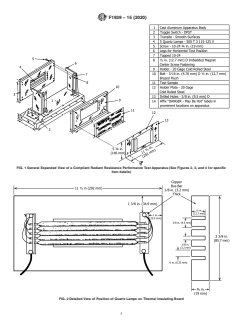
a suitable apparatus is shown in Fig. 1.
2 2 2 2
21 kW⁄m (0.5 cal/cm s), or (b) 84 kW/m (2 cal/cm s).
6.1.1 Radiant Heat Source—A suitable, vertically oriented
radiant heat source is shown in Fig. 1. It consists of a bank of
NOTE 3—Other exposure heat flux values are allowed. The test facility
shall verify the stability of the exposure level over the material’s exposure five, 500 W infrared, tubular, translucent quartz lamps having
time interval (used to determine the radiant heat resistance value) and
a 127-mm (5.0-in.) lighted length and a mean overall length of
include this in the test results report.
222 mm (8 ⁄4 in.). The lamps are mounted on 9.5 6 0.4-mm
3 1
4.2 The transfer of heat through the test specimen is
( ⁄8 6 ⁄64-in.) centers so that the lamp surfaces are approxi-
measured using a copper slug calorimeter. The change in
mately 0.4 mm ( ⁄64 in.) apart. The bank or array of lamps are
temperature versus time is used, along with the known thermo-
mounted and centered behind a 63.5 by 140-mm (2 ⁄2 by
1 1
physical properties of copper to determine the respective
5 ⁄2-in.)cut-outthatispositionedinthecenterofa12.7mm( ⁄2
3 1
thermal energy delivered.
in.) thick, 86 mm (3 ⁄8 in.) wide by 292 mm (11 ⁄2 in.) long,
high-temperature insulating board as shown in Fig. 2. The
4.3 A radiant heat resistance rating of the test specimen is
quartz lamps shall be heated electrically, and the power input
determined as the intersection of the time-dependent cumula-
controlled by means of a rheostat or variable power supply
tive radiant heat response as measured by the calorimeter to a
having a capacity of at least 25 A.
time-dependent, empirical performance curve identified in
6.1.1.1 Setting and monitoring the voltmeter readout on a
10.9.
voltage-controlled variable power supply is one method to
4.4 Subjective observations of the thermal response of
calibrate and monitor the exposure level during the testing on
tested specimens are optionally noted.
a system so equipped. A voltmeter, accurate to 61V, is
typically installed with the appropriate load circuit to indicate
5. Significance and Use
lamp operating power.
5.1 This test method is intended for the determination of the 6.1.1.2 Any covers or guards installed on the quartz lamp
radiant heat resistance value of a material, a combination of assembly shall be designed such that any convective energy
F1939 − 15 (2020)
FIG. 1 General Expanded View of a Compliant Radiant Resistance Performance Test Apparatus (See Figures 2, 3, and 4 for specific
item details)
FIG. 2 Detailed View of Position of Quartz Lamps on Thermal Insulating Board
F1939 − 15 (2020)
to the test specimen is 25.4 6 0.4 mm (1.0 6 ⁄64 in.). The rear
holder plate thickness is 0.9 6 0.05 mm (0.036 6 0.002 in.)
and includes a bracket to hold the copper calorimeter sensor
assembly. This rear plate holds the specimen in place so that it
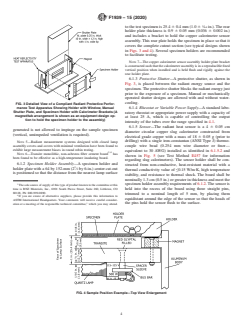
covers the complete cutout section (see typical designs shown
in Figs. 3 and 4). Several specimen holders are recommended
to facilitate testing.
NOTE 7—The copper calorimeter sensor assembly holder plate bracket
isconstructedsuchthatthecalorimeterassemblyisinareproduciblefixed
vertical position when installed and is held flush and rigidly against the
rear holder plate.
6.1.3 Protective Shutter—A protective shutter, as shown in
Fig. 3, is placed between the radiant energy source and the
specimen. The protective shutter blocks the radiant energy just
prior to the exposure of a specimen. Manual or mechanically
operated shutter designs are allowed with and without water-
cooling.
FIG. 3 Detailed View of a Compliant Radiant Protective Perfor-
mance Test Apparatus Showing Holder with Window, Manual
6.1.4 Rheostat or Variable Power Supply—Astandard labo-
Shutter Plate, and Specimen Holder with Calorimeter Brackets (A
ratory rheostat or appropriate power supply with a capacity of
magnet/tab arrangement is shown as an equipment design op-
at least 25 A, which is capable of controlling the output
tion to hold the specimen holder to the assembly)
intensity of the tubes over the range specified in 4.1.
6.1.5 Sensor—The radiant heat sensor is a 4 6 0.05 cm
generated is not allowed to impinge on the sample specimen
diameter circular copper slug calorimeter constructed from
(vertical, umimpeded ventilation is required).
electrical grade copper with a mass of 18 6 0.05 g (prior to
drilling) with a single iron-constantan (ANSI Type J) thermo-
NOTE 5—Radiant measurement systems designed with closed lamp
assembly covers and covers with minimal ventilation have been found to couple wire bead (0.254 mm wire diameter or finer—
exhibit large measurement biases in round robin testing.
equivalent to 30 AWG) installed as identified in 6.1.5.2 and
3,4
NOTE 6—Transite monolithic, non-asbestos fiber cement board has
shown in Fig. 5 (see Test Method E457 for information
been found to be effective as a high-temperature insulating board.
regarding slug calorimeters). The sensor holder shall be con-
6.1.2 Specimen Holder Assembly—A specimen holder and
structed from non-conductive, heat-resistant material with a
holder plate with a 64 by 152-mm (2 ⁄2 by 6-in.) center cut-out
thermal conductivity value of ≤0.15 W/m·K, high temperature
is positioned so that the distance from the nearest lamp surface
stability, and resistance to thermal shock. The board shall be
nominally 1.3 cm (0.5 in.) or greater in thickness and meet the
specimen holder assembly requirements of 6.1.2. The sensor is
Thesolesourceofsupplyofthistypeofproductknowntothecommitteeatthis
time is BNZ Materials, Inc., 6901 South Pierce Street, Suite 260, Littleton, CO
held into the recess of the board using three straight pins,
80128, Ph: 800-999-0890.
trimmed to a nominal length of 5 mm, by placing them
If you are aware of alternative suppliers, please provide this information to
equidistant around the edge of the sensor so that the heads of
ASTM International Headquarters. Your comments will receive careful consider-
the pins hold the sensor flush to the surface.
ation at a meeting of the responsible technical committee, which you may attend.
FIG. 4 Sample Position Example—Top View Enlargement
F1939 − 15 (2020)
NOTE 1—Secure the copper disk into the supporting insulation board with three or four sewing pins cut to 9.5 mm (0.375 in.) in length (positioned
around the periphery so that the sewing pin heads hold the disk into the board).
FIG. 5 Radiant Heat Resistance Test Sensor (Copper Calorimeter Mounted in Insulation Block) Showing Mechanical Bonding of Ther-
mocouple to Copper Disk
6.1.5.1 Paint the exposed surface of the copper slug calo- 6.1.6 DataAcquisition/AnalysisSystem—Adataacquisition/
rimeters with a thin coating of a flat black, high-temperature analysis system is required that is capable of recording the
4,5
spraypaintwithanabsorptivityof0.9orgreater. Thepainted calorimeter temperature response, calculating the resulting
sensor must be dried and cured, in accordance with the thermal energy, and determining the test endpoint by compar-
manufacturer’sinstructions,beforeuseandpresentauniformly ing the time-dependent thermal energy transfer reading to the
applied coating (no visual thick spots or surface irregularities). empirical performance curve.
In the absence of manufacturer’s instructions, an external heat 6.1.6.1 The data acquisition component must have a mini-
source (for example, an external heat lamp), shall be used to mum sampling rate of four samples per second for tempera-
completelydriveoffanyremainingorganiccarriersinafreshly tures to 250 °C with a minimum resolution of 0.1 °C and an
painted surface before use. accuracy of 60.75 °C. It must be capable of making cold
junction corrections and converting the millivolt thermocouple
NOTE8—AbsorptivityofpaintedcalorimetersisdiscussedintheASTM
signals to temperature.
Report, “ASTM Research Program on Electric Arc Test Method Devel-
6.1.7 Solvents,alcoholorpetroleumsolventforcleaningthe
opment to Evaluate Protective Clothing Fabric;ASTM F18.65.01 Testing
Group Report on Arc Testing Analysis of the F1959 Standard Test
copper slug calorimeter.
Method—Phase I.”
6.1.8 Paint, flat black, spray type with an absorptivity value
6.1.5.2 Thethermocouplewireisinstalledinthecalorimeter of >0.90.
as shown in Fig. 5.
7. Hazards
(1) The thermocouple wire shall be bonded to the copper
7.1 This test method uses a high radiant energy source to
disk either mechanically or by using high melting point (HMP)
test materials. The apparatus shall be adequately shielded to
solder.
minimizeanyradiantexposuretopersonnel.Avoidviewingthe
6.1.5.3 A mechanical bond shall be produced by mechani-
lamps when energized.
cally deforming the copper disk material (utilizing a copper
filling slug as shown in Fig. 5) around the thermocouple bead.
7.2 Perform the test in a hood to carry away combustion
6.1.5.4 Asolder bond shall be produced by using a suitable
products, smoke, and fumes. Shield the apparatus or turn off
HMP solder with a melting temperature of >280 °C.
the hood while running the test; turn the hood on to clear the
fumes. Maintain an adequate separation between the radiant
NOTE 9—HMP solders consisting of 5 % Sb-95 %Pb (~307 °C melting
point) and 5 %Sb-93.5 %Pb-1.5 %Ag (~300 °C melting point) have been heat source and combustible materials.
found to be suitable. The 280 °C temperature minimum identified above
7.3 The specimen holder and sensor assembly become
corresponds to the point where melting of the solder bond would be
heated during prolonged testing—use protective gloves when
experienced with an ~17 s exposure of an 84 kW/m heat flux to a
prepared copper calorimeter with a surface area of 12.57 cm and a mass handling these hot objects.
of 18.0 g.Acareful soldering technique is required to avoid “cold” solder
7.4 Observe the appropriate precautions when a specimen
joints (where the solder has not formed a suitable bond of the thermo-
ignites or releases combustible gases. Use only the appropriate
couple to the copper disk).
fire suppression materials for electrical systems if it becomes
necessary to extinguish a fire at the unit.
Zynolyte #635 has been found suitable. The sole source of supply of Zynolyte
#635 known to the committee at this time is Aervoe Industries, 1198 Mark Circle See NIST Monograph 175 or MNL12 Manual on the Use of Thermocouples in
Gardnerville, NV 89410, Ph: 800-227-0196. Temperature Measurement.
F1939 − 15 (2020)
7.5 Refer to manufacturer’s Material Safety Data Sheets 8.5 Determination of Test Specimens Average Thickness—
(MSDS) for information on handling, use, storage, and dis- Determine the three specimens’ average thickness following
posal of chemicals used in this test method. Test Method D1777.
8.6 Determination of Test Specimens Average Surface
8. Sampling and Specimen Preparation
Density—Determine the three specimens’average surface den-
8.1 Laboratory Sample—Select a minimum of a 1.0 m sity(massdividedbysurfacearea)identifiedin8.3.3following
Test Methods D3776/D3776M.
sample size from the material to be tested. Individual test
specimens will be produced from this sample.
9. Preparation, Calibration, and Maintenance of
8.2 Laundering of Laboratory Sample:
Apparatus
8.2.1 For specimens submitted without explicit test launder-
9.1 Radiant Heat Flux Calibration:
ing specifications, launder the laboratory sample for one wash
9.1.1 Calibrating the test apparatus radiant heat flux value is
and dry cycle prior to conditioning. Use laundry conditions of
an iterative process. In some cases, several calibration passes
AATCC Test Method 135 (1, V, A, i).
will be required to establish the standard value for testing
8.2.1.1 Stitching the edges of the laboratory sample is
within the specifications described below.
allowed to minimize unraveling of the sample material.
9.1.1.1 Aradiant heat flux recalibration is required any time
8.2.1.2 Restoring test specimens to a flat condition by
the quartz bulb assembly is turned off after a calibration value
pressing is allowed.
has been established.
8.2.1.3 If an alternative laundry procedure is employed,
9.1.2 Select the standard radiant heat flux level that will be
report the procedure used.
used for testing.
8.2.2 For those materials that require cleaning other than
9.1.2.1 The standard values to select from are: (a)
laundering, follow the manufacturer’s recommended practice
2 2 2 2
21 kW⁄m (0.5 cal/cm s), and (b)84kW/m (2.0 cal/cm s).
using one cleaning cycle followed by drying and note the
procedure used in the test report. NOTE 10—Other values of radiant heat flux can be selected to represent
the conditions of an expected hazard. However, this deviation must be
8.2.3 Samples submitted with instructions to not launder
reported within the results with a summary of the stability of the level
shall be tested as received.
reported consisting of an average and standard deviation from ten
8.2.4 Record the procedure used in the test report for
calibration passes (with no changes to the power setting to the quartz bulb
materials that are submitted with explicit laundering instruc-
assembly).
tions. For samples submitted with instructions not to launder,
9.1.3 Set the quartz bulb assembly power supply output to
record in the test report that the samples were tested as
the approximate value expected for the selected radiant heat
received.
flux level.
8.3 Test Specimens—Cut eight (8) test specimens in a 9.1.4 Energize the lamps and allow the bulb assembly to
diagonal sampling pattern across the prepared laboratory warm up before proceeding with the calibration.
sample. A minimum dimension of 250 mm (10 in.) long and 9.1.4.1 A minimum of 60 s warm-up is required for radiant
2 2
100 mm (4 in.) wide is required for proper fit of the test heat flux exposure values ≤42 kW/m (≤1 cal/cm s).
specimens in the holder identified in 6.1.2. 9.1.4.2 A minimum of 15 s warm-up is required for radiant
2 2
8.3.1 If the laboratory sample edges have been stitched to heat flux exposure values >42 kW/m (>1 cal/cm s).
reduce unraveling (see 8.2.1.1), test specimens are cut so they 9.1.5 Place the shutter device between the specimen holder
do not incorporate the stitching material. location and the lamps to completely block the radiant heat.
8.3.2 Cut the long length direction from the machine (for 9.1.6 Place the copper calorimeter sensor, which is initially
at room temperature, into a specimen holder plate (with no
example, warp or wale) direction of the material.
specimen) and then place the assembly into the specimen
8.3.3 Three of the eight test specimens identified above are
holder testing location in front of the shuttered heat source.
required for determining average thickness and surface density
Ensure that the sensor that has a clean, black surface without
(see 8.5 and 8.6).
signs of paint blistering, exposed copper, or any accumulation
8.4 Conditioning—Condition each test specimen for at least
of deposits; otherwise recondition the sensor surface as de-
24hat21 6 2 °C (70 6 5 °F) and 65 6 5 % relative humidity.
scribed in 9.3.2.
The specimens shall be tested within 30 min of removal from
9.1.7 Start the data acquisition system, remove the shutter,
the conditioning area.
and collect the copper calorimeter sensor information for a
8.4.1 If any specimens removed from conditioning cannot
minimum period of 10 s of radiant energy exposure.
betestedwithin30min,returnthemtotheconditioningareaor
9.1.8 Replace the shutter and remove the specimen holder/
seal them in polyethylene bags (or other material with low
copper calorimeter sensor and allow it to cool to room
water vapor permeability) until immediately prior to testing.
temperature. Remove the shutter and also allow it to cool to
8.4.2 Bagged specimens have a four (4) h storage limit and
room temperature.
are required to be tested within 20 min after removal from the
bag. NOTE 11—Use protective gloves when handling the hot shutter and
specimen/copper calorimeter assembly.
8.4.3 Bagged specimens that exceed the four (4) h storage
limit shall be removed from their bag and reconditioned in 9.1.9 Calculate the average exposure heat flux value using a
accordance with 8.4 prior to testing. sampling interval that starts with the temperature measured at
F1939 − 15 (2020)
time = 0 (sample taken just before the shutter is removed) and 9.2.2 Output Verification of Lamps in Service:
ends with the temperature measured at exposure time = 10 s
9.2.2.1 Follow the procedure in 9.2.1 to re-verify the indi-
using the computational method identified in 11.1 (Sensor
vidual lamps and the lamp array outputs at intervals not to
Response). This value is the measured radiant heat flux.
exceed 150 h of lamp operating time at a heat flux output of
2 2
9.1.9.1 If this value is not within 62.1 kW/m
84 kW⁄m (2 cal/cm s), or intervals not to exceed 500 h of
(60.05 cal⁄cm s) of the standard value selected in 9.1.2, adjust
lamp operating time at a heat flux output of 21 kW/m
the quartz bulb assembly power supply output appropriately
(0.5 cal⁄cm s), or a voltage change of more than 5 V for an
2 2
and repeat the calibration sequence outlined in 9.1.5 – 9.1.9.
output setting of 84 kW/m (2 cal/cm s) from that noted in
2 2
9.1.9.2 Ifthisvalueiswithin 62.1kW/m (60.05cal/cm s)
9.2.1.7 (for systems using a variable power transformer supply
of the standard value selected in 9.1.2, the unit is considered
to power the lamps).
calibrated and the resulting heat flux value is recorded.
NOTE 14—The operating life expectancy of the 500 W quartz infrared
9.2 Verification of Quartz Bulb Assembly Output Unifor-
lamps specified in 6.1.1 is typically 5000 h at full output per the
2 2
mity: manufacturer (~130 kW/m (3.1 cal/cm s)). However, experience has
shown that the age and the variation in color temperature of the lamps in
9.2.1 Initial Output Verification of New Lamps:
the array can affect the incident heat flux delivered to the test specimen.
9.2.1.1 Complete the radiant heat
...