

ASTM C860-15(2019)
(Test Method)Standard Test Method for Determining the Consistency of Refractory Castable Using the Ball-In-Hand Test
General Information
- Abstract
SIGNIFICANCE AND USE
3.1 This test method is used to determine if a freshly mixed refractory castable is of the proper consistency to provide optimum performance. There are times when the manufacturer’s specified water content and consistency will purposely not lead to the correct ball in hand but should be used to provide optimum performance. Contact the manufacturer when in doubt. This test method can also be used to estimate the correct water addition rate of a castable when either the manufacturer's specified water content is not available or when unique circumstances have rendered that recommendation unusable.
3.2 The correct water content is an important factor that must be controlled to obtain optimum castable performance. Excess water can reduce strength, increase volume shrinkage, and promote segregation of the castable ingredients. Insufficient water can produce “honeycombs” (air voids) in the castable because of the insufficient mobility during placement and, in extreme cases, can prevent the complete hydration of the cement (if used).
3.3 The ball-in-hand test is subjective and somewhat depends on the skill of the operator. However, it is a universally accessible method due to the simplicity of the equipment required, and it is readily used in the field.
3.4 The total wet mixing time of a castable influences the rheological and final properties and therefore should be monitored.
3.5 This test method can be performed in a laboratory or on a job site.
SCOPE
1.1 This test method covers the procedures for determining the consistency of a castable using the ball-in-hand test. The amount of water used in a castable has a significant influence on its performance.
1.2 This test method applies to castable refractories that are described in Classification C401. It also applies to such castables containing metal fibers.
1.3 This test method is not intended to determine the proper consistency for gunning, pumping, or self-flow applications.
1.4 The values stated in inch-pound units are to be regarded as standard. The values given in parentheses are mathematical conversions to SI units that are provided for information only and are not considered standard.
1.5 This standard does not purport to address all of the safety concerns, if any, associated with its use. It is the responsibility of the user of this standard to establish appropriate safety, health, and environmental practices and determine the applicability of regulatory limitations prior to use. (See 6.2.3 for a specific safety warning.)
1.6 This international standard was developed in accordance with internationally recognized principles on standardization established in the Decision on Principles for the Development of International Standards, Guides and Recommendations issued by the World Trade Organization Technical Barriers to Trade (TBT) Committee.
- Status
- Published
- Publication Date
- 31-Aug-2019
- Technical Committee
- C08 - Refractories
- Drafting Committee
- C08.09 - Monolithics

Overview
ASTM C860-15(2019) – Standard Test Method for Determining the Consistency of Refractory Castable Using the Ball-In-Hand Test provides a widely accepted field and laboratory procedure for assessing the consistency of freshly mixed refractory castables. This test method is especially important to ensure the correct water content in castable refractories, which significantly impacts their performance, durability, and installation quality.
Developed by ASTM International, this standard is commonly referenced in industries utilizing refractory castables, such as steel, cement, glass, and petrochemical sectors. The test method offers a simple, practical approach that is accessible without specialized equipment, providing a reliable assessment of mix consistency for both routine quality control and troubleshooting scenarios.
Key Topics
Significance of Water Content:
Proper water addition is crucial for optimal performance. Excessive water can reduce cured strength, increase shrinkage, and cause separation of ingredients, whereas too little water can lead to poor consolidation and incomplete hydration.Ball-In-Hand Consistency Test:
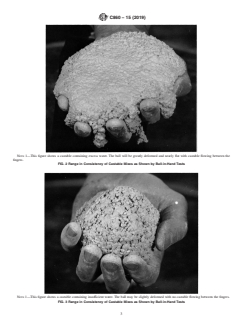
The method involves hand-forming a ball from a sample of freshly mixed castable and observing its deformation and flow between the fingers:- Castable with excess water appears overly deformed or flat and may ooze between fingers.
- Insufficient water leads to a rigid ball with minimal flow and little deformation.
- Proper consistency is indicated by a ball that is somewhat deformed with slight flow between the fingers.
Applicability:
This test method applies to castable refractory materials, as classified under ASTM C401, including mixes with metal fibers. It is not suited for determining the consistency of methods like gunning, pumping, or self-flow applications.Subjectivity and Skill:
The ball-in-hand test is subjective and depends on operator skill, but its straightforward nature makes it suitable for quick field use and training.Mixing Time and Procedure:
The total wet mixing time can affect both fresh and final properties of the castable. The test must be conducted according to recommended mixing durations and procedures to ensure reliable results.
Applications
Quality Control in Industrial Installations:
The ball-in-hand test offers a practical method for on-site verification of castable consistency during refractory lining installation in industries such as steel making, foundries, cement plants, and power generation.Laboratory Testing:
It provides a rapid, hands-on assessment during development, batch testing, or when verifying the effects of aggregate moisture and environmental factors on consistency.Troubleshooting:
This method helps field teams adjust water addition when:- Manufacturer recommendations are unavailable or unsuitable for specific conditions.
- Aggregate moisture content or mixing equipment influences required water amounts.
- Unusual circumstances arise, requiring estimation of water content for proper installation.
Training and Standardization:
Its simplicity makes it ideal for operator training, ensuring consistent installation practices and adherence to international standards.
Related Standards
ASTM C401 - Classification of Alumina and Alumina-Silicate Castable Refractories:
Defines the types of castable refractories to which ASTM C860 applies.Other ASTM Refractory Standards:
Organizations using ASTM C860 may also reference standards such as ASTM C892 (Test Method for Thermal Shock Resistance) and ASTM C133 (Testing Cold Crushing Strength).ISO and Industry-Specific Standards:
Industries may integrate ASTM C860 with international or customer-specific refractory testing procedures for comprehensive quality assurance.
By following ASTM C860-15(2019), organizations can better control the critical variable of water addition in castable refractories, improving installation outcomes and long-term performance while supporting compliance with global technical and safety standards.
Relations
- Effective Date
- 01-Sep-2019
- Effective Date
- 01-Mar-2012
- Refers
ASTM C401-91(2005) - Standard Classification of Alumina and Alumina-Silicate Castable Refractories - Effective Date
- 01-Dec-2005
- Refers
ASTM C401-91(2000) - Standard Classification of Alumina and Alumina-Silicate Castable Refractories - Effective Date
- 01-Jan-2000
- Effective Date
- 01-Sep-2019
- Effective Date
- 01-Sep-2019
Frequently Asked Questions
ASTM C860-15(2019) is a standard published by ASTM International. Its full title is "Standard Test Method for Determining the Consistency of Refractory Castable Using the Ball-In-Hand Test". This standard covers: SIGNIFICANCE AND USE 3.1 This test method is used to determine if a freshly mixed refractory castable is of the proper consistency to provide optimum performance. There are times when the manufacturer’s specified water content and consistency will purposely not lead to the correct ball in hand but should be used to provide optimum performance. Contact the manufacturer when in doubt. This test method can also be used to estimate the correct water addition rate of a castable when either the manufacturer's specified water content is not available or when unique circumstances have rendered that recommendation unusable. 3.2 The correct water content is an important factor that must be controlled to obtain optimum castable performance. Excess water can reduce strength, increase volume shrinkage, and promote segregation of the castable ingredients. Insufficient water can produce “honeycombs” (air voids) in the castable because of the insufficient mobility during placement and, in extreme cases, can prevent the complete hydration of the cement (if used). 3.3 The ball-in-hand test is subjective and somewhat depends on the skill of the operator. However, it is a universally accessible method due to the simplicity of the equipment required, and it is readily used in the field. 3.4 The total wet mixing time of a castable influences the rheological and final properties and therefore should be monitored. 3.5 This test method can be performed in a laboratory or on a job site. SCOPE 1.1 This test method covers the procedures for determining the consistency of a castable using the ball-in-hand test. The amount of water used in a castable has a significant influence on its performance. 1.2 This test method applies to castable refractories that are described in Classification C401. It also applies to such castables containing metal fibers. 1.3 This test method is not intended to determine the proper consistency for gunning, pumping, or self-flow applications. 1.4 The values stated in inch-pound units are to be regarded as standard. The values given in parentheses are mathematical conversions to SI units that are provided for information only and are not considered standard. 1.5 This standard does not purport to address all of the safety concerns, if any, associated with its use. It is the responsibility of the user of this standard to establish appropriate safety, health, and environmental practices and determine the applicability of regulatory limitations prior to use. (See 6.2.3 for a specific safety warning.) 1.6 This international standard was developed in accordance with internationally recognized principles on standardization established in the Decision on Principles for the Development of International Standards, Guides and Recommendations issued by the World Trade Organization Technical Barriers to Trade (TBT) Committee.
SIGNIFICANCE AND USE 3.1 This test method is used to determine if a freshly mixed refractory castable is of the proper consistency to provide optimum performance. There are times when the manufacturer’s specified water content and consistency will purposely not lead to the correct ball in hand but should be used to provide optimum performance. Contact the manufacturer when in doubt. This test method can also be used to estimate the correct water addition rate of a castable when either the manufacturer's specified water content is not available or when unique circumstances have rendered that recommendation unusable. 3.2 The correct water content is an important factor that must be controlled to obtain optimum castable performance. Excess water can reduce strength, increase volume shrinkage, and promote segregation of the castable ingredients. Insufficient water can produce “honeycombs” (air voids) in the castable because of the insufficient mobility during placement and, in extreme cases, can prevent the complete hydration of the cement (if used). 3.3 The ball-in-hand test is subjective and somewhat depends on the skill of the operator. However, it is a universally accessible method due to the simplicity of the equipment required, and it is readily used in the field. 3.4 The total wet mixing time of a castable influences the rheological and final properties and therefore should be monitored. 3.5 This test method can be performed in a laboratory or on a job site. SCOPE 1.1 This test method covers the procedures for determining the consistency of a castable using the ball-in-hand test. The amount of water used in a castable has a significant influence on its performance. 1.2 This test method applies to castable refractories that are described in Classification C401. It also applies to such castables containing metal fibers. 1.3 This test method is not intended to determine the proper consistency for gunning, pumping, or self-flow applications. 1.4 The values stated in inch-pound units are to be regarded as standard. The values given in parentheses are mathematical conversions to SI units that are provided for information only and are not considered standard. 1.5 This standard does not purport to address all of the safety concerns, if any, associated with its use. It is the responsibility of the user of this standard to establish appropriate safety, health, and environmental practices and determine the applicability of regulatory limitations prior to use. (See 6.2.3 for a specific safety warning.) 1.6 This international standard was developed in accordance with internationally recognized principles on standardization established in the Decision on Principles for the Development of International Standards, Guides and Recommendations issued by the World Trade Organization Technical Barriers to Trade (TBT) Committee.
ASTM C860-15(2019) is classified under the following ICS (International Classification for Standards) categories: 81.080 - Refractories. The ICS classification helps identify the subject area and facilitates finding related standards.
ASTM C860-15(2019) has the following relationships with other standards: It is inter standard links to ASTM C860-15, ASTM C401-12, ASTM C401-91(2005), ASTM C401-91(2000), ASTM C71-12(2018), ASTM C1445-13(2018). Understanding these relationships helps ensure you are using the most current and applicable version of the standard.
ASTM C860-15(2019) is available in PDF format for immediate download after purchase. The document can be added to your cart and obtained through the secure checkout process. Digital delivery ensures instant access to the complete standard document.
Standards Content (Sample)
This international standard was developed in accordance with internationally recognized principles on standardization established in the Decision on Principles for the
Development of International Standards, Guides and Recommendations issued by the World Trade Organization Technical Barriers to Trade (TBT) Committee.
Designation: C860 − 15 (Reapproved 2019)
Standard Test Method for
Determining the Consistency of Refractory Castable Using
the Ball-In-Hand Test
This standard is issued under the fixed designation C860; the number immediately following the designation indicates the year of
original adoption or, in the case of revision, the year of last revision. A number in parentheses indicates the year of last reapproval. A
superscript epsilon (´) indicates an editorial change since the last revision or reapproval.
This standard has been approved for use by agencies of the U.S. Department of Defense.
1. Scope Castable Refractories
1.1 This test method covers the procedures for determining
3. Significance and Use
the consistency of a castable using the ball-in-hand test. The
amount of water used in a castable has a significant influence
3.1 This test method is used to determine if a freshly mixed
on its performance. refractory castable is of the proper consistency to provide
optimum performance. There are times when the manufactur-
1.2 This test method applies to castable refractories that are
er’s specified water content and consistency will purposely not
described in Classification C401. It also applies to such
lead to the correct ball in hand but should be used to provide
castables containing metal fibers.
optimum performance. Contact the manufacturer when in
1.3 This test method is not intended to determine the proper
doubt.This test method can also be used to estimate the correct
consistency for gunning, pumping, or self-flow applications.
wateradditionrateofacastablewheneitherthemanufacturer’s
1.4 The values stated in inch-pound units are to be regarded specified water content is not available or when unique
as standard. The values given in parentheses are mathematical circumstances have rendered that recommendation unusable.
conversions to SI units that are provided for information only
3.2 The correct water content is an important factor that
and are not considered standard.
must be controlled to obtain optimum castable performance.
1.5 This standard does not purport to address all of the
Excess water can reduce strength, increase volume shrinkage,
safety concerns, if any, associated with its use. It is the
and promote segregation of the castable ingredients. Insuffi-
responsibility of the user of this standard to establish appro-
cient water can produce “honeycombs” (air voids) in the
priate safety, health, and environmental practices and deter-
castable because of the insufficient mobility during placement
mine the applicability of regulatory limitations prior to use.
and, in extreme cases, can prevent the complete hydration of
(See 6.2.3 for a specific safety warning.)
the cement (if used).
1.6 This international standard was developed in accor-
3.3 The ball-in-hand test is subjective and somewhat de-
dance with internationally recognized principles on standard-
pends on the skill of the operator. However, it is a universally
ization established in the Decision on Principles for the
accessible method due to the simplicity of the equipment
Development of International Standards, Guides and Recom-
required, and it is readily used in the field.
mendations issued by the World Trade Organization Technical
3.4 The total wet mixing time of a castable influences the
Barriers to Trade (TBT) Committee.
rheological and final properties and therefore should be moni-
2. Referenced Documents tored.
2.1 ASTM Standards:
3.5 This test method can be performed in a laboratory or on
C401 Classification of Alumina and Alumina-Silicate a job site.
4. Apparatus
This test method is under the jurisdiction of ASTM Committee C08 on
4.1 Castable Mixer—Either a manually or electrically oper-
Refractories and is the direct responsibility of Subcommittee C08.09 on Monolith-
ics.
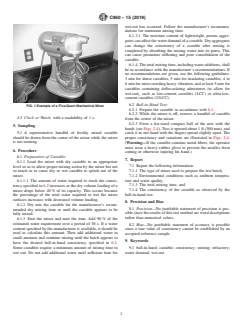
ated mechanical mixer (see Fig. 1) may be used to prepare
Current edition approved Sept. 1, 2019. Published September 2019. Originally
batches for consistency determination in a laboratory. Wet
approved in 1977. Last previous edition approved in 2015 as C860 – 15. DOI:
castable may also be obtained while in the field from the mixer
10.1520/C0860-15R19.
For referenced ASTM standards, visit the ASTM website, www.astm.org, or being used for installation.
contact ASTM Customer Service at service@astm.org. For Annual Book of ASTM
4.2 Heavy Rubber Gloves, for castables containing metal
Standards volume information, refer to the standard’s Document Summary page on
the ASTM website. fibers.
Copyright © ASTM International, 100 Barr Harbor Drive, PO Box C700, West Conshohocken, PA 19428-2959. United States
C860 − 15 (2019)
wet-out has occurred. Follow the manufacturer’s recommen-
dations for minimum mixing time.
6.1.3.1 The moisture content of lightweight, porous aggre-
gates can affect the water demand of a castable. Dry aggregates
can change the consistency of a castable after mixing is
completed by absorbing the mixing water into its pores. This
can cause premature stiffening and poor consolidation of the
castable.
6.1.4 The total mixing time, including
...