

ASTM D5515-22
(Test Method)Standard Test Method for Determination of the Swelling Properties of Bituminous Coal Using a Dilatometer
General Information
- Abstract
SIGNIFICANCE AND USE
5.1 Values of the dilatation properties of coals may be used to predict or explain the behavior of a coal or blends during carbonization or in other processes such as gasification, liquefaction, and combustion.
SCOPE
1.1 This test method specifies a procedure for the measurement of the swelling of bituminous coal using a dilatometer.
1.2 The test method is limited in applicability to those coals which have a free swelling index ≥1 as determined in accordance with Test Method D720.
1.3 Units—The values stated in SI units are to be regarded as standard. The values given in parentheses after SI units are provided for information only and are not considered standard.
1.4 This standard does not purport to address all of the safety concerns, if any, associated with its use. It is the responsibility of the user of this standard to establish appropriate safety, health, and environmental practices and determine the applicability of regulatory limitations prior to use.
1.5 This international standard was developed in accordance with internationally recognized principles on standardization established in the Decision on Principles for the Development of International Standards, Guides and Recommendations issued by the World Trade Organization Technical Barriers to Trade (TBT) Committee.
- Status
- Published
- Publication Date
- 31-Aug-2022
- Technical Committee
- D05 - Coal and Coke
- Drafting Committee
- D05.15 - Metallurgical Properties of Coal and Coke
Buy Documents
ASTM D5515-22 - Standard Test Method for Determination of the Swelling Properties of Bituminous Coal Using a Dilatometer
REDLINE ASTM D5515-22 - Standard Test Method for Determination of the Swelling Properties of Bituminous Coal Using a Dilatometer
Overview
ASTM D5515-22: Standard Test Method for Determination of the Swelling Properties of Bituminous Coal Using a Dilatometer provides a standardized method for measuring the swelling behavior of bituminous coal when heated. This test is crucial for understanding the performance of coal during industrial processes such as carbonization, gasification, liquefaction, and combustion. The data obtained from this method help coal producers, operators, and researchers predict and manage the behavior of coal and coal blends in high-temperature environments.
The method utilizes a dilatometer-a specialized instrument that tracks the dimensional changes (swelling or contraction) of a formed coal sample during controlled heating. This standard, maintained by ASTM International, ensures consistent results and supports the global coal and coke industry by aligning with internationally recognized quality and safety principles.
Key Topics
Dilatometer Test Methodology
The standard outlines the preparation of coal samples, forming of the "coal pencil," and the stepwise heating cycle. It details the equipment requirements, such as furnace specifications, retort tubes, and measuring apparatus, to enable accurate and repeatable measurements.Measurement Parameters
The test quantifies key parameters including:- Percent contraction and dilatation
- Softening temperature (T1)
- Maximum contraction temperature (T2)
- Maximum dilatation temperature (T3)
- Air-dried coal mass and percent water added
Applicability Criteria
This test is limited to bituminous coals with a free swelling index of 1 or greater (as determined by ASTM D720). It provides guidelines for sample preparation and handling to avoid bias and ensure reliability.Safety and Calibration
Users are required to establish appropriate safety practices and conduct regular calibration of the apparatus for valid data. The standard provides guidance for apparatus cleaning, calibration of retort tube radii, and use of reference materials.
Applications
Coal Carbonization and Coking
Swelling properties measured by this standard are essential in predicting how a coal or blend will behave in carbonization processes for coke production. The test supports coke plant operations and blend optimization by evaluating coal compatibility and behavior under process conditions.Gasification and Liquefaction Feasibility
In advanced coal conversion technologies such as gasification and liquefaction, understanding coal's swelling characteristics allows engineers to select coals that maximize efficiency and reduce operational risks.Combustion Control
The data inform the combustion industry about the likely physical changes coal may undergo, contributing to stable furnace operation and reducing the risk of blockages or equipment damage caused by excessive swelling.Quality Control and Research
Laboratories engaged in coal quality assessment use this method for routine testing, comparison among coal sources, and research into coal properties for process development and innovation.
Related Standards
Several interconnected standards are referenced for proper implementation and broader understanding:
ASTM D720 - Test Method for Free-Swelling Index of Coal
Establishes eligibility of a coal sample for D5515-22 testing.ASTM D2013 - Practice for Preparing Coal Samples for Analysis
Provides procedures for consistent sample preparation.ASTM D2234/D2234M - Practice for Collection of a Gross Sample of Coal
Outlines protocols for representative sampling.ISO 349 - Audibert-Arnu Dilatometer Test
An international alternative detailing different coal swelling measurement protocols.ISO 8264 - Hard Coal-Determination of the Swelling Properties Using a Dilatometer
Another ISO method offering alternative procedures and result interpretations.
Keywords: bituminous coal, swelling properties, dilatometer, ASTM D5515-22, coal testing, coal carbonization, coal gasification, coal liquefaction, combustion, metallurgical coal, coal quality standards, sample preparation, coal industry standards.
Relations
- Effective Date
- 01-Dec-2019
- Effective Date
- 15-Oct-2017
- Effective Date
- 01-Mar-2016
- Effective Date
- 15-May-2010
- Effective Date
- 01-Jan-2010
- Effective Date
- 01-Oct-2009
- Effective Date
- 01-Jun-2007
- Effective Date
- 01-May-2007
- Effective Date
- 01-Nov-2004
- Effective Date
- 01-Apr-2004
- Effective Date
- 01-Apr-2004
- Effective Date
- 01-Jan-2004
- Effective Date
- 01-Dec-2003
- Effective Date
- 10-Jun-2003
- Effective Date
- 10-Oct-2002
Buy Documents
ASTM D5515-22 - Standard Test Method for Determination of the Swelling Properties of Bituminous Coal Using a Dilatometer
REDLINE ASTM D5515-22 - Standard Test Method for Determination of the Swelling Properties of Bituminous Coal Using a Dilatometer
Get Certified
Connect with accredited certification bodies for this standard

Element Materials Technology
Materials testing and product certification.

ABS Group Brazil
ABS Group certification services in Brazil.

ABS Quality Evaluations Inc.
American Bureau of Shipping quality certification.
Sponsored listings
Frequently Asked Questions
ASTM D5515-22 is a standard published by ASTM International. Its full title is "Standard Test Method for Determination of the Swelling Properties of Bituminous Coal Using a Dilatometer". This standard covers: SIGNIFICANCE AND USE 5.1 Values of the dilatation properties of coals may be used to predict or explain the behavior of a coal or blends during carbonization or in other processes such as gasification, liquefaction, and combustion. SCOPE 1.1 This test method specifies a procedure for the measurement of the swelling of bituminous coal using a dilatometer. 1.2 The test method is limited in applicability to those coals which have a free swelling index ≥1 as determined in accordance with Test Method D720. 1.3 Units—The values stated in SI units are to be regarded as standard. The values given in parentheses after SI units are provided for information only and are not considered standard. 1.4 This standard does not purport to address all of the safety concerns, if any, associated with its use. It is the responsibility of the user of this standard to establish appropriate safety, health, and environmental practices and determine the applicability of regulatory limitations prior to use. 1.5 This international standard was developed in accordance with internationally recognized principles on standardization established in the Decision on Principles for the Development of International Standards, Guides and Recommendations issued by the World Trade Organization Technical Barriers to Trade (TBT) Committee.
SIGNIFICANCE AND USE 5.1 Values of the dilatation properties of coals may be used to predict or explain the behavior of a coal or blends during carbonization or in other processes such as gasification, liquefaction, and combustion. SCOPE 1.1 This test method specifies a procedure for the measurement of the swelling of bituminous coal using a dilatometer. 1.2 The test method is limited in applicability to those coals which have a free swelling index ≥1 as determined in accordance with Test Method D720. 1.3 Units—The values stated in SI units are to be regarded as standard. The values given in parentheses after SI units are provided for information only and are not considered standard. 1.4 This standard does not purport to address all of the safety concerns, if any, associated with its use. It is the responsibility of the user of this standard to establish appropriate safety, health, and environmental practices and determine the applicability of regulatory limitations prior to use. 1.5 This international standard was developed in accordance with internationally recognized principles on standardization established in the Decision on Principles for the Development of International Standards, Guides and Recommendations issued by the World Trade Organization Technical Barriers to Trade (TBT) Committee.
ASTM D5515-22 is classified under the following ICS (International Classification for Standards) categories: 75.140 - Waxes, bituminous materials and other petroleum products. The ICS classification helps identify the subject area and facilitates finding related standards.
ASTM D5515-22 has the following relationships with other standards: It is inter standard links to ASTM D2234/D2234M-19, ASTM D2234/D2234M-17, ASTM D2234/D2234M-16, ASTM D720-91(2010), ASTM D2234/D2234M-10, ASTM D2234/D2234M-09a, ASTM D2013-07, ASTM D2234/D2234M-07, ASTM D2013-04, ASTM D720-91(2004), ASTM D720-91(2004)e1, ASTM D2234/D2234M-03e1, ASTM D2013-03, ASTM D2234/D2234M-03, ASTM D2234/D2234M-02a. Understanding these relationships helps ensure you are using the most current and applicable version of the standard.
ASTM D5515-22 is available in PDF format for immediate download after purchase. The document can be added to your cart and obtained through the secure checkout process. Digital delivery ensures instant access to the complete standard document.
Standards Content (Sample)
This international standard was developed in accordance with internationally recognized principles on standardization established in the Decision on Principles for the
Development of International Standards, Guides and Recommendations issued by the World Trade Organization Technical Barriers to Trade (TBT) Committee.
Designation: D5515 − 22
Standard Test Method for
Determination of the Swelling Properties of Bituminous Coal
Using a Dilatometer
This standard is issued under the fixed designation D5515; the number immediately following the designation indicates the year of
original adoption or, in the case of revision, the year of last revision.Anumber in parentheses indicates the year of last reapproval.A
superscript epsilon (´) indicates an editorial change since the last revision or reapproval.
INTRODUCTION
The principle of this test method is that the final volume of char obtained at the conclusion of a
standard dilatation test is dependent on the mass of coal in the coal pencil and on the radius of the
retort tube.This test method incorporates a procedure which: determines the mass of air-dried coal in
the coal pencil; provides a means to measure the average retort tube radii; and employs a means to
report coal expansion on an air dried coal mass basis.
Other test methods used to determine the swelling properties of bituminous coals include the Ruhr
(ISO 8264) and Audibert-Arnu (ISO 349) International Standard Organization (ISO) test methods.
However these two ISO test methods provide consistently different values for percent dilatation and
percent contraction. Percent contraction and dilatation values obtained using the Audibert-Arnu test
method are higher and lower respectively than those obtained using the Ruhr test method. These
differences have been attributed to trimming the length of the coal pencil from different ends. The
Audibert-Arnu test method specifies that the wider end of the coal pencil be trimmed, while the Ruhr
test method specifies that the narrower end of the coal pencil be trimmed.
1. Scope mendations issued by the World Trade Organization Technical
Barriers to Trade (TBT) Committee.
1.1 This test method specifies a procedure for the measure-
ment of the swelling of bituminous coal using a dilatometer.
2. Referenced Documents
1.2 Thetestmethodislimitedinapplicabilitytothosecoals 2
2.1 ASTM Standards:
which have a free swelling index ≥1 as determined in accor-
D720Test Method for Free-Swelling Index of Coal
dance with Test Method D720.
D2013Practice for Preparing Coal Samples for Analysis
D2234/D2234MPractice for Collection of a Gross Sample
1.3 Units—The values stated in SI units are to be regarded
of Coal
as standard. The values given in parentheses after SI units are
providedforinformationonlyandarenotconsideredstandard.
2.2 ISO Standards:
ISO349Hard Coal-Audibert-Arnu Dilatometer Test
1.4 This standard does not purport to address all of the
ISO8264Hard Coal—Determination of the Swelling Prop-
safety concerns, if any, associated with its use. It is the
erties Using a Dilatometer
responsibility of the user of this standard to establish appro-
priate safety, health, and environmental practices and deter-
3. Terminology
mine the applicability of regulatory limitations prior to use.
3.1 Definitions:
1.5 This international standard was developed in accor-
3.1.1 air-dried coal pencil mass, M ,n—the calculated
dance with internationally recognized principles on standard-
dry
mass of the trimmed 60 mm long coal pencil corrected for
ization established in the Decision on Principles for the
added water, expressed in grams.
Development of International Standards, Guides and Recom-
For referenced ASTM standards, visit the ASTM website, www.astm.org, or
This test method is under the jurisdiction of ASTM Committee D05 on Coal contact ASTM Customer Service at service@astm.org. For Annual Book of ASTM
and Coke and is the direct responsibility of Subcommittee D05.15 on Metallurgical Standards volume information, refer to the standard’s Document Summary page on
Properties of Coal and Coke. the ASTM website.
Current edition approved Sept. 1, 2022. Published September 2022. Originally Available from International Organization for Standardization (ISO), 1, ch. de
approved in 1994. Last previous edition approved in 2021 as D5515–21. DOI: la Voie-Creuse, Case postale 56, CH-1211, Geneva 20, Switzerland, http://
10.1520/D5515-22. www.iso.ch.
Copyright © ASTM International, 100 Barr Harbor Drive, PO Box C700, West Conshohocken, PA 19428-2959. United States
D5515 − 22
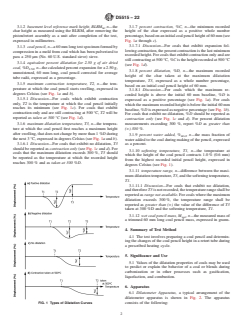
3.1.2 basement level reference mark height, BLRM ,n—the 3.1.7 percent contraction, %C, n—the minimum recorded
ht
char height as measured using the BLRM, after removing the height of the char expressed as a positive whole number
piston/retort assembly as a unit after completion of the test, percentage,basedonaninitialcoalpencilheightof60mm(see
expressed in millimetres. Fig. 1a through c).
3.1.7.1 Discussion—For coals that exhibit expansion fol-
3.1.3 coal pencil, n—a60mmlongtestspecimenformedby
lowingcontraction,thepercentcontractionisthelastminimum
compressioninamoldfromcoalwhichhasbeenpulverizedto
recordedheight.Forcoalsthatexhibitcontractiononlyandare
pass a 250 µm (No. 60 U.S. standard sieve) sieve.
stillcontractingat500°C, %Cistheheightrecordedat500°C
3.1.4 equivalent percent dilatation for 2.50 g of air dried
(see Fig. 1d).
coal, %D ,n—thecalculatedpercentexpansionfora2.50g,
2.50
3.1.8 percent dilatation, %D, n—the maximum recorded
unmoistened, 60 mm long, coal pencil corrected for average
height of the char taken at the maximum dilatation
tube radii, expressed as a percentage.
temperature, T3, expressed as a whole number percentage,
3.1.5 maximum contraction temperature, T2, n—the tem-
based on an initial coal pencil height of 60 mm.
perature at which the coal pencil starts swelling, expressed in
3.1.8.1 Discussion—For coals which the maximum re-
degrees Celsius (see Fig. 1a and b).
corded height is above the initial 60 mm baseline, %D is
3.1.5.1 Discussion—For coals which exhibit contraction
expressed as a positive percentage (see Fig. 1a). For coals
only, T2 is the temperature at which the coal pencil initially
whichthemaximumrecordedheightisbelowtheinitial60mm
reaches its minimum (see Fig. 1c). For coals that exhibit
baseline, %Disexpressedasnegativepercentage(seeFig.1b).
contraction only and are still contracting at 500°C, T2 will be
For coals that exhibit no dilatation, %D should be reported as
reported as taken at 500 °C (see Fig. 1d).
contraction only (see Fig. 1c and d). For percent dilatation
measurements exceeding 300 %, report %D as greater than
3.1.6 maximum dilatation temperature, T3, n—the tempera-
(>) 300 %.
ture at which the coal pencil first reaches a maximum height
afterswelling,thatdoesnotchangebymorethan1 %Dduring
3.1.9 percent water added, % ,n—the mass fraction of
H O
thenext3°C,expressedindegreesCelsius(seeFig.1aand b).
water added to the coal during making of the pencil, expressed
3.1.6.1 Discussion—For coals that exhibit no dilatation, T3
as a percent.
should be reported as contraction only (see Fig. 1c and d). For
3.1.10 softening temperature, T1, n—the temperature at
coals that the maximum dilatation exceeds 300 %, T3 should
which the height of the coal pencil contracts 1.0% (0.6 mm)
be reported as the temperature at which the recorded height
from the highest recorded initial pencil height, expressed in
reaches 300 % and as taken at 300 %D.
degrees Celsius (see Fig. 1).
3.1.11 temperature range, n—difference between the maxi-
mumdilatationtemperature, T3,andthesofteningtemperature,
T1.
3.1.11.1 Discussion—For coals that exhibit no dilatation,
andtherefore T3isnotrecorded,thetemperaturerangeshallbe
reportedas range not available.Forcoalswherethemaximum
dilatation exceeds 300%, the temperature range shall be
reported as greater than (>) the value of the difference of T3
taken at 300 %D and the softening temperature, T1.
3.1.12 wet coal pencil mass, M ,n—themeasuredmassof
wet
a trimmed 60 mm long coal pencil mass, expressed in grams.
4. Summary of Test Method
4.1 The test involves preparing a coal pencil and determin-
ingthechangesofthecoalpencilheightinaretorttubeduring
a prescribed heating cycle.
5. Significance and Use
5.1 Values of the dilatation properties of coals may be used
to predict or explain the behavior of a coal or blends during
carbonization or in other processes such as gasification,
liquefaction, and combustion.
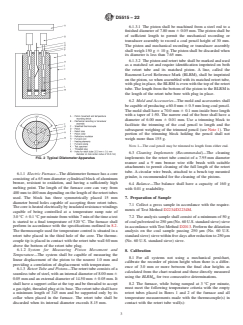
6. Apparatus
6.1 Dilatometer Apparatus, a typical arrangement of the
dilatometer apparatus is shown in Fig. 2. The apparatus
FIG. 1 Types of Dilatation Curves consists of the following:
D5515 − 22
6.1.3.1 The piston shall be machined from a steel rod to a
finished diameter of 7.80 mm 6 0.05 mm. The piston shall be
of sufficient length to permit the mechanical recording or
transducer assembly to record a coal pencil height of 30 mm.
The piston and mechanical recording or transducer assembly
shall weigh 150 g 6 10 g. The piston shall be discarded when
its diameter is less than 7.65 mm.
6.1.3.2 The piston and retort tube shall be marked and used
as a matched set and require identification imprinted on both
the retort tube and its matched piston. A line, called the
Basement Level Reference Mark (BLRM), shall be imprinted
on the piston, so when assembled with its matched retort tube,
with plug in place, the BLRM is even with the top of the retort
tube.The length from the bottom of the piston to the BLRM is
the length of the retort tube bore with plug in place.
6.2 Mold and Accessories—The mold and accessories shall
becapableofproducinga60.0mm 60.5mmlongcoalpencil.
The mold shall have a 70.0 mm 6 0.1 mm inside bore length
with a taper of 1:50. The narrow end of the bore shall have a
diameter of 6.00 mm 6 0.01 mm. Use a trimming block to
facilitate the trimming of the coal pencil to length and the
subsequent weighing of the trimmed pencil (see Note 1). The
portion of the trimming block holding the pencil shall not
weigh more than 155 g.
NOTE 1—The coal pencil may be trimmed to length from either end.
6.3 Cleaning Implements (Recommended)—The cleaning
implements for the retort tube consist of a 7.95mm diameter
FIG. 2 Typical Dilatometer Apparatus
reamer anda9mm bronze wire rifle brush with suitable
attachments to permit cleaning of the full length of the retort
tube. A circular wire brush, attached to a bench top mounted
6.1.1 Electric Furnace—The dilatometer furnace has a core
grinder, is recommended for the cleaning of the pistons.
consisting of a 65 mm diameter cylindrical block of aluminum
bronze, resistant to oxidation, and having a sufficiently high
6.4 Balance—The balance shall have a capacity of 160 g
melting point. The length of the furnace core can vary from
with 0.01 g readability.
400mmto460mmdependingonthelengthoftheretorttubes
used. The block has three symmetrically placed 15 mm
7. Preparation of Sample
diameter bored holes capable of accepting three retort tubes.
7.1 Collect a gross sample in accordance with the require-
Thecoreisheatedelectricallybyinsulatedresistancewindings
ments of Test Method D2234/D2234M.
capable of being controlled at a temperature ramp rate of
3.0°C 60.1°Cperminutefromwithin7minofthetimeatest 7.2 The analysis sample shall consist of a minimum of 50 g
is started to a final temperature of 520°C. The furnace shall ofcoalpulverizedto250µm(No.60U.S.standardsieve)sieve
perform in accordance with the specifications outlined in 8.2. in accordance withTest Method D2013. Perform the dilatation
The thermocouple used for temperature control is situated in a analysis on the coal sample passing 250 µm (No. 60 U.S.
retort tube placed in the third hole of the core. The thermo-
standardsieve)sievewithinfivedaysafterreductionto250µm
couple tip is placed in contact with the retort tube wall 60 mm (No. 60 U.S. standard sieve) sieve.
above the bottom of the retort tube plug.
6.1.2 System for Measuring Piston Movement and
8. Calibration
Temperature—The system shall be capable of measuring the
8.1 For all systems not using a mechanical pen/chart,
linear displacement of the piston to the nearest 1.0 mm and
calibrate the recorder of piston height when there is a differ-
providing a correlation of displacement with temperature.
ence of 3.0 mm or more between the final char heights as
6.1.3 Retort Tube and Pistons—Theretorttubeconsistsofa
calculated from the chart readout and those directly measured
seamlesstubeofsteel,withaninternaldiameterof8.00mm 6
using the BLRM for two consecutive determinations.
ht
0.05 mm and an external diameter of 14.50 mm 6 0.05 mm. It
shall have a support collar at the top and be threaded to accept 8.2 The furnace, while being ramped at 3°C per minute,
a gas-tight, threaded plug at its base.The retort tube shall have must meet the following temperature criteria with the empty
a minimum length of 345 mm and be supported only by its retort tubes placed in Bores 1 and 2 of the furnace and all
collar when placed in the furnace. The retort tube shall be temperature measurements made with the thermocouple(s) in
discarded when its internal diameter exceeds 8.15 mm. contact with the retort tube wall(s):
D5515 − 22
8.2.1 Temperatures measured in Bores 1 and 2 must be ofthetrimmedpencilnottransferredintotheretorttubeas M6.
63°C measured at the same height for 0 mm, 45 mm, 90 mm, To determine the accurate mass of coal in the coal pencil, it is
135 mm, and 180 mm above the retort tube plug. essentialthatanyuntransferredfragmentsofthecoalpencilare
8.2.2 Temperatures measured between the control thermo- weighed along with the trimming block.
coupleplacedat60mmabovetheretorttubeplugandthoseof
10. Procedure
Bores 1 and 2 shall be 63°C measured at 0mm, 45mm,
10.1 Clean the dilatometer retort and piston assembly.
90mm, and 135mm and 66°C at 180mm.
Firmly attach the retort tube plugs to the retort tubes. Check
8.3 The dilatometer temperature readout of the measuring
that the matched piston slides freely in the retort tube.
thermocouple shall be checked by comparison with a digital
10.2 Prepare the coal pencils and load them into the retort
thermometer which is calibrated for the same type of thermo-
tubes as described in Section 9.
couple. If the temperature difference is greater than 63°C,
then the dilatometer furnace temperature readout requires
10.3 Load both retort tube and piston assemblies, charged
recalibration using a temperature calibrator.
with trimmed coal pencils, into the dilatometer furnace, which
is thermally stabilized at its 315°C setpoint.
8.4 The furnace temperature profile and measuring thermo-
couple calibration shall be verified at a minimum interval of
10.4 Attach the mechanism used to measure piston height
every 400 determinations or 6 months, whichever occurs first,
and adjust the piston height reading to 0 %D 6 5 %D.
or upon any furnace component being repaired or replaced.
10.5 The heating control shall be set so that the furnace
8.5 Calibrate the retort tubes, as described in Annex A1,
temperature recovers to the 315°C setpoint within 10min of
prior to initial use and after every 50 tests.
loading the retort tubes and piston assemblies. Start the
temperature control program immediately once the setpoint
9. Preparation of the Coal Pencil
temperature is reached.
9.1 All masses shall be recorded to the nearest 0.01 g. Care
10.6 Terminatethetestwhennomovementofthepistoncan
must be taken to avoid sample loss and the following steps
bedetectedfor5minaftercompletionofthedilatationprocess.
must be performed without interruption.
In the instance of no dilatation, terminate the test when the
9.1.1 Preparation of Homogeneous Coal Sample and Water
furnace temperature reaches 500°C. Reset the furnace to
Mix—The fraction of water in the mix shall be ≤11%ona
315°C 6 5°C. Remove the piston height-measuring mecha-
mass fraction basis.
nism. Remove the retort tube and piston assemblies as a unit.
9.1.1.1 Weigh a mixing vessel. Record the mass as M1.
Measure and record the BLRM for each piston/retort tube
ht
9.1.1.2 Add approximately2gof coal to the pre-weighed
assembly. Allow the assembly to cool to room temperature
mixingvessel;distributethecoalevenlyoverthebottomofthe
before cleaning.
mixing vessel. Record the mass as M2.
10.7 Determine and record the softening (T1), maximum
9.1.1.3 Add approximately 1 mL of distilled water to the
contraction (T2), maximum dilatation (T3) temperatures, per-
coal. Record the mass as M3.
cent contraction (%C), an
...
This document is not an ASTM standard and is intended only to provide the user of an ASTM standard an indication of what changes have been made to the previous version. Because
it may not be technically possible to adequately depict all changes accurately, ASTM recommends that users consult prior editions as appropriate. In all cases only the current version
of the standard as published by ASTM is to be considered the official document.
Designation: D5515 − 21 D5515 − 22
Standard Test Method for
Determination of the Swelling Properties of Bituminous Coal
Using a Dilatometer
This standard is issued under the fixed designation D5515; the number immediately following the designation indicates the year of
original adoption or, in the case of revision, the year of last revision. A number in parentheses indicates the year of last reapproval. A
superscript epsilon (´) indicates an editorial change since the last revision or reapproval.
INTRODUCTION
The principle of this test method is that the final volume of char obtained at the conclusion of a
standard dilatation test is dependent on the mass of coal in the coal pencil and on the radius of the
retort tube. This test method incorporates a procedure which: determines the mass of air-dried coal in
the coal pencil; provides a means to measure the average retort tube radii; and employs a means to
report coal expansion on an air dried coal mass basis.
Other test methods used to determine the swelling properties of bituminous coals include the Ruhr
(ISO 8264) and Audibert-Arnu (ISO 349) International Standard Organization (ISO) test methods.
However these two ISO test methods provide consistently different values for percent dilatation and
percent contraction. Percent contraction and dilatation values obtained using the Audibert-Arnu test
method are higher and lower respectively than those obtained using the Ruhr test method. These
differences have been attributed to trimming the length of the coal pencil from different ends. The
Audibert-Arnu test method specifies that the wider end of the coal pencil be trimmed, while the Ruhr
test method specifies that the narrower end of the coal pencil be trimmed.
1. Scope
1.1 This test method specifies a procedure for the measurement of the swelling of bituminous coal using a dilatometer.
1.2 The test method is limited in applicability to those coals which have a free swelling index ≥1 as determined in accordance with
Test Method D720.
1.3 Units—The values stated in SI units are to be regarded as standard. The values given in parentheses after SI units are provided
for information only and are not considered standard.
1.4 This standard does not purport to address all of the safety concerns, if any, associated with its use. It is the responsibility
of the user of this standard to establish appropriate safety, health, and environmental practices and determine the applicability of
regulatory limitations prior to use.
1.5 This international standard was developed in accordance with internationally recognized principles on standardization
established in the Decision on Principles for the Development of International Standards, Guides and Recommendations issued
by the World Trade Organization Technical Barriers to Trade (TBT) Committee.
This test method is under the jurisdiction of ASTM Committee D05 on Coal and Coke and is the direct responsibility of Subcommittee D05.15 on Metallurgical Properties
of Coal and Coke.
Current edition approved April 1, 2021Sept. 1, 2022. Published April 2021September 2022. Originally approved in 1994. Last previous edition approved in 20202021 as
D5515 – 20.D5515 – 21. DOI: 10.1520/D5515-21.10.1520/D5515-22.
Copyright © ASTM International, 100 Barr Harbor Drive, PO Box C700, West Conshohocken, PA 19428-2959. United States
D5515 − 22
2. Referenced Documents
2.1 ASTM Standards:
D720 Test Method for Free-Swelling Index of Coal
D2013 Practice for Preparing Coal Samples for Analysis
D2234/D2234M Practice for Collection of a Gross Sample of Coal
2.2 ISO Standards:
ISO 349 Hard Coal-Audibert-Arnu Dilatometer Test
ISO 8264 Hard Coal—Determination of the Swelling Properties Using a Dilatometer
3. Terminology
3.1 Definitions:
3.1.1 air-dried coal pencil mass, M —, n—the calculated mass of the trimmed 60 mm long coal pencil corrected for added water,
dry
expressed in grams.
3.1.2 basement level reference mark height, BLRM ,—n—the char height as measured using the BLRM, after removing the
ht
piston/retort assembly as a unit after completion of the test, expressed in millimetres.
3.1.3 coal pencil—pencil, n—a 60 mm long test specimen formed by compression in a mold from coal which has been pulverized
to pass a 250 μm (No. 60 U.S. standard sieve) sieve.
3.1.4 equivalent percent dilatation for 2.50 g of air dried coal, %D ,—n—the calculated percent expansion for a 2.50 g,
2.50
unmoistened, 60 mm long, coal pencil corrected for average tube radii, expressed as a percentage.
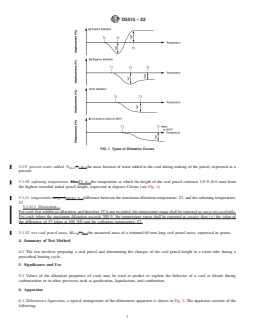
3.1.5 maximum contraction temperature, T2—T2, n—the temperature at which the coal pencil starts swelling, expressed in degrees
Celsius (see Fig. 1a and b).
3.1.5.1 Discussion—
For coals which exhibit contraction only, T2 is the temperature at which the coal pencil initially reaches its minimum (see Fig. 1c).
For coals that exhibit contraction only and are still contracting at 500 °C, T2 will be reported as taken at 500 °C (see Fig. 1d).
3.1.6 maximum dilatation temperature, T3—T3, n—the temperature at which the coal pencil first reaches a maximum height after
swelling, that does not change by more than 1 %D during the next 3 °C, expressed in degrees Celsius (see Fig. 1a and b).
3.1.6.1 Discussion—
For coals that exhibit no dilatation, T3 should be reported as contraction only (see Fig. 1c and d). For coals that the maximum
dilatation exceeds 300 %, T3 should be reported as the temperature at which the recorded height reaches 300 % and as taken at
300 %D.
3.1.7 percent contraction, %C—%C, n—the minimum recorded height of the char expressed as a positive whole number
percentage, based on an initial coal pencil height of 60 mm (see Fig. 1a through c).
3.1.7.1 Discussion—
For coals that exhibit expansion following contraction, the percent contraction is the last minimum recorded height. For coals that
exhibit contraction only and are still contracting at 500 °C, %C is the height recorded at 500 °C (see Fig. 1d).
3.1.8 percent dilatation, %D—%D, n—the maximum recorded height of the char taken at the maximum dilatation temperature,
T3, expressed as a whole number percentage, based on an initial coal pencil height of 60 mm.
3.1.8.1 Discussion—
For coals which the maximum recorded height is above the initial 60 mm baseline, %D is expressed as a positive percentage (see
Fig. 1a). For coals which the maximum recorded height is below the initial 60 mm baseline, %D is expressed as negative
percentage (see Fig. 1b). For coals that exhibit no dilatation, %D should be reported as contraction only (see Fig. 1c and d). For
percent dilatation measurements exceeding 300 %, report %D as greater than (>) 300 %.
For referenced ASTM standards, visit the ASTM website, www.astm.org, or contact ASTM Customer Service at service@astm.org. For Annual Book of ASTM Standards
volume information, refer to the standard’s Document Summary page on the ASTM website.
Available from International Organization for Standardization (ISO), 1, ch. de la Voie-Creuse, Case postale 56, CH-1211, Geneva 20, Switzerland, http://www.iso.ch.
D5515 − 22
FIG. 1 Types of Dilatation Curves
3.1.9 percent water added, % —, n—the mass fraction of water added to the coal during making of the pencil, expressed as a
H O
percent.
3.1.10 softening temperature, T1—T1, n—the temperature at which the height of the coal pencil contracts 1.0 % (0.6 mm) from
the highest recorded initial pencil height, expressed in degrees Celsius (see Fig. 1).
3.1.11 temperature range—range, n—difference between the maximum dilatation temperature, T3, and the softening temperature,
T1.
3.1.11.1 Discussion—
For coals that exhibit no dilatation, and therefore T3 is not recorded, the temperature range shall be reported as range not available.
For coals where the maximum dilatation exceeds 300 %, the temperature range shall be reported as greater than (>) the value of
the difference of T3 taken at 300 %D and the softening temperature, T1.
3.1.12 wet coal pencil mass, M ,—n—the measured mass of a trimmed 60 mm long coal pencil mass, expressed in grams.
wet
4. Summary of Test Method
4.1 The test involves preparing a coal pencil and determining the changes of the coal pencil height in a retort tube during a
prescribed heating cycle.
5. Significance and Use
5.1 Values of the dilatation properties of coals may be used to predict or explain the behavior of a coal or blends during
carbonization or in other processes such as gasification, liquefaction, and combustion.
6. Apparatus
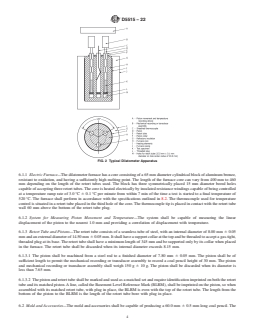
6.1 Dilatometer Apparatus, a typical arrangement of the dilatometer apparatus is shown in Fig. 2. The apparatus consists of the
following:
D5515 − 22
FIG. 2 Typical Dilatometer Apparatus
6.1.1 Electric Furnace—The dilatometer furnace has a core consisting of a 65 mm diameter cylindrical block of aluminum bronze,
resistant to oxidation, and having a sufficiently high melting point. The length of the furnace core can vary from 400 mm to 460
mm depending on the length of the retort tubes used. The block has three symmetrically placed 15 mm diameter bored holes
capable of accepting three retort tubes. The core is heated electrically by insulated resistance windings capable of being controlled
at a temperature ramp rate of 3.0 °C 6 0.1 °C per minute from within 7 min of the time a test is started to a final temperature of
520 °C. The furnace shall perform in accordance with the specifications outlined in 8.2. The thermocouple used for temperature
control is situated in a retort tube placed in the third hole of the core. The thermocouple tip is placed in contact with the retort tube
wall 60 mm above the bottom of the retort tube plug.
6.1.2 System for Measuring Piston Movement and Temperature—The system shall be capable of measuring the linear
displacement of the piston to the nearest 1.0 mm and providing a correlation of displacement with temperature.
6.1.3 Retort Tube and Pistons—The retort tube consists of a seamless tube of steel, with an internal diameter of 8.00 mm 6 0.05
mm and an external diameter of 14.50 mm 6 0.05 mm. It shall have a support collar at the top and be threaded to accept a gas-tight,
threaded plug at its base. The retort tube shall have a minimum length of 345 mm and be supported only by its collar when placed
in the furnace. The retort tube shall be discarded when its internal diameter exceeds 8.15 mm.
6.1.3.1 The piston shall be machined from a steel rod to a finished diameter of 7.80 mm 6 0.05 mm. The piston shall be of
sufficient length to permit the mechanical recording or transducer assembly to record a coal pencil height of 30 mm. The piston
and mechanical recording or transducer assembly shall weigh 150 g 6 10 g. The piston shall be discarded when its diameter is
less than 7.65 mm.
6.1.3.2 The piston and retort tube shall be marked and used as a matched set and require identification imprinted on both the retort
tube and its matched piston. A line, called the Basement Level Reference Mark (BLRM), shall be imprinted on the piston, so when
assembled with its matched retort tube, with plug in place, the BLRM is even with the top of the retort tube. The length from the
bottom of the piston to the BLRM is the length of the retort tube bore with plug in place.
6.2 Mold and Accessories—The mold and accessories shall be capable of producing a 60.0 mm 6 0.5 mm long coal pencil. The
D5515 − 22
mold shall have a 70.0 mm 6 0.1 mm inside bore length with a taper of 1:50. The narrow end of the bore shall have a diameter
of 6.00 mm 6 0.01 mm. Use a trimming block to facilitate the trimming of the coal pencil to length and the subsequent weighing
of the trimmed pencil (see Note 1). The portion of the trimming block holding the pencil shall not weigh more than 155 g.
NOTE 1—The coal pencil may be trimmed to length from either end.
6.3 Cleaning Implements (Recommended)—The cleaning implements for the retort tube consist of a 7.95 mm diameter reamer and
a 9 mm bronze wire rifle brush with suitable attachments to permit cleaning of the full length of the retort tube. A circular wire
brush, attached to a bench top mounted grinder, is recommended for the cleaning of the pistons.
6.4 Balance—The balance shall have a weighing capacity of 160 g with 0.01 g readability.
7. Preparation of Sample
7.1 Collect a gross sample in accordance with the requirements of Test Method D2234/D2234M.
7.2 The analysis sample shall consist of a minimum of 50 g of coal pulverized to 250 μm (No. 60 U.S. standard sieve) sieve in
accordance with Test Method D2013. Perform the dilatation analysis on the coal sample passing 250 μm (No. 60 U.S. standard
sieve) sieve within five days after reduction to 250 μm (No. 60 U.S. standard sieve) sieve.
8. Calibration
8.1 For all systems not using a mechanical pen/chart, calibrate the recorder of piston height when there is a difference of 3.0 mm
or more between the final char heights as calculated from the chart readout and those directly measured using the BLRM for two
ht
consecutive determinations.
8.2 The furnace, while being ramped at 3 °C per minute, must meet the following temperature criteria with the empty retort tubes
placed in Bores 1 and 2 of the furnace and all temperature measurements made with the thermocouple(s) in contact with the retort
tube wall(s):
8.2.1 Temperatures measured in Bores 1 and 2 must be 63 °C measured at the same height for 0 mm, 45 mm, 90 mm, 135 mm,
and 180 mm above the retort tube plug.
8.2.2 Temperatures measured between the control thermocouple placed at 60 mm above the retort tube plug and those of Bores
1 and 2 shall be 63 °C measured at 0 mm, 45 mm, 90 mm, and 135 mm and 66 °C at 180 mm.
8.3 The dilatometer temperature readout of the measuring thermocouple shall be checked by comparison with a digital
thermometer which is calibrated for the same type of thermocouple. If the temperature difference is greater than 63 °C, then the
dilatometer furnace temperature readout requires recalibration using a temperature calibrator.
8.4 The furnace temperature profile and measuring thermocouple calibration shall be verified at a minimum interval of every 400
determinations or 6 months, whichever occurs first, or upon any furnace component being repaired or replaced.
8.5 Calibrate the retort tubes, as described in Annex A1, prior to initial use and after every 50 tests.
9. Preparation of the Coal Pencil
9.1 All masses shall be recorded to the nearest 0.01 g. Care must be taken to avoid sample loss and the following steps must be
performed without interruption.
9.1.1 Preparation of Homogeneous Coal Sample and Water Mix—The fraction of water in the mix shall be ≤11 % on a mass
fraction basis.
9.1.1.1 Weigh a mixing vessel. Record the mass as M1.
D5515 − 22
9.1.1.2 Add approximately 2 g of coal to the pre-weighed mixing vessel; distribute the coal evenly over the bottom of the mixing
vessel. Record the mass as M2.
9.1.1.3 Add approximately 1 mL of distilled water to the coal. Record the mass as M3.
9.1.1.4 Mix the coal and water together using a metal spatula to form a homogeneous paste. Care must be taken to avoid loss of
sample.
9.1.1.5 Add another increment of approximately 8 g of coal. Record the mass as M4. Mix to homogeneity using a metal spatula.
9.2 Construction of the Coal Pencil:
9.2.1 If a mold release agent has been applied to the bore of the pencil mold, then excess release agent must be removed by forcing
a wad of tissue through the bore of the mold before adding the moistened coal.
9.2.2 Add not less than ten increments of the moistened coal to a mold and compact.
9.2.3 Press the coal pencil out of the mold using equipment provided. If a break in the pencil occurs at any point during its
construction, the pencil shall be remade. Gently place the pencil into a trimming block and trim the pencil to a 60 mm length.
Discard the trimmed off portion of the pencil. Record the mass of the trimmed coal pencil and trimming block as M5.
9.3 Transfer the trimmed coal pencil into the top of the horizontally placed retort tube. The coal pencil is gently pushed to the
bottom of the retort tube with the matched piston. Check that the matched piston slides freely inside the retort tube. Record the
mass of the trimming block and any fragments of the trimmed pencil not transferred into the retort tube as M6. To determine the
accurate mass of coal in the coal pencil, it is essential that any untransferred fragments of the coal pencil are weighed along with
the trimming block.
10. Procedure
10.1 Clean the dilatometer retort and piston assembly. Firmly attach the retort tube plugs to the retort tubes. Check that the
matched piston slides freely in the retort tube.
10.2 Prepare the coal pencils and load them into the retort tubes as described in Section 9.
10.3 Load both retort tube and piston assemblies, charged with trimmed coal pencils, into the dilatometer furnace, which is
thermally stabilized at its 315 °C setpoint.
10.4 Attach the mechanism used to measure piston height and adjust the piston height reading to 0 %D 6 5 %D.
10.5 The heating control shall be set so that the furnace temperature recovers to the 315 °C setpoint within 10 min of loading the
retort tubes and piston assemblies. Start the temperature control program immediately once the setpoint temperature is reached.
10.6 Terminate the test when no movement of the piston can be detected for 5 min after completion of the dilatation process. In
the instance of no dilatation, terminate the test when the furnace temperature reaches 500 °C. Reset the furnace to 315 °C 6 5 °C.
Remove the piston height-measuring mechanism. Remove the retort tube and piston assemblies as a unit. Measure and record the
BLRM for each piston/retort tube assembly. Allow the assembly to cool to room temperatu
...