


ASTM E1575-18
(Practice)Standard Practice for Pressure Water Cleaning and Cutting
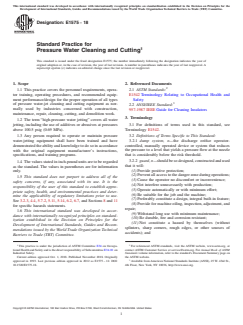
Standard Practice for Pressure Water Cleaning and Cutting
SIGNIFICANCE AND USE
4.1 This practice is intended to provide guidance on the proper operation of pressure water-jet cleaning and cutting equipment.
4.2 This practice is also applicable at lower pressures where there is foreseeable risk of injury.
4.3 This practice is provided to assist persons unfamiliar with the operation of water-jet cleaning and cutting equipment in learning to correctly use the equipment.
4.4 Correct operation and use of the pressure water-jet cleaning and cutting equipment requires that the operator has familiarized himself with the identification of pressure metal fittings, hoses, guns, and accessories in accordance with the original equipment manufacturer’s specifications, instructions, and programmed instructional material; only then shall hydrojetting begin. Modification of water-jetting equipment shall not be done without prior written approval by the manufacturer of the equipment. Employees shall be instructed in the recognition and avoidance of unsafe conditions as identified/required in 5.18. (Warning—Serious harm or injury may result from the misuse of water-jetting equipment and the use of improper fittings, hoses, or attachments.)
4.5 The use of pressure water-jet equipment for cutting and cleaning is a rapidly evolving technology. This practice will be periodically reviewed for any required changes at least every five years.
SCOPE
1.1 This practice covers the personnel requirements, operator training, operating procedures, and recommended equipment performance/design for the proper operation of all types of pressure water-jet cleaning and cutting equipment as normally used by industries concerned with construction, maintenance, repair, cleaning, cutting, and demolition work.
1.2 The term “high-pressure water jetting” covers all water jetting, including the use of additives or abrasives at pressures above 100.5 psig (0.69 MPa).
1.3 Any person required to operate or maintain pressure water-jetting equipment shall have been trained and have demonstrated the ability and knowledge to do so in accordance with the original equipment manufacturer's instructions, specifications, and training programs.
1.4 The values stated in inch-pound units are to be regarded as the standard. The values in parentheses are for information only.
1.5 This standard does not purport to address all of the safety concerns, if any, associated with its use. It is the responsibility of the user of this standard to establish appropriate safety, health, and environmental practices and determine the applicability of regulatory limitations prior to use. See 3.2.3, 4.4, 5.7.2, 5.11, 5.14, 6.2, 6.7, and Sections 8 and 11 for specific hazards statements.
1.6 This international standard was developed in accordance with internationally recognized principles on standardization established in the Decision on Principles for the Development of International Standards, Guides and Recommendations issued by the World Trade Organization Technical Barriers to Trade (TBT) Committee.
General Information
- Status
- Published
- Publication Date
- 30-Sep-2018
- Technical Committee
- E34 - Occupational Health and Safety
- Drafting Committee
- E34.10 - Industrial Safety
Relations
- Effective Date
- 01-Oct-2018
- Effective Date
- 01-Jan-2020
- Effective Date
- 01-Feb-2018
- Effective Date
- 01-Aug-2010
- Effective Date
- 01-Apr-2004
- Effective Date
- 01-Jan-1998
Overview
ASTM E1575-18: Standard Practice for Pressure Water Cleaning and Cutting provides comprehensive guidelines for the safe and effective operation of pressure water-jet cleaning and cutting equipment. Developed by ASTM, this international standard is essential for industries involved in construction, maintenance, repair, cleaning, cutting, and demolition activities. The standard covers essential aspects such as personnel requirements, operator training, safe operating procedures, and the recommended design and performance of equipment. Due to the powerful nature of pressurized water jets and the associated risks, adherence to ASTM E1575-18 is crucial for operational safety and compliance with regulatory expectations.
Key Topics
- Personnel and Operator Training: Only individuals trained according to the original equipment manufacturer’s materials and programs should operate or maintain water-jet equipment. Training must include the proper use, safety procedures, and regular proficiency demonstrations, with records maintained for at least five years.
- Equipment Operation: Guidance includes correct identification and use of pressure metal fittings, hoses, guns, and accessories. Modifications to equipment must have written manufacturer approval.
- Safety and Protective Measures: The standard emphasizes the importance of personal protective equipment (PPE)-including head, eye, hand, body, and hearing protection-and the use of system guards, shields, and appropriate operational controls to avoid injury.
- Operating Procedures: Step-by-step procedures detail pre-operating planning, use of equipment checklists, establishment of warning barriers, handling of electrical hazards, and maintenance routines.
- Hazard Identification and Emergency Protocols: The document outlines hazard recognition, first aid measures, and procedures for addressing injuries from water jet exposure.
- System Components: Definitions and requirements for pumps, hoses, nozzles, valves, and safety devices ensure equipment is used within its rated pressures and with all protective features in place.
Applications
ASTM E1575-18 is primarily applied in industries where high-pressure water-jet systems are used for cleaning, surface preparation, and cutting. Common sectors include:
- Construction and Demolition: Safely removing coatings, debris, or materials using water-jet cutting or cleaning.
- Industrial Maintenance: Cleaning tanks, pipes, and hard-to-reach surfaces with high-pressure water jets while minimizing the use of chemicals.
- Manufacturing and Fabrication: Cutting materials such as metal, concrete, or composites precisely and efficiently using water-jet cutting technology.
- Utilities and Municipal Services: Maintenance of water distribution and wastewater systems through internal pipe cleaning (often called "moleing" or "lancing").
Proper implementation of ASTM E1575-18 minimizes workplace accidents, ensures equipment longevity, and supports compliance with health and environmental regulations. Training and annual refreshers, as stated in the standard, keep operators proficient and aware of evolving best practices.
Related Standards
To ensure complete compliance and enhance safety practices, consider referencing these related standards:
- ASTM E1542: Terminology Relating to Occupational Health and Safety, for definitions and context.
- ANSI/IEEE Standard 957-1987: IEEE Guide for Cleaning Insulators, particularly for safe cleaning procedures using similar technology.
- National Electrical Code (NEC) Section 430-91: For guidelines on the use of electrical equipment in pressure cleaning scenarios.
ASTM E1575-18 is reviewed every five years to incorporate technological advances and updates in safety practices. Using this standard as part of your industrial cleaning and cutting processes promotes a safer work environment and ensures compliance with industry-recognized best practices. For the latest edition and authoritative guidance, always refer directly to the current ASTM publication.
Buy Documents
ASTM E1575-18 - Standard Practice for Pressure Water Cleaning and Cutting
REDLINE ASTM E1575-18 - Standard Practice for Pressure Water Cleaning and Cutting
Get Certified
Connect with accredited certification bodies for this standard

National Aerospace and Defense Contractors Accreditation Program (NADCAP)
Global cooperative program for special process quality in aerospace.
CARES (UK Certification Authority for Reinforcing Steels)
UK certification for reinforcing steels and construction.
DVS-ZERT GmbH
German welding certification society.
Sponsored listings
Frequently Asked Questions
ASTM E1575-18 is a standard published by ASTM International. Its full title is "Standard Practice for Pressure Water Cleaning and Cutting". This standard covers: SIGNIFICANCE AND USE 4.1 This practice is intended to provide guidance on the proper operation of pressure water-jet cleaning and cutting equipment. 4.2 This practice is also applicable at lower pressures where there is foreseeable risk of injury. 4.3 This practice is provided to assist persons unfamiliar with the operation of water-jet cleaning and cutting equipment in learning to correctly use the equipment. 4.4 Correct operation and use of the pressure water-jet cleaning and cutting equipment requires that the operator has familiarized himself with the identification of pressure metal fittings, hoses, guns, and accessories in accordance with the original equipment manufacturer’s specifications, instructions, and programmed instructional material; only then shall hydrojetting begin. Modification of water-jetting equipment shall not be done without prior written approval by the manufacturer of the equipment. Employees shall be instructed in the recognition and avoidance of unsafe conditions as identified/required in 5.18. (Warning—Serious harm or injury may result from the misuse of water-jetting equipment and the use of improper fittings, hoses, or attachments.) 4.5 The use of pressure water-jet equipment for cutting and cleaning is a rapidly evolving technology. This practice will be periodically reviewed for any required changes at least every five years. SCOPE 1.1 This practice covers the personnel requirements, operator training, operating procedures, and recommended equipment performance/design for the proper operation of all types of pressure water-jet cleaning and cutting equipment as normally used by industries concerned with construction, maintenance, repair, cleaning, cutting, and demolition work. 1.2 The term “high-pressure water jetting” covers all water jetting, including the use of additives or abrasives at pressures above 100.5 psig (0.69 MPa). 1.3 Any person required to operate or maintain pressure water-jetting equipment shall have been trained and have demonstrated the ability and knowledge to do so in accordance with the original equipment manufacturer's instructions, specifications, and training programs. 1.4 The values stated in inch-pound units are to be regarded as the standard. The values in parentheses are for information only. 1.5 This standard does not purport to address all of the safety concerns, if any, associated with its use. It is the responsibility of the user of this standard to establish appropriate safety, health, and environmental practices and determine the applicability of regulatory limitations prior to use. See 3.2.3, 4.4, 5.7.2, 5.11, 5.14, 6.2, 6.7, and Sections 8 and 11 for specific hazards statements. 1.6 This international standard was developed in accordance with internationally recognized principles on standardization established in the Decision on Principles for the Development of International Standards, Guides and Recommendations issued by the World Trade Organization Technical Barriers to Trade (TBT) Committee.
SIGNIFICANCE AND USE 4.1 This practice is intended to provide guidance on the proper operation of pressure water-jet cleaning and cutting equipment. 4.2 This practice is also applicable at lower pressures where there is foreseeable risk of injury. 4.3 This practice is provided to assist persons unfamiliar with the operation of water-jet cleaning and cutting equipment in learning to correctly use the equipment. 4.4 Correct operation and use of the pressure water-jet cleaning and cutting equipment requires that the operator has familiarized himself with the identification of pressure metal fittings, hoses, guns, and accessories in accordance with the original equipment manufacturer’s specifications, instructions, and programmed instructional material; only then shall hydrojetting begin. Modification of water-jetting equipment shall not be done without prior written approval by the manufacturer of the equipment. Employees shall be instructed in the recognition and avoidance of unsafe conditions as identified/required in 5.18. (Warning—Serious harm or injury may result from the misuse of water-jetting equipment and the use of improper fittings, hoses, or attachments.) 4.5 The use of pressure water-jet equipment for cutting and cleaning is a rapidly evolving technology. This practice will be periodically reviewed for any required changes at least every five years. SCOPE 1.1 This practice covers the personnel requirements, operator training, operating procedures, and recommended equipment performance/design for the proper operation of all types of pressure water-jet cleaning and cutting equipment as normally used by industries concerned with construction, maintenance, repair, cleaning, cutting, and demolition work. 1.2 The term “high-pressure water jetting” covers all water jetting, including the use of additives or abrasives at pressures above 100.5 psig (0.69 MPa). 1.3 Any person required to operate or maintain pressure water-jetting equipment shall have been trained and have demonstrated the ability and knowledge to do so in accordance with the original equipment manufacturer's instructions, specifications, and training programs. 1.4 The values stated in inch-pound units are to be regarded as the standard. The values in parentheses are for information only. 1.5 This standard does not purport to address all of the safety concerns, if any, associated with its use. It is the responsibility of the user of this standard to establish appropriate safety, health, and environmental practices and determine the applicability of regulatory limitations prior to use. See 3.2.3, 4.4, 5.7.2, 5.11, 5.14, 6.2, 6.7, and Sections 8 and 11 for specific hazards statements. 1.6 This international standard was developed in accordance with internationally recognized principles on standardization established in the Decision on Principles for the Development of International Standards, Guides and Recommendations issued by the World Trade Organization Technical Barriers to Trade (TBT) Committee.
ASTM E1575-18 is classified under the following ICS (International Classification for Standards) categories: 25.100.01 - Cutting tools in general; 25.220.20 - Surface treatment. The ICS classification helps identify the subject area and facilitates finding related standards.
ASTM E1575-18 has the following relationships with other standards: It is inter standard links to ASTM E1575-12, ASTM E1542-20, ASTM E1542-18, ASTM E1542-10, ASTM E1542-93(2004), ASTM E1542-93(1998). Understanding these relationships helps ensure you are using the most current and applicable version of the standard.
ASTM E1575-18 is available in PDF format for immediate download after purchase. The document can be added to your cart and obtained through the secure checkout process. Digital delivery ensures instant access to the complete standard document.
Standards Content (Sample)
This international standard was developed in accordance with internationally recognized principles on standardization established in the Decision on Principles for the
Development of International Standards, Guides and Recommendations issued by the World Trade Organization Technical Barriers to Trade (TBT) Committee.
Designation: E1575 − 18
Standard Practice for
Pressure Water Cleaning and Cutting
This standard is issued under the fixed designation E1575; the number immediately following the designation indicates the year of
original adoption or, in the case of revision, the year of last revision. A number in parentheses indicates the year of last reapproval. A
superscript epsilon (´) indicates an editorial change since the last revision or reapproval.
1. Scope 2. Referenced Documents
1.1 This practice covers the personnel requirements, opera- 2.1 ASTM Standards:
tor training, operating procedures, and recommended equip- E1542 Terminology Relating to Occupational Health and
ment performance/design for the proper operation of all types Safety
of pressure water-jet cleaning and cutting equipment as nor-
2.2 ANSI/IEEE Standard:
mally used by industries concerned with construction,
957-1987 IEEE Guide for Cleaning Insulators
maintenance, repair, cleaning, cutting, and demolition work.
3. Terminology
1.2 The term “high-pressure water jetting” covers all water
3.1 For definitions of terms used in this standard, see
jetting, including the use of additives or abrasives at pressures
above 100.5 psig (0.69 MPa). Terminology E1542.
3.2 Definitions of Terms Specific to This Standard:
1.3 Any person required to operate or maintain pressure
water-jetting equipment shall have been trained and have 3.2.1 dump system, n—the discharge orifice operator-
controlled, manually operated device or system that reduces
demonstrated the ability and knowledge to do so in accordance
with the original equipment manufacturer’s instructions, the pressure to a level that yields a pressure flow at the nozzle
that is considerably below the risk threshold.
specifications, and training programs.
3.2.2 guard,n—shouldbesodesigned,constructedandused
1.4 The values stated in inch-pound units are to be regarded
that it will:
as the standard. The values in parentheses are for information
(1) Provide positive protection;
only.
(2) Prevent all access to the danger zone during operations;
1.5 This standard does not purport to address all of the
(3) Cause the operator no discomfort or inconvenience;
safety concerns, if any, associated with its use. It is the
(4) Not interfere unnecessarily with production;
responsibility of the user of this standard to establish appro-
(5) Operate automatically or with minimum effort;
priate safety, health, and environmental practices and deter-
(6) Be suitable for the job and the machine;
mine the applicability of regulatory limitations prior to use.
(7) Preferably constitute a design, integral built-in feature;
See 3.2.3, 4.4, 5.7.2, 5.11, 5.14, 6.2, 6.7, and Sections 8 and 11
(8) Provide for machine oiling, inspection, adjustment, and
for specific hazards statements.
repair;
1.6 This international standard was developed in accor-
(9) Withstand long use with minimum maintenance;
dance with internationally recognized principles on standard-
(10) Be durable, fire and corrosion resistant;
ization established in the Decision on Principles for the
(11) Not constitute a hazard by themselves (without
Development of International Standards, Guides and Recom-
splinters, sharp corners, rough edges, or other sources of
mendations issued by the World Trade Organization Technical
accidents); and
Barriers to Trade (TBT) Committee.
1 2
This practice is under the jurisdiction of ASTM Committee E34 on Occupa- For referenced ASTM standards, visit the ASTM website, www.astm.org, or
tionalHealthandSafety andisthedirectresponsibilityofSubcommitteeE34.10 on contact ASTM Customer Service at service@astm.org. For Annual Book of ASTM
Industrial Safety. Standards volume information, refer to the standard’s Document Summary page on
Current edition approved Oct. 1, 2018. Published November 2018. Originally the ASTM website.
approved in 1993. Last previous edition approved in 2012 as E1575 – 12. DOI: Available fromAmerican National Standards Institute (ANSI), 25 W. 43rd St.,
10.1520/E1575-18. 4th Floor, New York, NY 10036, http://www.ansi.org.
Copyright © ASTM International, 100 Barr Harbor Drive, PO Box C700, West Conshohocken, PA 19428-2959. United States
E1575 − 18
(12) Protectagainstforeseeableuseandforeseeablemisuse equipment, as well as any heating elements or injection
of operational contingencies, not merely against normally systems attached thereto.
expected hazards as determined from a job safety analysis.
3.2.13 shotgunning, n—an application whereby a lance or
nozzle combination can be manipulated in virtually all planes
3.2.3 high-pressure water cleaning, v—the use of high-
of operation.
pressure water, with or without the addition of other liquids or
solid particles, to remove unwanted matter from various
4. Significance and Use
surfaces,wherethepressureoftheliquidjetexceeds100.5psig
(0.69 MPa) at the orifice. (Warning—The limit of 100.5 psig
4.1 This practice is intended to provide guidance on the
(0.69 MPa) does not mean that pressures below 100.5 psig
proper operation of pressure water-jet cleaning and cutting
(0.69 MPa) cannot cause injury or require any less attention to
equipment.
the principles of this practice.Adequate precautions, similar to
4.2 This practice is also applicable at lower pressures where
those of this practice, are required at all pressures.)
there is foreseeable risk of injury.
3.2.4 high-pressure water cutting, v—the use of high-
4.3 This practice is provided to assist persons unfamiliar
pressure water, with or without the addition of other liquids or
with the operation of water-jet cleaning and cutting equipment
solidparticles,topenetrateintothesurfaceofamaterialforthe
in learning to correctly use the equipment.
purpose of cutting that material, where the pressure of the
liquid jet exceeds 100.5 psig (0.69 MPa) at the orifice.
4.4 Correct operation and use of the pressure water-jet
cleaning and cutting equipment requires that the operator has
3.2.5 hose assembly, n—a hose with safety coupling, each
familiarized himself with the identification of pressure metal
indicating pressure capacities and attached in accordance with
fittings, hoses, guns, and accessories in accordance with the
manufacturer’s specifications.
original equipment manufacturer’s specifications, instructions,
3.2.6 lance, n—a rigid metal tube used to extend the nozzle
and programmed instructional material; only then shall hydro-
from the end of the hose.
jetting begin. Modification of water-jetting equipment shall not
3.2.7 lancing, v—an application whereby a lance and nozzle be done without prior written approval by the manufacturer of
combination is inserted into, and retracted from, the interior of
the equipment. Employees shall be instructed in the recogni-
a pipe or tubular product. tion and avoidance of unsafe conditions as identified/required
in 5.18.(Warning—Serious harm or injury may result from
3.2.8 moleing, v—an application whereby a hose fitted
the misuse of water-jetting equipment and the use of improper
either with a nozzle or with a nozzle attached to a lance is
fittings, hoses, or attachments.)
inserted into, and retracted from, the interior of a tubular
product. It is a system commonly intended for cleaning the
4.5 The use of pressure water-jet equipment for cutting and
internal surfaces of tubes, pipes, or drains. It can be self-
cleaning is a rapidly evolving technology.This practice will be
propelled by its backward-directed jets and is manufactured in periodically reviewed for any required changes at least every
various shapes, sizes, and combinations of forward- and
five years.
backward-directed jets.
5. Apparatus
3.2.9 nozzle, n—a device with one or more openings where
the fluid discharges from the system. The nozzle restricts the
5.1 Pressurizing Pump—Aunit designed to deliver pressure
area of flow of the fluid, accelerating the water to the required
water or other fluid with or without chemicals or particle
velocity and shaping it to the required flow pattern and
material.Thisisusuallybasedonpositivedisplacementpistons
distribution for a particular application. Combinations of for-
or rubber diaphragm/hydraulic systems and discharges water
ward and backward nozzles are often used to balance the
into a common manifold in which either flexible hoses or rigid
thrust. Such nozzles are commonly referred to as tips, jets,
tubing connect to lances and nozzles. These pumps can be
orifices, etc.
either mobile or permanently mounted.
5.1.1 The pump shall have permanently mounted identifi-
3.2.10 operator, n—a person who has been trained in
cation plates or tags which provide the following information:
accordancewiththeoriginalmanufacturer’sinstructionaltrain-
5.1.1.1 Product and supplier,
ing program and has demonstrated the knowledge, experience,
5.1.1.2 Production model and serial number, or year of
and ability to perform the assigned task.
production,
3.2.11 operator trainee, n—a person not fully qualified due
5.1.1.3 Maximum performance, in terms of gallons per
to the lack of sufficient knowledge or experience, or both, to
minute and pressure in pound-force per square inch, and
perform the assigned task without supervision.
5.1.1.4 An outline of recommended safety procedures and
3.2.12 pressure water jet system, n—water delivery systems
warnings.
that have nozzles or other openings whose function is to
5.2 Relief System—The system shall be equipped with an
increase the speed of liquids that may cause injury. Solid
automatic relief device on the discharge side of the pump and
particles or additional chemicals may also be introduced, but
an auxiliary relief dump device as part of the pump.
the exit in all cases will be in a free stream. The system shall
include the pumps (pressure-producing devices), hoses, lances, 5.3 Relief System Types—These may take the form of the
nozzles, valves, safety devices, and personal protective following:
E1575 − 18
5.3.1 Pressure Relief Valve or Bursting Disk in Holder— 5.7.2 Solenoid and Electrically Operated Control Dump
Usually mounted on the pump discharge chamber to prevent Systems—All electrically controlled dump systems should be
the pressure exceeding the rated maximum pressure of the of fail-safe design. (Warning—Voltage of an alternating cur-
whole system. rent (ac) or direct current (dc) dump system handled by
personnel shall not exceed 24 V.)
5.3.2 Automatic Pressure Regulating Valve (Unloading
Valve)—Limits the pressure at which the pump operates by
5.8 High-Pressure Hose and Couplings—A flexible hose
releasing a preset proportion of the generated flow back to the
and coupling that connects two components and delivers the
pump suction chamber or to waste. It may be used to regulate
high-pressure fluid to the gun or nozzle components. The hose
the water pressure from the pump and is individually set for
and fittings shall have a burst rating of a minimum of 2.5 times
each operation. This device may be integral with the pump
the maximum working pressure. Operating levels below this
hydraulic assembly. Where there is no demand for pumpage,
ratio should require a protective shielding around that hose and
the pressure is brought down to zero.
coupling. The hose and coupling shall be marked with the
5.3.3 Bypass Valve—Limits the pressure at which the pump manufacturer’s symbol, serial number, the maximum permis-
operates by releasing a preset proportion of the generated flow sible operating pressure, and the test pressure. High-pressure
hose shall be tested at 2.5 times working pressure in accor-
back to the pump suction chamber or to waste. It may be used
to regulate the water pressure from the pump and is individu- dance with the original equipment operator’s specifications,
test methods, instructions, and training programs.
allysetforeachoperation.Thisdevicemaybeintegralwiththe
pump hydraulic assembly.
5.9 End Fittings and Couplings—Pressure hose end fittings
and safety couplings shall be manufactured to be compatible
5.4 Pressure Gage—The system shall be equipped with a
with the hose and tested as a unit.
gageindicatingthepressurebeingdeveloped.Gagesshallhave
a scale range of at least 50 % above the maximum working
5.10 Jetting Gun Extension—A length or lengths of tube
pressure of the system.
carrying pressure fluid to the nozzle. Each shall be manufac-
tured from material suitable to the application. End connec-
5.5 Filter or Strainer—The water system shall be equipped
tionsshallbesuitablefortheapplication.Theextensionisused
with a filter or strainer to prevent particles from restricting the
in conjunction with a control valve. The extension shall have a
orifices in the nozzle. The strainer or filter shall be capable of
minimum burst strength of at least 2.5 times the highest actual
removing particles smaller in size than the smallest orifice in
operating pressure used.
the nozzle and usually smaller to protect pumps and other
components.
5.11 Nozzle—The nozzle creates the water jet or jets at the
required velocity, flow rate, pressure, shape, and distribution
5.6 Dry Shut-Off Control Valve—This operator-controlled
for a particular application. Combinations of forward and
valve,normallyhandcontrolled,automaticallyshutsoffflowto
backward direct water jets are often used to balance the thrust.
the lance or nozzle assembly, or both, when released by the
Such nozzles may be referred to as tips, jets, or orifices.
operator but retains the operating pressure within the supply
(Warning—Personal protective equipment and nozzle guard
line when so shut off. This valve shall be used in systems with
shall be provided.)
an automatic pressure regulating valve.
5.12 Water Jet—A jet stream of water produced from the
5.6.1 Release the pressure in the dry shut-off valve and line
individual outlet orifice of a nozzle. The shape of the jet is
when the pump is shut down; otherwise, the valve operating
determined by the form of the orifice, while the speed at which
lever may remain alive. This valve may alternatively be
it travels is determined by the orifice design, orifice area, and
actuated by solenoid or pilot pressure mechanism.
flow. The pressure drop at the orifice is a result of an increase
5.7 Dump System—The system should be equipped with a
in velocity. The two most commonly used jet shapes are the
device that will either shut down the unit, idle it to low
straight jet and fan-shaped jet.
revolutions per minute, bypass the flow, or reduce the dis-
5.12.1 StraightJet—Concentratesthestreamofwaterovera
charge pressure to a low level. The dump system shall be
small area of the workpiece by minimizing the spread. A
manually controlled only by the nozzle orifice operator. The
typical application is for cutting, or for general cleaning of
dump system actuator device should be shielded to preclude
matter with higher shear or bond strength, or both.
inadvertent operation. This device shall immediately shut off
5.12.2 Fan Jet—Spreads the stream of water in one plane,
the pressure water stream if the operator loses control.
thus giving a wide band coverage of the workpiece. A typical
5.7.1 Dump Control Valve—An operator-controlled valve,
application is for cleaning larger areas requiring less energy to
normally hand operated, that automatically terminates signifi-
remove unwanted matter.
cant flow to the lance or nozzle assembly, or both, when
5.13 Jetting Hand Manifold and Spray Bars—These are
released by the nozzle operator, thus relieving the operating
pieces of equipment which individual nozzles are fitted for
pressure within the whole system by diverting the flow
protection of the workmen.
produced by the pump to atmosphere. A valve size should be
selected that will not cause generation of significant back 5.14 Foot Control Valve—The orifice operator’s control
pressure at the maximum possible pumping rate of the pump. valve may be arranged for actuation by the operator’s foot if
This valve may alternatively be actuated by a solenoid or a desired, either in place of, or in addition to, hand control.
pilot pressure mechanism. (Warning—An adequate guard shall be fitted to prevent
E1575 − 18
accidental operation, and the base plate should be sufficient to nism. Such clogging can cause a loss of control, which can be
ensure stability in use. If of the dump type, the layout should dangerous to the operator.)
ensure that the dump line used is restrained from whipping
6.3 Hose Assemblies—Inspect all hose assemblies prior to
when the valve is released.)
use with respect to the following:
6.3.1 Correct pressure rating and size,
5.15 Jetting Gun—A portable combination of operator’s
control valve, lance, and nozzle resembling a gun in layout and 6.3.2 Free from external damage, that is, broken wires, and
6.3.3 All end fittings and couplings are in good order and of
assembly. The control valve is hand operated by a squeeze-
action, dead-man-type trigger for the hand of the operator who the correct pressure rating for the unit operating pressure.
shouldalwayshavecontrolofthisdeviceandmaybeofthedry
6.4 Nozzles—Keep all jetting nozzles clean and check the
shut-off or dump type, the gun being named accordingly. The
orifice to ensure that it is not obstructed or damaged before
hand control normally takes the form of a trigger or lever that
installation. Do not use defective nozzles; replace or repair
is provided with a guard adequate to prevent accidental
before installation. During the startup prior to operation, move
operation and that shall have the means of being immobilized
the nozzle from the lance and flush the system thoroughly to
in the “off” position by means of a safety catch. The gun shall
remove air and foreign particles.
be fitted with a shoulder pad or hand grips to facilitate
6.5 Jetting Guns and Lances—Check jetting guns and
back-thrust control.
lances daily and examine the trigger mechanism and guard
5.16 Retro Gun—A retro safety gun is fitted with forward-
thoroughly to ensure correct operation. Observe all pressure
and backward-facing jets. This reduces the thrust experienced
connections during operation of the equipment. If a leak is
by the operator.This type of gun is used mainly for underwater
observed, shut down the pump and repair or replace the
jettingoperations.Theretrobalancejetprotectiontubeshallbe
connection before further operation.
sufficiently long or constructed so as to prevent the operator
6.6 Foot Control Valves—Check and clean all foot control
from directing a retro balance jet at himself.
valves and switches daily and give the foot mechanism and
5.17 Changeover Valve—An operator-controlled valve de-
guard a thorough visual and mechanical examination to ensure
signed to properly direct pressure water flow from the pump to
correctoperationandfreedomfromaccidentalactuation.When
one or other items of equipment at the operator’s choice. It
the nozzle operator is not the trigger operator, the nozzle
shall be designed to withstand 2.5 times the maximum system
operator shall use a guarded safety foot control valve to
pressure, and may be power-operated.
de-energize the flow in the event of an emergency.
5.18 Original Equipment Manufacturer (OEM)—The origi-
6.7 Electrical Equipment—All electrically operated pres-
nal equipment manufacturer shall design the equipment based
sure water-jet cleaning and cutting equipment units shall be
upon the foreseeable uses and misuses and design recognized
checked daily for external damage, with special emphasis
hazards out of the equipment. Hazards that cannot be designed
placed on connections, junction boxes, switches, and supply
out shall be guarded and warned to protect and alert the
cables, and shall be of the waterproof type. (See National
operator. Warnings and instructions shall never be used as a Electric Code Section 430-91.) (Warning—Ensure that the
substitute for the elimination of hazards or guarding. Failure
electrical system is protected from the ingress of water. Only
Mode and Effects Analysis (SAE J-1739) and Job Safety NEMA-classified electrical equipment, which is of the water-
analysis shall be provided by the OEM in their programmed
proof type, shall be used. Check correct direction of rotation of
instructional material. the electric motor on initial installation and after every recon-
nection.)
6. Care and Maintenance of Equipment
6.8 Trailers—Check trailer-mounted units daily, examining
6.1 Pump Unit—Maintain the pump unit in accordance with the tires, braking systems, jacking points, towing hitch, lights,
safety chains, structural damage, and for general cleanliness.
the manufacturer’s instructions, specifications, and pro-
grammed instructional material. Where applicable, this should Tow the units only by vehicles designed for that purpose.
include daily checks on the following items:
6.9 Engine Controls—Check all throttle cables and engine
6.1.1 Drive Unit—Lubricating oil, water, hydraulic fluid,
stop devices daily to ensure that they are functioning properly.
and fuel levels,
6.10 Maintenance Servicing and Repair—The following
6.1.2 Pump Unit—Lubricating oil and gear box oil levels,
operations should only be carried out by competent personnel:
6.1.3 Hydraulic Hose Reel—Lubricatingoilandfluidlevels,
6.10.1 Manufacturer’s servicing requirements.
and
6.10.2 The following items should be overhauled and
6.1.4 Condition of Guards and Shields.
checked for correct functioning at the original manufacturer’s
6.2 Filters and Strainers—Check all water filters at regular recommended intervals:
6.10.2.1 Pressure relief valve,
intervals, dependent upon the supply water conditions, and in
accordance with the pump manufacturer’s recommendations. 6.10.2.2 Bursting disks, if used,
6.10.2.3 Pressure control valves,
(Warning—Take extreme care to filter the water source
through a proper micron filtration device, to prevent foreign 6.10.2.4 Hand- or foot-operated dump control valve or dry
shut-off control valve,
particles from cutting changeover valves and seating surfaces,
andtopreventcloggingthechangeovervalveoperatingmecha- 6.10.2.5 Dry shut-off valve or dump system,
E1575 − 18
6.10.2.6 Changeover valve, and and proper tools to use on couplings and fittings shall be
6.10.2.7 Personal protective equipment. explained to operators and employees as delineated by the
instructions provided by the original equipment manufacturer.
6.11 Tools—Use the correct size tools when maintaining or
assembling jetting systems. The use of adjustable tools having 7.8 Stance—Theproperstanceforsoundfootingandhowto
serrated gripping jaws (for example, pipe wrenches) can use the various devices for lancing, shotgunning, and moleing
damage equipment and is not recommended, particularly on shall be demonstrated. The operator and employee trainees,
the crimped portion of a hose fitting. underclosesupervision,shallusethevariousdeviceswhilethe
unit is slowly pressurized, as delineated by the instructions
6.12 Compatibility—Check all component parts and fittings
provided by the original equipment manufacturer.
to ensure they are of the correct size and rating for the unit.
7.9 Proficiency—Personnel shall demonstrate knowledge
7. Operational and Training Requirements
and skill in the proper operation, inspection, and maintenance
7.1 Qualified Operators—Only personnel who have been of equipment through practical application.
7.9.1 The employer of operators and operator trainees is
trained in accordance with the ORIGINAL EQUIPMENT
responsible for establishing and validating practices that are in
MANUFACTURER’S programmed instructional material
compliance with relevant recommended practices and stan-
from the original equipment manufacturer shall operate pres-
dards.
sure waterjetting equipment and supervise the training of new
operators.
7.10 General Requirements:
7.10.1 The system shall be depressurized when:
7.2 Operator and Employer Training—Apersonnel training
7.10.1.1 It is not in use,
program shall be developed utilizing the original equipment
7.10.1.2 An unauthorized or inadequately protected person
manufacturer’s programmed instructional material and shall be
enters the barricaded area,
presented to each operator and employee before assignment to
7.10.1.3 Replacement or repairs are made to the system, or
the employee’s first pressure water-jet cleaning and cutting
equipment task. Such training shall include, as a minimum, 7.10.1.4 Any recommended practices are violated.
coverage of all items listed in this practice that are relevant to
7.11 Refresher Training—Operator retraining shall be on an
safe operation, maintenance, and use of the equipment, and
annual basis, or more frequently if needed.
records of employee training shall be kept for five years.
7.3 Cutting Action—The cutting action of a pressure water 8. Hazards
jet and the potential hazard it poses to the human body shall be
8.1 Personnel Protection and Use of Protective Clothing:
demonstrated through the use of audiovisual aids or actual use
8.1.1 Compliance—All applicable recommended practices
of equipment (by cutting through a piece of lumber, a concrete
and regulations, instructions, and warnings covering personal
block, cleaning painted metal, etc.).
protective equipment shall be followed as prescribed by the
7.4 Personal Protective Equipment—The minimum per- original equipment manufacturer’s programmed instructional
sonal protective equipment requirements shall be explained to material.
each operator and employee. Instructions shall be given as to 8.1.2 HeadProtection—Alloperatorsshallwearthesuitable
when and how specific clothing and other types of personal head protection capable of withstanding the jet stream. This
protective equipment shall be worn according to the type of should include a full face shield, suitable for the type of work
work performed as specified in the original equipment manu- or operation being undertaken.
facturer’s programmed instructional materials. 8.1.3 Eye Protection—Suitable eye protection (adequate for
thepurposeandofadequatefitontheperson)shallbeprovided
7.5 System Operation—The operation of the system shall be
to all operators of pressure water-jetting equipment and must
explained by pointing out potential problems and proper
be worn within the working area.Where liquids liable to cause
corrective action, based upon the foreseeable uses and misuses
eye damage (see Material Safety Data Sheets) are encountered,
analysis (system safety) as provided by the original equipment
it is necessary to use either a combination of visor and goggles
manufacturer.
or a full hood with shield.
7.6 Control Devices—The operation of all control devices
8.1.4 Body Protection—All operators should be supplied
shall be explained. The importance of not tampering with any
with suitable jet-resistant waterproof clothing and personal
control devices, as well as the importance of keeping the
protective equipment (for example, foot, leg guards) having
control device in proper working order, shall be stressed.
application for the type of work being undertaken. Garments
7.6.1 Equipment Maintenance—Valves and seating surfaces
should provide full protective cover to the operator, including
in pressure-regulating devices encounter high wear during
arms. Liquid- or chemical-resistant suits shall be worn where
pressure water jetting. These items require frequent
there is a reasonable probability of injury (see Material Safety
inspections, maintenance, or replacements, or a combination
Data Sheets) that can be prevented by such equipment.
thereof, in order to provide proper operation as delineated by
8.1.5 Hand Protection—Adequate hand protection shall be
the instructions provided by the original equ
...
This document is not an ASTM standard and is intended only to provide the user of an ASTM standard an indication of what changes have been made to the previous version. Because
it may not be technically possible to adequately depict all changes accurately, ASTM recommends that users consult prior editions as appropriate. In all cases only the current version
of the standard as published by ASTM is to be considered the official document.
Designation: E1575 − 12 E1575 − 18
Standard Practice for
Pressure Water Cleaning and Cutting
This standard is issued under the fixed designation E1575; the number immediately following the designation indicates the year of
original adoption or, in the case of revision, the year of last revision. A number in parentheses indicates the year of last reapproval. A
superscript epsilon (´) indicates an editorial change since the last revision or reapproval.
1. Scope
1.1 This practice covers the personnel requirements, operator training, operating procedures, and recommended equipment
performance/design for the proper operation of all types of pressure water-jet cleaning and cutting equipment as normally used by
industries concerned with construction, maintenance, repair, cleaning, cutting, and demolition work.
1.2 The term high-pressure“high-pressure water jettingjetting” covers all water jetting, including the use of additives or
abrasives at pressures above 100.5 psig (0.69 MPa).
1.3 Any person required to operate or maintain pressure water-jetting equipment shall have been trained and have demonstrated
the ability and knowledge to do so in accordance with the original equipment manufacturer’s instructions, specifications, and
training programs.
1.4 The values stated in inch-pound units are to be regarded as the standard. The values in parentheses are for information only.
1.5 This standard does not purport to address all of the safety concerns, if any, associated with its use. It is the responsibility
of the user of this standard to establish appropriate safety safety, health, and healthenvironmental practices and determine the
applicability of regulatory limitations prior to use. See 3.1.33.2.3, 4.4, 5.7.2, 5.11, 5.14, 6.2, 6.7, and Sections 8 and 11 for specific
hazards statements.
1.6 This international standard was developed in accordance with internationally recognized principles on standardization
established in the Decision on Principles for the Development of International Standards, Guides and Recommendations issued
by the World Trade Organization Technical Barriers to Trade (TBT) Committee.
2. Referenced Documents
2.1 ASTM Standards:
E1542 Terminology Relating to Occupational Health and Safety
2.2 ANSI/IEEE Standard:
957-1987 IEEE Guide for Cleaning Insulators
3. Terminology
3.1 For definitions of terms used in this standard, see Terminology E1542.
3.2 Definitions of Terms Specific to This Standard:
3.2.1 dump system, n—the discharge orifice operator-controlled, manually operated device or system that reduces the pressure
to a level that yields a pressure flow at the nozzle that is considerably below the risk threshold.
3.2.2 guard, n—should be so designed, constructed and used that it will:will:
(a) provide positive protection;
(b) prevent all access to the danger zone during operations;
(c) cause the operator no discomfort or inconvenience;
(d) not interfere unnecessarily with production;
(e) operate automatically or with minimum effort;
This practice is under the jurisdiction of ASTM Committee E34 on Occupational Health and Safety and is the direct responsibility of Subcommittee E34.10 on Industrial
Safety.
Current edition approved Aug. 1, 2012Oct. 1, 2018. Published September 2012November 2018. Originally approved in 1993. Last previous edition approved in 20082012
as E1575 - 08.E1575 – 12. DOI: 10.1520/E1575-12.10.1520/E1575-18.
For referenced ASTM standards, visit the ASTM website, www.astm.org, or contact ASTM Customer Service at service@astm.org. For Annual Book of ASTM Standards
volume information, refer to the standard’s Document Summary page on the ASTM website.
Available from American National Standards Institute (ANSI), 25 W. 43rd St., 4th Floor, New York, NY 10036, http://www.ansi.org.
Copyright © ASTM International, 100 Barr Harbor Drive, PO Box C700, West Conshohocken, PA 19428-2959. United States
E1575 − 18
(f) be suitable for the job and the machine;
(g) preferably constitute a design, integral built-in feature;
(h) provide for machine oiling, inspection, adjustment and repair;
(i) withstand long use with minimum maintenance;
(j) be durable, fire- and corrosion-resistant;
(k) not constitute a hazard by themselves (without splinters, sharp corners, rough edges, or other sources of accidents); and
(1) protect against foreseeable use and foreseeable misuse of operational contingencies, not merely against normally expected
hazards as determined from a job safety analysis
(1) Provide positive protection;
(2) Prevent all access to the danger zone during operations;
(3) Cause the operator no discomfort or inconvenience;
(4) Not interfere unnecessarily with production;
(5) Operate automatically or with minimum effort;
(6) Be suitable for the job and the machine;
(7) Preferably constitute a design, integral built-in feature;
(8) Provide for machine oiling, inspection, adjustment, and repair;
(9) Withstand long use with minimum maintenance;
(10) Be durable, fire and corrosion resistant;
(11) Not constitute a hazard by themselves (without splinters, sharp corners, rough edges, or other sources of accidents); and
(12) Protect against foreseeable use and foreseeable misuse of operational contingencies, not merely against normally expected
hazards as determined from a job safety analysis.
3.2.3 high-pressure water cleaning, v—the use of high-pressure water, with or without the addition of other liquids or solid
particles, to remove unwanted matter from various surfaces, where the pressure of the liquid jet exceeds 100.5 psig (0.69 MPa)
at the orifice. (Warning—The limit of 100.5 psig (0.69 MPa) does not mean that pressures below 100.5 psig (0.69 MPa) cannot
cause injury or require any less attention to the principles of this practice. Adequate precautions, similar to those of this practice,
are required at all pressures.)
3.2.4 high-pressure water cutting, v—the use of high-pressure water, with or without the addition of other liquids or solid
particles, to penetrate into the surface of a material for the purpose of cutting that material, where the pressure of the liquid jet
exceeds 100.5 psig (0.69 MPa) at the orifice.
3.2.5 hose assembly, n—a hose with safety coupling, each indicating pressure capacities and attached in accordance with
manufacturer’s specifications.
3.2.6 lance, n—a rigid metal tube used to extend the nozzle from the end of the hose.
3.2.7 lancing, v—an application whereby a lance and nozzle combination is inserted into, and retracted from, the interior of a
pipe or tubular product.
3.2.8 moleing, v—an application whereby a hose fitted either with a nozzle or with a nozzle attached to a lance is inserted into,
and retracted from, the interior of a tubular product. It is a system commonly intended for cleaning the internal surfaces of tubes,
pipes, or drains. It can be self-propelled by its backward directed backward-directed jets and is manufactured in various shapes,
sizes, and combinations of forward- and backward-directed jets.
3.2.9 nozzle, n—a device with one or more openings where the fluid discharges from the system. The nozzle restricts the area
of flow of the fluid, accelerating the water to the required velocity and shaping it to the required flow pattern and distribution for
a particular application. Combinations of forward and backward nozzles are often used to balance the thrust. Such nozzles are
commonly referred to as tips, jets, orifices, etc.
3.2.10 operator, n—a person who has been trained in accordance with the original manufacturer’s instructional training program
and has demonstrated the knowledge, experience, and ability to perform the assigned task.
3.2.11 operator trainee, n—a person not fully qualified due to the lack of sufficient knowledge or experience, or both, to perform
the assigned task without supervision.
3.2.12 pressure water jet system, n—water delivery systems that have nozzles or other openings whose function is to increase
the speed of liquids that may cause injury. Solid particles or additional chemicals may also be introduced, but the exit in all cases
will be in a free stream. The system shall include the pumps (pressure-producing devices), hoses, lances, nozzles, valves, safety
devices, and personal protective equipment, as well as any heating elements or injection systems,systems attached thereto.
3.2.13 shotgunning, n—an application whereby a lance or nozzle combination can be manipulated in virtually all planes of
operation.
4. Significance and Use
4.1 This practice is intended to provide guidance on the proper operation of pressure water-jet cleaning and cutting equipment.
4.2 This practice is also applicable at lower pressures where there is foreseeable risk of injury.
E1575 − 18
4.3 This practice is provided to assist persons unfamiliar with the operation of water-jet cleaning and cutting equipment in
learning to correctly use the equipment.
4.4 Correct operation and use of the pressure water-jet cleaning and cutting equipment requires that the operator has familiarized
himself with the identification of pressure metal fittings, hoses, guns, and accessories in accordance with the original equipment
manufacturersmanufacturer’s specifications, instructions, and programmed instructional materialmaterial; only then shall hydro-
jetting begin. Modification of water-jetting equipment shall not be done without prior written approval by the manufacturer of the
equipment. Employees shall be instructed in the recognition and avoidance of unsafe conditions as identified/required in 5.18.
(Warning—Serious harm or injury may result from the misuse of water-jetting equipment and the use of improper fittings, hoses,
or attachments.)
4.5 The use of pressure water-jet equipment for cutting and cleaning is a rapidly evolving technology. This practice will be
periodically reviewed for any required changes at least every five years.
5. Apparatus
5.1 Pressurizing Pump—A unit designed to deliver pressure water or other fluid with or without chemicals or particle material.
This is usually based on positive displacement pistons or rubber diaphragm/hydraulic systems and discharges water into a common
manifold in which either flexible hoses or rigid tubing connect to lances and nozzles. These pumps can be either mobile or
permanently mounted.
5.1.1 The pump shall have permanently mounted identification plates or tags which provide the following information:
5.1.1.1 Product and supplier,
5.1.1.2 Production model and serial number, or year of production,
5.1.1.3 Maximum performance, in terms of gallons per minute and pressure in pound-force per square inch, and
5.1.1.4 An outline of recommended safety procedures and warnings.
5.2 Relief System—The system shall be equipped with an automatic relief device on the discharge side of the pump and an
auxiliary relief dump device as part of the pump.
5.3 Relief System-Types—System Types—These may take the form of the following:
5.3.1 Pressure Relief Valve or Bursting Disk in Holder—Usually mounted on the pump discharge chamber to prevent the
pressure exceeding the rated maximum pressure of the whole system.
5.3.2 Automatic Pressure Regulating Valve (Unloading Valve)—Limits the pressure at which the pump operates by releasing a
preset proportion of the generated flow back to the pump suction chamber or to waste. It may be used to regulate the water pressure
from the pump and is individually set for each operation. This device may be integral with the pump hydraulic assembly. Where
there is no demand for pumpage, the pressure is brought down to zero.
5.3.3 Bypass Valve—Limits the pressure at which the pump operates by releasing a preset proportion of the generated flow back
to the pump suction chamber or to waste. It may be used to regulate the water pressure from the pump and is individually set for
each operation. This device may be integral with the pump hydraulic assembly.
5.4 Pressure Gage—The system shall be equipped with a gage indicating the pressure being developed. Gages shall have a scale
range of at least 50 % above the maximum working pressure of the system.
5.5 Filter or Strainer—The water system shall be equipped with a filter or strainer to prevent particles from restricting the
orifices in the nozzle. The strainer or filter shall be capable of removing particles smaller in size than the smallest orifice in the
nozzle and usually smaller to protect pumps and other components.
5.6 Dry Shut-Off Control Valve—This operator-controlled valve, normally hand-controlled, hand controlled, automatically shuts
off flow to the lance or nozzle assembly, or both, when released by the operator but retains the operating pressure within the supply
line when so shut off. This valve shall be used in systems with an automatic pressure regulating valve.
5.6.1 Release the pressure in the dry shut-off valve and line when the pump is shut down; otherwise, the valve operating lever
may remain alive. This valve may alternatively be actuated by solenoid or pilot pressure mechanism.
5.7 Dump System—The system should be equipped with a device that will either shut down the unit, idle it to low revolutions
per minute, bypass the flow, or reduce the discharge pressure to a low level. The dump system shall be manually controlled only
by the nozzle orifice operator. The dump system actuator device should be shielded to preclude inadvertent operation. This device
shall immediately shut off the pressure water stream if the operator loses control.
5.7.1 Dump Control Valve—An operator-controlled valve, normally hand-operated, hand operated, that automatically terminates
significant flow to the lance or nozzle assembly, or both, when released by the nozzle operator, thus relieving the operating pressure
within the whole system by diverting the flow produced by the pump to atmosphere. A valve size should be selected that will not
cause generation of significant back pressure at the maximum possible pumping rate of the pump. This valve may alternatively
be actuated by a solenoid or a pilot pressure mechanism.
5.7.2 Solenoid and Electrically Operated Control Dump Systems—All electrically controlled dump systems should be of
fail-safe design. (Warning—Voltage of an alternatingcurrent alternating current (ac) or directcurrent direct current (dc) dump
system handled by personnel shall not exceed 24 V.)
E1575 − 18
5.8 High-Pressure Hose and Couplings—A flexible hose and coupling that connects two components and delivers the
high-pressure fluid to the gun or nozzle components. The hose and fittings shall have a burst rating of a minimum of 2.5 times the
maximum working pressure. Operating levels below this ratio should require a protective shielding around that hose and coupling.
The hose and coupling shall be marked with the manufacturer’s symbol, serial number, the maximum permissible operating
pressure, and the test pressure. High-pressure hose shall be tested at 2.5 times working pressure in accordance with the original
equipment operators’operator’s specifications, test methods, instructions, and training programs.
5.9 End Fittings and Couplings—Pressure hose end fittings and safety couplings shall be manufactured to be compatible with
the hose and tested as a unit.
5.10 Jetting Gun Extension—A length or lengths of tube carrying pressure fluid to the nozzle. Each shall be manufactured from
material suitable to the application. End connections shall be suitable for the application. The extension is used in conjunction with
a control valve. The extension shall have a minimum burst strength of at least 2.5 times the highest actual operating pressure used.
5.11 Nozzle—The nozzle creates the water jet or jets at the required velocity, flow rate, pressure, shape, and distribution for a
particular application. Combinations of forward and backward direct water jets are often used to balance the thrust. Such nozzles
may be referred to as tips, jets, or orifices. (Warning—Personal protective equipment and nozzle guard shall be provided.)
5.12 Water Jet—A jet stream of water produced from the individual outlet orifice of a nozzle. The shape of the jet is determined
by the form of the orifice, while the speed at which it travels is determined by the orifice design, orifice area, and flow. The pressure
drop at the orifice is a result of an increase in velocity. The two most commonly used jet shapes are the straight-jet straight jet and
fan-shaped jet.
5.12.1 Straight Jet—Concentrates the stream of water over a small area of the workpiece by minimizing the spread. A typical
application is for cutting, or for general cleaning of matter with higher shear or bond strength, or both.
5.12.2 Fan Jet—Spreads the stream of water in one plane, thus giving a wide band coverage of the workpiece. A typical
application is for cleaning larger areas requiring less energy to remove unwanted matter.
5.13 Jetting Hand Manifold and Spray Bars—These are pieces of equipment which individual nozzles are fitted for protection
of the workmen.
5.14 Foot Control Valve—The orifice operator’s control valve may be arranged for actuation by the operator’s foot if desired,
either in place of, or in addition to, hand-control. hand control. (Warning—An adequate guard shall be fitted to prevent accidental
operation, and the base plate should be sufficient to ensure stability in use. If of the dump type, the layout should ensure that the
dump line used is restrained from whipping when the valve is released.)
5.15 Jetting Gun—A portable combination of operator’s control valve, lance, and nozzle resembling a gun in layout and
assembly. The control valve is hand-operated hand operated by a squeeze-actionsqueeze-action, dead-man-type trigger for the hand
of the operator who should always have control of this device and may be of the dry shut-off or dump type, the gun being named
accordingly. The hand-control hand control normally takes the form of a trigger or lever that is provided with a guard adequate
to prevent accidental operation and that shall have the means of being immobilized in the “off” position by means of a safety catch.
The gun shall be fitted with a shoulder pad or hand grips to facilitate back-thrust control.
5.16 Retro Gun—A retro safety gun is fitted with forward- and backward-facing jets. This reduces the thrust experienced by the
operator. This type of gun is used mainly for underwater jetting operations. The retro balance jet protection tube shall be sufficiently
long or constructed so as to prevent the operator from directing a retro balance jet at himself.
5.17 Changeover Valve—An operator-controlled valve designed to properly direct pressure water flow from the pump to one
or other items of equipment at the operator’s choice. It shall be designed to withstand 2.5 times the maximum system pressure,
and may be power-operated.
5.18 Original Equipment Manufacturer (OEM)—The original equipment manufacturer shall design the equipment based upon
the foreseeable uses and misuses and design recognized hazards out of the equipment. Hazards that cannot be designed out shall
be guarded and warned to protect and alert the operator. Warnings and instructions shall never be used as a substitute for the
elimination of hazards or guarding. Failure Mode and Effects Analysis (SAE J-1739) and Job Safety analysis shall be provided by
the OEM in theretheir programmed instructional material.
6. Care and Maintenance of Equipment
6.1 Pump Unit—Maintain the pump unit in accordance with the manufacturer’s instructions, specifications, and programmed
instructional material. Where applicable, this should include daily checks on the following items:
6.1.1 Drive Unit—Lubricating oil, water, hydraulic fluid, and fuel levels,
6.1.2 Pump Unit—Lubricating oil and gear box oil levels,
6.1.3 Hydraulic Hose Reel—Lubricating oil and fluid levels, and
6.1.4 Condition of Guards and Shields.
6.2 Filters and Strainers—Check all water filersfilters at regular intervals, dependent upon the supply water conditions, and in
accordance with the pump manufacturer’s recommendations. (Warning—Take extreme care to filter the water source through a
E1575 − 18
proper micron filtration device, to prevent foreign particles from cutting changeover valves and seating surfaces, and to prevent
clogging the changeover valve operating mechanism. Such clogging can cause a loss of control, which can be dangerous to the
operator.)
6.3 Hose Assemblies—Inspect all hose assemblies prior to use with respect to the following:
6.3.1 Correct pressure rating and size,
6.3.2 Free from external damage, that is, broken wires, and
6.3.3 All end fittings and couplings are in good order and of the correct pressure rating for the unit operating pressure.
6.4 Nozzles—Keep all jetting nozzles clean and check the orifice to ensure that it is not obstructed or damaged before
installation. Do not use defective nozzles; replace or repair before installation. During the startup prior to operation, move the
nozzle from the lance and flush the system thoroughly to remove air and foreign particles.
6.5 Jetting Guns and Lances—Check jetting guns and lances daily and examine the trigger mechanism and guard thoroughly
to ensure correct operation. Observe all pressure connections during operation of the equipment. If a leak is observed, shut down
the pump and repair or replace the connection before further operation.
6.6 Foot Control Valves—Check and clean all foot control valves and switches daily and give the foot mechanism and guard
a thorough visual and mechanical examination to ensure correct operation and freedom from accidental actuation. When the nozzle
operator is not the trigger operator, the nozzle operator shall use a guarded safety foot control valve to de-energize the flow in the
event of an emergency.
6.7 Electrical Equipment—All electrically operated,operated pressure water-jet cleaning and cutting equipment units shall be
checked daily for external damage, with special emphasis placed on connections, junction boxes, switches, and supply cables, and
shall be of the waterproof type. (See National Electric Code Section 430-91.) (Warning—Ensure that the electrical system is
protected from the ingress of waterwater. Only NEMA classified NEMA-classified electrical equipment, which is of the waterproof
type, shall be used. Check correct direction of rotation of the electric motor on initial installation and after every reconnection.)
6.8 Trailers—Check trailer-mounted units daily, examining the tires, braking systems, jacking points, towing hitch, lights, safety
chains, structural damage, and for general cleanliness. Tow the units only by vehicles designed for that purpose.
6.9 Engine Controls—Check all throttle cables and engine stop devices daily to ensure that they are functioning properly.
6.10 Maintenance Servicing and Repair—The following operations should only be carried out by competent personnel:
6.10.1 Manufacturer’s servicing requirements.
6.10.2 The following items should be overhauled and checked for correct functioning at the original manufacturer’s
recommended intervals:
6.10.2.1 Pressure relief valve,
6.10.2.2 Bursting disks, if used,
6.10.2.3 Pressure control valves,
6.10.2.4 Hand- or foot-operated dump control valve or dry shut-off control valve,
6.10.2.5 Dry shut-off valve or dump system,
6.10.2.6 Changeover valve, and
6.10.2.7 Personal protective equipment.
6.11 Tools—Use the correct size tools when maintaining or assembling jetting systems. The use of adjustable tools having
serrated gripping jaws (for example, pipe wrenches) can damage equipment and is not recommended, particularly on the crimped
portion of a hose fitting.
6.12 Compatibility—Check all component parts and fittings to ensure they are of the correct size and rating for the unit.
7. Operational and Training Requirements
7.1 Qualified Operators—Only personnel who have been trained in accordance with the ORIGINAL EQUIPMENT
MANUFACTURERS’MANUFACTURER’S programmed instructional material from the original equipment manufacturer shall
operate pressure waterjetting equipment and supervise the training of new operators.
7.2 Operator and Employer Training—A personnel training program shall be developed utilizing the original equipment
manufacturer’s programmed instructional material and shall be presented to each operator and employee before assignment to the
employee’s first pressure water-jet cleaning and cutting equipment task. Such training shall include, as a minimum, coverage of
all items listed in this practice that are relevant to safe operation, maintenance, and use of the equipment, and records of employee
training shall be kept for five years.
7.3 Cutting Action—The cutting action of a pressure water jet and the potential hazard it poses to the human body shall be
demonstrated through the use of audiovisual aids or actual use of equipment (by cutting through a piece of lumber, a concrete
block, cleaning painted metal, etc.).
E1575 − 18
7.4 Personal Protective Equipment—The minimum personal protective equipment requirements shall be explained to each
operator and employee. Instructions shall be given as to when and how specific clothing and other types of personal protective
equipment shall be worn according to the type of work performed as specified in the original equipment manufacturer’s
programmed instructional materials.
7.5 System Operation—The operation of the system shall be explained by pointing out potential problems and proper corrective
action, based upon the foreseeable uses and misuses analysis (system safety) as provided by the original equipment manufacturer.
7.6 Control Devices—The operation of all control devices shall be explained. The importance of not tampering with any control
devices, as well as the importance of keeping the control device in proper working order, shall be stressed.
7.6.1 Equipment Maintenance—Valves and seating surfaces in pressure-regulating devices encounter high wear during pressure
water jetting. These items require frequent inspections, maintenance, or replacements, or a combination thereof, in order to provide
proper operation as delineated by the instructions provided by the original equipment manufacturer.
7.7 Hose—The proper method of connecting hoses, including laying out without kinks, protection from excessive wear, and
proper tools to use on couplings and fittings shall be explained to operators and employees as delineated by the instructions
provided by the original equipment manufacturer.
7.8 Stance—The proper stance for sound footing and how to use the various devices for lancing, shotgunning, and moleing shall
be demonstrated. The operator and employee trainees, under close supervision, shall use the various devices while the unit is
slowly pressurized, as delineated by the instructions provided by the original equipment manufacturer.
7.9 Proficiency—Personnel shall demonstrate knowledge and skill in the proper operation, inspection, and maintenance of
equipment through practical application.
7.9.1 The employer of operators and operator trainees is responsible for establishing and validating practices that are in
compliance with relevant recommended practices and standards.
7.10 General Requirements:
7.10.1 The system shall be depressurized when:
7.10.1.1 It is not in use,
7.10.1.2 An unauthorized or inadequately protected person enters the barricaded area,
7.10.1.3 Replacement or repairs are made to the system, or
7.10.1.4 Any recommended practices are violated.
7.11 Refresher Training—Operator retraining shall be on an annual basis, or more frequently if needed.
8. Hazards
8.1 Personnel Protection and Use of Protective Clothing:
8.1.1 Compliance—All applicable recommended practices and regulations, instructions, and warnings covering personal
protective equipment shall be followed as prescribed by the original equipment manufacturer’s programmed instructional material.
8.1.2 Head Protection—All operators shall wear the suitable head protection capable of withstanding the jet stream. This should
include a full face shield, suitable for the type of work or operation being undertaken.
8.1.3 Eye Protection—Suitable eye protection (adequate for the purpose and of adequate fit on the person) shall be provided to
all operators of pressure water-jetting equipment and must be worn within the working area. Where liquids liable to cause eye
damage (see Material Safety Data Sheets) are encountered, it is necessary
...
Questions, Comments and Discussion
Ask us and Technical Secretary will try to provide an answer. You can facilitate discussion about the standard in here.
Loading comments...