

ASTM D6745-22
(Test Method)Standard Test Method for Linear Thermal Expansion of Electrode Carbons
General Information
- Abstract
SIGNIFICANCE AND USE
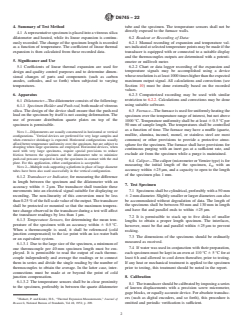
5.1 Coefficients of linear thermal expansion are used for design and quality control purposes and to determine dimensional changes of parts and components (such as carbon anodes, cathodes, and so forth) when subjected to varying temperatures.
SCOPE
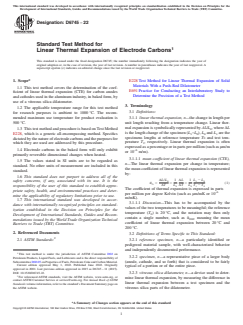
1.1 This test method covers the determination of the coefficient of linear thermal expansion (CTE) for carbon anodes and cathodes used in the aluminum industry, in baked form, by use of a vitreous silica dilatometer.
1.2 The applicable temperature range for this test method for research purposes is ambient to 1000 °C. The recommended maximum use temperature for product evaluation is 500 °C.
1.3 This test method and procedure is based on Test Method E228, which is a generic all-encompassing method. Specifics dictated by the nature of electrode carbons and the purposes for which they are used are addressed by this procedure.
1.4 Electrode carbons in the baked form will only exhibit primarily reversible dimensional changes when heated.
1.5 The values stated in SI units are to be regarded as standard. No other units of measurement are included in this standard.
1.6 This standard does not purport to address all of the safety concerns, if any, associated with its use. It is the responsibility of the user of this standard to establish appropriate safety, health, and environmental practices and determine the applicability of regulatory limitations prior to use.
1.7 This international standard was developed in accordance with internationally recognized principles on standardization established in the Decision on Principles for the Development of International Standards, Guides and Recommendations issued by the World Trade Organization Technical Barriers to Trade (TBT) Committee.
- Status
- Published
- Publication Date
- 30-Apr-2022
- Technical Committee
- D02 - Petroleum Products, Liquid Fuels, and Lubricants
- Drafting Committee
- D02.05 - Properties of Fuels, Petroleum Coke and Carbon Material
Overview
ASTM D6745-22: Standard Test Method for Linear Thermal Expansion of Electrode Carbons is a key standard developed by ASTM International for measuring the coefficient of linear thermal expansion (CTE) in carbon anodes and cathodes, primarily within the aluminum industry. This test method is essential for product design, quality control, and research, enabling accurate assessment of dimensional changes in carbon components exposed to high temperatures. The method utilizes a vitreous silica dilatometer and applies to baked carbon materials in a temperature range from ambient to 1000 °C (for research) and up to 500 °C for product evaluation.
Key Topics
Scope of the Standard
- Focuses on the determination of CTE for carbon anodes and cathodes in baked form, commonly used in aluminum production.
- Employs a vitreous silica dilatometer for precise measurement.
- Applicable for both research (up to 1000 °C) and product evaluation (up to 500 °C).
Significance and Use
- Design and Engineering: Accurate CTE data inform structural and thermal design decisions for components subjected to thermal variations.
- Quality Control: Ensures consistency and reliability in carbon electrode manufacturing.
- Dimensional Stability: Helps in predicting reversible dimensional changes in electrode carbons as operational temperatures fluctuate.
Test Methodology
- Involves continuous recording of expansion as the carbon specimen is subjected to controlled heating.
- Calculation of CTE based on changes in specimen length over specified temperature ranges.
- Emphasizes the use of reference materials for calibration to maintain measurement accuracy.
Precision and Reporting
- Outlines criteria for repeatability and reproducibility to ensure interlaboratory consistency.
- Requires detailed documentation of material properties, test conditions, apparatus, and calibration procedures.
Applications
ASTM D6745-22 is vital wherever precise measurement of thermal expansion in carbon-based materials is required. Major applications include:
- Aluminum Industry: Fundamental for evaluating carbon anodes and cathodes used in electrolytic aluminum production cells.
- Thermal Process Components: Useful for other industries utilizing baked carbon parts that operate under variable thermal conditions.
- Material Science Research: Supports the development of new carbon formulations or the improvement of existing products by providing robust data on thermal expansion behavior.
- Quality Assurance Programs: Underpins supplier specifications, acceptance criteria, and product reliability by standardizing thermal expansion testing.
Benefits:
- Minimizes the risk of component failure due to thermal stresses.
- Facilitates compliance with industry regulations and buyer requirements.
- Enhances product consistency and customer satisfaction.
Related Standards
This standard refers to and complements several other ASTM standards relevant to material testing and measurement:
- ASTM E228 - Test Method for Linear Thermal Expansion of Solid Materials with a Push-Rod Dilatometer: Provides generic procedures for measuring linear expansion, serving as a foundation for D6745-22.
- ASTM E691 - Practice for Conducting an Interlaboratory Study to Determine the Precision of a Test Method: Ensures reliability and statistical validation of test results across laboratories.
- Other Industry Standards:
- Reference materials certified by the National Institute of Standards and Technology (NIST) are often used for calibration and verification of results.
Keywords: ASTM D6745, linear thermal expansion, coefficient of thermal expansion, CTE, electrode carbons, carbon anode, carbon cathode, aluminum industry, dilatometer, thermal expansion testing, material properties, quality control, baked carbon, standard reference material.
By adhering to ASTM D6745-22, organizations can reliably measure and control the linear thermal expansion of electrode carbons, ensuring optimal performance and product integrity in high-temperature applications.
Relations
- Effective Date
- 01-Sep-2016
- Effective Date
- 01-May-2013
- Effective Date
- 01-Nov-2011
- Effective Date
- 01-Oct-2008
- Effective Date
- 01-Sep-2006
- Effective Date
- 01-Nov-2005
- Effective Date
- 10-May-1999
- Effective Date
- 01-Jan-1995
Get Certified
Connect with accredited certification bodies for this standard

IMP NDT d.o.o.
Non-destructive testing services. Radiography, ultrasonic, magnetic particle, penetrant, visual inspection.
Inštitut za kovinske materiale in tehnologije
Institute of Metals and Technology. Materials testing, metallurgical analysis, NDT.
Q Techna d.o.o.
NDT and quality assurance specialist. 30+ years experience. NDT personnel certification per ISO 9712, nuclear and thermal power plant inspections, QA/
Sponsored listings
Frequently Asked Questions
ASTM D6745-22 is a standard published by ASTM International. Its full title is "Standard Test Method for Linear Thermal Expansion of Electrode Carbons". This standard covers: SIGNIFICANCE AND USE 5.1 Coefficients of linear thermal expansion are used for design and quality control purposes and to determine dimensional changes of parts and components (such as carbon anodes, cathodes, and so forth) when subjected to varying temperatures. SCOPE 1.1 This test method covers the determination of the coefficient of linear thermal expansion (CTE) for carbon anodes and cathodes used in the aluminum industry, in baked form, by use of a vitreous silica dilatometer. 1.2 The applicable temperature range for this test method for research purposes is ambient to 1000 °C. The recommended maximum use temperature for product evaluation is 500 °C. 1.3 This test method and procedure is based on Test Method E228, which is a generic all-encompassing method. Specifics dictated by the nature of electrode carbons and the purposes for which they are used are addressed by this procedure. 1.4 Electrode carbons in the baked form will only exhibit primarily reversible dimensional changes when heated. 1.5 The values stated in SI units are to be regarded as standard. No other units of measurement are included in this standard. 1.6 This standard does not purport to address all of the safety concerns, if any, associated with its use. It is the responsibility of the user of this standard to establish appropriate safety, health, and environmental practices and determine the applicability of regulatory limitations prior to use. 1.7 This international standard was developed in accordance with internationally recognized principles on standardization established in the Decision on Principles for the Development of International Standards, Guides and Recommendations issued by the World Trade Organization Technical Barriers to Trade (TBT) Committee.
SIGNIFICANCE AND USE 5.1 Coefficients of linear thermal expansion are used for design and quality control purposes and to determine dimensional changes of parts and components (such as carbon anodes, cathodes, and so forth) when subjected to varying temperatures. SCOPE 1.1 This test method covers the determination of the coefficient of linear thermal expansion (CTE) for carbon anodes and cathodes used in the aluminum industry, in baked form, by use of a vitreous silica dilatometer. 1.2 The applicable temperature range for this test method for research purposes is ambient to 1000 °C. The recommended maximum use temperature for product evaluation is 500 °C. 1.3 This test method and procedure is based on Test Method E228, which is a generic all-encompassing method. Specifics dictated by the nature of electrode carbons and the purposes for which they are used are addressed by this procedure. 1.4 Electrode carbons in the baked form will only exhibit primarily reversible dimensional changes when heated. 1.5 The values stated in SI units are to be regarded as standard. No other units of measurement are included in this standard. 1.6 This standard does not purport to address all of the safety concerns, if any, associated with its use. It is the responsibility of the user of this standard to establish appropriate safety, health, and environmental practices and determine the applicability of regulatory limitations prior to use. 1.7 This international standard was developed in accordance with internationally recognized principles on standardization established in the Decision on Principles for the Development of International Standards, Guides and Recommendations issued by the World Trade Organization Technical Barriers to Trade (TBT) Committee.
ASTM D6745-22 is classified under the following ICS (International Classification for Standards) categories: 19.060 - Mechanical testing. The ICS classification helps identify the subject area and facilitates finding related standards.
ASTM D6745-22 has the following relationships with other standards: It is inter standard links to ASTM E228-11(2016), ASTM E691-13, ASTM E691-11, ASTM E691-08, ASTM E228-06, ASTM E691-05, ASTM E691-99, ASTM E228-95. Understanding these relationships helps ensure you are using the most current and applicable version of the standard.
ASTM D6745-22 is available in PDF format for immediate download after purchase. The document can be added to your cart and obtained through the secure checkout process. Digital delivery ensures instant access to the complete standard document.
Standards Content (Sample)
This international standard was developed in accordance with internationally recognized principles on standardization established in the Decision on Principles for the
Development of International Standards, Guides and Recommendations issued by the World Trade Organization Technical Barriers to Trade (TBT) Committee.
Designation: D6745 − 22
Standard Test Method for
Linear Thermal Expansion of Electrode Carbons
This standard is issued under the fixed designation D6745; the number immediately following the designation indicates the year of
original adoption or, in the case of revision, the year of last revision.Anumber in parentheses indicates the year of last reapproval.A
superscript epsilon (´) indicates an editorial change since the last revision or reapproval.
1. Scope* E228Test Method for Linear Thermal Expansion of Solid
Materials With a Push-Rod Dilatometer
1.1 This test method covers the determination of the coef-
E691Practice for Conducting an Interlaboratory Study to
ficient of linear thermal expansion (CTE) for carbon anodes
Determine the Precision of a Test Method
andcathodesusedinthealuminumindustry,inbakedform,by
use of a vitreous silica dilatometer.
3. Terminology
1.2 The applicable temperature range for this test method
3.1 Definitions:
for research purposes is ambient to 1000°C. The recom-
mended maximum use temperature for product evaluation is
3.1.1 linear thermal expansion, n—the change in length per
500°C. unit length resulting from a temperature change. Linear ther-
malexpansionissymbolicallyrepresentedby∆L/L ,where∆L
1.3 ThistestmethodandprocedureisbasedonTestMethod
isthelengthchangeofthespecimen(L −L ), L and L arethe
1 0 0 1
E228, which is a generic all-encompassing method. Specifics
specimens lengths at reference temperature T and test tem-
dictatedbythenatureofelectrodecarbonsandthepurposesfor 0
perature T , respectively. Linear thermal expansion is often
which they are used are addressed by this procedure. 1
expressedasapercentageorinpartspermillion(suchasµm/m
1.4 Electrode carbons in the baked form will only exhibit
–6
or 10 m/m).
primarily reversible dimensional changes when heated.
3.1.1.1 mean coeffıcient of linear thermal expansion (CTE),
1.5 The values stated in SI units are to be regarded as
n—The linear thermal expansion per change in temperature;
standard. No other units of measurement are included in this
the mean coefficient of linear thermal expansion is represented
standard.
by:
1.6 This standard does not purport to address all of the
∆L/L 1 ∆L 1 L 2 L
safety concerns, if any, associated with its use. It is the 0 1 0
α¯ 5 5 · 5 (1)
T
∆T L ∆T L T 2 T
responsibility of the user of this standard to establish appro- 0 0 1 0
The coefficient of thermal expansion is expressed in parts
priate safety, health, and environmental practices and deter-
–6
per million per degree Kelvin (such as µm/mK or 10
mine the applicability of regulatory limitations prior to use.
m/mK).
1.7 This international standard was developed in accor-
3.1.1.1 Discussion—This has to be accompanied by the
dance with internationally recognized principles on standard-
values of the two temperatures to be meaningful; the reference
ization established in the Decision on Principles for the
temperature (T ) is 20°C, and the notation may then only
Development of International Standards, Guides and Recom-
contain a single number, such as α¯ , meaning the mean
mendations issued by the World Trade Organization Technical
coefficient of linear thermal expansion between 20°C and
Barriers to Trade (TBT) Committee.
200°C.
2. Referenced Documents
3.2 Definitions of Terms Specific to This Standard:
2.1 ASTM Standards: 3.2.1 reference specimen, n—a particularly identified or
pedigreed material sample, with well-characterized behavior
and independently documented performance.
This test method is under the jurisdiction of ASTM Committee D02 on
3.2.2 specimen, n—a representative piece of a larger body
Petroleum Products, Liquid Fuels, and Lubricants and is the direct responsibility of
SubcommitteeD02.05onPropertiesofFuels,PetroleumCokeandCarbonMaterial. (anode, cathode, and so forth) that is considered to be fairly
Current edition approved May 1, 2022. Published June 2022. Originally
typical of a portion or of the entire piece.
approved in 2001. Last previous edition approved in 2015 as D6745–11 (2015).
DOI: 10.1520/D6745-22.
3.2.3 vitreous silica dilatometer, n—a device used to deter-
For referenced ASTM standards, visit the ASTM website, www.astm.org, or
mine linear thermal expansion, by measuring the difference in
contact ASTM Customer Service at service@astm.org. For Annual Book of ASTM
linear thermal expansion between a test specimen and the
Standards volume information, refer to the standard’s Document Summary page on
the ASTM website. vitreous silica parts of the dilatometer.
*A Summary of Changes section appears at the end of this standard
Copyright © ASTM International, 100 Barr Harbor Drive, PO Box C700, West Conshohocken, PA 19428-2959. United States
D6745 − 22
4. Summary of Test Method tube and the specimen. The temperature sensors shall not be
directly exposed to the furnace walls.
4.1 Arepresentativespecimenisplacedintoavitreoussilica
dilatometer and heated, while its linear expansion is continu- 6.2 Readout or Recording of Data:
ously recorded.The change of the specimen length is recorded 6.2.1 Manual recording of expansion and temperature val-
as a function of temperature. The coefficient of linear thermal uesindicatedatselectedtemperaturepointsmaybemadeifthe
expansion is then calculated from these recorded data. transducer is equipped with or connected to a suitable display
and the thermocouples outputs are determined with a potenti-
5. Significance and Use
ometer or millivolt meter.
6.2.2 Chart or data logger recording of the expansion and
5.1 Coefficients of linear thermal expansion are used for
temperature signals may be accomplished using a device
design and quality control purposes and to determine dimen-
whoseresolutionisatleast1000timeshigherthantheexpected
sional changes of parts and components (such as carbon
maximum output signal. All calculations and corrections (see
anodes, cathodes, and so forth) when subjected to varying
Section 10) must be done externally based on the recorded
temperatures.
values.
6. Apparatus
6.2.3 Computerized recording may be used with similar
restriction to 6.2.2. Calculations and corrections may be done
6.1 Dilatometer—Thedilatometerconsistsofthefollowing:
using suitable software.
6.1.1 Specimen Holder and Push-rod,bothmadeofvitreous
silica. The design of the device shall ensure that the push-rod
6.3 Furnace—The furnace is used for uniformly heating the
load on the specimen by itself is not causing deformation. The
specimen over the temperature range of interest, but not above
use of pressure distribution quartz plates on top of the
1000°C.Temperatureuniformityshallbeatleast 60.5°Cper
specimen is permissible.
50mm of sample length. The temperatures shall be controlled
as a function of time. The furnace may have a muffle (quartz,
NOTE 1—Dilatometers are usually constructed in horizontal or vertical
mullite, alumina, inconel, monel, or stainless steel are most
configurations. Vertical devices are preferred for very large samples and
when extensive shrinkage is expected. Horizontal configurations usually common) or other provisions to provide a protective atmo-
afford better temperature uniformity over the specimen, but are subject to
sphere for the specimen. The furnace shall have provisions for
drooping when large specimens are employed. Horizontal devices, when
continuous purging with an inert gas at a sufficient rate, and
used with very large specimens, require special provisions to reduce
exclude air from the specimen while a purge is maintained.
friction between the specimen and the dilatometer tube to minimize
push-rod pressure required to keep the specimen in contact with the end
6.4 Caliper—Thecaliper(micrometerorVerniertype)isfor
plate. For this application, either configuration is acceptable.
measuring the initial length of the specimen, L , with an
NOTE2—Multiplerodssupportingaplatforminplaceoflargediameter
accuracy within 625µm, and a capacity to open to the length
tubes have been also used successfully in the vertical configuration.
of the specimen plus 1mm.
6.1.2 Transducer or Indicator, for measuring the difference
in length between the specimen and the dilatometer with an
7. Test Specimen
accuracy within 6 2µm. The transducer shall translate these
7.1 Specimensshallbecylindrical,preferablywitha50mm
movements into an electrical signal suitable for displaying or
62mmdiameter.Slightlysmallerorlargerdiameterscanalso
recording. The non-linearity of this conversion must be less
be accommodated without degradation of data. The length of
than0.25%ofthefullscalevalueoftheoutput.Thetransducer
the specimens shall be between 50mm and 130mm in length
shall be protected or mounted so that the maximum tempera-
and have flat and parallel ends to within 625µm.
ture change observed in the transducer during a test will affect
the transducer readings by less than 1µm.
7.2 It is permissible to stack up to five disks of smaller
6.1.3 Temperature Sensors, for determining the mean tem-
lengths to obtain a proper length specimen. The interfaces,
perature of the specimen with an accuracy within 6 0.5°C.
however, must be flat and parallel within 625µm to prevent
When a thermocouple is used, it shall be referenced (cold
rocking.
junction compensated) to the ice point with an ice-water bath
7.3 The dimensions of the specimens should be ordinarily
or an equivalent system.
measured as received.
6.1.3.1 Duetothelargesizeofthespecimen,aminimumof
7.4 If water was used in conjunction with their preparation,
one thermocouple per 40mm specimen length must be em-
eachspecimenmustbekeptinanovenat110°C 65°Cforat
ployed. It is permissible to read the output of each thermo-
least 6h and allowed to cool down thereafter, prior to testing.
couple independently and average the readings or to connect
them in series and divide the single reading by the number of If any heat or mechanical treatment is applied to the specimen
prior to testing, this treatment should be noted in the report.
thermocouples to obtain the average. In the latter case, inter-
connections must be made at or beyond the point of cold
junction compensation. 8. Calibration
6.1.3.2 The temperature sensors shall be in close proximity
8.1 Thetransducershouldbecalibratedbyimposingaseries
to the specimen, preferably in between the quartz dilatometer
of known displacements with a precision screw micrometer,
gageblocks,orequallyaccuratedevice.Forabsolutetransduc-
ers (such as digital encoders, and so forth), this procedure is
Hidnert, P. and Krider, H.S., “Thermal Expansion Measurements,” Journal of
Research, National Bureau of Standards, Vol 48, 1952, p. 209. omitted and periodic verification is sufficient.
D6745 − 22
8.2 Verificationofthecalibrationofthetemperaturesensors readilyavailableintheliterature;forexample,platinum.These
separately from the dilatometer is to be performed periodically materials are well suited for round-robin, day-to-day verifica-
or when contamination of the junction is suspected. tion (working reference) of equipment performance and peri-
odic verification programs. Purity and physical parameters
8.3 Regardlessofindependentcalibrationsofthetransducer
(density, electrical resistivity, and so forth) must be reasonably
and the thermocouples, the dilatometer, as a total system, shall
matched to use literature data.
be calibrated by determining the thermal expansion of at least
8.6.4 Characterized Private Stock Materials—These are
one reference material of known thermal expansion. Recom-
substances that are mainly used for in-house verifications.
mended reference materials are listed in Annex A1.
Even though they may be thought of as being well
8.3.1 The calibration should be done using approximately
characterized, the data is primarily self consistent. If such a
the same thermal cycle as that used for testing (see 9.7 and
material is found to be very stable by independent tests, it may
9.8).
be used in round-robin tests, but caution should be exercised
8.3.2 The calibration constant may be derived as follows:
when the data is intended to arbitrate disputes or differences
∆L ∆L
between facilities. Typical use should be limited to that of an
A 5 2 (2)
S D S D
L L
0 t 0 m
in-house working reference. Primary reason for use is having
thermal characteristics closely resembling those of actual test
where:
specimens.
m = measured expansion of the reference material, and
t = true or certified expansion of the reference material.
9. Procedure
8.4 Ifthecalibrationspecimenisconsiderablysmallerinthe
9.1 Measure the initial (room temperature) length of the
cross section than the specimen, it is necessary to provide a
specimen, and record it as L .
thermaljacketaroundittopreventerrorscausedbyconvective 0
currents. A thermal jacket may be produced by drilling a hole
9.2 Place the specimen into the dilatometer after making
in the axis of a carbon specimen and loosely fitting the
certain that all contacting surfaces are free of foreign material.
calibration specimen into it. The carbon jacket must be about
It is important to have good seating of the specimen in a stable
1mm shorter than the calibration specimen.
position. (Warning—Alkali contamination will adversely af-
fect fused silica parts. Avoid touching them with hands.)
8.5 The published values of thermal expansion for quartz
maynotbeusedtocomputeacorrectionfactor.Accountingfor
9.3 Ensure that the temperature sensors shall not restrict
the expansion of the dilatometer parts through calculations in
movement of the specimen in the dilatometer. Do not allow an
place of the calibration procedure described above is not
exposed junction to contact any carbonaceous materials.
permitted.
9.4 Make certain that the push-rod is in stable contact with
8.6 Materials usable for calibration or verification of opera-
thespecimen.Apressuredistributionplatemadeoffusedsilica
tion fall into four categories.
may be used between the push-rod and the specimen.
8.6.1 Standard Reference Materials—These are actual
9.5 Insert the loaded dilatometer into the furnace (at ambi-
specimens supplied with a certificate by NIST, or a similar
ent temperature) and allow the temperature of the specimen to
5,6
national standards organization of another country
...
This document is not an ASTM standard and is intended only to provide the user of an ASTM standard an indication of what changes have been made to the previous version. Because
it may not be technically possible to adequately depict all changes accurately, ASTM recommends that users consult prior editions as appropriate. In all cases only the current version
of the standard as published by ASTM is to be considered the official document.
Designation: D6745 − 11 (Reapproved 2015) D6745 − 22
Standard Test Method for
Linear Thermal Expansion of Electrode Carbons
This standard is issued under the fixed designation D6745; the number immediately following the designation indicates the year of
original adoption or, in the case of revision, the year of last revision. A number in parentheses indicates the year of last reapproval. A
superscript epsilon (´) indicates an editorial change since the last revision or reapproval.
1. Scope Scope*
1.1 This test method covers the determination of the coefficient of linear thermal expansion (CTE) for carbon anodes and cathodes
used in the aluminum industry, in baked form, by use of a vitreous silica dilatometer.
1.2 The applicable temperature range for this test method for research purposes is ambient to 1000 °C. The recommended
maximum use temperature for product evaluation is 500 °C.
1.3 This test method and procedure is based on Test Method E228, which is a generic all-encompassing method. Specifics dictated
by the nature of electrode carbons and the purposes for which they are used are addressed by this procedure.
1.4 Electrode carbons in the baked form will only exhibit primarily reversible dimensional changes when heated.
1.5 The values stated in SI units are to be regarded as standard. No other units of measurement are included in this standard.
1.6 This standard does not purport to address all of the safety concerns, if any, associated with its use. It is the responsibility
of the user of this standard to establish appropriate safety safety, health, and healthenvironmental practices and determine the
applicability of regulatory limitations prior to use.
1.7 This international standard was developed in accordance with internationally recognized principles on standardization
established in the Decision on Principles for the Development of International Standards, Guides and Recommendations issued
by the World Trade Organization Technical Barriers to Trade (TBT) Committee.
2. Referenced Documents
2.1 ASTM Standards:
E228 Test Method for Linear Thermal Expansion of Solid Materials With a Push-Rod Dilatometer
E691 Practice for Conducting an Interlaboratory Study to Determine the Precision of a Test Method
3. Terminology
3.1 Definitions:
3.1.1 linear thermal expansion, n—the change in length per unit length resulting from a temperature change. Linear thermal
expansion is symbolically represented by ΔL/ΔL/L , where ΔL is the length change of the specimen (L −L ), L and L are the
0 1 0 0 1
This test method is under the jurisdiction of ASTM Committee D02 on Petroleum Products, Liquid Fuels, and Lubricants and is the direct responsibility of Subcommittee
D02.05 on Properties of Fuels, Petroleum Coke and Carbon Material.
Current edition approved Oct. 1, 2015May 1, 2022. Published December 2015June 2022. Originally approved in 2001. Last previous edition approved in 20112015 as
D6745 – 11.D6745 – 11 (2015). DOI: 10.1520/D6745-11R15.10.1520/D6745-22.
For referenced ASTM standards, visit the ASTM website, www.astm.org, or contact ASTM Customer Service at service@astm.org. For Annual Book of ASTM Standards
volume information, refer to the standard’s Document Summary page on the ASTM website.
*A Summary of Changes section appears at the end of this standard
Copyright © ASTM International, 100 Barr Harbor Drive, PO Box C700, West Conshohocken, PA 19428-2959. United States
D6745 − 22
specimens lengths at reference temperature T and test temperature T , respectively. Linear thermal expansion is often expressed
0 1
–6
as a percentage or in parts per million (such as μm/m). μm/m or 10 m/m).
3.1.1.1 mean coeffıcient of linear thermal expansion (CTE), n—The linear thermal expansion per change in temperature; the
mean coefficient of linear thermal expansion is represented by:
ΔL/L 1 ΔL 1 L 2 L
0 1 0
¯
α 5 5 · 5 (1)
T
ΔT L ΔT L T 2 T
0 0 1 0
–6
The coefficient of thermal expansion is expressed in parts per million per degree Kelvin (such as μm/mK or 10 m/mK).
3.1.1.1 Discussion—
This has to be accompanied by the values of the two temperatures to be meaningful; the reference temperature (T ) is 20 °C, and
the notation may then only contain a single number, such as α¯ , meaning the mean coefficient of linear thermal expansion
between 20 °C and 200 °C.
3.2 Definitions of Terms Specific to This Standard:
3.2.1 reference specimen, n—a particularly identified or pedigreed material sample, with well-characterized behavior and
independently documented performance.
3.2.2 specimen, n—a representative piece of a larger body (anode, cathode, and so forth) that is considered to be fairly typical of
a portion or of the entire piece.
3.2.3 vitreous silica dilatometer, n—a device used to determine linear thermal expansion, by measuring the difference in linear
thermal expansion between a test specimen and the vitreous silica parts of the dilatometer.
4. Summary of Test Method
4.1 A representative specimen is placed into a vitreous silica dilatometer and heated, while its linear expansion is continuously
recorded. The change of the specimen length is recorded as a function of temperature. The coefficient of linear thermal expansion
is then calculated from these recorded data.
5. Significance and Use
5.1 Coefficients of linear thermal expansion are used for design and quality control purposes and to determine dimensional
changes of parts and components (such as carbon anodes, cathodes, and so forth) when subjected to varying temperatures.
6. Apparatus
6.1 Dilatometer—The dilatometer consists of the following:
6.1.1 Specimen Holder and Push-rod, both made of vitreous silica. The design of the device shall ensure that the push-rod load
on the specimen by itself is not causing deformation. The use of pressure distribution quartz plates on top of the specimen is
permissible.
NOTE 1—Dilatometers are usually constructed in horizontal or vertical configurations. Vertical devices are preferred for very large samples and when
extensive shrinkage is expected. Horizontal configurations usually afford better temperature uniformity over the specimen, but are subject to drooping
when large specimens are employed. Horizontal devices, when used with very large specimens, require special provisions to reduce friction between the
specimen and the dilatometer tube to minimize push-rod pressure required to keep the specimen in contact with the end plate. For this application, either
configuration is acceptable.
NOTE 2—Multiple rods supporting a platform in place of large diameter tubes have been also used successfully in the vertical configuration.
6.1.2 Transducer or Indicator, for measuring the difference in length between the specimen and the dilatometer with an accuracy
within 6 2 μm. The transducer shall translate these movements into an electrical signal suitable for displaying or recording. The
non-linearity of this conversion must be less than 0.25 % of the full scale value of the output. The transducer shall be protected
or mounted so that the maximum temperature change observed in the transducer during a test will affect the transducer readings
by less than 1 μm.
Hidnert, P. and Krider, H.S., “Thermal Expansion Measurements,” Journal of Research, National Bureau of Standards, Vol 48, 1952, p. 209.
D6745 − 22
6.1.3 Temperature Sensors, for determining the mean temperature of the specimen with an accuracy within 6 0.5 °C. When a
thermocouple is used, it shall be referenced (cold junction compensated) to the ice point with an ice-water bath or an equivalent
system.
6.1.3.1 Due to the large size of the specimen, a minimum of one thermocouple per 40 mm specimen length must be employed.
It is permissible to read the output of each thermocouple independently and average the readings or to connect them in series and
divide the single reading by the number of thermocouples to obtain the average. In the latter case, interconnections must be made
at or beyond the point of cold junction compensation.
6.1.3.2 The temperature sensors shall be in close proximity to the specimen, preferably in between the quartz dilatometer tube and
the specimen. The temperature sensors shall not be directly exposed to the furnace walls.
6.2 Readout or Recording of Data:
6.2.1 Manual recording of expansion and temperature values indicated at selected temperature points may be made if the
transducer is equipped with or connected to a suitable display and the thermocouples outputs are determined with a potentiometer
or millivolt meter.
6.2.2 Chart or data logger recording of the expansion and temperature signals may be accomplished using a device whose
resolution is at least 1000 times higher than the expected maximum output signal. All calculations and corrections (see Section 10)
must be done externally based on the recorded values.
6.2.3 Computerized recording may be used with similar restriction to 6.2.2. Calculations and corrections may be done using
suitable software.
6.3 Furnace—The furnace is used for uniformly heating the specimen over the temperature range of interest, but not above
1000 °C. Temperature uniformity shall be at least 6 0.5 °C per 50 mm of sample length. The temperatures shall be controlled as
a function of time. The furnace may have a muffle (quartz, mullite, alumina, inconel, monel, or stainless steel are most common)
or other provisions to provide a protective atmosphere for the specimen. The furnace shall have provisions for continuous purging
with an inert gas at a sufficient rate, and exclude air from the specimen while a purge is maintained.
6.4 Caliper—The caliper (micrometer or Vernier type) is for measuring the initial length of the specimen, L , with an accuracy
within 625 μm, and a capacity to open to the length of the specimen plus 1 mm.
7. Test Specimen
7.1 Specimens shall be cylindrical, preferably with a 50 mm 6 2 mm diameter. Slightly smaller or larger diameters can also be
accommodated without degradation of data. The length of the specimens shall be between 50 mm and 130 mm in length and have
flat and parallel ends to within 625 μm.
7.2 It is permissible to stack up to five disks of smaller lengths to obtain a proper length specimen. The interfaces, however, must
be flat and parallel within 625 μm to prevent rocking.
7.3 The dimensions of the specimens should be ordinarily measured as received.
7.4 If water was used in conjunction with their preparation, each specimen must be kept in an oven at 110 °C 6 5 °C for at least
6 h and allowed to cool down thereafter, prior to testing. If any heat or mechanical treatment is applied to the specimen prior to
testing, this treatment should be noted in the report.
8. Calibration
8.1 The transducer should be calibrated by imposing a series of known displacements with a precision screw micrometer, gage
blocks, or equally accurate device. For absolute transducers (such as digital encoders, and so forth), this procedure is omitted and
periodic verification is sufficient.
D6745 − 22
8.2 Verification of the calibration of the temperature sensors separately from the dilatometer is to be performed periodically or
when contamination of the junction is suspected.
8.3 Regardless of independent calibrations of the transducer and the thermocouples, the dilatometer, as a total system, shall be
calibrated by determining the thermal expansion of at least one reference material of known thermal expansion. Recommended
reference materials are listed in Annex A1.
8.3.1 The calibration should be done using approximately the same thermal cycle as that used for testing (see 9.7 and 9.8).
8.3.2 The calibration constant may be derived as follows:
ΔL ΔL
A 5 2 (2)
S D S D
L L
0 t 0 m
where:
m = measured expansion of the reference material, and
t = true or certified expansion of the reference material.
8.4 If the calibration specimen is considerably smaller in the cross section than the specimen, it is necessary to provide a thermal
jacket around it to prevent errors caused by convective currents. A thermal jacket may be produced by drilling a hole in the axis
of a carbon specimen and loosely fitting the calibration specimen into it. The carbon jacket must be about 1 mm 1 mm shorter than
the calibration specimen.
8.5 The use of published values of thermal expansion for quartz may not be used to compute a correction factor. Accounting for
the expansion of the dilatometer parts through calculations in place of athe calibration procedure described above is not permitted.
8.6 Materials usable for calibration or verification of operation fall into four categories.
8.6.1 Standard Reference Materials—These are actual specimens supplied with a certificate by NIST, or a similar national
5,6
standards organization of another country.
NOTE 3—These materials are very few and NIST supplies have been exhausted in some cases. To determine the absolute accuracy of a device, materials
in this category are the most preferred.
8.6.2 Traceable Reference Materials—These are extensively investigated materials, substantially described in published literature
and considered stable. Often they are generically identical to Standard Reference Materials. Specific lots when tested in a
systematic fashion using a dilatometer calibrated with a certified Standard Reference Material can be referred to as Traceable
Reference Materials. They may also serve well in comparing equipment or test procedures at different laboratories and to arbitrate
disputes and differences.
8.6.3 Reference Materials—These are widely investigated, well-characterized materials that were found to be stable with time and
temperature exposure and performance data are readily available in the literature; for example, platinum. These materials are well
suited for round-robin, day-to-day verification (working reference) of equipment performance and periodic verification programs.
Purity and physical parameters (density, electrical resistivity, and so forth) must be reasonably matched to use literature data.
8.6.4 Characterized Private Stock Materials—These are substances that are mainly used for in-house verifications. Even though
they may be thought of as being well characterized, the data is primarily self consistent. If such a material is found to be very stable
by independent tests, it may be used in round-robin tests, but caution should be exercised when the data is intended to arbitrate
disputes or differences between facilities. Typical use should be limited to that of an in-house working reference. Primary reason
for use is having thermal characteristics closely resembling those of actual test specimens.
National Institute of Standards and Technology (formerly the National Bureau of Standards, Gaithersburg, MD 20899-0001.
Standard Reference Materials SRM731 and SRM720, National Institute of Standards and Technology, (certific
...