

ASTM C877M-21
(Specification)Standard Specification for External Sealing Bands for Concrete Pipe, Manholes, and Precast Box Sections (Metric)
General Information
- Abstract
ABSTRACT
This specification deals with the metric standard for three types of external sealing bands to be used in conjunction with concrete pipe, manholes, and precast box sections. The first type of bands shall be composed of rubber, mastic, and protective film elements, while the second type shall consist of a plastic film, reinforced, rubberized, asphalt, mastic coating with steel straps. The third type shall be composed of a backing band, an applied continuous butyl adhesive coating and an optional release element. All the elements of each type of sealing band shall have physical properties conforming with specified limits as determined through appropriate test methods herein provided.
SCOPE
1.1 This specification covers external sealing bands to be used in conjunction with concrete pipe as defined in Terminology C822 and conforming to Specifications C14M, C76M, C412M, C478/C478M, C506M, C507M, C655M, C985M, C1417M, and C1433M.
1.1.1 Type I, Rubber and Mastic Bands.
1.1.2 Type II, Plastic Film and Mesh Reinforced Mastic Bands.
1.1.3 Type III, Chemically Bonded Adhesive Butyl Bands.
1.2 This specification is the metric counterpart of Specification C877.
Note 1: This specification covers only the design and material of the sealing bands. Sealing bands covered by this specification are adequate, when properly installed, for external hydrostatic pressures up to 90 kPa, (9.14 m) without leakage. The amount of infiltration or exfiltration flow in an installed pipeline is dependent upon many factors other than the sealing bands; allowable quantities and suitable testing of the installed pipeline and system must be covered by other specifications.
1.3 This international standard was developed in accordance with internationally recognized principles on standardization established in the Decision on Principles for the Development of International Standards, Guides and Recommendations issued by the World Trade Organization Technical Barriers to Trade (TBT) Committee.
- Status
- Published
- Publication Date
- 14-Jan-2021
- Technical Committee
- C13 - Concrete Pipe
- Drafting Committee
- C13.08 - Joints for Precast Concrete Structures
Buy Documents
ASTM C877M-21 - Standard Specification for External Sealing Bands for Concrete Pipe, Manholes, and Precast Box Sections (Metric)
REDLINE ASTM C877M-21 - Standard Specification for External Sealing Bands for Concrete Pipe, Manholes, and Precast Box Sections (Metric)
Overview
ASTM C877M-21 is the internationally recognized standard specification for external sealing bands for use with concrete pipe, manholes, and precast box sections, presented in metric units. Developed by ASTM International, this specification defines three types of external sealing bands, specifying their materials, design, and minimum physical requirements. The standard ensures the effectiveness of joints by providing guidelines for sealing bands that enhance watertightness and durability, making it critical to infrastructure projects involving underground utility systems.
Key Topics
- Types of External Sealing Bands:
The standard details three main types:- Type I: Rubber and mastic bands
- Type II: Plastic film and mesh-reinforced mastic bands
- Type III: Chemically bonded adhesive butyl bands
- Material Specifications:
Each band type requires specific materials such as rubber, mastic, plastic films, mesh reinforcement, and butyl adhesive, with strict physical properties for strength, elongation, and durability. - Performance Requirements:
Sealing bands covered by ASTM C877M-21 are designed to withstand external hydrostatic pressures up to 90 kPa when properly installed, ensuring effective sealing without leakage. - Dimensional Guidelines:
The standard specifies minimum widths, thicknesses, and overlap requirements according to the pipe's diameter and type of sealing band. - Testing and Inspection:
Bands must pass defined test methods related to tensile strength, hardness, water absorption, aging, adhesion, and more to demonstrate compliance with quality criteria.
Applications
ASTM C877M-21 applies to a wide range of construction and civil engineering projects involving concrete pipelines and associated precast structures. Practical uses include:
- Municipal stormwater and sewage systems
- Road and highway culverts
- Precast box culverts and drainage structures
- Underground utility installations
- Infrastructure upgrades requiring watertight pipe joints
External sealing bands specified by this standard provide effective protection against infiltration and exfiltration, contributing to the long-term performance and environmental safety of underground systems. By adhering to ASTM C877M-21, project stakeholders ensure durable, quality joints that minimize maintenance and operational risks.
Related Standards
For comprehensive compliance and integration, ASTM C877M-21 references and aligns with several related ASTM specifications and test methods, such as:
- Concrete Pipe Specifications:
- ASTM C14M: Nonreinforced Concrete Sewer, Storm Drain, and Culvert Pipe
- ASTM C76M: Reinforced Concrete Culvert and Sewer Pipe
- ASTM C478M: Precast Reinforced Concrete Manhole Sections
- ASTM C506M, C507M, C655M, C985M, C1417M, C1433M: Various other concrete pipe and box culvert standards
- Material and Performance Test Methods:
- ASTM D412: Tensile Properties of Rubber
- ASTM D2240: Durometer Hardness
- ASTM D882: Tensile Properties of Thin Plastic Sheeting
- ASTM D903: Peel/Adhesion Strength of Adhesive Bonds
- Others covering water absorption, compression set, volatility, and more
Referencing these supporting standards ensures all sealing band elements meet the necessary mechanical and chemical properties, vital for reliable performance in concrete infrastructure.
Summary
ASTM C877M-21 delivers a robust framework for specifying, testing, and applying external sealing bands for concrete pipes and precast structures in metric units. Its clear definitions and requirements enable engineers, manufacturers, and contractors to achieve secure, leak-resistant joints in municipal and industrial infrastructure, supporting resilient, long-lasting construction outcomes. For optimal effectiveness, compliance should be paired with applicable system and pipeline testing standards.
Relations
- Effective Date
- 01-May-2020
- Effective Date
- 01-May-2020
- Effective Date
- 01-Dec-2019
- Effective Date
- 15-Jul-2019
- Effective Date
- 15-Jul-2019
- Effective Date
- 15-Jul-2019
- Effective Date
- 01-Jul-2019
- Effective Date
- 01-Jul-2019
- Effective Date
- 01-Jul-2019
- Effective Date
- 01-Jul-2019
- Effective Date
- 01-Jul-2019
- Effective Date
- 01-May-2019
- Effective Date
- 01-May-2019
- Effective Date
- 01-Jan-2019
- Effective Date
- 01-Oct-2018
Buy Documents
ASTM C877M-21 - Standard Specification for External Sealing Bands for Concrete Pipe, Manholes, and Precast Box Sections (Metric)
REDLINE ASTM C877M-21 - Standard Specification for External Sealing Bands for Concrete Pipe, Manholes, and Precast Box Sections (Metric)
Get Certified
Connect with accredited certification bodies for this standard

Institut za varilstvo d.o.o. (Welding Institute)
Slovenia's leading welding institute since 1952. ISO 3834, EN 1090, pressure equipment certification, NDT personnel, welder qualification. Only IIW Au
Sponsored listings
Frequently Asked Questions
ASTM C877M-21 is a technical specification published by ASTM International. Its full title is "Standard Specification for External Sealing Bands for Concrete Pipe, Manholes, and Precast Box Sections (Metric)". This standard covers: ABSTRACT This specification deals with the metric standard for three types of external sealing bands to be used in conjunction with concrete pipe, manholes, and precast box sections. The first type of bands shall be composed of rubber, mastic, and protective film elements, while the second type shall consist of a plastic film, reinforced, rubberized, asphalt, mastic coating with steel straps. The third type shall be composed of a backing band, an applied continuous butyl adhesive coating and an optional release element. All the elements of each type of sealing band shall have physical properties conforming with specified limits as determined through appropriate test methods herein provided. SCOPE 1.1 This specification covers external sealing bands to be used in conjunction with concrete pipe as defined in Terminology C822 and conforming to Specifications C14M, C76M, C412M, C478/C478M, C506M, C507M, C655M, C985M, C1417M, and C1433M. 1.1.1 Type I, Rubber and Mastic Bands. 1.1.2 Type II, Plastic Film and Mesh Reinforced Mastic Bands. 1.1.3 Type III, Chemically Bonded Adhesive Butyl Bands. 1.2 This specification is the metric counterpart of Specification C877. Note 1: This specification covers only the design and material of the sealing bands. Sealing bands covered by this specification are adequate, when properly installed, for external hydrostatic pressures up to 90 kPa, (9.14 m) without leakage. The amount of infiltration or exfiltration flow in an installed pipeline is dependent upon many factors other than the sealing bands; allowable quantities and suitable testing of the installed pipeline and system must be covered by other specifications. 1.3 This international standard was developed in accordance with internationally recognized principles on standardization established in the Decision on Principles for the Development of International Standards, Guides and Recommendations issued by the World Trade Organization Technical Barriers to Trade (TBT) Committee.
ABSTRACT This specification deals with the metric standard for three types of external sealing bands to be used in conjunction with concrete pipe, manholes, and precast box sections. The first type of bands shall be composed of rubber, mastic, and protective film elements, while the second type shall consist of a plastic film, reinforced, rubberized, asphalt, mastic coating with steel straps. The third type shall be composed of a backing band, an applied continuous butyl adhesive coating and an optional release element. All the elements of each type of sealing band shall have physical properties conforming with specified limits as determined through appropriate test methods herein provided. SCOPE 1.1 This specification covers external sealing bands to be used in conjunction with concrete pipe as defined in Terminology C822 and conforming to Specifications C14M, C76M, C412M, C478/C478M, C506M, C507M, C655M, C985M, C1417M, and C1433M. 1.1.1 Type I, Rubber and Mastic Bands. 1.1.2 Type II, Plastic Film and Mesh Reinforced Mastic Bands. 1.1.3 Type III, Chemically Bonded Adhesive Butyl Bands. 1.2 This specification is the metric counterpart of Specification C877. Note 1: This specification covers only the design and material of the sealing bands. Sealing bands covered by this specification are adequate, when properly installed, for external hydrostatic pressures up to 90 kPa, (9.14 m) without leakage. The amount of infiltration or exfiltration flow in an installed pipeline is dependent upon many factors other than the sealing bands; allowable quantities and suitable testing of the installed pipeline and system must be covered by other specifications. 1.3 This international standard was developed in accordance with internationally recognized principles on standardization established in the Decision on Principles for the Development of International Standards, Guides and Recommendations issued by the World Trade Organization Technical Barriers to Trade (TBT) Committee.
ASTM C877M-21 is classified under the following ICS (International Classification for Standards) categories: 23.040.80 - Seals for pipe and hose assemblies. The ICS classification helps identify the subject area and facilitates finding related standards.
ASTM C877M-21 has the following relationships with other standards: It is inter standard links to ASTM D36/D36M-14(2020), ASTM C14M-20, ASTM C76M-19b, ASTM C655M-19a, ASTM C1417M-19, ASTM C412M-19, ASTM C76M-19a, ASTM C506M-19, ASTM D217-19a, ASTM C507M-19, ASTM C655M-19, ASTM C681-14(2019), ASTM D217-19, ASTM C76M-19, ASTM C76M-18a. Understanding these relationships helps ensure you are using the most current and applicable version of the standard.
ASTM C877M-21 is available in PDF format for immediate download after purchase. The document can be added to your cart and obtained through the secure checkout process. Digital delivery ensures instant access to the complete standard document.
Standards Content (Sample)
This international standard was developed in accordance with internationally recognized principles on standardization established in the Decision on Principles for the
Development of International Standards, Guides and Recommendations issued by the World Trade Organization Technical Barriers to Trade (TBT) Committee.
Designation:C877M −21
Standard Specification for
External Sealing Bands for Concrete Pipe, Manholes, and
Precast Box Sections (Metric)
This standard is issued under the fixed designation C877M; the number immediately following the designation indicates the year of
original adoption or, in the case of revision, the year of last revision. A number in parentheses indicates the year of last reapproval. A
superscript epsilon (´) indicates an editorial change since the last revision or reapproval.
1. Scope C14M Specification for Nonreinforced Concrete Sewer,
Storm Drain, and Culvert Pipe (Metric)
1.1 This specification covers external sealing bands to be
C76M Specification for Reinforced Concrete Culvert, Storm
used in conjunction with concrete pipe as defined in Terminol-
Drain, and Sewer Pipe (Metric)
ogy C822 and conforming to Specifications C14M, C76M,
C412M Specification for Concrete Drain Tile (Metric)
C412M, C478/C478M, C506M, C507M, C655M, C985M,
C478/C478M Specification for Circular Precast Reinforced
C1417M, and C1433M.
Concrete Manhole Sections
1.1.1 Type I, Rubber and Mastic Bands.
C506M Specification for Reinforced ConcreteArch Culvert,
1.1.2 Type II, Plastic Film and Mesh Reinforced Mastic
Storm Drain, and Sewer Pipe (Metric)
Bands.
C507M Specification for Reinforced Concrete Elliptical
1.1.3 Type III, Chemically Bonded Adhesive Butyl Bands.
Culvert, Storm Drain, and Sewer Pipe (Metric)
1.2 This specification is the metric counterpart of Specifi-
C655M Specification for Reinforced Concrete D-Load
cation C877.
Culvert, Storm Drain, and Sewer Pipe (Metric)
NOTE 1—This specification covers only the design and material of the
C681 Test Method for Volatility of Oil- and Resin-Based,
sealing bands. Sealing bands covered by this specification are adequate,
Knife-Grade, Channel Glazing Compounds
when properly installed, for external hydrostatic pressures up to 90 kPa,
C822 Terminology Relating to Concrete Pipe and Related
(9.14 m) without leakage.The amount of infiltration or exfiltration flow in
Products
aninstalledpipelineisdependentuponmanyfactorsotherthanthesealing
bands; allowable quantities and suitable testing of the installed pipeline
C985M Specification for Nonreinforced Concrete Specified
and system must be covered by other specifications.
Strength Culvert, Storm Drain, and Sewer Pipe (Metric)
1.3 This international standard was developed in accor-
C1417M Specification for Manufacture of Reinforced Con-
dance with internationally recognized principles on standard-
crete Sewer, Storm Drain, and Culvert Pipe for Direct
ization established in the Decision on Principles for the
Design (Metric)
Development of International Standards, Guides and Recom-
C1433M Specification for Precast Reinforced Concrete
mendations issued by the World Trade Organization Technical
Monolithic Box Sections for Culverts, Storm Drains, and
Barriers to Trade (TBT) Committee.
Sewers (Metric)
D36/D36M Test Method for Softening Point of Bitumen
2. Referenced Documents
(Ring-and-Ball Apparatus)
2.1 ASTM Standards:
D217 Test Methods for Cone Penetration of Lubricating
A167 Specification for Stainless and Heat-Resisting
Grease
Chromium-Nickel Steel Plate, Sheet, and Strip (With-
D395 Test Methods for Rubber Property—Compression Set
drawn 2014)
D412 Test Methods forVulcanized Rubber andThermoplas-
tic Elastomers—Tension
D471 Test Method for Rubber Property—Effect of Liquids
This specification is under the jurisdiction of ASTM Committee C13 on
D570 Test Method for Water Absorption of Plastics
Concrete Pipe and is the direct responsibility of Subcommittee C13.08 on Joints for
D573 Test Method for Rubber—Deterioration in an Air
Precast Concrete Structures.
Current edition approved Jan. 15, 2021. Published January 2021. Originally
Oven
approved in 1980. Last previous edition approved in 2016 as C877M – 16. DOI:
D624 Test Method for Tear Strength of Conventional Vul-
10.1520/C0877M-21.
2 canized Rubber and Thermoplastic Elastomers
For referenced ASTM standards, visit the ASTM website, www.astm.org, or
contact ASTM Customer Service at service@astm.org. For Annual Book of ASTM
D882 Test Method for Tensile Properties of Thin Plastic
Standards volume information, refer to the standard’s Document Summary page on
Sheeting
the ASTM website.
D903 Test Method for Peel or Stripping Strength of Adhe-
The last approved version of this historical standard is referenced on
www.astm.org. sive Bonds
Copyright © ASTM International, 100 Barr Harbor Drive, PO Box C700, West Conshohocken, PA 19428-2959. United States
C877M−21
TABLE 1 Required Minimum Sealing Band Width (Types I and II)
D1171 Test Method for Rubber Deterioration—Surface
Ozone Cracking Outdoors (Triangular Specimens) Equivalent Circular Pipe Sealing Band
Diameter, mm Width, mm
D1278 Test Methods for Rubber from Natural Sources—
450 to 825 180
Chemical Analysis
900 to 1950 230
D1682 Test Method for Breaking Load and Elongation of
2100 to 2700 280
Textile Fabric (Withdrawn 1992) 2850 to 3600 330
D1963 Test Method for Specific Gravity of Drying Oils,
Varnishes, Resins, and Related Materials at 25/25°C
(Withdrawn 2004)
other imperfections. The basic polymer shall be natural,
D2202 Test Method for Slump of Sealants
D2240 Test Method for Rubber Property—Durometer Hard- synthetic, or a blend of both and shall meet the physical
requirements prescribed in Section 6. The rubber element shall
ness
D3407 Test Methods for Joint Sealants, Hot-Poured, for have ribs with a height of 4.8 mm, spaced 19 to 32 mm apart,
andhaveathicknessbetweentheribsof1.6mm.Thethickness
Concrete and Asphalt Pavements (Withdrawn 1996)
D3953 Specification for Strapping, Flat Steel and Seals of the ribs is not prohibited from varying from 3.2 mm at the
base to 0.8 mm at the top.
3. Terminology
5.1.3 Mastic Element—The mastic element shall contain
rubber, reclaimed rubber and asphaltic derivatives, clay, and/or
3.1 Definitions—Fordefinitionsoftermsrelatingtoconcrete
resin and shall meet the physical requirements prescribed in
pipe, see Terminology C822.
Section6.Themasticelementshallhaveathicknessof3.2mm
4. Basis of Acceptance
and be free of porous areas, air pockets, and contamination by
foreign matter.
4.1 The acceptability of the sealing bands shall be deter-
5.1.4 Protective Film—The protective film shall be water
mined by the results of the physical tests prescribed in this
soluble, have a 0.025-mm thickness, and meet the physical
specification, if and when required, and by inspection to
requirements prescribed in Section 6.
determine whether the sealing bands conform to this specifi-
cation as to design and freedom from defects.
NOTE 2—The function of the film is to protect the mastic surface prior
to installation. It is intended to dissolve away in the presence of moisture
5. Materials and Manufacture for Sealing Bands
during installation and expose the mastic for sealing.
5.1 Type I, Rubber and Mastic Bands:
5.2 Type II Plastic Film and Mesh Reinforced Mastic
5.1.1 Sealing bands shall be composed of rubber, mastic,
Bands:
and protective film elements as schematically shown in Fig. 1
5.2.1 Sealing bands shall be composed of a plastic film,
and with dimensions as required in the following:
reinforced, rubberized, asphalt, mastic coating with steel straps
5.1.1.1 Length of Sealing Band—For a given pipe size, the
as schematically shown in Fig. 2 with dimensions as required
length of the sealing band as furnished shall be such that after
in the following:
being stretched longitudinally 8 to 12 % as part of the
5.2.1.1 Length of Sealing Band for a Given Pipe Size—The
installation procedure, the sealing band will encircle the
length of the sealing band shall be equal to the outside
outside perimeter of the pipe and overlap by an amount equal
perimeter of the joint plus 200 mm to provide for overlap.
to, but not less than, the width of the sealing band. Sealing
5.2.1.2 Width of Sealing Band—The width of the sealing
bands may be furnished in the required length or multiples
band shall conform to the requirements of Table 1.
thereof.
5.2.2 Plastic Film Element—The plastic film element shall
5.1.1.2 Width of Sealing Band—The width of the sealing
be an extruded polymer which provides external reinforcement
band shall conform to the requirements of Table 1.
and shall meet the physical requirements prescribed in Section
5.1.2 Rubber Element—The rubber element shall be ex-
6.
truded or molded from a high-grade rubber compound and
5.2.3 Mesh Reinforcement Element—The mesh reinforce-
shall be cured in such a manner that any cross section will be
ment shall consist of a woven plastic mesh and shall meet the
dense, homogeneous, and free of porosity, blisters, pitting, and
physical requirements prescribed in Section 6.
5.2.4 Rubberized Asphalt Mastic Element—The rubberized,
asphalt, mastic element shall be a self adhering composition
and shall meet the requirements prescribed in Section 6.
FIG. 1 Sealing Band Type I Schematic (Not to Scale) FIG. 2 Sealing Band Type II (Not to Scale)
C877M−21
TABLE 2 Required Minimum Sealing Band Width (Type III)
5.2.5 Tie Strap Element—Thetiestrapelementshallbesteel
straps with a minimum width of 15 mm and a minimum Equivalent Circular Pipe Minimum Sealing Band
Diameter, mm Width,
thickness of 0.50 mm and shall conform to Specification
mm
D3953. Steel straps shall be secured around the pipe with
300-900 152
appropriate strapping tools as recommended by the sealing
901-2000 229
2001 and larger 305
band manufacturer.
5.2.6 Tie Strap Sleeve Element—The tie strap sleeve ele-
ment shall consist of a minimum of 25 mm wide flat sleeve
inside which the steel tie straps are not prohibited from sliding
freely. The sleeve shall be made from woven or non-woven
2 prescribed in Section 6, shall be a self-adhering semi-solid and
polypropylene fabric with nominal mass of 0.12 kg/m .
shall be applied evenly and homogeneously to the backing
5.2.7 Release Sheet Element—The release element shall
band with a minimum thickness of:
consist of coated paper or plastic that has demonstrated its
Type A (Plastic Backing Band) 0.75-mm
suitability for this use.
Type B (Rubber Backing Band) 0.75-mm
5.3 Type III, Chemically-Bonded Adhesive Butyl Bands:
5.3.4 Optional Primer Element—When required, a primer
Type A (Plastic backing band)
shall be used as directed by the sealing band manufacturer and
Type B (Rubber backing band)
shall be spread in a continuous film at the intersection of the
5.3.1 Sealing bands shall be composed of a backing band,
joint.Theapplicationwidthshallbesufficienttoensurethatthe
an applied continuous butyl adhesive coating and an optional
entire band area will contact only primed surfaces.
release element (as schematically shown in Fig. 3), with width
5.3.5 Optional Tie Strap—The optional tie strap element
and overlap dimensions as required by 5.3.1.1 and 5.3.1.2.
shall be steel straps with a minimum width of 16 mm and a
Purchaser specified clamping devices or tie straps are not
minimumthicknessof5mmandshallconformtospecification
prohibited to be used with these sealing bands.
D3953. Steel straps shall be secured around the pipe with
5.3.1.1 Length of Sealing Band for a Given Pipe Size—The
appropriate strapping tools as recommended by the sealing
length of the sealing bands shall be equal to the outside
band manufacturer.
perimeter of the joint plus a minimum distance equal to two
5.3.6 Optional Clamping Devices—Optional clamping de-
times the width of the material used to provide for overlap.
vices shall be constructed of corrosion resistant material
This requirement will allow the sealing bands to be applied
meeting the physical properties and chemical composition
without stretching the product during application.
requirements of Specification A167.
5.3.1.2 Width of Sealing Band—The minimum width of the
5.3.7 Optional Release Element—The optional release ele-
sealing band
...
This document is not an ASTM standard and is intended only to provide the user of an ASTM standard an indication of what changes have been made to the previous version. Because
it may not be technically possible to adequately depict all changes accurately, ASTM recommends that users consult prior editions as appropriate. In all cases only the current version
of the standard as published by ASTM is to be considered the official document.
Designation: C877M − 16 C877M − 21
Standard Specification for
External Sealing Bands for Concrete Pipe, Manholes, and
Precast Box Sections (Metric)
This standard is issued under the fixed designation C877M; the number immediately following the designation indicates the year of
original adoption or, in the case of revision, the year of last revision. A number in parentheses indicates the year of last reapproval. A
superscript epsilon (´) indicates an editorial change since the last revision or reapproval.
1. Scope
1.1 This specification covers external sealing bands to be used in conjunction with concrete pipe as defined in Terminology C822
and conforming to Specifications C14M, C76M, C412M, C478MC478/C478M, C506M, C507M, C655M, C985M, C1417M, and
C1433M.
1.1.1 Type I, Rubber and Mastic Bands.
1.1.2 Type II, Plastic Film and Mesh Reinforced Mastic Bands.
1.1.3 Type III, Chemically Bonded Adhesive Butyl Bands.
1.2 This specification is the metric counterpart of Specification C877.
NOTE 1—This specification covers only the design and material of the sealing bands. Sealing bands covered by this specification are adequate, when
properly installed, for external hydrostatic pressures up to 90 kPa, (9.14 m) without leakage. The amount of infiltration or exfiltration flow in an installed
pipeline is dependent upon many factors other than the sealing bands; allowable quantities and suitable testing of the installed pipeline and system must
be covered by other specifications.
1.3 This international standard was developed in accordance with internationally recognized principles on standardization
established in the Decision on Principles for the Development of International Standards, Guides and Recommendations issued
by the World Trade Organization Technical Barriers to Trade (TBT) Committee.
2. Referenced Documents
2.1 ASTM Standards:
A167 Specification for Stainless and Heat-Resisting Chromium-Nickel Steel Plate, Sheet, and Strip (Withdrawn 2014)
C14M Specification for Nonreinforced Concrete Sewer, Storm Drain, and Culvert Pipe (Metric)
C76M Specification for Reinforced Concrete Culvert, Storm Drain, and Sewer Pipe (Metric)
C412M Specification for Concrete Drain Tile (Metric)
C478MC478/C478M Specification for Circular Precast Reinforced Concrete Manhole Sections (Metric) (Withdrawn 2020)
C506M Specification for Reinforced Concrete Arch Culvert, Storm Drain, and Sewer Pipe (Metric)
This specification is under the jurisdiction of ASTM Committee C13 on Concrete Pipe and is the direct responsibility of Subcommittee C13.08 on Joints for Precast
Concrete Structures.
Current edition approved Dec. 15, 2016Jan. 15, 2021. Published January 2017January 2021. Originally approved in 1980. Last previous edition approved in 20092016
as C877M – 02 (2009).C877M – 16. DOI: 10.1520/C0877M-16.10.1520/C0877M-21.
For referenced ASTM standards, visit the ASTM website, www.astm.org, or contact ASTM Customer Service at service@astm.org. For Annual Book of ASTM Standards
volume information, refer to the standard’s Document Summary page on the ASTM website.
The last approved version of this historical standard is referenced on www.astm.org.
Copyright © ASTM International, 100 Barr Harbor Drive, PO Box C700, West Conshohocken, PA 19428-2959. United States
C877M − 21
C507M Specification for Reinforced Concrete Elliptical Culvert, Storm Drain, and Sewer Pipe (Metric)
C655M Specification for Reinforced Concrete D-Load Culvert, Storm Drain, and Sewer Pipe (Metric)
C681 Test Method for Volatility of Oil- and Resin-Based, Knife-Grade, Channel Glazing Compounds
C822 Terminology Relating to Concrete Pipe and Related Products
C985M Specification for Nonreinforced Concrete Specified Strength Culvert, Storm Drain, and Sewer Pipe (Metric)
C1417M Specification for Manufacture of Reinforced Concrete Sewer, Storm Drain, and Culvert Pipe for Direct Design (Metric)
C1433M Specification for Precast Reinforced Concrete Monolithic Box Sections for Culverts, Storm Drains, and Sewers
(Metric)
D36D36/D36M Test Method for Softening Point of Bitumen (Ring-and-Ball Apparatus)
D217 Test Methods for Cone Penetration of Lubricating Grease
D395 Test Methods for Rubber Property—Compression Set
D412 Test Methods for Vulcanized Rubber and Thermoplastic Elastomers—Tension
D471 Test Method for Rubber Property—Effect of Liquids
D570 Test Method for Water Absorption of Plastics
D573 Test Method for Rubber—Deterioration in an Air Oven
D624 Test Method for Tear Strength of Conventional Vulcanized Rubber and Thermoplastic Elastomers
D882 Test Method for Tensile Properties of Thin Plastic Sheeting
D903 Test Method for Peel or Stripping Strength of Adhesive Bonds
D1171 Test Method for Rubber Deterioration—Surface Ozone Cracking Outdoors (Triangular Specimens)
D1278 Test Methods for Rubber from Natural Sources—Chemical Analysis
D1682 Test Method for Breaking Load and Elongation of Textile Fabric (Withdrawn 1992)
D1963 Test Method for Specific Gravity of Drying Oils, Varnishes, Resins, and Related Materials at 25/25°C (Withdrawn 2004)
D2202 Test Method for Slump of Sealants
D2240 Test Method for Rubber Property—Durometer Hardness
D3407 Test Methods for Joint Sealants, Hot-Poured, for Concrete and Asphalt Pavements (Withdrawn 1996)
D3953 Specification for Strapping, Flat Steel and Seals
3. Terminology
3.1 Definitions—For definitions of terms relating to concrete pipe, see Terminology C822.
4. Basis of Acceptance
4.1 The acceptability of the sealing bands shall be determined by the results of the physical tests prescribed in this specification,
if and when required, and by inspection to determine whether the sealing bands conform to this specification as to design and
freedom from defects.
5. Materials and Manufacture for Sealing Bands
5.1 Type I, Rubber and Mastic Bands:
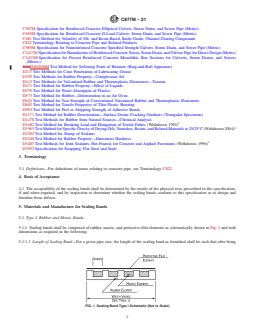
5.1.1 Sealing bands shall be composed of rubber, mastic, and protective film elements as schematically shown in Fig. 1 and with
dimensions as required in the following:
5.1.1.1 Length of Sealing Band—For a given pipe size, the length of the sealing band as furnished shall be such that after being
FIG. 1 Sealing Band Type I Schematic (Not to Scale)
C877M − 21
stretched longitudinally 8 to 12 % as part of the installation procedure, the sealing band will encircle the outside perimeter of the
pipe and overlap by an amount equal to, but not less than, the width of the sealing band. Sealing bands may be furnished in the
required length or multiples thereof.
5.1.1.2 Width of Sealing Band—The width of the sealing band shall conform to the requirements of Table 1.
5.1.2 Rubber Element—The rubber element shall be extruded or molded from a high-grade rubber compound and shall be cured
in such a manner that any cross section will be dense, homogeneous, and free of porosity, blisters, pitting, and other imperfections.
The basic polymer shall be natural, synthetic, or a blend of both and shall meet the physical requirements prescribed in Section
6. The rubber element shall have ribs with a height of 4.8 mm, spaced 19 to 32 mm apart, and have a thickness between the ribs
of 1.6 mm. The thickness of the ribs is not prohibited from varying from 3.2 mm at the base to 0.8 mm at the top.
5.1.3 Mastic Element—The mastic element shall contain rubber, reclaimed rubber and asphaltic derivatives, clay, and/or resin and
shall meet the physical requirements prescribed in Section 6. The mastic element shall have a thickness of 3.2 mm and be free of
porous areas, air pockets, and contamination by foreign matter.
5.1.4 Protective Film—The protective film shall be water soluble, have a 0.025-mm thickness, and meet the physical requirements
prescribed in Section 6.
NOTE 2—The function of the film is to protect the mastic surface prior to installation. It is intended to dissolve away in the presence of moisture during
installation and expose the mastic for sealing.
5.2 Type II Plastic Film and Mesh Reinforced Mastic Bands:
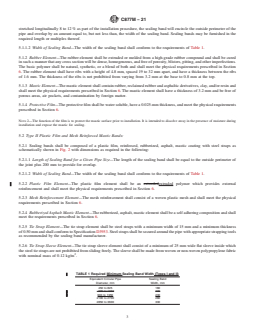
5.2.1 Sealing bands shall be composed of a plastic film, reinforced, rubberized, asphalt, mastic coating with steel straps as
schematically shown in Fig. 2 with dimensions as required in the following:
5.2.1.1 Length of Sealing Band for a Given Pipe Size—The length of the sealing band shall be equal to the outside perimeter of
the joint plus 200 mm to provide for overlap.
5.2.1.2 Width of Sealing Band—The width of the sealing band shall conform to the requirements of Table 1.
5.2.2 Plastic Film Element—The plastic film element shall be an extendedextruded polymer which provides external
reinforcement and shall meet the physical requirements prescribed in Section 6.
5.2.3 Mesh Reinforcement Element—The mesh reinforcement shall consist of a woven plastic mesh and shall meet the physical
requirements prescribed in Section 6.
5.2.4 Rubberized Asphalt Mastic Element—The rubberized, asphalt, mastic element shall be a self adhering composition and shall
meet the requirements prescribed in Section 6.
5.2.5 Tie Strap Element—The tie strap element shall be steel straps with a minimum width of 15 mm and a minimum thickness
of 0.50 mm and shall conform to Specification D3953. Steel straps shall be secured around the pipe with appropriate strapping tools
as recommended by the sealing band manufacturer.
5.2.6 Tie Strap Sleeve Element—The tie strap sleeve element shall consist of a minimum of 25 mm wide flat sleeve inside which
the steel tie straps are not prohibited from sliding freely. The sleeve shall be made from woven or non-woven polypropylene fabric
with nominal mass of 0.12 kg/m .
TABLE 1 Required Minimum Sealing Band Width (Types I and II)
Equivalent Circular Pipe Sealing Band
Diameter, mm Width, mm
450 to 825 180
900 to 1950 230
900 to 1950 230
2100 to 2700 280
2850 to 3600 330
C877M − 21
FIG. 2 Sealing Band Type II (Not to Scale)
5.2.7 Release Sheet Element—The disposable release sheet element shall consist of a silicone coated paper with a minimum basis
mass of 0.1 kg/mcoated paper or plastic that has demonstrated its suitability for . this use.
5.3 Type III, Chemically-Bonded Adhesive Butyl Bands:
Type A (Plastic backing band)
Type B (Rubber backing band)
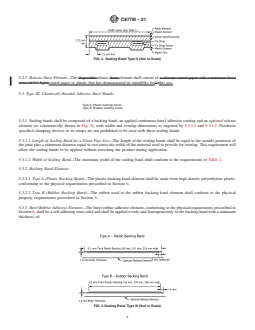
5.3.1 Sealing bands shall be composed of a backing band, an applied continuous butyl adhesive coating and an optional release
element (as schematically shown in Fig. 3), with width and overlap dimensions as required by 5.3.1.1 and 5.3.1.2. Purchaser
specified clamping devices or tie straps are not prohibited to be used with these sealing bands.
5.3.1.1 Length of Sealing Band for a Given Pipe Size—The length of the sealing bands shall be equal to the outside perimeter of
the joint plus a minimum distance equal to two times the width of the material used to provide for overlap. This requirement will
allow the sealing bands to be applied without stretching the product during application.
5.3.1.2 Width of Sealing Band—The minimum width of the sealing band shall conform to the requirements of Table 2.
5.3.2 Backing Band Element:
5.3.2.1 Type A (Plastic Backing Band)—The plastic backing band element shall be made from high density polyethylene plastic,
conforming to the physical requirements prescribed in Section 6.
5.3.2.2 Type B (Rubber Backing Band)—The rubber used in the rubber backing band element shall conform to the physical
property requirements prescribed in Section 6.
5.3.3 Butyl Rubber Adhesive Element—The butyl rubber adhesive element, conforming to the physical requirements prescribed in
Section 6, shall be a self-adhering semi-solid and shall be applied evenly and homogeneously to the backing band with a minimum
thickness of:
FIG. 3 Sealing Band Type III (Not to Scale)
C877M − 21
TABLE 2 Required Sealing Band Width (Type III)
Equivalent Circular Pipe Minimum Sealing Band
Diameter, mm Width,
mm
300-900 152
901-2000 229
2001 and larger 305
TABLE 2 Required Minimum Sealing Band Width (Type III)
Equivalent Circular Pipe Minimum Sealing Band
Diameter, mm Width,
mm
300-900 152
901-2000 229
2001 and larger 305
Type A (Plastic Backing Band) 0.75-mm
Type B (Rubber Backing Band) 0.75-mm
5.3.4 Optional Primer Element—When required, a primer shall be used as directed by the sealing band manufacturer and shall be
spread in a continuous film at the intersection of the joint. The application width sha
...