

ASTM C1709-22
(Guide)Standard Guide for Evaluation of Alternative Supplementary Cementitious Materials (ASCM) for Use in Concrete
General Information
- Abstract
SIGNIFICANCE AND USE
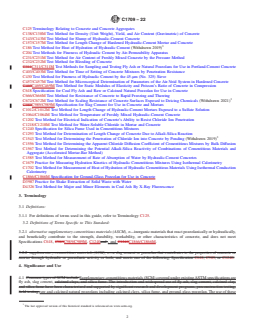
4.1 Supplementary cementitious materials (SCM) covered under existing ASTM specifications are fly ash, slag cement, raw and calcined natural pozzolans including calcined clays, silica fume, and ground-glass pozzolan. The use of these materials, and limits established in existing specifications, are based on data obtained from research programs, field testing, and long term performance monitoring. Performance of SCM in specific concrete mixtures is commonly verified through preconstruction testing. This guide provides an approach to assessing the properties of materials that are not covered under existing specifications, and for assessing the performance of those materials in concrete.
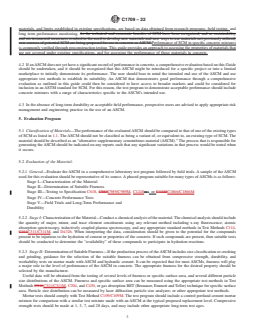
4.2 If an ASCM does not yet have a significant record of performance in concrete, a comprehensive evaluation based on this Guide should be undertaken, and it should be recognized that this ASCM might be introduced for a specific project or into a limited marketplace to initially demonstrate its performance. The user should bear in mind the intended end use of the ASCM and use appropriate test methods to establish its suitability. An ASCM that demonstrates good performance through a comprehensive evaluation as outlined in this guide could then be considered to have access to broader markets and could be considered for inclusion in an ASTM standard for SCM. For this reason, the test program to demonstrate acceptable performance should include concrete mixtures with a range of characteristics specific to the ASCM’s intended use.
4.3 In the absence of long-term durability or acceptable field performance, prospective users are advised to apply appropriate risk management and engineering practice in the use of an ASCM.
SCOPE
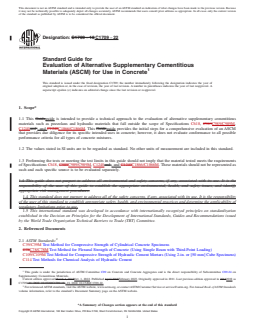
1.1 This guide is intended to provide a technical approach to the evaluation of alternative supplementary cementitious materials such as pozzolans and hydraulic materials that fall outside the scope of Specifications C618, C989/C989M, C1240, and C1866/C1866M. This guide provides the initial steps for a comprehensive evaluation of an ASCM that provides due diligence for its specific intended uses in concrete; however, it does not evaluate conformance to all possible performance criteria for all types of concrete mixtures.
1.2 The values stated in SI units are to be regarded as standard. No other units of measurement are included in this standard.
1.3 Performing the tests or meeting the test limits in this guide should not imply that the material tested meets the requirements of Specifications C618, C989/C989M, C1240, and C1866/C1866M. These materials should not be represented as such and each specific source is to be evaluated separately.
1.4 This standard does not purport to address all of the safety concerns, if any, associated with its use. It is the responsibility of the user of this standard to establish appropriate safety, health, and environmental practices and determine the applicability of regulatory limitations prior to use.
1.5 This international standard was developed in accordance with internationally recognized principles on standardization established in the Decision on Principles for the Development of International Standards, Guides and Recommendations issued by the World Trade Organization Technical Barriers to Trade (TBT) Committee.
- Status
- Published
- Publication Date
- 30-Sep-2022
- Technical Committee
- C09 - Concrete and Concrete Aggregates
- Drafting Committee
- C09.24 - Supplementary Cementitious Materials
Buy Documents
ASTM C1709-22 - Standard Guide for Evaluation of Alternative Supplementary Cementitious Materials (ASCM) for Use in Concrete
REDLINE ASTM C1709-22 - Standard Guide for Evaluation of Alternative Supplementary Cementitious Materials (ASCM) for Use in Concrete
Overview
ASTM C1709-22, Standard Guide for Evaluation of Alternative Supplementary Cementitious Materials (ASCM) for Use in Concrete, provides a comprehensive framework for assessing pozzolanic or hydraulic materials not already covered under existing ASTM specifications, such as C618 (fly ash, natural pozzolans), C989/C989M (slag cement), C1240 (silica fume), and C1866/C1866M (ground-glass pozzolan). This guide supports the due diligence needed to introduce innovative materials, ensures their suitability for use in concrete, and offers a methodological approach for both laboratory and field evaluation.
The use of alternative supplementary cementitious materials (ASCM) plays a significant role in advancing concrete technology, enhancing sustainability, and addressing the growing demand for environmentally responsible construction practices.
Key Topics
Scope and Intent
- Developed for ASCMs that fall outside established ASTM material specifications.
- Offers an evaluation process rather than definitive acceptance criteria for all concrete types.
- Emphasizes SI units as the standard measurement system.
Significance and Use
- Traditional SCMs like fly ash, silica fume, and slag have established records; new ASCMs must undergo comprehensive testing.
- Preconstruction laboratory testing and field trials are recommended to demonstrate performance.
- Guides users in assessing durability, mechanical properties, and chemical compatibility.
Evaluation Approach
- Material Characterization: Chemical analysis, potential for harmful compounds, and source representativeness.
- Fineness Assessment: Testing various fineness levels to optimize performance in mortar and concrete.
- Comparative Testing: Benchmarking against existing SCM standards for properties like compressive strength, durability, air content, and setting time.
- Concrete Performance Tests: Slump, air content, setting time, density, bleeding, compressive/flexural strength, shrinkage, modulus of elasticity, sulfate resistance, and alkali-silica reactivity.
- Field Trials and Durability: At least one year of field testing for real-world performance, focusing on aspects like freeze-thaw resistance, scaling, and long-term durability.
Risk Management
- When long-term performance data is limited, users should follow appropriate engineering and risk management practices during initial adoption.
Applications
New Material Qualification:
- Provides producers, researchers, and specifiers with a structured path to qualify new ASCMs for concrete use.
Sustainability Initiatives:
- Helps incorporate industrial by-products or novel materials into concrete, supporting circular economy and carbon reduction goals.
Project-Specific Solutions:
- Allows tailored evaluation for unique project requirements where traditional SCMs are not available or suitable.
Innovation Enablement:
- Opens the market for next-generation supplementary materials that can enhance durability or performance in challenging environments.
Risk Mitigation:
- Ensures new materials undergo rigorous testing before deployment in critical structures, safeguarding long-term durability.
Related Standards
- ASTM C618 – Specification for Coal Fly Ash and Raw or Calcined Natural Pozzolan for Use in Concrete
- ASTM C989/C989M – Specification for Slag Cement for Use in Concrete and Mortars
- ASTM C1240 – Specification for Silica Fume Used in Cementitious Mixtures
- ASTM C1866/C1866M – Specification for Ground-Glass Pozzolan for Use in Concrete
- ASTM C39/C39M – Test Method for Compressive Strength of Cylindrical Concrete Specimens
- ASTM C78/C78M – Test Method for Flexural Strength of Concrete
- ASTM C114 – Test Methods for Chemical Analysis of Hydraulic Cement
- ASTM C231/C231M, C143/C143M, C138/C138M – Testing fresh concrete properties
- ASTM C457/C457M – Microscopical Determination of Parameters of the Air-Void System in Hardened Concrete
Conclusion
ASTM C1709-22 establishes a standardized approach for the evaluation of alternative supplementary cementitious materials in concrete. By following this guide, organizations can responsibly introduce innovative materials, enhance sustainability efforts, and ensure the long-term reliability of concrete structures. These practices are crucial for driving progress in modern concrete technology and meeting evolving environmental and performance demands.
Relations
- Effective Date
- 01-Apr-2024
- Effective Date
- 01-Feb-2024
- Effective Date
- 01-Jan-2024
- Effective Date
- 01-Jan-2024
- Refers
ASTM C204-24 - Standard Test Methods for Fineness of Hydraulic Cement by Air-Permeability Apparatus - Effective Date
- 01-Jan-2024
- Effective Date
- 15-Dec-2023
- Effective Date
- 01-Dec-2023
- Refers
ASTM C39/C39M-23 - Standard Test Method for Compressive Strength of Cylindrical Concrete Specimens - Effective Date
- 01-Dec-2023
- Effective Date
- 01-Dec-2023
- Effective Date
- 01-Oct-2023
- Effective Date
- 01-May-2020
- Effective Date
- 01-Jan-2020
- Effective Date
- 15-Dec-2019
- Effective Date
- 01-Apr-2019
- Effective Date
- 01-Jan-2019
Buy Documents
ASTM C1709-22 - Standard Guide for Evaluation of Alternative Supplementary Cementitious Materials (ASCM) for Use in Concrete
REDLINE ASTM C1709-22 - Standard Guide for Evaluation of Alternative Supplementary Cementitious Materials (ASCM) for Use in Concrete
Get Certified
Connect with accredited certification bodies for this standard

DIBt (Deutsches Institut für Bautechnik)
German Institute for Building Technology.
DIN CERTCO
DIN Group product certification.

Aboma Certification B.V.
Specialized in construction, metal, and transport sectors.
Sponsored listings
Frequently Asked Questions
ASTM C1709-22 is a guide published by ASTM International. Its full title is "Standard Guide for Evaluation of Alternative Supplementary Cementitious Materials (ASCM) for Use in Concrete". This standard covers: SIGNIFICANCE AND USE 4.1 Supplementary cementitious materials (SCM) covered under existing ASTM specifications are fly ash, slag cement, raw and calcined natural pozzolans including calcined clays, silica fume, and ground-glass pozzolan. The use of these materials, and limits established in existing specifications, are based on data obtained from research programs, field testing, and long term performance monitoring. Performance of SCM in specific concrete mixtures is commonly verified through preconstruction testing. This guide provides an approach to assessing the properties of materials that are not covered under existing specifications, and for assessing the performance of those materials in concrete. 4.2 If an ASCM does not yet have a significant record of performance in concrete, a comprehensive evaluation based on this Guide should be undertaken, and it should be recognized that this ASCM might be introduced for a specific project or into a limited marketplace to initially demonstrate its performance. The user should bear in mind the intended end use of the ASCM and use appropriate test methods to establish its suitability. An ASCM that demonstrates good performance through a comprehensive evaluation as outlined in this guide could then be considered to have access to broader markets and could be considered for inclusion in an ASTM standard for SCM. For this reason, the test program to demonstrate acceptable performance should include concrete mixtures with a range of characteristics specific to the ASCM’s intended use. 4.3 In the absence of long-term durability or acceptable field performance, prospective users are advised to apply appropriate risk management and engineering practice in the use of an ASCM. SCOPE 1.1 This guide is intended to provide a technical approach to the evaluation of alternative supplementary cementitious materials such as pozzolans and hydraulic materials that fall outside the scope of Specifications C618, C989/C989M, C1240, and C1866/C1866M. This guide provides the initial steps for a comprehensive evaluation of an ASCM that provides due diligence for its specific intended uses in concrete; however, it does not evaluate conformance to all possible performance criteria for all types of concrete mixtures. 1.2 The values stated in SI units are to be regarded as standard. No other units of measurement are included in this standard. 1.3 Performing the tests or meeting the test limits in this guide should not imply that the material tested meets the requirements of Specifications C618, C989/C989M, C1240, and C1866/C1866M. These materials should not be represented as such and each specific source is to be evaluated separately. 1.4 This standard does not purport to address all of the safety concerns, if any, associated with its use. It is the responsibility of the user of this standard to establish appropriate safety, health, and environmental practices and determine the applicability of regulatory limitations prior to use. 1.5 This international standard was developed in accordance with internationally recognized principles on standardization established in the Decision on Principles for the Development of International Standards, Guides and Recommendations issued by the World Trade Organization Technical Barriers to Trade (TBT) Committee.
SIGNIFICANCE AND USE 4.1 Supplementary cementitious materials (SCM) covered under existing ASTM specifications are fly ash, slag cement, raw and calcined natural pozzolans including calcined clays, silica fume, and ground-glass pozzolan. The use of these materials, and limits established in existing specifications, are based on data obtained from research programs, field testing, and long term performance monitoring. Performance of SCM in specific concrete mixtures is commonly verified through preconstruction testing. This guide provides an approach to assessing the properties of materials that are not covered under existing specifications, and for assessing the performance of those materials in concrete. 4.2 If an ASCM does not yet have a significant record of performance in concrete, a comprehensive evaluation based on this Guide should be undertaken, and it should be recognized that this ASCM might be introduced for a specific project or into a limited marketplace to initially demonstrate its performance. The user should bear in mind the intended end use of the ASCM and use appropriate test methods to establish its suitability. An ASCM that demonstrates good performance through a comprehensive evaluation as outlined in this guide could then be considered to have access to broader markets and could be considered for inclusion in an ASTM standard for SCM. For this reason, the test program to demonstrate acceptable performance should include concrete mixtures with a range of characteristics specific to the ASCM’s intended use. 4.3 In the absence of long-term durability or acceptable field performance, prospective users are advised to apply appropriate risk management and engineering practice in the use of an ASCM. SCOPE 1.1 This guide is intended to provide a technical approach to the evaluation of alternative supplementary cementitious materials such as pozzolans and hydraulic materials that fall outside the scope of Specifications C618, C989/C989M, C1240, and C1866/C1866M. This guide provides the initial steps for a comprehensive evaluation of an ASCM that provides due diligence for its specific intended uses in concrete; however, it does not evaluate conformance to all possible performance criteria for all types of concrete mixtures. 1.2 The values stated in SI units are to be regarded as standard. No other units of measurement are included in this standard. 1.3 Performing the tests or meeting the test limits in this guide should not imply that the material tested meets the requirements of Specifications C618, C989/C989M, C1240, and C1866/C1866M. These materials should not be represented as such and each specific source is to be evaluated separately. 1.4 This standard does not purport to address all of the safety concerns, if any, associated with its use. It is the responsibility of the user of this standard to establish appropriate safety, health, and environmental practices and determine the applicability of regulatory limitations prior to use. 1.5 This international standard was developed in accordance with internationally recognized principles on standardization established in the Decision on Principles for the Development of International Standards, Guides and Recommendations issued by the World Trade Organization Technical Barriers to Trade (TBT) Committee.
ASTM C1709-22 is classified under the following ICS (International Classification for Standards) categories: 91.100.10 - Cement. Gypsum. Lime. Mortar. The ICS classification helps identify the subject area and facilitates finding related standards.
ASTM C1709-22 has the following relationships with other standards: It is inter standard links to ASTM C1012/C1012M-24, ASTM C989/C989M-24, ASTM C231/C231M-24, ASTM C311/C311M-24, ASTM C204-24, ASTM C109/C109M-23, ASTM C457/C457M-23a, ASTM C39/C39M-23, ASTM C1064/C1064M-23, ASTM C114-23, ASTM D3987-12(2020), ASTM C1293-20, ASTM C125-19a, ASTM C232/C232M-14(2019), ASTM C125-19. Understanding these relationships helps ensure you are using the most current and applicable version of the standard.
ASTM C1709-22 is available in PDF format for immediate download after purchase. The document can be added to your cart and obtained through the secure checkout process. Digital delivery ensures instant access to the complete standard document.
Standards Content (Sample)
This international standard was developed in accordance with internationally recognized principles on standardization established in the Decision on Principles for the
Development of International Standards, Guides and Recommendations issued by the World Trade Organization Technical Barriers to Trade (TBT) Committee.
Designation: C1709 − 22
Standard Guide for
Evaluation of Alternative Supplementary Cementitious
Materials (ASCM) for Use in Concrete
This standard is issued under the fixed designation C1709; the number immediately following the designation indicates the year of
original adoption or, in the case of revision, the year of last revision. A number in parentheses indicates the year of last reapproval. A
superscript epsilon (´) indicates an editorial change since the last revision or reapproval.
1. Scope* 2. Referenced Documents
1.1 This guide is intended to provide a technical approach to 2.1 ASTM Standards:
the evaluation of alternative supplementary cementitious ma- C39/C39M Test Method for Compressive Strength of Cylin-
terials such as pozzolans and hydraulic materials that fall drical Concrete Specimens
outside the scope of Specifications C618, C989/C989M, C78/C78M Test Method for Flexural Strength of Concrete
C1240, and C1866/C1866M. This guide provides the initial (Using Simple Beam with Third-Point Loading)
steps for a comprehensive evaluation of an ASCM that C109/C109M Test Method for Compressive Strength of
provides due diligence for its specific intended uses in con- Hydraulic Cement Mortars (Using 2-in. or [50 mm] Cube
crete; however, it does not evaluate conformance to all possible Specimens)
performance criteria for all types of concrete mixtures. C114 Test Methods for Chemical Analysis of Hydraulic
Cement
1.2 The values stated in SI units are to be regarded as
C125 Terminology Relating to Concrete and Concrete Ag-
standard. No other units of measurement are included in this
gregates
standard.
C138/C138M Test Method for Density (Unit Weight), Yield,
1.3 Performing the tests or meeting the test limits in this
and Air Content (Gravimetric) of Concrete
guide should not imply that the material tested meets the
C143/C143M Test Method for Slump of Hydraulic-Cement
requirements of Specifications C618, C989/C989M, C1240,
Concrete
and C1866/C1866M. These materials should not be repre-
C157/C157M Test Method for Length Change of Hardened
sented as such and each specific source is to be evaluated
Hydraulic-Cement Mortar and Concrete
separately.
C186 Test Method for Heat of Hydration of Hydraulic
1.4 This standard does not purport to address all of the Cement (Withdrawn 2019)
safety concerns, if any, associated with its use. It is the
C204 Test Methods for Fineness of Hydraulic Cement by
responsibility of the user of this standard to establish appro- Air-Permeability Apparatus
priate safety, health, and environmental practices and deter-
C231/C231M Test Method for Air Content of Freshly Mixed
mine the applicability of regulatory limitations prior to use. Concrete by the Pressure Method
1.5 This international standard was developed in accor-
C232/C232M Test Method for Bleeding of Concrete
dance with internationally recognized principles on standard- C311/C311M Test Methods for Sampling and Testing Fly
ization established in the Decision on Principles for the
Ash or Natural Pozzolans for Use in Portland-Cement
Development of International Standards, Guides and Recom- Concrete
mendations issued by the World Trade Organization Technical
C403/C403M Test Method for Time of Setting of Concrete
Barriers to Trade (TBT) Committee. Mixtures by Penetration Resistance
1 2
This guide is under the jurisdiction of ASTM Committee C09 on Concrete and For referenced ASTM standards, visit the ASTM website, www.astm.org, or
Concrete Aggregates and is the direct responsibility of Subcommittee C09.24 on contact ASTM Customer Service at service@astm.org. For Annual Book of ASTM
Supplementary Cementitious Materials. Standards volume information, refer to the standard’s Document Summary page on
Current edition approved Oct. 1, 2022. Published February 2023. Originally the ASTM website.
approved in 2011. Last previous edition approved in 2018 as C1709–18. DOI: The last approved version of this historical standard is referenced on www.ast-
10.1520/C1709-22. m.org.
*A Summary of Changes section appears at the end of this standard
Copyright © ASTM International, 100 Barr Harbor Drive, PO Box C700, West Conshohocken, PA 19428-2959. United States
C1709 − 22
C430 Test Method for Fineness of Hydraulic Cement by the 3.2.1 alternative supplementary cementitious materials
45-μm (No. 325) Sieve (ASCM), n—inorganic materials that react pozzolanically or
hydraulically, and beneficially contribute to the strength,
C457/C457M Test Method for Microscopical Determination
of Parameters of the Air-Void System in Hardened Con- durability, workability, or other characteristics of concrete, and
does not meet Specifications C618, C989/C989M, C1240, and
crete
C1866/C1866M.
C469/C469M Test Method for Static Modulus of Elasticity
and Poisson’s Ratio of Concrete in Compression
4. Significance and Use
C618 Specification for Coal Fly Ash and Raw or Calcined
Natural Pozzolan for Use in Concrete
4.1 Supplementary cementitious materials (SCM) covered
C666/C666M Test Method for Resistance of Concrete to
under existing ASTM specifications are fly ash, slag cement,
Rapid Freezing and Thawing
raw and calcined natural pozzolans including calcined clays,
C672/C672M Test Method for Scaling Resistance of Con-
silica fume, and ground-glass pozzolan. The use of these
crete Surfaces Exposed to Deicing Chemicals (Withdrawn
materials, and limits established in existing specifications, are
2021)
based on data obtained from research programs, field testing,
C989/C989M Specification for Slag Cement for Use in
and long term performance monitoring. Performance of SCM
Concrete and Mortars
in specific concrete mixtures is commonly verified through
C1012/C1012M Test Method for Length Change of
preconstruction testing. This guide provides an approach to
Hydraulic-Cement Mortars Exposed to a Sulfate Solution
assessing the properties of materials that are not covered under
C1064/C1064M Test Method for Temperature of Freshly
existing specifications, and for assessing the performance of
Mixed Hydraulic-Cement Concrete
those materials in concrete.
C1202 Test Method for Electrical Indication of Concrete’s
4.2 If an ASCM does not yet have a significant record of
Ability to Resist Chloride Ion Penetration
performance in concrete, a comprehensive evaluation based on
C1218/C1218M Test Method for Water-Soluble Chloride in
this Guide should be undertaken, and it should be recognized
Mortar and Concrete
that this ASCM might be introduced for a specific project or
C1240 Specification for Silica Fume Used in Cementitious
into a limited marketplace to initially demonstrate its perfor-
Mixtures
mance. The user should bear in mind the intended end use of
C1293 Test Method for Determination of Length Change of
the ASCM and use appropriate test methods to establish its
Concrete Due to Alkali-Silica Reaction
suitability. An ASCM that demonstrates good performance
C1543 Test Method for Determining the Penetration of
through a comprehensive evaluation as outlined in this guide
Chloride Ion into Concrete by Ponding (Withdrawn
could then be considered to have access to broader markets and
2019)
could be considered for inclusion in an ASTM standard for
C1556 Test Method for Determining the Apparent Chloride
SCM. For this reason, the test program to demonstrate accept-
Diffusion Coefficient of Cementitious Mixtures by Bulk
able performance should include concrete mixtures with a
Diffusion
range of characteristics specific to the ASCM’s intended use.
C1567 Test Method for Determining the Potential Alkali-
4.3 In the absence of long-term durability or acceptable field
Silica Reactivity of Combinations of Cementitious Mate-
performance, prospective users are advised to apply appropri-
rials and Aggregate (Accelerated Mortar-Bar Method)
ate risk management and engineering practice in the use of an
C1585 Test Method for Measurement of Rate of Absorption
ASCM.
of Water by Hydraulic-Cement Concretes
C1679 Practice for Measuring Hydration Kinetics of Hy-
5. Evaluation Program
draulic Cementitious Mixtures Using Isothermal Calorim-
5.1 Classification of Materials—The performance of the
etry
evaluated ASCM should be compared to that of one of the
C1702 Test Method for Measurement of Heat of Hydration
existing types of SCM as listed in 1.1. The ASCM should not
of Hydraulic Cementitious Materials Using Isothermal
be classified as being a variant of, or equivalent to, an existing
Conduction Calorimetry
type of SCM. The material should be described as an “alter-
C1866/C1866M Specification for Ground-Glass Pozzolan
native supplementary cementitious material (ASCM).” The
for Use in Concrete
process that is responsible for generating the ASCM should be
D3987 Practice for Shake Extraction of Solid Waste with
indicated on any reports such that any significant variations in
Water
that process would be noted when it occurs.
D4326 Test Method for Major and Minor Elements in Coal
Ash By X-Ray Fluorescence
5.2 Evaluation of the Material:
5.2.1 General—Evaluate the ASCM in a comprehensive
3. Terminology laboratory test program followed by field trials. A sample of the
ASCM used for this evaluation should be representative of its
3.1 Definitions:
source. A phased program suitable for many types of ASCMs
3.1.1 For definitions of terms used in this guide, refer to
is as follows:
Terminology C125.
Stage I—Characterization of the Material
3.2 Definitions of Terms Specific to This Standard: Stage II—Determination of Suitable Fineness
C1709 − 22
Stage III—Testing to Specification C618, C989/C989M, air-entraining admixture is then added, and the jar is shaken for
C1240, or C1866/C1866M an additional 15 s. The jar is then placed upright for 30 s, and
then the cap is removed. If the foam is breaking rapidly or if
Stage IV—Concrete Performance Tests
voids appear on the water mixture surface after 30 s, add more
Stage V—Field Trials and Long-Term Performance and
air-entraining admixture, and repeat the shaking and observa-
Durability
tion procedure. Continue to incrementally add air entraining
5.2.2 Stage I: Characterization of the Material—Conduct a
admixture until the foam is stable for 30 s, and then shake the
chemical analysis of the material. The chemical analysis
mixture for an additional 15 s. The foam is in a stable state
should include the quantity of major, minor, and trace element
when the foam is not breaking rapidly and no voids in the foam
constituents using any relevant method including x-ray
appear on the water mixture surface for at le
...
This document is not an ASTM standard and is intended only to provide the user of an ASTM standard an indication of what changes have been made to the previous version. Because
it may not be technically possible to adequately depict all changes accurately, ASTM recommends that users consult prior editions as appropriate. In all cases only the current version
of the standard as published by ASTM is to be considered the official document.
Designation: C1709 − 18 C1709 − 22
Standard Guide for
Evaluation of Alternative Supplementary Cementitious
Materials (ASCM) for Use in Concrete
This standard is issued under the fixed designation C1709; the number immediately following the designation indicates the year of
original adoption or, in the case of revision, the year of last revision. A number in parentheses indicates the year of last reapproval. A
superscript epsilon (´) indicates an editorial change since the last revision or reapproval.
1. Scope*
1.1 This Guideguide is intended to provide a technical approach to the evaluation of alternative supplementary cementitious
materials such as pozzolans and hydraulic materials that fall outside the scope of Specifications C618, C989C989/C989M,
C1240and , and C1240C1866/C1866M. This Guideguide provides the initial steps for a comprehensive evaluation of an ASCM
that provides due diligence for its specific intended uses in concrete; however, it does not evaluate conformance to all possible
performance criteria for all types of concrete mixtures.
1.2 The values stated in SI units are to be regarded as standard. No other units of measurement are included in this standard.
1.3 Performing the tests or meeting the test limits in this guide should not imply that the material tested meets the requirements
of Specifications C618, C989C989/C989M, C1240and , and C1240C1866/C1866M. These materials should not be represented as
such and each specific source is to be evaluated separately.
1.4 This guide does not purport to address all environmental and safety concerns, if any, associated with its use. It is the
responsibility of the user of this guide to establish the appropriate environmental, health, and safety issues, and identify
appropriate risk management procedures.
1.4 This standard does not purport to address all of the safety concerns, if any, associated with its use. It is the responsibility
of the user of this standard to establish appropriate safety, health, and environmental practices and determine the applicability of
regulatory limitations prior to use.
1.5 This international standard was developed in accordance with internationally recognized principles on standardization
established in the Decision on Principles for the Development of International Standards, Guides and Recommendations issued
by the World Trade Organization Technical Barriers to Trade (TBT) Committee.
2. Referenced Documents
2.1 ASTM Standards:
C39/C39M Test Method for Compressive Strength of Cylindrical Concrete Specimens
C78C78/C78M Test Method for Flexural Strength of Concrete (Using Simple Beam with Third-Point Loading)
C109/C109M Test Method for Compressive Strength of Hydraulic Cement Mortars (Using 2-in. or [50 mm] Cube Specimens)
C114 Test Methods for Chemical Analysis of Hydraulic Cement
This guide is under the jurisdiction of ASTM Committee C09 on Concrete and Concrete Aggregates and is the direct responsibility of Subcommittee C09.24 on
Supplementary Cementitious Materials.
Current edition approved March 1, 2018Oct. 1, 2022. Published April 2018February 2023. Originally approved in 2011. Last previous edition approved in 20112018 as
C1709–11. DOI: 10.1520/C1709-18.–18. DOI: 10.1520/C1709-22.
For referenced ASTM standards, visit the ASTM website, www.astm.org, or contact ASTM Customer Service at service@astm.org. For Annual Book of ASTM Standards
volume information, refer to the standard’s Document Summary page on the ASTM website.
*A Summary of Changes section appears at the end of this standard
Copyright © ASTM International, 100 Barr Harbor Drive, PO Box C700, West Conshohocken, PA 19428-2959. United States
C1709 − 22
C125 Terminology Relating to Concrete and Concrete Aggregates
C138/C138M Test Method for Density (Unit Weight), Yield, and Air Content (Gravimetric) of Concrete
C143/C143M Test Method for Slump of Hydraulic-Cement Concrete
C157/C157M Test Method for Length Change of Hardened Hydraulic-Cement Mortar and Concrete
C186 Test Method for Heat of Hydration of Hydraulic Cement (Withdrawn 2019)
C204 Test Methods for Fineness of Hydraulic Cement by Air-Permeability Apparatus
C231/C231M Test Method for Air Content of Freshly Mixed Concrete by the Pressure Method
C232/C232M Test Method for Bleeding of Concrete
C311C311/C311M Test Methods for Sampling and Testing Fly Ash or Natural Pozzolans for Use in Portland-Cement Concrete
C403/C403M Test Method for Time of Setting of Concrete Mixtures by Penetration Resistance
C430 Test Method for Fineness of Hydraulic Cement by the 45-μm (No. 325) Sieve
C457/C457M Test Method for Microscopical Determination of Parameters of the Air-Void System in Hardened Concrete
C469C469/C469M Test Method for Static Modulus of Elasticity and Poisson’s Ratio of Concrete in Compression
C618 Specification for Coal Fly Ash and Raw or Calcined Natural Pozzolan for Use in Concrete
C666/C666M Test Method for Resistance of Concrete to Rapid Freezing and Thawing
C672/C672M Test Method for Scaling Resistance of Concrete Surfaces Exposed to Deicing Chemicals (Withdrawn 2021)
C989C989/C989M Specification for Slag Cement for Use in Concrete and Mortars
C1012/C1012M Test Method for Length Change of Hydraulic-Cement Mortars Exposed to a Sulfate Solution
C1064/C1064M Test Method for Temperature of Freshly Mixed Hydraulic-Cement Concrete
C1202 Test Method for Electrical Indication of Concrete’s Ability to Resist Chloride Ion Penetration
C1218/C1218M Test Method for Water-Soluble Chloride in Mortar and Concrete
C1240 Specification for Silica Fume Used in Cementitious Mixtures
C1293 Test Method for Determination of Length Change of Concrete Due to Alkali-Silica Reaction
C1543 Test Method for Determining the Penetration of Chloride Ion into Concrete by Ponding (Withdrawn 2019)
C1556 Test Method for Determining the Apparent Chloride Diffusion Coefficient of Cementitious Mixtures by Bulk Diffusion
C1567 Test Method for Determining the Potential Alkali-Silica Reactivity of Combinations of Cementitious Materials and
Aggregate (Accelerated Mortar-Bar Method)
C1585 Test Method for Measurement of Rate of Absorption of Water by Hydraulic-Cement Concretes
C1679 Practice for Measuring Hydration Kinetics of Hydraulic Cementitious Mixtures Using Isothermal Calorimetry
C1702 Test Method for Measurement of Heat of Hydration of Hydraulic Cementitious Materials Using Isothermal Conduction
Calorimetry
C1866/C1866M Specification for Ground-Glass Pozzolan for Use in Concrete
D3987 Practice for Shake Extraction of Solid Waste with Water
D4326 Test Method for Major and Minor Elements in Coal Ash By X-Ray Fluorescence
3. Terminology
3.1 Definitions:
3.1.1 For definitions of terms used in this guide, refer to Terminology C125.
3.2 Definitions of Terms Specific to This Standard:
3.2.1 alternative supplementary cementitious materials (ASCM), n—inorganic materials that react pozzolanically or hydraulically,
and beneficially contribute to the strength, durability, workability, or other characteristics of concrete, and does not meet
Specifications C618, C989C989/C989M, C1240and , and C1240C1866/C1866M.
3.2.2 supplementary cementitious materials (SCM), n—a slag cement or pozzolan that contributes to the properties of concrete or
mortar through hydraulic or pozzolanic activity or both; and meets one of the following: Specification C618, C989, or C1240.
4. Significance and Use
4.1 Common types of SCM include Supplementary cementitious materials (SCM) covered under existing ASTM specifications are
fly ash, slag cement, calcined clays, and silica fume. The introduction and widespread use of fly ash, slag cement, calcined clay,
and silica fume have been characterized and supported by significant research and development programs, preconstruction testing,
field testing raw and calcined natural pozzolans including calcined clays, silica fume, and ground-glass pozzolan. The use of these
The last approved version of this historical standard is referenced on www.astm.org.
C1709 − 22
materials, and limits established in existing specifications, are based on data obtained from research programs, field testing, and
long term performance monitoring. As the technical and economic benefits of SCM have been recognized, and as sustainability
and environmental awareness resulted in the need to develop new materials and new ways to use materials not previously utilized,
new sources of potential SCM are being proposed for use in concrete as ASCM.Performance of SCM in specific concrete mixtures
is commonly verified through preconstruction testing. This guide provides an approach to assessing the properties of materials that
are not covered under existing specifications, and for assessing the performance of those materials in concrete.
4.2 If an ASCM does not yet have a significant record of performance in concrete, a comprehensive evaluation based on this Guide
should be undertaken, and it should be recognized that this ASCM might be introduced for a specific project or into a limited
marketplace to initially demonstrate its performance. The user should bear in mind the intended end use of the ASCM and use
appropriate test methods to establish its suitability. An ASCM that demonstrates good performance through a comprehensive
evaluation as outlined in this guide could then be considered to have access to broader markets and could be considered for
inclusion in an ASTM standard for SCM. For this reason, the test program to demonstrate acceptable performance should include
concrete mixtures with a range of characteristics specific to the ASCM’s intended use.
4.3 In the absence of long-term durability or acceptable field performance, prospective users are advised to apply appropriate risk
management and engineering practice in the use of an ASCM.
5. Evaluation Program
5.1 Classification of Materials—The performance of the evaluated ASCM should be compared to that of one of the existing types
of SCM as listed in 1.1. The ASCM should not be classified as being a variant of, or equivalent to, an existing type of SCM. The
material should be described as an “alternative supplementary cementitious material (ASCM).” The process that is responsible for
generating the ASCM should be indicated on any reports such that any significant variations in that process would be noted when
it occurs.
5.2 Evaluation of the Material:
5.2.1 General—Evaluate the ASCM in a comprehensive laboratory test program followed by field trials. A sample of the ASCM
used for this evaluation should be representative of its source. A phased program suitable for many types of ASCMs is as follows:
Stage I—Characterization of the Material
Stage II—Determination of Suitable Fineness
Stage III—Testing to Specification C618, C989C989/C989M, C1240or , or C1240C1866/C1866M
Stage IV—Concrete Performance Tests
Stage V—Field Trials and Long-Term Performance and
Durability
5.2.2 Stage I: Characterization of the Material—Conduct a chemical analysis of the material. The chemical analysis should include
the quantity of major, minor, and trace element constituents using any relevant method including x-
...