

ASTM C204-24
(Test Method)Standard Test Methods for Fineness of Hydraulic Cement by Air-Permeability Apparatus
General Information
- Abstract
ABSTRACT
This test method covers determination of the fineness of hydraulic cement, using the Blaine air-permeability apparatus, in terms of the specific surface expressed as total surface area in square centimetres per gram, or square metres per kilogram, of cement. Two test methods are given: test method A is the reference test method using the manually operated standard Blaine apparatus, while test method B permits the use of automated apparatus that has in accordance with the qualification requirements of this test method demonstrated acceptable performance. The Blaine air-permeability apparatus consists essentially of a means of drawing a definite quantity of air through a prepared bed of cement of definite porosity. The permeability cell shall consist of a rigid cylinder, constructed of austenitic stainless steel. The disk shall be constructed of noncorroding metal, and shall fit the inside of the cell snugly. The plunger shall be constructed of austenitic stainless steel and shall fit into the cell. The filter paper disks shall be circular, with smooth edges, and shall have the same diameter as the inside of the cell. The U-tube manometer shall be constructed according to the design indicated. The manometer shall be filled to the midpoint line with a nonvolatile, nonhygroscopic liquid of low viscosity and density. The timer shall have a positive starting and stopping mechanism. The calibration of the air permeability apparatus shall be made using the standard reference material. The automated test method shall employ apparatus designed either on the principles of the Blaine air-permeability method or apparatus based on the air-permeability principles of the Lea and Nurse method. When the specific surface values determined by an automated apparatus are to be used for acceptance or rejection of cement, the method used shall comply with the qualification requirements. When standardization is required in order to achieve agreement between test method A and test method B, the apparatus shall be standardized according to the requirements prescribed.
SCOPE
1.1 This test method covers determination of the fineness of hydraulic cement, using the Blaine air-permeability apparatus, in terms of the specific surface expressed as total surface area in square centimetres per gram, or square metres per kilogram, of cement. Two test methods are given: Test Method A is the Reference Test Method using the manually operated standard Blaine apparatus, while Test Method B permits the use of automated apparatus that has in accordance with the qualification requirements of this test method demonstrated acceptable performance. Although the test method may be, and has been, used for the determination of the measures of fineness of various other materials, it should be understood that, in general, relative rather than absolute fineness values are obtained.
1.1.1 This test method is known to work well for portland cements. However, the user should exercise judgement in determining its suitability with regard to fineness measurements of cements with densities, or porosities that differ from those assigned to Standard Reference Material No. 114 or No. 46h.
1.2 The values stated in SI units are to be regarded as the standard.
1.3 Warning—Mercury has been designated by many regulatory agencies as a hazardous substance that can cause serious medical issues. Mercury, or its vapor, has been demonstrated to be hazardous to health and corrosive to materials. Caution should be taken when handling mercury and mercury containing products. See the applicable product Safety Data Sheet (SDS) for additional information. Users should be aware that selling mercury and/or mercury containing products into your state or country may be prohibited by law.
1.4 This standard does not purport to address all of the safety concerns, if any, associated with its use. It is the responsibility of the user of this standard to establish appropriate safe...
- Status
- Published
- Publication Date
- 31-Dec-2023
- Technical Committee
- C01 - Cement
- Drafting Committee
- C01.25 - Fineness
Buy Documents
ASTM C204-24 - Standard Test Methods for Fineness of Hydraulic Cement by Air-Permeability Apparatus
REDLINE ASTM C204-24 - Standard Test Methods for Fineness of Hydraulic Cement by Air-Permeability Apparatus
Overview
ASTM C204-24, titled Standard Test Methods for Fineness of Hydraulic Cement by Air-Permeability Apparatus, is an internationally recognized standard developed by ASTM International. This standard outlines the procedures for determining the fineness of hydraulic cement, primarily through the use of the Blaine air-permeability apparatus. Fineness, expressed as the total surface area per unit mass, is a key characteristic of hydraulic cement, affecting its rate of hydration and strength development. The standard presents two primary test methods: a manual reference method and an automated method, each designed for accuracy and repeatability in laboratory and industrial settings.
Key Topics
- Blaine Air-Permeability Apparatus: Central to the procedure, this apparatus measures the specific surface (fineness) of cement by calculating airflow resistance through a compacted powder bed. The fineness is reported in square centimetres per gram or square metres per kilogram.
- Test Methods:
- Test Method A (Manual): The reference procedure employs the manually operated Blaine apparatus using standardized stainless steel components and filter paper. This method is trusted for reliability, especially with portland cement.
- Test Method B (Automated): Allows the use of automated apparatus, provided it meets the qualification requirements outlined in the standard. Automation can be based on Blaine principles or the Lea and Nurse constant flow method.
- Calibration and Standardization: Regular calibration is essential to ensure accurate and consistent results, utilizing NIST Standard Reference Materials (such as SRM No. 114 or 46h). For automated equipment, rigorous qualification and periodic requalification are prescribed.
- Precision and Guidelines: The standard specifies procedures to enhance measurement precision and outlines the expected repeatability and reproducibility in different laboratory settings.
Applications
ASTM C204-24 is widely used in:
- Quality Control in Cement Manufacturing: By determining cement fineness, manufacturers can predict cement reactivity, optimize grinding efficiency, and ensure compliance with regulatory and contractual specifications.
- Construction Material Testing Laboratories: Routine testing of cement samples to monitor consistency and quality prior to concrete production.
- Research & Development: Used by researchers developing new cement formulations or studying the effect of fineness on properties such as setting time, strength development, and durability.
- Acceptance and Certification Testing: Provides an objective basis for acceptance or rejection of cement shipments based on specified fineness criteria.
- Optimization of Concrete Performance: Since finer cements generally hydrate more rapidly, knowing the specific surface helps adjust mix designs for targeted performance properties.
Related Standards
- ASTM C125 – Terminology Relating to Concrete and Concrete Aggregates
- ASTM C219 – Terminology Relating to Hydraulic and Other Inorganic Cements
- ASTM C670 – Practice for Preparing Precision and Bias Statements for Test Methods for Construction Materials
- ASTM E832 – Specification for Laboratory Filter Papers
- AASHTO T 153 – Equivalent test method for state and federal transportation projects
- NIST SRM No. 114 and No. 46h – Standard reference materials for calibration
- BS 4359: 1971 – British Standard for Air Permeability Methods
Practical Value
Implementing ASTM C204-24 ensures standardized, reliable determination of cement fineness, which directly influences hydration rate, strength development, workability, and durability of concrete. This standard supports both manufacturers and end users in quality management, research, and regulatory compliance while helping the construction industry achieve safe and consistent results with hydraulic cement products.
Relations
- Replaces
ASTM C204-23 - Standard Test Methods for Fineness of Hydraulic Cement by Air-Permeability Apparatus - Effective Date
- 01-Jan-2024
- Effective Date
- 01-Apr-2024
- Effective Date
- 01-Feb-2024
- Effective Date
- 01-Jan-2024
- Effective Date
- 01-Aug-2020
- Effective Date
- 15-Jun-2015
- Referred By
ASTM C1866/C1866M-22 - Standard Specification for Ground-Glass Pozzolan for Use in Concrete - Effective Date
- 01-Jan-2024
- Referred By
ASTM C989/C989M-22 - Standard Specification for Slag Cement for Use in Concrete and Mortars - Effective Date
- 01-Jan-2024
- Effective Date
- 01-Jan-2024
- Effective Date
- 01-Jan-2024
- Effective Date
- 01-Jan-2024
- Effective Date
- 01-Jan-2024
- Referred By
ASTM C1222-23 - Standard Practice for Evaluation of Laboratories Testing Hydraulic Cement - Effective Date
- 01-Jan-2024
- Referred By
ASTM C183/C183M-23 - Standard Practice for Sampling and the Amount of Testing of Hydraulic Cement - Effective Date
- 01-Jan-2024
- Effective Date
- 01-Jan-2024
Buy Documents
ASTM C204-24 - Standard Test Methods for Fineness of Hydraulic Cement by Air-Permeability Apparatus
REDLINE ASTM C204-24 - Standard Test Methods for Fineness of Hydraulic Cement by Air-Permeability Apparatus
Get Certified
Connect with accredited certification bodies for this standard

DIBt (Deutsches Institut für Bautechnik)
German Institute for Building Technology.
DIN CERTCO
DIN Group product certification.

Aboma Certification B.V.
Specialized in construction, metal, and transport sectors.
Sponsored listings
Frequently Asked Questions
ASTM C204-24 is a standard published by ASTM International. Its full title is "Standard Test Methods for Fineness of Hydraulic Cement by Air-Permeability Apparatus". This standard covers: ABSTRACT This test method covers determination of the fineness of hydraulic cement, using the Blaine air-permeability apparatus, in terms of the specific surface expressed as total surface area in square centimetres per gram, or square metres per kilogram, of cement. Two test methods are given: test method A is the reference test method using the manually operated standard Blaine apparatus, while test method B permits the use of automated apparatus that has in accordance with the qualification requirements of this test method demonstrated acceptable performance. The Blaine air-permeability apparatus consists essentially of a means of drawing a definite quantity of air through a prepared bed of cement of definite porosity. The permeability cell shall consist of a rigid cylinder, constructed of austenitic stainless steel. The disk shall be constructed of noncorroding metal, and shall fit the inside of the cell snugly. The plunger shall be constructed of austenitic stainless steel and shall fit into the cell. The filter paper disks shall be circular, with smooth edges, and shall have the same diameter as the inside of the cell. The U-tube manometer shall be constructed according to the design indicated. The manometer shall be filled to the midpoint line with a nonvolatile, nonhygroscopic liquid of low viscosity and density. The timer shall have a positive starting and stopping mechanism. The calibration of the air permeability apparatus shall be made using the standard reference material. The automated test method shall employ apparatus designed either on the principles of the Blaine air-permeability method or apparatus based on the air-permeability principles of the Lea and Nurse method. When the specific surface values determined by an automated apparatus are to be used for acceptance or rejection of cement, the method used shall comply with the qualification requirements. When standardization is required in order to achieve agreement between test method A and test method B, the apparatus shall be standardized according to the requirements prescribed. SCOPE 1.1 This test method covers determination of the fineness of hydraulic cement, using the Blaine air-permeability apparatus, in terms of the specific surface expressed as total surface area in square centimetres per gram, or square metres per kilogram, of cement. Two test methods are given: Test Method A is the Reference Test Method using the manually operated standard Blaine apparatus, while Test Method B permits the use of automated apparatus that has in accordance with the qualification requirements of this test method demonstrated acceptable performance. Although the test method may be, and has been, used for the determination of the measures of fineness of various other materials, it should be understood that, in general, relative rather than absolute fineness values are obtained. 1.1.1 This test method is known to work well for portland cements. However, the user should exercise judgement in determining its suitability with regard to fineness measurements of cements with densities, or porosities that differ from those assigned to Standard Reference Material No. 114 or No. 46h. 1.2 The values stated in SI units are to be regarded as the standard. 1.3 Warning—Mercury has been designated by many regulatory agencies as a hazardous substance that can cause serious medical issues. Mercury, or its vapor, has been demonstrated to be hazardous to health and corrosive to materials. Caution should be taken when handling mercury and mercury containing products. See the applicable product Safety Data Sheet (SDS) for additional information. Users should be aware that selling mercury and/or mercury containing products into your state or country may be prohibited by law. 1.4 This standard does not purport to address all of the safety concerns, if any, associated with its use. It is the responsibility of the user of this standard to establish appropriate safe...
ABSTRACT This test method covers determination of the fineness of hydraulic cement, using the Blaine air-permeability apparatus, in terms of the specific surface expressed as total surface area in square centimetres per gram, or square metres per kilogram, of cement. Two test methods are given: test method A is the reference test method using the manually operated standard Blaine apparatus, while test method B permits the use of automated apparatus that has in accordance with the qualification requirements of this test method demonstrated acceptable performance. The Blaine air-permeability apparatus consists essentially of a means of drawing a definite quantity of air through a prepared bed of cement of definite porosity. The permeability cell shall consist of a rigid cylinder, constructed of austenitic stainless steel. The disk shall be constructed of noncorroding metal, and shall fit the inside of the cell snugly. The plunger shall be constructed of austenitic stainless steel and shall fit into the cell. The filter paper disks shall be circular, with smooth edges, and shall have the same diameter as the inside of the cell. The U-tube manometer shall be constructed according to the design indicated. The manometer shall be filled to the midpoint line with a nonvolatile, nonhygroscopic liquid of low viscosity and density. The timer shall have a positive starting and stopping mechanism. The calibration of the air permeability apparatus shall be made using the standard reference material. The automated test method shall employ apparatus designed either on the principles of the Blaine air-permeability method or apparatus based on the air-permeability principles of the Lea and Nurse method. When the specific surface values determined by an automated apparatus are to be used for acceptance or rejection of cement, the method used shall comply with the qualification requirements. When standardization is required in order to achieve agreement between test method A and test method B, the apparatus shall be standardized according to the requirements prescribed. SCOPE 1.1 This test method covers determination of the fineness of hydraulic cement, using the Blaine air-permeability apparatus, in terms of the specific surface expressed as total surface area in square centimetres per gram, or square metres per kilogram, of cement. Two test methods are given: Test Method A is the Reference Test Method using the manually operated standard Blaine apparatus, while Test Method B permits the use of automated apparatus that has in accordance with the qualification requirements of this test method demonstrated acceptable performance. Although the test method may be, and has been, used for the determination of the measures of fineness of various other materials, it should be understood that, in general, relative rather than absolute fineness values are obtained. 1.1.1 This test method is known to work well for portland cements. However, the user should exercise judgement in determining its suitability with regard to fineness measurements of cements with densities, or porosities that differ from those assigned to Standard Reference Material No. 114 or No. 46h. 1.2 The values stated in SI units are to be regarded as the standard. 1.3 Warning—Mercury has been designated by many regulatory agencies as a hazardous substance that can cause serious medical issues. Mercury, or its vapor, has been demonstrated to be hazardous to health and corrosive to materials. Caution should be taken when handling mercury and mercury containing products. See the applicable product Safety Data Sheet (SDS) for additional information. Users should be aware that selling mercury and/or mercury containing products into your state or country may be prohibited by law. 1.4 This standard does not purport to address all of the safety concerns, if any, associated with its use. It is the responsibility of the user of this standard to establish appropriate safe...
ASTM C204-24 is classified under the following ICS (International Classification for Standards) categories: 91.100.10 - Cement. Gypsum. Lime. Mortar. The ICS classification helps identify the subject area and facilitates finding related standards.
ASTM C204-24 has the following relationships with other standards: It is inter standard links to ASTM C204-23, ASTM C219-24, ASTM C670-24a, ASTM C670-24, ASTM C219-20a, ASTM C670-15, ASTM C1866/C1866M-22, ASTM C989/C989M-22, ASTM C10/C10M-19, ASTM C1157/C1157M-23, ASTM C821-22, ASTM C595/C595M-23, ASTM C1222-23, ASTM C183/C183M-23, ASTM C1709-22. Understanding these relationships helps ensure you are using the most current and applicable version of the standard.
ASTM C204-24 is available in PDF format for immediate download after purchase. The document can be added to your cart and obtained through the secure checkout process. Digital delivery ensures instant access to the complete standard document.
Standards Content (Sample)
This international standard was developed in accordance with internationally recognized principles on standardization established in the Decision on Principles for the
Development of International Standards, Guides and Recommendations issued by the World Trade Organization Technical Barriers to Trade (TBT) Committee.
Designation: C204 − 24 American Association State
Highway and Transportation Officials Standard
AASHTO No.: T 153
Standard Test Methods for
Fineness of Hydraulic Cement by Air-Permeability
Apparatus
This standard is issued under the fixed designation C204; the number immediately following the designation indicates the year of
original adoption or, in the case of revision, the year of last revision. A number in parentheses indicates the year of last reapproval. A
superscript epsilon (´) indicates an editorial change since the last revision or reapproval.
1. Scope* responsibility of the user of this standard to establish appro-
priate safety, health, and environmental practices and deter-
1.1 This test method covers determination of the fineness of
mine the applicability of regulatory limitations prior to use.
hydraulic cement, using the Blaine air-permeability apparatus,
in terms of the specific surface expressed as total surface area 1.5 This international standard was developed in accor-
in square centimetres per gram, or square metres per kilogram, dance with internationally recognized principles on standard-
of cement. Two test methods are given: Test Method A is the
ization established in the Decision on Principles for the
Reference Test Method using the manually operated standard
Development of International Standards, Guides and Recom-
Blaine apparatus, while Test Method B permits the use of
mendations issued by the World Trade Organization Technical
automated apparatus that has in accordance with the qualifica-
Barriers to Trade (TBT) Committee.
tion requirements of this test method demonstrated acceptable
performance. Although the test method may be, and has been,
2. Referenced Documents
used for the determination of the measures of fineness of
2.1 ASTM Standards:
various other materials, it should be understood that, in
general, relative rather than absolute fineness values are A582/A582M Specification for Free-Machining Stainless
obtained. Steel Bars
1.1.1 This test method is known to work well for portland
C125 Terminology Relating to Concrete and Concrete Ag-
cements. However, the user should exercise judgement in
gregates
determining its suitability with regard to fineness measure-
C219 Terminology Relating to Hydraulic and Other Inor-
ments of cements with densities, or porosities that differ from
ganic Cements
those assigned to Standard Reference Material No. 114 or
C670 Practice for Preparing Precision and Bias Statements
No. 46h.
for Test Methods for Construction Materials
1.2 The values stated in SI units are to be regarded as the E832 Specification for Laboratory Filter Papers
standard. 3
2.2 NIST Standards:
1.3 Warning—Mercury has been designated by many regu-
No. 46h National Institute of Standards and Technology
latory agencies as a hazardous substance that can cause
Standard Reference Material
serious medical issues. Mercury, or its vapor, has been
No. 114 National Institute of Standards and Technology
demonstrated to be hazardous to health and corrosive to
Standard Reference Material
materials. Caution should be taken when handling mercury
2.3 Other Document:
and mercury containing products. See the applicable product
BS 4359: 1971 British Standard Method for the Determina-
Safety Data Sheet (SDS) for additional information. Users
tion of Specific Surface of Powders: Part 2: Air Perme-
should be aware that selling mercury and/or mercury contain-
ability Methods
ing products into your state or country may be prohibited by
law.
1.4 This standard does not purport to address all of the
safety concerns, if any, associated with its use. It is the 2
For referenced ASTM standards, visit the ASTM website, www.astm.org, or
contact ASTM Customer Service at service@astm.org. For Annual Book of ASTM
Standards volume information, refer to the standard’s Document Summary page on
This test method is under the jurisdiction of ASTM Committee C01 on Cement the ASTM website.
and is the direct responsibility of Subcommittee C01.25 on Fineness. Available from National Institute of Standards and Technology (NIST), 100
Current edition approved Jan. 1, 2024. Published January 2024. Originally Bureau Dr., Stop 1070, Gaithersburg, MD 20899-1070, http://www.nist.gov.
approved in 1946. Last previous edition approved in 2023 as C204 – 23. DOI: Available from British Standards Institute (BSI), 389 Chiswick High Rd.,
10.1520/C0204-24. London W4 4AL, U.K., http://www.bsi-global.com.
*A Summary of Changes section appears at the end of this standard
Copyright © ASTM International, 100 Barr Harbor Drive, PO Box C700, West Conshohocken, PA 19428-2959. United States
C204 − 24
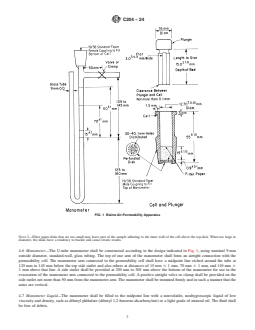
TEST METHOD A: REFERENCE METHOD described in 4.2 – 4.8.
4.2 Permeability Cell—The permeability cell shall consist
3. Terminology
of a rigid cylinder with a smooth bore of inside diameter
3.1 Definitions:
12.70 mm 6 0.10 mm, constructed of austenitic stainless steel.
3.1.1 For definitions of terms used in this test method, refer
The top of the cell shall be at right angles to the principal axis
to Terminology C125 and C219.
of the cell. The lower portion of the cell must be able to form
an airtight fit with the upper end of the manometer, so that there
4. Apparatus
is no air leakage between the contacting surfaces. A ledge
4.1 Nature of Apparatus—The Blaine air-permeability ap-
⁄2 mm to 1 mm in width shall be an integral part of the cell or
paratus consists essentially of a means of drawing a definite
be firmly fixed in the cell 55 mm 6 10 mm from the top of the
quantity of air through a prepared bed of cement of definite
cell for support of the perforated metal disk. The top of the
porosity. The number and size of the pores in a prepared bed of
permeability cell shall be fitted with a protruding collar to
definite porosity is a function of the size of the particles and
facilitate the removal of the cell from the manometer.
determines the rate of airflow through the bed. The apparatus,
illustrated in Fig. 1, shall consist specifically of the parts NOTE 1—Specification A582/A582M Type 303 stainless steel (UNS
FIG. 1 Blaine Air-Permeability Apparatus
C204 − 24
designation S30300) has been found to be suitable for the construction of
for time intervals up to 60 s, and to 1 % or less for time
the permeability cell and the plunger.
intervals of 60 s to 300 s.
4.3 Disk—The disk shall be constructed of noncorroding
5. Calibration of Apparatus
metal and shall be 0.9 mm 6 0.1 mm in thickness, perforated
with 30 to 40 holes 1 mm in diameter equally distributed over
5.1 Sample—The calibration of the air permeability appara-
its area. The disk shall fit the inside of the cell snugly. The
tus shall be made using the current lot of NIST Standard
center portion of one side of the disk shall be marked or
Reference Material No. 114 or 46h. The sample shall be at
inscribed in a legible manner so as to permit the operator
room temperature when tested.
always to place that side downwards when inserting it into the
5.2 Bulk Volume of Compacted Bed of Powder—Determine
cell. The marking or inscription shall not extend into any of the
the bulk volume of the compacted bed of powder by physical
holes, nor touch their peripheries, nor extend into that area of
measurement or by the mercury displacement method as
the disk that rests on the cell ledge.
follows:
4.4 Plunger—The plunger shall be constructed of austenitic
5.2.1 Bulk Volume Determination by Physical
stainless steel and shall fit into the cell with a clearance of not
Measurement—Place two filter papers in the permeability cell.
more than 0.1 mm. The bottom of the plunger shall sharply
Use a rod slightly smaller than the diameter of the cell to press
meet the lateral surfaces and shall be at right angles to the
down the edges of the filter paper flat on the perforated disk.
principal axis. An air vent shall be provided by means of a flat
Determine the dimensions of the permeability cell, in cm, using
3.0 mm 6 0.3 mm wide on one side of the plunger. The top of
a measuring device readable to 0.001 cm. Measure the inside
the plunger shall be provided with a collar such that when the
diameter of the permeability cell near the perforated disk.
plunger is placed in the cell and the collar brought in contact
Measure the depth of the cell and the length of the plunger.
with the top of the cell, the distance between the bottom of the
Take three measurements of each dimension and use the
plunger and the top of the perforated disk shall be 15 mm 6
average value of each dimension to calculate the bulk volume
1 mm.
as follows:
4.5 Filter Paper—The filter paper shall be medium
V 5 π r h (1)
retentive, corresponding to Type 1, Grade B, in accordance
where:
with Specification E832. The filter paper disks shall be circular,
V = bulk volume occupied by sample, cm ,
with smooth edges, and shall have the same diameter (Note 2)
r = diameter cell/2, cm, and
as the inside of the cell.
h = cell depth – plunger length, cm.
NOTE 2—Filter paper disks that are too small may leave part of the
5.2.2 Bulk Volume Determination by the Mercury Displace-
sample adhering to the inner wall of the cell above the top disk. When too
ment Method—Place two filter paper disks in the permeability
large in diameter, the disks have a tendency to buckle and cause erratic
cell, pressing down the edges, using a rod having a diameter
results.
slightly smaller than that of the cell, until the filter disks are flat
4.6 Manometer—The U-tube manometer shall be con-
on the perforated metal disk; then fill the cell with mercury,
structed according to the design indicated in Fig. 1, using
ACS reagent grade or better, removing any air bubbles adher-
nominal 9 mm outside diameter, standard-wall, glass tubing.
ing to the wall of the cell. Use tongs when handling the cell. If
The top of one arm of the manometer shall form an airtight
the cell is made of material that will amalgamate with mercury,
connection with the permeability cell. The manometer arm
the interior of the cell shall be protected by a very thin film of
connected to the permeability cell shall have a midpoint line
oil just prior to adding the mercury. Level the mercury with the
etched around the tube at 125 mm to 145 mm below the top
top of the cell by lightly pressing a small glass plate against the
side outlet and also others at distances of 15 mm 6 1 mm,
mercury surface until the glass is flush to the surface of the
70 mm 6 1 mm, and 110 mm 6 1 mm above that line. A side
mercury and rim of the cell, being sure that no bubble or void
outlet shall be provided at 250 mm to 305 mm above the
exists between the mercury surface and the glass plate.
bottom of the manometer for use in the evacuation of the
Remove the mercury from the cell and measure and record the
manometer arm connected to the permeability cell. A positive
mass of the mercury. Remove one of the filter disks from the
airtight valve or clamp shall be provided on the side outlet not
cell. Using a trial quantity of 2.80 g of cement (Note 3)
more than 50 mm from the manometer arm. The manometer
compress the cement (Note 4) in accordance with 5.5 with one
shall be mounted firmly and in such a manner that the arms are
filter disk above and one below the sample. Into the unfilled
vertical.
space at the top of the cell, add mercury, remove entrapped air,
4.7 Manometer Liquid—The manometer shall be filled to and level off the top as before. Remove the mercury from the
the midpoint line with a nonvolatile, nonhygroscopic liquid of cell and measure and record the mass of the mercury.
low viscosity and density, such as dibutyl phthalate (dibutyl
5.2.3 Calculate the bulk volume occupied by the cement to
1,2-benzene-dicarboxylate) or a light grade of mineral oil. The
the nearest 0.005 cm as follows:
fluid shall be free of debris.
V 5 ~W 2 W !/D (2)
A B
4.8 Timer—The timer shall have a positive starting and
where:
stopping mechanism and shall be capable of being read to the
V = bulk volume of cement, cm ,
nearest 0.5 s or less. The timer shall be accurate to 0.5 s or less
C204 − 24
edges down with a rod having a diameter slightly smaller than
W = grams of mercury required to fill the cell, no cement
A
that of the cell. Measure the mass to the nearest 0.001 g the
being in the cell,
quantity of cement determined in accordance with 5.4 and
W = grams of mercury required to fill the portion of the cell
B
place in the cell. Tap the side of the cell lightly in order to level
not occupied by the prepared bed of cement in the cell,
the bed of cement. Place a filter paper disk on top of the cement
and
D = density of mercury at the temperature of test, Mg/m and compress the cement with the plunger until the plunger
collar is in contact with the top of the cell. Slowly withdraw the
(see Table 1).
plunger a short distance, rotate about 90°, repress, and then
5.2.4 Make at least two determinations of bulk volume of
slowly withdraw. Use of fresh paper filter disks is required for
cement, using separate compactions for each determination.
each determination.
The bulk volume value used for subsequent calculations shall
5.6 Permeability Test:
be the average of two values agreeing within 60.005 cm .
Note the temperature in the vicinity of the cell and record at the 5.6.1 Attach the permeability cell to the manometer tube,
making certain that an airtight connection is obtained (Note 6)
beginning and end of the determination.
and taking care not to jar or disturb the prepared bed of cement.
NOTE 3—It is not necessary to use the standard sample for the bulk
5.6.2 Slowly evacuate the air in the one arm of the manom-
volume determination.
eter U-tube until the liquid reaches the top mark, and then close
NOTE 4—The prepared bed of cement shall be firm. If too loose or if the
cement cannot be compressed to the desired volume, adjust the trial
the valve tightly. Start the timer when the bottom of the
quantity of cement used.
meniscus of the manometer liquid reaches the second (next to
the top) mark and stop when the bottom of the meniscus of
5.3 Preparation of Sample—Enclose the contents of a vial
of the standard cement sample in a jar, approximately 120 cm liquid reaches the third (next to the bottom) mark. Note the
time interval measured and record in seconds. Note the
(4 oz), and shake vigorously for 2 min to fluff the cement and
break up lumps or agglomerates. Allow the jar to stand temperature of test and record in degrees Celsius.
unopened for a further 2 min, then remove the lid and stir 5.6.3 In the calibration of the instrument, make at least three
gently to distribute throughout the sample the fine fraction that determinations of the time of flow on each of three separately
has settled on the surface after fluffing.
prepared beds of the standard sample (Note 7). The calibration
shall be made by the same operator who makes the fineness
5.4 Mass of Sample—The mass of the standard sample used
determination.
for the calibration test shall be that required to produce a bed
of cement having a porosity of 0.500 6 0.005, and shall be
NOTE 6—A little stopcock grease should be applied to the standard taper
calculated as follows: connection. The efficiency of the connection can be determined by
attaching the cell to the manometer, stoppering it, partially evacuating the
W 5 ρV~1 2 ε! (3)
one arm of the manometer, then closing the valve. Any continuous drop in
pressure indicates a leak in the system.
where:
NOTE 7—The sample may be refluffed and reused for preparation of the
W = grams of sample required,
test bed, provided that it is kept dry and all tests are made within 4 h of
ρ = density of test sample (for portland cement a value of the opening of the sample.
3 3
3.15 Mg/m or 3.15 g/cm shall be used),
5.7 Recalibration—The apparatus shall be recalibrated
V = bulk volume of bed of cement, cm , as determined in
(Note 8):
accordance with 5.2, and
5.7.1 At periodic intervals, the duration of which shall not
ε = desired porosity of bed of cement (0.500 6 0.005)
exceed 2 ⁄2 years of service, to correct for possible wear on the
(Note 5).
plunger or permeability cell, or upon receipt of evidence that
NOTE 5—The porosity is the ratio of volume of voids in a bed of cement
the test is not providing data in accordance with the precision
to the total or bulk volume of the bed, V.
and bias statement in Section 9.
5.5 Preparation of Bed of Cement—Seat the perforated disk
5.7.2 If any loss in the manometer fluid occurs, recalibrate
on the ledge in the permeability cell, inscribed or marked face
starting with 5.5, or
down. Place a filter paper disk on the metal disk and press the
5.7.3 If a change is made in the type or quality of the filter
paper used for the tests.
TABLE 1 Density of Mercury, Viscosity of Air (η), and =η at
NOTE 8—It is suggested that a secondary sample be prepared and used
Given Temperatur
...
This document is not an ASTM standard and is intended only to provide the user of an ASTM standard an indication of what changes have been made to the previous version. Because
it may not be technically possible to adequately depict all changes accurately, ASTM recommends that users consult prior editions as appropriate. In all cases only the current version
of the standard as published by ASTM is to be considered the official document.
Designation: C204 − 23 C204 − 24 American Association State
Highway and Transportation Officials Standard
AASHTO No.: T 153
Standard Test Methods for
Fineness of Hydraulic Cement by Air-Permeability
Apparatus
This standard is issued under the fixed designation C204; the number immediately following the designation indicates the year of
original adoption or, in the case of revision, the year of last revision. A number in parentheses indicates the year of last reapproval. A
superscript epsilon (´) indicates an editorial change since the last revision or reapproval.
1. Scope*
1.1 This test method covers determination of the fineness of hydraulic cement, using the Blaine air-permeability apparatus, in
terms of the specific surface expressed as total surface area in square centimetres per gram, or square metres per kilogram, of
cement. Two test methods are given: Test Method A is the Reference Test Method using the manually operated standard Blaine
apparatus, while Test Method B permits the use of automated apparatus that has in accordance with the qualification requirements
of this test method demonstrated acceptable performance. Although the test method may be, and has been, used for the
determination of the measures of fineness of various other materials, it should be understood that, in general, relative rather than
absolute fineness values are obtained.
1.1.1 This test method is known to work well for portland cements. However, the user should exercise judgement in determining
its suitability with regard to fineness measurements of cements with densities, or porosities that differ from those assigned to
Standard Reference Material No. 114 or No. 46h.
1.2 The values stated in SI units are to be regarded as the standard.
1.3 Warning—Mercury has been designated by many regulatory agencies as a hazardous substance that can cause serious
medical issues. Mercury, or its vapor, has been demonstrated to be hazardous to health and corrosive to materials. Caution should
be taken when handling mercury and mercury containing products. See the applicable product Safety Data Sheet (SDS) for
additional information. Users should be aware that selling mercury and/or mercury containing products into your state or country
may be prohibited by law.
1.4 This standard does not purport to address all of the safety concerns, if any, associated with its use. It is the responsibility
of the user of this standard to establish appropriate safety, health, and environmental practices and determine the applicability of
regulatory limitations prior to use.
1.5 This international standard was developed in accordance with internationally recognized principles on standardization
established in the Decision on Principles for the Development of International Standards, Guides and Recommendations issued
by the World Trade Organization Technical Barriers to Trade (TBT) Committee.
2. Referenced Documents
2.1 ASTM Standards:
A582/A582M Specification for Free-Machining Stainless Steel Bars
This test method is under the jurisdiction of ASTM Committee C01 on Cement and is the direct responsibility of Subcommittee C01.25 on Fineness.
Current edition approved April 1, 2023Jan. 1, 2024. Published May 2023January 2024. Originally approved in 1946. Last previous edition approved in 20182023 as C204 –
ɛ1
1823. . DOI: 10.1520/C0204-23.10.1520/C0204-24.
For referenced ASTM standards, visit the ASTM website, www.astm.org, or contact ASTM Customer Service at service@astm.org. For Annual Book of ASTM Standards
volume information, refer to the standard’s Document Summary page on the ASTM website.
*A Summary of Changes section appears at the end of this standard
Copyright © ASTM International, 100 Barr Harbor Drive, PO Box C700, West Conshohocken, PA 19428-2959. United States
C204 − 24
C125 Terminology Relating to Concrete and Concrete Aggregates
C219 Terminology Relating to Hydraulic and Other Inorganic Cements
C670 Practice for Preparing Precision and Bias Statements for Test Methods for Construction Materials
E832 Specification for Laboratory Filter Papers
2.2 NIST Standards:
No. 46h National Institute of Standards and Technology Standard Reference Material
No. 114 National Institute of Standards and Technology Standard Reference Material
2.3 Other Document:
BS 4359: 1971 British Standard Method for the Determination of Specific Surface of Powders: Part 2: Air Permeability
Methods
TEST METHOD A: REFERENCE METHOD
3. Terminology
3.1 Definitions:
3.1.1 For definitions of terms used in this test method, refer to Terminology C125 and C219.
4. Apparatus
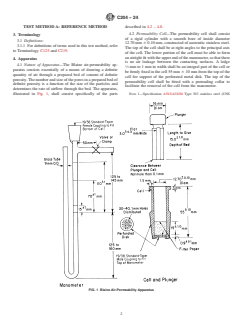
4.1 Nature of Apparatus—The Blaine air-permeability apparatus consists essentially of a means of drawing a definite quantity of
air through a prepared bed of cement of definite porosity. The number and size of the pores in a prepared bed of definite porosity
is a function of the size of the particles and determines the rate of airflow through the bed. The apparatus, illustrated in Fig. 1, shall
consist specifically of the parts described in 4.2 – 4.8.
4.2 Permeability Cell—The permeability cell shall consist of a rigid cylinder with a smooth bore of inside diameter 12.70 mm 6
0.10 mm in inside diameter, mm, constructed of austenitic stainless steel. The interior of the cell shall have a finish of 0.81 μm
(32 μin.). The top of the cell shall be at right angles to the principal axis of the cell. The lower portion of the cell must be able
to form an airtight fit with the upper end of the manometer, so that there is no air leakage between the contacting surfaces. A ledge
⁄2 mm to 1 mm in width shall be an integral part of the cell or be firmly fixed in the cell 55 mm 6 10 mm from the top of the
cell for support of the perforated metal disk. The top of the permeability cell shall be fitted with a protruding collar to facilitate
the removal of the cell from the manometer.
NOTE 1—Specification A582/A582M Type 303 stainless steel (UNS designation S30300) has been found to be suitable for the construction of the
permeability cell and the plunger.
4.3 Disk—The disk shall be constructed of noncorroding metal and shall be 0.9 mm 6 0.1 mm in thickness, perforated with 30
to 40 holes 1 mm in diameter equally distributed over its area. The disk shall fit the inside of the cell snugly. The center portion
of one side of the disk shall be marked or inscribed in a legible manner so as to permit the operator always to place that side
downwards when inserting it into the cell. The marking or inscription shall not extend into any of the holes, nor touch their
peripheries, nor extend into that area of the disk that rests on the cell ledge.
4.4 Plunger—The plunger shall be constructed of austenitic stainless steel and shall fit into the cell with a clearance of not more
than 0.1 mm. 0.1 mm. The bottom of the plunger shall sharply meet the lateral surfaces and shall be at right angles to the principal
axis. An air vent shall be provided by means of a flat 3.0 mm 6 0.3 mm 0.3 mm wide on one side of the plunger. The top of the
plunger shall be provided with a collar such that when the plunger is placed in the cell and the collar brought in contact with the
top of the cell, the distance between the bottom of the plunger and the top of the perforated disk shall be 15 mm 6 1 mm.15 mm
6 1 mm.
4.5 Filter Paper—The filter paper shall be medium retentive, corresponding to Type 1, Grade B, in accordance with Specification
E832. The filter paper disks shall be circular, with smooth edges, and shall have the same diameter (Note 2) as the inside of the
cell.
Available from National Institute of Standards and Technology (NIST), 100 Bureau Dr., Stop 1070, Gaithersburg, MD 20899-1070, http://www.nist.gov.
Available from British Standards Institute (BSI), 389 Chiswick High Rd., London W4 4AL, U.K., http://www.bsi-global.com.
C204 − 24
FIG. 1 Blaine Air-Permeability Apparatus
NOTE 2—Filter paper disks that are too small may leave part of the sample adhering to the inner wall of the cell above the top disk. When too large in
diameter, the disks have a tendency to buckle and cause erratic results.
4.6 Manometer—The U-tube manometer shall be constructed according to the design indicated in Fig. 1, using nominal 9 mm
outside diameter, standard-wall, glass tubing. The top of one arm of the manometer shall form an airtight connection with the
permeability cell. The manometer arm connected to the permeability cell shall have a midpoint line etched around the tube at
125 mm to 145 mm below the top side outlet and also others at distances of 15 mm 6 1 mm, 70 mm 6 1 mm, and 110 mm 6
1 mm above that line. A side outlet shall be provided at 250 mm to 305 mm above the bottom of the manometer for use in the
evacuation of the manometer arm connected to the permeability cell. A positive airtight valve or clamp shall be provided on the
side outlet not more than 50 mm from the manometer arm. The manometer shall be mounted firmly and in such a manner that the
arms are vertical.
4.7 Manometer Liquid—The manometer shall be filled to the midpoint line with a nonvolatile, nonhygroscopic liquid of low
viscosity and density, such as dibutyl phthalate (dibutyl 1,2-benzene-dicarboxylate) or a light grade of mineral oil. The fluid shall
be free of debris.
C204 − 24
4.8 Timer—The timer shall have a positive starting and stopping mechanism and shall be capable of being read to the nearest 0.5
s or less. The timer shall be accurate to 0.5 s or less for time intervals up to 60 s, and to 1 % or less for time intervals of 6060 s
to 300 s.
5. Calibration of Apparatus
5.1 Sample—The calibration of the air permeability apparatus shall be made using the current lot of NIST Standard Reference
Material No. 114 or 46h. The sample shall be at room temperature when tested.
5.2 Bulk Volume of Compacted Bed of Powder—Determine the bulk volume of the compacted bed of powder by physical
measurement or by the mercury displacement method as follows:
5.2.1 Bulk Volume Determination by Physical Measurement—Place two filter papers in the permeability cell. Use a rod slightly
smaller than the diameter of the cell to press down the edges of the filter paper flat on the perforated disk. Determine the dimensions
of the permeability cell, in cm, using a measuring device readable to 0.001 cm. Measure the inside diameter of the permeability
cell near the perforated disk. Measure the depth of the cell and the length of the plunger. Take three measurements of each
dimension and use the average value of each dimension to calculate the bulk volume as follows:
V 5 πr h (1)
where:
V = bulk volume occupied by sample, cm ,
r = diameter cell/2, cm, and
h = cell depth – plunger length, cm.
5.2.2 Bulk Volume Determination by the Mercury Displacement Method—Place two filter paper disks in the permeability cell,
pressing down the edges, using a rod having a diameter slightly smaller than that of the cell, until the filter disks are flat on the
perforated metal disk; then fill the cell with mercury, ACS reagent grade or better, removing any air bubbles adhering to the wall
of the cell. Use tongs when handling the cell. If the cell is made of material that will amalgamate with mercury, the interior of the
cell shall be protected by a very thin film of oil just prior to adding the mercury. Level the mercury with the top of the cell by lightly
pressing a small glass plate against the mercury surface until the glass is flush to the surface of the mercury and rim of the cell,
being sure that no bubble or void exists between the mercury surface and the glass plate. Remove the mercury from the cell and
measure and record the mass of the mercury. Remove one of the filter disks from the cell. Using a trial quantity of 2.80 g of cement
(Note 3) compress the cement (Note 4) in accordance with 5.5 with one filter disk above and one below the sample. Into the unfilled
space at the top of the cell, add mercury, remove entrapped air, and level off the top as before. Remove the mercury from the cell
and measure and record the mass of the mercury.
5.2.3 Calculate the bulk volume occupied by the cement to the nearest 0.005 cm as follows:
V 5 ~W 2 W !/D (2)
A B
where:
V = bulk volume of cement, cm ,
W = grams of mercury required to fill the cell, no cement being in the cell,
A
W = grams of mercury required to fill the portion of the cell not occupied by the prepared bed of cement in the cell, and
B
D = density of mercury at the temperature of test, Mg/m (see Table 1).
5.2.4 Make at least two determinations of bulk volume of cement, using separate compactions for each determination. The bulk
volume value used for subsequent calculations shall be the average of two values agreeing within 60.005 cm . Note the
temperature in the vicinity of the cell and record at the beginning and end of the determination.
NOTE 3—It is not necessary to use the standard sample for the bulk volume determination.
NOTE 4—The prepared bed of cement shall be firm. If too loose or if the cement cannot be compressed to the desired volume, adjust the trial quantity
of cement used.
C204 − 24
TABLE 1 Density of Mercury, Viscosity of Air (η), and =η at
Given Temperatures
Density of
Room Viscosity of Air, η
Mercury, =η
Temperature, °C μPa·s
Mg/m
18 13.55 17.98 4.24
20 13.55 18.08 4.25
22 13.54 18.18 4.26
24 13.54 18.28 4.28
26 13.53 18.37 4.29
28 13.53 18.47 4.30
30 13.52 18.57 4.31
32 13.52 18.67 4.32
34 13.51 18.76 4.33
5.3 Preparation of Sample—Enclose the contents of a vial of the standard cement sample in a jar, approximately 120 cm (4 oz),
and shake vigorously for 2 min to fluff the cement and break up lumps or agglomerates. Allow the jar to stand unopened for a
further 2 min, then remove the lid and stir gently to distribute throughout the sample the fine fraction that has settled on the surface
after fluffing.
5.4 Mass of Sample—The mass of the standard sample used for the calibration test shall be that required to produce a bed of
cement having a porosity of 0.500 6 0.005, and shall be calculated as follows:
W 5 ρV 12ε (3)
~ !
where:
W = grams of sample required,
3 3
ρ = density of test sample (for portland cement a value of 3.15 Mg/m or 3.15 g/cm shall be used),
V = bulk volume of bed of cement, cm , as determined in accordance with 5.2, and
ε = desired porosity of bed of cement (0.500 6 0.005) (Note 5).
NOTE 5—The porosity is the ratio of volume of voids in a bed of cement to the total or bulk volume of the bed, V.
5.5 Preparation of Bed of Cement—Seat the perforated disk on the ledge in the permeability cell, inscribed or marked face down.
Place a filter paper disk on the metal disk and press the edges down with a rod having a diameter slightly smaller than that of the
cell. Measure the mass to the nearest 0.001 g the quantity of cement determined in accordance with 5.4 and place in the cell. Tap
the side of the cell lightly in order to level the bed of cement. Place a filter paper disk on top of the cement and compress the cement
with the plunger until the plunger collar is in contact with the top of the cell. Slowly withdraw the plunger a short distance, rotate
about 90°, repress, and then slowly withdraw. Use of fresh paper filter disks is required for each determination.
5.6 Permeability Test:
5.6.1 Attach the permeability cell to the manometer tube, making certain that an airtight connection is obtained (Note 6) and taking
care not to jar or disturb the prepared bed of cement.
5.6.2 Slowly evacuate the air in the one arm of the manometer U-tube until the liquid reaches the top mark, and then close the
valve tightly. Start the timer when the bottom of the meniscus of the manometer liquid reaches the second (next to the top) mark
and stop when the bottom of the meniscus of liquid reaches the third (next to the bottom) mark. Note the time interval measured
and record in seconds. Note the temperature of test and record in degrees Celsius.
5.6.3 In the calibration of the instrument, make at least three determinations of the time of flow on each of three separately
prepared beds of the standard sample (Note 7). The calibration shall be made by the same operator who makes the fineness
determination.
NOTE 6—A little stopcock grease should be applied to the standard taper connection. The efficiency of the connection can be determined by attaching the
cell to the manometer, stoppering it, partially evacuating the one arm of the manometer, then closing the valve. Any continuous drop in pressure indicates
a leak in the system.
C204 − 24
NOTE 7—The sample may be refluffed and reused for preparation of the test bed, provided that it is kept dry and all tests are made within 4 h of the opening
of the sample.
5.7 Recalibration—The apparatus shall be recalibrated (Note 8):
5.7.1 At periodic intervals, the duration of which shall not exceed 2 ⁄2 years of service, to correct for possible wear on the plunger
...