

ASTM D4070-15(2022)
(Specification)Standard Specification for Adhesive Lubricant for Installation of Preformed Elastomeric Bridge Compression Seals in Concrete Structures
General Information
- Abstract
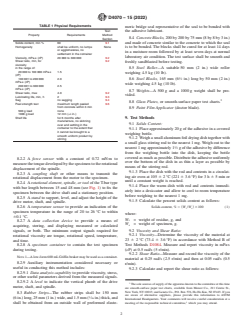
SCOPE
1.1 This specification covers an adhesive lubricant for facilitating the insertion and positioning of preformed elastomeric bridge compression seals in either concrete or steel-faced joints, and which bonds the seal to the joint faces to waterproof the joint.
1.2 Since a precision estimate for this standard has not been developed, this test method is to be used for research or informational purposes only. Therefore, this test should not be used for acceptance or rejection of a material for purchasing purposes.
1.3 SI units are the standard. Units in parentheses are for information only.
1.4 This international standard was developed in accordance with internationally recognized principles on standardization established in the Decision on Principles for the Development of International Standards, Guides and Recommendations issued by the World Trade Organization Technical Barriers to Trade (TBT) Committee.
- Status
- Published
- Publication Date
- 31-May-2022
- Technical Committee
- D04 - Road and Paving Materials
- Drafting Committee
- D04.34 - Preformed Joint Fillers, Sealers and Sealing Systems

Overview
ASTM D4070-15(2022) is the standard specification issued by ASTM International for adhesive lubricants utilized during the installation of preformed elastomeric bridge compression seals. These seals are integral to concrete or steel-faced joints in bridge construction and are designed to waterproof joints, prevent moisture infiltration, and accommodate structural movement. The specification defines the requirements for the adhesive lubricant, ensuring it facilitates both the insertion and bonding of the elastomeric seal to the joint faces.
This standard supports industry professionals in selecting and evaluating adhesive lubricants that optimize the performance of bridge joint sealing systems. It covers the basic physical properties, sampling, testing protocols, packaging, and marking required for compliance.
Key Topics
Scope and Intended Use
- Defines adhesive lubricants for inserting and positioning preformed elastomeric bridge compression seals in concrete or steel joints
- Ensures the adhesive bonds the seal to the joint faces, enabling effective waterproofing through expansion and contraction cycles
Physical Requirements
- The adhesive must be a one-component, moisture-curing polyurethane extended with aromatic hydrocarbon solvent
- Key performance criteria include:
- Minimum 60% solids content
- Viscosity between 20,000 to 300,000 mPa·s
- Shear ratio and proper lubricating life
- No sagging
- Adequate peel strength from bonded surfaces
Testing and Sampling
- Physical property tests should be conducted at standard laboratory conditions (23 ± 2 °C)
- Sampling protocols require composite samples from multiple containers of the same batch
Certification and Acceptance
- Acceptance may be based on manufacturer or third-party certification, or purchaser testing
- Emphasizes that test results should be used for research and informational purposes, not as direct criteria for purchase acceptance or rejection
Packaging and Marking
- Materials must be packaged in specified containers with clear labeling of manufacturer, product, batch information, safety, and application instructions
Applications
ASTM D4070-15(2022) finds practical use in:
Bridge Construction and Maintenance
- Ensures reliable and durable sealing of joints in new or existing concrete bridges
- Prevents water ingress, which can lead to concrete degradation and corrosion of reinforcement elements
Civil Infrastructure Projects
- Suitable for any application involving preformed elastomeric bridge compression seals in concrete or steel-faced joints
- Used by engineers, contractors, and infrastructure owners for quality assurance and product selection
Laboratory and Field Evaluation
- Guides testing laboratories and quality control teams in evaluating the physical properties and shelf life of adhesive lubricants before field use
Related Standards
Professionals applying ASTM D4070-15(2022) may also reference:
- ASTM D1084 - Test Methods for Viscosity of Adhesives
- Other relevant ASTM standards for bridge compression seals, joint fillers, and sealing systems
Practical Value
This standard improves the reliability of bridge joint installations by specifying the key physical and handling properties required of adhesive lubricants. By following ASTM D4070-15(2022), project stakeholders enhance the longevity, watertightness, and overall performance of elastomeric bridge compression seals, contributing to the durability and safety of critical infrastructure assets.
Keywords: adhesive lubricant, bridge compression seals, elastomeric seal, concrete joints, joint waterproofing, ASTM D4070, infrastructure standards, civil engineering, viscosity, joint sealing.
Relations
- Effective Date
- 01-Feb-2008
- Effective Date
- 01-Apr-2005
- Effective Date
- 10-Mar-1997
Get Certified
Connect with accredited certification bodies for this standard

DIBt (Deutsches Institut für Bautechnik)
German Institute for Building Technology.
DIN CERTCO
DIN Group product certification.

Aboma Certification B.V.
Specialized in construction, metal, and transport sectors.
Sponsored listings
Frequently Asked Questions
ASTM D4070-15(2022) is a technical specification published by ASTM International. Its full title is "Standard Specification for Adhesive Lubricant for Installation of Preformed Elastomeric Bridge Compression Seals in Concrete Structures". This standard covers: SCOPE 1.1 This specification covers an adhesive lubricant for facilitating the insertion and positioning of preformed elastomeric bridge compression seals in either concrete or steel-faced joints, and which bonds the seal to the joint faces to waterproof the joint. 1.2 Since a precision estimate for this standard has not been developed, this test method is to be used for research or informational purposes only. Therefore, this test should not be used for acceptance or rejection of a material for purchasing purposes. 1.3 SI units are the standard. Units in parentheses are for information only. 1.4 This international standard was developed in accordance with internationally recognized principles on standardization established in the Decision on Principles for the Development of International Standards, Guides and Recommendations issued by the World Trade Organization Technical Barriers to Trade (TBT) Committee.
SCOPE 1.1 This specification covers an adhesive lubricant for facilitating the insertion and positioning of preformed elastomeric bridge compression seals in either concrete or steel-faced joints, and which bonds the seal to the joint faces to waterproof the joint. 1.2 Since a precision estimate for this standard has not been developed, this test method is to be used for research or informational purposes only. Therefore, this test should not be used for acceptance or rejection of a material for purchasing purposes. 1.3 SI units are the standard. Units in parentheses are for information only. 1.4 This international standard was developed in accordance with internationally recognized principles on standardization established in the Decision on Principles for the Development of International Standards, Guides and Recommendations issued by the World Trade Organization Technical Barriers to Trade (TBT) Committee.
ASTM D4070-15(2022) is classified under the following ICS (International Classification for Standards) categories: 91.080.40 - Concrete structures. The ICS classification helps identify the subject area and facilitates finding related standards.
ASTM D4070-15(2022) has the following relationships with other standards: It is inter standard links to ASTM D1084-08, ASTM D1084-97(2005), ASTM D1084-97. Understanding these relationships helps ensure you are using the most current and applicable version of the standard.
ASTM D4070-15(2022) is available in PDF format for immediate download after purchase. The document can be added to your cart and obtained through the secure checkout process. Digital delivery ensures instant access to the complete standard document.
Standards Content (Sample)
This international standard was developed in accordance with internationally recognized principles on standardization established in the Decision on Principles for the
Development of International Standards, Guides and Recommendations issued by the World Trade Organization Technical Barriers to Trade (TBT) Committee.
Designation: D4070 −15 (Reapproved 2022)
Standard Specification for
Adhesive Lubricant for Installation of Preformed
Elastomeric Bridge Compression Seals in Concrete
Structures
This standard is issued under the fixed designation D4070; the number immediately following the designation indicates the year of
original adoption or, in the case of revision, the year of last revision. A number in parentheses indicates the year of last reapproval. A
superscript epsilon (´) indicates an editorial change since the last revision or reapproval.
1. Scope throughout repeated cycles of expansion and contraction,
effectively sealing the joint against infiltration of moisture.
1.1 This specification covers an adhesive lubricant for
facilitating the insertion and positioning of preformed elasto-
4. Physical Requirements
mericbridgecompressionsealsineitherconcreteorsteel-faced
joints, and which bonds the seal to the joint faces to waterproof 4.1 The material shall conform to the physical properties
the joint.
described in Table 1.
1.2 Since a precision estimate for this standard has not been
5. Sampling
developed, this test method is to be used for research or
informational purposes only. Therefore, this test should not be 5.1 Samples of the adhesive lubricant shall be 1 L (1 qt)
used for acceptance or rejection of a material for purchasing
consisting of a composite taken from three or more separate
purposes. containers chosen at random from the same batch. A batch or
lot shall be considered as all finished material that was
1.3 SI units are the standard. Units in parentheses are for
manufactured simultaneously or continuously as a unit prior to
information only.
packaging. Each of the containers sampled shall be resealed
1.4 This international standard was developed in accor-
and marked for identification.
dance with internationally recognized principles on standard-
5.2 Samples shall be taken at the point of manufacture or
ization established in the Decision on Principles for the
warehouse prior to delivery, or at the point of delivery from
Development of International Standards, Guides and Recom-
each lot.
mendations issued by the World Trade Organization Technical
Barriers to Trade (TBT) Committee.
6. Test Conditions
2. Referenced Documents
6.1 Tests shall be conducted at standard laboratory condi-
2.1 ASTM Standards: tions of 23 6 2 °C (73.4 6 3.6 °F). All materials and
equipment shall be held at these conditions prior to test for a
D1084 Test Methods for Viscosity of Adhesives
sufficient time to ensure equilibrium.
3. General Requirements
7. Specimen Preparation
3.1 The adhesive lubricant shall be a one-component,
moisture-curing, polyurethane compound extended with aro-
7.1 Using a square-tipped spatula, thoroughly hand-mix
matic hydrocarbon solvent. The compound shall provide ad-
approximately 500 mL (1 pt) of lubricant adhesive in a round
equate lubrication for insertion of the seal into the joint and, in
can for 1 min.
the actual field application, shall bond the seal to the joint face
8. Apparatus
8.1 Oven—The oven shall be a circulating air oven capable
This specification is under the jurisdiction of ASTM Committee D04 on Road
of maintaining temperature of 105 6 2 °C (221 6 4 °F).
and Paving Materials and is the direct responsibility of Subcommittee D04.34 on
Preformed Joint Fillers, Sealers and Sealing Systems.
8.2 Viscometer, Rotational—The essential instrumentation
Current edition approved June 1, 2022. Published June 2022. Originally
required providing the minimum rotational viscometer analyti-
approved in 1981. Last previous edition approved in 2015 as D4070 – 15. DOI:
10.1520/D4070-15R22.
cal capabilities for this method include:
For referenced ASTM standards, visit the ASTM website, www.astm.org, or
8.2.1 Adrive motor, to apply a unidirectional displacement
contact ASTM Customer Service at service@astm.org. For Annual Book of ASTM
tothespecimenataratefrom0.05to0.5rad/s(0.5to50r/min)
Standards volume information, refer to the standard’s Document Summary page on
the ASTM website. constant to within 1 %.
Copyright © ASTM International, 100 Barr Harbor Drive, PO Box C700, West Conshohocken, PA 19428-2959. United States
D4070 − 15 (2022)
TABLE 1 Physical Requirements
meric bridge seal representative of the seal to be bonded with
Test the adhesive lubricant.
Property Requirements Method
8.4 ConcreteBlocks, 200 by 200 by 75 mm (8 by 8 by 3 in.)
Section
and made of concrete similar to the concrete to which the seal
Solids content, min % 60 9.1
Homogeneity shall be uniform, no lumps None
is to be bonded. The blocks shall be cured for at least 14 days
or agglomerates, no
in a moisture room followed by at least seven days at normal
settlement in the container
laboratory air condition. The test surface shall be smooth and
Viscosity, mPa·s (cP) 20 000 to 300 000 9.2
Shear ratio, min, for 9.2
freshly sandblasted before testing.
viscosity
in the range of: 8.5 Steel Roller—A suitable 50 mm (2 in.) wide roller
20 000 to 100 000 mPa·s 1.5
weighing 4.5 kg (10 lb).
(cP)
100 001 to 200 000 2.0
8.6 Steel Blocks, 165 mm (6 ⁄2 in.) long by 50 mm (2 in.)
mPa·s (cP)
wide weighing 4.5 kg (10 lb).
200 001 to 300 000 2.5
mPa·s (cP)
8.7 Weights—A 500 g and a 1000 g weight shall be pro-
Shear ratio, max 4.0 9.2
vided.
Lubricating life, min, h 2 9.3
Sag no sagging 9.4 3
8.8 Glass Plates, or smooth-surface paper test charts.
Peel strength test maximum length peeled 9.6
from concrete within 3 min
8.9 Paint Film Applicator (doctor blade).
500 g load none
1000 g load 12 mm ( ⁄2 in.)
9. Test Methods
Shelf life for 6 months after
manufacture, no skinning
9.1 Solids Content:
over and settling in the
container to the extent that
9.1.1 Place approximately 20 g of the adhesive in a covered
it cannot be brought to a
weighing bottle.
smooth uniform product by
9.1.2 Weighasmallaluminumfoildryingdishtogetherwith
stirring
a small glass stirring rod to the nearest 1 mg. Weigh out to the
nearest 1 mg approximately 1 ⁄2 g of the adhesive by difference
from the weighing bottle into the dish, keeping the bottle
covered as much as possible. Distribute the adhesive uniformly
8.2.2 A force sensor with a constant of 0.72 mN·m to
over the bottom of the dish in as thin a layer as possible by
measure the torque developed by the specimen to the rotational
means of the stirring rod.
displacement of the spindle.
9.1.3 Place the dish with the rod and contents in a circulat-
8.2.3 A coupling shaft or other means to transmit the
ing air oven at 105 6 2 °C (221 6 3.6 °F) for 3 h 6 5 min or
rotational displacement from the motor to the specimen.
until a constant weight is reached.
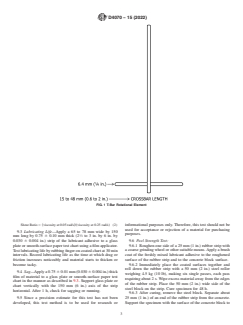
8.2.4 Arotational element, spindle, or tool of theT-bar type
9.1.4 Place the warm dish with rod and contents immedi-
with bar length between 15 and 48 mm (see Fig. 1)tofixthe
ately into a desiccator and allow to cool to room temperature
specimen between the drive shaft and a stationary position.
before weighing to the nearest 1 mg.
8.2.5 A stand to support, level, and adjust the height of the
9.1.5 Calculate the percent solids content as follows:
drive motor, shaft, and spindle.
Solids content, % 5 W /W 3100 (1)
8.2.6 A temperature sensor to provide an indication of the ~ !
r s
specimen temperature in the range of 20 to 26 °C to within
where:
60.1 °C.
W = weight of residue, g, and
r
8.2.7 A data collection device to provide a means of
W = weight
...