

ASTM D7388-23
(Specification)Standard Specification for Engine Coolant Grade 1,3-Propanediol (PDO)
General Information
- Abstract
ABSTRACT
This specification covers engine coolant grade 1,3-propanediol (PDO). Engine coolant grade 1,3-propanediol shall conform to the chemical and physical property requirements specified. Density or relative density, color of clear liquids, pH, trace chloride ion, ion chromatography analysis, digital density meter, ethylene glycols and propylene glycols analyses, and inductively couple plasma-atomic emission spectroscopy tests shall be performed.
SCOPE
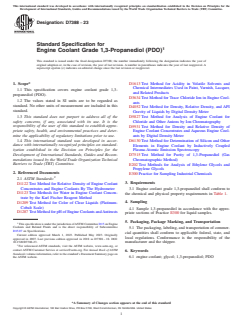
1.1 This specification covers engine coolant grade 1,3-propanediol (PDO).
1.2 The values stated in SI units are to be regarded as standard. No other units of measurement are included in this standard.
1.3 This standard does not purport to address all of the safety concerns, if any, associated with its use. It is the responsibility of the user of this standard to establish appropriate safety, health, and environmental practices and determine the applicability of regulatory limitations prior to use.
1.4 This international standard was developed in accordance with internationally recognized principles on standardization established in the Decision on Principles for the Development of International Standards, Guides and Recommendations issued by the World Trade Organization Technical Barriers to Trade (TBT) Committee.
- Status
- Published
- Publication Date
- 28-Feb-2023
- Technical Committee
- D15 - Engine Coolants and Related Fluids
- Drafting Committee
- D15.07 - Specifications
Buy Documents


ASTM D7388-23 - Standard Specification for Engine Coolant Grade 1,3-Propanediol (PDO)


REDLINE ASTM D7388-23 - Standard Specification for Engine Coolant Grade 1,3-Propanediol (PDO)
Overview
ASTM D7388-23: Standard Specification for Engine Coolant Grade 1,3-Propanediol (PDO) provides the essential requirements and test methods for assessing the quality and suitability of 1,3-propanediol used in engine coolant formulations. Developed by ASTM International, this standard establishes chemical and physical property criteria to ensure that PDO meets the necessary performance, safety, and environmental standards in automotive and industrial cooling systems.
Engine coolant grade 1,3-propanediol is widely used as an alternative glycol component in coolant/antifreeze blends, offering distinct environmental and operational benefits. The standard helps manufacturers, laboratories, and users verify product quality, supporting safe and effective engine coolant applications.
Key Topics
Chemical and Physical Property Requirements
The specification outlines mandatory thresholds for purity, including:- Minimum 99.0% 1,3-propanediol content by mass
- Maximum limits for impurities such as dipropylene glycol (0.5%) and other glycols (0.2%)
- Water content capped at 0.5% by mass
- Acidity, chloride, sulfate, nitrite, nitrate, phosphate, silicon, boron, and select metals strictly limited
Testing Procedures
Recognized ASTM test methods must be used to confirm compliance, such as:- Density by digital density meter
- pH evaluation
- Ion chromatography for anion content
- Color determination (Platinum-Cobalt Scale)
- Gas chromatographic analysis for purity
- Inductively Coupled Plasma-Atomic Emission Spectroscopy for elemental impurities
Packaging and Labeling
The standard highlights conformance to federal, state, and local regulations covering packaging, marking, and transportation, ensuring safe handling and regulatory compliance.International Standardization Principles
ASTM D7388-23 adheres to internationally recognized approaches established by the World Trade Organization's Technical Barriers to Trade (TBT) Committee, supporting global trade and uniform quality.
Applications
Engine coolant grade 1,3-propanediol is primarily applied in the formulation of coolants for automotive and stationary engines. Key applications include:
Automotive Cooling Systems
PDO-based coolants provide efficient heat transfer and corrosion protection, ensuring optimal engine performance and longevity. Their favorable toxicity and biodegradability profiles make them suitable for environmentally conscious users.Industrial Engine Coolants
Used in off-highway vehicles, generators, and large-scale refrigeration systems, PDO coolants offer a reliable solution where both environmental compliance and operational efficiency are priorities.Quality Assurance and Procurement
Laboratories and manufacturers rely on ASTM D7388-23 to verify incoming raw materials, support regulatory documentation, and assure clients of coolant safety and consistency.
Related Standards
Several related ASTM standards are referenced in ASTM D7388-23 to guide testing and compliance, including:
- ASTM D1122 - Measurement of relative density by hydrometer
- ASTM D1209 - Assessment of color in clear liquids
- ASTM D1287 - Testing pH of engine coolants and antirusts
- ASTM D3634/D5827 - Determination of trace chloride and other anions
- ASTM D7515 - Gas chromatographic method for PDO purity
- ASTM E300 - Practice for sampling industrial chemicals
- ASTM D6130 - Analysis of elemental composition by ICP-AES
Adhering to ASTM D7388-23 ensures that engine coolant products containing 1,3-propanediol meet stringent quality, safety, and environmental standards demanded by both regulatory authorities and the marketplace.
Relations
- Effective Date
- 15-May-2020
- Effective Date
- 01-Jan-2020
- Effective Date
- 01-Mar-2018
- Effective Date
- 01-Nov-2017
- Effective Date
- 01-Apr-2017
- Effective Date
- 01-Apr-2016
- Effective Date
- 01-Feb-2014
- Effective Date
- 01-May-2013
- Effective Date
- 01-May-2013
- Effective Date
- 01-Jun-2012
- Effective Date
- 01-Apr-2012
- Effective Date
- 01-Nov-2011
- Effective Date
- 01-Oct-2011
- Effective Date
- 01-Nov-2009
- Effective Date
- 01-Nov-2009
Buy Documents
ASTM D7388-23 - Standard Specification for Engine Coolant Grade 1,3-Propanediol (PDO)
REDLINE ASTM D7388-23 - Standard Specification for Engine Coolant Grade 1,3-Propanediol (PDO)
Get Certified
Connect with accredited certification bodies for this standard

ECOCERT
Organic and sustainability certification.

Eurofins Food Testing Global
Global leader in food, environment, and pharmaceutical product testing.

Intertek Bangladesh
Intertek certification and testing services in Bangladesh.
Sponsored listings
Frequently Asked Questions
ASTM D7388-23 is a technical specification published by ASTM International. Its full title is "Standard Specification for Engine Coolant Grade 1,3-Propanediol (PDO)". This standard covers: ABSTRACT This specification covers engine coolant grade 1,3-propanediol (PDO). Engine coolant grade 1,3-propanediol shall conform to the chemical and physical property requirements specified. Density or relative density, color of clear liquids, pH, trace chloride ion, ion chromatography analysis, digital density meter, ethylene glycols and propylene glycols analyses, and inductively couple plasma-atomic emission spectroscopy tests shall be performed. SCOPE 1.1 This specification covers engine coolant grade 1,3-propanediol (PDO). 1.2 The values stated in SI units are to be regarded as standard. No other units of measurement are included in this standard. 1.3 This standard does not purport to address all of the safety concerns, if any, associated with its use. It is the responsibility of the user of this standard to establish appropriate safety, health, and environmental practices and determine the applicability of regulatory limitations prior to use. 1.4 This international standard was developed in accordance with internationally recognized principles on standardization established in the Decision on Principles for the Development of International Standards, Guides and Recommendations issued by the World Trade Organization Technical Barriers to Trade (TBT) Committee.
ABSTRACT This specification covers engine coolant grade 1,3-propanediol (PDO). Engine coolant grade 1,3-propanediol shall conform to the chemical and physical property requirements specified. Density or relative density, color of clear liquids, pH, trace chloride ion, ion chromatography analysis, digital density meter, ethylene glycols and propylene glycols analyses, and inductively couple plasma-atomic emission spectroscopy tests shall be performed. SCOPE 1.1 This specification covers engine coolant grade 1,3-propanediol (PDO). 1.2 The values stated in SI units are to be regarded as standard. No other units of measurement are included in this standard. 1.3 This standard does not purport to address all of the safety concerns, if any, associated with its use. It is the responsibility of the user of this standard to establish appropriate safety, health, and environmental practices and determine the applicability of regulatory limitations prior to use. 1.4 This international standard was developed in accordance with internationally recognized principles on standardization established in the Decision on Principles for the Development of International Standards, Guides and Recommendations issued by the World Trade Organization Technical Barriers to Trade (TBT) Committee.
ASTM D7388-23 is classified under the following ICS (International Classification for Standards) categories: 71.080.60 - Alcohols. Ethers. The ICS classification helps identify the subject area and facilitates finding related standards.
ASTM D7388-23 has the following relationships with other standards: It is inter standard links to ASTM D5931-20, ASTM D1287-11(2020), ASTM D6130-11(2018), ASTM D5931-13(2017), ASTM D1122-16(2017)e1, ASTM D1122-16, ASTM D7515-09(2014), ASTM D1122-13, ASTM D5931-13, ASTM D1613-06(2012), ASTM E202-12, ASTM D6130-11, ASTM D1287-11, ASTM D3634-99(2009), ASTM D1287-09. Understanding these relationships helps ensure you are using the most current and applicable version of the standard.
ASTM D7388-23 is available in PDF format for immediate download after purchase. The document can be added to your cart and obtained through the secure checkout process. Digital delivery ensures instant access to the complete standard document.
Standards Content (Sample)
This international standard was developed in accordance with internationally recognized principles on standardization established in the Decision on Principles for the
Development of International Standards, Guides and Recommendations issued by the World Trade Organization Technical Barriers to Trade (TBT) Committee.
Designation: D7388 − 23
Standard Specification for
Engine Coolant Grade 1,3-Propanediol (PDO)
This standard is issued under the fixed designation D7388; the number immediately following the designation indicates the year of
original adoption or, in the case of revision, the year of last revision. A number in parentheses indicates the year of last reapproval. A
superscript epsilon (´) indicates an editorial change since the last revision or reapproval.
1. Scope* D1613 Test Method for Acidity in Volatile Solvents and
Chemical Intermediates Used in Paint, Varnish, Lacquer,
1.1 This specification covers engine coolant grade 1,3-
and Related Products
propanediol (PDO).
D3634 Test Method for Trace Chloride Ion in Engine Cool-
1.2 The values stated in SI units are to be regarded as
ants
standard. No other units of measurement are included in this
D4052 Test Method for Density, Relative Density, and API
standard.
Gravity of Liquids by Digital Density Meter
1.3 This standard does not purport to address all of the D5827 Test Method for Analysis of Engine Coolant for
safety concerns, if any, associated with its use. It is the
Chloride and Other Anions by Ion Chromatography
responsibility of the user of this standard to establish appro- D5931 Test Method for Density and Relative Density of
priate safety, health, and environmental practices and deter-
Engine Coolant Concentrates and Aqueous Engine Cool-
mine the applicability of regulatory limitations prior to use. ants by Digital Density Meter
1.4 This international standard was developed in accor-
D6130 Test Method for Determination of Silicon and Other
dance with internationally recognized principles on standard- Elements in Engine Coolant by Inductively Coupled
ization established in the Decision on Principles for the
Plasma-Atomic Emission Spectroscopy
Development of International Standards, Guides and Recom- D7515 Test Method for Purity of 1,3-Propanediol (Gas
mendations issued by the World Trade Organization Technical
Chromatographic Method)
Barriers to Trade (TBT) Committee. E202 Test Methods for Analysis of Ethylene Glycols and
Propylene Glycols
2. Referenced Documents
E300 Practice for Sampling Industrial Chemicals
2.1 ASTM Standards:
3. Requirements
D1122 Test Method for Relative Density of Engine Coolant
Concentrates and Engine Coolants By The Hydrometer
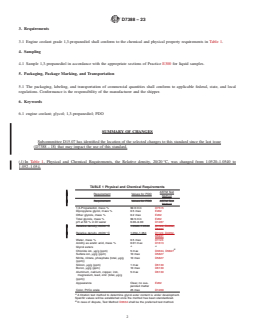
3.1 Engine coolant grade 1,3-propanediol shall conform to
D1123 Test Methods for Water in Engine Coolant Concen-
the chemical and physical property requirements in Table 1.
trate by the Karl Fischer Reagent Method
4. Sampling
D1209 Test Method for Color of Clear Liquids (Platinum-
Cobalt Scale)
4.1 Sample 1,3-propanediol in accordance with the appro-
D1287 Test Method for pH of Engine Coolants and Antirusts
priate sections of Practice E300 for liquid samples.
5. Packaging, Package Marking, and Transportation
This specification is under the jurisdiction of ASTM Committee D15 on Engine
Coolants and Related Fluids and is the direct responsibility of Subcommittee
5.1 The packaging, labeling, and transportation of commer-
D15.07 on Specifications.
cial quantities shall conform to applicable federal, state, and
Current edition approved March 1, 2023. Published May 2023. Originally
local regulations. Conformance is the responsibility of
...
This document is not an ASTM standard and is intended only to provide the user of an ASTM standard an indication of what changes have been made to the previous version. Because
it may not be technically possible to adequately depict all changes accurately, ASTM recommends that users consult prior editions as appropriate. In all cases only the current version
of the standard as published by ASTM is to be considered the official document.
Designation: D7388 − 18 D7388 − 23
Standard Specification for
Engine Coolant Grade 1,3-Propanediol (PDO)
This standard is issued under the fixed designation D7388; the number immediately following the designation indicates the year of
original adoption or, in the case of revision, the year of last revision. A number in parentheses indicates the year of last reapproval. A
superscript epsilon (´) indicates an editorial change since the last revision or reapproval.
1. Scope Scope*
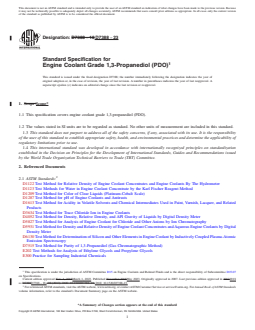
1.1 This specification covers engine coolant grade 1,3-propanediol (PDO).
1.2 The values stated in SI units are to be regarded as standard. No other units of measurement are included in this standard.
1.3 This standard does not purport to address all of the safety concerns, if any, associated with its use. It is the responsibility
of the user of this standard to establish appropriate safety, health, and environmental practices and determine the applicability of
regulatory limitations prior to use.
1.4 This international standard was developed in accordance with internationally recognized principles on standardization
established in the Decision on Principles for the Development of International Standards, Guides and Recommendations issued
by the World Trade Organization Technical Barriers to Trade (TBT) Committee.
2. Referenced Documents
2.1 ASTM Standards:
D1122 Test Method for Relative Density of Engine Coolant Concentrates and Engine Coolants By The Hydrometer
D1123 Test Methods for Water in Engine Coolant Concentrate by the Karl Fischer Reagent Method
D1209 Test Method for Color of Clear Liquids (Platinum-Cobalt Scale)
D1287 Test Method for pH of Engine Coolants and Antirusts
D1613 Test Method for Acidity in Volatile Solvents and Chemical Intermediates Used in Paint, Varnish, Lacquer, and Related
Products
D3634 Test Method for Trace Chloride Ion in Engine Coolants
D4052 Test Method for Density, Relative Density, and API Gravity of Liquids by Digital Density Meter
D5827 Test Method for Analysis of Engine Coolant for Chloride and Other Anions by Ion Chromatography
D5931 Test Method for Density and Relative Density of Engine Coolant Concentrates and Aqueous Engine Coolants by Digital
Density Meter
D6130 Test Method for Determination of Silicon and Other Elements in Engine Coolant by Inductively Coupled Plasma-Atomic
Emission Spectroscopy
D7515 Test Method for Purity of 1,3-Propanediol (Gas Chromatographic Method)
E202 Test Methods for Analysis of Ethylene Glycols and Propylene Glycols
E300 Practice for Sampling Industrial Chemicals
This specification is under the jurisdiction of ASTM Committee D15 on Engine Coolants and Related Fluids and is the direct responsibility of Subcommittee D15.07
on Specifications.
Current edition approved Nov. 1, 2018March 1, 2023. Published November 2018May 2023. Originally approved in 2007. Last previous edition approved in 20132018
as D7388D7388 – 18.–08 (2013). DOI: 10.1520/D7388–18. DOI: 10.1520/D7388-23.
For referenced ASTM standards, visit the ASTM website, www.astm.org, or contact ASTM Customer Service at service@astm.org. For Annual Book of ASTM Standards
volume information, refer to the standard’s Document Summary page on the ASTM website.
*A Summary of Changes section appears at the end of this standard
Copyright © ASTM International, 100 Barr Harbor Drive, PO Box C700, W
...