

ASTM D7901-23
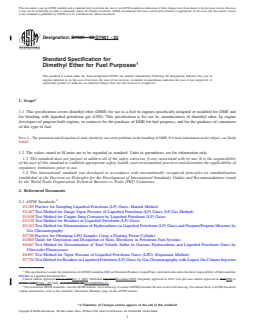
(Specification)Standard Specification for Dimethyl Ether for Fuel Purposes
General Information
- Abstract
ABSTRACT
This specification covers dimethyl ether (DME) for use as a fuel in engines specifically designed or modified for DME and for blending with liquefied petroleum gas. It is intended for use by DME manufacturers, purpose-built engine developers, in contracts for the purchase of DME for fuel purposes, and for the guidance of consumers of this type of fuel. This specification includes chemical composition and other requirements, sampling, and test methods.
SCOPE
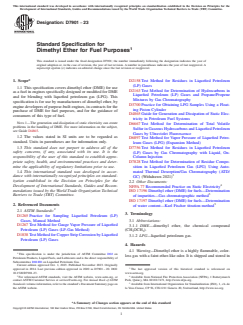
1.1 This specification covers dimethyl ether (DME) for use as a fuel in engines specifically designed or modified for DME and for blending with liquefied petroleum gas (LPG). This specification is for use by manufacturers of dimethyl ether, by engine developers of purpose-built engines, in contracts for the purchase of DME for fuel purposes, and for the guidance of consumers of this type of fuel.
Note 1: The generation and dissipation of static electricity can create problems in the handling of DME. For more information on the subject, see Guide D4865.
1.2 The values stated in SI units are to be regarded as standard. Units in parentheses are for information only.
1.3 This standard does not purport to address all of the safety concerns, if any, associated with its use. It is the responsibility of the user of this standard to establish appropriate safety, health, and environmental practices and determine the applicability of regulatory limitations prior to use.
1.4 This international standard was developed in accordance with internationally recognized principles on standardization established in the Decision on Principles for the Development of International Standards, Guides and Recommendations issued by the World Trade Organization Technical Barriers to Trade (TBT) Committee.
- Status
- Published
- Publication Date
- 30-Sep-2023
- Technical Committee
- D02 - Petroleum Products, Liquid Fuels, and Lubricants
- Drafting Committee
- D02.H0 - Liquefied Petroleum Gas
Overview
ASTM D7901-23: Standard Specification for Dimethyl Ether for Fuel Purposes outlines the requirements for using dimethyl ether (DME) as a fuel in specially designed or modified engines and for DME blending with liquefied petroleum gas (LPG). Developed by ASTM International, this specification addresses chemical composition, physical properties, safety considerations, sampling, and applicable test methods. Its target audiences include DME manufacturers, engine developers, OEMs, fuel suppliers, and end consumers.
Dimethyl ether is a clean, efficient, alternative fuel, increasingly recognized for its potential in reducing emissions and enhancing fuel security. ASTM D7901-23 provides a consensus-based framework to ensure DME fuel meets quality, performance, and safety expectations essential for commercial and consumer adoption.
Key Topics
- Scope of Specification: Covers requirements for DME used as a primary fuel in purpose-built engines and as a component for LPG blending.
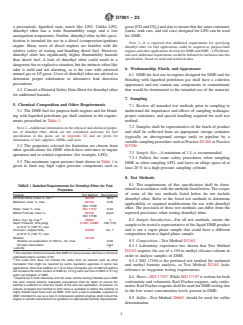
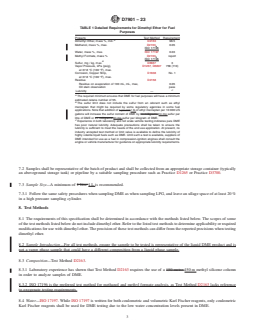
- Chemical Composition: Specifies minimum DME purity (98.5% by mass), maximum limits for methanol (0.05% by mass), water (0.03% by mass), and sulfur (3 mg/kg), plus reporting requirements for methyl formate content.
- Physical Properties: Includes limitations for vapor pressure (max 758 kPa at 37.8°C), copper strip corrosion, and residue content to ensure compatibility and performance in fuel applications.
- Sampling and Test Methods: References procedures for representative sampling (e.g., ASTM D1265, D3700) and test methods for verifying composition (e.g., ASTM D2163, ISO 17196), water content (ISO 17197), and other critical parameters.
- Workmanship & Safety: Emphasizes the importance of DME being colorless and free of detrimental contaminants, details proper odorization and leak detection, and highlights the significant flammability hazards compared to conventional diesel fuel.
- Material Compatibility & Handling: Provides guidance on compatible materials for DME handling and the need for proper grounding to mitigate static electricity risks during storage and transportation.
Applications
- Fuel for DME Engines: Ensures consistent fuel quality for manufacturers and users of vehicles and equipment operating on DME, supporting reliable engine operation and long-term performance.
- Blending with LPG: Enables safe and effective blending of DME in LPG for use in markets where this practice is established or emerging, facilitating adoption in diverse regions.
- Fuel Procurement & Regulation: Offers a uniform basis for contracts, regulatory compliance, and performance guarantees-including in jurisdictions such as California, where established fuel standards are mandatory.
- Biofuel and Sustainability Initiatives: Supports the use of DME produced from renewable sources (e.g., biomethane), aiding stakeholders focused on low-emission, sustainable fuel solutions.
- OEM Product Development: Provides engine and equipment manufacturers with a well-defined fuel specification, enabling innovation and the creation of purpose-built DME powertrains.
Related Standards
To ensure comprehensive fuel quality oversight and safe DME handling, ASTM D7901-23 draws on several key standards:
Sampling & Analytical Methods:
- ASTM D1265: Sampling Liquefied Petroleum (LP) Gases
- ASTM D3700: Obtaining LPG Samples Using a Floating Piston Cylinder
- ASTM D2163: Determination of Hydrocarbons in LP Gases
- ISO 17196: DME for fuels-Impurities via gas chromatographic method
- ISO 17197: DME for fuels-Water content determination via Karl Fischer titration
Physical & Chemical Testing:
- ASTM D6667: Sulfur in Gaseous Hydrocarbons
- ASTM D1838: Copper Strip Corrosion by LP Gases
- ASTM D2158, D7756: Residues in LP Gases
- ASTM D1267, D6897: Vapor Pressure of LPG
Safety & Handling:
- ASTM D4865: Static Electricity in Petroleum Fuel Systems
- NFPA 77: Recommended Practice on Static Electricity
General Compliance:
- Developed in accordance with WTO TBT Committee international standardization principles
By adhering to ASTM D7901-23 and its referenced practices, stakeholders in the DME fuel industry can achieve consistent fuel quality, maximize safety, facilitate market adoption, and support regulatory compliance worldwide.
Relations
- Effective Date
- 01-Oct-2023
- Effective Date
- 01-Dec-2023
- Effective Date
- 01-Nov-2023
- Effective Date
- 01-Mar-2023
- Effective Date
- 01-Mar-2023
- Effective Date
- 01-Jul-2019
- Effective Date
- 01-Oct-2023
- Effective Date
- 01-Oct-2023
Get Certified
Connect with accredited certification bodies for this standard

ECOCERT
Organic and sustainability certification.

Element Materials Technology
Materials testing and product certification.

ABS Group Brazil
ABS Group certification services in Brazil.
Sponsored listings
Frequently Asked Questions
ASTM D7901-23 is a technical specification published by ASTM International. Its full title is "Standard Specification for Dimethyl Ether for Fuel Purposes". This standard covers: ABSTRACT This specification covers dimethyl ether (DME) for use as a fuel in engines specifically designed or modified for DME and for blending with liquefied petroleum gas. It is intended for use by DME manufacturers, purpose-built engine developers, in contracts for the purchase of DME for fuel purposes, and for the guidance of consumers of this type of fuel. This specification includes chemical composition and other requirements, sampling, and test methods. SCOPE 1.1 This specification covers dimethyl ether (DME) for use as a fuel in engines specifically designed or modified for DME and for blending with liquefied petroleum gas (LPG). This specification is for use by manufacturers of dimethyl ether, by engine developers of purpose-built engines, in contracts for the purchase of DME for fuel purposes, and for the guidance of consumers of this type of fuel. Note 1: The generation and dissipation of static electricity can create problems in the handling of DME. For more information on the subject, see Guide D4865. 1.2 The values stated in SI units are to be regarded as standard. Units in parentheses are for information only. 1.3 This standard does not purport to address all of the safety concerns, if any, associated with its use. It is the responsibility of the user of this standard to establish appropriate safety, health, and environmental practices and determine the applicability of regulatory limitations prior to use. 1.4 This international standard was developed in accordance with internationally recognized principles on standardization established in the Decision on Principles for the Development of International Standards, Guides and Recommendations issued by the World Trade Organization Technical Barriers to Trade (TBT) Committee.
ABSTRACT This specification covers dimethyl ether (DME) for use as a fuel in engines specifically designed or modified for DME and for blending with liquefied petroleum gas. It is intended for use by DME manufacturers, purpose-built engine developers, in contracts for the purchase of DME for fuel purposes, and for the guidance of consumers of this type of fuel. This specification includes chemical composition and other requirements, sampling, and test methods. SCOPE 1.1 This specification covers dimethyl ether (DME) for use as a fuel in engines specifically designed or modified for DME and for blending with liquefied petroleum gas (LPG). This specification is for use by manufacturers of dimethyl ether, by engine developers of purpose-built engines, in contracts for the purchase of DME for fuel purposes, and for the guidance of consumers of this type of fuel. Note 1: The generation and dissipation of static electricity can create problems in the handling of DME. For more information on the subject, see Guide D4865. 1.2 The values stated in SI units are to be regarded as standard. Units in parentheses are for information only. 1.3 This standard does not purport to address all of the safety concerns, if any, associated with its use. It is the responsibility of the user of this standard to establish appropriate safety, health, and environmental practices and determine the applicability of regulatory limitations prior to use. 1.4 This international standard was developed in accordance with internationally recognized principles on standardization established in the Decision on Principles for the Development of International Standards, Guides and Recommendations issued by the World Trade Organization Technical Barriers to Trade (TBT) Committee.
ASTM D7901-23 is classified under the following ICS (International Classification for Standards) categories: 71.080.60 - Alcohols. Ethers; 75.160.20 - Liquid fuels. The ICS classification helps identify the subject area and facilitates finding related standards.
ASTM D7901-23 has the following relationships with other standards: It is inter standard links to ASTM D7901-20, ASTM D1265-23a, ASTM D4865-23, ASTM D1267-23, ASTM D1265-23, ASTM D4865-19, ASTM D7995-19, ASTM D7994-17. Understanding these relationships helps ensure you are using the most current and applicable version of the standard.
ASTM D7901-23 is available in PDF format for immediate download after purchase. The document can be added to your cart and obtained through the secure checkout process. Digital delivery ensures instant access to the complete standard document.
Standards Content (Sample)
This international standard was developed in accordance with internationally recognized principles on standardization established in the Decision on Principles for the
Development of International Standards, Guides and Recommendations issued by the World Trade Organization Technical Barriers to Trade (TBT) Committee.
Designation: D7901 − 23
Standard Specification for
Dimethyl Ether for Fuel Purposes
This standard is issued under the fixed designation D7901; the number immediately following the designation indicates the year of
original adoption or, in the case of revision, the year of last revision. A number in parentheses indicates the year of last reapproval. A
superscript epsilon (´) indicates an editorial change since the last revision or reapproval.
1. Scope* D2158 Test Method for Residues in Liquefied Petroleum
(LP) Gases
1.1 This specification covers dimethyl ether (DME) for use
D2163 Test Method for Determination of Hydrocarbons in
as a fuel in engines specifically designed or modified for DME
Liquefied Petroleum (LP) Gases and Propane/Propene
and for blending with liquefied petroleum gas (LPG). This
Mixtures by Gas Chromatography
specification is for use by manufacturers of dimethyl ether, by
D3700 Practice for Obtaining LPG Samples Using a Float-
engine developers of purpose-built engines, in contracts for the
ing Piston Cylinder
purchase of DME for fuel purposes, and for the guidance of
D4865 Guide for Generation and Dissipation of Static Elec-
consumers of this type of fuel.
tricity in Petroleum Fuel Systems
NOTE 1—The generation and dissipation of static electricity can create
D6667 Test Method for Determination of Total Volatile
problems in the handling of DME. For more information on the subject,
Sulfur in Gaseous Hydrocarbons and Liquefied Petroleum
see Guide D4865.
Gases by Ultraviolet Fluorescence
1.2 The values stated in SI units are to be regarded as
D6897 Test Method for Vapor Pressure of Liquefied Petro-
standard. Units in parentheses are for information only.
leum Gases (LPG) (Expansion Method)
1.3 This standard does not purport to address all of the
D7756 Test Method for Residues in Liquefied Petroleum
safety concerns, if any, associated with its use. It is the (LP) Gases by Gas Chromatography with Liquid, On-
responsibility of the user of this standard to establish appro-
Column Injection
priate safety, health, and environmental practices and deter- D7828 Test Method for Determination of Residue Compo-
mine the applicability of regulatory limitations prior to use.
sition in Liquefied Petroleum Gas (LPG) Using Auto-
1.4 This international standard was developed in accor- mated Thermal Desorption/Gas Chromatography (ATD/
dance with internationally recognized principles on standard-
GC) (Withdrawn 2021)
ization established in the Decision on Principles for the
2.2 Other Documents:
Development of International Standards, Guides and Recom-
NFPA 77 Recommended Practice on Static Electricity
mendations issued by the World Trade Organization Technical
ISO 17196 Dimethyl ether (DME) for fuels—Determination
Barriers to Trade (TBT) Committee.
of impurities—Gas chromatographic method
ISO 17197 Dimethyl ether (DME) for fuels—Determination
2. Referenced Documents
of water content—Karl Fischer titration method
2.1 ASTM Standards:
3. Terminology
D1265 Practice for Sampling Liquefied Petroleum (LP)
Gases, Manual Method
3.1 Abbreviations:
D1267 Test Method for Gauge Vapor Pressure of Liquefied 3.1.1 DME—dimethyl ether, the chemical compound
Petroleum (LP) Gases (LP-Gas Method)
(CH OCH ).
3 3
D1838 Test Method for Copper Strip Corrosion by Liquefied
3.1.2 LPG—liquefied petroleum gas.
Petroleum (LP) Gases
4. Hazards
4.1 Warning—Dimethyl ether is a highly flammable, color-
This specification is under the jurisdiction of ASTM Committee D02 on
less gas with a faint ether-like odor. It is shipped and stored in
Petroleum Products, Liquid Fuels, and Lubricants and is the direct responsibility of
Subcommittee D02.H0 on Liquefied Petroleum Gas.
Current edition approved Oct. 1, 2023. Published November 2023. Originally
approved in 2014. Last previous edition approved in 2020 as D7901 – 20. DOI: The last approved version of this historical standard is referenced on
10.1520/D7901-23. www.astm.org.
2 4
For referenced ASTM standards, visit the ASTM website, www.astm.org, or Available from National Fire Protection Association (NFPA), 1 Batterymarch
contact ASTM Customer Service at service@astm.org. For Annual Book of ASTM Park, Quincy, MA 02169-7471, http://www.nfpa.org.
Standards volume information, refer to the standard’s Document Summary page on Available from International Organization for Standardization (ISO), 1, ch. de
the ASTM website. la Voie-Creuse, CP 56, CH-1211 Geneva 20, Switzerland, http://www.iso.org.
*A Summary of Changes section appears at the end of this standard
Copyright © ASTM International, 100 Barr Harbor Drive, PO Box C700, West Conshohocken, PA 19428-2959. United States
D7901 − 23
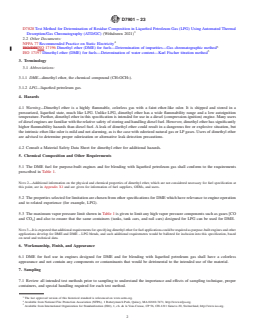
a pressurized, liquefied state, much like LPG. Unlike LPG, gases [CO and CO ] and also to ensure that the same containers
dimethyl ether has a wide flammability range and a low (tanks, tank cars, and rail cars) designed for LPG can be used
autoignition temperature. Further, dimethyl ether in this speci- for DME.
fication is intended for use in a diesel (compression-ignition)
NOTE 3—It is expected that additional requirements for specifying
engine. Many users of diesel engines are familiar with the
dimethyl ether for fuel applications could be required as purpose-built
relative safety of storing and handling diesel fuel. However,
engines and other applications develop for DME and DME – LPG blends,
dimethyl ether has significantly higher flammability hazards and such additional requirements would be balloted for inclusion into this
specification, based on need and technical data.
than diesel fuel. A leak of dimethyl ether could result in a
dangerous fire or explosive situation, but the intrinsic ether-like
6. Workmanship, Finish, and Appearance
odor is mild and not alarming, as is the case with odorized
natural gas or LP gases. Users of dimethyl ether are advised to
6.1 DME for fuel use in engines designed for DME and for
determine proper odorization or alternative leak detection
blending with liquefied petroleum gas shall have a colorless
precautions.
appearance and not contain any components or contaminants
that would be detrimental to the intended use of the material.
4.2 Consult a Material Safety Data Sheet for dimethyl ether
for additional hazards.
7. Sampling
5. Chemical Composition and Other Requirements
7.1 Review all intended test methods prior to sampling to
understand the importance and effects of sampling technique,
5.1 The DME fuel for purpose-built engines and for blend-
ing with liquefied petroleum gas shall conform to the require- proper containers, and special handling required for each test
method.
ments prescribed in Table 1.
7.2 Samples shall be representative of the batch of product
NOTE 2—Additional information on the physical and chemical proper-
ties of dimethyl ether, which are not considered necessary for fuel
and shall be collected from an appropriate storage container
specification at this point, are in Appendix X1 and are given for
(typically an aboveground storage tank) or pipeline by a
information of fuel suppliers, OEMs, and users.
suitable sampling procedure such as Practice D1265 or Practice
5.2 The properties selected for limitation are chosen from
D3700.
other specifications for DME which have relevance to engine
7.3 Sample Size—A minimum of 1 L is recommended.
operation and to related experience (for example, LPG).
7.3.1 Follow the same safety procedures when sampling
5.3 The maximum vapor pressure limit shown in Table 1 is
DME as when sampling LPG, and leave an ullage space of at
given to limit any high vapor pressure components such as
least 20 % in a high pressure sampling cylinder.
8. Test Methods
8.1 The requirements of this specification shall be deter-
TABLE 1 Detailed Requirements for Dimethyl Ether for Fuel
mined in accordance with the methods listed below. The scopes
Purposes
of some of the test methods listed below do not include
Property Test Method Requirement
A
Dimethyl Ether, mass %, min. D2163 98.5
dimethyl ether. Refer to the listed test methods to determine
Methanol, mass %, max. D2163, 0.05
applicability or required modifications for use with dimethyl
ISO 17196
ether. The precision of these test methods can differ from the
Water, mass %, max. ISO 17197 0.03
Methyl Formate, mass % D2163, report
reported precisions when testing dimethyl ether.
ISO 17196
B
Sulfur, mg / kg, max. D6667 3
8.2 Sample Introduction—For all test methods, ensure the
Vapor Pressure, kPa (psig), D1267, D6897 758 (110)
sample to be tested is representative of the liquid DME product
at 37.8 °C (100 °F), max.
and is not a vapor phase sample that could have a different
Corrosion, Copper Strip, D1838 No. 1
at 37.8 °C (100 °F), max. composition from a liquid phase sample.
Residue D2158
Residue on evaporation of 100 mL, mL, max, 0.05 8.3 Composition—Test Method D2163.
Oil stain observation pass
8.3.1 Laboratory experience has shown that Test Method
C
Lubricity —
D2163 requires the use of a 150 m methyl silicone column in
A
The required minimum ensures that DME for fuel purposes will have a minimum
order to analyze samples of DME.
estimated cetane number of 55.
B
The sulfur limit does not include the sulfur from an odorant such as ethyl 8.3.2 ISO 17196 is the preferred test method for methanol
mercaptan that might be required by some regulatory agencies in some fuel
and methyl formate analysis, as Test Method D2163 lacks
applications. Note that addition of 1 lb of ethyl mercaptan per 10 000 US gallons
reference to oxygenate testing requirements.
will increase the sulfur content of DME by 14 mg sulfur per litre of DME or 21 mg
sulfur per kilogram of DME.
C 8.4 Water—ISO 17197. While ISO 17197 is written for both
Experience in both laboratory and full scale vehicle testing indicates pure DME
has poor natural lubricity. Adequate precautions shall be taken to ensure the coulometric and volumetric Karl Fischer reagents, only coulo-
lubricity is sufficient to meet the needs of the end use application. At present, no
metric Karl Fischer reagents shall be used for DME testing due
industry accepted test method or limit value is available to define the lubricity of
to the low water concentration levels present in DME.
highly volatile liquid fuels such as DME. Until such a test is available, suppliers of
DME intended for use as a fuel in compression-ignition engines shall consult the
8.5 Sulfur—Test Method D6667 should be used for sulfur
engine or vehicle manufacturer for guidance on appropriate lubricity requirements.
determination.
D7901 − 23
8.6 Vapor Pressure—Test Methods D1267 and D6897 may 8.8 Residue—Test Method D2158.
be used for vapor pressure determination. In case of dispute,
Test Method D1267 shall be the referee test method. 9. Keywords
8.7 Corrosion—Test Method D1838. 9.1 dimethyl ether; DME
APPENDIXES
(Nonmandatory Information)
X1. PHYSICAL AND CHEMICAL PROPERTIES OF DIMETHYL ETHER
TABLE X1.1 Physical and Chemical Properties of Dimethyl Ether
X1.1 A selection of physical and chemical properties of
dimethyl ether, as outlined in Table X1.1, has been assembled Property Value
Chemical Formula CH OCH
3 3
from a variety of sources. These are believed to be the best
CAS No. 115-10-
...
This document is not an ASTM standard and is intended only to provide the user of an ASTM standard an indication of what changes have been made to the previous version. Because
it may not be technically possible to adequately depict all changes accurately, ASTM recommends that users consult prior editions as appropriate. In all cases only the current version
of the standard as published by ASTM is to be considered the official document.
Designation: D7901 − 20 D7901 − 23
Standard Specification for
Dimethyl Ether for Fuel Purposes
This standard is issued under the fixed designation D7901; the number immediately following the designation indicates the year of
original adoption or, in the case of revision, the year of last revision. A number in parentheses indicates the year of last reapproval. A
superscript epsilon (´) indicates an editorial change since the last revision or reapproval.
1. Scope*
1.1 This specification covers dimethyl ether (DME) for use as a fuel in engines specifically designed or modified for DME and
for blending with liquefied petroleum gas (LPG). This specification is for use by manufacturers of dimethyl ether, by engine
developers of purpose-built engines, in contracts for the purchase of DME for fuel purposes, and for the guidance of consumers
of this type of fuel.
NOTE 1—The generation and dissipation of static electricity can create problems in the handling of DME. For more information on the subject, see Guide
D4865.
1.2 The values stated in SI units are to be regarded as standard. Units in parentheses are for information only.
1.3 This standard does not purport to address all of the safety concerns, if any, associated with its use. It is the responsibility
of the user of this standard to establish appropriate safety, health, and environmental practices and determine the applicability of
regulatory limitations prior to use.
1.4 This international standard was developed in accordance with internationally recognized principles on standardization
established in the Decision on Principles for the Development of International Standards, Guides and Recommendations issued
by the World Trade Organization Technical Barriers to Trade (TBT) Committee.
2. Referenced Documents
2.1 ASTM Standards:
D1265 Practice for Sampling Liquefied Petroleum (LP) Gases, Manual Method
D1267 Test Method for Gauge Vapor Pressure of Liquefied Petroleum (LP) Gases (LP-Gas Method)
D1838 Test Method for Copper Strip Corrosion by Liquefied Petroleum (LP) Gases
D2158 Test Method for Residues in Liquefied Petroleum (LP) Gases
D2163 Test Method for Determination of Hydrocarbons in Liquefied Petroleum (LP) Gases and Propane/Propene Mixtures by
Gas Chromatography
D3700 Practice for Obtaining LPG Samples Using a Floating Piston Cylinder
D4865 Guide for Generation and Dissipation of Static Electricity in Petroleum Fuel Systems
D6667 Test Method for Determination of Total Volatile Sulfur in Gaseous Hydrocarbons and Liquefied Petroleum Gases by
Ultraviolet Fluorescence
D6897 Test Method for Vapor Pressure of Liquefied Petroleum Gases (LPG) (Expansion Method)
D7756 Test Method for Residues in Liquefied Petroleum (LP) Gases by Gas Chromatography with Liquid, On-Column Injection
This specification is under the jurisdiction of ASTM Committee D02 on Petroleum Products, Liquid Fuels, and Lubricants and is the direct responsibility of Subcommittee
D02.H0 on Liquefied Petroleum Gas.
Current edition approved June 1, 2020Oct. 1, 2023. Published July 2020November 2023. Originally approved in 2014. Last previous edition approved in 20142020 as
D7901 – 14b.D7901 – 20. DOI: 10.1520/D7901-20.10.1520/D7901-23.
For referenced ASTM standards, visit the ASTM website, www.astm.org, or contact ASTM Customer Service at service@astm.org. For Annual Book of ASTM Standards
volume information, refer to the standard’s Document Summary page on the ASTM website.
*A Summary of Changes section appears at the end of this standard
Copyright © ASTM International, 100 Barr Harbor Drive, PO Box C700, West Conshohocken, PA 19428-2959. United States
D7901 − 23
D7828 Test Method for Determination of Residue Composition in Liquefied Petroleum Gas (LPG) Using Automated Thermal
Desorption/Gas Chromatography (ATD/GC) (Withdrawn 2021)
2.2 Other Documents:
NFPA 77 Recommended Practice on Static Electricity
ISO/DISISO 17196 Dimethyl ether (DME) for fuels—Determination of impurities—Gas chromatographic method
ISO 17197 Dimethyl ether (DME) for fuels—Determination of water content—Karl Fischer titration method
3. Terminology
3.1 Abbreviations:
3.1.1 DME—dimethyl ether, the chemical compound (CH OCH ).
3 3
3.1.2 LPG—liquefied petroleum gas.
4. Hazards
4.1 Warning—Dimethyl ether is a highly flammable, colorless gas with a faint ether-like odor. It is shipped and stored in a
pressurized, liquefied state, much like LPG. Unlike LPG, dimethyl ether has a wide flammability range and a low autoignition
temperature. Further, dimethyl ether in this specification is intended for use in a diesel (compression-ignition) engine. Many users
of diesel engines are familiar with the relative safety of storing and handling diesel fuel. However, dimethyl ether has significantly
higher flammability hazards than diesel fuel. A leak of dimethyl ether could result in a dangerous fire or explosive situation, but
the intrinsic ether-like odor is mild and not alarming, as is the case with odorized natural gas or LP gases. Users of dimethyl ether
are advised to determine proper odorization or alternative leak detection precautions.
4.2 Consult a Material Safety Data Sheet for dimethyl ether for additional hazards.
5. Chemical Composition and Other Requirements
5.1 The DME fuel for purpose-built engines and for blending with liquefied petroleum gas shall conform to the requirements
prescribed in Table 1.
NOTE 2—Additional information on the physical and chemical properties of dimethyl ether, which are not considered necessary for fuel specification at
this point, are in Appendix X1 and are given for information of fuel suppliers, OEMs, and users.
5.2 The properties selected for limitation are chosen from other specifications for DME which have relevance to engine operation
and to related experience (for example, LPG).
5.3 The maximum vapor pressure limit shown in Table 1 is given to limit any high vapor pressure components such as gases [CO
and CO ] and also to ensure that the same containers (tanks, tank cars, and rail cars) designed for LPG can be used for DME.
NOTE 3—It is expected that additional requirements for specifying dimethyl ether for fuel applications could be required as purpose-built engines and other
applications develop for DME and DME – LPG blends, and such additional requirements would be balloted for inclusion into this specification, based
on need and technical data.
6. Workmanship, Finish, and Appearance
6.1 DME for fuel use in engines designed for DME and for blending with liquefied petroleum gas shall have a colorless
appearance and not contain any components or contaminants that would be detrimental to the intended use of the material.
7. Sampling
7.1 Review all intended test methods prior to sampling to understand the importance and effects of sampling technique, proper
containers, and special handling required for each test method.
The last approved version of this historical standard is referenced on www.astm.org.
Available from National Fire Protection Association (NFPA), 1 Batterymarch Park, Quincy, MA 02169-7471, http://www.nfpa.org.
Available from International Organization for Standardization (ISO), 1, ch. de la Voie-Creuse, CP 56, CH-1211 Geneva 20, Switzerland, http://www.iso.org.
D7901 − 23
TABLE 1 Detailed Requirements for Dimethyl Ether for Fuel
Purposes
Property Test Method Requirement
A
Dimethyl Ether, mass %, min. D2163 98.5
Methanol, mass %, max. D2163, 0.05
ISO 17196
Water, mass %, max. ISO 17197 0.03
Methyl Formate, mass % D2163, report
ISO 17196
B
Sulfur, mg / kg, max. D6667 3
Vapor Pressure, kPa (psig), D1267, D6897 758 (110)
at 37.8 °C (100 °F), max.
Corrosion, Copper Strip, D1838 No. 1
at 37.8 °C (100 °F), max.
Residue D2158
Residue on evaporation of 100 mL, mL, max, 0.05
Oil stain observation pass
C
Lubricity —
A
The required minimum ensures that DME for fuel purposes will have a minimum
estimated cetane number of 55.
B
The sulfur limit does not include the sulfur from an odorant such as ethyl
mercaptan that might be required by some regulatory agencies in some fuel
applications. Note that addition of 1 pound 1 lb of ethyl mercaptan per 10 000 US
gallons will increase the sulfur content of DME by 14 milligrams 14 mg sulfur per
litre of DME or 21 milligrams 21 mg sulfur per kilogram of DME.
C
Experience in both laboratory and full scale vehicle testing indicates pure DME
has poor natural lubricity. Adequate precautions shall be taken to ensure the
lubricity is sufficient to meet the needs of the end use application. At present, no
industry accepted test method or limit value is available to define the lubricity of
highly volatile liquid fuels such as DME. Until such a test is available, suppliers of
DME intended for use as a fuel in compression-ignition engines shall consult the
engine or vehicle manufacturer for guidance on appropriate lubricity requirements.
7.2 Samples shall be representative of the batch of product and shall be collected from an appropriate storage container (typically
an aboveground storage tank) or pipeline by a suitable sampling procedure such as Practice D1265 or Practice D3700.
7.3 Sample Size—A minimum of 1 litre 1 L is recommended.
7.3.1 Follow the same safety procedures when sampling DME as when sampling LPG, and leave an ullage space of at least 20 %
in a high pressure sampling cylinder.
8. Test Methods
8.1 The requirements of this specification shall be determined in accordance with the methods listed below. The scopes of some
of the test methods listed below do not include dimethyl ether. Refer to the listed test methods to determine applicability or required
modifications for use with dimethyl ether. The precision of these test methods can differ from the reported precisions when testing
dimethyl ether.
8.2 Sample Introduction—For all test methods, ensure the sample to be tested is representative of the liquid DME product and is
not a vapor phase sample that could have a different composition from a liquid phase sample.
8.3 Composition—Test Method D2163.
8.3.1 Laboratory experience has shown that Test Method D2163 requires the use of a 150 metre 150 m methyl silicone column
in order to analyze samples of DME.
8.3.2 ISO 17196 is the preferred test method for methanol and methyl formate analysis, as Test Method D2163 lacks reference
to oxygenate testing requirements.
8.4 Water—ISO 17197. While ISO 17197 is written for both coulometric and volumetric Karl Fischer reagents, only coulometric
Karl Fischer reagents shall be used for DME testing due to the low water concentration levels present in DME.
D7901 − 23
8.5 Sulfur—Test Method D6667 should be used for sulfur determination.
8.6 Vapor Pressure—Test Methods D1267 and D6897 may be used for vapor pressure determination. In case of dispute, Test
Method D1267 shall be the referee test method.
8.7 Corrosion—Test Method D1838.
8.8 Residue—Test Method D2158.
9. Keywords
9.1 dimethyl ether; DME
APPENDIXES
(Nonmandatory Information)
X1. PHYSICAL AND CHEMICAL PROPERTIES OF DIMETHYL ETHER
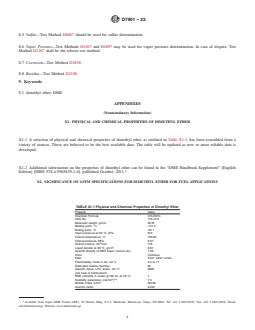
X1.1 A selection of physical and chemical properties of dimethyl ether, as outlined in Table X1.1, has been assembled from a
variety of sources. These are believed to be the best available data. The table will be updated as new or more reliable data is
developed.
X1.2 Additional information on the properties of dimethyl ether can be found in the “DME Handbook Supplement” [
...