

ASTM C482-20
(Test Method)Standard Test Method for Bond Strength of Ceramic Tile to Portland Cement Paste
General Information
- Abstract
SIGNIFICANCE AND USE
5.1 This test method provides a means of determining whether or not tile of the types indicated in 1.1 can be bonded with adequate strength to portland cement paste. Tile specifications can refer to this test method in order to establish minimum bond strength limits appropriate to the service conditions that are anticipated.
5.2 Separation between bond coat and setting bed, or breakage of the setting bed itself shall not be considered failures of tile bond.
SCOPE
1.1 This test method covers the determination of the ability of ceramic tile, ceramic mosaic tile, quarry tile, porcelain tile, and paver tile to be bonded to portland cement paste. Tiles may be glazed or unglazed. This test method includes both face-mounted and back-mounted tile.
1.2 The values stated in inch-pound units are to be regarded as standard. The values given in parentheses are mathematical conversions to SI units that are provided for information only and are not considered standard.
1.3 This standard does not purport to address all of the safety concerns, if any, associated with its use. It is the responsibility of the user of this standard to establish appropriate safety, health, and environmental practices and determine the applicability of regulatory limitations prior to use.
1.4 This international standard was developed in accordance with internationally recognized principles on standardization established in the Decision on Principles for the Development of International Standards, Guides and Recommendations issued by the World Trade Organization Technical Barriers to Trade (TBT) Committee.
- Status
- Published
- Publication Date
- 31-Mar-2020
- Technical Committee
- C21 - Ceramic Whitewares and Related Products
- Drafting Committee
- C21.06 - Ceramic Tile
Buy Documents
ASTM C482-20 - Standard Test Method for Bond Strength of Ceramic Tile to Portland Cement Paste
REDLINE ASTM C482-20 - Standard Test Method for Bond Strength of Ceramic Tile to Portland Cement Paste
Overview
ASTM C482-20 is the Standard Test Method for Bond Strength of Ceramic Tile to Portland Cement Paste, developed by ASTM International. This standard method evaluates the ability of various ceramic tiles-including glazed and unglazed ceramic tile, mosaic tile, quarry tile, porcelain tile, and paver tile-to form a durable bond with portland cement paste. As a vital reference for manufacturers, testing laboratories, and quality control professionals, ASTM C482-20 helps ensure that ceramic tiles meet minimum bond strength requirements, which are critical for safe and long-lasting installations in residential, commercial, and industrial environments.
By detailing procedures for testing under controlled laboratory conditions, ASTM C482-20 provides an objective assessment of bonding performance, supporting compliance with building codes and product specifications. The standard applies to both face-mounted and back-mounted tiles and acknowledges internationally recognized best practices for standardization.
Key Topics
- Types of Tiles Covered: Includes glazed and unglazed ceramic tile, mosaic tile, quarry tile, porcelain tile, and paver tile.
- Test Method Summary: Tiles are bonded to a portland cement paste bond coat, cured, and then subjected to shear loading until failure occurs at the tile-bond coat interface.
- Bond Strength Calculation: Bond strength is calculated by dividing the maximum force at failure by the bonded area, measured in pounds per square inch or pascals.
- Failure Criteria: Failures are assessed at the bond interface. Separations or breakages in the setting bed, rather than at the tile/bond interface, are not considered tile bond failures.
- Sample Preparation and Testing Conditions: Details for selecting, preparing, and conditioning tiles, as well as curing times, are included to ensure consistency and comparability among tests.
- Reporting: Test reports must detail the material, back design and orientation, individual and average bond strengths, and the failure location.
Applications
- Product Development: Tile manufacturers use ASTM C482-20 to design and validate ceramic tiles that are compatible with portland cement paste, ensuring reliable installation performance.
- Quality Control: Laboratories and contractors utilize this standard for routine testing to verify that tile products comply with minimum bond strength requirements.
- Specifying and Purchasing: Architects, specifiers, and procurement professionals reference ASTM C482-20 when selecting ceramic tile systems, ensuring specified bond strength for intended service conditions.
- Building Code Compliance: Regulatory authorities and inspectors use results from ASTM C482-20 to confirm that tile installations meet safety and durability criteria outlined in project documentation or building codes.
- Research and Comparative Assessment: The standard supports R&D activities by providing a reproducible method for comparing the bonding performance of different ceramic tile products or installation systems.
Related Standards
Professionals working with ASTM C482-20 may also find the following ASTM standards relevant:
- ASTM C150 - Specification for Portland Cement
- ASTM C185 - Test Method for Air Content of Hydraulic Cement Mortar
- ASTM C207 - Specification for Hydrated Lime for Masonry Purposes
- ASTM C242 - Terminology of Ceramic Whitewares and Related Products
Understanding and utilizing ASTM C482-20 helps ensure that ceramic tile installations are safe, durable, and compliant with industry best practices. Implementing this standard in your testing and specification processes enhances the quality and performance of tile applications bonded to portland cement paste.
Relations
- Replaces
ASTM C482-02(2014) - Standard Test Method for Bond Strength of Ceramic Tile to Portland Cement Paste - Effective Date
- 01-Apr-2020
- Effective Date
- 01-Apr-2020
- Effective Date
- 01-Feb-2020
- Effective Date
- 01-Dec-2019
- Effective Date
- 01-Oct-2019
- Effective Date
- 01-Aug-2019
- Effective Date
- 01-Feb-2018
- Effective Date
- 01-Jul-2015
- Effective Date
- 01-Mar-2015
- Effective Date
- 01-Feb-2014
- Effective Date
- 01-May-2012
- Effective Date
- 01-Jun-2011
- Effective Date
- 01-Jul-2008
- Effective Date
- 01-Nov-2007
- Effective Date
- 01-Jan-2006
Buy Documents
ASTM C482-20 - Standard Test Method for Bond Strength of Ceramic Tile to Portland Cement Paste
REDLINE ASTM C482-20 - Standard Test Method for Bond Strength of Ceramic Tile to Portland Cement Paste
Get Certified
Connect with accredited certification bodies for this standard

DIBt (Deutsches Institut für Bautechnik)
German Institute for Building Technology.
DIN CERTCO
DIN Group product certification.

Aboma Certification B.V.
Specialized in construction, metal, and transport sectors.
Sponsored listings
Frequently Asked Questions
ASTM C482-20 is a standard published by ASTM International. Its full title is "Standard Test Method for Bond Strength of Ceramic Tile to Portland Cement Paste". This standard covers: SIGNIFICANCE AND USE 5.1 This test method provides a means of determining whether or not tile of the types indicated in 1.1 can be bonded with adequate strength to portland cement paste. Tile specifications can refer to this test method in order to establish minimum bond strength limits appropriate to the service conditions that are anticipated. 5.2 Separation between bond coat and setting bed, or breakage of the setting bed itself shall not be considered failures of tile bond. SCOPE 1.1 This test method covers the determination of the ability of ceramic tile, ceramic mosaic tile, quarry tile, porcelain tile, and paver tile to be bonded to portland cement paste. Tiles may be glazed or unglazed. This test method includes both face-mounted and back-mounted tile. 1.2 The values stated in inch-pound units are to be regarded as standard. The values given in parentheses are mathematical conversions to SI units that are provided for information only and are not considered standard. 1.3 This standard does not purport to address all of the safety concerns, if any, associated with its use. It is the responsibility of the user of this standard to establish appropriate safety, health, and environmental practices and determine the applicability of regulatory limitations prior to use. 1.4 This international standard was developed in accordance with internationally recognized principles on standardization established in the Decision on Principles for the Development of International Standards, Guides and Recommendations issued by the World Trade Organization Technical Barriers to Trade (TBT) Committee.
SIGNIFICANCE AND USE 5.1 This test method provides a means of determining whether or not tile of the types indicated in 1.1 can be bonded with adequate strength to portland cement paste. Tile specifications can refer to this test method in order to establish minimum bond strength limits appropriate to the service conditions that are anticipated. 5.2 Separation between bond coat and setting bed, or breakage of the setting bed itself shall not be considered failures of tile bond. SCOPE 1.1 This test method covers the determination of the ability of ceramic tile, ceramic mosaic tile, quarry tile, porcelain tile, and paver tile to be bonded to portland cement paste. Tiles may be glazed or unglazed. This test method includes both face-mounted and back-mounted tile. 1.2 The values stated in inch-pound units are to be regarded as standard. The values given in parentheses are mathematical conversions to SI units that are provided for information only and are not considered standard. 1.3 This standard does not purport to address all of the safety concerns, if any, associated with its use. It is the responsibility of the user of this standard to establish appropriate safety, health, and environmental practices and determine the applicability of regulatory limitations prior to use. 1.4 This international standard was developed in accordance with internationally recognized principles on standardization established in the Decision on Principles for the Development of International Standards, Guides and Recommendations issued by the World Trade Organization Technical Barriers to Trade (TBT) Committee.
ASTM C482-20 is classified under the following ICS (International Classification for Standards) categories: 91.100.10 - Cement. Gypsum. Lime. Mortar. The ICS classification helps identify the subject area and facilitates finding related standards.
ASTM C482-20 has the following relationships with other standards: It is inter standard links to ASTM C482-02(2014), ASTM C185-20, ASTM C242-20, ASTM C185-19, ASTM C242-19a, ASTM C242-19, ASTM C242-18, ASTM C185-15, ASTM C242-15, ASTM C242-14, ASTM C242-12, ASTM C207-06(2011), ASTM C185-08, ASTM C242-01(2007), ASTM C207-06. Understanding these relationships helps ensure you are using the most current and applicable version of the standard.
ASTM C482-20 is available in PDF format for immediate download after purchase. The document can be added to your cart and obtained through the secure checkout process. Digital delivery ensures instant access to the complete standard document.
Standards Content (Sample)
This international standard was developed in accordance with internationally recognized principles on standardization established in the Decision on Principles for the
Development of International Standards, Guides and Recommendations issued by the World Trade Organization Technical Barriers to Trade (TBT) Committee.
Designation: C482 − 20
Standard Test Method for
Bond Strength of Ceramic Tile to Portland Cement Paste
This standard is issued under the fixed designation C482; the number immediately following the designation indicates the year of
original adoption or, in the case of revision, the year of last revision. A number in parentheses indicates the year of last reapproval. A
superscript epsilon (´) indicates an editorial change since the last revision or reapproval.
1. Scope 3.1.1 For definitions of the types of tile listed in 1.1, refer to
Terminology C242.
1.1 This test method covers the determination of the ability
of ceramic tile, ceramic mosaic tile, quarry tile, porcelain tile,
4. Summary of Test Method
and paver tile to be bonded to portland cement paste.Tiles may
be glazed or unglazed. This test method includes both face-
4.1 This test method consists of bonding tile under con-
mounted and back-mounted tile.
trolled conditions to a pure portland cement paste bond coat,
1.2 The values stated in inch-pound units are to be regarded supported by a cement mortar bed.
as standard. The values given in parentheses are mathematical
4.2 After proper cure of the test assembly, a load is applied
conversions to SI units that are provided for information only
to one edge of the tile and the load increased at a definite rate
and are not considered standard.
until the bond between tile and bond coat is broken.
1.3 This standard does not purport to address all of the
safety concerns, if any, associated with its use. It is the 4.3 Because the laboratory method of applying shear stress
responsibility of the user of this standard to establish appro- rapidly loads both tile and setting bed in compression, a
priate safety, health, and environmental practices and deter-
stronger than normal setting bed for the test specimens is
mine the applicability of regulatory limitations prior to use. specified. This avoids failure of the setting bed before the
1.4 This international standard was developed in accor-
desired failure at the tile-bond coat interface occurs. In real tile
dance with internationally recognized principles on standard-
installations with portland cement paste an entirely different
ization established in the Decision on Principles for the
loading mechanism, usually generated primarily by shrinking
Development of International Standards, Guides and Recom-
of the setting bed or structural backing, results in mild tension
mendations issued by the World Trade Organization Technical
in setting bed and mild compression in the tile, but the same
Barriers to Trade (TBT) Committee.
type of shear stress occurs between tile and bond coat as does
in response to the laboratory loading method.The finding of an
2. Referenced Documents
adequate bond strength under the conditions of this test method
2.1 ASTM Standards:
can be taken as proof that the tested tile could be permanently
C150 Specification for Portland Cement
bonded in a properly installed conventional installation using
C185 Test Method for Air Content of Hydraulic Cement
the lean, low-shrinkage mortars customarily specified for this
Mortar
particular purpose.
C207 Specification for Hydrated Lime for Masonry Pur-
4.4 To maintain practical sample size and limit maximum
poses
C242 Terminology of Ceramic Whitewares and Related breaking load, tile larger than nominal 4 ⁄4 in. (108 mm) on a
Products
side must be cut to 4 in. (102 mm).
3. Terminology
5. Significance and Use
3.1 Definitions:
5.1 This test method provides a means of determining
whether or not tile of the types indicated in 1.1 can be bonded
This test method is under the jurisdiction ofASTM Committee C21 on Ceramic
with adequate strength to portland cement paste. Tile specifi-
Whitewares and Related Products and is the direct responsibility of Subcommittee
cations can refer to this test method in order to establish
C21.06 on Ceramic Tile.
Current edition approved April 1, 2020. Published April 2020. Originally
minimum bond strength limits appropriate to the service
approved in 1961. Last previous edition approved in 2014 as C482 – 02 (2014).
conditions that are anticipated.
DOI: 10.1520/C0482-20.
For referenced ASTM standards, visit the ASTM website, www.astm.org, or
5.2 Separation between bond coat and setting bed, or
contact ASTM Customer Service at service@astm.org. For Annual Book of ASTM
breakage of the setting bed itself shall not be considered
Standards volume information, refer to the standard’s Document Summary page on
the ASTM website. failures of tile bond.
Copyright © ASTM International, 100 Barr Harbor Drive, PO Box C700, West Conshohocken, PA 19428-2959. United States
C482 − 20
6. Apparatus shearing load at a rate of 200 6 20 psi/min (1.4 6
0.1 MPa⁄min) to the tile being tested. To obtain the actual
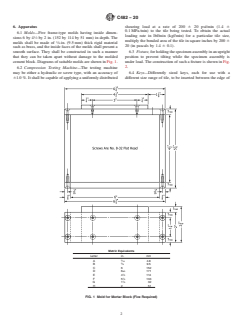
6.1 Molds—Five frame-type molds having inside dimen-
loading rate in lbf/min (kgf/min) for a particular tile size,
sions 6 by 4 ⁄2 by 2 in. (152 by 114 by 51 mm) in depth. The
multiply the bonded area of the tile in square inches by 200 6
molds shall be made of ⁄8-in. (9.5 mm) thick rigid material
20 (in pascals by 1.4 6 0.1).
such as brass, and the inside faces of the molds shall present a
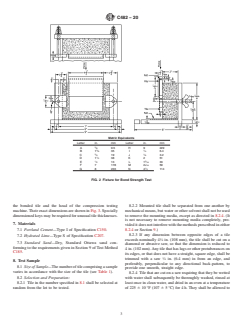
smooth surface. They shall be constructed in such a manner 6.3 Fixture,forholdingthespecimenassemblyinanupright
that they can be taken apart without damage to the molded position to prevent tilting while the specimen assembly is
cement block. Diagrams of suitable molds are shown in Fig. 1. under load. The construction of such a fixture is shown in Fig.
2.
6.2 Compression Testing Machine—The testing machine
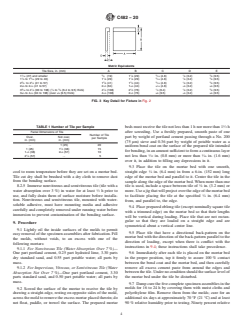
may be either a hydraulic or screw type, with an accuracy of 6.4 Keys—Differently sized keys, each for use with a
61.0 %. It shall be capable of applying a uniformly distributed different size range of tile, to be inserted between the edge of
Metric Equivalents
Letter in. mm
A ⁄16 4.8
B ⁄8 9.5
C 6 152
D6 ⁄4 171
E4 ⁄2 114
F5 ⁄4 133
G1 ⁄4 32
H2 51
FIG. 1 Mold for Mortar Block (Five Required)
C482 − 20
Metric Equivalents
Letter in. mm Letter in. mm
A ⁄8 9.5 H 9 229
3 1
B1 ⁄8 35 I ⁄4 6.4
3 1
C ⁄4 19 J ⁄8 3.2
D1 ⁄2 38 K 2 51
1 5
E ⁄2 13 L 1 ⁄16 33
F 7 178 M 2 ⁄16 59
G 8 203 N 4 ⁄2 114
FIG. 2 Fixture for Bond Strength Test
the bonded tile and the head of the compression testing 8.2.2 Mounted tile shall be separated from one another by
machine.Their exact dimensions are shown in Fig. 3. Specially mechanical means, but water or other solvent shall not be used
dimensioned keys may be required for unusual tile thicknesses. to remove the mounting media, except as directed in 8.2.4. (It
is not necessary to remove mounting media completely, pro-
7. Materials
vided it does not interfere with the methods prescribed in either
7.1 Portland Cement—Type I of Specification C150. 8.2.4 or Section 9.)
8.2.3 If any dimension between opposite edges of a tile
7.2 Hydrated Lime—Type S of Specification C207.
exceeds nominally 4 ⁄4 in. (108 mm), the tile shall be cut on a
7.3 Standard Sand—Dry, Standard Ottawa sand con-
diamond or abrasive saw, so that the dimension is reduced to
forming to the requirements given in Section 9 of Test Method
4 in.(102mm).Anytilethathaslugsorotherprotuberanceson
C185.
its edges, or that does not have a straight, square edge, shall be
trimmed with a saw ⁄4 in. (6.4 mm) in from an edge, and
8. Test Sample
preferably, perpendicular to any directional back-pattern, to
8.1 SizeofSample—Thenumberoftilecomprisingasample
provide one smooth, straight edge.
varies in accordance with the size of the tile (see Table 1).
8.2.4 Tile that are cut on a saw requiring that they be wetted
8.2 Selection and Preparation: with water shall subsequently be thoroughly washed, rinsed at
8.2.1 Tile in the number specified in 8.1 shall be selected at least once in clean water, and dried in an oven at a temperature
random from the lot to be tested. of 225 6 10 °F (107 6 5 °C) for 4 h. They shall be allowed to
...
This document is not an ASTM standard and is intended only to provide the user of an ASTM standard an indication of what changes have been made to the previous version. Because
it may not be technically possible to adequately depict all changes accurately, ASTM recommends that users consult prior editions as appropriate. In all cases only the current version
of the standard as published by ASTM is to be considered the official document.
Designation: C482 − 02 (Reapproved 2014) C482 − 20
Standard Test Method for
Bond Strength of Ceramic Tile to Portland Cement Paste
This standard is issued under the fixed designation C482; the number immediately following the designation indicates the year of
original adoption or, in the case of revision, the year of last revision. A number in parentheses indicates the year of last reapproval. A
superscript epsilon (´) indicates an editorial change since the last revision or reapproval.
1. Scope
1.1 This test method covers the determination of the ability of glazed ceramic wall tile, ceramic mosaic tile, quarry tile, and
pavers porcelain tile, and paver tile to be bonded to portland cement paste. Tiles may be glazed or unglazed. This test method
includes both face-mounted and back-mounted tile.
1.2 The values stated in inch-pound units are to be regarded as standard. The values given in parentheses are mathematical
conversions to SI units that are provided for information only and are not considered standard.
1.3 This standard does not purport to address all of the safety concerns, if any, associated with its use. It is the responsibility
of the user of this standard to establish appropriate safety safety, health, and healthenvironmental practices and determine the
applicability of regulatory limitations prior to use.
1.4 This international standard was developed in accordance with internationally recognized principles on standardization
established in the Decision on Principles for the Development of International Standards, Guides and Recommendations issued
by the World Trade Organization Technical Barriers to Trade (TBT) Committee.
2. Referenced Documents
2.1 ASTM Standards:
C150 Specification for Portland Cement
C185 Test Method for Air Content of Hydraulic Cement Mortar
C207 Specification for Hydrated Lime for Masonry Purposes
C242 Terminology of Ceramic Whitewares and Related Products
3. Terminology
3.1 Definitions:
3.1.1 For definitions of the types of tile listed in 1.1, refer to Terminology C242.
4. Summary of Test Method
4.1 This test method consists of bonding tile under controlled conditions to a pure portland cement paste bond coat, supported
by a cement mortar bed.
4.2 After proper cure of the test assembly, a load is applied to one edge of the tile and the load increased at a definite rate until
the bond between tile and bond coat is broken.
4.3 Because the laboratory method of applying shear stress rapidly loads both tile and setting bed in compression, a stronger
than normal setting bed for the test specimens is specified. This avoids failure of the setting bed before the desired failure at the
tile-bond coat interface occurs. In real tile installations with portland cement paste an entirely different loading mechanism, usually
generated primarily by shrinking of the setting bed or structural backing, results in mild tension in setting bed and mild
compression in the tile, but the same type of shear stress occurs between tile and bond coat as does in response to the laboratory
loading method. The finding of an adequate bond strength under the conditions of this test method can be taken as proof that the
tested tile could be permanently bonded in a properly installed conventional installation using the lean, low-shrinkage mortars
customarily specified for this particular purpose.
This test method is under the jurisdiction of ASTM Committee C21 on Ceramic Whitewares and Related Products and is the direct responsibility of Subcommittee C21.06
on Ceramic Tile.
Current edition approved Dec. 1, 2014April 1, 2020. Published December 2014April 2020. Originally approved in 1961. Last previous edition approved in 20092014 as
C482 – 02 (2009).(2014). DOI: 10.1520/C0482-02R14.10.1520/C0482-20.
For referenced ASTM standards, visit the ASTM website, www.astm.org, or contact ASTM Customer Service at service@astm.org. For Annual Book of ASTM Standards
volume information, refer to the standard’s Document Summary page on the ASTM website.
Copyright © ASTM International, 100 Barr Harbor Drive, PO Box C700, West Conshohocken, PA 19428-2959. United States
C482 − 20
4.4 To maintain practical sample size and limit maximum breaking load, tile larger than nominal 4 ⁄4 in. (108 mm) on a side
must be cut to 4 in. (102 mm).
5. Significance and Use
5.1 This test method provides a means of determining whether or not tile of the types indicated in 1.1 can be bonded with
adequate strength to portland cement paste. Tile specifications can refer to this test method in order to establish minimum bond
strength limits appropriate to the service conditions that are anticipated.
5.2 Separation between bond coat and setting bed, or breakage of the setting bed itself shall not be considered failures of tile
bond.
6. Apparatus
6.1 Molds—Five frame-type molds having inside dimensions 6 by 4 ⁄2 by 2 in. (152 by 114 by 51 mm) in depth. The molds shall
be made of ⁄8-in. (9.5-mm)(9.5 mm) thick rigid material such as brass, and the inside faces of the molds shall present a smooth
surface. They shall be constructed in such a manner that they can be taken apart without damage to the molded cement block.
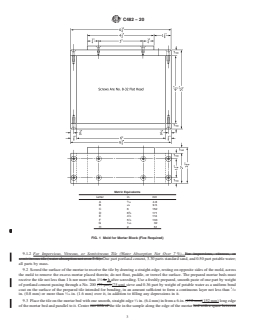
Diagrams of suitable molds are shown in Fig. 1.
6.2 Compression Testing Machine—The testing machine may be either a hydraulic or screw type, with an accuracy of 61.0 %.
It shall be capable of applying a uniformly distributed shearing load at a rate of 200 6 20 psi/min (1.4 6 0.10.1 MPa MPa/min)
⁄min) to the tile being tested. To obtain the actual loading rate in lbf/min (kgf/min) for a particular tile size, multiply the bonded
area of the tile in square inches by 200 6 20 (in pascals by 1.4 6 0.1).
6.3 Fixture, for holding the specimen assembly in an upright position to prevent tilting while the specimen assembly is under
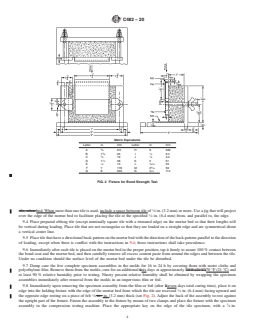
load. The construction of such a fixture is shown in Fig. 2.
6.4 Keys—Differently sized keys, each for use with a different size range of tile, to be inserted between the edge of the bonded
tile and the head of the compression testing machine. Their exact dimensions are shown in Fig. 3. Specially dimensioned keys may
be required for unusual tile thicknesses.
7. Materials
7.1 Portland Cement—Type I of Specification C150.
7.2 Hydrated Lime—Type S of Specification C207.
7.3 Standard Sand—Dry, Standard Ottawa sand con-forming to the requirements given in Section 9 of Test Method C185.
8. Test Sample
8.1 Size of Sample—The number of tile comprising a sample varies according to in accordance with the size of the tile (see Table
1).
8.2 Selection and Preparation:
8.2.1 Tile in the number specified in 8.1 shall be selected at random from the lot to be tested.
8.2.2 Mounted tile shall be separated from one another by mechanical means, but water or other solvent shall not be used to
remove the mounting media, except as directed in 8.2.4. (It is not necessary to remove mounting media completely, provided it
does not interfere with the methods prescribed in either 8.2.4 or Section 9.)
8.2.3 If any dimension between opposite edges of a tile exceeds nominally 4 ⁄4 in. (108 mm), the tile shall be cut on a diamond
or abrasive saw, so that the dimension is reduced to 4 in. 4 in. (102 mm). Any tile that has lugs or other protuberances on its edges,
or that does not have a straight, square edge, shall be trimmed with a saw ⁄4 in. (6.4 mm) in from an edge, and preferably,
perpendicular to any directional back-pattern, to provide one smooth, straight edge.
8.2.4 Tile that are cut on a saw requiring that they be wetted with water shall subsequently be thoroughly washed, rinsed at least
once in clean water, and dried in an oven at a temperature of 225 6 10°F10 °F (107 6 5°C)5 °C) for 4 h. They shall be allowed
to cool to room temperature before they are set on a mortar bed. Tile cut dry shall be brushed with a dry cloth to remove dust from
the bonding surface.
8.2.5 Immerse nonvitreous and semivitreous tile (tile with a water absorption over 3 %) in water for at least ⁄2 h prior to use,
and fully drain them of surface moisture before installation. Nonvitreous and semivitreous tile, mounted with water-soluble
adhesive, must have mounting media and adhesive carefully and completely removed under running water before immersion to
prevent contamination of the bonding surface.
9. Procedure
9.1 Lightly oil the inside surfaces of the molds to permit easy removal of the specimen assemblies after fabrication. Fill the
molds, without voids, to an excess with one of the following mortars:
9.1.1 For Nonv
...