

ASTM D2156-09(2024)
(Test Method)Standard Test Method for Smoke Density in Flue Gases from Burning Distillate Fuels
General Information
- Abstract
SIGNIFICANCE AND USE
5.1 This test method provides a means of controlling smoke production in home heating equipment to an acceptable level. Excessive smoke density adversely affects efficiency by heat-exchanger fouling.
5.2 The range of smoke densities covered by this test method is that which has been found particularly pertinent to home-heating application. It is more sensitive to small amounts of smoke than several other smoke tests as indicated in the following comparison:
Smoke Spot
Number
Icham, percent
Transmission
Ringelman
Smoke Number
0
100
0
2
95
0
4
80
0
6
54
0
8
18
0
9
0
0
9
0
0 to 5
SCOPE
1.1 This test method covers the evaluation of smoke density in the flue gases from burning distillate fuels. It is intended primarily for use with home heating equipment burning kerosine or heating oils. It can be used in the laboratory or in the field to compare fuels for clean burning or to compare heating equipment.
1.2 The values stated in SI units are to be regarded as standard. No other units of measurement are included in this standard.
1.2.1 Arbitrary and relative units are also used.
1.3 This standard does not purport to address all of the safety concerns, if any, associated with its use. It is the responsibility of the user of this standard to establish appropriate safety, health, and environmental practices and determine the applicability of regulatory limitations prior to use.
1.4 This international standard was developed in accordance with internationally recognized principles on standardization established in the Decision on Principles for the Development of International Standards, Guides and Recommendations issued by the World Trade Organization Technical Barriers to Trade (TBT) Committee.
- Status
- Published
- Publication Date
- 29-Feb-2024
- Technical Committee
- D02 - Petroleum Products, Liquid Fuels, and Lubricants
- Drafting Committee
- D02.E0 - Burner, Diesel and Non-Aviation Gas Turbine Fuels

Overview
ASTM D2156-09(2024), Standard Test Method for Smoke Density in Flue Gases from Burning Distillate Fuels, is an internationally recognized standard developed by ASTM International. This test method focuses on evaluating and controlling smoke density emitted in the flue gases from burning distillate fuels, such as kerosine and heating oil. Primarily intended for home heating equipment, it ensures that smoke production is kept at acceptable levels, thereby enhancing heating efficiency and environmental compliance.
This standard is applicable to both laboratory and field settings and is used to compare various fuels for clean burning as well as to assess the performance of heating equipment. The method delivers a sensitive and robust measurement of smoke density, facilitating efforts to optimize combustion and reduce particulate emissions in residential heating systems.
Key Topics
- Smoke Density Evaluation: The test quantifies smoke density in flue gas using a smoke spot number, which is determined by visually matching the color of a test spot on filter paper with a standardized smoke scale.
- Controlled Sampling Method: A defined sample of flue gas is drawn through filter paper, and the resulting smoke spot is compared to a scale ranging from 0 (white) to 9 (black), ensuring a consistent approach.
- Applicability to Distillate Fuels: The method is tailored for use with common heating fuels, specifically kerosine and heating oils, making it directly relevant to residential and small commercial heating appliances.
- Significance for Efficiency and Fouling: Excess smoke leads to heat exchanger fouling, impacting appliance efficiency. Regular monitoring of smoke density helps maintain proper function and reduces maintenance.
- Precision and Reproducibility: The method specifies strict procedures to provide repeatable and reproducible results, crucial for consistent home heating system diagnostics and regulatory checks.
- Safety Practices: Users are reminded to establish appropriate safety, health, and environmental management, as the standard does not address all potential hazards.
Applications
- Residential Heating Maintenance: Homeowners, service professionals, and inspectors use this test method to identify excessive smoke emissions, diagnose faulty equipment, and ensure efficient, clean combustion in oil-fired boilers and furnaces.
- Fuel Quality Comparison: Laboratories and fuel distributors utilize the method to compare different fuel batches or types for their propensity to generate smoke, supporting quality assurance and purchasing decisions.
- Regulatory Compliance: Local authorities and regulatory agencies employ results from this standard to verify compliance with air quality and emissions standards for residential heating.
- Equipment Comparison: Manufacturers and installers use the test to assess and compare heating system designs for their ability to minimize smoke production, promoting cleaner technology adoption.
- Troubleshooting and Optimization: Service technicians apply this test to optimize burner adjustments and airflow settings, reducing smoke density and maximizing appliance lifecycle performance.
Related Standards
- ASTM E97 - Test Method for Directional Reflectance Factor, relevant for specifying the optical properties of filter media used in smoke testing.
- Ringelmann Smoke Chart - Alternative and historical method for classifying smoke density, often referenced for comparison purposes.
- International and Local Air Quality Standards - These may reference or incorporate ASTM D2156 methodologies for enforcement or guidance regarding residential fuel combustion emissions.
- ISO and EN Standards for Fuel Emission Testing - While ASTM D2156 is primarily referenced in North America, similar European and international standards govern smoke emissions from distillate fuel combustion.
By providing a reliable, repeatable method for measuring smoke emissions from distillate fuel-burning appliances, ASTM D2156-09(2024) plays a critical role in maintaining heating efficiency, supporting fuel quality assurance, and protecting air quality in residential and light commercial settings.
Relations
- Effective Date
- 01-Mar-2024
- Effective Date
- 01-Mar-2024
Get Certified
Connect with accredited certification bodies for this standard

Element Materials Technology
Materials testing and product certification.

ABS Group Brazil
ABS Group certification services in Brazil.

ABS Quality Evaluations Inc.
American Bureau of Shipping quality certification.
Sponsored listings
Frequently Asked Questions
ASTM D2156-09(2024) is a standard published by ASTM International. Its full title is "Standard Test Method for Smoke Density in Flue Gases from Burning Distillate Fuels". This standard covers: SIGNIFICANCE AND USE 5.1 This test method provides a means of controlling smoke production in home heating equipment to an acceptable level. Excessive smoke density adversely affects efficiency by heat-exchanger fouling. 5.2 The range of smoke densities covered by this test method is that which has been found particularly pertinent to home-heating application. It is more sensitive to small amounts of smoke than several other smoke tests as indicated in the following comparison: Smoke Spot Number Icham, percent Transmission Ringelman Smoke Number 0 100 0 2 95 0 4 80 0 6 54 0 8 18 0 9 0 0 9 0 0 to 5 SCOPE 1.1 This test method covers the evaluation of smoke density in the flue gases from burning distillate fuels. It is intended primarily for use with home heating equipment burning kerosine or heating oils. It can be used in the laboratory or in the field to compare fuels for clean burning or to compare heating equipment. 1.2 The values stated in SI units are to be regarded as standard. No other units of measurement are included in this standard. 1.2.1 Arbitrary and relative units are also used. 1.3 This standard does not purport to address all of the safety concerns, if any, associated with its use. It is the responsibility of the user of this standard to establish appropriate safety, health, and environmental practices and determine the applicability of regulatory limitations prior to use. 1.4 This international standard was developed in accordance with internationally recognized principles on standardization established in the Decision on Principles for the Development of International Standards, Guides and Recommendations issued by the World Trade Organization Technical Barriers to Trade (TBT) Committee.
SIGNIFICANCE AND USE 5.1 This test method provides a means of controlling smoke production in home heating equipment to an acceptable level. Excessive smoke density adversely affects efficiency by heat-exchanger fouling. 5.2 The range of smoke densities covered by this test method is that which has been found particularly pertinent to home-heating application. It is more sensitive to small amounts of smoke than several other smoke tests as indicated in the following comparison: Smoke Spot Number Icham, percent Transmission Ringelman Smoke Number 0 100 0 2 95 0 4 80 0 6 54 0 8 18 0 9 0 0 9 0 0 to 5 SCOPE 1.1 This test method covers the evaluation of smoke density in the flue gases from burning distillate fuels. It is intended primarily for use with home heating equipment burning kerosine or heating oils. It can be used in the laboratory or in the field to compare fuels for clean burning or to compare heating equipment. 1.2 The values stated in SI units are to be regarded as standard. No other units of measurement are included in this standard. 1.2.1 Arbitrary and relative units are also used. 1.3 This standard does not purport to address all of the safety concerns, if any, associated with its use. It is the responsibility of the user of this standard to establish appropriate safety, health, and environmental practices and determine the applicability of regulatory limitations prior to use. 1.4 This international standard was developed in accordance with internationally recognized principles on standardization established in the Decision on Principles for the Development of International Standards, Guides and Recommendations issued by the World Trade Organization Technical Barriers to Trade (TBT) Committee.
ASTM D2156-09(2024) is classified under the following ICS (International Classification for Standards) categories: 75.160.20 - Liquid fuels. The ICS classification helps identify the subject area and facilitates finding related standards.
ASTM D2156-09(2024) has the following relationships with other standards: It is inter standard links to ASTM D2156-09(2018), ASTM D2157-18. Understanding these relationships helps ensure you are using the most current and applicable version of the standard.
ASTM D2156-09(2024) is available in PDF format for immediate download after purchase. The document can be added to your cart and obtained through the secure checkout process. Digital delivery ensures instant access to the complete standard document.
Standards Content (Sample)
This international standard was developed in accordance with internationally recognized principles on standardization established in the Decision on Principles for the
Development of International Standards, Guides and Recommendations issued by the World Trade Organization Technical Barriers to Trade (TBT) Committee.
Designation: D2156 − 09 (Reapproved 2024)
Standard Test Method for
Smoke Density in Flue Gases from Burning Distillate Fuels
This standard is issued under the fixed designation D2156; the number immediately following the designation indicates the year of
original adoption or, in the case of revision, the year of last revision. A number in parentheses indicates the year of last reapproval. A
superscript epsilon (´) indicates an editorial change since the last revision or reapproval.
This standard has been approved for use by agencies of the U.S. Department of Defense.
1. Scope 3.1.1 smoke spot number, n—the number of the spot on the
standard scale most closely matching the color (or shade) of the
1.1 This test method covers the evaluation of smoke density
test spot.
in the flue gases from burning distillate fuels. It is intended
primarily for use with home heating equipment burning kero-
4. Summary of Test Method
sine or heating oils. It can be used in the laboratory or in the
4.1 A test smoke spot is obtained by pulling a fixed volume
field to compare fuels for clean burning or to compare heating
of flue gas through a fixed area of standard filter paper. The
equipment.
color (or shade) of the spot thus produced is visually matched
1.2 The values stated in SI units are to be regarded as
with a standard scale, and the smoke density is expressed as a
standard. No other units of measurement are included in this
“smoke spot number.”
standard.
1.2.1 Arbitrary and relative units are also used.
5. Significance and Use
1.3 This standard does not purport to address all of the
5.1 This test method provides a means of controlling smoke
safety concerns, if any, associated with its use. It is the
production in home heating equipment to an acceptable level.
responsibility of the user of this standard to establish appro-
Excessive smoke density adversely affects efficiency by heat-
priate safety, health, and environmental practices and deter-
exchanger fouling.
mine the applicability of regulatory limitations prior to use.
5.2 The range of smoke densities covered by this test
1.4 This international standard was developed in accor-
method is that which has been found particularly pertinent to
dance with internationally recognized principles on standard-
home-heating application. It is more sensitive to small amounts
ization established in the Decision on Principles for the
of smoke than several other smoke tests as indicated in the
Development of International Standards, Guides and Recom-
following comparison:
mendations issued by the World Trade Organization Technical
Smoke Spot Icham, percent Ringelman
Barriers to Trade (TBT) Committee.
Number Transmission Smoke Number
0 100 0
2. Referenced Documents
2 95 0
4 80 0
2.1 ASTM Standards:
6 54 0
E97 Method of Test for Directional Reflectance Factor,
8 18 0
9 0 0
45-Deg 0-Deg, of Opaque Specimens by Broad-Band
9 0 0 to 5
Filter Reflectometry (Withdrawn 1991)
6. Apparatus
3. Terminology
6.1 Sampling Device—A suitable device providing a total
3.1 Definitions of Terms Specific to This Standard:
flue gas sample volume of 36.9 L 6 1.65 L at 16 °C, 101 kPa
for each 645 mm effective surface area of filter paper shall be
This method is under the jurisdiction of ASTM Committee D02 on Petroleum
employed. The sampling device and connections shall be of
Products, Liquid Fuels, and Lubricants and is the direct responsibility of Subcom-
such construction that the total travel of flue gas sample from
mittee D02.E0 on Burner, Diesel and Non-Aviation Gas Turbine Fuels.
flue to filter paper shall not exceed 410 mm. The device shall
Current edition approved March 1, 2024. Published April 2024. Originally
approved in 1963. Last previous edition approved in 2018 as D2156 – 09 (2018).
provide for cooling the sample below the charring temperature
DOI: 10.1520/D2156-09R24.
for the filter paper but not below the dew point of the sample.
For referenced ASTM standards, visit the ASTM website, www.astm.org, or
Suitable laboratory and portable field service equipment is
contact ASTM Customer Service at service@astm.org. For Annual Book of ASTM
Standards volume information, refer to the standard’s Document Summary page on illustrated in Fig. 1 and Fig. 2.
the ASTM website.
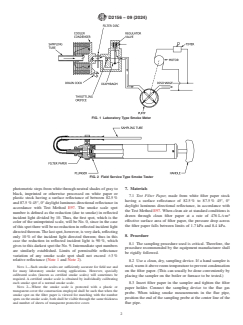
6.2 Smoke Scale—The smoke scale required consists of ten
The last approved version of this historical standard is referenced on
www.astm.org. spots numbered consecutively from 0 to 9, ranging in equal
Copyright © ASTM International, 100 Barr Harbor Drive, PO Box C700, West Conshohocken, PA 19428-2959. United States
D2156 − 09 (2024)
FIG. 1 Laboratory Type Smoke Meter
FIG. 2 Field Service Type Smoke Tester
photometric steps from white through neutral shades of gray to 7. Materials
black, imprinted or otherwise processed on white paper or
7.1 Test Filter Paper, made from white filter paper stock
plastic stock having a surface reflectance of between 82.5 %
having a surface reflectance of 82.5 % to 87.5 % 45°, 0°
and 87.5 % 45°, 0° daylight luminous directional reflectance in
daylight luminous directional reflectance, in accordance with
accordance with Test Method E97. The smoke scale spot
the Test Method E97. When clean air at standard conditions is
number is defined as the reduction (due to smoke) in reflected
drawn through clean filter paper at a rate of 476 L ⁄s·m
incident light divided by 10. Thus, the first spot, which is the
effective surface area of filter paper, the pressure drop across
color of the unimprinted scale, will be No. 0, since in the case
the filter paper falls between limits of 1.7 kPa and 8.4 kPa.
of this spot there will be no reduction in reflected incident light
directed thereon. The last spot, however, is very dark, reflecting
8. Procedure
only 10 % of the incident light directed thereon; thus in this
case the reduction in reflected incident light is 90 %, which
8.1 The sampling procedure used is critical. Therefore, the
gives to this darkest spot the No. 9. Intermediate spot numbers
procedure recommended by the equipment manufacturer shall
are similarly established. Limits of permissible reflectance
be rigidly followed.
variation of any smoke scale spot shall not exceed 63 %
relative reflectance (Note 1 and Note 2).
8.2 Use a clean, dry, sampling device. If a hand sampler is
used, warm it above room temperature to prevent condensation
NOTE 1—Such smoke scales are sufficiently accurate for field use and
on the filter paper. (This can usually be done conveniently by
for many laboratory smoke testing applications. However, specially
calibrated scales (known as certified smoke scales) will sometimes be
placing the sampler on the boiler or furnace to be tested.)
required. A certified smoke scale is obtained by individually calibrating
each smoke spot of a normal smoke scale. 8.3 Insert filter paper in the sampler and tighten the filter
NOTE 2—Where the smoke scale is protected with a plastic or
paper holder. Connect the sampling device to the flue gas
transparent cover the construction employed shall be such that when the
probe. When taking smoke measurements in the flue pipe,
smoke spot on the filter paper is viewed for matching with the number
position the end of the sampling probe at the center line of the
spots on the smoke scale, both shall be visible through the same thickness
and number of sheets of transparent protective cover. flue pipe.
-------------
...