

ASTM G172-19
(Guide)Standard Guide for Statistical Analysis of Accelerated Service Life Data
General Information
- Abstract
SIGNIFICANCE AND USE
4.1 The nature of accelerated service life estimation normally requires that stresses higher than those experienced during service conditions are applied to the material being evaluated. For non-constant use stress, such as experienced by time varying weather outdoors, it may in fact be useful to choose an accelerated stress fixed at a level slightly lower than (say 90 % of) the maximum experienced outdoors. By controlling all variables other than the one used for accelerating degradation, one may model the expected effect of that variable at normal, or usage conditions. If laboratory accelerated test devices are used, it is essential to provide precise control of the variables used in order to obtain useful information for service life prediction. It is assumed that the same failure mechanism operating at the higher stress is also the life determining mechanism at the usage stress. It must be noted that the validity of this assumption is crucial to the validity of the final estimate.
4.2 Accelerated service life test data often show different distribution shapes than many other types of data. This is due to the effects of measurement error (typically normally distributed), combined with those unique effects which skew service life data towards early failure time (infant mortality failures) or late failure times (aging or wear-out failures). Applications of the principles in this guide can be helpful in allowing investigators to interpret such data.
4.3 The choice and use of a particular acceleration model and life distribution model should be based primarily on how well it fits the data and whether it leads to reasonable projections when extrapolating beyond the range of data. Further justification for selecting models should be based on theoretical considerations.
Note 2: Accelerated service life or reliability data analysis packages are becoming more readily available in common computer software packages. This makes data reduction and analyses more direct...
SCOPE
1.1 This guide describes general statistical methods for analyses of accelerated service life data. It provides a common terminology and a common methodology for calculating a quantitative estimate of functional service life.
1.2 This guide covers the application of two general models for determining service life distribution at usage condition. The Arrhenius model serves as a general model where a single stress variable, specifically temperature, affects the service life. It also covers the Eyring Model for applications where multiple stress variables act simultaneously to affect the service life.
1.3 This guide emphasizes the use of the Weibull life distribution and is written to be used in combination with Guide G166.
1.4 The uncertainty and reliability of every accelerated service life model becomes more critical as the number of stress variables increases and the extent of extrapolation from the accelerated stress levels to the usage level increases, or both. The models and methodology used in this guide are to provide examples of data analysis techniques only. The fundamental requirements of proper variable selection and measurement must still be met by the users for a meaningful model to result.
1.5 This international standard was developed in accordance with internationally recognized principles on standardization established in the Decision on Principles for the Development of International Standards, Guides and Recommendations issued by the World Trade Organization Technical Barriers to Trade (TBT) Committee.
- Status
- Published
- Publication Date
- 31-Dec-2018
- Technical Committee
- G03 - Weathering and Durability
- Drafting Committee
- G03.08 - Service Life Prediction
Overview
ASTM G172-19: Standard Guide for Statistical Analysis of Accelerated Service Life Data provides a comprehensive framework for analyzing data from accelerated service life tests. Devices, materials, and components are often subjected to higher-than-normal stresses in the laboratory to predict their performance and durability under typical service conditions. The guide details statistical methodologies, focusing on life estimation, distribution models, and the selection of acceleration variables. These methods help industries efficiently estimate product lifespan, assess reliability, and support informed materials selection or product design decisions.
Key Topics
- Accelerated Service Life Testing
Employing test conditions with stress levels (e.g., temperature, humidity) higher than those encountered during normal service to expedite failure modes and gather longevity data within practical time frames. - Statistical Methods and Models
The guide covers generally accepted statistical models, primarily using the Weibull life distribution, for analyzing failure times and predicting service life. - Acceleration Models
Provides methodologies for single and multiple variable acceleration models:- Arrhenius Model: Used when temperature is the primary accelerating factor.
- Eyring Model: Adopted when multiple factors (such as temperature and relative humidity) jointly influence service life.
- Data Distribution and Interpretation
Discusses measurement error, skew toward early (infant mortality) or late (aging, wear-out) failure times, and the critical consideration of censored or incomplete test data. - Uncertainty and Reliability
Emphasizes careful selection and measurement of variables, as reliability and uncertainty become more critical when extrapolating lab results to real-world usage.
Applications
- Product Development & Material Qualification
Manufacturers use accelerated life test analysis to rapidly compare new materials, coatings, adhesives, or components, ensuring expected performance over their intended service life. - Quality Control & Reliability Prediction
Statistical analysis of service life data helps organizations refine their quality assurance processes, optimize maintenance intervals, and increase customer satisfaction by accurately projecting product longevity. - Standardized Reporting and Comparisons
Common terminology and methodologies facilitate clear communication between buyers, sellers, and regulatory bodies, enabling consistent comparisons and compliance with international requirements. - Optimization of Test Resources
The guidance on distribution of test specimens across stress levels helps organizations design efficient tests, reducing costs and improving predictive power.
Related Standards
- ASTM G166
Guide for Statistical Analysis of Service Life Data - This standard provides detailed methodologies for estimating Weibull parameters and interpreting life distribution data. - ASTM G169
Guide for Application of Basic Statistical Methods to Weathering Tests - Focuses on statistical approaches to interpret environmental exposure and weathering data. - General Reliability Standards
ASTM and other organizations offer numerous standards on reliability testing and statistical assessment relevant to electronics, automotive, aerospace, and building materials industries.
Keywords: ASTM G172-19, accelerated service life, statistical analysis, Weibull distribution, Arrhenius model, Eyring model, reliability prediction, material testing, product durability, service life estimation, accelerated aging, quality control, international standards.
This guide is essential for professionals involved in reliability engineering, materials science, product quality, and regulatory compliance, offering vital tools and concepts for robust service life prediction and statistical data analysis.
Relations
- Replaces
ASTM G172-02(2010)e1 - Standard Guide for Statistical Analysis of Accelerated Service Life Data - Effective Date
- 01-Jan-2019
- Effective Date
- 15-Feb-2020
- Effective Date
- 01-Jul-2011
- Effective Date
- 01-Dec-2005
- Effective Date
- 10-Jan-2000
- Effective Date
- 01-Jan-2019
Get Certified
Connect with accredited certification bodies for this standard

BSI Group
BSI (British Standards Institution) is the business standards company that helps organizations make excellence a habit.

Bureau Veritas
Bureau Veritas is a world leader in laboratory testing, inspection and certification services.

DNV
DNV is an independent assurance and risk management provider.
Sponsored listings
Frequently Asked Questions
ASTM G172-19 is a guide published by ASTM International. Its full title is "Standard Guide for Statistical Analysis of Accelerated Service Life Data". This standard covers: SIGNIFICANCE AND USE 4.1 The nature of accelerated service life estimation normally requires that stresses higher than those experienced during service conditions are applied to the material being evaluated. For non-constant use stress, such as experienced by time varying weather outdoors, it may in fact be useful to choose an accelerated stress fixed at a level slightly lower than (say 90 % of) the maximum experienced outdoors. By controlling all variables other than the one used for accelerating degradation, one may model the expected effect of that variable at normal, or usage conditions. If laboratory accelerated test devices are used, it is essential to provide precise control of the variables used in order to obtain useful information for service life prediction. It is assumed that the same failure mechanism operating at the higher stress is also the life determining mechanism at the usage stress. It must be noted that the validity of this assumption is crucial to the validity of the final estimate. 4.2 Accelerated service life test data often show different distribution shapes than many other types of data. This is due to the effects of measurement error (typically normally distributed), combined with those unique effects which skew service life data towards early failure time (infant mortality failures) or late failure times (aging or wear-out failures). Applications of the principles in this guide can be helpful in allowing investigators to interpret such data. 4.3 The choice and use of a particular acceleration model and life distribution model should be based primarily on how well it fits the data and whether it leads to reasonable projections when extrapolating beyond the range of data. Further justification for selecting models should be based on theoretical considerations. Note 2: Accelerated service life or reliability data analysis packages are becoming more readily available in common computer software packages. This makes data reduction and analyses more direct... SCOPE 1.1 This guide describes general statistical methods for analyses of accelerated service life data. It provides a common terminology and a common methodology for calculating a quantitative estimate of functional service life. 1.2 This guide covers the application of two general models for determining service life distribution at usage condition. The Arrhenius model serves as a general model where a single stress variable, specifically temperature, affects the service life. It also covers the Eyring Model for applications where multiple stress variables act simultaneously to affect the service life. 1.3 This guide emphasizes the use of the Weibull life distribution and is written to be used in combination with Guide G166. 1.4 The uncertainty and reliability of every accelerated service life model becomes more critical as the number of stress variables increases and the extent of extrapolation from the accelerated stress levels to the usage level increases, or both. The models and methodology used in this guide are to provide examples of data analysis techniques only. The fundamental requirements of proper variable selection and measurement must still be met by the users for a meaningful model to result. 1.5 This international standard was developed in accordance with internationally recognized principles on standardization established in the Decision on Principles for the Development of International Standards, Guides and Recommendations issued by the World Trade Organization Technical Barriers to Trade (TBT) Committee.
SIGNIFICANCE AND USE 4.1 The nature of accelerated service life estimation normally requires that stresses higher than those experienced during service conditions are applied to the material being evaluated. For non-constant use stress, such as experienced by time varying weather outdoors, it may in fact be useful to choose an accelerated stress fixed at a level slightly lower than (say 90 % of) the maximum experienced outdoors. By controlling all variables other than the one used for accelerating degradation, one may model the expected effect of that variable at normal, or usage conditions. If laboratory accelerated test devices are used, it is essential to provide precise control of the variables used in order to obtain useful information for service life prediction. It is assumed that the same failure mechanism operating at the higher stress is also the life determining mechanism at the usage stress. It must be noted that the validity of this assumption is crucial to the validity of the final estimate. 4.2 Accelerated service life test data often show different distribution shapes than many other types of data. This is due to the effects of measurement error (typically normally distributed), combined with those unique effects which skew service life data towards early failure time (infant mortality failures) or late failure times (aging or wear-out failures). Applications of the principles in this guide can be helpful in allowing investigators to interpret such data. 4.3 The choice and use of a particular acceleration model and life distribution model should be based primarily on how well it fits the data and whether it leads to reasonable projections when extrapolating beyond the range of data. Further justification for selecting models should be based on theoretical considerations. Note 2: Accelerated service life or reliability data analysis packages are becoming more readily available in common computer software packages. This makes data reduction and analyses more direct... SCOPE 1.1 This guide describes general statistical methods for analyses of accelerated service life data. It provides a common terminology and a common methodology for calculating a quantitative estimate of functional service life. 1.2 This guide covers the application of two general models for determining service life distribution at usage condition. The Arrhenius model serves as a general model where a single stress variable, specifically temperature, affects the service life. It also covers the Eyring Model for applications where multiple stress variables act simultaneously to affect the service life. 1.3 This guide emphasizes the use of the Weibull life distribution and is written to be used in combination with Guide G166. 1.4 The uncertainty and reliability of every accelerated service life model becomes more critical as the number of stress variables increases and the extent of extrapolation from the accelerated stress levels to the usage level increases, or both. The models and methodology used in this guide are to provide examples of data analysis techniques only. The fundamental requirements of proper variable selection and measurement must still be met by the users for a meaningful model to result. 1.5 This international standard was developed in accordance with internationally recognized principles on standardization established in the Decision on Principles for the Development of International Standards, Guides and Recommendations issued by the World Trade Organization Technical Barriers to Trade (TBT) Committee.
ASTM G172-19 is classified under the following ICS (International Classification for Standards) categories: 03.120.30 - Application of statistical methods. The ICS classification helps identify the subject area and facilitates finding related standards.
ASTM G172-19 has the following relationships with other standards: It is inter standard links to ASTM G172-02(2010)e1, ASTM G166-00(2020), ASTM G166-00(2011), ASTM G166-00(2005), ASTM G166-00, ASTM G141-09(2021). Understanding these relationships helps ensure you are using the most current and applicable version of the standard.
ASTM G172-19 is available in PDF format for immediate download after purchase. The document can be added to your cart and obtained through the secure checkout process. Digital delivery ensures instant access to the complete standard document.
Standards Content (Sample)
This international standard was developed in accordance with internationally recognized principles on standardization established in the Decision on Principles for the
Development of International Standards, Guides and Recommendations issued by the World Trade Organization Technical Barriers to Trade (TBT) Committee.
Designation: G172 − 19
Standard Guide for
Statistical Analysis of Accelerated Service Life Data
This standard is issued under the fixed designation G172; the number immediately following the designation indicates the year of
original adoption or, in the case of revision, the year of last revision.Anumber in parentheses indicates the year of last reapproval.A
superscript epsilon (´) indicates an editorial change since the last revision or reapproval.
1. Scope 3. Terminology
1.1 This guide describes general statistical methods for 3.1 Terms Commonly Used in Service Life Estimation:
analyses of accelerated service life data. It provides a common 3.1.1 accelerated stress, n—a stress variable, such as tem-
terminology and a common methodology for calculating a perature or irradiance, applied to the test material at levels
quantitative estimate of functional service life. intensified over those encountered in the service environment.
3.1.2 F(t),n—theprobabilitythatarandomunitdrawnfrom
1.2 Thisguidecoverstheapplicationoftwogeneralmodels
the population will fail by time (t).
fordeterminingservicelifedistributionatusagecondition.The
Arrhenius model serves as a general model where a single
3.1.2.1 Discussion—Also F(t) = the decimal fraction of
stressvariable,specificallytemperature,affectstheservicelife.
units in the population that will fail by time (t). The decimal
ItalsocoverstheEyringModelforapplicationswheremultiple
fraction multiplied by 100 is numerically equal to the percent
stress variables act simultaneously to affect the service life.
failure by time (t).
1.3 This guide emphasizes the use of the Weibull life
3.1.3 usage stress, n—the level of the experimental variable
distribution and is written to be used in combination with
that is considered to represent the stress occurring in normal
Guide G166.
use.
1.4 The uncertainty and reliability of every accelerated
3.1.3.1 Discussion—This value must be determined quanti-
service life model becomes more critical as the number of
tatively for accurate estimates to be made. In actual practice,
stress variables increases and the extent of extrapolation from
usage stress may be highly variable, such as those encountered
the accelerated stress levels to the usage level increases, or
in outdoor environments.
both. The models and methodology used in this guide are to
3.1.4 Weibulldistribution,n—forthepurposesofthisguide,
provide examples of data analysis techniques only. The funda-
the Weibull distribution is represented by the equation:
mental requirements of proper variable selection and measure-
t b
2S D
ment must still be met by the users for a meaningful model to F~t! 51 2 e c (1)
result.
where:
1.5 This international standard was developed in accor-
F(t) = probability of failure by time (t) as defined in 3.1.2,
dance with internationally recognized principles on standard-
t = units of time used for service life,
ization established in the Decision on Principles for the
c = scale parameter, and
Development of International Standards, Guides and Recom-
b = shape parameter.
mendations issued by the World Trade Organization Technical
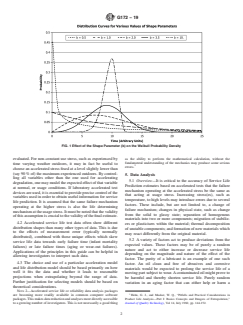
3.1.4.1 Discussion—The shape parameter (b), 3.1.4,isso
Barriers to Trade (TBT) Committee.
called because this parameter determines the overall shape of
2. Referenced Documents the curve. Examples of the effect of this parameter on the
distribution curve are shown in Fig. 1.
2.1 ASTM Standards:
3.1.4.2 Discussion—The scale parameter (c), 3.1.4,isso
G166Guide for Statistical Analysis of Service Life Data
called because it positions the distribution along the scale of
the time axis. It is equal to the time for 63.2% failure.
This guide is under the jurisdiction of ASTM Committee G03 on Weathering
NOTE 1—This is arrived at by allowing t to equal c in Eq 1. This then
and Durability and is the direct responsibility of Subcommittee G03.08 on Service
-1
reduces to Failure Probability=1− e , which further reduces to equal 1
Life Prediction.
− 0.368 or 0.632.
Current edition approved Jan. 1, 2019. Published February 2019. Originally
Ɛ1
approved in 2002. Last previous edition approved in 2010 as G172-02(2010) .
4. Significance and Use
DOI: 10.1520/G0172-19.
For referenced ASTM standards, visit the ASTM website, www.astm.org, or
4.1 The nature of accelerated service life estimation nor-
contact ASTM Customer Service at service@astm.org. For Annual Book of ASTM
mally requires that stresses higher than those experienced
Standards volume information, refer to the standard’s Document Summary page on
the ASTM website. during service conditions are applied to the material being
Copyright © ASTM International, 100 Barr Harbor Drive, PO Box C700, West Conshohocken, PA 19428-2959. United States
G172 − 19
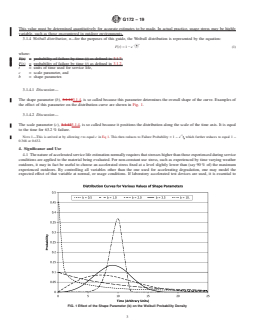
FIG. 1 Effect of the Shape Parameter (b) on the Weibull Probability Density
as the ability to perform the mathematical calculation, without the
evaluated. For non-constant use stress, such as experienced by
fundamental understanding of the mechanics may produce some serious
time varying weather outdoors, it may in fact be useful to
errors.
choose an accelerated stress fixed at a level slightly lower than
(say 90% of) the maximum experienced outdoors. By control-
5. Data Analysis
ling all variables other than the one used for accelerating
5.1 Overview—It is critical to the accuracy of Service Life
degradation,onemaymodeltheexpectedeffectofthatvariable
Prediction estimates based on accelerated tests that the failure
at normal, or usage conditions. If laboratory accelerated test
mechanism operating at the accelerated stress be the same as
devicesareused,itisessentialtoprovideprecisecontrolofthe
that acting at usage stress. Increasing stress(es), such as
variables used in order to obtain useful information for service
temperature, to high levels may introduce errors due to several
life prediction. It is assumed that the same failure mechanism
factors. These include, but are not limited to, a change of
operating at the higher stress is also the life determining
failure mechanism; changes in physical state, such as change
mechanismattheusagestress.Itmustbenotedthatthevalidity
from the solid to glassy state; separation of homogenous
ofthisassumptioniscrucialtothevalidityofthefinalestimate.
materials into two or more components; migration of stabiliz-
4.2 Accelerated service life test data often show different
ers or plasticisers within the material; thermal decomposition
distribution shapes than many other types of data. This is due
ofunstablecomponents;andformationofnewmaterialswhich
to the effects of measurement error (typically normally
may react differently from the original material.
distributed), combined with those unique effects which skew
5.2 A variety of factors act to produce deviations from the
service life data towards early failure time (infant mortality
expected values. These factors may be of purely a random
failures) or late failure times (aging or wear-out failures).
nature and act to either increase or decrease service life
Applications of the principles in this guide can be helpful in
depending on the magnitude and nature of the effect of the
allowing investigators to interpret such data.
factor. The purity of a lubricant is an example of one such
4.3 The choice and use of a particular acceleration model
factor. An oil clean and free of abrasives and corrosive
and life distribution model should be based primarily on how
materials would be expected to prolong the service life of a
well it fits the data and whether it leads to reasonable
movingpartsubjecttowear.Acontaminatedoilmightproveto
projections when extrapolating beyond the range of data.
be harmful and thereby shorten service life. Purely random
Further justification for selecting models should be based on
variation in an aging factor that can either help or harm a
theoretical considerations.
NOTE 2—Accelerated service life or reliability data analysis packages
are becoming more readily available in common computer software
Hahn, G. J., and Meeker, W. Q., “Pitfalls and Practical Considerations in
packages.Thismakesdatareductionandanalysesmoredirectlyaccessible Product Life Analysis—Part I: Basics Concepts and Dangers of Extrapolation,”
to a growing number of investigators.This is not necessarily a good thing Journal of Quality Technology, Vol 14, July 1982, pp. 144-152.
G172 − 19
service life might lead to a normal, or gaussian, distribution. 5.4.2 The Arrhenius model has, however, been found to be
Such distributions are symmetrical about a central tendency, of widespread utility and the accuracy has been verified in
usually the mean. some systems. Wherever possible, confirmation of the accu-
racy of the accelerated model should be verified by actual
5.2.1 Some non-random factors act to skew service life
usagedata.Theformoftheequationmostoftenencounteredis:
distributions. Defects are generally thought of as factors that
2∆H/kT
can only decrease service life (that is, monotonically decreas-
Rate 5 Ae (2)
ing performance). Thin spots in protective coatings, nicks in
where:
extruded wires, and chemical contamination in thin metallic
A = pre-exponential factor and is characteristic of the
films are examples of such defects that can cause an overall
product failure mechanism and test conditions,
failure even though the bulk of the material is far from failure.
T = absolute temperature in Kelvin (K),
These factors skew the service life distribution towards early
∆H = activation energy. For the sake of consistency with
failure times.
many references contained in this guide, the symbol
5.2.2 Factors that skew service life towards greater times
∆H is used. In other recent texts, it has become a
also exist. Preventive maintenance on a test material, high
common practice to use E for the activation energy
quality raw materials, reduced impurities, and inhibitors or
parameter. Either symbol is correct, and
other additives are such factors.These factors produce lifetime
k = Boltzmann’sconstant.Anyofseveraldifferentequiva-
distributions shifted towards increased longevity and are those
lent values for this constant can be used depending on
typically found in products having a relatively long production
the units appropriate for the specific situation. Three
history. -5
commonly used values are: (1) 8.617 × 10 eV/K, (2)
-18
1.380 × 10 ergs/K, and (3) 0.002 kcal/mole·K.
5.3 Failure Distribution—There are two main elements to
the data analysis forAccelerated Service Life Predictions. The
5.4.3 The rate may be that of any reasonable parameter that
first element is determining a mathematical description of the
one wishes to model at accelerated conditions and relate to
life time distribution as a function of time. The Weibull
usage conditions. It could be the rate in color change units per
distribution has been found to be the most generally useful.As
month, gloss loss units per year, crack growth in mm’s per
Weibull parameter estimations are treated in some detail in
year, degree of chalking per year, and so forth. It could also be
Guide G166, they will not be covered in depth here. It is the
the amount of corrosion penetration per hour, or byte error
intentionofthisguidethatitbeusedinconjunctionwithGuide
growth rate on data storage disks.
G166.Themethodologypresentedhereindemonstrateshowto
5.4.4 Because the purpose of this guide is to model service
integrate the information from Guide G166 with accelerated
life, the Eq 2 may be rewritten to express theArrhenius model
testdata.Thisintegrationpermitsestimatesofservicelifetobe
in terms of time rather than rate.As time and rate are inversely
made with greater precision and accuracy as well as in less
related, the new expression is formed by changing the sign of
time than would be required if the effect of stress were not
the exponent so that the time, t, is:
accelerated. Confirmation of the accelerated model should be
∆H/kT
Time 5 A'e (3)
made from field data or data collected at typical usage
5.4.5 The time element used in the Eq 3 is arbitrary. It can
conditions.
be the time for the first 5% failure, time for average failure,
5.3.1 Establishing, in an accelerated time frame, a descrip-
time for 63.2% failure, time for 95% failure, or any other
tion of the distribution of frequency (or probability) of failure
representation that would suit the particular application.
versus time in service is the objective of this guide. Determi-
5.4.6 Because Guide G166 emphasizes the utility of the
nation of the shape of this distribution as well as its position
Weibull distribution model, it will be used for the rest of the
along the time scale axis is the principal criteria for estimating
discussion in this guide as well. Should a different distribution
service life.
model fit a particular application, simple adjustments permit
5.4 Acceleration Model—The most common model for
their use. Therefore, by setting the value for time in the above
single variable accelerations is the Arrhenius model. It was
expression to be the time for 63.3% failure, the model will
determined empirically from observations made by the Swed-
predict the scale parameter for the Weibull distribution at the
ish scientist S. A. Arrhenius. As it is one that is often
usage stress.
encountered in accelerated testing, it will be used as the
5.4.7 TheWeibullmodel,asgiveninEq1,isalsoexpressed
fundamental model for single variables accelerations in this
as a function of time. We can, therefore, relate the Weibull
guide.
distribution model to the Arrhenius acceleration model by:
5.4.1 Although the Arrhenius model is commonly used, it t b
2S D ∆H/kT
1 2 e c 5 Ae 5 F~t! (4)
should not be considered to be a basic scientific law, nor to
necessarily apply to all systems. Application of the principles 5.4.8 By determining the Weibull shape and scale param-
of this guide will increase the confidence of the data analyst eters at temperatures above the expected service temperature,
regarding the suitability of such a model. There are many and relating these parameters with the Arrhenius model, one
instances where its suitability is questionable. Biological sys- may determine an expression to estimate these parameters at
tems are not expected to fit this model, nor are systems that usagecondition.ThisintegrationoftheWeibullparametersand
undergo a change of phase or a change of mechanism between anaccelerationmodelsuchasArrheniusformsthefundamental
the usage and some experimental levels. structure of this guide.
G172 − 19
6. Accelerated Service Life Model—Single Variable 8. Example Calculations—Single Accelerating Variable of
Temperature, Weibull Distribution
6.1 For the purposes of this discussion, the accelerating
stress variable is assumed to be temperature. This is generally 8.1 Determine Weibull scale and shape parameters for
true for most systems and is the stress most frequently used in failure times at each accelerated temperature.
theArrheniusmodel.Otherones,suchasvoltage,mayworkas 8.1.1 Consider a hypothetical case where 55 adhesive
well. coated strips are placed on test.This particular adhesive is one
thatexhibitsacharacteristicofthermaldegradationresultingin
6.2 Temperature Selection—One of the critical points used
sudden failure from stress. The specimens are divided into
in Accelerated Service Life modeling is the choice of the
three groups with one group being placed in an oven at 80°C,
number and levels of the accelerating stress. Theoretically, it
the second group in an oven at 70°C, and the third group into
takes only two levels of stress to develop a linear model and
an oven at 60°C. The first group contains 10 specimens, the
extrapolate to usage conditions. This does not provide any
second group contains 15 specimens, and the third group
insight into the degree of linearity, or goodness of fit, of the
contains30specimens.Thisapproximatesthe1X,2X,4Xratio
model. At least three levels of the accelerating stress are
cited above.
necessary to determine an estimate of linearity. These should
be chosen such that one can reasonably expect to obtain good
TABLE 1 Failure Times for Experimental Adhesive, h
estimates for the shape and scale parameters of the Weibull
80 °C 70 °C 60 °C
modelattheloweststresstemperatureandwithintheallowable
time for the experiment. 1465 2375 2407 3590
1384 2259 2521 3703
6.2.1 If the service life of the material is expected to be on
1177 2399 2727 3764
the order of years at 25°C, and the time available to collect
1857 2062 2820 3806
1998 1773 2903 4018
supporting data is on the order of months, then the lowest
1244 2367 2954 4087
temperature chosen might be 60°C. This would reasonably be
1506 2606 3102 4210
expected to produce sufficient failures to model the Weibull
1424 2348 3122 4230
1595 1869 3221 4254
distributionwithintheallottedtimeframe.Thisisonlyusedas
947 2194 3237 4407
an example. The temperature is system dependent and will
2115 3239 4560
vary for each material evaluated.
3240 3398 4525
1411 3440 4650
6.2.2 The highest temperature chosen is one that should
1707 3524 4680
allow one to accurately measure the time to failure of each
2522 3557 4850
specimen under test. If the selected upper temperature is too
high,thenallornearlyallofthetestspecimensmayfailbefore
the first test measurement interval. More importantly, if the
8.1.2 Thetimetofailureforthisapplicationisdefinedasthe
highest temperature level produces a change in degradation
time at which the adhesive strip will no longer support a 5lb
mechanism, the model is not valid.
load. The test apparatus is constructed with one end of each
6.3 Specimen Distribution—Whenever the cost of speci-
stripadheredtoatestpanelandtheotherendsuspendinga5lb
mens or the cost of analysis is a significant factor, a non-
weight. Optical proximity sensors are used to detect when the
uniformdistributionofspecimensisrecommendedoverhaving
strip releases from the panel. The times to fail for each
the same number of specimens at each temperature. The
individual strip are recorded electronically to the nearest hour.
reasons for this are:
Table 1 is a summary of the times to fail for each individual
6.3.1 Use of more specimens at lower temperatures, com-
strip, by temperature.
pared to the number used at higher temperatures, increases the
8.1.3 From these three sets of data, three sets of Weibull
chance of obtaining sufficient failures within the allotted time
parameters are calculated, one for each temperature. Refer to
for the experiment and improves the accuracy of extrapolation
Guide G166 for detailed examples for these calculations. The
to the usage condition.
values determined from the above sets of data are shown in
6.3.2 If three evenly spaced temperatures are chosen for the
Table 2.
numberofstresslevels,andtherearexspecimensavailablefor
the experiment then place x/7 at the high temperature, 2x/7 at
TABLE 2 Summary of Weibull Parameters for the Accelerated
the mid temperature, and 4x/7 at the lowest temperature. This
Data in Table 1
isonlyafirstorderguide. Ifthecostofspecimensandanalysis
80 °C 70 °C 60 °C
are not significant, then a more even distribution among the Weibull Scale 1580.8 2391.1 3932.9
Weibull Shape 5.39 5.45 6.10
stress conditions may be appropriate.
7. Service Life Estimation
8.2 Plot data on one common Weibull graph.
7.1 Guide G166 may be consulted for methods which may
8.2.1 Graphicallydisplaythedatabeforeproceedingfurther
be employed to estimate the service life of a material.
with analysis. This simple step allows the analyst to detect
abnormaltrends,outliers,andanyotheranomalousbehaviorof
thedata.ThegraphinFig.2showsthethreesetsofaccelerated
Meeker,W.Q.,andHahn,G.J.,“HowtoPlananAcceleratedLifeTest,”ASQC
Basic References, 10, 1985. data displayed on one Weibull axis.
G172 − 19
FIG. 2 Weibull Probability Plots for 80 °C, 70 °C, and 60 °C Experimental Adhesive Failure Times, h
8.2.2 From inspection of the graphical display above and 8.3.3 Convert °C to K—In order to convert °C to K, the
thenumericalvaluesoftheshapeparametersinTable2,itmay constant 273.1 is added to each centigrade temperature. Thus
be seen that the Weibull shapes (slopes of the line) are 80°C becomes 353.1 K, 70°C becomes 343.1 K, and 60°C
essentially the same.Asignificant difference among the shapes becomes 333.1 K.
mayindicateachangeindegradationmechanismhasoccurred. 8.3.4 Regression—Calculation of the reciprocals of Kelvin
Iftheshapesareessentiallythesame,thenitissafertoassume temperature and the natural logarithm of the Weibull Scale
that the same mechanism operates at all of the experimental parameters produces the values shown in Table 3.
temperatures.
8.2.3 The Weibull scale parameters show a clear trend
TABLE 3 Summary of Estimated Weibull Scale Parameters for
towardhighervaluesasthetemperaturedecreases.Thisiswhat
Experimental Adhesive
is to be expected if the samples fail sooner at higher tempera-
Weibull Scale, ln,
tures. Temp. K 1/K
h (Scale, h)
353.1 0.0028321 1580.8 7.3657
8.3 Estimate the Weibull scale parameter at the usage
343.1 0.0029146 2391.1 7.7795
condition.
333.1 0.0030021 3932.9 8.2771
8.3.1 For the sake of this example, it is assumed that the
usage temperature for this tape application is 25°C. We need
thentoregresstheWeibullscaleparametersversustemperature
toestimatewhatthesc
...
This document is not an ASTM standard and is intended only to provide the user of an ASTM standard an indication of what changes have been made to the previous version. Because
it may not be technically possible to adequately depict all changes accurately, ASTM recommends that users consult prior editions as appropriate. In all cases only the current version
of the standard as published by ASTM is to be considered the official document.
´1
Designation: G172 − 02 (Reapproved 2010) G172 − 19
Standard Guide for
Statistical Analysis of Accelerated Service Life Data
This standard is issued under the fixed designation G172; the number immediately following the designation indicates the year of
original adoption or, in the case of revision, the year of last revision. A number in parentheses indicates the year of last reapproval. A
superscript epsilon (´) indicates an editorial change since the last revision or reapproval.
ε NOTE—Editorially corrected designation and footnote 1 in November 2013
1. Scope
1.1 This guide briefly presents some generally accepted methods of statistical analyses that are useful in the interpretation
describes general statistical methods for analyses of accelerated service life data. It is intended to produce provides a common
terminology as well as developing and a common methodology and quantitative expressions relating to service life estimation.for
calculating a quantitative estimate of functional service life.
1.2 This guide covers the application of the Arrhenius equation to service life data. It serves as a general model for determining
rates at usage conditions, such as temperature. It serves as a general guide for determining service life distribution at usage
condition. two general models for determining service life distribution at usage condition. The Arrhenius model serves as a general
model where a single stress variable, specifically temperature, affects the service life. It also covers applications where more than
one variable the Eyring Model for applications where multiple stress variables act simultaneously to affect the service life. For the
purposes of this guide, the acceleration model used for multiple stress variables is the Eyring Model. This model was derived from
the fundamental laws of thermodynamics and has been shown to be useful for modeling some two variable accelerated service life
data. It can be extended to more than two variables.
1.3 Only those statistical methods that have found wide acceptance in service life data analyses have been considered in this
guide.
1.3 The This guide emphasizes the use of the Weibull life distribution is emphasized in this guide and example calculations of
situations commonly encountered in analysis of service life data are covered in detail. It is the intention of this guide that it and
is written to be used in conjunctioncombination with Guide G166.
1.4 The accuracy of the uncertainty and reliability of every accelerated service life model becomes more critical as the number
of stress variables increases and/orand the extent of extrapolation from the accelerated stress levels to the usage level increases.
increases, or both. The models and methodology used in this guide are shown for the purpose to provide examples of data analysis
techniques only. The fundamental requirements of proper variable selection and measurement must still be met by the users for
a meaningful model to result.
1.5 This international standard was developed in accordance with internationally recognized principles on standardization
established in the Decision on Principles for the Development of International Standards, Guides and Recommendations issued
by the World Trade Organization Technical Barriers to Trade (TBT) Committee.
2. Referenced Documents
2.1 ASTM Standards:
G166 Guide for Statistical Analysis of Service Life Data
G169 Guide for Application of Basic Statistical Methods to Weathering Tests
3. Terminology
3.1 Terms Commonly Used in Service Life Estimation:
This guide is under the jurisdiction of ASTM Committee G03 on Weathering and Durability and is the direct responsibility of Subcommittee G03.08 on Service Life
Prediction.
Current edition approved July 1, 2010Jan. 1, 2019. Published July 2010February 2019. Originally approved in 2002. Last previous edition approved in 20022010 as
Ɛ1
G172 - 02.G172 - 02(2010) . DOI: 10.1520/G0172-02R10.10.1520/G0172-19.
For referenced ASTM standards, visit the ASTM website, www.astm.org, or contact ASTM Customer Service at service@astm.org. For Annual Book of ASTM Standards
volume information, refer to the standard’s Document Summary page on the ASTM website.
Copyright © ASTM International, 100 Barr Harbor Drive, PO Box C700, West Conshohocken, PA 19428-2959. United States
G172 − 19
3.1.1 accelerated stress, n—that experimentala stress variable, such as temperature, which istemperature or irradiance, applied
to the test material at levels higher than intensified over those encountered in normal use.the service environment.
3.1.2 beginning of life, n—this is usually determined to be the time of delivery to the end user or installation into field service.
Exceptions may include time of manufacture, time of repair, or other agreed upon time.
3.1.3 cdf, n—the cumulative distribution function (cdf), denoted by F(t), represents the probability of failure (or the population
fraction failing) by time = (t). See 3.1.7.
3.1.4 complete data, n—a complete data set is one where all of the specimens placed on test fail by the end of the allocated test
time.
3.1.5 end of life, n—occasionally this is simple and obvious, such as the breaking of a chain or burning out of a light bulb
filament. In other instances, the end of life may not be so catastrophic or obvious. Examples may include fading, yellowing,
cracking, crazing, etc. Such cases need quantitative measurements and agreement between evaluator and user as to the precise
definition of failure. For example, when some critical physical parameter (such as yellowing) reaches a pre-defined level. It is also
possible to model more than one failure mode for the same specimen (that is, the time to reach a specified level of yellowing may
be measured on the same specimen that is also tested for cracking).
3.1.6 f(t), n—the probability density function (pdf), equals the probability of failure between any two points of time t and t ;
(1) (2)
dF~t!
f t 5 . For the normal distribution, the pdf is the “bell shape” curve.
~ !
dt
3.1.2 F(t), n—the probability that a random unit drawn from the population will fail by time (t). Also F(t) = the decimal fraction
of units in the population that will fail by time (t). The decimal fraction multiplied by 100 is numerically equal to the percent failure
by time (t).
3.1.2.1 Discussion—
Also F(t) = the decimal fraction of units in the population that will fail by time (t). The decimal fraction multiplied by 100 is
numerically equal to the percent failure by time (t).
3.1.8 incomplete data, n—an incomplete data set is one where (1) there are some specimens that are still surviving at the
expiration of the allowed test time, or (2) where one or more specimens is removed from the test prior to expiration of the allocated
test time. The shape and scale parameters of the above distributions may be estimated even if some of the test specimens did not
fail. There are three distinct cases where this might occur.
3.1.8.1 multiple censored, n—specimens that were removed prior to the end of the test without failing are referred to as left
censored or type II censored. Examples would include specimens that were lost, dropped, mishandled, damaged or broken due to
stresses not part of the test. Adjustments of failure order can be made for those specimens actually failed.
3.1.8.2 specimen censored, n—specimens that were still surviving when the test was terminated after a set number of failures
are considered to be specimen censored. This is another case of right censored or type I censoring. See 3.1.8.3.
3.1.8.3 time censored, n—specimens that were still surviving when the test was terminated after elapse of a set time are
considered to be time censored. Examples would include experiments where exposures are conducted for a predetermined length
of time. At the end of the predetermined time, all specimens are removed from the test. Those that are still surviving are said to
be censored. This is also referred to as right censored or type I censoring. Graphical solutions can still be used for parameter
estimation. A minimum of ten observed failures should be used for estimating parameters (that is, slope and intercept, shape and
scale, etc.).
3.1.9 material property, n—customarily, service life is considered to be the period of time during which a system meets critical
specifications. Correct measurements are essential to produce meaningful and accurate service life estimates.
3.1.9.1 Discussion—
There exists many ASTM recognized and standardized measurement procedures for determining material properties. These
practices have been developed within committees having appropriate expertise, therefore, no further elaboration will be provided.
3.1.10 R(t), n—the probability that a random unit drawn from the population will survive at least until time (t). Also R(t) = the
fraction of units in the population that will survive at least until time (t); R(t) = 1 − F(t).
3.1.3 usage stress, n—the level of the experimental variable that is considered to represent the stress occurring in normal use.
This value must be determined quantitatively for accurate estimates to be made. In actual practice, usage stress may be highly
variable, such as those encountered in outdoor environments.
3.1.3.1 Discussion—
G172 − 19
This value must be determined quantitatively for accurate estimates to be made. In actual practice, usage stress may be highly
variable, such as those encountered in outdoor environments.
3.1.4 Weibull distribution, n—for the purposes of this guide, the Weibull distribution is represented by the equation:
t b
S D
F t 5 12 e c (1)
~ !
where:
F(t) = probability of failure by time (t) as defined in 3.1.7,
F(t) = probability of failure by time (t) as defined in 3.1.2,
t = units of time used for service life,
c = scale parameter, and
b = shape parameter.
3.1.4.1 Discussion—
The shape parameter (b), 3.1.123.1.4, is so called because this parameter determines the overall shape of the curve. Examples of
the effect of this parameter on the distribution curve are shown in Fig. 1.
3.1.4.2 Discussion—
The scale parameter (c), 3.1.123.1.4, is so called because it positions the distribution along the scale of the time axis. It is equal
to the time for 63.2 % failure.
-1
NOTE 1—This is arrived at by allowing t to equal c in Eq 1. This then reduces to Failure Probability = 1 − e ., which further reduces to equal 1 −
0.368 or 0.632.
4. Significance and Use
4.1 The nature of accelerated service life estimation normally requires that stresses higher than those experienced during service
conditions are applied to the material being evaluated. For non-constant use stress, such as experienced by time varying weather
outdoors, it may in fact be useful to choose an accelerated stress fixed at a level slightly lower than (say 90 % of) the maximum
experienced outdoors. By controlling all variables other than the one used for accelerating degradation, one may model the
expected effect of that variable at normal, or usage conditions. If laboratory accelerated test devices are used, it is essential to
FIG. 1 Effect of the Shape Parameter (b) on the Weibull Probability Density
G172 − 19
provide precise control of the variables used in order to obtain useful information for service life prediction. It is assumed that the
same failure mechanism operating at the higher stress is also the life determining mechanism at the usage stress. It must be noted
that the validity of this assumption is crucial to the validity of the final estimate.
4.2 Accelerated service life test data often show different distribution shapes than many other types of data. This is due to the
effects of measurement error (typically normally distributed), combined with those unique effects which skew service life data
towards early failure time (infant mortality failures) or late failure times (aging or wear-out failures). Applications of the principles
in this guide can be helpful in allowing investigators to interpret such data.
4.3 The choice and use of a particular acceleration model and life distribution model should be based primarily on how well
it fits the data and whether it leads to reasonable projections when extrapolating beyond the range of data. Further justification for
selecting models should be based on theoretical considerations.
NOTE 2—Accelerated service life or reliability data analysis packages are becoming more readily available in common computer software packages.
This makes data reduction and analyses more directly accessible to a growing number of investigators. This is not necessarily a good thing as the ability
to perform the mathematical calculation, without the fundamental understanding of the mechanics may produce some serious errors. See Ref (1).
5. Data Analysis
5.1 Overview—It is critical to the accuracy of Service Life Prediction estimates based on accelerated tests that the failure
mechanism operating at the accelerated stress be the same as that acting at usage stress. Increasing stress(es), such as temperature,
to high levels may introduce errors due to several factors. These include, but are not limited to, a change of failure
mechanism,mechanism; changes in physical state, such as change from the solid to glassy state,state; separation of homogenous
materials into two or more components,components; migration of stabilizers or plasticisers within the material,material; thermal
decomposition of unstable componentscomponents; and formation of new materials which may react differently from the original
material.
5.2 A variety of factors act to produce deviations from the expected values. These factors may be of purely a random nature
and act to either increase or decrease service life depending on the magnitude and nature of the effect of the factor. The purity of
a lubricant is an example of one such factor. An oil clean and free of abrasives and corrosive materials would be expected to
prolong the service life of a moving part subject to wear. A contaminated oil might prove to be harmful and thereby shorten service
life. Purely random variation in an aging factor that can either help or harm a service life might lead to a normal, or gaussian,
distribution. Such distributions are symmetrical about a central tendency, usually the mean.
5.2.1 Some non-random factors act to skew service life distributions. Defects are generally thought of as factors that can only
decrease service life (that is, monotonically decreasing performance). Thin spots in protective coatings, nicks in extruded wires,
and chemical contamination in thin metallic films are examples of such defects that can cause an overall failure even though the
bulk of the material is far from failure. These factors skew the service life distribution towards early failure times.
5.2.2 Factors that skew service life towards greater times also exist. Preventive maintenance on a test material, high quality raw
materials, reduced impurities, and inhibitors or other additives are such factors. These factors produce lifetime distributions shifted
towards increased longevity and are those typically found in products having a relatively long production history.
5.3 Failure Distribution—There are two main elements to the data analysis for Accelerated Service Life Predictions. The first
element is determining a mathematical description of the life time distribution as a function of time. The Weibull distribution has
been found to be the most generally useful. As Weibull parameter estimations are treated in some detail in Guide G166, they will
not be covered in depth here. It is the intention of this guide that it be used in conjunction with Guide G166. The methodology
presented herein demonstrates how to integrate the information from Guide G166 with accelerated test data. This integration
permits estimates of service life to be made with greater precision and accuracy as well as in less time than would be required if
the effect of stress were not accelerated. Confirmation of the accelerated model should be made from field data or data collected
at typical usage conditions.
5.3.1 Establishing, in an accelerated time frame, a description of the distribution of frequency (or probability) of failure versus
time in service is the objective of this guide. Determination of the shape of this distribution as well as its position along the time
scale axis is the principal criteria for estimating service life.
5.4 Acceleration Model—The most common model for single variable accelerations is the Arrhenius model. It was determined
empirically from observations made by the Swedish scientist S. A. Arrhenius. As it is one that is often encountered in accelerated
testing, it will be used as the fundamental model for single variables accelerations in this guide.
5.4.1 Although the Arrhenius model is commonly used, it should not be considered to be a basic scientific law, nor to necessarily
apply to all systems. Application of the principles of this guide will increase the confidence of the data analyst regarding the
suitability of such a model. There are many instances where its suitability is questionable. Biological systems are not expected to
fit this model, nor are systems that undergo a change of phase or a change of mechanism between the usage and some experimental
levels.
The boldface numbers in parentheses refer to the list of references at the end of this standard.Hahn, G. J., and Meeker, W. Q., “Pitfalls and Practical Considerations in
Product Life Analysis—Part I: Basics Concepts and Dangers of Extrapolation,” Journal of Quality Technology, Vol 14, July 1982, pp. 144-152.
G172 − 19
5.4.2 The Arrhenius model has, however, been found to be of widespread utility and the accuracy has been verified in some
systems. Wherever possible, confirmation of the accuracy of the accelerated model should be verified by actual usage data. The
form of the equation most often encountered is:
2ΔH/kT
Rate 5 Ae (2)
where:
A = pre-exponential factor and is characteristic of the product failure mechanism and test conditions,
T = absolute temperature in Kelvin (K),
ΔH = activation energy. For the sake of consistency with many references contained in this guide, the symbol ΔH is used. In
other recent texts, it has become a common practice to use E for the activation energy parameter. Either symbol is correct,
and
k = Boltzmann’s constant. Any of several different equivalent values for this constant can be used depending on the units
-5 -18
appropriate for the specific situation. Three commonly used values are: (1) 8.617 × 10 eV/K, (2) 1.380 × 10 ergs/K,
and (3) 0.002 kcal/mole·K.
5.4.3 The rate may be that of any reasonable parameter that one wishes to model at accelerated conditions and relate to usage
conditions. It could be the rate in color change units per month, gloss loss units per year, crack growth in mm’s per year, degree
of chalking per year, and so forth. It could also be the amount of corrosion penetration per hour, or byte error growth rate on data
storage disks.
5.4.4 Because the purpose of this guide is to model service life, the Eq 2 may be rewritten to express the Arrhenius model in
terms of time rather than rate. As time and rate are inversely related, the new expression is formed by changing the sign of the
exponent so that the time, t, is:
ΔH/kT
Time 5 A'e (3)
5.4.5 The time element used in the Eq 3 is arbitrary. It can be the time for the first 5 % failure, time for average failure, time
for 63.2 % failure, time for 95 % failure, or any other representation that would suit the particular application.
5.4.6 Because Guide G166 emphasizes the utility of the Weibull distribution model, it will be used for the rest of the discussion
in this guide as well. Should a different distribution model fit a particular application, simple adjustments permit their use.
Therefore, by setting the value for time in the above expression to be the time for 63.3 % failure, the model will predict the scale
parameter for the Weibull distribution at the usage stress.
5.4.7 The Weibull model, as given in Eq 1, is also expressed as a function of time. We can, therefore, relate the Weibull
distribution model to the Arrhenius acceleration model by:
t b
2 ΔH/kT
S D
12 e c 5 Ae 5 F~t! (4)
5.4.8 By determining the Weibull shape and scale parameters at temperatures above the expected service temperature, and
relating these parameters with the Arrhenius model, one may determine an expression to estimate these parameters at usage
condition. This integration of the Weibull parameters and an acceleration model such as Arrhenius forms the fundamental structure
of this guide.
6. Accelerated Service Life Model—Single Variable
6.1 For the purposes of this discussion, the accelerating stress variable is assumed to be temperature. This is generally true for
most systems and is the stress most frequently used in the Arrhenius model. Other ones, such as voltage, may work as well.
6.2 Temperature Selection—One of the critical points used in Accelerated Service Life modeling is the choice of the number
and levels of the accelerating stress. Theoretically, it takes only two levels of stress to develop a linear model and extrapolate to
usage conditions. This does not provide any insight into the degree of linearity, or goodness of fit, of the model. At least three levels
of the accelerating stress are necessary to determine an estimate of linearity. These should be chosen such that one can reasonably
expect to obtain good estimates for the shape and scale parameters of the Weibull model at the lowest stress temperature and within
the allowable time for the experiment.
6.2.1 If the service life of the material is expected to be on the order of years at 25°C,25 °C, and the time available to collect
supporting data is on the order of months, then the lowest temperature chosen might be 60°C.60 °C. This would reasonably be
expected to produce sufficient failures to model the Weibull distribution within the allotted time frame. This is only used as an
example. The temperature is system dependent and will vary for each material evaluated.
6.2.2 The highest temperature chosen is one that should allow one to accurately measure the time to failure of each specimen
under test. If the selected upper temperature is too high, then all or nearly all of the test specimens may fail before the first test
measurement interval. More importantly, if the highest temperature level produces a change in degradation mechanism, the model
is not valid.
6.3 Specimen Distribution—Whenever the cost of specimens or the cost of analysis is a significant factor, a non-uniform
distribution of specimens is recommended over having the same number of specimens at each temperature. The reasons for this
are:
G172 − 19
6.3.1 Use of more specimens at lower temperatures, compared to the number used at higher temperatures, increases the chance
of obtaining sufficient failures within the allotted time for the experiment and improves the accuracy of extrapolation to the usage
condition.
6.3.2 If three evenly spaced temperatures are chosen for the number of stress levels, and there are x specimens available for the
experiment then place x/7 at the high temperature, 2x/7 at the mid temperature, and 4x/7 at the lowest temperature. This is only
a first order guide guide.(see Ref ( 2)). If the cost of specimens and analysis are not significant, then a more even distribution
among the stress conditions may be appropriate.
7. Service Life Estimation
7.1 The Guide G166 may be consulted for methods which may be employed to estimate the service life of a material.
8. Example Calculations—Single Accelerating Variable of Temperature, Weibull Distribution
8.1 Determine Weibull scale and shape parameters for failure times at each accelerated temperature.
8.1.1 Consider a hypothetical case where 55 adhesive coated strips are placed on test. This particular adhesive is one that
exhibits a characteristic of thermal degradation resulting in sudden failure from stress. The specimens are divided into three groups
with one group being placed in an oven at 80°C,80 °C, the second group in an oven at 70°C70 °C, and the third group into an oven
at 60°C.60 °C. The first group contains 10 specimens, the second group contains 15 specimens, and the third group contains 30
specimens. This approximates the 1X, 2X, 4X ratio cited above.
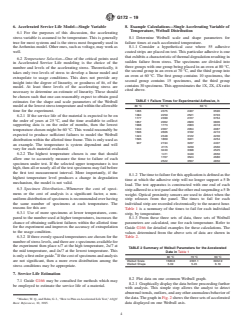
TABLE 1 Failure Times for Experimental Adhesive, h
80°C80 °C 70°C70 °C 60°C60 °C
1465 2375 2407 3590
1384 2259 2521 3703
1177 2399 2727 3764
1857 2062 2820 3806
1998 1773 2903 4018
1244 2367 2954 4087
1506 2606 3102 4210
1424 2348 3122 4230
1595 1869 3221 4254
947 2194 3237 4407
2115 3239 4560
3240 3398 4525
1411 3440 4650
1707 3524 4680
2522 3557 4850
8.1.2 The time to failure for this application is defined as the time at which the adhesive strip will no longer support a 5 lb 5 lb
load. The test apparatus is constructed with one end of each strip adhered to a test panel and the other end suspending a 5 lb 5 lb
weight. Optical proximity sensors are used to detect when the strip releases from the panel. The times to fail for each individual
strip are recorded electronically to the nearest hour. Table 1 is a summary of the times to fail for each individual strip, by
temperature.
8.1.3 From these three sets of data, three sets of Weibull parameters are calculated, one for each temperature. Refer to Guide
G166 for detailed examples for these calculations. The values determined from the above sets of data are shown in Table 2.
TABLE 2 Summary of Weibull Pa
...