

ASTM F513-22
(Specification)Standard Specification for Eye and Face Protective Equipment for Hockey Players
General Information
- Abstract
SCOPE
1.1 This specification covers performance requirements and test methods for face protectors marketed, sold, and intended for ice hockey.
1.2 The intent of this specification is to reduce the risk of injury to the face without compromising the form or appeal of the game. To do so, the face protector shall be used:
1.2.1 As intended within the rules of the game and
1.2.2 In accordance with the manufacturer’s instructions.
1.3 Ice hockey is a sport with intrinsic hazards associated with the normal conduct of the game. Participation in ice hockey implies the acceptance of some risk of injury. Use of a face protector certified to this specification will not prevent all injuries.
1.4 This specification has been prepared after careful consideration of the frequency and mechanisms associated with facial and eye injuries that can potentially occur within the rules of the game of ice hockey.
1.5 Requirements and the corresponding test methods, where appropriate, are given for the following:
1.5.1 Construction,
1.5.2 Puck impact resistance,
1.5.3 Penetration,
1.5.4 Field of vision, and
1.5.5 Marking and information.
1.6 Face protection is intended for use by players, goalkeepers, and certain functionaries (for example, referees and coaches). Types of protectors considered under this specification are:
1.6.1 Type B1—A full-face protector intended for use by persons older than ten years of age, other than goaltenders;
1.6.2 Type B2—A full-face protector intended for use by persons ten years of age or younger, other than goaltenders; and
1.6.3 Type C (Visor)—A visor intended for use by person in the junior age category and older, other than goaltenders.
1.7 Units—The values stated in SI units are to be regarded as the standard. No other units of measurement are included in this standard.
1.8 Use of the singular does not exclude the plural (and vice versa) when the sense allows.
1.9 Although the intended primary application of this specification is stated in this scope, note that it remains the responsibility of the users of this specification to judge its suitability for their particular purpose.
1.10 This standard does not purport to address all of the safety concerns, if any, associated with its use. It is the responsibility of the user of this standard to establish appropriate safety, health, and environmental practices and determine the applicability of regulatory limitations prior to use.
1.11 This international standard was developed in accordance with internationally recognized principles on standardization established in the Decision on Principles for the Development of International Standards, Guides and Recommendations issued by the World Trade Organization Technical Barriers to Trade (TBT) Committee.
- Status
- Published
- Publication Date
- 14-Jun-2022
- Technical Committee
- F08 - Sports Equipment, Playing Surfaces, and Facilities
- Drafting Committee
- F08.15 - Ice Hockey
Buy Documents
ASTM F513-22 - Standard Specification for Eye and Face Protective Equipment for Hockey Players
REDLINE ASTM F513-22 - Standard Specification for Eye and Face Protective Equipment for Hockey Players
Overview
ASTM F513-22: Standard Specification for Eye and Face Protective Equipment for Hockey Players establishes test methods and performance requirements for equipment such as face protectors and visors designed for use in ice hockey. The standard aims to reduce the risk of injuries to the eyes and face while preserving the natural form and appeal of the sport. This specification details requirements for construction, impact resistance, penetration resistance, field of vision, and information for users, ensuring robust protection for players, coaches, referees, and other functionaries.
Key Topics
- Scope of Protection: Addresses both full-face protectors and visors for ice hockey, covering users of various ages and roles except goaltenders.
- Types of Face Protectors:
- Type B1: Full-face protector for players over ten years old.
- Type B2: Full-face protector for players ten years old or younger.
- Type C (Visor): Partial face protection, primarily for junior and adult players.
- Performance Requirements:
- Construction: Mandates the use of materials that are resistant to household cleaners, do not cause skin irritation, and maintain integrity after exposure to heat or UV radiation.
- Impact Resistance: Specifies rigorous testing to ensure the equipment can withstand hockey puck impacts without structural failure or detachment from the helmet.
- Penetration Resistance: Face protectors must prevent direct contact between external blades or objects and the face within protected areas.
- Field of Vision & Optical Quality: Protectors must provide a clear, undistorted field of view, with minimal prism imbalance, adequate light transmittance, and low haze, ensuring optimal performance and safety.
- Product Marking & User Information: Requires permanent and legible marking of each protector with type, model, manufacturer, and manufacturing date. Detailed fitting, cleaning, and usage instructions must accompany each product.
Applications
- Player Safety in Ice Hockey: Ensures that all non-goaltender players, across age groups, have access to tested, reliable eye and face protection that meets strict standards for impact and penetration resistance.
- Equipment Manufacturing and Certification: Provides guidance to manufacturers and testing laboratories for designing, producing, and certifying compliant protective gear, essential for gaining approval from hockey organizations and leagues.
- Regulation and Compliance: Assists regulatory bodies, sports organizations, and safety committees in referencing a definitive, internationally recognized benchmark when setting rules or enforcing equipment requirements.
- Consumer Confidence and Education: Supports players, parents, and coaches in selecting appropriate protective equipment, enhancing awareness of minimum safety features required in face and eye protectors for hockey.
Related Standards
- ASTM D1003: Test Method for Haze and Luminous Transmittance of Transparent Plastics - referenced for optical quality assessment.
- ASTM D2240: Test Method for Rubber Property-Durometer Hardness - relevant for materials used in padding and impact zones.
- CSA Z262.6-14: Specifications for Facially Featured Headforms – provides headform requirements for accurate equipment testing and sizing.
By adhering to ASTM F513-22, manufacturers and end-users can ensure that ice hockey face and eye protection meets stringent safety, performance, and usability benchmarks. The standard plays a crucial role in advancing sports safety, supporting manufacturers’ compliance efforts, and maintaining the integrity of the game. For more information or to procure certified eye and face protective equipment, always reference ASTM F513-22 compliant products.
Relations
- Refers
ASTM D1003-11 - Standard Test Method for Haze and Luminous Transmittance of Transparent Plastics - Effective Date
- 15-Apr-2011
- Refers
ASTM D1003-11e1 - Standard Test Method for Haze and Luminous Transmittance of Transparent Plastics - Effective Date
- 15-Apr-2011
- Refers
ASTM D1003-07 - Standard Test Method for Haze and Luminous Transmittance of Transparent Plastics - Effective Date
- 01-Nov-2007
- Refers
ASTM D1003-00 - Standard Test Method for Haze and Luminous Transmittance of Transparent Plastics - Effective Date
- 10-Jun-2000
Buy Documents
ASTM F513-22 - Standard Specification for Eye and Face Protective Equipment for Hockey Players
REDLINE ASTM F513-22 - Standard Specification for Eye and Face Protective Equipment for Hockey Players
Get Certified
Connect with accredited certification bodies for this standard

CIS Institut d.o.o.
Personal Protective Equipment (PPE) certification body. Notified Body NB-2890 for EU Regulation 2016/425 PPE.

Kiwa BDA Testing
Building and construction product certification.
Kmetijski inštitut Slovenije
Agricultural Institute of Slovenia. Soil testing, plant health, agricultural product analysis.
Sponsored listings
Frequently Asked Questions
ASTM F513-22 is a technical specification published by ASTM International. Its full title is "Standard Specification for Eye and Face Protective Equipment for Hockey Players". This standard covers: SCOPE 1.1 This specification covers performance requirements and test methods for face protectors marketed, sold, and intended for ice hockey. 1.2 The intent of this specification is to reduce the risk of injury to the face without compromising the form or appeal of the game. To do so, the face protector shall be used: 1.2.1 As intended within the rules of the game and 1.2.2 In accordance with the manufacturer’s instructions. 1.3 Ice hockey is a sport with intrinsic hazards associated with the normal conduct of the game. Participation in ice hockey implies the acceptance of some risk of injury. Use of a face protector certified to this specification will not prevent all injuries. 1.4 This specification has been prepared after careful consideration of the frequency and mechanisms associated with facial and eye injuries that can potentially occur within the rules of the game of ice hockey. 1.5 Requirements and the corresponding test methods, where appropriate, are given for the following: 1.5.1 Construction, 1.5.2 Puck impact resistance, 1.5.3 Penetration, 1.5.4 Field of vision, and 1.5.5 Marking and information. 1.6 Face protection is intended for use by players, goalkeepers, and certain functionaries (for example, referees and coaches). Types of protectors considered under this specification are: 1.6.1 Type B1—A full-face protector intended for use by persons older than ten years of age, other than goaltenders; 1.6.2 Type B2—A full-face protector intended for use by persons ten years of age or younger, other than goaltenders; and 1.6.3 Type C (Visor)—A visor intended for use by person in the junior age category and older, other than goaltenders. 1.7 Units—The values stated in SI units are to be regarded as the standard. No other units of measurement are included in this standard. 1.8 Use of the singular does not exclude the plural (and vice versa) when the sense allows. 1.9 Although the intended primary application of this specification is stated in this scope, note that it remains the responsibility of the users of this specification to judge its suitability for their particular purpose. 1.10 This standard does not purport to address all of the safety concerns, if any, associated with its use. It is the responsibility of the user of this standard to establish appropriate safety, health, and environmental practices and determine the applicability of regulatory limitations prior to use. 1.11 This international standard was developed in accordance with internationally recognized principles on standardization established in the Decision on Principles for the Development of International Standards, Guides and Recommendations issued by the World Trade Organization Technical Barriers to Trade (TBT) Committee.
SCOPE 1.1 This specification covers performance requirements and test methods for face protectors marketed, sold, and intended for ice hockey. 1.2 The intent of this specification is to reduce the risk of injury to the face without compromising the form or appeal of the game. To do so, the face protector shall be used: 1.2.1 As intended within the rules of the game and 1.2.2 In accordance with the manufacturer’s instructions. 1.3 Ice hockey is a sport with intrinsic hazards associated with the normal conduct of the game. Participation in ice hockey implies the acceptance of some risk of injury. Use of a face protector certified to this specification will not prevent all injuries. 1.4 This specification has been prepared after careful consideration of the frequency and mechanisms associated with facial and eye injuries that can potentially occur within the rules of the game of ice hockey. 1.5 Requirements and the corresponding test methods, where appropriate, are given for the following: 1.5.1 Construction, 1.5.2 Puck impact resistance, 1.5.3 Penetration, 1.5.4 Field of vision, and 1.5.5 Marking and information. 1.6 Face protection is intended for use by players, goalkeepers, and certain functionaries (for example, referees and coaches). Types of protectors considered under this specification are: 1.6.1 Type B1—A full-face protector intended for use by persons older than ten years of age, other than goaltenders; 1.6.2 Type B2—A full-face protector intended for use by persons ten years of age or younger, other than goaltenders; and 1.6.3 Type C (Visor)—A visor intended for use by person in the junior age category and older, other than goaltenders. 1.7 Units—The values stated in SI units are to be regarded as the standard. No other units of measurement are included in this standard. 1.8 Use of the singular does not exclude the plural (and vice versa) when the sense allows. 1.9 Although the intended primary application of this specification is stated in this scope, note that it remains the responsibility of the users of this specification to judge its suitability for their particular purpose. 1.10 This standard does not purport to address all of the safety concerns, if any, associated with its use. It is the responsibility of the user of this standard to establish appropriate safety, health, and environmental practices and determine the applicability of regulatory limitations prior to use. 1.11 This international standard was developed in accordance with internationally recognized principles on standardization established in the Decision on Principles for the Development of International Standards, Guides and Recommendations issued by the World Trade Organization Technical Barriers to Trade (TBT) Committee.
ASTM F513-22 is classified under the following ICS (International Classification for Standards) categories: 13.340.20 - Head protective equipment; 97.220.30 - Indoor sports equipment. The ICS classification helps identify the subject area and facilitates finding related standards.
ASTM F513-22 has the following relationships with other standards: It is inter standard links to ASTM D1003-11, ASTM D1003-11e1, ASTM D1003-07, ASTM D1003-00. Understanding these relationships helps ensure you are using the most current and applicable version of the standard.
ASTM F513-22 is available in PDF format for immediate download after purchase. The document can be added to your cart and obtained through the secure checkout process. Digital delivery ensures instant access to the complete standard document.
Standards Content (Sample)
This international standard was developed in accordance with internationally recognized principles on standardization established in the Decision on Principles for the
Development of International Standards, Guides and Recommendations issued by the World Trade Organization Technical Barriers to Trade (TBT) Committee.
Designation:F513 −22 An American National Standard
Standard Specification for
Eye and Face Protective Equipment for Hockey Players
ThisstandardisissuedunderthefixeddesignationF513;thenumberimmediatelyfollowingthedesignationindicatestheyearoforiginal
adoptionor,inthecaseofrevision,theyearoflastrevision.Anumberinparenthesesindicatestheyearoflastreapproval.Asuperscript
epsilon (´) indicates an editorial change since the last revision or reapproval.
1. Scope 1.7 Units—The values stated in SI units are to be regarded
as the standard. No other units of measurement are included in
1.1 This specification covers performance requirements and
this standard.
test methods for face protectors marketed, sold, and intended
for ice hockey. 1.8 Useofthesingulardoesnotexcludetheplural(andvice
versa) when the sense allows.
1.2 The intent of this specification is to reduce the risk of
injury to the face without compromising the form or appeal of 1.9 Althoughtheintendedprimaryapplicationofthisspeci-
the game. To do so, the face protector shall be used: fication is stated in this scope, note that it remains the
1.2.1 As intended within the rules of the game and responsibility of the users of this specification to judge its
1.2.2 In accordance with the manufacturer’s instructions. suitability for their particular purpose.
1.10 This standard does not purport to address all of the
1.3 Ice hockey is a sport with intrinsic hazards associated
safety concerns, if any, associated with its use. It is the
with the normal conduct of the game. Participation in ice
responsibility of the user of this standard to establish appro-
hockey implies the acceptance of some risk of injury. Use of a
priate safety, health, and environmental practices and deter-
face protector certified to this specification will not prevent all
mine the applicability of regulatory limitations prior to use.
injuries.
1.11 This international standard was developed in accor-
1.4 This specification has been prepared after careful con-
dance with internationally recognized principles on standard-
sideration of the frequency and mechanisms associated with
ization established in the Decision on Principles for the
facial and eye injuries that can potentially occur within the
Development of International Standards, Guides and Recom-
rules of the game of ice hockey.
mendations issued by the World Trade Organization Technical
1.5 Requirements and the corresponding test methods,
Barriers to Trade (TBT) Committee.
where appropriate, are given for the following:
1.5.1 Construction,
2. Referenced Documents
1.5.2 Puck impact resistance,
2.1 ASTM Standards:
1.5.3 Penetration,
D1003Test Method for Haze and Luminous Transmittance
1.5.4 Field of vision, and
of Transparent Plastics
1.5.5 Marking and information.
D2240TestMethodforRubberProperty—DurometerHard-
1.6 Face protection is intended for use by players,
ness
goalkeepers, and certain functionaries (for example, referees
2.2 CSA Standard:
and coaches). Types of protectors considered under this speci-
CSA Z262.6-14Specifications for Facially Featured Head-
fication are:
forms
1.6.1 Type B1—A full-face protector intended for use by
persons older than ten years of age, other than goaltenders;
3. Terminology
1.6.2 Type B2—A full-face protector intended for use by
3.1 For the purposes of this specification, the following
persons ten years of age or younger, other than goaltenders;
definitions apply.
and
1.6.3 Type C (Visor)—Avisor intended for use by person in
3.2 Definitions:
the junior age category and older, other than goaltenders.
1 2
This specification is under the jurisdiction ofASTM Committee F08 on Sports For referenced ASTM standards, visit the ASTM website, www.astm.org, or
Equipment, Playing Surfaces, and Facilities and is the direct responsibility of contact ASTM Customer Service at service@astm.org. For Annual Book of ASTM
Subcommittee F08.15 on Ice Hockey. Standards volume information, refer to the standard’s Document Summary page on
Current edition approved June 15, 2022. Published July 2022. Originally the ASTM website.
approved in 1977. Last previous edition approved in 2018 as F513–12 (2018). AvailablefromtheCanadianStandardsAssociation,5060SpectrumWay,Suite
DOI: 10.1520/F0513-22. 100, Mississauga, Ontario L4W 5N6 Canada.
Copyright © ASTM International, 100 Barr Harbor Drive, PO Box C700, West Conshohocken, PA 19428-2959. United States
F513−22
3.2.1 chip, n—readily visible particle missing from the 3.2.6.3 superior (upward), adv—refers to an angle in the
protector with an area bigger than 9 mm . vertical plane measured upwards from the horizontal.
3.2.2 collimated light source (source of illumination), 3.2.6.4 temporally, adv—refers to an angle in the horizontal
n—quartz halogen lamp (17 lx or 1.58 footcandles) producing plane measured from the primary position of gaze to the right
a 100-mm beam at 6-m distance that is centered on the pupils for the right eye and from the primary position of gaze to the
oftheeyesoftheheadformorthemidpointbetweenthepupils left for the left eye.
of the eyes of the headform; this centering is maintained at all
3.2.7 glabella, n—most prominent midline point between
times during the optical quality test.
the eyebrows identical to the bony glabella of the frontal bone.
3.2.3 combination, n—combinedunitofafull-faceprotector
3.2.8 goniometer, n—positioning device that moves the
orvisorplacedonahockeyhelmetwithwhichitisdesignedto
headform such that the angular rotation and movement in both
be used.
the horizontal and vertical directions enables a spherical scan
3.2.4 computer interface, n—linkagebetweenthecomputer, to be made of the fields of vision as seen through a face
the goniometer, and the sensors that enables a fully automated protector or visor.
measurement process via a menu-driven operation during the
3.2.9 haze, n—percentage of transmitted light that, in pass-
optical quality test.
ing through the specimen, deviates from the incident beam by
3.2.5 dioptre, n—measure of the power of a lens or a prism forward scattering.
equal to the reciprocal of its focal length expressed in metres.
3.2.10 helmet positioning index, HPI, n—vertical distance
3.2.6 field of vision, n—projection outward of all retinal measured at the median plane, from the front edge of the
points(thenervouslayeroftheeye)atwhichvisualsensations helmet to the basic plane, when the helmet is placed on the
can be initiated (see Fig. 1). reference headform.
3.2.6.1 inferior (downward), adv—refers to an angle in the 3.2.11 impact sites for testing face protectors:—
vertical plane measured downwards from the horizontal. 3.2.11.1 eye impact, n—point in the horizontal plane 25° to
the median plane and in the direction of the eye (see Fig. 2).
3.2.6.2 nasally, adv—refers to an angle in the horizontal
planemeasuredfromtheprimarypositionofgazetotheleftfor 3.2.11.2 mouth impact, n—point in the intersection between
the right eye and from the primary position of gaze to the right the horizontal plane and the median plane in the direction of
for the left eye. the center of the mouth.
FIG. 1Peripheral Field of Vision
F513−22
FIG. 2Puck Impact Sites for Testing Face Protectors
3.2.11.3 side impact, n—point halfway between the mouth 3.2.16 no-contact zone, n—designatedzoneoftheheadform
level and the eye level in the horizontal plane, 25° to the in which contact is not permitted during the puck impact
median plane, and in the direction of the axis formed by the resistance test (see 4.7 and Fig. 3).
intersection of the median plane and the frontal plane (see Fig.
3.2.17 optical clarity, n—sharpness of an image.
2).
3.2.18 optical quality field-of-vision area, n—that area on a
3.2.12 interpupillary distance, PD, n—distance in millime-
transparentfaceprotectororvisordeterminedbytheoutlineof
tres between the centers of the pupils of both eyes on the
a cone whose axis projects along the primary position of the
facially featured headform.
gaze and extends 35° (radius of fixation), the apex of the cone
3.2.13 laser, n—luminous device used for alignment of the is centered on each pupil, and the area generated by each cone
sensors. is joined above and below and is extended to a point 90°
laterally to each side in the horizontal plane (see Fig. A1.1).
3.2.14 luminous transmittance, n—ratio of the light trans-
mitted by a medium to the incident light. 3.2.19 orbit, n—the bony cavity containing the eyeball.
3.2.15 menton, n—lowest point on the mandibular symphy- 3.2.20 orbitale, n—lowermost point on the inferior margin
sis. of the orbit (infraorbital margin).
F513−22
Dimensions (mm)
Facially Featured Headform
(according to CSA Z262.6-14)
AB C D E F
Adult Male (50th Percentile) 48 16 28 17 36 68
Juvenile Male (50th Percentile) 60 0 25 0 36 60
Child (50th Percentile) 55 0 23 0 35 55
FIG. 3No-Contact Zone (Projected Dimensions)
3.2.21 peripheral field of vision, n—oval-shaped field ex-
tending 90° temporally, 60° inferiorly, 45° nasally, and 35°
superiorly (see Fig. 1).
3.2.22 permanent, n—information that remains legible and
cannot be removed in its entirety under conditions of normal
use.
3.2.23 photosensors, n—sensors 5 mm in diameter centered
in the pupils of the headform covered by a 5-mm translucent
lens of 8-mm radius of curvature, convex forward.
3.2.23.1 Discussion—(1) The photosensors are cosine
FIG. 4Orientation Planes
corrected, for example, provided with diffusing covers that are
a means of correcting the light-sensitive surface for wide
3.2.24.5 median plane, n—verticalplanethatpassesthrough
angles of incidence. (2) Light contact with the sensors pro-
the headform from front to back and divides the headform into
duces an electrical signal that is fed into a computer interface.
right and left halves (see Fig. 4).
3.2.24 planes:
3.2.24.6 reference plane, n—construction plane parallel to
3.2.24.1 basic plane of a headform, n—plane relative to the
the basic plane of the headform at a distance from it which is
headform that corresponds to the basic plane of the human
a function of the size of the headform.
head.
3.2.25 porion, n—highest point on the upper margin of the
3.2.24.2 basic plane of the human head, n—plane that is
cutaneous, external auditory meatus.
located at the level of the external upper borders of the ear
canal(externalauditorymeatus)andtheinferiormarginsofthe 3.2.26 primary position of gaze, n—line running forward
orbits of the eyes. from the center of the pupil parallel to the median and
horizontal planes (see Fig. 4).
3.2.24.3 frontal plane, n—vertical plane that is perpendicu-
lar to the median and reference planes and passes through the 3.2.27 prism dioptre, n—unit used in measuring the deviat-
top of the headform (see Fig. 4). ingpowerofaprism;thispowerinprismdioptresis100times
the tangent of the angle of deviation of a ray of light.
3.2.24.4 horizontal plane, n—plane that passes across the
head at right angles to both the frontal and median plane (see 3.2.28 prism imbalance, n—lightpassingthroughalensand
Fig. 4). entering the one eye is deviated by an amount differing in
F513−22
direction from the same light passing through the lens and 4.1.1 Documentation—Themanufacturershallprovidewrit-
entering the fellow eye. ten documentation indicating that the materials used in the
construction of the face protector fulfill the requirements of
3.2.29 protector, n—comprises a face protector either spe-
4.1.2 – 4.1.6.
cially adapted to the helmet or forming a continuous unit
4.1.2 Cleaners—Allmaterialsusedshallbeknownnottobe
designedtoprotectthewholeorpartsofthewearer’sheadand
adversely affected by ordinary household soap and cleaners as
face against injury.
recommended by the manufacturer.
3.2.29.1 full-face protector, n—device intended to reduce
4.1.3 Finishes—Paints,glues,andfinishesusedinmanufac-
the risk of injury to the eyes and face of ice hockey partici-
turing shall be compatible with the materials used in the
pants.
construction of the head and face protector.
3.2.29.2 visor, n—device intended to reduce the risk of
4.1.4 Nonirritants—Material coming in contact with the
injury to the eyes of ice hockey participants.
wearer’s head shall not be of any type known to cause skin
3.2.30 resolution, n—ability of an optical system to distin-
irritation or disease or undergo significant loss of strength,
guish two points at their minimum separation.
flexibility, or other physical changes as a result of contact with
3.2.31 scan area, n—oval,peripheralfieldsareaspecifiedby perspiration, oil, or grease from the wearer’s head.
superior, temporal, inferior, and nasal directions.
4.1.5 Adhesives—Adhesive material used to attach padding
orstrapstothefaceprotectororvisorshallbeofaformulation
3.2.32 subnasale, Sn, n—deepest point on the concavity of
that will not alter the chemical or physical properties of the
theanteriorsurfaceofthemaxillainthemidlinewithin3.0mm
materials to an extent so as to reduce their protective qualities.
of the floor of the nose (see Fig. 5).
4.1.6 Polymeric Changes—All materials used in the con-
3.2.33 threshold value, n—outputreadingobtainedwhenthe
struction of the face protector shall be resistant to irreversible
columnated light beam has been centered on the midpoint
polymeric changes when exposed to temperatures up to 70°C
between the pupils in the primary position of gaze and the
or ultraviolet radiation.
headform is rotated 90° in the horizontal plane and the
collimated light source contacts the pupillary sensor closest to 4.2 Finish—Allpartsshallbewellfinishedandfreeofsharp
the light source.
edges and other irregularities that would present a potential
hazard to the user or other players.
3.2.34 vertex, n—point of intersection on the headform of
the median plane with the frontal plane (see Fig. 4).
4.3 Attachment System—The attachment system of a face
protector to a helmet shall be so designed so that the face
4. Requirements
protectorcanbeeasilyattachedtothehelmetwithoutrequiring
4.1 Materials: any machining operation by the user.
Dimensions (mm)
Facially-featured Headform
(according to CSA Z262.6-14)
AB C D E F P X
Adult Male (50th Percentile) 100.8 34 25.4 100.5 25 32 130 27.5
Juvenile Male (50th Percentile) 94.3 28 25.4 90 21 31 120 25.5
Child (50th Percentile) 91.1 22.5 25.4 79.5 21 21 102 24.5
FIG. 5Definition of Protected Area for Full-Face Protector (Side View)
F513−22
4.4 Mass Restriction (Type B2 Only)—Helmet and Type B2 4.8.1.1 Maximum Distance—The distance measured on the
face protector combinations that, according to manufacturer’s medianplaneandparalleltothebasicplanebetweentheinside
recommendations, fit headforms Size E or smaller shall have a of the face protector and Points K and Sn on the facially
mass no greater than 900 g. featured headform shall not exceed 60 mm (see Fig. 5).
4.8.1.2 Overlap—Face protectors shall overlap the lower
4.5 Optical Quality:
edge of the helmet (forehead area) by at least 6 mm.
4.5.1 Visual Inspection:
4.8.1.3 Padding Area—The face protector shall have a
4.5.1.1 The following is a list of matters for which the face
padded load-bearing area with a minimum area as shown in
protector will be subjectively inspected in a visual and tactile
Fig. 6.
fashion within the field of vision:
4.8.1.4 Minimum Distance—Except where it is covered by
(1)Localized power errors;
padding, no part of the face protector shall be closer than 10
(2)Aberrations caused by waves, warpage, and so forth;
mm to the surface of the facially featured headform.
and
4.8.2 Type C:
(3)Lens defects such as scratches, greyness, bubbles,
cracks, watermarks, and so forth.
4.8.2.1 Maximum Distance (Headform to Eye Protector)—
4.5.1.2 If any of the above deficiencies are present, no The distance measured on the median plane, parallel to the
further testing shall be conducted and the product is failed. basic plane from the headform between the inside of the eye
protector and Points K and Sn on the facially featured
4.5.2 Test Requirements:
headform shall not exceed 60 mm (see Fig. 7).
4.5.2.1 When testing in accordance with 5.5 at 20 6 2°C,
4.8.2.2 Overlap—The eye protector shall overlap the lower
face protectors shall:
edge of the helmet (forehead area) by at least 6 mm.
NOTE 1—Items (1) to (4) apply for materials you have to look through
4.8.2.3 Maximum Distance (Helmet to Eye Protector)—The
only.
maximum distance between the helmet and the eye protector
(1)Possess adequate definition to permit resolution of the
shall not exceed 20 mm.
240-s ring;
(2)Have a luminous transmittance of not less than 80%
4.9 Protected Area of Coverage:
and face protectors specifically identified as being tinted or
4.9.1 Type B1 and B2—Full-Face Protectors:
intended for filtering by the manufacturer shall have a mini-
4.9.1.1 The area protected by the face protector and helmet
mum luminous transmittance of 20%;
combination shall extend laterally and vertically around the
(3)Have a prism imbalance not exceeding 0.5 prism
headform at least to the Line GHZZHG in Fig. 5, as seen from
dioptre;fortwoeyes,theprismimbalancetestallowsatotalof
the side, when the face protector is assembled and mounted on
up to 1.0 prism dioptre of prismatic deviation;
the appropriate helmet in accordance with the manufacturer’s
(4)Have a haze reading that does not exceed 3%; and
instructions and when placed on a facially featured headform
(5)Havenooccultationinthefieldofvisionasindicatedin
as described in 5.4.3.
Fig. 1.
4.9.1.2 Where the helmet provides protection in front of the
4.6 Penetration (Test Blade):
Line GHZZHG, the face protector need not extend back to the
4.6.1 Types B1, B2, and C—With the exception of the ear
GHZZHG line provided the face protector overlaps the helmet
apertures, there shall be no contact with the bare headform by
by at least 6 mm as seen from the side.
the test blade within the protected areas when testing in
4.9.2 Type C—Visors—The area protected by the visor and
accordance with 5.6.
the helmet combination shall extend laterally and vertically
aroundtheheadformatleasttotheLineGHSnSnHGinFig.7,
4.7 Puck Impact Resistance:
as seen from the side when the eye protector is assembled,
4.7.1 Types B1, B2—With the exception of the toughness
mounted on the appropriate helmet in accordance with the
test, neither the protector nor the puck shall touch the facially
manufacturer’s instructions, and placed on a facially featured
featured headform within the no-contact zone (Fig. 3) when
headform as described in 5.4.2. Where the helmet provides
tested in accordance with 5.7.The shock-absorbing material at
protectioninfrontoftheLineGHSn,thevisorneednotextend
theload-bearingareashallremainsecurelyattachedtotheface
back to the GHSn line, provided the visor overlaps the helmet
protector. There shall be no breakage of the structural compo-
by at least 6 mm when viewed from the side.
nents of the face protector or failure of the face protector’s
points of attachment to the helmet. Cracking of surface
5. Test Methods
coatings is permissible but chips (see 3.2.1) are not permitted.
4.7.2 Type C—With the exception of the toughness test,
5.1 Sampling:
neither the visor nor the puck shall touch the facially featured
5.1.1 Types—Only new, full-face protectors and visors as
headform when tested in accordance with 5.7. There shall be
offered for sale shall be tested. The helmets shall be inspected
no chips, cracking, or breakage of the eye protector or failure
visually and by hand before conditioning.
of the face protector’s points of attachment to the helmet or
5.1.2 Documentation—Verify that the manufacturer shall
separation of the eye protector from the helmet.
provide written documentation indicating that the materials
4.8 Design:
used in the construction of the helmet and face protector fulfill
4.8.1 Types B1, B2: the general requirements in 4.1.2 – 4.1.6.
F513−22
Dimensions (mm)
Facially-featured Headform
(according to CSA Z262.6-14)
DA B
Adult Male (50th Percentile) 53 18-27 18
Juvenile Male (50th Percentile) 48 15-24 15
Child (50th Percentile) 42 15-24 15
FIG. 6Minimum Load-Bearing Area
5.1.3 Face Protectors—Face protectors shall be assembled 5.4.1 Determination of Head-Positioning Index (HPI)—The
andmountedontheappropriatehelmetsinaccordancewiththe HPI and corresponding headform size shall be specified by the
instructions of the manufacturer. helmet manufacturer. If the HPI and corresponding headform
size is not available from the manufacturer, the helmet-face
5.2 Inspection and Determination of Mass (for Helmet/ B2
protector combination shall not be tested.
Face Protector Combinations Fitting Headforms Size E or
5.4.2 Positioning of Helmets with Visors—Adjust and posi-
Smaller)—Determine the mass of the head protector/face
tion the helmet on the largest headform for the helmet’s size
protector combinations of the same model and size submitted
range using the HPI.
for testing that are conditioned in accordance with 5.3.1.
Calculate and record the mean value in grams rounded to the
5.5 Determination of Vision Quality for Face Protectors:
nearest 10 g.
5.5.1 Peripheral Fields of Vision—Test in accordance with
5.3 Conditioning: Annex A2.
5.3.1 Ambient Conditioning (for Contact Test)—Thesample
5.5.2
...
This document is not an ASTM standard and is intended only to provide the user of an ASTM standard an indication of what changes have been made to the previous version. Because
it may not be technically possible to adequately depict all changes accurately, ASTM recommends that users consult prior editions as appropriate. In all cases only the current version
of the standard as published by ASTM is to be considered the official document.
Designation: F513 − 12 (Reapproved 2018) F513 − 22 An American National Standard
Standard Specification for
Eye and Face Protective Equipment for Hockey Players
This standard is issued under the fixed designation F513; the number immediately following the designation indicates the year of original
adoption or, in the case of revision, the year of last revision. A number in parentheses indicates the year of last reapproval. A superscript
epsilon (´) indicates an editorial change since the last revision or reapproval.
1. Scope
1.1 This specification covers performance requirements and test methods for face protectors marketed, sold, and intended for ice
hockey.
1.2 The intent of this specification is to reduce the risk of injury to the face without compromising the form or appeal of the game.
To do so, the face protector shall be used:
1.2.1 As intended within the rules of the game and
1.2.2 In accordance with the manufacturer’s instructions.
1.3 Ice hockey is a sport with intrinsic hazards associated with the normal conduct of the game. Participation in ice hockey implies
the acceptance of some risk of injury. Use of a face protector certified to this specification will not prevent all injuries.
1.4 This specification has been prepared after careful consideration of the frequency and mechanisms associated with facial and
eye injuries that can potentially occur within the rules of the game of ice hockey.
1.5 Requirements and the corresponding test methods, where appropriate, are given for the following:
1.5.1 Construction,
1.5.2 Puck impact resistance,
1.5.3 Penetration,
1.5.4 Field of vision, and
1.5.5 Marking and information.
1.6 Face protection is intended for use by players, goalkeepers, and certain functionaries (for example, referees and coaches).
Types of protectors considered under this specification are:
1.6.1 Type B1—A full-face protector intended for use by persons older than ten years of age, other than goaltenders;
This specification is under the jurisdiction of ASTM Committee F08 on Sports Equipment, Playing Surfaces, and Facilities and is the direct responsibility of
Subcommittee F08.15 on Ice Hockey.
Current edition approved April 1, 2018June 15, 2022. Published May 2018July 2022. Originally approved in 1977. Last previous edition approved in 20122018 as
F513 – 12.F513 – 12 (2018). DOI: 10.1520/F0513-12R18.10.1520/F0513-22.
Copyright © ASTM International, 100 Barr Harbor Drive, PO Box C700, West Conshohocken, PA 19428-2959. United States
F513 − 22
1.6.2 Type B2—A full-face protector intended for use by persons ten years of age or younger, other than goaltenders; and
1.6.3 Type C (Visor)—A visor intended for use by person in the junior age category and older, other than goaltenders.
1.7 Units—The values stated in SI units are to be regarded as the standard. No other units of measurement are included in this
standard.
1.8 Use of the singular does not exclude the plural (and vice versa) when the sense allows.
1.9 Although the intended primary application of this specification is stated in this scope, note that it remains the responsibility
of the users of this specification to judge its suitability for their particular purpose.
1.10 This standard does not purport to address all of the safety concerns, if any, associated with its use. It is the responsibility
of the user of this standard to establish appropriate safety, health, and environmental practices and determine the applicability of
regulatory limitations prior to use.
1.11 This international standard was developed in accordance with internationally recognized principles on standardization
established in the Decision on Principles for the Development of International Standards, Guides and Recommendations issued
by the World Trade Organization Technical Barriers to Trade (TBT) Committee.
2. Referenced Documents
2.1 ASTM Standards:
D1003 Test Method for Haze and Luminous Transmittance of Transparent Plastics
D2240 Test Method for Rubber Property—Durometer Hardness
2.2 CSA Standard:
CSA Z262.6-02Z262.6-14 Specifications for Facially Featured Headforms
3. Terminology
3.1 For the purposes of this specification, the following definitions apply.
3.2 Definitions:
3.1.1 For the purposes of this specification, the following definitions apply.
3.2.1 chip, n—readily visible particle missing from the protector with an area bigger than 9 mm .
3.2.2 collimated light source (source of illumination), n—quartz halogen lamp (17 lx or 1.58 footcandles) producing a 100-mm
beam at 6-m distance that is centered on the pupils of the eyes of the headform or the midpoint between the pupils of the eyes of
the headform; this centering is maintained at all times during the optical quality test.
3.2.3 combination, n—combined unit of a full-face protector or visor placed on a hockey helmet with which it is designed to be
used.
3.2.4 computer interface, n—linkage between the computer, the goniometer, and the sensors that enables a fully automated
measurement process via a menu-driven operation during the optical quality test.
3.2.5 dioptre, n—measure of the power of a lens or a prism equal to the reciprocal of its focal length expressed in metres.
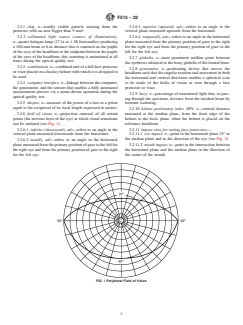
3.2.6 field of vision, n—projection outward of all retinal points (the nervous layer of the eye) at which visual sensations can be
initiated (see Fig. 1).
3.2.6.1 inferior (downward), adv—refers to an angle in the vertical plane measured downwards from the horizontal.
For referenced ASTM standards, visit the ASTM website, www.astm.org, or contact ASTM Customer Service at service@astm.org. For Annual Book of ASTM Standards
volume information, refer to the standard’s Document Summary page on the ASTM website.
Available from the Canadian Standards Association, 5060 Spectrum Way, Suite 100, Mississauga, Ontario L4W 5N6 Canada.
F513 − 22
FIG. 1 Peripheral Field of Vision
3.2.6.2 nasally, adv—refers to an angle in the horizontal plane measured from the primary position of gaze to the left for the
right eye and from the primary position of gaze to the right for the left eye.
3.2.6.3 superior (upward), adv—refers to an angle in the vertical plane measured upwards from the horizontal.
3.2.6.4 temporally, adv—refers to an angle in the horizontal plane measured from the primary position of gaze to the right for
the right eye and from the primary position of gaze to the left for the left eye.
3.2.7 glabella, n—most prominent midline point between the eyebrows identical to the bony glabella of the frontal bone.
3.2.8 goniometer, n—positioning device that moves the headform such that the angular rotation and movement in both the
horizontal and vertical directions enables a spherical scan to be made of the fields of vision as seen through a face protector or
visor.
3.2.9 haze, n—percentage of transmitted light that, in passing through the specimen, deviates from the incident beam by forward
scattering.
3.2.10 helmet positioning index, HPI, n—vertical distance measured at the median plane, from the front edge of the helmet to the
basic plane, when the helmet is placed on the reference headform.
3.2.11 impact sites for testing face protectors:—
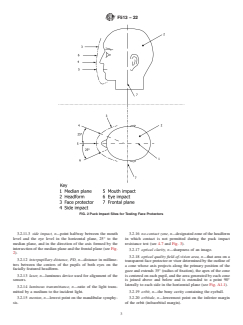
3.2.11.1 eye impact, n—point in the horizontal plane 25° to the median plane and in the direction of the eye (see Fig. 2).
3.2.11.2 mouth impact, n—point in the intersection between the horizontal plane and the median plane in the direction of the
center of the mouth.
3.2.11.3 side impact, n—point halfway between the mouth level and the eye level in the horizontal plane, 25° to the median
plane, and in the direction of the axis formed by the intersection of the median plane and the frontal plane (see Fig. 2).
3.2.12 interpupillary distance, PD, n—distance in millimetres between the centers of the pupils of both eyes on the facially
featured headform.
3.2.13 laser, n—luminous device used for alignment of the sensors.
F513 − 22
FIG. 2 Puck Impact Sites for Testing Face Protectors
3.2.14 luminous transmittance, n—ratio of the light transmitted by a medium to the incident light.
3.2.15 menton, n—lowest point on the mandibular symphysis.
3.2.16 no-contact zone, n—designated zone of the headform in which contact is not permitted during the puck impact resistance
test (see 4.84.7 and Fig. 3).
3.2.17 optical clarity, n—sharpness of an image.
3.2.18 optical quality field-of-vision area, n—that area on a transparent face protector or visor determined by the outline of a cone
whose axis projects along the primary position of the gaze and extends 35° (radius of fixation), the apex of the cone is centered
on each pupil, and the area generated by each cone is joined above and below and is extended to a point 90° laterally to each side
in the horizontal plane (see Fig. A1.1).
3.2.19 orbit, n—the bony cavity containing the eyeball.
F513 − 22
Dimensions (mm)
Facially Featured Headform
(according to CSA Z262.6-02)Z262.6-14)
A B C D E F
Adult Male (50th Percentile) 48 16 28 17 36 68
Juvenile Male (50th Percentile) 60 0 25 0 36 60
Child (50th Percentile) 55 0 23 0 35 55
FIG. 3 No-Contact Zone (Projected Dimensions)
3.2.20 orbitale, n—lowermost point on the inferior margin of the orbit (infraorbital margin).
3.2.21 peripheral field of vision, n—oval-shaped field extending 90° temporally, 60° inferiorly, 45° nasally, and 35° superiorly (see
Fig. 1).
3.2.22 permanent, n—information that remains legible and cannot be removed in its entirety under conditions of normal use.
3.2.23 photosensors, n—sensors 5 mm in diameter centered in the pupils of the headform covered by a 5-mm translucent lens of
8-mm radius of curvature, convex forward.
3.2.23.1 Discussion—
(1) The photosensors are cosine corrected, for example, provided with diffusing covers that are a means of correcting the
light-sensitive surface for wide angles of incidence. (2) Light contact with the sensors produces an electrical signal that is fed into
a computer interface.
3.2.24 planes:
3.2.24.1 basic plane of a headform, n—plane relative to the headform that corresponds to the basic plane of the human head.
3.2.24.2 basic plane of the human head, n—plane that is located at the level of the external upper borders of the ear canal
(external auditory meatus) and the inferior margins of the orbits of the eyes.
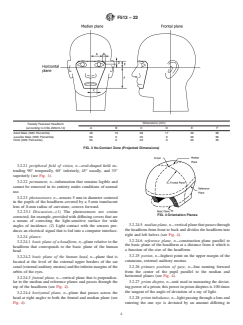
3.2.24.3 frontal plane, n—vertical plane that is perpendicular to the median and reference planes and passes through the top of
the headform (see Fig. 4).
3.2.24.4 horizontal plane, n—plane that passes across the head at right angles to both the frontal and median plane (see Fig. 4).
3.2.24.5 median plane, n—vertical plane that passes through the headform from front to back and divides the headform into
right and left halves (see Fig. 4).
3.2.24.6 reference plane, n—construction plane parallel to the basic plane of the headform at a distance from it which is a
function of the size of the headform.
3.2.25 porion, n—highest point on the upper margin of the cutaneous, external auditory meatus.
F513 − 22
FIG. 4 Orientation Planes
3.2.26 primary position of gaze, n—line running forward from the center of the pupil parallel to the median and horizontal planes
(see Fig. 4).
3.2.27 prism dioptre, n—unit used in measuring the deviating power of a prism; this power in prism dioptres is 100 times the
tangent of the angle of deviation of a ray of light.
3.2.28 prism imbalance, n—light passing through a lens and entering the one eye is deviated by an amount differing in direction
from the same light passing through the lens and entering the fellow eye.
3.2.29 protector, n—comprises a face protector either specially adapted to the helmet or forming a continuous unit designed to
protect the whole or parts of the wearer’s head and face against injury.
3.2.29.1 full-face protector, n—device intended to reduce the risk of injury to the eyes and face of ice hockey participants.
3.2.29.2 visor, n—device intended to reduce the risk of injury to the eyes of ice hockey participants.
3.2.30 resolution, n—ability of an optical system to distinguish two points at their minimum separation.
3.2.31 scan area, n—oval, peripheral fields area specified by superior, temporal, inferior, and nasal directions.
3.1.33 scotoma, n—blind spot in the field of vision.
3.2.32 subnasale, Sn, n—deepest point on the concavity of the anterior surface of the maxilla in the midline within 3.0 mm of the
floor of the nose (see Fig. 5).
3.2.33 threshold value, n—output reading obtained when the columnated light beam has been centered on the midpoint between
the pupils in the primary position of gaze and the headform is rotated 90° in the horizontal plane and the collimated light source
contacts the pupillary sensor closest to the light source.
3.2.34 vertex, n—point of intersection on the headform of the median plane with the frontal plane (see Fig. 4).
4. Requirements
4.1 Materials:
4.1.1 Documentation—The manufacturer shall provide written documentation indicating that the materials used in the construction
of the face protector fulfill the requirements of 4.1.2 – 4.1.6.
4.1.2 Cleaners—All materials used shall be known not to be adversely affected by ordinary household soap and cleaners as
recommended by the manufacturer.
4.1.3 Finishes—Paints, glues, and finishes used in manufacturing shall be compatible with the materials used in the construction
of the head and face protector.
F513 − 22
Dimensions (mm)
Facially-featured Headform
(according to CSA Z262.6-02)Z262.6-14)
A B C D E F P X
Adult Male (50th Percentile) 100.8 34 25.4 100.5 25 32 130 27.5
Juvenile Male (50th Percentile) 94.3 28 25.4 90 21 31 120 25.5
Child (50th Percentile) 91.1 22.5 25.4 79.5 21 21 102 24.5
FIG. 5 Definition of Protected Area for Full-Face Protector (Side View)
4.1.4 Nonirritants—Material coming in contact with the wearer’s head shall not be of any type known to cause skin irritation or
disease or undergo significant loss of strength, flexibility, or other physical changes as a result of contact with perspiration, oil, or
grease from the wearer’s head.
4.1.5 Adhesives—Adhesive material used to attach padding or straps to the face protector or visor shall be of a formulation that
will not alter the chemical or physical properties of the materials to an extent so as to reduce their protective qualities.
4.1.6 Polymeric Changes—All materials used in the construction of the face protector shall be resistant to irreversible polymeric
changes when exposed to temperatures up to 70°C or ultraviolet radiation.
4.2 Finish—All parts shall be well finished and free of sharp edges and other irregularities that would present a potential hazard
to the user or other players.
4.3 Attachment System—The attachment system of a face protector to a helmet shall be so designed so that the face protector can
be easily attached to the helmet without requiring any machining operation by the user.
4.4 Mass Restriction (Type B2 Only)—Helmet and Type B2 face protector combinations that, according to manufacturer’s
recommendations, fit headforms Size E or smaller shall have a mass no greater than 900 g.
4.5 Optical Quality:
4.5.1 Visual Inspection:
4.5.1.1 The following is a list of matters for which the face protector will be subjectively inspected in a visual and tactile fashion
within the field of vision:
(1) Localized power errors;
(2) Aberrations caused by waves, warpage, and so forth; and
(3) Lens defects such as scratches, greyness, bubbles, cracks, watermarks, and so forth.
4.5.1.2 If any of the above deficiencies are present, no further testing shall be conducted and the product is failed.
F513 − 22
4.5.2 Test Requirements:
4.5.2.1 When testing in accordance with 5.5 at 20 6 2°C, face protectors shall:
NOTE 1—Items (1) to (4) apply for materials you have to look through only.
(1) Possess adequate definition to permit resolution of the 240-s ring;
(2) Have a luminous transmittance of not less than 80 % and face protectors specifically identified as being tinted or intended
for filtering by the manufacturer shall have a minimum luminous transmittance of 20 %;
(3) Have a prism imbalance not exceeding 0.5 prism dioptre; for two eyes, the prism imbalance test allows a total of up to 1.0
prism dioptre of prismatic deviation;
(4) Have a haze reading that does not exceed 3 %; and
(5) Have no occultation in the field of vision as indicated in Fig. 1.
4.6 Scotomas—When tested in accordance with 5.5.2, there shall be no overlapping bilateral scotomas in the peripheral field of
vision.
4.6 Penetration (Test Blade):
4.6.1 Types B1, B2, and C—With the exception of the ear apertures, there shall be no contact with the bare headform by the test
blade within the protected areas when testing in accordance with 5.6.
4.7 Puck Impact Resistance:
4.7.1 Types B1, B2—With the exception of the toughness test, neither the protector nor the puck shall touch the facially featured
headform within the no-contact zone (Fig. 3) when tested in accordance with 5.7. The shock-absorbing material at the load-bearing
area shall remain securely attached to the face protector. There shall be no breakage of the structural components of the face
protector or failure of the face protector’s points of attachment to the helmet. Cracking of surface coatings is permissible but chips
(see 3.1.23.2.1) are not permitted.
4.7.2 Type C—With the exception of the toughness test, neither the visor nor the puck shall touch the facially featured headform
when tested in accordance with 5.7. There shall be no chips, cracking, or breakage of the eye protector or failure of the face
protector’s points of attachment to the helmet or separation of the eye protector from the helmet.
4.8 Design:
4.8.1 Types B1, B2:
4.8.1.1 Maximum Distance—The distance measured on the median plane and parallel to the basic plane between the inside of the
face protector and Points K and Sn on the facially featured headform shall not exceed 60 mm (see Fig. 5).
4.8.1.2 Overlap—Face protectors shall overlap the lower edge of the helmet (forehead area) by at least 6 mm.
4.8.1.3 Padding Area—The face protector shall have a padded load-bearing area with a minimum area as shown in Fig. 6.
4.8.1.4 Minimum Distance—Except where it is covered by padding, no part of the face protector shall be closer than 10 mm to
the surface of the facially featured headform.
4.8.2 Type C:
4.8.2.1 Maximum Distance (Headform to Eye Protector)—The distance measured on the median plane, parallel to the basic plane
from the headform between the inside of the eye protector and Points K and Sn on the facially featured headform shall not exceed
60 mm (see Fig. 7).
4.8.2.2 Overlap—The eye protector shall overlap the lower edge of the helmet (forehead area) by at least 6 mm.
F513 − 22
Facially-featured Headform
Dimensions (mm)
(according to CSA Z262.6-
D A B
02)Z262.6-14)
Adult Male (50th Percentile) 53 18-27 18
Juvenile Male (50th Percentile) 48 15-24 15
Child (50th Percentile) 42 15-24 15
FIG. 6 Minimum Load-Bearing Area
4.8.2.3 Maximum Distance (Helmet to Eye Protector)—The maximum distance between the helmet and the eye protector shall not
exceed 20 mm.
4.9 Protected Area of Coverage:
4.9.1 Type B1 and B2—Full-Face Protectors:
4.9.1.1 The area protected by the face protector and helmet combination shall extend laterally and vertically around the headform
at least to the Line GHZZHG in Fig. 5, as seen from the side, when the face protector is assembled and mounted on the appropriate
helmet in accordance with the manufacturer’s instructions and when placed on a facially featured headform as described in 5.4.3.
4.9.1.2 Where the helmet provides protection in front of the Line GHZZHG, the face protector need not extend back to the
GHZZHG line provided the face protector overlaps the helmet by at least 6 mm as seen from the side.
4.9.2 Type C—Visors—The area protected by the visor and the helmet combination shall extend laterally and vertically around the
headform at least to the Line GHSnSnHG in Fig. 7, as seen from the side when the eye protector is assembled, mounted on the
appropriate helmet in accordance with the manufacturer’s instructions, and placed on a facially featured headform as described in
5.4.2. Where the helmet provides protection in front of the Line GHSn, the visor need not extend back to the GHSn line, provided
the visor overlaps the helmet by at least 6 mm when viewed from the side.
5. Test Methods
5.1 Sampling:
5.1.1 Types—Only new, full-face protectors and visors as offered for sale shall be tested. The helmets shall be inspected visually
and by hand before conditioning.
F513 − 22
Dimensions (mm)
Facially-featured Headform
(according to CSA Z262.6-02)Z262.6-14)
A B C F P X
Adult Male (50th Percentile) 100.8 34 25.4 32 129.9 27.5
Juvenile Male (50th Percentile) 94.3 28 25.4 31 121.5 25.5
Child (50th Percentile) 91.1 22.5 25.4 21 102 24.5
Head Circumferences Dimensions (mm)
Adult Male (50th Percentile) 575
Juvenile Male (50th Percentile) 535
Child (50th Percentile) 515
For References Only
FIG. 7 Definition of Protected Area for Visors (Side View)
5.1.2 Documentation—Verify that the manufacturer shall provide written documentation indicating that the materials used in the
construction of the helmet and face protector fulfill the general requirements in 4.1.2 – 4.1.6.
5.1.3 Face Protectors—Face protectors shall be assembled and mounted on the appropriate helmets in accordance with the
instructions of the manufacturer.
5.2 Inspection and Determination of Mass (for Helmet/ B2 Face Protector Combinations Fitting Headforms Size E or
Smaller)—Determine the mass of the head protector/face protector combinations of the same model and size submitted for testing
that are conditioned in accordance with 5.3.1. Calculate and record the mean value in grams rounded to the nearest 10 g.
5.3 Conditioning:
5.3.1 Ambient Conditioning (for Contact Test)—The sample shall be exposed to a temperature of (20 6 2)°C and a relative
humidity not exceeding 55 % for not less than 4 h.
5.3.2 Low-Temperature Conditioning (for Toughness Test)—The sample shall be exposed to a temperature of (–25 6 2)°C for not
less than 4 h. Testing shall begin within 40 s of removal from the refrigeration chamber.
5.3.3 Testing Co
...