

ASTM F683-23a
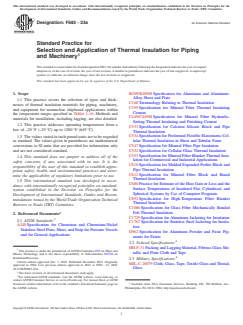
(Practice)Standard Practice for Selection and Application of Thermal Insulation for Piping and Machinery
General Information
- Abstract
ABSTRACT
This practice provides the design and dimensional details required for the proper selection of the type of, and correct installation procedures for, thermal insulation materials suitable for use on piping, machinery, and equipment employed in nonnuclear shipboard applications. The insulation and lagging requirements for the removable covers of valves, fittings, flanges, and machinery or equipment, as well as the requirements for thermal insulating tape, are also detailed completely.
SCOPE
1.1 This practice covers the selection of types and thicknesses of thermal insulation materials for piping, machinery, and equipment for nonnuclear shipboard applications within the temperature ranges specified in Tables 1-16. Methods and materials for installation, including lagging, are also detailed.
1.2 This practice addresses operating temperatures from a low of –20 °F (–29 °C) up to 1200 °F (649 °C).
1.3 The values stated in inch-pound units are to be regarded as standard. The values given in parentheses are mathematical conversions to SI units that are provided for information only and are not considered standard.
1.4 This standard does not purport to address all of the safety concerns, if any, associated with its use. It is the responsibility of the user of this standard to establish appropriate safety, health, and environmental practices and determine the applicability of regulatory limitations prior to use.
1.5 This international standard was developed in accordance with internationally recognized principles on standardization established in the Decision on Principles for the Development of International Standards, Guides and Recommendations issued by the World Trade Organization Technical Barriers to Trade (TBT) Committee.
- Status
- Published
- Publication Date
- 30-Nov-2023
- Technical Committee
- F25 - Ships and Marine Technology
- Drafting Committee
- F25.02 - Insulation/Processes
Buy Documents
ASTM F683-23a - Standard Practice for Selection and Application of Thermal Insulation for Piping and Machinery
REDLINE ASTM F683-23a - Standard Practice for Selection and Application of Thermal Insulation for Piping and Machinery
Overview
ASTM F683-23a, titled Standard Practice for Selection and Application of Thermal Insulation for Piping and Machinery, provides comprehensive guidelines for selecting, specifying, and installing thermal insulation materials for piping, machinery, and equipment. Specifically focused on nonnuclear shipboard applications, this ASTM International standard addresses both interior and weather-exposed systems, detailing requirements for insulation types, thicknesses, and installation methods across a wide temperature range.
This standard is essential for professionals involved in marine engineering, shipbuilding, and maintenance, ensuring that thermal insulation systems are effective, compliant, and safe.
Key Topics
Scope and Applicability
Coverage includes piping, valves, fittings, flanges, machinery, and equipment used for nonnuclear shipboard applications, spanning operating temperatures from –20 °F (–29 °C) to 1200 °F (649 °C).Types of Insulation Materials
The standard references a range of approved materials, including:- Cellular glass
- Elastomeric cellular
- Mineral fiber
- Calcium silicate
- Expanded perlite
- High-temperature fiber blanket
- Woven and knitted glass fiber tape
Insulation and Lagging Requirements
Details minimum thicknesses for different insulation materials and specifies lagging (protective coverings) for various operating environments, including high-traffic and potentially damaging locations.Installation Procedures
Highlights best practices for preparing surfaces, applying finishes, choosing appropriate fasteners, and ensuring mechanical protection in high-wear areas.Regulatory and Safety Compliance
Requires adherence to U.S. Coast Guard (USCG) and IMO SOLAS regulations for fire safety and noncombustibility, and encourages establishing health, safety, and environmental measures.
Applications
Marine Engineering and Shipbuilding
Ensures the selection and correct installation of thermal insulation for shipboard piping and machinery to manage energy efficiency, personnel protection, and equipment performance across various ship systems.Maintenance and Repair
Provides clear instructions for maintenance personnel on when and how to replace or upgrade insulation, including requirements for removable covers on valves and fittings.System-Specific Guidance
Offers material and thickness guidelines for:- Refrigerant piping (anti-sweat applications)
- Hot freshwater and steam piping
- Weather-exposed versus interior piping
- Machinery and specific equipment with high or low temperature ranges
Personnel Safety and System Integrity
Improves surface temperature control, reduces condensation-related risk, and protects critical systems and crew from burns or thermal hazards.
Related Standards
ASTM F683-23a references and aligns with several other important insulation and marine standards, including:
- ASTM C168: Terminology Relating to Thermal Insulation
- ASTM C533: Specification for Calcium Silicate Block and Pipe Thermal Insulation
- ASTM C547: Specification for Mineral Fiber Pipe Insulation
- ASTM C552: Specification for Cellular Glass Thermal Insulation
- ASTM C553, C610, C892: Specifications for various blanket, perlite, and high-temperature insulations
- ASTM C680: Practice for Heat Gain/Loss Estimation
- MIL and Federal Specifications: Covers requirements for glass fiber cloth, insulation tapes, cements, and sealants used in shipboard settings
- Regulatory Codes: 46 CFR (U.S. Code of Federal Regulations), SOLAS, and IMO Fire Test Procedures
By applying ASTM F683-23a, ship designers, engineers, and maintenance teams can ensure that thermal insulation systems on marine vessels comply with current regulatory standards, deliver effective thermal performance, and help maintain efficient, safe ship operations.
Keywords: ASTM F683, thermal insulation, piping insulation, marine insulation standard, machinery insulation, shipboard insulation, insulation thickness, lagging, nonnuclear ship applications, insulation installation.
Relations
- Effective Date
- 01-Dec-2023
- Effective Date
- 15-Apr-2024
- Effective Date
- 01-Nov-2023
- Effective Date
- 01-Mar-2023
- Effective Date
- 01-May-2022
- Effective Date
- 01-Dec-2023
- Referred By
ASTM F1155-10(2019) - Standard Practice for Selection and Application of Piping System Materials - Effective Date
- 01-Dec-2023
- Effective Date
- 01-Dec-2023
Buy Documents
ASTM F683-23a - Standard Practice for Selection and Application of Thermal Insulation for Piping and Machinery
REDLINE ASTM F683-23a - Standard Practice for Selection and Application of Thermal Insulation for Piping and Machinery
Get Certified
Connect with accredited certification bodies for this standard

DNV
DNV is an independent assurance and risk management provider.

Lloyd's Register
Lloyd's Register is a global professional services organisation specialising in engineering and technology.
DNV Energy Systems
Energy and renewable energy certification.
Sponsored listings
Frequently Asked Questions
ASTM F683-23a is a standard published by ASTM International. Its full title is "Standard Practice for Selection and Application of Thermal Insulation for Piping and Machinery". This standard covers: ABSTRACT This practice provides the design and dimensional details required for the proper selection of the type of, and correct installation procedures for, thermal insulation materials suitable for use on piping, machinery, and equipment employed in nonnuclear shipboard applications. The insulation and lagging requirements for the removable covers of valves, fittings, flanges, and machinery or equipment, as well as the requirements for thermal insulating tape, are also detailed completely. SCOPE 1.1 This practice covers the selection of types and thicknesses of thermal insulation materials for piping, machinery, and equipment for nonnuclear shipboard applications within the temperature ranges specified in Tables 1-16. Methods and materials for installation, including lagging, are also detailed. 1.2 This practice addresses operating temperatures from a low of –20 °F (–29 °C) up to 1200 °F (649 °C). 1.3 The values stated in inch-pound units are to be regarded as standard. The values given in parentheses are mathematical conversions to SI units that are provided for information only and are not considered standard. 1.4 This standard does not purport to address all of the safety concerns, if any, associated with its use. It is the responsibility of the user of this standard to establish appropriate safety, health, and environmental practices and determine the applicability of regulatory limitations prior to use. 1.5 This international standard was developed in accordance with internationally recognized principles on standardization established in the Decision on Principles for the Development of International Standards, Guides and Recommendations issued by the World Trade Organization Technical Barriers to Trade (TBT) Committee.
ABSTRACT This practice provides the design and dimensional details required for the proper selection of the type of, and correct installation procedures for, thermal insulation materials suitable for use on piping, machinery, and equipment employed in nonnuclear shipboard applications. The insulation and lagging requirements for the removable covers of valves, fittings, flanges, and machinery or equipment, as well as the requirements for thermal insulating tape, are also detailed completely. SCOPE 1.1 This practice covers the selection of types and thicknesses of thermal insulation materials for piping, machinery, and equipment for nonnuclear shipboard applications within the temperature ranges specified in Tables 1-16. Methods and materials for installation, including lagging, are also detailed. 1.2 This practice addresses operating temperatures from a low of –20 °F (–29 °C) up to 1200 °F (649 °C). 1.3 The values stated in inch-pound units are to be regarded as standard. The values given in parentheses are mathematical conversions to SI units that are provided for information only and are not considered standard. 1.4 This standard does not purport to address all of the safety concerns, if any, associated with its use. It is the responsibility of the user of this standard to establish appropriate safety, health, and environmental practices and determine the applicability of regulatory limitations prior to use. 1.5 This international standard was developed in accordance with internationally recognized principles on standardization established in the Decision on Principles for the Development of International Standards, Guides and Recommendations issued by the World Trade Organization Technical Barriers to Trade (TBT) Committee.
ASTM F683-23a is classified under the following ICS (International Classification for Standards) categories: 27.220 - Heat recovery. Thermal insulation. The ICS classification helps identify the subject area and facilitates finding related standards.
ASTM F683-23a has the following relationships with other standards: It is inter standard links to ASTM F683-23, ASTM C168-24, ASTM C680-23a, ASTM C680-23, ASTM C168-22, ASTM F3319-20, ASTM F1155-10(2019), ASTM F2876-22. Understanding these relationships helps ensure you are using the most current and applicable version of the standard.
ASTM F683-23a is available in PDF format for immediate download after purchase. The document can be added to your cart and obtained through the secure checkout process. Digital delivery ensures instant access to the complete standard document.
Standards Content (Sample)
This international standard was developed in accordance with internationally recognized principles on standardization established in the Decision on Principles for the
Development of International Standards, Guides and Recommendations issued by the World Trade Organization Technical Barriers to Trade (TBT) Committee.
Designation: F683 − 23a An American National Standard
Standard Practice for
Selection and Application of Thermal Insulation for Piping
and Machinery
This standard is issued under the fixed designation F683; the number immediately following the designation indicates the year of original
adoption or, in the case of revision, the year of last revision. A number in parentheses indicates the year of last reapproval. A superscript
epsilon (´) indicates an editorial change since the last revision or reapproval.
This standard has been approved for use by agencies of the U.S. Department of Defense.
1. Scope B209/B209M Specification for Aluminum and Aluminum-
Alloy Sheet and Plate
1.1 This practice covers the selection of types and thick-
C168 Terminology Relating to Thermal Insulation
nesses of thermal insulation materials for piping, machinery,
C195 Specification for Mineral Fiber Thermal Insulating
and equipment for nonnuclear shipboard applications within
Cement
the temperature ranges specified in Tables 1-16. Methods and
C449/C449M Specification for Mineral Fiber Hydraulic-
materials for installation, including lagging, are also detailed.
Setting Thermal Insulating and Finishing Cement
1.2 This practice addresses operating temperatures from a
C533 Specification for Calcium Silicate Block and Pipe
low of –20 °F (–29 °C) up to 1200 °F (649 °C).
Thermal Insulation
C534 Specification for Preformed Flexible Elastomeric Cel-
1.3 The values stated in inch-pound units are to be regarded
as standard. The values given in parentheses are mathematical lular Thermal Insulation in Sheet and Tubular Form
C547 Specification for Mineral Fiber Pipe Insulation
conversions to SI units that are provided for information only
and are not considered standard. C552 Specification for Cellular Glass Thermal Insulation
C553 Specification for Mineral Fiber Blanket Thermal Insu-
1.4 This standard does not purport to address all of the
lation for Commercial and Industrial Applications
safety concerns, if any, associated with its use. It is the
C610 Specification for Molded Expanded Perlite Block and
responsibility of the user of this standard to establish appro-
Pipe Thermal Insulation
priate safety, health, and environmental practices and deter-
C612 Specification for Mineral Fiber Block and Board
mine the applicability of regulatory limitations prior to use.
Thermal Insulation
1.5 This international standard was developed in accor-
C680 Practice for Estimate of the Heat Gain or Loss and the
dance with internationally recognized principles on standard-
Surface Temperatures of Insulated Flat, Cylindrical, and
ization established in the Decision on Principles for the
Spherical Systems by Use of Computer Programs
Development of International Standards, Guides and Recom-
C892 Specification for High-Temperature Fiber Blanket
mendations issued by the World Trade Organization Technical
Thermal Insulation
Barriers to Trade (TBT) Committee.
C1086 Specification for Glass Fiber Mechanically Bonded
Felt Thermal Insulation
2. Referenced Documents
C1729 Specification for Aluminum Jacketing for Insulation
2.1 ASTM Standards:
C1767 Specification for Stainless Steel Jacketing for Insula-
A240 Specification for Chromium and Chromium-Nickel
tion
Stainless Steel Plate, Sheet, and Strip for Pressure Vessels
D962 Specification for Aluminum Powder and Paste Pig-
and for General Applications
ments for Paints
2.2 Federal Specifications:
HH-P-31 Packing and Lagging Material, Fibrous Glass Me-
This practice is under the jurisdiction of ASTM Committee F25 on Ships and
tallic and Plain Cloth and Tape
Marine Technology and is the direct responsibility of Subcommittee F25.02 on
Insulation/Processes.
2.3 Military Specifications:
Current edition approved Dec. 1, 2023. Published December 2023. Originally
MIL-C-20079 Cloth, Glass, Tape, Textile Glass and Thread,
approved in 1980. Last previous edition approved in 2023 as F683 – 23. DOI:
Glass
10.1520/F0683-23A.
The latest revision of all referenced documents shall apply.
For referenced ASTM standards, visit the ASTM website, www.astm.org, or
contact ASTM Customer Service at service@astm.org. For Annual Book of ASTM
Standards volume information, refer to the standard’s Document Summary page on Available from DLA Document Services, Building 4/D, 700 Robbins Ave.,
the ASTM website. Philadelphia, PA 19111-5094, http://quicksearch.dla.mil.
Copyright © ASTM International, 100 Barr Harbor Drive, PO Box C700, West Conshohocken, PA 19428-2959. United States
F683 − 23a
A,B
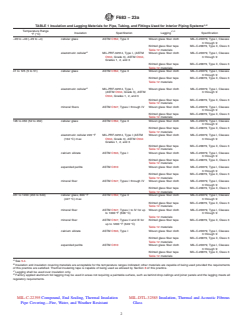
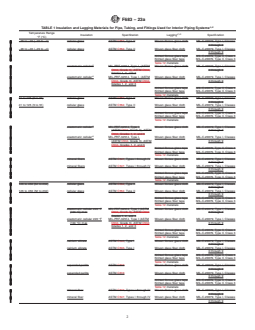
TABLE 1 Insulation and Lagging Materials for Pipe, Tubing, and Fittings Used for Interior Piping Systems
Temperature Range
C,D
Insulation Specification Lagging Specification
°F (°C)
−20 to +40 (−29 to +4) cellular glass ASTM C552, Type II Woven glass fiber cloth MIL-C-20079, Type I, Classes
3 through 9
Knitted glass fiber tape MIL-C-20079, Type II, Class 3
Table 12 materials
A
elastomeric cellular MIL-PRF-32514, Type I, (ASTM Woven glass fiber cloth MIL-C-20079, Type I, Classes
C534, Grade 3), ASTM C534, 3 through 9
Grades 1, 2, and 3
Knitted glass fiber tape MIL-C-20079, Type II, Class 3
Table 12 materials
41 to 125 (5 to 51) cellular glass ASTM C552, Type II Woven glass fiber cloth MIL-C-20079, Type I, Classes
3 through 9
Knitted glass fiber tape MIL-C-20079, Type II, Class 3
Table 12 materials
A
elastomeric cellular MIL-PRF-32514, Type I, Woven glass fiber cloth MIL-C-20079, Type I, Classes
(ASTM C534, Grade 3), ASTM 3 through 9
C534, Grades 1, 2, and 3
Knitted glass fiber tape MIL-C-20079, Type II, Class 3
Table 12 materials
mineral fibers ASTM C547, Types I through IV Woven glass fiber cloth MIL-C-20079, Type I, Classes
3 through 9
Knitted glass fiber tape MIL-C-20079, Type II, Class 3
Table 12 materials
126 to 450 (52 to 232) cellular glass ASTM C552, Type II Woven glass fiber cloth MIL-C-20079, Type I, Classes
3 through 9
Knitted glass fiber tape MIL-C-20079, Type II, Class 3
Table 12 materials
elastomeric cellular 220 °F MIL-PRF-32514, Type I (ASTM Woven glass fiber cloth MIL-C-20079, Type I, Classes
(104 °C) max C534, Grade 3), ASTM C534 3 through 9
Grades 1, 2, and 3
Knitted glass fiber tape MIL-C-20079, Type II, Class 3
Table 12 materials
calcium silicate ASTM C533, Type I Woven glass fiber cloth MIL-C-20079, Type I, Classes
3 through 9
Knitted glass fiber tape MIL-C-20079, Type II, Class 3
Table 12 materials
expanded perlite ASTM C610 Woven glass fiber cloth MIL-C-20079, Type I, Classes
3 through 9
Knitted glass fiber tape MIL-C-20079, Type II, Class 3
Table 12 materials
mineral fiber ASTM C547, Types I through IV Woven glass fiber cloth MIL-C-20079, Type I, Classes
3 through 9
Knitted glass fiber tape MIL-C-20079, Type II, Class 3
Table 12 materials
451 to 1200 (233 to 649) cellular glass, 800 °F ASTM C552, Type II Woven glass fiber cloth MIL-C-20079, Type I, Classes
(427 °C) max 3 through 9
Knitted glass fiber tape MIL-C-20079, Type II, Class 3
Table 12 materials
mineral fiber ASTM C547, Types I to IV for up Woven glass fiber cloth MIL-C-20079, Type I, Classes
to 1000 °F (538 °C) 3 through 9
Table 12 materials
mineral fiber ASTM C547, Types II and III for Knitted glass fiber tape MIL-C-20079, Type II, Class 3
up to 1200 °F (649 °C)
Table 12 materials
calcium silicate ASTM C533, Type I Woven glass fiber cloth MIL-C-20079, Type I, Classes
3 through 9
Knitted glass fiber tape MIL-C-20079, Type II, Class 3
Table 12 materials
expanded perlite ASTM C610 Woven glass fiber cloth MIL-C-20079, Type I, Classes
3 through 9
Knitted glass fiber tape MIL-C-20079, Type II, Class 3
Table 12 materials
A
See 5.4.
B
Insulation and insulation covering materials are acceptable for the temperature ranges indicated; other materials are capable of being used provided the requirements
of this practice are satisfied. Thermal insulating tape is capable of being used as allowed by Section 8 of this practice.
C
Lagging shall be used over insulation only.
D
Factory applied aluminum foil lagging may be used in areas not requiring a paintable surface, such as behind drop ceilings and joiner panels and the lagging meets all
regulatory requirements.
MIL-C-22395 Compound, End Sealing, Thermal Insulation MIL-DTL-32585 Insulation, Thermal and Acoustic Fibrous
Pipe Covering—Fire, Water, and Weather Resistant Glass
F683 − 23a
A
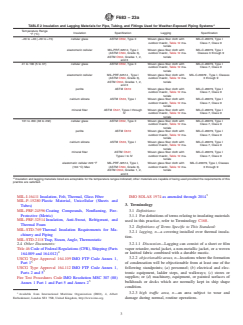
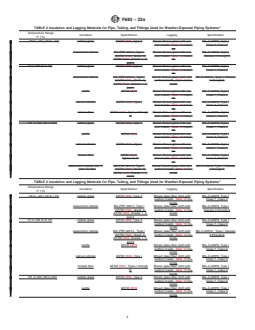
TABLE 2 Insulation and Lagging Materials for Pipe, Tubing, and Fittings Used for Weather-Exposed Piping Systems
Temperature Range
Insulation Specification Lagging Specification
°F (°C)
−20 to +40 (−29 to +15) cellular glass ASTM C552, Type II Woven glass fiber cloth with MIL-C-20079, Type I
outdoor mastic, Table 12 ma- Class 7, Class 9
terials
elastomeric cellular MIL-PRF-32514, Type I Woven glass fiber cloth with MIL-C-20079, Type I
(ASTM C534, Grade 3), outdoor mastic, Table 12 ma- Classes 3 through 9
ASTM C534, Grades 1, 2, terials
and 3
41 to 100 (5 to 37) cellular glass ASTM C552, Type II Woven glass fiber cloth with MIL-C-20079, Type I
outdoor mastic, Table 12 ma- Class 7, Class 9
terials
elastomeric cellular MIL-PRF-32514 , Type I Woven glass fiber cloth with MIL-C-20079 , Type I, Classes
(ASTM C534, Grade 3), outdoor mastic, Table 12 ma- 3 through 9
ASTM C534, Grades 1, 2, terials
and 3
perlite ASTM C610 Woven glass fiber cloth with MIL-C-20079, Type I
outdoor mastic, Table 12 ma- Class 7, Class 9
terials
calcium silicate ASTM C533, Type I Woven glass fiber cloth with MIL-C-20079, Type I
outdoor mastic, Table 12 ma- Class 7, Class 9
terials
mineral fiber ASTM C547, Types I through Woven glass fiber cloth with MIL-C-20079, Type I
IV outdoor mastic, Table 12 ma- Class 7, Class 9
terials
101 to 450 (38 to 232) cellular glass ASTM C552, Type II Woven glass fiber cloth with MIL-C-20079, Type I
outdoor mastic, Table 12 ma- Class 7, Class 9
terials
perlite ASTM C610 Woven glass fiber cloth with MIL-C-20079, Type I
outdoor mastic, Table 12 ma- Class 7, Class 9
terials
calcium silicate ASTM C533, Type I Woven glass fiber cloth with MIL-C-20079, Type I
outdoor mastic, Table 12 ma- Class 7, Class 9
terials
mineral fiber ASTM C547, Woven glass fiber cloth with MIL-C-20079, Type I
Types I to IV outdoor mastic, Table 12 ma- Class 7, Class 9
terials
elastomeric cellular 220 °F MIL-PRF-32514, Type I, Woven glass fiber cloth with MIL-C-20079, Type I, Classes
(104 °C) Max (ASTM C534, Grade 3), outdoor mastic, Table 12 ma- 3 through 9
ASTM C534, Grades 1, 2, terials
and 3
A
Insulation and lagging materials listed are acceptable for the temperature ranges indicated; other materials are capable of being used provided the requirements of this
practice are satisfied.
MIL-I-16411 Insulation, Felt, Thermal, Glass Fiber IMO SOLAS 1974 as amended through 2014
MIL-P-15280 Plastic Material, Unicellular (Sheets and
3. Terminology
Tubes)
MIL-PRF-24596 Coating Compounds, Nonflaming, Fire-
3.1 Definitions:
Protective (Metric) 3.1.1 For definitions of terms relating to insulating materials
MIL-PRF-32514 Insulation, Anti-Sweat, Refrigerant, and
used in this practice, refer to Terminology C168.
Thermal Foam
3.2 Definitions of Terms Specific to This Standard:
MIL-STD-769 Thermal Insulation Requirements for Ma-
3.2.1 lagging, n—a covering installed over thermal insula-
chinery and Piping
tion.
MIL-STD-2118 Trap, Steam, Angle, Thermostatic
3.2.1.1 Discussion—Lagging can consist of a sheet or film
2.4 Other Documents:
vapor retarder, metal jacket, a non-metallic jacket, or a woven
Title 46 Code of Federal Regulations (CFR), Shipping (Parts
or knitted fabric combined with a durable mastic.
164.009 and 164.012)
3.2.2 objectionable areas, n—locations where the formation
USCG Type Approval 164.109 IMO FTP Code Annex 1,
of condensation will be objectionable from at least one of the
Part 1
following standpoints; (a) personnel; (b) electrical and elec-
USCG Type Approval 164.112 IMO FTP Code Annex 1,
tronic equipment, ladder steps, and walkways; (c) stores or
Parts 2 and 5
supplies; or (d) machinery, equipment, or painted surfaces of
Fire Test Procedures Code IMO Resolution MSC 307 (88)
bulkheads or decks which are normally kept in ship shape
Annex 1 Part 1 and Part 5 and Annex 2
condition.
5 3.2.3 high traffıc area, n—an area subject to wear and
Available from International Maritime Organization (IMO), 4, Albert
Embankment, London SE1 7SR, United Kingdom, http://www.imo.org. damage during normal, routine operations.
F683 − 23a
A,B
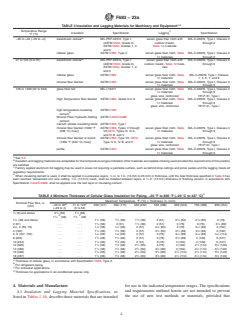
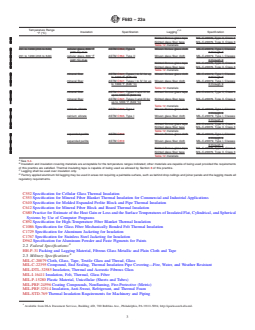
TABLE 3 Insulation and Lagging Materials for Machinery and Equipment
Temperature Range
C
Insulation Specification Lagging Specification
°F (°C)
A
−20 to +40 (−29 to +4) elastomeric cellular MIL-PRF-32514, Type I, woven glass fiber cloth with MIL-C-20079, Type I, Classes 3
(ASTM C534, Grade 3), outdoor mastic, through 9
ASTM C534, Grades 1, 2, Table 12 materials
and 3
cellular glass ASTM C552, Type II woven glass fiber cloth, Table MIL-C-20079, Type I, Classes 3
12 materials through 9
A
41 to 125 (5 to 51) elastomeric cellular MIL-PRF-32514, Type I, woven glass fiber cloth with MIL-C-20079, Type I, Classes 3
(ASTM C534, Grade 3), outdoor mastic, Table 12 mate- through 9
ASTM C534, Grades 1, 2, rials
and 3
cellular glass ASTM C552 woven glass fiber cloth, Table MIL-C-20079, Type I, Classes
12 materials 1, 3, 5, 7, and 9
mineral fiber blanket ASTM C553 woven glass fiber cloth, Table MIL-C-20079, Type I, Classes 3
12 materials through 9
126 to 1200 (52 to 649) glass fiber felt MIL-I-16411 woven glass fiber cloth, Table MIL-C-20079, Type I, Classes 3
12 materials through 9
glass wire, reinforced HH-P-31, Type I
High Temperature fiber blanket ASTM C892, Grade 6 or 8 woven glass fiber cloth, Table MIL-C-20079, Type I, Classes 3
12 materials through 9
glass wire, reinforced HH-P-31, Type I
high-temperature insulating ASTM C195
D
cement
Mineral Fiber Hydraulic-Setting ASTM C449/C449M
cement
calcium silicate insulating block ASTM C533, Type I
mineral fiber blanket (1000 °F ASTM C553, Types V through woven glass fiber cloth, Table MIL-C-20079, Type I, Classes 3
(538 °C) max)) VII;C612, Types III, IV A, 12 materials through 9
and IV B, and V
mineral fiber blanket or board ASTM C553, Type VII; C612, woven glass fiber cloth, Table MIL-C-20079, Type I, Classes 3
(1200 °F (649 °C) max)) Type IV A, IV B, and V 12 materials through 9
glass wire, reinforced HH-P-31, Type I
perlite ASTM C610 woven glass fiber cloth, Table MIL-C-20079, Type I, Classes 3
12 materials through 9
A
See 5.4.
B
Insulation and lagging materials are acceptable for the temperature ranges indicated; other materials are capable of being used provided the requirements of this practice
are satisfied.
C
Factory applied aluminum foil lagging may be used in areas not requiring a paintable surface, such as behind drop ceilings and joiner panels and the lagging meets all
regulatory requirements.
D
When insulating cement is used, it shall be applied in successive layers, ⁄2 in. to 1 in. (13 mm to 25 mm) in thickness, until the total thickness specified in Table 6 has
been reached. Galvanized iron wire netting, 1 in. (13 mm) mesh, shall be installed between layers. A ⁄2 in. (13 mm) thickness of finishing cement, in accordance with
Specification C449/C449M, shall be applied over the last layer of insulating cement.
A
TABLE 4 Minimum Thickness of Cellular Glass Insulation for Piping, −20 °F to 800 °F (−29 °C to 427 °C)
Maximum Temperature, °F (°C) × Thickness, in. (mm)
Nominal Pipe Size, in.
B C
−20 to 40 41 to 125 250 (121) 350 (177) 450 (232) 550 (288) 650 (343) 750 (399) 850 (454)
(mm)
(–29 to 4) (5 to 52)
1 1 1
⁄4 (6) and above 2 ⁄2 (63) 1 ⁄2 (38) . . . . . . . . . . . . . . . . . . . . .
D D
1 1
1 ⁄2 (38) 1 ⁄2 (38)
1 1 1 1 1 1
1 ⁄2 (38) and below . . . . . . 1 ⁄2 (38) 1 ⁄2 (38) 1 ⁄2 (38) 2 (51) 2 ⁄2 (63) 2 ⁄2 (63) 3 (76)
1 1 1
2 (51) . . . . . . 1 ⁄2 (38) 2 (51) 1 ⁄2 (38) 2 (51) 3 (76) 3 (76) 3 ⁄2 (89)
1 1 1 1 1
2 ⁄2, 3 (63, 76) . . . . . . 1 ⁄2 (38) 1 ⁄2 (38) 2 (51) 2 ⁄2 (63) 3 (76) 3 ⁄2 (89) 4 (102)
1 1 1 1 1
4 (102) . . . . . . 1 ⁄2 (38) 1 ⁄2 (38) 2 (51) 2 ⁄2 (63) 3 ⁄2 (89) 3 ⁄2 (89) 4 (102)
1 1 1 1 1
5, 6 (127, 152) . . . . . . 1 ⁄2 (38) 1 ⁄2 (38) 2 (51) 3 (76) 3 ⁄2 (89) 3 ⁄2 (89) 4 ⁄2 (114)
1 1 1
8 (203) . . . . . . 1 ⁄2 (38) 1 ⁄2 (38) 2 (51) 3 (76) 3 ⁄2 (89) 4 (102) 5 (127)
1 1
10 (254) . . . . . . 1 ⁄2 (38) 1 ⁄2 (38) 2 (51) 3 (76) 4 (102) 4 (102) 5 (127)
1 1 1 1 1
12 (305) . . . . . . 1 ⁄2 (38) 1 ⁄2 (38) 2 ⁄2 (63) 3 (76) 4 (102) 4 ⁄2 (114) 5 ⁄2 (140)
1 1 1 1 1 1
14 (356) . . . . . . 1 ⁄2 (38) 1 ⁄2 (38) 2 ⁄2 (63) 3 ⁄2 (89) 4 (102) 4 ⁄2 (114) 5 ⁄2 (140)
1 1 1 1 1 1 1
16 (406) . . . . . . 1 ⁄2 (38) 1 ⁄2 (38) 2 ⁄2 (63) 3 ⁄2 (89) 4 ⁄2 (114) 4 ⁄2 (114) 5 ⁄2 (140)
1 1 1 1 1 1 1
18 (457) . . . . . . 1 ⁄2 (38) 1 ⁄2 (38) 2 ⁄2 (63) 3 ⁄2 (89) 4 ⁄2 (114) 4 ⁄2 (114) 5 ⁄2 (140)
A
Thickness of cellular glass, in accordance with Specification C552, Type II.
B
For refrigerant piping.
C
For antisweat applications.
D
Thickness for applications in air-conditioned spaces only.
4. Materials and Manufacture for use in the indicated temperature ranges. The specifications
and requirements outlined herein are not intended to prevent
4.1 Insulation and Lagging Material Specifications, as
the use of new test methods or materials, provided that
listed in Tables 1-16, describe those materials that are intended
F683 − 23a
TABLE 5 Minimum Thickness of Elastomeric Cellular Insulation
5.6.3 Thermostatic steam traps and 24 in. (620 mm) of
A
Piping, –20 °F to +220 °F (–29 °C to 104 °C)
piping upstream of traps, which shall not be insulated. When
Nominal Size, Temperature Range, Nominal Thickness, in. (mm)
located in areas in which personnel protection is required,
in. (mm) °F (°C)
Non-conditioned Air conditioned
expanded metal shields or multilayer glass cloth shall be
spaces spaces only
provided.
B
1 1
⁄4 (6) and −20 to 60 (–29 to 4) 1 ⁄2 (38) 1 (25)
5.6.4 Mechanical joints exposed to sub-atmospheric pres-
above
sures and those included in the fuel oil service piping from
A
Thickness of elastomeric cellular insulation, conforming with, MIL-PRF-32514,
Type I or Type II or Specification C534. heaters to burners.
B
For refrigerant piping.
5.6.5 Fuel oil piping between headers and burners.
5.6.6 Piping above 125 °F (52 °C) in bilges, not within
watertight enclosures.
5.6.7 Piping or equipment that will form condensation in
sufficient technical data is submitted to demonstrate that the
non-objectionable areas.
proposed test method or material is equivalent in quality, 3
5.6.8 Dead-end hot water piping ⁄8 in. (10 mm) and smaller.
effectiveness, durability, and safety to that prescribed by this
5.6.9 Pressure-gauge piping.
practice.
5.6.10 Soot-blower valve units and soot-blower flanges.
5.6.11 Piping in voids and cofferdams except where omit-
5. General Requirements
ting insulation is detrimental to system operation, such as
5.1 Piping, including valves, fittings, and flanges conveying
catapult steam.
vapors, gases, or liquids that attain temperatures outside the
5.6.12 Safety valve bodies, springs, and lifting gear.
range from 55 °F to 125 °F (13 °C to 52 °C) during normal
5.6.13 Piping over shower stalls and behind and under
operation, shall be insulated except as otherwise stated herein.
lavatories.
5.6.14 Valves or flanges in the collection holding tank
5.2 The insulation thicknesses specified in this practice are
(CHT) system.
designed to maintain the surface temperature at or below
125 °F (52 °C) for fluid temperatures up to 650 °F (343 °C)
5.7 Higher-temperature-type insulations are capable of be-
with an ambient temperature of 85 °F (29 °C). For fluid
ing used where lower-temperature-type insulations are
temperatures above 650 °F, the surface will be maintained at a
specified, provided that they are satisfactory in all other
maximum of 133 °F (56 °C).
respects.
5.2.1 Insulation thicknesses have been calculated in accor-
5.8 In “high traffic” locations in which the completed
dance with the computer programs in Practice C680.
insulation and lagging is liable to abuse and within 4 ft (1.2 m)
5.3 Piping and units of equipment with designated internal
of the deck, such as shipping, unshipping, and maintenance
temperatures of 300 °F (149 °C) and over shall be insulated
areas, the insulation shall be suitably protected from mechani-
from their supports or the supports insulated from the struc-
cal damage.
tures to which they are attached where the heat transmitted is
NOTE 1—The following are suitable protection suggestions:
objectionable on the opposite side of the structure.
(1) In way of foot traffic insulation with high compressive strength with
5.4 Insulated piping passing through accommodation, a durable jacketing such as heavy cloth or materials listed in Table 12 can
be used. Examples include calcium silicate, cellular glass but are not
service, and control spaces must be covered with approved
limited to. If insulation with a high compressive strength is not used, then
noncombustible materials, which meet 46 CFR, Sections
a jacketing material compliant with materials listed in Table 12 are
164.009 and 164.012, or USCG Type Approval 164.109 and
recommended.
164.112 as issued by the USCG. Elastomeric cellular insulation
(2) In way of forklift or other machinery operations, guards or bumpers
shall not be used in these spaces except where allowed by should be used to prevent contact. Installing mechanical protection on the
insulation system will not protect it from this type of impact and will only
SOLAS.
increase the cost to repair.
5.5 Special consideration shall be given to the insulation of
5.9 Before installing insulation, surface preparation of the
integral piping supplied with and mounted on equipment or
piping is to be accomplished in accordance with the ship’s
machinery. In these cases, alternative materials and methods of
painting schedule.
installation shall be considered provided that they comply with
the performance requirements of this practice. 5.10 Fasteners shall be welded to the structure or equipment
(with permission of the vendor of the equipment) for securing
5.6 Minimum insulation requirements have not been estab-
insulation to the equipment.
lished for those surfaces or applications in which insulations
had not been specified in past practices. In effect, the following 5.11 For bends, fittings, and so forth, where molded sections
surfaces are excluded from insulation requirements: of pipe insulation cannot be used, mitered sections of the pipe
5.6.1 Surfaces where application of insulation will affect insulation or pre-formed fittings and covers shall be used,
proper operation. provided that they are suitable for the temperature and that the
5.6.2 Equipment, components, and systems designed for the requirements of this practice are satisfied (see 4.1 and 5.4).
dispersion of heat, except when located in areas in which When using calcium silicate fittings in sizes under 2 in.
personnel protection is required insulation, shall be installed in (51 mm) nominal pipe size (NPS) shall be insulated with
accordance with the requirements identified in 5.2. insulating cement, in accordance with Specification C449/
F683 − 23a
A,B
TABLE 6 Minimum Thickness of Mineral Fiber Insulation for Hot Piping, 850 °F (454 °C) Maximum
Nominal Pipe Size, in. Maximum Temperature, °F (°C) × Thickness, in. (mm)
(mm)
150 (66) 250 (121) 350 (177) 450 (232) 550 (288) 650 (343) 750 (399) 850 (454)
1 1 1
1 ⁄2 (38) and below 1 (25) 1 (25) 1 (25) 1 ⁄2 (38) 2 (51) 2 (51) 2 ⁄2 (63) 3 (76)
1 1 1 1
2 (51) 1 (25) 1 (25) 1 (25) 1 ⁄2 (38) 2 (51) 2 ⁄2 (63) 2 ⁄2 (63) 3 ⁄2 (89)
1 1 1 1
2 ⁄2, 3 (63, 76) 1 (25) 1 (25) 1 (25) 1 ⁄2 (38) 2 (51) 3 (76) 3 ⁄2 (89) 3 ⁄2 (89)
1 1
4 (102) 1 (25) 1 (25) 1 (25) 1 ⁄2 (38) 2 (51) 3 (76) 3 ⁄2 (89) 4 (102)
1 1
5, 6 (127, 152) 1 (25) 1 (25) 1 (25) 2 (51) 2 ⁄2 (63) 3 (76) 3 ⁄2 (89) 4 (102)
1 1 1
8 (203) 1 (25) 1 (25) 1 (25) 2 (51) 2 ⁄2 (63) 3 (76) 3 ⁄2 (89) 4 ⁄2 (114)
1 1 1 1 1
10 (254) 1 (25) 1 (25) 1 ⁄2 (38) 2 (51) 2 ⁄2 (63) 3 ⁄2 (89) 3 ⁄2 (89) 4 ⁄2 (114)
1 1 1 1 1
12 (305) 1 (25) 1 (25) 1 ⁄2 (38) 2 (51) 2 ⁄2 (63) 3 ⁄2 (89) 4 ⁄2 (114) 4 ⁄2 (114)
1 1 1
14, 16, 18 1 (25) 1 (25) 1 ⁄2 (38) 2 (51) 3 (76) 3 ⁄2 (89) 4 ⁄2 (114) 5 (127)
(356, 406, 457)
A
Commercially known as glass fiber.
B
Thickness of mineral fiber insulation in accordance with Specification C547.
A,B
TABLE 7 Minimum Thickness of Mineral Fiber Insulation for Hot Piping, 1050 °F (566 °C) Maximum
Maximum Temperature, °F (°C) × Thickness, in. (mm)
Nominal Pipe Size,
in. (mm)
150 (66) 250 (121) 350 (177) 450 (232) 550 (288) 650 (343) 750 (399) 850 (454) 950 (510) 1050 (566)
1 1 1 1
1 ⁄2 (38) and below 1 (25) 1 (25) 1 (25) 1 ⁄2 (38) 2 (51) 2 (51) 2 (51) 2 ⁄2 (63) 3 (76) 3 ⁄2 (89)
1 1 1 1
2 (51) 1 (25) 1 (25) 1 (25) 1 ⁄2 (38) 2 (51) 2 ⁄2 (63) 2 ⁄2 (63) 3 (76) 3 ⁄2 (89) 4 (102)
1 1 1 1 1 1
2 ⁄2, 3 (63, 76) 1 (25) 1 (25) 1 (25) 1 ⁄2 (38) 2 (51) 2 ⁄2 (63) 3 ⁄2 (89) 3 ⁄2 (89) 4 (102) 4 ⁄2 (114)
1 1 1 1
4 (102) 1 (25) 1 (25) 1 (25) 1 ⁄2 (38) 2 (51) 2 ⁄2 (63) 3 (76) 3 ⁄2 (89) 4 (102) 4 ⁄2 (114)
1 1 1 1 1
5, 6 (127, 152) 1 (25) 1 (25) 1 ⁄2 (38) 2 (51) 2 ⁄2 (63) 3 (76) 3 (76) 3 ⁄2 (89) 4 ⁄2 (114) 5 ⁄2 (140)
1 1 1 1
8 (203) 1 (25) 1 (25) 1 ⁄2 (38) 2 (51) 2 ⁄2 (63) 3 (76) 3 (76) 4 (102) 4 ⁄2 (114) 5 ⁄2 (140)
1 1 1
10 (254) 1 (25) 1 (25) 1 ⁄2 (38) 2 (51) 2 ⁄2 (63) 3 (76) 3 ⁄2 (89) 4 (102) 5 (127) 6 (152)
1 1 1 1
12 (305) 1 (25) 1 (25) 1 ⁄2 (38) 2 (51) 2 ⁄2 (63) 3 ⁄2 (89) 3 ⁄2 (89) 4 (102) 5 (127) 6 (152)
1 1 1 1 1 1 1
14 (356) 1 (25) 1 (25) 1 ⁄2 (38) 2 (51) 2 ⁄2 (63) 3 ⁄2 (89) 3 ⁄2 (89) 4 ⁄2 (114) 5 ⁄2 (140) 6 ⁄2 (165)
1 1 1 1 1 1
16 (406) 1 (25) 1 (25) 1 ⁄2 (38) 2 (51) 3 (76) 3 ⁄2 (89) 3 ⁄2 (89) 4 ⁄2 (114) 5 ⁄2 (140) 6 ⁄2 (165)
1 1 1 1 1
18 (457) 1 (25) 1 (25) 1 ⁄2 (38) 2 (51) 3 (76) 3 ⁄2 (89) 4 (102) 4 ⁄2 (114) 5 ⁄2 (140) 6 ⁄2 (165)
A
Commercially known as mineral wool.
B
Thickness of mineral fiber insulation, in accordance with Specification C547.
A
TABLE 8 Minimum Thickness of Calcium Silicate Insulation (Specification C533) for Hot Piping, 1050 °F (566 °C) Maximum
Maximum Temperature, °F (°C) × Thickness, in. (mm)
Nominal Pipe Size, in.
B
(mm)
150 (66) 250 (121) 350 (177) 450 (232) 550 (288) 650 (343) 750 (399) 850 (454) 950 (510) 1050 (566)
1 1 1 1 1 1
1 ⁄2 (38) and below 1 (25) 1 (25) 1 (25) 1 ⁄2 (38) 2 (51) 2 ⁄2 (63) 2 ⁄2 (63) 2 ⁄2 (63) 3 (76) 3 ⁄2 (89)
1 1 1 1
2 (51) 1 (25) 1 (25) 1 (25) 1 ⁄2 (38) 2 (51) 2 ⁄2 (63) 2 ⁄2 (63) 3 (76) 3 ⁄2 (89) 4 (102)
1 1 1 1
2 ⁄2, 3, 4 (63, 76, 102) 1 (25) 1 (25) 1 ⁄2 (38) 2 (51) 2 ⁄2 (63) 3 (76) 3 (76) 3 ⁄2 (89) 4 (102) 5 (127)
1 1 1 1 1 1 1 1
5, 6 (127, 152) 1 ⁄2 (38) 1 ⁄2 (38) 1 ⁄2 (38) 2 (51) 2 ⁄2 (63) 3 ⁄2 (89) 3 ⁄2 (89) 4 (102) 4 ⁄2 (114) 5 ⁄2 (140)
1 1 1 1 1 1 1
8 (203) 1 ⁄2 (38) 1 ⁄2 (38) 1 ⁄2 (38) 2 (51) 2 ⁄2 (63) 3 ⁄2 (89) 3 ⁄2 (89) 4 (102) 5 (127) 5 ⁄2 (140)
1 1 1 1 1 1
10 (254) 1 ⁄2 (38) 1 ⁄2 (38) 1 ⁄2 (38) 2 (51) 3 (76) 3 ⁄2 (89) 3 ⁄2 (89) 4 ⁄2 (114) 5 (127) 6 (152)
1 1 1 1 1 1 1
12 (305) 1 ⁄2 (38) 1 ⁄2 (38) 1 ⁄2 (38) 2 (51) 3 (76) 3 ⁄2 (89) 3 ⁄2 (89) 4 ⁄2 (114) 5 ⁄2 (140) 6 (152)
1 1 1 1 1 1 1
14 (356) 1 ⁄2 (38) 1 ⁄2 (38) 1 ⁄2 (38) 2 ⁄2 (63) 3 (76) 4 (102) 4 (102) 4 ⁄2 (114) 5 ⁄2 (140) 6 ⁄2 (165)
1 1 1 1 1 1
16, 18 (406, 457) 1 ⁄2 (38) 1 ⁄2 (38) 1 ⁄2 (38) 2 ⁄2 (63) 3 (76) 4 (102) 4 (102) 5 (127) 5 ⁄2 (140) 6 ⁄2 (165)
A
Thickness of calcium silicate insulation, in accordance with Specification C533.
B
For indoor use only.
A
TABLE 9 Minimum Thickness of Perlite Insulation (Specification C610) for Hot Piping, 1050 °F (566 °C) Maximum
Maximum Temperature, °F (°C) × Thickness, in. (mm)
Nominal Pipe Size, in. (mm)
150 (66) 250 (121) 350 (177) 450 (232) 550 (288) 650 (343) 750 (399) 850 (454) 950 (510) 1050 (566)
1 1 1 1 1 1
1 ⁄2 (38) and below 1 (25) 1 (25) 1 (25) 1 ⁄2 (38) 2 (51) 2 ⁄2 (63) 2 ⁄2 (63) 2 ⁄2 (63) 3 (76) 3 ⁄2 (89)
1 1 1 1
2 (51) 1 (25) 1 (25) 1 (25) 1 ⁄2 (38) 2 (51) 2 ⁄2 (63) 2 ⁄2 (63) 3 (76) 3 ⁄2 (89) 4 (102)
1 1 1 1
2 ⁄2, 3, 4 (63, 76, 102) 1 (25) 1 (25) 1 ⁄2 (38) 2 (51) 2 ⁄2 (63) 3 (76) 3 (76) 3 ⁄2 (89) 4 (102) 5 (127)
1 1 1 1 1 1 1 1
5, 6 (127, 152) 1 ⁄2 (38) 1 ⁄2 (38) 1 ⁄2 (38) 2 (51) 2 ⁄2 (63) 3 ⁄2 (89) 3 ⁄2 (89) 4 (102) 4 ⁄2 (114) 5 ⁄2 (140)
1 1 1 1 1 1 1
8 (203) 1 ⁄2 (38) 1 ⁄2 (38) 1 ⁄2 (38) 2 (51) 2 ⁄2 (63) 3 ⁄2 (89) 3 ⁄2 (89) 4 (102) 5 (127) 5 ⁄2 (140)
1 1 1 1 1 1
10 (255) 1 ⁄2 (38) 1 ⁄2 (38) 1 ⁄2 (38) 2 (51) 3 (76) 3 ⁄2 (89) 3 ⁄2 (89) 4 ⁄2 (114) 5 (127) 6 (152)
1 1 1 1 1 1 1
12 (305) 1 ⁄2 (38) 1 ⁄2 (38) 1 ⁄2 (38) 2 (51) 3 (76) 3 ⁄2 (89) 3 ⁄2 (89) 4 ⁄2 (114) 5 ⁄2 (140) 6 (152)
1 1 1 1 1 1 1
14 (356) 1 ⁄2 (38) 1 ⁄2 (38) 1 ⁄2 (38) 2 ⁄2 (63) 3 (76) 4 (102) 4 (102) 4 ⁄2 (114) 5 ⁄2 (140) 6 ⁄2 (163)
1 1 1 1 1 1
16, 18 (406, 457) 1 ⁄2 (38) 1 ⁄2 (38) 1 ⁄2 (38) 2 ⁄2 (63) 3 (76) 4 (102) 4 (102) 5 (127) 5 ⁄2 (140) 6 ⁄2 (165)
A
Thickness of perlite insulation, in accordance with Specification C610.
F683 − 23a
TABLE 10 Minimum Thickness of Antisweat Insulation for
6.2.4.3 If cold, fresh, or potable water tanks (not having a
Machinery and Equipment
side integral with the shell) are installed in a heated area, the
Nominal Thickness, in.
piping to the pumps and therefore to the services need not be
A
(mm)
Temperature Range,
insulated. If this water is being used for flushing water closets,
Material Specification
°F (°C)
Unconditioned Conditioned
the drain piping need not be insulated.
Spaces Spaces
B 6.2.4.4 Freshwater fill piping inside the ship shall be insu-
−20 to +40 (−29 to +4) elastomeric cellular, 2 (51) 1 (25)
ASTM C534, Type II lated.
B
cellular glass, ASTM C552, 3 (76) 1 ⁄2 (38)
6.2.4.5 Drains from drinking water chillers shall be insu-
Type I
lated.
B
3 1
41 to 125 (5 to 51) elastomeric cellular, ASTM ⁄4 (19) ⁄2 (13)
6.3 Interior Piping, Temperature Range from 61 °F to
C534, Type II
B
cellular glass, ASTM C552, 1 (25) ⁄2 (13)
450 °F (16.1 °C to 232 °C)—Use for hot freshwater, hot-water
Type I
heating, fuel oil service discharge from heaters to headers,
B
mineral fiber blanket, ASTM 1 (25) ⁄4 (19)
condensate, and air ejector piping, boiler feed, high- and
C553, C612
A low-pressure steam drain piping, and other services within the
Nominal thickness exclusive of vapor retarder.
B
Thickness for application in air-conditioned spaces only.
temperature range.
6.3.1 For insulation and lagging materials, see Table 1.
6.3.2 For insulation thickness, see Table 4, Table 5, Table 6,
C449M or stuffed out with Type 1, Form 3, in accordance with MIl-DTL-32585 Table 7, or Table 8.
and covered with hydraulic setting insulating cement
6.3.3 For installation details, see Fig. 1, Fig. 2, Fig. 3, Fig.
5.12 Where insulation specifications listed in Tables 1 and 3 4, or Fig. 5, as applicable.
provide for the use of nonmetal “jacketed”-type insulation,
6.3.4 Special Conditions—On piping, tubing, and fittings
separate lagging material shall be omitted.
sized less than NPS ⁄8 in., insulation need be
...
This document is not an ASTM standard and is intended only to provide the user of an ASTM standard an indication of what changes have been made to the previous version. Because
it may not be technically possible to adequately depict all changes accurately, ASTM recommends that users consult prior editions as appropriate. In all cases only the current version
of the standard as published by ASTM is to be considered the official document.
Designation: F683 − 23 F683 − 23a An American National Standard
Standard Practice for
Selection and Application of Thermal Insulation for Piping
and Machinery
This standard is issued under the fixed designation F683; the number immediately following the designation indicates the year of original
adoption or, in the case of revision, the year of last revision. A number in parentheses indicates the year of last reapproval. A superscript
epsilon (´) indicates an editorial change since the last revision or reapproval.
This standard has been approved for use by agencies of the U.S. Department of Defense.
1. Scope
1.1 This practice covers the selection of types and thicknesses of thermal insulation materials for piping, machinery, and
equipment for nonnuclear shipboard applications within the temperature ranges specified in Tables 1-16. Methods and materials
for installation, including lagging, are also detailed.
1.2 This practice addresses operating temperatures from a low of –20 °F (–29 °C) up to 1200 °F (649 °C).
1.3 The values stated in inch-pound units are to be regarded as standard. The values given in parentheses are mathematical
conversions to SI units that are provided for information only and are not considered standard.
1.4 This standard does not purport to address all of the safety concerns, if any, associated with its use. It is the responsibility
of the user of this standard to establish appropriate safety, health, and environmental practices and determine the applicability of
regulatory limitations prior to use.
1.5 This international standard was developed in accordance with internationally recognized principles on standardization
established in the Decision on Principles for the Development of International Standards, Guides and Recommendations issued
by the World Trade Organization Technical Barriers to Trade (TBT) Committee.
2. Referenced Documents
2.1 ASTM Standards:
A240 Specification for Chromium and Chromium-Nickel Stainless Steel Plate, Sheet, and Strip for Pressure Vessels and for
General Applications
B209/B209M Specification for Aluminum and Aluminum-Alloy Sheet and Plate
C168 Terminology Relating to Thermal Insulation
C195 Specification for Mineral Fiber Thermal Insulating Cement
C449/C449M Specification for Mineral Fiber Hydraulic-Setting Thermal Insulating and Finishing Cement
C533 Specification for Calcium Silicate Block and Pipe Thermal Insulation
C534 Specification for Preformed Flexible Elastomeric Cellular Thermal Insulation in Sheet and Tubular Form
C547 Specification for Mineral Fiber Pipe Insulation
This practice is under the jurisdiction of ASTM Committee F25 on Ships and Marine Technology and is the direct responsibility of Subcommittee F25.02 on
Insulation/Processes.
Current edition approved May 1, 2023Dec. 1, 2023. Published June 2023December 2023. Originally approved in 1980. Last previous edition approved in 20212023 as
F683 – 21.F683 – 23. DOI: 10.1520/F0683-23.10.1520/F0683-23A.
The latest revision of all referenced documents shall apply.
For referenced ASTM standards, visit the ASTM website, www.astm.org, or contact ASTM Customer Service at service@astm.org. For Annual Book of ASTM Standards
volume information, refer to the standard’s Document Summary page on the ASTM website.
Copyright © ASTM International, 100 Barr Harbor Drive, PO Box C700, West Conshohocken, PA 19428-2959. United States
F683 − 23a
A,B
TABLE 1 Insulation and Lagging Materials for Pipe, Tubing, and Fittings Used for Interior Piping Systems
Temperature Range
C,D
Insulation Specification Lagging Specification
°F (°C)
−20 to +40 (−29 to +4) cellular glass ASTM C552, Type II Woven fibrous glass cloth MIL-C-20079, Type I, Classes
3 through 9
−20 to +40 (−29 to +4) cellular glass ASTM C552, Type II Woven glass fiber cloth MIL-C-20079, Type I, Classes
3 through 9
Knitted fibrous glass tape MIL-C-20079, Type II, Class 3
Knitted glass fiber tape MIL-C-20079, Type II, Class 3
Table 12 materials
A
elastomeric cellular MIL-PRF-32514, Type I, (ASTM Woven fibrous glass cloth MIL-C-20079, Type I, Classes
C534, Grade 3), ASTM C534, 3 through 9
Grades 1, 2, and 3
A
elastomeric cellular MIL-PRF-32514, Type I, (ASTM Woven glass fiber cloth MIL-C-20079, Type I, Classes
C534, Grade 3), ASTM C534, 3 through 9
Grades 1, 2, and 3
Knitted fibrous glass tape MIL-C-20079, Type II, Class 3
Knitted glass fiber tape MIL-C-20079, Type II, Class 3
Table 12 materials
41 to 125 (5 to 51) cellular glass ASTM C552, Type II Woven fibrous glass cloth MIL-C-20079, Type I, Classes
3 through 9
41 to 125 (5 to 51) cellular glass ASTM C552, Type II Woven glass fiber cloth MIL-C-20079, Type I, Classes
3 through 9
Knitted fibrous glass tape MIL-C-20079, Type II, Class 3
Knitted glass fiber tape MIL-C-20079, Type II, Class 3
Table 12 materials
A
elastomeric cellular MIL-PRF-32514, Type I, Woven fibrous glass cloth MIL-C-20079, Type I, Classes
(ASTM C534, Grade 3), ASTM 3 through 9
C534, Grades 1, 2, and 3
A
elastomeric cellular MIL-PRF-32514, Type I, Woven glass fiber cloth MIL-C-20079, Type I, Classes
(ASTM C534, Grade 3), ASTM 3 through 9
C534, Grades 1, 2, and 3
Knitted fibrous glass tape MIL-C-20079, Type II, Class 3
Knitted glass fiber tape MIL-C-20079, Type II, Class 3
Table 12 materials
mineral fibers ASTM C547, Types I through IV Woven fibrous glass cloth MIL-C-20079, Type I, Classes
3 through 9
mineral fibers ASTM C547, Types I through IV Woven glass fiber cloth MIL-C-20079, Type I, Classes
3 through 9
Knitted fibrous glass tape MIL-C-20079, Type II, Class 3
Knitted glass fiber tape MIL-C-20079, Type II, Class 3
Table 12 materials
126 to 450 (52 to 232) cellular glass ASTM C552, Type II Woven fibrous glass cloth MIL-C-20079, Type I, Classes
3 through 9
126 to 450 (52 to 232) cellular glass ASTM C552, Type II Woven glass fiber cloth MIL-C-20079, Type I, Classes
3 through 9
Knitted fibrous glass tape MIL-C-20079, Type II, Class 3
Knitted glass fiber tape MIL-C-20079, Type II, Class 3
Table 12 materials
elastomeric cellular 220 °F MIL-PRF-32514, Type I (ASTM Woven fibrous glass cloth MIL-C-20079, Type I, Classes
(104 °C) max C534, Grade 3), ASTM C534 3 through 9
Grades 1, 2, and 3
elastomeric cellular 220 °F MIL-PRF-32514, Type I (ASTM Woven glass fiber cloth MIL-C-20079, Type I, Classes
(104 °C) max C534, Grade 3), ASTM C534 3 through 9
Grades 1, 2, and 3
Knitted fibrous glass tape MIL-C-20079, Type II, Class 3
Knitted glass fiber tape MIL-C-20079, Type II, Class 3
Table 12 materials
calcium silicate ASTM C533, Type I Woven fibrous glass cloth MIL-C-20079, Type I, Classes
3 through 9
calcium silicate ASTM C533, Type I Woven glass fiber cloth MIL-C-20079, Type I, Classes
3 through 9
Knitted fibrous glass tape MIL-C-20079, Type II, Class 3
Knitted glass fiber tape MIL-C-20079, Type II, Class 3
Table 12 materials
expanded perlite ASTM C610 Woven fibrous glass cloth MIL-C-20079, Type I, Classes
3 through 9
expanded perlite ASTM C610 Woven glass fiber cloth MIL-C-20079, Type I, Classes
3 through 9
Knitted fibrous glass tape MIL-C-20079, Type II, Class 3
Knitted glass fiber tape MIL-C-20079, Type II, Class 3
Table 12 materials
mineral fiber ASTM C547, Types I through IV Woven fibrous glass cloth MIL-C-20079, Type I, Classes
3 through 9
mineral fiber ASTM C547, Types I through IV Woven glass fiber cloth MIL-C-20079, Type I, Classes
3 through 9
F683 − 23a
Temperature Range
C,D
Insulation Specification Lagging Specification
°F (°C)
Knitted fibrous glass tape MIL-C-20079, Type II, Class 3
Knitted glass fiber tape MIL-C-20079, Type II, Class 3
Table 12 materials
451 to 1200 (233 to 649) cellular glass, 800 °F ASTM C552, Type II Woven fibrous glass cloth MIL-C-20079, Type I, Classes
(427 °C) max 3 through 9
451 to 1200 (233 to 649) cellular glass, 800 °F ASTM C552, Type II Woven glass fiber cloth MIL-C-20079, Type I, Classes
(427 °C) max 3 through 9
Knitted fibrous glass tape MIL-C-20079, Type II, Class 3
Knitted glass fiber tape MIL-C-20079, Type II, Class 3
Table 12 materials
mineral fiber ASTM C547, Types I to IV for up Woven fibrous glass cloth MIL-C-20079, Type I, Classes
to 1000 °F (538 °C) 3 through 9
mineral fiber ASTM C547, Types I to IV for up Woven glass fiber cloth MIL-C-20079, Type I, Classes
to 1000 °F (538 °C) 3 through 9
Table 12 materials
mineral fiber ASTM C547, Types II and III for Knitted fibrous glass tape MIL-C-20079, Type II, Class 3
up to 1200 °F (649 °C)
mineral fiber ASTM C547, Types II and III for Knitted glass fiber tape MIL-C-20079, Type II, Class 3
up to 1200 °F (649 °C)
Table 12 materials
calcium silicate ASTM C533, Type I Woven fibrous glass cloth MIL-C-20079, Type I, Classes
3 through 9
calcium silicate ASTM C533, Type I Woven glass fiber cloth MIL-C-20079, Type I, Classes
3 through 9
Knitted fibrous glass tape MIL-C-20079, Type II, Class 3
Knitted glass fiber tape MIL-C-20079, Type II, Class 3
Table 12 materials
expanded perlite ASTM C610 Woven fibrous glass cloth MIL-C-20079, Type I, Classes
3 through 9
expanded perlite ASTM C610 Woven glass fiber cloth MIL-C-20079, Type I, Classes
3 through 9
Knitted fibrous glass tape MIL-C-20079, Type II, Class 3
Knitted glass fiber tape MIL-C-20079, Type II, Class 3
Table 12 materials
A
See 5.4.
B
Insulation and insulation covering materials are acceptable for the temperature ranges indicated; other materials are capable of being used provided the requirements
of this practice are satisfied. Thermal insulating tape is capable of being used as allowed by Section 8 of this practice.
C
Lagging shall be used over insulation only.
D
Factory applied aluminum foil lagging may be used in areas not requiring a paintable surface, such as behind drop ceilings and joiner panels and the lagging meets all
regulatory requirements.
C552 Specification for Cellular Glass Thermal Insulation
C553 Specification for Mineral Fiber Blanket Thermal Insulation for Commercial and Industrial Applications
C610 Specification for Molded Expanded Perlite Block and Pipe Thermal Insulation
C612 Specification for Mineral Fiber Block and Board Thermal Insulation
C680 Practice for Estimate of the Heat Gain or Loss and the Surface Temperatures of Insulated Flat, Cylindrical, and Spherical
Systems by Use of Computer Programs
C892 Specification for High-Temperature Fiber Blanket Thermal Insulation
C1086 Specification for Glass Fiber Mechanically Bonded Felt Thermal Insulation
C1729 Specification for Aluminum Jacketing for Insulation
C1767 Specification for Stainless Steel Jacketing for Insulation
D962 Specification for Aluminum Powder and Paste Pigments for Paints
2.2 Federal Specifications:
HH-P-31 Packing and Lagging Material, Fibrous Glass Metallic and Plain Cloth and Tape
2.3 Military Specifications:
MIL-C-20079 Cloth, Glass, Tape, Textile Glass and Thread, Glass
MIL-C-22395 Compound, End Sealing, Thermal Insulation Pipe Covering—Fire, Water, and Weather Resistant
MIL-DTL-32585 Insulation, Thermal and Acoustic Fibrous Glass
MIL-I-16411 Insulation, Felt, Thermal, Glass Fiber
MIL-P-15280 Plastic Material, Unicellular (Sheets and Tubes)
MIL-PRF-24596 Coating Compounds, Nonflaming, Fire-Protective (Metric)
MIL-PRF-32514 Insulation, Anti-Sweat, Refrigerant, and Thermal Foam
MIL-STD-769 Thermal Insulation Requirements for Machinery and Piping
Available from DLA Document Services, Building 4/D, 700 Robbins Ave., Philadelphia, PA 19111-5094, http://quicksearch.dla.mil.
F683 − 23a
A
TABLE 2 Insulation and Lagging Materials for Pipe, Tubing, and Fittings Used for Weather-Exposed Piping Systems
Temperature Range
Insulation Specification Lagging Specification
°F (°C)
−20 to +40 (−29 to +15) cellular glass ASTM C552, Type II Woven fibrous glass with out- MIL-C-20079, Type I
door mastic, Table 12 materi- Class 7, Class 9
als
elastomeric cellular MIL-PRF-32514, Type I Woven fibrous glass with out- MIL-C-20079, Type I
(ASTM C534, Grade 3), door mastic, Table 12 materi- Classes 3 through 9
ASTM C534, Grades 1, 2, als
and 3
41 to 100 (5 to 37) cellular glass ASTM C552, Type II Woven fibrous glass with out- MIL-C-20079, Type I
door mastic, Table 12 materi- Class 7, Class 9
als
elastomeric cellular MIL-PRF-32514 , Type I Woven fibrous glass cloth with MIL-C-20079 , Type I, Classes
(ASTM C534, Grade 3), outdoor mastic, Table 12 ma- 3 through 9
ASTM C534, Grades 1, 2, terials
and 3
perlite ASTM C610 Woven fibrous glass with out- MIL-C-20079, Type I
door mastic, Table 12 materi- Class 7, Class 9
als
calcium silicate ASTM C533, Type I Woven fibrous glass with out- MIL-C-20079, Type I
door mastic, Table 12 materi- Class 7, Class 9
als
mineral fiber ASTM C547, Types I through Woven fibrous glass with out- MIL-C-20079, Type I
IV door mastic, Table 12 materi- Class 7, Class 9
als
101 to 450 (38 to 232) cellular glass ASTM C552, Type II Woven fibrous glass with out- MIL-C-20079, Type I
door mastic, Table 12 materi- Class 7, Class 9
als
perlite ASTM C610 Woven fibrous glass with out- MIL-C-20079, Type I
door mastic, Table 12 materi- Class 7, Class 9
als
calcium silicate ASTM C533, Type I Woven fibrous glass with out- MIL-C-20079, Type I
door mastic, Table 12 materi- Class 7, Class 9
als
mineral fiber ASTM C547, Woven fibrous glass with out- MIL-C-20079, Type I
Types I to IV door mastic, Table 12 materi- Class 7, Class 9
als
elastomeric cellular 220 °F MIL-PRF-32514, Type I, Woven fibrous glass cloth with MIL-C-20079, Type I, Classes
(104 °C) Max (ASTM C534, Grade 3), outdoor mastic, Table 12 ma- 3 through 9
ASTM C534, Grades 1, 2, terials
and 3
A
TABLE 2 Insulation and Lagging Materials for Pipe, Tubing, and Fittings Used for Weather-Exposed Piping Systems
Temperature Range
Insulation Specification Lagging Specification
°F (°C)
−20 to +40 (−29 to +15) cellular glass ASTM C552, Type II Woven glass fiber cloth with MIL-C-20079, Type I
outdoor mastic, Table 12 ma- Class 7, Class 9
terials
elastomeric cellular MIL-PRF-32514, Type I Woven glass fiber cloth with MIL-C-20079, Type I
(ASTM C534, Grade 3), outdoor mastic, Table 12 ma- Classes 3 through 9
ASTM C534, Grades 1, 2, terials
and 3
41 to 100 (5 to 37) cellular glass ASTM C552, Type II Woven glass fiber cloth with MIL-C-20079, Type I
outdoor mastic, Table 12 ma- Class 7, Class 9
terials
elastomeric cellular MIL-PRF-32514 , Type I Woven glass fiber cloth with MIL-C-20079 , Type I, Classes
(ASTM C534, Grade 3), outdoor mastic, Table 12 ma- 3 through 9
ASTM C534, Grades 1, 2, terials
and 3
perlite ASTM C610 Woven glass fiber cloth with MIL-C-20079, Type I
outdoor mastic, Table 12 ma- Class 7, Class 9
terials
calcium silicate ASTM C533, Type I Woven glass fiber cloth with MIL-C-20079, Type I
outdoor mastic, Table 12 ma- Class 7, Class 9
terials
mineral fiber ASTM C547, Types I through Woven glass fiber cloth with MIL-C-20079, Type I
IV outdoor mastic, Table 12 ma- Class 7, Class 9
terials
101 to 450 (38 to 232) cellular glass ASTM C552, Type II Woven glass fiber cloth with MIL-C-20079, Type I
outdoor mastic, Table 12 ma- Class 7, Class 9
terials
perlite ASTM C610 Woven glass fiber cloth with MIL-C-20079, Type I
outdoor mastic, Table 12 ma- Class 7, Class 9
terials
F683 − 23a
Temperature Range
Insulation Specification Lagging Specification
°F (°C)
calcium silicate ASTM C533, Type I Woven glass fiber cloth with MIL-C-20079, Type I
outdoor mastic, Table 12 ma- Class 7, Class 9
terials
mineral fiber ASTM C547, Woven glass fiber cloth with MIL-C-20079, Type I
Types I to IV outdoor mastic, Table 12 ma- Class 7, Class 9
terials
elastomeric cellular 220 °F MIL-PRF-32514, Type I, Woven glass fiber cloth with MIL-C-20079, Type I, Classes
(104 °C) Max (ASTM C534, Grade 3), outdoor mastic, Table 12 ma- 3 through 9
ASTM C534, Grades 1, 2, terials
and 3
A
Insulation and lagging materials listed are acceptable for the temperature ranges indicated; other materials are capable of being used provided the requirements of this
practice are satisfied.
MIL-STD-2118 Trap, Steam, Angle, Thermostatic
2.4 Other Documents:
Title 46 Code of Federal Regulations (CFR), Shipping (Parts 164.009 and 164.012)
USCG Type Approval 164.109 IMO FTP Code Annex 1, Part 1
USCG Type Approval 164.112 IMO FTP Code Annex 1, Parts 2 and 5
Fire Test Procedures Code IMO Resolution MSC 307 (88) Annex 1 Part 1 and Part 5 and Annex 2
IMO SOLAS 1974 as amended through 2014
3. Terminology
3.1 Definitions:
3.1.1 For definitions of terms relating to insulating materials used in this practice, refer to Terminology C168.
3.2 Definitions of Terms Specific to This Standard:
3.2.1 lagging, n—a covering installed over thermal insulation.
3.2.1.1 Discussion—
Lagging can consist of a sheet or film vapor retarder, metal jacket, a non-metallic jacket, or a woven or knitted fabric combined
with a durable mastic.
3.2.2 objectionable areas, n—locations where the formation of condensation will be objectionable from at least one of the
following standpoints; (a) personnel; (b) electrical and electronic equipment, ladder steps, and walkways; (c) stores or supplies;
or (d) machinery, equipment, or painted surfaces of bulkheads or decks which are normally kept in ship shape condition.
3.2.3 high traffıc area, n—an area subject to wear and damage during normal, routine operations.
4. Materials and Manufacture
4.1 Insulation and Lagging Material Specifications, as listed in Tables 1-16, describe those materials that are intended for use in
the indicated temperature ranges. The specifications and requirements outlined herein are not intended to prevent the use of new
test methods or materials, provided that sufficient technical data is submitted to demonstrate that the proposed test method or
material is equivalent in quality, effectiveness, durability, and safety to that prescribed by this practice.
5. General Requirements
5.1 Piping, including valves, fittings, and flanges conveying vapors, gases, or liquids that attain temperatures outside the range
from 55 °F to 125 °F (13 °C to 52 °C) during normal operation, shall be insulated except as otherwise stated herein.
5.2 The insulation thicknesses specified in this practice are designed to maintain the surface temperature at or below 125 °F
(52 °C) for fluid temperatures up to 650 °F (343 °C) with an ambient temperature of 85 °F (29 °C). For fluid temperatures above
650 °F, the surface will be maintained at a maximum of 133 °F (56 °C).
Available from International Maritime Organization (IMO), 4, Albert Embankment, London SE1 7SR, United Kingdom, http://www.imo.org.
F683 − 23a
A,B
TABLE 3 Insulation and Lagging Materials for Machinery and Equipment
Temperature Range
C
Insulation Specification Lagging Specification
°F (°C)
A
−20 to +40 (−29 to +4) elastomeric cellular MIL-PRF-32514, Type I, woven fibrous glass cloth with MIL-C-20079, Type I, Classes 3
(ASTM C534, Grade 3), outdoor mastic, through 9
ASTM C534, Grades 1, 2, Table 12 materials
and 3
A
−20 to +40 (−29 to +4) elastomeric cellular MIL-PRF-32514, Type I, woven glass fiber cloth with MIL-C-20079, Type I, Classes 3
(ASTM C534, Grade 3), outdoor mastic, through 9
ASTM C534, Grades 1, 2, Table 12 materials
and 3
cellular glass ASTM C552, Type II woven fibrous glass cloth, Table MIL-C-20079, Type I, Classes 3
12 materials through 9
cellular glass ASTM C552, Type II woven glass fiber cloth, Table MIL-C-20079, Type I, Classes 3
12 materials through 9
A
41 to 125 (5 to 51) elastomeric cellular MIL-PRF-32514, Type I, woven fibrous glass cloth with MIL-C-20079, Type I, Classes 3
(ASTM C534, Grade 3), outdoor mastic, Table 12 mate- through 9
ASTM C534, Grades 1, 2, rials
and 3
A
41 to 125 (5 to 51) elastomeric cellular MIL-PRF-32514, Type I, woven glass fiber cloth with MIL-C-20079, Type I, Classes 3
(ASTM C534, Grade 3), outdoor mastic, Table 12 mate- through 9
ASTM C534, Grades 1, 2, rials
and 3
cellular glass ASTM C552 woven fibrous glass cloth, Table MIL-C-20079, Type I, Classes
12 materials 1, 3, 5, 7, and 9
cellular glass ASTM C552 woven glass fiber cloth, Table MIL-C-20079, Type I, Classes
12 materials 1, 3, 5, 7, and 9
mineral fiber blanket ASTM C553 woven fibrous glass cloth, Table MIL-C-20079, Type I, Classes 3
12 materials through 9
mineral fiber blanket ASTM C553 woven glass fiber cloth, Table MIL-C-20079, Type I, Classes 3
12 materials through 9
126 to 1200 (52 to 649) glass fiber felt MIL-I-16411 woven fibrous glass cloth, Table MIL-C-20079, Type I, Classes 3
12 materials through 9
126 to 1200 (52 to 649) glass fiber felt MIL-I-16411 woven glass fiber cloth, Table MIL-C-20079, Type I, Classes 3
12 materials through 9
glass wire, reinforced HH-P-31, Type I
High Temperature fiber blanket ASTM C892, Grade 6 or 8 woven fibrous glass cloth, Table MIL-C-20079, Type I, Classes 3
12 materials through 9
High Temperature fiber blanket ASTM C892, Grade 6 or 8 woven glass fiber cloth, Table MIL-C-20079, Type I, Classes 3
12 materials through 9
glass wire, reinforced HH-P-31, Type I
high-temperature insulating ASTM C195
D
cement
Mineral Fiber Hydraulic-Setting ASTM C449/C449M
cement
calcium silicate insulating block ASTM C533, Type I
mineral fiber blanket (1000 °F ASTM C553, Types V through woven fibrous glass cloth, Table MIL-C-20079, Type I, Classes 3
(538 °C) max)) VII;C612, Types III, IV A, 12 materials through 9
and IV B, and V
mineral fiber blanket (1000 °F ASTM C553, Types V through woven glass fiber cloth, Table MIL-C-20079, Type I, Classes 3
(538 °C) max)) VII;C612, Types III, IV A, 12 materials through 9
and IV B, and V
mineral fiber blanket or board ASTM C553, Type VII; C612, woven fibrous glass cloth, Table MIL-C-20079, Type I, Classes 3
(1200 °F (649 °C) max)) Type IV A, IV B, and V 12 materials through 9
mineral fiber blanket or board ASTM C553, Type VII; C612, woven glass fiber cloth, Table MIL-C-20079, Type I, Classes 3
(1200 °F (649 °C) max)) Type IV A, IV B, and V 12 materials through 9
glass wire, reinforced HH-P-31, Type I
perlite ASTM C610 woven fibrous glass cloth, Table MIL-C-20079, Type I, Classes 3
12 materials through 9
perlite ASTM C610 woven glass fiber cloth, Table MIL-C-20079, Type I, Classes 3
12 materials through 9
A
See 5.4.
B
Insulation and lagging materials are acceptable for the temperature ranges indicated; other materials are capable of being used provided the requirements of this practice
are satisfied.
C
Factory applied aluminum foil lagging may be used in areas not requiring a paintable surface, such as behind drop ceilings and joiner panels and the lagging meets all
regulatory requirements.
D
When insulating cement is used, it shall be applied in successive layers, ⁄2 in. to 1 in. (13 mm to 25 mm) in thickness, until the total thickness specified in Table 6 has
been reached. Galvanized iron wire netting, 1 in. (13 mm) mesh, shall be installed between layers. A ⁄2 in. (13 mm) thickness of finishing cement, in accordance with
Specification C449/C449M, shall be applied over the last layer of insulating cement.
5.2.1 Insulation thicknesses have been calculated in accordance with the computer programs in Practice C680.
F683 − 23a
A
TABLE 4 Minimum Thickness of Cellular Glass Insulation for Piping, −20 °F to 800 °F (−29 °C to 427 °C)
Maximum Temperature, °F (°C) × Thickness, in. (mm)
Nominal Pipe Size, in.
B C
−20 to 40 41 to 125 250 (121) 350 (177) 450 (232) 550 (288) 650 (343) 750 (399) 850 (454)
(mm)
(–29 to 4) (5 to 52)
1 1 1
⁄4 (6) and above 2 ⁄2 (63) 1 ⁄2 (38) . . . . . . . . . . . . . . . . . . . . .
D D
1 1
1 ⁄2 (38) 1 ⁄2 (38)
1 1 1 1 1 1
1 ⁄2 (38) and below . . . . . . 1 ⁄2 (38) 1 ⁄2 (38) 1 ⁄2 (38) 2 (51) 2 ⁄2 (63) 2 ⁄2 (63) 3 (76)
1 1 1
2 (51) . . . . . . 1 ⁄2 (38) 2 (51) 1 ⁄2 (38) 2 (51) 3 (76) 3 (76) 3 ⁄2 (89)
1 1 1 1 1
2 ⁄2, 3 (63, 76) . . . . . . 1 ⁄2 (38) 1 ⁄2 (38) 2 (51) 2 ⁄2 (63) 3 (76) 3 ⁄2 (89) 4 (102)
1 1 1 1 1
4 (102) . . . . . . 1 ⁄2 (38) 1 ⁄2 (38) 2 (51) 2 ⁄2 (63) 3 ⁄2 (89) 3 ⁄2 (89) 4 (102)
1 1 1 1 1
5, 6 (127, 152) . . . . . . 1 ⁄2 (38) 1 ⁄2 (38) 2 (51) 3 (76) 3 ⁄2 (89) 3 ⁄2 (89) 4 ⁄2 (114)
1 1 1
8 (203) . . . . . . 1 ⁄2 (38) 1 ⁄2 (38) 2 (51) 3 (76) 3 ⁄2 (89) 4 (102) 5 (127)
1 1
10 (254) . . . . . . 1 ⁄2 (38) 1 ⁄2 (38) 2 (51) 3 (76) 4 (102) 4 (102) 5 (127)
1 1 1 1 1
12 (305) . . . . . . 1 ⁄2 (38) 1 ⁄2 (38) 2 ⁄2 (63) 3 (76) 4 (102) 4 ⁄2 (114) 5 ⁄2 (140)
1 1 1 1 1 1
14 (356) . . . . . . 1 ⁄2 (38) 1 ⁄2 (38) 2 ⁄2 (63) 3 ⁄2 (89) 4 (102) 4 ⁄2 (114) 5 ⁄2 (140)
1 1 1 1 1 1 1
16 (406) . . . . . . 1 ⁄2 (38) 1 ⁄2 (38) 2 ⁄2 (63) 3 ⁄2 (89) 4 ⁄2 (114) 4 ⁄2 (114) 5 ⁄2 (140)
1 1 1 1 1 1 1
18 (457) . . . . . . 1 ⁄2 (38) 1 ⁄2 (38) 2 ⁄2 (63) 3 ⁄2 (89) 4 ⁄2 (114) 4 ⁄2 (114) 5 ⁄2 (140)
A
Thickness of cellular glass, in accordance with Specification C552, Type II.
B
For refrigerant piping.
C
For antisweat applications.
D
Thickness for applications in air-conditioned spaces only.
TABLE 5 Minimum Thickness of Elastomeric Cellular Insulation
A
Piping, –20 °F to +220 °F (–29 °C to 104 °C)
Nominal Size, Temperature Range, Nominal Thickness, in. (mm)
in. (mm) °F (°C)
Non-conditioned Air conditioned
spaces spaces only
B
1 1
⁄4 (6) and −20 to 60 (–29 to 4) 1 ⁄2 (38) 1 (25)
above
A
Thickness of elastomeric cellular insulation, conforming with, MIL-PRF-32514,
Type I or Type II or Specification C534.
B
For refrigerant piping.
5.3 Piping and units of equipment with designated internal temperatures of 300 °F (149 °C) and over shall be insulated from their
supports or the supports insulated from the structures to which they are attached where the heat transmitted is objectionable on the
opposite side of the structure.
5.4 Insulated piping passing through accommodation, service, and control spaces must be covered with approved noncombustible
materials, which meet 46 CFR, Sections 164.009 and 164.012, or USCG Type Approval 164.109 and 164.112 as issued by the
USCG. Elastomeric cellular insulation shall not be used in these spaces except where allowed by SOLAS.
5.5 Special consideration shall be given to the insulation of integral piping supplied with and mounted on equipment or machinery.
In these cases, alternative materials and methods of installation shall be considered provided that they comply with the performance
requirements of this practice.
5.6 Minimum insulation requirements have not been established for those surfaces or applications in which insulations had not
been specified in past practices. In effect, the following surfaces are excluded from insulation requirements:
5.6.1 Surfaces where application of insulation will affect proper operation.
5.6.2 Equipment, components, and systems designed for the dispersion of heat, except when located in areas in which personnel
protection is required insulation, shall be installed in accordance with the requirements identified in 5.2.
5.6.3 Thermostatic steam traps and 24 in. (620 mm) of piping upstream of traps, which shall not be insulated. When located in
areas in which personnel protection is required, expanded metal shields or multilayer glass cloth shall be provided.
5.6.4 Mechanical joints exposed to sub-atmospheric pressures and those included in the fuel oil service piping from heaters to
burners.
5.6.5 Fuel oil piping between headers and burners.
F683 − 23a
A,B
TABLE 6 Minimum Thickness of Mineral Fiber Insulation for Hot Piping, 850 °F (454 °C) Maximum
Nominal Pipe Size, in. Maximum Temperature, °F (°C) × Thickness, in. (mm)
(mm)
150 (66) 250 (121) 350 (177) 450 (232) 550 (288) 650 (343) 750 (399) 850 (454)
1 1 1
1 ⁄2 (38) and below 1 (25) 1 (25) 1 (25) 1 ⁄2 (38) 2 (51) 2 (51) 2 ⁄2 (63) 3 (76)
1 1 1 1
2 (51) 1 (25) 1 (25) 1 (25) 1 ⁄2 (38) 2 (51) 2 ⁄2 (63) 2 ⁄2 (63) 3 ⁄2 (89)
1 1 1 1
2 ⁄2, 3 (63, 76) 1 (25) 1 (25) 1 (25) 1 ⁄2 (38) 2 (51) 3 (76) 3 ⁄2 (89) 3 ⁄2 (89)
1 1
4 (102) 1 (25) 1 (25) 1 (25) 1 ⁄2 (38) 2 (51) 3 (76) 3 ⁄2 (89) 4 (102)
1 1
5, 6 (127, 152) 1 (25) 1 (25) 1 (25) 2 (51) 2 ⁄2 (63) 3 (76) 3 ⁄2 (89) 4 (102)
1 1 1
8 (203) 1 (25) 1 (25) 1 (25) 2 (51) 2 ⁄2 (63) 3 (76) 3 ⁄2 (89) 4 ⁄2 (114)
1 1 1 1 1
10 (254) 1 (25) 1 (25) 1 ⁄2 (38) 2 (51) 2 ⁄2 (63) 3 ⁄2 (89) 3 ⁄2 (89) 4 ⁄2 (114)
1 1 1 1 1
12 (305) 1 (25) 1 (25) 1 ⁄2 (38) 2 (51) 2 ⁄2 (63) 3 ⁄2 (89) 4 ⁄2 (114) 4 ⁄2 (114)
1 1 1
14, 16, 18 1 (25) 1 (25) 1 ⁄2 (38) 2 (51) 3 (76) 3 ⁄2 (89) 4 ⁄2 (114) 5 (127)
(356, 406, 457)
A
Commercially known as glass fiber.
B
Thickness of mineral fiber insulation in accordance with Specification C547.
A,B
TABLE 7 Minimum Thickness of Mineral Fiber Insulation for Hot Piping, 1050 °F (566 °C) Maximum
Maximum Temperature, °F (°C) × Thickness, in. (mm)
Nominal Pipe Size,
in. (mm)
150 (66) 250 (121) 350 (177) 450 (232) 550 (288) 650 (343) 750 (399) 850 (454) 950 (510) 1050 (566)
1 1 1 1
1 ⁄2 (38) and below 1 (25) 1 (25) 1 (25) 1 ⁄2 (38) 2 (51) 2 (51) 2 (51) 2 ⁄2 (63) 3 (76) 3 ⁄2 (89)
1 1 1 1
2 (51) 1 (25) 1 (25) 1 (25) 1 ⁄2 (38) 2 (51) 2 ⁄2 (63) 2 ⁄2 (63) 3 (76) 3 ⁄2 (89) 4 (102)
1 1 1 1 1 1
2 ⁄2, 3 (63, 76) 1 (25) 1 (25) 1 (25) 1 ⁄2 (38) 2 (51) 2 ⁄2 (63) 3 ⁄2 (89) 3 ⁄2 (89) 4 (102) 4 ⁄2 (114)
1 1 1 1
4 (102) 1 (25) 1 (25) 1 (25) 1 ⁄2 (38) 2 (51) 2 ⁄2 (63) 3 (76) 3 ⁄2 (89) 4 (102) 4 ⁄2 (114)
1 1 1 1 1
5, 6 (127, 152) 1 (25) 1 (25) 1 ⁄2 (38) 2 (51) 2 ⁄2 (63) 3 (76) 3 (76) 3 ⁄2 (89) 4 ⁄2 (114) 5 ⁄2 (140)
1 1 1 1
8 (203) 1 (25) 1 (25) 1 ⁄2 (38) 2 (51) 2 ⁄2 (63) 3 (76) 3 (76) 4 (102) 4 ⁄2 (114) 5 ⁄2 (140)
1 1 1
10 (254) 1 (25) 1 (25) 1 ⁄2 (38) 2 (51) 2 ⁄2 (63) 3 (76) 3 ⁄2 (89) 4 (102) 5 (127) 6 (152)
1 1 1 1
12 (305) 1 (25) 1 (25) 1 ⁄2 (38) 2 (51) 2 ⁄2 (63) 3 ⁄2 (89) 3 ⁄2 (89) 4 (102) 5 (127) 6 (152)
1 1 1 1 1 1 1
14 (356) 1 (25) 1 (25) 1 ⁄2 (38) 2 (51) 2 ⁄2 (63) 3 ⁄2 (89) 3 ⁄2 (89) 4 ⁄2 (114) 5 ⁄2 (140) 6 ⁄2 (165)
1 1 1 1 1 1
16 (406) 1 (25) 1 (25) 1 ⁄2 (38) 2 (51) 3 (76) 3 ⁄2 (89) 3 ⁄2 (89) 4 ⁄2 (114) 5 ⁄2 (140) 6 ⁄2 (165)
1 1 1 1 1
18 (457) 1 (25) 1 (25) 1 ⁄2 (38) 2 (51) 3 (76) 3 ⁄2 (89) 4 (102) 4 ⁄2 (114) 5 ⁄2 (140) 6 ⁄2 (165)
A
Commercially known as mineral wool.
B
Thickness of mineral fiber insulation, in accordance with Specification C547.
A
TABLE 8 Minimum Thickness of Calcium Silicate Insulation (Specification C533) for Hot Piping, 1050 °F (566 °C) Maximum
Maximum Temperature, °F (°C) × Thickness, in. (mm)
Nominal Pipe Size, in.
B
(mm)
150 (66) 250 (121) 350 (177) 450 (232) 550 (288) 650 (343) 750 (399) 850 (454) 950 (510) 1050 (566)
1 1 1 1 1 1
1 ⁄2 (38) and below 1 (25) 1 (25) 1 (25) 1 ⁄2 (38) 2 (51) 2 ⁄2 (63) 2 ⁄2 (63) 2 ⁄2 (63) 3 (76) 3 ⁄2 (89)
1 1 1 1
2 (51) 1 (25) 1 (25) 1 (25) 1 ⁄2 (38) 2 (51) 2 ⁄2 (63) 2 ⁄2 (63) 3 (76) 3 ⁄2 (89) 4 (102)
1 1 1 1
2 ⁄2, 3, 4 (63, 76, 102) 1 (25) 1 (25) 1 ⁄2 (38) 2 (51) 2 ⁄2 (63) 3 (76) 3 (76) 3 ⁄2 (89) 4 (102) 5 (127)
1 1 1 1 1 1 1 1
5, 6 (127, 152) 1 ⁄2 (38) 1 ⁄2 (38) 1 ⁄2 (38) 2 (51) 2 ⁄2 (63) 3 ⁄2 (89) 3 ⁄2 (89) 4 (102) 4 ⁄2 (114) 5 ⁄2 (140)
1 1 1 1 1 1 1
8 (203) 1 ⁄2 (38) 1 ⁄2 (38) 1 ⁄2 (38) 2 (51) 2 ⁄2 (63) 3 ⁄2 (89) 3 ⁄2 (89) 4 (102) 5 (127) 5 ⁄2 (140)
1 1 1 1 1 1
10 (254) 1 ⁄2 (38) 1 ⁄2 (38) 1 ⁄2 (38) 2 (51) 3 (76) 3 ⁄2 (89) 3 ⁄2 (89) 4 ⁄2 (114) 5 (127) 6 (152)
1 1 1 1 1 1 1
12 (305) 1 ⁄2 (38) 1 ⁄2 (38) 1 ⁄2 (38) 2 (51) 3 (76) 3 ⁄2 (89) 3 ⁄2 (89) 4 ⁄2 (114) 5 ⁄2 (140) 6 (152)
1 1 1 1 1 1 1
14 (356) 1 ⁄2 (38) 1 ⁄2 (38) 1 ⁄2 (38) 2 ⁄2 (63) 3 (76) 4 (102) 4 (102) 4 ⁄2 (114) 5 ⁄2 (140) 6 ⁄2 (165)
1 1 1 1 1 1
16, 18 (406, 457) 1 ⁄2 (38) 1 ⁄2 (38) 1 ⁄2 (38) 2 ⁄2 (63) 3 (76) 4 (102) 4 (102) 5 (127) 5 ⁄2 (140) 6 ⁄2 (165)
A
Thickness of calcium silicate insulation, in accordance with Specification C533.
B
For indoor use only.
5.6.6 Piping above 125 °F (52 °C) in bilges, not within watertight enclosures.
5.6.7 Piping or equipment that will form condensation in non-objectionable areas.
5.6.8 Dead-end hot water piping ⁄8 in. (10 mm) and smaller.
5.6.9 Pressure-gauge piping.
5.6.10 Soot-blower valve units and soot-blower flanges.
5.6.11 Piping in voids and cofferdams except where omitting insulation is detrimental to system operation, such as catapult steam.
5.6.12 Safety valve bodies, springs, and lifting gear.
F683 − 23a
A
TABLE 9 Minimum Thickness of Perlite Insulation (Specification C610) for Hot Piping, 1050 °F (566 °C) Maximum
Maximum Temperature, °F (°C) × Thickness, in. (mm)
Nominal Pipe Size, in. (mm)
150 (66) 250 (121) 350 (177) 450 (232) 550 (288) 650 (343) 750 (399) 850 (454) 950 (510) 1050 (566)
1 1 1 1 1 1
1 ⁄2 (38) and below 1 (25) 1 (25) 1 (25) 1 ⁄2 (38) 2 (51) 2 ⁄2 (63) 2 ⁄2 (63) 2 ⁄2 (63) 3 (76) 3 ⁄2 (89)
1 1 1 1
2 (51) 1 (25) 1 (25) 1 (25) 1 ⁄2 (38) 2 (51) 2 ⁄2 (63) 2 ⁄2 (63) 3 (76) 3 ⁄2 (89) 4 (102)
1 1 1 1
2 ⁄2, 3, 4 (63, 76, 102) 1 (25) 1 (25) 1 ⁄2 (38) 2 (51) 2 ⁄2 (63) 3 (76) 3 (76) 3 ⁄2 (89) 4 (102) 5 (127)
1 1 1 1 1 1 1 1
5, 6 (127, 152) 1 ⁄2 (38) 1 ⁄2 (38) 1 ⁄2 (38) 2 (51) 2 ⁄2 (63) 3 ⁄2 (89) 3 ⁄2 (89) 4 (102) 4 ⁄2 (114) 5 ⁄2 (140)
1 1 1 1 1 1 1
8 (203) 1 ⁄2 (38) 1 ⁄2 (38) 1 ⁄2 (38) 2 (51) 2 ⁄2 (63) 3 ⁄2 (89) 3 ⁄2 (89) 4 (102) 5 (127) 5 ⁄2 (140)
1 1 1 1 1 1
10 (255) 1 ⁄2 (38) 1 ⁄2 (38) 1 ⁄2 (38) 2 (51) 3 (76) 3 ⁄2 (89) 3 ⁄2 (89) 4 ⁄2 (114) 5 (127) 6 (152)
1 1 1 1 1 1 1
12 (305) 1 ⁄2 (38) 1 ⁄2 (38) 1 ⁄2 (38) 2 (51) 3 (76) 3 ⁄2 (89) 3 ⁄2 (89) 4 ⁄2 (114) 5 ⁄2 (140) 6 (152)
1 1 1 1 1 1 1
14 (356) 1 ⁄2 (38) 1 ⁄2 (38) 1 ⁄2 (38) 2 ⁄2 (63) 3 (76) 4 (102) 4 (102) 4 ⁄2 (114) 5 ⁄2 (140) 6 ⁄2 (163)
1 1 1 1 1 1
16, 18 (406, 457) 1 ⁄2 (38) 1 ⁄2 (38) 1 ⁄2 (38) 2 ⁄2 (63) 3 (76) 4 (102) 4 (102) 5 (127) 5 ⁄2 (140) 6 ⁄2 (165)
A
Thickness of perlite insulation, in accordance with Specification C610.
TABLE 10 Minimum Thickness of Antisweat Insulation for
Machinery and Equipment
Nominal Thickness, in.
A
(mm)
Temperature Range,
Material Specification
°F (°C)
Unconditioned Conditioned
Spaces Spaces
B
−20 to +40 (−29 to +4) elastomeric cellular, 2 (51) 1 (25)
ASTM C534, Type II
B
cellular glass, ASTM C552, 3 (76) 1 ⁄2 (38)
Type I
B
3 1
41 to 125 (5 to 51) elastomeric cellular, ASTM ⁄4 (19) ⁄2 (13)
C534, Type II
B
cellular glass, ASTM C552, 1 (25) ⁄2 (13)
Type I
B
mineral fiber blanket, ASTM 1 (25) ⁄4 (19)
C553, C612
A
Nominal thickness exclusive of vapor retarder.
B
Thickness for application in air-conditioned spaces only.
5.6.13 Piping over shower stalls and behind and under lavatories.
5.6.14 Valves or flanges in the collection holding tank (CHT) system.
5.7 Higher-temperature-type insulations are capable of being used where lower-temperature-type insulations are specified,
provided that they are satisfactory in all other respects.
5.8 In “high traffic” locations in which the completed insulation and lagging is liable to abuse and within 4 ft (1.2 m) of the deck,
such as shipping, unshipping, and maintenance areas, the insulation shall be suitably protected from mechanical damage.
NOTE 1—The following are suitable protection suggestions:
(1) In way of foot traffic insulation with high compressive strength with a durable jacketing such as heavy cloth or materials listed in Table 12 can
be used. Examples include calcium silicate, cellular glass but are not limited to. If insulation with a high compressive strength is not used, then a jacketing
material compliant with materials listed in Table 12 are recommended.
(2) In way of forklift or other machinery operations, guards or bumpers should be used to prevent contact. Installing mechanical protection on the
insulation system will not protect it from this type of impact and will only increase the cost to repair.
5.9 Before installing insulation, surface preparation of the piping is to be accomplished in accordance with the ship’s painting
schedule.
5.10 Fasteners shall be welded to the structure or equipment (with permission of the vendor of the equipment) for securing
insulation to the equipment.
5.11 For bends, fittings, and so forth, where molded sections of pipe insulation cannot be used, mitered sections of the pipe
insulation or pre-formed fittings and covers shall be used, provided that they are suitable for the temperature and that the
requirements of this practice are satisfied (see 4.1 and 5.4). When using calcium silicate fittings in sizes under 2 in. (51 mm)
F683 − 23a
TABLE 11 Minimum Thickness of Insulating Materials for Hot Surfaces of Machinery and Equipment, 126 °F to 1050 °F (52 °C to 566 °C)
A
Maximum Temperature, °F (°C) × Thickness, in. (mm)
Material
150 (66) 250 (121) 350 (177) 450 (232) 550 (288) 650 (343) 750 (399) 850 (454) 950 (510) 1050 (566)
1 1 1 1
Woven glass fiber, MIL-DTL- 1 (25) 1 (25) 1 ⁄2 (38) 2 ⁄2 (63) 3 (76) 4 (102) 4 (102) 5 (127) 5 ⁄2 (140) 6 ⁄2 (165)
1 1 1 1
Block calcium silicate, 1 ⁄2 (38) 1 ⁄2 (38) 2 (51) 2 ⁄2 (63) 4 (102) 4 (102) 4 (102) 5 (127) 5 (127) 5 ⁄2 (140)
Specification C533, Type I
1 1 1 1
Block perlite, Specification C610 1 ⁄2 (38) 1 ⁄2 (38) 2 (51) 2 ⁄2 (63) 4 (102) 4 (102) 4 (102) 5 (127) 5 (127) 5 ⁄2 (140)
1 1 1 1 1 1
High temperature fiber, Specifica- 1 (25) 1 (25) 2 (51) 2 ⁄2 (63) 3 ⁄2 (89) 4 ⁄2 (114) 4 ⁄2 (114) 5 ⁄2 (140) 6 (152) 7 ⁄2 (191)
tion C892, Grade 6
1 1
High temperature fiber, Specifica- 1 (25) 1 (25) 1 ⁄2 (38) 2 ⁄2 (63) 3 (76) 4 (102) 4 (102) 5 (127) 6 (152) 7 (178)
tion C892 Grade 8
B
1 1 1 1 1 1 1
Mineral fiber, Specification 1 ⁄2 (38) 1 ⁄2 (38) 2 (51) 2 ⁄2 (63) 3 ⁄2 (89) 3 ⁄2 (89) 3 ⁄2 (89) 4 (102) 4 ⁄2 (114) 5 (127)
C553
C 1 1
Elastomeric cellular, Specifica- ⁄2 (13) ⁄2 (13)
tion C534
1 1 1
Insulating cement, Specification 2 (51) 2 (51) 2 ⁄2 (63) 3 ⁄2 (89) 5 (127) 5 (127) 5 (127) 5 ⁄2 (140)
C195
A
Does not include finishing cement.
B
1000 °F (537 °C) maximum temperature.
C
180 °F (82 °C) maximum temperature.
A
TABLE 12 Metal and Non-Metallic Cladding Materials
Minimum Thickness,
Material Specification
in. (mm)
C
Aluminum ASTM C1729 0.016 (0.40)
C
Corrosion-resistant ASTM C1767 0.010 (0.25)
steel
Non-metallic sys- In accordance with manufac- In accordance with
B
tems turer manufacturer
A
For use on piping and machinery insulation in locations where insulation is
subject to abuse, except for uptake applications in which metal lagging shall be
galvanized steel, Specification D962, Coating Designation G-115, not less than ⁄32
in. in. (0.795 mm) thick.
B
For use on systems in the weather unless the product meets the flame, smoke
and toxicity requirements of Ship Specifications and Regulatory Body.
C
These standard specifications incorporate by reference the appropriate metal
alloy standards (Specifications B209/B209M for aluminum and A240 for stainless
steel).
nominal pipe size (NPS) shall be insulated with insulating cement, in accordance with Specification C449/C449M or stuffed out
with Type 1, Form 3, in accordance with MIl-DTL-32585 and covered with hydraulic setting insulating cement
5.12 Where insulation specifications listed in Tables 1 and 3 provide for the use of nonmetal “jacketed”-type insulation, separate
lagging material shall be omitted.
5.13 Single-layered insulation construction shall be permitted on all surfaces operating at temperatures below 600 °F (316 °C).
Double-layered insulation construction shall be used with all joints staggered on all surfaces operating at temperatures of 600 °F
and above, except single-layered construction will be permitted when the total insulation thickness is 3 in. (75 mm) (75 mm) or
less or the pipe size is NPS 2 in. (50 mm) or below.
6. Selection Requirements, Piping
6.1 Interior Piping, Temperature Range from −20 °F to +40 °F (−29 °C to +4 °C)—Use for air conditioning and ship’s stores
refrigerant piping and other services within the temperature range.
6.1.1 For insulation and lagging materials, see Table 1.
6.1.2 For insulation thickness, see Table 4 or Table 5.
6.1.3 For installation details, see Fig. 1 or Fig. 2, as applicable.
6.2 Interior Piping, Temperature Range from 41 °F to 60 °F (15.6 °C to 52 °C)—Use for cold freshwater, plumbing drains,
firemain, main and auxiliary, saltwater circulating, and saltwater cooling, piping, and other services within the temperature range.
F683 − 23a
A
TABLE 13 Minimum Thickness of Glass Fiber Felt for Removable/Reusable Insulation Blankets
Maximum Temperature, °F (°C) × Thickness, in. (mm)
Nominal Pipe Size,
in. (mm)
150 (66) 250 (121) 350 (177) 450 (232) 550 (288) 650 (343) 750 (399) 850 (454) 950 (510) 1050 (566)
1 1 1 1 1 1
⁄2 (13) 1 (25) 1 (25) 1 ⁄2 (38) 1 ⁄2 (38) 2 (51) 2 (51) 2 ⁄2 (63) 2 ⁄2 (63) 3 (76) 3 ⁄2 (89)
1 1 1
1 (25) 1 (25) 1 (25) 1 (25) 1 ⁄2 (38) 2 (51) 2 (51) 2 ⁄2 (63) 3 (76) 3 (76) 3 ⁄2 (89)
1 1 1 1 1
1 ⁄2 (38) 1 (25) 1 (25) 1 (25) 1 ⁄2 (38) 2 (51) 2 ⁄2 (63) 2 ⁄2 (63) 3 (76) 3 ⁄2 (89) 4 (102)
1 1 1 1
2 (51) 1 (25) 1 (25) 1 (25) 1 ⁄2 (38) 2 (51) 2 ⁄2 (63) 2 ⁄2 (63) 3 (76) 3 ⁄2 (89) 4 (102)
1 1 1 1
3 (76) 1 (25) 1 (25) 1 (25) 1 ⁄2 (38) 2 (51) 2 ⁄2 (63) 3 (76) 3 ⁄2 (89) 4 (102) 4 ⁄2 (114)
1 1 1
4 (102) 1 (25) 1 (25) 1 ⁄2 (38) 2 (51) 2 ⁄2 (63) 3 (76) 3 (76) 3 ⁄2 (89) 4 (102) 5 (127)
1 1 1 1
6 (152) 1 (25) 1 (25) 1 ⁄2 (38) 2 (51) 2 ⁄2 (63) 3 (76) 3 (76) 4 (102) 4 ⁄2 (114) 5 ⁄2 (140)
1 1 1 1
8 (203) 1 (25) 1 (25) 1 ⁄2 (38) 2 (51) 2 ⁄2 (63) 3 (76) 3 ⁄2 (89) 4 (102) 5 (127) 5 ⁄2 (140)
1 1 1 1
10 (254) 1 (25) 1 (25) 1 ⁄2 (38) 2 (51) 2 ⁄2 (63) 3 ⁄2 (89) 3 ⁄2 (89) 4 (102) 5 (127) 6 (152)
1 1 1 1 1
12 (305) 1 (25) 1 (25) 1 ⁄2 (38) 2 (51) 2 ⁄2 (63) 3 ⁄2 (89) 3 ⁄2 (89) 4 ⁄2 (114) 5 (127) 6 (152)
1 1 1 1 1 1
14 (356) 1 (25) 1 (25) 1 ⁄2 (38) 2 (51) 2 ⁄2 (63) 3 ⁄2 (89) 3 ⁄2 (89) 4 ⁄2 (114) 5 ⁄2 (140) 6 (152)
1 1 1 1 1 1
16 (406) 1 (25) 1 (25) 1 ⁄2 (38) 2 (51) 3 (76) 3 ⁄2 (89) 3 ⁄2 (89) 4 ⁄2 (114) 5 ⁄2 (140) 6 ⁄2 (165)
1 1 1 1 1
18 (457) 1 (25) 1 (25) 1 ⁄2 (38) 2 (51) 3 (76) 3 ⁄2 (89) 4 (102) 4 ⁄2 (114) 5 ⁄2 (140) 6 ⁄2 (165)
A
Thickness of glass fiber felt, in accordance with MIL-DTM-32585 or Specification C1086.
3 3
TABLE 14 Minimum Thickness of Nominal 8 lb ⁄ft (128 kg ⁄m ) High Temperature Fiber Blanket for Removable/Reusable Insulation
A
Blankets
Maximum Temperature, °F (°C) × Thickness, in. (mm)
Nominal Pipe Size,
in. (mm)
150 (66) 250 (121) 350 (177) 450 (232) 550 (288) 650 (343) 750 (399) 850 (454) 950 (510) 1050 (566)
1 1 1 1
⁄2 (13) 1 (25) 1 (25) 1 (25) 1 ⁄2 (38) 1 ⁄2 (38) 2 (51) 2 (51) 2 ⁄2 (63) 3 (76) 3 (76)
1 1 1
1 (25) 1 (25) 1 (25) 1 (25) 1 ⁄2 (38) 2 (51) 2 (51) 2 ⁄2 (63) 3 (76) 3 (76) 3 ⁄2 (89)
1 1 1 1 1
1 ⁄2 (38) 1 (25) 1 (25) 1 (25) 1 ⁄2 (38) 2 (51) 2 ⁄2 (63) 2 ⁄2 (63) 3 (76) 3 ⁄2 (89) 4 (102)
1 1 1 1
2 (51) 1 (25) 1 (25) 1 (25) 1 ⁄2 (38) 2 (51) 2 ⁄2 (63) 2 ⁄2 (63) 3 (76) 3 ⁄2 (89) 4 (102)
1 1 1 1
3 (76) 1 (25) 1 (25) 1 ⁄2 (38) 2 (51) 2 ⁄2 (63) 3 (76) 3 (76) 3 ⁄2 (89) 4 (102) 4 ⁄2 (114)
1 1 1 1
4 (102) 1 (25) 1 (25) 1 ⁄2 (38) 2 (50) 2 ⁄2 (63) 3 (76) 3 (76) 3 ⁄2 (89) 4 (102) 4 ⁄2 (114)
1 1 1
6 (152) 1 (25) 1 (25) 1 ⁄2 (38) 2 (51) 2 ⁄2 (63) 3 (76) 3 (76) 4 (102) 4 ⁄2 (114) 5 (127)
1 1 1 1 1 1
8 (203) 1 (25) 1 (25) 1 ⁄2 (38) 2 (51) 2 ⁄2 (63) 3 ⁄2 (89) 3 ⁄2 (89) 4 (102) 4 ⁄2 (114) 5 ⁄2 (140)
1 1 1 1
10 (254) 1 (25) 1 (25) 1 ⁄2 (38) 2 (51) 3 (76) 3 ⁄2 (89) 3 ⁄2 (89) 4 (102) 5 (127) 5 ⁄2 (140)
1 1 1 1
12 (305) 1 (25) 1 (25) 1 ⁄2 (38) 2 (51) 3 (76) 3 ⁄2 (89) 3 ⁄2 (89) 4 ⁄2 (114) 5 (127) 6 (152)
1 1 1 1
14 (356) 1 (25) 1 (25) 1 ⁄2 (38) 2 (51) 3 (76) 3 ⁄2 (89) 3 ⁄2 (89) 4 ⁄2 (114) 5 (127) 6 (152)
1 1 1 1
16 (406) 1 (25) 1 (25) 1 ⁄2 (38) 2 (51) 3 (76) 3 ⁄2 (89) 3 ⁄2 (89) 4 ⁄2 (114) 5 (127) 6 (152)
1 1 1 1 1
18 (457) 1 (25) 1 (25) 1 ⁄2 (38) 2 ⁄2 (63) 3 (76) 3 ⁄2 (89) 4 (102) 4 ⁄2 (114) 5 ⁄2 (140) 6 (152)
A 3 3
Thickness of 8-lb/ft (128-kg ⁄m ) high temperature fiber blanket in accordance with Specification C892, Grade 8.
3 3
TABLE 15 Minimum Thickness of Nominal 6 lb ⁄ft (96 kg ⁄m ) High Temperature Fiber Blanket for Removable/Reusable Insulation
A
Blankets
Maximum Temperature, °F (°C) × Thickness, in. (mm)
Nominal Pipe Size,
in. (mm)
150 (66) 250 (121) 350 (177) 450 (232) 550 (288) 650 (343) 750 (399) 850 (454) 950 (510) 1050 (566)
1 1 1 1 1
⁄2 (13) 1 (25) 1 (25) 1 (25) 1 ⁄2 (38) 1 ⁄2 (38) 2 (51) 2 (51) 2 ⁄2 (63) 2 ⁄2 (63) 3 (76)
1 1 1 1 1
1 (25) 1 (25) 1 (25) 1 (25) 1 ⁄2 (38) 2 (51) 2 ⁄2 (63) 2 ⁄2 (63) 2 ⁄2 (63) 3 (76) 3 ⁄2 (89)
1 1 1 1 1 1
1 ⁄2 (38) 1 (25) 1 (25) 1 ⁄2 (38) 1 ⁄2 (38) 2 (51) 2 ⁄2 (63) 2 ⁄2 (63) 2 ⁄2 (63) 3 (76) 4 (102)
1 1 1 1 1
2 (51) 1 (25) 1 (25) 1 ⁄2 (38) 1 ⁄2 (38) 2 (51) 2 ⁄2 (63) 2 ⁄2 (63) 3 (76) 3 ⁄2 (89) 4 (102)
1 1 1 1
3 (76) 1 (25) 1 (25) 1 ⁄2 (38) 2 (51) 2 ⁄2 (63) 3 (76) 3 (76) 3 ⁄2 (89) 4 (102) 4 ⁄2 (114)
1 1 1 1
4 (102) 1 (25) 1 (25) 1 ⁄2 (38) 2 (51) 2 ⁄2 (63) 3 (76) 3 (76) 3 ⁄2 (89) 4 ⁄2 (114) 5 (127)
1 1 1 1 1 1
6 (152) 1 (25) 1 (25) 1 ⁄2 (38) 2 (51) 2 ⁄2 (63) 3 ⁄2 (89) 3 ⁄2 (89) 4 (102) 4 ⁄2 (114) 5 ⁄2 (140)
1 1 1 1 1
8 (203) 1 (25) 1 (25) 1 ⁄2 (38) 2 (51) 2 ⁄2 (63) 3 ⁄2 (89) 3 ⁄2 (89) 4 (102) 5 (127) 5 ⁄2 (140)
1 1 1 1
10 (254) 1 (25) 1 (25) 1 ⁄2 (38) 2 (51) 3 (76) 3 ⁄2 (89) 3 ⁄2 (
...