

ASTM F2905/F2905M-22
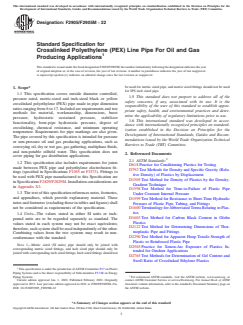
(Specification)Standard Specification for Crosslinked Polyethylene (PEX) Line Pipe For Oil and Gas Producing Applications
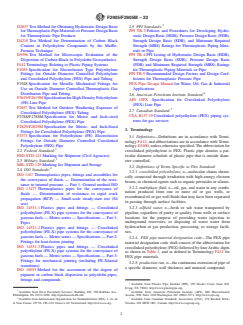
General Information
- Abstract
ABSTRACT
This specification covers the requirements and test methods for outside diameter controlled, pressure rated, black metric-sized and IPS-sized crosslinked polyethylene (PEX) pipe, fittings and joints intended for oil and gas producing applications. It presents the criteria for materials made in pipe dimension ratios ranging from 6 to 17, along with workmanship, burst pressure, hydrostatic sustained pressure, bent-pipe hydrostatic pressure, stabilizer functionality, degree of crosslinking, and chemical resistance. It also includes guidelines for pipe and fittings markings.
SCOPE
1.1 This specification covers outside diameter controlled, pressure rated, metric-sized and inch-sized black or yellow crosslinked polyethylene (PEX) pipe made in pipe dimension ratios ranging from 6 to 17. Included are requirements and test methods for material, workmanship, dimensions, burst pressure, hydrostatic sustained pressure, stabilizer functionality, bent-pipe hydrostatic pressure, degree of crosslinking, chemical resistance, and minimum operating temperature. Requirements for pipe markings are also given. The pipe covered by this specification is intended for pressure or non-pressure oil and gas producing applications, such as conveying oil, dry or wet gas, gas gathering, multiphase fluids, and non-potable oilfield water. This specification does not cover piping for gas distribution applications.
1.2 This specification also includes requirements for joints made between PEX pipe and polyethylene electrofusion fittings (specified in Specifications F1055 or F3373). Fittings to be used with PEX pipe manufactured to this Specification are in Specification F2829/F2829M. Installation considerations are in Appendix X3.
1.3 The text of this specification references notes, footnotes, and appendixes, which provide explanatory material. These notes and footnotes (excluding those in tables and figures) shall not be considered as requirements of the specification.
1.4 Units—The values stated in either SI units or inch-pound units are to be regarded separately as standard. The values stated in each system may not be exact equivalents; therefore, each system shall be used independently of the other. Combining values from the two systems may result in non-conformance with the standard.
Note 1: Metric sized (SI units) pipe should only be joined with corresponding metric sized fittings, and inch sized pipe should only be joined with corresponding inch sized fittings. Inch sized fittings should not be used for metric sized pipe, and metric sized fittings should not be used for IPS inch sized pipe.
1.5 This standard does not purport to address all of the safety concerns, if any, associated with its use. It is the responsibility of the user of this standard to establish appropriate safety, health, and environmental practices and determine the applicability of regulatory limitations prior to use.
1.6 This international standard was developed in accordance with internationally recognized principles on standardization established in the Decision on Principles for the Development of International Standards, Guides and Recommendations issued by the World Trade Organization Technical Barriers to Trade (TBT) Committee.
- Status
- Published
- Publication Date
- 31-Dec-2021
- Technical Committee
- F17 - Plastic Piping Systems
- Drafting Committee
- F17.68 - Energy Piping Systems
Buy Documents
ASTM F2905/F2905M-22 - Standard Specification for Crosslinked Polyethylene (PEX) Line Pipe For Oil and Gas Producing Applications
REDLINE ASTM F2905/F2905M-22 - Standard Specification for Crosslinked Polyethylene (PEX) Line Pipe For Oil and Gas Producing Applications
Overview
ASTM F2905/F2905M-22 defines the requirements for crosslinked polyethylene (PEX) line pipe used in oil and gas producing applications. Developed by ASTM International, this standard establishes comprehensive criteria and test methods for manufacturing, testing, and marking outside diameter controlled, pressure rated PEX pipes, fittings, and joints in both metric-sized and IPS (inch) sizes. The specification covers PEX pipes in pipe dimension ratios (DR) from 6 to 17 and includes both black and yellow pipe options, specifically intended for conveying oil, dry or wet gas, gas gathering, multiphase fluids, and non-potable oilfield water. It is not intended for gas distribution piping.
Key Topics
- Scope of Applicability: Covers PEX line pipes and associated fittings for oil and gas production, including use in pressure and non-pressure pipeline systems.
- Material Requirements: Specifies the use of crosslinked polyethylene (PEX), defined by a set degree of crosslinking, long-term hydrostatic strength, and density.
- Performance Criteria: Includes requirements for burst pressure, hydrostatic sustained pressure, and resistance to chemical exposure.
- Quality and Workmanship: Mandates homogeneity, freedom from defects, and uniformity in physical properties.
- Dimensional Compliance: Outlines tolerances for outside diameter, wall thickness, and out-of-roundness for both metric and inch-sized pipes.
- Testing Methods: Incorporates procedures for hydrostatic pressure, tensile strength, stabilizer functionality, degree of crosslinking, and UV stability.
- Joint and Fitting Requirements: Includes guidance for electrofusion and mechanical fittings, as well as installation considerations.
- Marking Guidelines: Specifies detailed marking requirements for traceability, application, minimum temperature, UV exposure limits, and pipe designation.
Applications
ASTM F2905/F2905M-22 is crucial for stakeholders in the oil and gas industry who require durable and reliable piping systems for production and gathering operations. Typical applications include:
- Crude oil and natural gas conveyance: PEX pipe is well-suited for transporting oil, dry or wet gas, multiphase fluids, and non-potable oilfield water from wells to processing and storage facilities.
- Gas gathering systems: Used in networked systems where performance and chemical resistance are critical for safe, long-term service.
- Salt and freshwater oilfield water pipelines: PEX pipes offer resistance to a variety of fluids used or produced in oil and gas operations, including those with challenging chemical environments.
- Multiphase fluid transport: The robust chemical resistance of crosslinked polyethylene is advantageous for flows containing combinations of oil, gas, and water.
Benefits of PEX line pipe in these applications include:
- High flexibility and ease of installation
- Resistance to corrosion and scaling
- Durability under fluctuating temperatures and pressures
- Reduced maintenance and long service life
Related Standards
ASTM F2905/F2905M-22 references several key standards and guidelines to ensure total system compatibility and performance, including:
- ASTM F1055 – Electrofusion type polyethylene fittings for outside diameter controlled PE and PEX pipe and tubing.
- ASTM F2829/F2829M – Fittings for crosslinked polyethylene pipe.
- API 15PX – Crosslinked polyethylene (PEX) line pipe for oil and gas.
- CSA B137.19 – PEX piping systems for gas services (Canada).
- PPI TR-3/TR-4/TR-9 – Policies and pressure rating methodologies for thermoplastic piping.
- ISO 1167, 13477, 14531 Series – Related ISO standards on plastics pipes, fittings, and assemblies.
Ensuring compliance with these related documents is vital for manufacturers, installers, and oil and gas operators to achieve safe and consistent performance with PEX line pipe products in demanding production environments.
Keywords: crosslinked polyethylene, PEX line pipe, oil and gas, ASTM F2905, hydrostatic stress, pipe specification, oilfield piping, pressure rated pipe, gas gathering systems, PEX fittings, pipeline standards
Relations
- Effective Date
- 01-Feb-2024
- Effective Date
- 01-Oct-2023
- Effective Date
- 01-Apr-2020
- Effective Date
- 01-Apr-2020
- Effective Date
- 01-Feb-2020
- Effective Date
- 01-Feb-2020
- Effective Date
- 01-Feb-2020
- Effective Date
- 01-Nov-2019
- Effective Date
- 01-Sep-2019
- Effective Date
- 01-Aug-2019
- Effective Date
- 01-Aug-2019
- Effective Date
- 15-Apr-2019
- Effective Date
- 01-Jan-2019
- Effective Date
- 01-Jan-2019
- Effective Date
- 01-Sep-2018
Buy Documents
ASTM F2905/F2905M-22 - Standard Specification for Crosslinked Polyethylene (PEX) Line Pipe For Oil and Gas Producing Applications
REDLINE ASTM F2905/F2905M-22 - Standard Specification for Crosslinked Polyethylene (PEX) Line Pipe For Oil and Gas Producing Applications
Get Certified
Connect with accredited certification bodies for this standard

Element Materials Technology
Materials testing and product certification.

ABS Group Brazil
ABS Group certification services in Brazil.

ABS Quality Evaluations Inc.
American Bureau of Shipping quality certification.
Sponsored listings
Frequently Asked Questions
ASTM F2905/F2905M-22 is a technical specification published by ASTM International. Its full title is "Standard Specification for Crosslinked Polyethylene (PEX) Line Pipe For Oil and Gas Producing Applications". This standard covers: ABSTRACT This specification covers the requirements and test methods for outside diameter controlled, pressure rated, black metric-sized and IPS-sized crosslinked polyethylene (PEX) pipe, fittings and joints intended for oil and gas producing applications. It presents the criteria for materials made in pipe dimension ratios ranging from 6 to 17, along with workmanship, burst pressure, hydrostatic sustained pressure, bent-pipe hydrostatic pressure, stabilizer functionality, degree of crosslinking, and chemical resistance. It also includes guidelines for pipe and fittings markings. SCOPE 1.1 This specification covers outside diameter controlled, pressure rated, metric-sized and inch-sized black or yellow crosslinked polyethylene (PEX) pipe made in pipe dimension ratios ranging from 6 to 17. Included are requirements and test methods for material, workmanship, dimensions, burst pressure, hydrostatic sustained pressure, stabilizer functionality, bent-pipe hydrostatic pressure, degree of crosslinking, chemical resistance, and minimum operating temperature. Requirements for pipe markings are also given. The pipe covered by this specification is intended for pressure or non-pressure oil and gas producing applications, such as conveying oil, dry or wet gas, gas gathering, multiphase fluids, and non-potable oilfield water. This specification does not cover piping for gas distribution applications. 1.2 This specification also includes requirements for joints made between PEX pipe and polyethylene electrofusion fittings (specified in Specifications F1055 or F3373). Fittings to be used with PEX pipe manufactured to this Specification are in Specification F2829/F2829M. Installation considerations are in Appendix X3. 1.3 The text of this specification references notes, footnotes, and appendixes, which provide explanatory material. These notes and footnotes (excluding those in tables and figures) shall not be considered as requirements of the specification. 1.4 Units—The values stated in either SI units or inch-pound units are to be regarded separately as standard. The values stated in each system may not be exact equivalents; therefore, each system shall be used independently of the other. Combining values from the two systems may result in non-conformance with the standard. Note 1: Metric sized (SI units) pipe should only be joined with corresponding metric sized fittings, and inch sized pipe should only be joined with corresponding inch sized fittings. Inch sized fittings should not be used for metric sized pipe, and metric sized fittings should not be used for IPS inch sized pipe. 1.5 This standard does not purport to address all of the safety concerns, if any, associated with its use. It is the responsibility of the user of this standard to establish appropriate safety, health, and environmental practices and determine the applicability of regulatory limitations prior to use. 1.6 This international standard was developed in accordance with internationally recognized principles on standardization established in the Decision on Principles for the Development of International Standards, Guides and Recommendations issued by the World Trade Organization Technical Barriers to Trade (TBT) Committee.
ABSTRACT This specification covers the requirements and test methods for outside diameter controlled, pressure rated, black metric-sized and IPS-sized crosslinked polyethylene (PEX) pipe, fittings and joints intended for oil and gas producing applications. It presents the criteria for materials made in pipe dimension ratios ranging from 6 to 17, along with workmanship, burst pressure, hydrostatic sustained pressure, bent-pipe hydrostatic pressure, stabilizer functionality, degree of crosslinking, and chemical resistance. It also includes guidelines for pipe and fittings markings. SCOPE 1.1 This specification covers outside diameter controlled, pressure rated, metric-sized and inch-sized black or yellow crosslinked polyethylene (PEX) pipe made in pipe dimension ratios ranging from 6 to 17. Included are requirements and test methods for material, workmanship, dimensions, burst pressure, hydrostatic sustained pressure, stabilizer functionality, bent-pipe hydrostatic pressure, degree of crosslinking, chemical resistance, and minimum operating temperature. Requirements for pipe markings are also given. The pipe covered by this specification is intended for pressure or non-pressure oil and gas producing applications, such as conveying oil, dry or wet gas, gas gathering, multiphase fluids, and non-potable oilfield water. This specification does not cover piping for gas distribution applications. 1.2 This specification also includes requirements for joints made between PEX pipe and polyethylene electrofusion fittings (specified in Specifications F1055 or F3373). Fittings to be used with PEX pipe manufactured to this Specification are in Specification F2829/F2829M. Installation considerations are in Appendix X3. 1.3 The text of this specification references notes, footnotes, and appendixes, which provide explanatory material. These notes and footnotes (excluding those in tables and figures) shall not be considered as requirements of the specification. 1.4 Units—The values stated in either SI units or inch-pound units are to be regarded separately as standard. The values stated in each system may not be exact equivalents; therefore, each system shall be used independently of the other. Combining values from the two systems may result in non-conformance with the standard. Note 1: Metric sized (SI units) pipe should only be joined with corresponding metric sized fittings, and inch sized pipe should only be joined with corresponding inch sized fittings. Inch sized fittings should not be used for metric sized pipe, and metric sized fittings should not be used for IPS inch sized pipe. 1.5 This standard does not purport to address all of the safety concerns, if any, associated with its use. It is the responsibility of the user of this standard to establish appropriate safety, health, and environmental practices and determine the applicability of regulatory limitations prior to use. 1.6 This international standard was developed in accordance with internationally recognized principles on standardization established in the Decision on Principles for the Development of International Standards, Guides and Recommendations issued by the World Trade Organization Technical Barriers to Trade (TBT) Committee.
ASTM F2905/F2905M-22 is classified under the following ICS (International Classification for Standards) categories: 23.040.20 - Plastics pipes; 23.100.40 - Piping and couplings; 75.180.01 - Equipment for petroleum and natural gas industries in general. The ICS classification helps identify the subject area and facilitates finding related standards.
ASTM F2905/F2905M-22 has the following relationships with other standards: It is inter standard links to ASTM D2765-16(2024), ASTM D2565-23, ASTM F412-20, ASTM F2619/F2619M-20, ASTM D4218-20, ASTM D1603-20, ASTM F1948-20, ASTM F1948-19, ASTM F2619/F2619M-19, ASTM D2290-19a, ASTM F2788/F2788M-19a, ASTM F2788/F2788M-19, ASTM F412-19, ASTM D2290-19, ASTM D1599-18. Understanding these relationships helps ensure you are using the most current and applicable version of the standard.
ASTM F2905/F2905M-22 is available in PDF format for immediate download after purchase. The document can be added to your cart and obtained through the secure checkout process. Digital delivery ensures instant access to the complete standard document.
Standards Content (Sample)
This international standard was developed in accordance with internationally recognized principles on standardization established in the Decision on Principles for the
Development of International Standards, Guides and Recommendations issued by the World Trade Organization Technical Barriers to Trade (TBT) Committee.
Designation:F2905/F2905M −22
Standard Specification for
Crosslinked Polyethylene (PEX) Line Pipe For Oil and Gas
Producing Applications
ThisstandardisissuedunderthefixeddesignationF2905/F2905M;thenumberimmediatelyfollowingthedesignationindicatestheyear
of original adoption or, in the case of revision, the year of last revision. A number in parentheses indicates the year of last reapproval.
A superscript epsilon (´) indicates an editorial change since the last revision or reapproval.
be used for metric sized pipe, and metric sized fittings should not be used
1. Scope*
for IPS inch sized pipe.
1.1 This specification covers outside diameter controlled,
1.5 This standard does not purport to address all of the
pressure rated, metric-sized and inch-sized black or yellow
safety concerns, if any, associated with its use. It is the
crosslinked polyethylene (PEX) pipe made in pipe dimension
responsibility of the user of this standard to establish appro-
ratios ranging from 6 to 17. Included are requirements and test
priate safety, health, and environmental practices and deter-
methods for material, workmanship, dimensions, burst
mine the applicability of regulatory limitations prior to use.
pressure, hydrostatic sustained pressure, stabilizer
1.6 This international standard was developed in accor-
functionality, bent-pipe hydrostatic pressure, degree of
dance with internationally recognized principles on standard-
crosslinking, chemical resistance, and minimum operating
ization established in the Decision on Principles for the
temperature. Requirements for pipe markings are also given.
Development of International Standards, Guides and Recom-
The pipe covered by this specification is intended for pressure
mendations issued by the World Trade Organization Technical
or non-pressure oil and gas producing applications, such as
Barriers to Trade (TBT) Committee.
conveying oil, dry or wet gas, gas gathering, multiphase fluids,
and non-potable oilfield water. This specification does not
2. Referenced Documents
cover piping for gas distribution applications.
2.1 ASTM Standards:
1.2 This specification also includes requirements for joints
D618 Practice for Conditioning Plastics for Testing
made between PEX pipe and polyethylene electrofusion fit-
D792 Test Methods for Density and Specific Gravity (Rela-
tings (specified in Specifications F1055 or F3373). Fittings to
tive Density) of Plastics by Displacement
be used with PEX pipe manufactured to this Specification are
D1505 Test Method for Density of Plastics by the Density-
inSpecificationF2829/F2829M.Installationconsiderationsare
Gradient Technique
in Appendix X3.
D1598 Test Method for Time-to-Failure of Plastic Pipe
1.3 Thetextofthisspecificationreferencesnotes,footnotes,
Under Constant Internal Pressure
and appendixes, which provide explanatory material. These
D1599 Test Method for Resistance to Short-Time Hydraulic
notesandfootnotes(excludingthoseintablesandfigures)shall
Pressure of Plastic Pipe, Tubing, and Fittings
not be considered as requirements of the specification.
D1600 TerminologyforAbbreviatedTermsRelatingtoPlas-
tics
1.4 Units—The values stated in either SI units or inch-
D1603 Test Method for Carbon Black Content in Olefin
pound units are to be regarded separately as standard. The
Plastics
values stated in each system may not be exact equivalents;
D2122 Test Method for Determining Dimensions of Ther-
therefore,eachsystemshallbeusedindependentlyoftheother.
moplastic Pipe and Fittings
Combining values from the two systems may result in non-
D2290 Test Method for Apparent Hoop Tensile Strength of
conformance with the standard.
Plastic or Reinforced Plastic Pipe
NOTE 1—Metric sized (SI units) pipe should only be joined with
D2565 Practice for Xenon-Arc Exposure of Plastics In-
corresponding metric sized fittings, and inch sized pipe should only be
tended for Outdoor Applications
joinedwithcorrespondinginchsizedfittings.Inchsizedfittingsshouldnot
D2765 Test Methods for Determination of Gel Content and
Swell Ratio of Crosslinked Ethylene Plastics
This specification is under the jurisdiction ofASTM Committee F17 on Plastic
Piping Systems and is the direct responsibility of Subcommittee F17.68 on Energy
Piping Systems. For referenced ASTM standards, visit the ASTM website, www.astm.org, or
Current edition approved Jan. 1, 2022. Published February 2022. Originally contact ASTM Customer Service at service@astm.org. For Annual Book of ASTM
approved in 2013. Last previous edition approved in 2021 as F2905/F2905M–21a. Standards volume information, refer to the standard’s Document Summary page on
DOI: 10.1520/F2905_F2905M-22 the ASTM website.
*A Summary of Changes section appears at the end of this standard
Copyright © ASTM International, 100 Barr Harbor Drive, PO Box C700, West Conshohocken, PA 19428-2959. United States
F2905/F2905M−22
D2837 Test Method for Obtaining Hydrostatic Design Basis 2.5 PPI Standards:
forThermoplasticPipeMaterialsorPressureDesignBasis PPI TR-3 Policies and Procedures for Developing Hydro-
for Thermoplastic Pipe Products static Design Basis (HDB), Pressure Design Basis (PDB),
D4218 Test Method for Determination of Carbon Black Strength Design Basis (SDB), and Minimum Required
Content in Polyethylene Compounds by the Muffle- Strength (MRS) Ratings for Thermoplastic Piping Mate-
Furnace Technique rials or Pipe
D5596 Test Method for Microscopic Evaluation of the PPI TR-4 PPI Listing of Hydrostatic Design Basis (HDB),
Dispersion of Carbon Black in Polyolefin Geosynthetics Strength Design Basis (SDB), Pressure Design Basis
F412 Terminology Relating to Plastic Piping Systems (PDB) and Minimum Required Strength (MRS) Ratings
F1055 Specification for Electrofusion Type Polyethylene for Thermoplastic Piping Materials or Pipe
Fittings for Outside Diameter Controlled Polyethylene PPI TR-9 Recommended Design Factors and Design Coef-
and Crosslinked Polyethylene (PEX) Pipe and Tubing ficients for Thermoplastic Pressure Pipe
F1948 Specification for Metallic Mechanical Fittings for PEX Pipe Design Manual for Water, Oil, Gas & Industrial
Use on Outside Diameter Controlled Thermoplastic Gas Applications
Distribution Pipe and Tubing 6
2.6 American Petroleum Institute Standard:
F2619/F2619M SpecificationforHigh-DensityPolyethylene
API 15PX Specification for Crosslinked Polyethylene
(PE) Line Pipe
(PEX) Line Pipe
F2657 Test Method for Outdoor Weathering Exposure of
2.7 Canadian Standard:
Crosslinked Polyethylene (PEX) Tubing
CSA B137.19 Crosslinked polyethylene (PEX) piping sys-
F2788/F2788M Specification for Metric and Inch-sized
tems for gas services
Crosslinked Polyethylene (PEX) Pipe
F2829/F2829M Specification for Metric- and Inch-Sized
3. Terminology
Fittings for Crosslinked Polyethylene (PEX) Pipe
F3373 Specification for Polyethylene (PE) Electrofusion
3.1 Definitions—Definitions are in accordance with Termi-
Fittings for Outside Diameter Controlled Crosslinked
nology F412, and abbreviations are in accordance with Termi-
Polyethylene (PEX) Pipe
nologyD1600,unlessotherwisespecified.Theabbreviationfor
2.2 Federal Standard:
crosslinked polyethylene is PEX. Plastic pipe denotes a par-
FED-STD-123 Marking for Shipment (Civil Agencies)
ticular diameter schedule of plastic pipe that is outside diam-
2.3 Military Standard:
eter controlled.
MIL-STD-129 Marking for Shipment and Storage
3.2 Definitions of Terms Specific to This Standard:
2.4 ISO Standards:
3.2.1 crosslinked polyethylene, n—molecular chains chemi-
ISO 1167 Thermoplastics pipes, fittings and assemblies for
cally connected through irradiation with high-energy electron
the conveyance of fluids — Determination of the resis-
beams,orchemicalagentssuchasorganicperoxidesorsilanes.
tance to internal pressure — Part 1: General method ISO
3.2.2 multiphase fluid, n—oil, gas, and water in any combi-
ISO 13477 Thermoplastics pipes for the conveyance of
nation produced from one or more oil or gas wells, or
fluids — Determination of resistance to rapid crack
recombined oil or gas well fluids that may have been separated
propagation (RCP) — Small-scale steady-state test (S4
in passing through surface facilities.
test)
3.2.3 oilfield water, n—fresh or salt water transported by
ISO 14531-1 Plastics pipes and fittings — Crosslinked
pipeline, regardless of purity or quality, from wells or surface
polyethylene (PE-X) pipe systems for the conveyance of
locations for the purpose of providing water injection to
gaseous fuels — Metric series — Specifications — Part 1:
underground reservoirs; or disposing of waste water from
Pipes
hydrocarbon or gas production, processing, or storage facili-
ISO 14531-2 Plastics pipes and fittings — Crosslinked
ties.
polyethylene (PE-X) pipe systems for the conveyance of
gaseous fuels — Metric series — Specifications — Part 2:
3.2.4 PEX pipe material designation code—The PEX pipe
Fittings for heat-fusion jointing
material designation code shall consist of the abbreviation for
ISO 14531-3 Plastics pipes and fittings — Crosslinked
crosslinked polyethylene (PEX) followed by fourArabic digits
polyethylene (PE-X) pipe systems for the conveyance of
as shown in Table 1, and as defined in Terminology F412 for
gaseous fuels — Metric series — Specifications — Part 3:
PEX pipe materials.
Fittings for mechanical jointing (including PE-X/metal
3.2.5 production run, n—thecontinuousextrusionofpipeof
transitions)
a specific diameter, wall thickness and material compound.
ISO 18553 Method for the assessment of the degree of
pigment or carbon black dispersion in polyolefin pipes,
fittings and compounds.
Available from Plastics Pipe Institute (PPI), 105 Decker Court, Suite 825,
Irving, TX 75062, http://www.plasticpipe.org.
3 6
Available from DLA Document Services, Building 4/D, 700 Robbins Ave., Available from American Petroleum Institute (API), 200 Massachusetts
Philadelphia, PA 19111-5094, http://quicksearch.dla.mil. Avenue, NW Suite 1100 Washington, DC 20001-5571, http://www.api.org.
4 7
Available from International Organization for Standardization (ISO), 1, ch. de Available from Canadian Standards Association (CSA), 178 Rexdale Blvd.,
la Voie-Creuse, CP 56, CH-1211 Geneva 20, Switzerland, http://www.iso.org. Toronto, ON M9W 1R3, Canada, http://www.csagroup.org.
F2905/F2905M−22
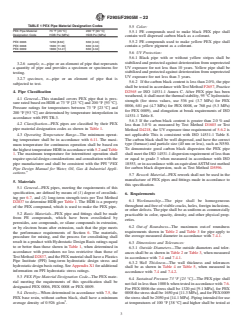
TABLE 1 PEX Pipe Material Designation Codes
5.5 Color:
PEX Pipe Material 73 °F [23 °C] 200 °F [93 °C] 5.5.1 PE compounds used to make black PEX pipe shall
Designation Code HDB Psi [MPa] HDB Psi [MPa]
contain well dispersed carbon black as a colorant.
5.5.2 PE compounds used to make yellow PEX pipe shall
PEX 0006 1250 [8.62] 630 [4.34]
PEX 0008 1600 [11.03] 630 [4.34]
contain a yellow pigment as a colorant.
PEX 0009 1800 [12.41] 630 [4.34]
5.6 UV Protection:
5.6.1 Black pipe with or without yellow stripes shall be
stabilized and protected against deterioration from unprotected
3.2.6 sample, n—pipe or an element of pipe that represents
UV exposure for not less than 10 years. Yellow pipe shall be
a quantity of pipe and provides a specimen or specimens for
stabilized and protected against deterioration from unprotected
testing.
UV exposure for not less than 3 years.
3.2.7 specimen, n—pipe or an element of pipe that is
5.6.2 If the carbon black content is less than 2.0%, the pipe
subjected to test.
shall be tested in accordance withTest Method F2657, Practice
D2565 or ISO 14531-1 Annex C. After PEX pipe has been
4. Pipe Classification
weathered, it shall meet the thermal stability, 95 °C hydrostatic
4.1 General—This standard covers PEX pipe that is pres-
strength (for stress values, use 536 psi (3.7 MPa) for PEX
sure rated based on HDB at 73 °F [23 °C] and 200 °F [93 °C].
0006, 681 psi (4.7 MPa) for PEX 0008, or 768 psi (5.3 MPa)
Pressure ratings for temperatures between 73 °F [23 °C] and
for PEX 0009), and elongation at break requirements of ISO
200 °F [93 °C] are determined by temperature interpolation in
14531-1 Table 8.
accordance with PPI TR-3.
5.6.3 If the carbon black content is greater than 2.0 % and
4.2 Classification—PEX pipes are classified by their PEX
less than 3.0 % as measured by Test Method D1603 or Test
pipe material designation codes as shown in Table 1.
Method D4218, the UV exposure time requirement of 5.6.2 is
not applicable This is consistent with ISO 14531-1 Table 8.
4.3 Operating Temperature Range—The minimum operat-
The carbon black shall be well dispersed, and have the correct
ing temperature shall be in accordance with 6.11. The maxi-
type (furnace) and particle size (40 nm or less), such as N550.
mum temperature for continuous operation shall be based on
To demonstrate good carbon black dispersion the PEX pipe
the highest temperature HDB in accordance with 5.2 and Table
shall meet the ISO 14531-1 dispersion requirement of less than
1. The maximum temperature for intermittent operation shall
or equal to grade 3 when measured in accordance with ISO
require special design considerations and consultation with the
18553, or in accordance with an equivalentASTM test method
pipe manufacturer and shall be consistent with the PPI “PEX
for carbon black dispersion, such as Test Method D5596.
Pipe Design Manual for Water, Oil, Gas & Industrial Appli-
cations.”
5.7 Rework Material—PEX rework shall not be used in the
manufacture of PEX pipes and fittings made in accordance to
5. Materials
this specification.
5.1 General—PEX pipes, meeting the requirements of this
specification, are defined by means of (1) degree of crosslink-
6. Requirements
ing per 6.7, and (2) long-term strength tests per Test Method
6.1 Workmanship—The pipe shall be homogeneous
D2837 to determine HDB per Table 1. The HDB is a property
throughout and free of visible cracks, holes, foreign inclusions,
of the PEX compound, which is used to make the PEX pipe.
or other defects. The pipe shall be as uniform as commercially
5.2 Basic Materials—PEX pipe and fittings shall be made
practicable in color, opacity, density, and other physical prop-
from PE compounds, which have been crosslinked by
erties.
peroxides, azo compounds, or silane compounds in extrusion,
6.2 Out-of Roundness—The maximum out-of roundness
or by electron beam after extrusion, such that the pipe meets
requirements shown in Table 2 and Table 3 for pipe apply to
the performance requirements of Section 6. The materials,
the average measured diameter in accordance with 7.4.1.
procedure for mixing, and the process for crosslinking shall
result in a product with Hydrostatic Design Basis ratings equal
6.3 Dimensions and Tolerances:
to or better than those shown in Table 1, when determined in
6.3.1 Outside Diameters—The outside diameters and toler-
accordance with procedures no less restrictive than those of
ances shall be as shown in Table 2 or Table 3, when measured
TestMethodD2837,andthePEXmaterialshallhaveaPlastics
in accordance with 7.4 and 7.4.1.
Pipe Institute (PPI) long-term hydrostatic design stress and
6.3.2 Wall Thickness—The wall thickness and tolerances
hydrostaticdesignbasisrating.SeeAppendixX1foradditional
shall be as shown in Table 4 or Table 5, when measured in
information on PPI hydrostatic stress ratings.
accordance with 7.4 and 7.4.2.
5.3 PEX Pipe Material Designation Code—The PEX mate-
6.4 Sustained Pressure 73 °F [23 °C]—The PEX pipe shall
rial meeting the requirements of this specification shall be
not fail in less than 1000 h when tested in accordance with 7.6.
designated PEX 0006, PEX 0008 or PEX 0009.
For PEX 0006 the stress shall be 1320 psi [9.1 MPa], for PEX
5.4 Density—When determined in accordance with 7.5, the 0008thestressshallbe1650psi[11.3MPa],andforPEX0009
PEX base resin, without carbon black, shall have a minimum the stress shall be 2050 psi [14.1 MPa]. Piping intended for use
average density of 0.926 g/cm . at temperatures of 100 °F [38 °C] and higher shall be tested at
F2905/F2905M−22
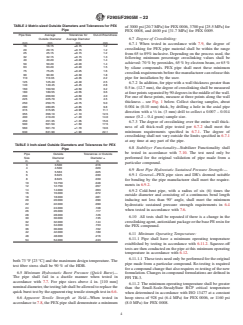
TABLE 2 Metric-sized Outside Diameters and Tolerances for PEX
of 3000 psi [20.7 MPa] for PEX 0006, 3700 psi [25.5 MPa] for
Pipe
PEX 0008, and 4600 psi [31.7 MPa] for PEX 0009.
Pipe Size Average Tolerances for Out-of-Roundness
6.7 Degree of Crosslinking:
Outside Diameter Average Diameter
mm mm mm mm
6.7.1 When tested in accordance with 7.9, the degree of
16 16.15 ±0.15 1.2
crosslinking for PEX pipe material shall be within the range
20 20.15 ±0.15 1.2
25 25.15 ±0.15 1.2
from 65 to 89% inclusive. Depending on the process used, the
32 32.15 ±0.15 1.3
following minimum percentage crosslinking values shall be
40 40.20 ±0.20 1.4
achieved: 70 % by peroxides, 65 % by electron beam, or 65 %
50 50.20 ±0.20 1.4
63 63.20 ±0.20 1.5
by silane compounds. PEX pipe shall meet these minimum
75 75.25 ±0.25 1.6
crosslinkrequirementsbeforethemanufacturercanreleasethis
90 90.30 ±0.30 1.8
pipe for installation by the user.
110 110.35 ±0.35 2.2
125 125.40 ±0.40 2.5
6.7.2 In addition, for pipe with a wall thickness greater than
140 140.45 ±0.45 2.8
0.5 in. (12.7 mm), the degree of crosslinking shall be measured
160 160.50 ±0.50 3.2
180 180.55 ±0.55 3.6
atfourpointsseparatedby90degreesinthemiddleofthewall.
200 200.60 ±0.60 4.0
For one of these points, measure at three points along the wall
225 225.70 ±0.70 4.5
thickness – see Fig. 1 below. Collect shaving samples, about
250 250.75 ±0.75 5.0
280 280.85 ±0.85 9.8
0.004 in (0.10 mm) thick, by drilling a hole in the axial pipe
315 315.95 ±0.95 11.1
direction with a ⁄8 in. (3 mm) drill to collect a 0.007 – 0.014
355 356.10 ±1.10 12.5
ounce (0.2 – 0.4 gram) sample size.
400 410.20 ±1.20 14.0
450 451.35 ±1.35 15.6
6.7.3 The degree of crosslinking over the entire wall thick-
500 501.50 ±1.50 17.5
ness of all thick-wall pipe tested per 6.7.2 shall meet the
560 561.70 ±1.70 19.6
630 631.90 ±1.90 22.1 minimum requirements specified in 6.7.1. The degree of
crosslinking shall not vary outside the limits specified in 6.7.1
at any time at any part of the pipe.
TABLE 3 Inch-sized Outside Diameters and Tolerances for PEX
6.8 Stabilizer Functionality—Stabilizer Functionality shall
Pipe
be tested in accordance with 7.10. The test need only be
Pipe Outside Tolerances or Outside
Size Diameter Diameter ±
performed for the original validation of pipe made from a
in. in. in.
particular compound.
3 3.500 .016
4 4.500 .020
6.9 Bent Pipe Hydrostatic Sustained Pressure Strength:—
5 5.563 .025
6 6.625 .030 6.9.1 General—PEX pipe sizes and DR’s deemed suitable
8 8.625 .039
for bending by the pipe manufacturer shall meet the require-
10 10.750 .048
ments in 6.9.2.
12 12.750 .057
14 14.000 .063
6.9.2 Cold-bent pipe, with a radius of six (6) times the
16 16.000 .072
outside diameter and consisting of a continuous bend length
18 18.000 .081
inducing not less than 90° angle, shall meet the minimum
20 20.000 .090
22 22.000 .099
hydrostatic sustained pressure strength requirements in 6.4
24 24.000 .108
when tested in accordance with 7.6.
26 26.000 .117
28 28.000 .126
6.10 All tests shall be repeated if there is a change in the
30 30.000 .135
32 32.000 .144 crosslinkingagent,antioxidantpackageorthebasePEresinfor
34 34.000 .153
the PEX compound.
36 36.000 .162
42 42.000 .189
6.11 Minimum Operating Temperature:
48 48.000 .216
6.11.1 Pipe shall have a minimum operating temperature
54 54.000 .243
established by testing in accordance with 6.11.2. Squeeze-off
tests are then conducted on the pipe at this minimum operating
temperature in accordance with 6.12.
6.11.1.1 These tests need only be performed for the original
both 73 °F [23 °C] and the maximum design temperature. The
pipe made from a particular compound. Re-testing is required
test fiber stress shall be 90 % of the HDB.
for a compound change that also requires re-testing of the new
6.5 Minimum Hydrostatic Burst Pressure (Quick Burst)—
formulation. Changes in compound formulations are defined in
The pipe shall fail in a ductile manner when tested in
PPI TR-3.
accordance with 7.7. For pipe sizes above 4 in. [110 mm]
6.11.2 The minimum operating temperature shall be greater
nominaldiameter,thetestinglabshallbeallowedtoreplacethe
than the Small-Scale-SteadyState RCP critical temperature
quick burst test by the apparent ring tensile strength test in 6.6.
when determined in accordance with ISO 13477 at a constant
6.6 Apparent Tensile Strength at Yield—When tested in hoop stress of 928 psi (6.4 MPa) for PEX 0006, or 1160 psi
accordance to 7.8, the PEX pipe shall demonstrate a minimum (8.0 MPa) for PEX 0008.
F2905/F2905M−22
TABLE 4 Metric-sized Wall Thickness and Tolerances for PEX Plastic Pipe Minimum Wall Thickness (t), mm (tolerance is plus 12%)
Pipe Size DR 6 DR 7.4 DR 9 DR 11 DR 13.6 DR 16.2 DR 17 DR 21
[mm]
16 3.0 2.3 2.0 . . . . .
20 3.4 3.0 2.3 2.0 . . . .
25 5.4 3.5 3.0 2.3 2.0 . . .
32 5.4 4.4 3.6 3.0 2.4 2.0 2.0 2.3
40 6.7 5.5 4.5 3.7 3.0 2.5 2.4 2.8
50 8.3 6.9 5.6 4.6 3.7 3.1 3.0 3.4
63 10.5 8.6 7.1 5.8 4.7 3.9 3.8 4.3
75 12.5 10.3 8.4 6.8 5.6 4.6 4.5 5.1
90 15.0 12.3 10.1 8.2 6.7 5.6 5.4 6.1
110 18.3 15.1 12.3 10.0 8.1 7.7 6.6 7.4
125 20.8 17.1 14.0 11.4 9.2 7.7 7.4 8.3
140 23.3 19.2 15.7 12.7 10.3 8.7 8.3 9.3
160 26.6 21.9 17.9 14.6 11.8 9.9 9.5 10.6
180 29.9 24.6 20.1 16.4 13.3 11.1 10.7 11.9
200 33.2 27.4 22.4 18.2 14.7 12.4 11.9 13.2
225 37.4 30.8 25.2 20.5 16.6 13.9 13.4 14.9
250 41.5 34.2 27.9 22.7 18.4 15.5 14.8 16.4
280 46.5 38.3 31.3 25.4 20.6 17.3 16.6 18.4
315 52.3 43.1 35.2 28.6 23.2 19.5 18.7 20.7
355 59.0 48.5 39.7 32.2 26.1 21.9 21.1 23.4
400 . 54.7 44.7 36.3 29.4 24.7 26.2 23.7
450 . 61.5 50.3 40.9 33.1 27.8 26.7 29.5
500 . . 55.8 45.4 36.8 30.9 29.7 32.8
560 . . 62.5 50.8 41.2 34.6 33.2 36.7
630 . . 70.3 57.2 46.3 38.9 37.4 41.3
710 . . 79.3 64.5 52.2 43.9 42.1 46.5
800 . . 89.3 72.6 58.8 49.4 47.4 52.3
900 . . . 81.7 66.2 56.6 53.3 58.8
1000 . . . 90.2 72.5 61.8 59.3 65.4
TABLE 5 Inch-Sized Wall Thickness and Tolerances for PEX Plastic Pipe
Pipe Size (in) DR
...
This document is not an ASTM standard and is intended only to provide the user of an ASTM standard an indication of what changes have been made to the previous version. Because
it may not be technically possible to adequately depict all changes accurately, ASTM recommends that users consult prior editions as appropriate. In all cases only the current version
of the standard as published by ASTM is to be considered the official document.
Designation: F2905/F2905M − 21a F2905/F2905M − 22
Standard Specification for
Crosslinked Polyethylene (PEX) Line Pipe For Oil and Gas
Producing Applications
This standard is issued under the fixed designation F2905/F2905M; the number immediately following the designation indicates the year
of original adoption or, in the case of revision, the year of last revision. A number in parentheses indicates the year of last reapproval.
A superscript epsilon (´) indicates an editorial change since the last revision or reapproval.
1. Scope*
1.1 This specification covers outside diameter controlled, pressure rated, metric-sized and inch-sized black or yellow crosslinked
polyethylene (PEX) pipe made in pipe dimension ratios ranging from 6 to 17. Included are requirements and test methods for
material, workmanship, dimensions, burst pressure, hydrostatic sustained pressure, stabilizer functionality, bent-pipe hydrostatic
pressure, degree of crosslinking, chemical resistance, and minimum operating temperature. Requirements for pipe markings are
also given. The pipe covered by this specification is intended for pressure or non-pressure oil and gas producing applications, such
as conveying oil, dry or wet gas, gas gathering, multiphase fluids, and non-potable oilfield water. This specification does not cover
piping for gas distribution applications.
1.2 This specification also includes requirements for joints made between PEX pipe and polyethylene electrofusion fittings
(specified in Specifications F1055 or F3373). Fittings to be used with PEX pipe manufactured to this Specification are in
Specification F2829/F2829M. Installation considerations are in Appendix X3.
1.3 The text of this specification references notes, footnotes, and appendixes, which provide explanatory material. These notes and
footnotes (excluding those in tables and figures) shall not be considered as requirements of the specification.
1.4 Units—The values stated in either SI units or inch-pound units are to be regarded separately as standard. The values stated in
each system may not be exact equivalents; therefore, each system shall be used independently of the other. Combining values from
the two systems may result in non-conformance with the standard.
NOTE 1—Metric sized (SI units) pipe should only be joined with corresponding metric sized fittings, and inch sized pipe should only be joined with
corresponding inch sized fittings. Inch sized fittings should not be used for metric sized pipe, and metric sized fittings should not be used for IPS inch
sized pipe.
1.5 This standard does not purport to address all of the safety concerns, if any, associated with its use. It is the responsibility
of the user of this standard to establish appropriate safety, health, and environmental practices and determine the applicability of
regulatory limitations prior to use.
1.6 This international standard was developed in accordance with internationally recognized principles on standardization
established in the Decision on Principles for the Development of International Standards, Guides and Recommendations issued
by the World Trade Organization Technical Barriers to Trade (TBT) Committee.
This specification is under the jurisdiction of ASTM Committee F17 on Plastic Piping Systems and is the direct responsibility of Subcommittee F17.68 on Energy Piping
Systems.
Current edition approved July 1, 2021Jan. 1, 2022. Published July 2021February 2022. Originally approved in 2013. Last previous edition approved in 2021 as
F2905/F2905M–21.–21a. DOI: 10.1520/F2905_F2905M-21A10.1520/F2905_F2905M-22
*A Summary of Changes section appears at the end of this standard
Copyright © ASTM International, 100 Barr Harbor Drive, PO Box C700, West Conshohocken, PA 19428-2959. United States
F2905/F2905M − 22
2. Referenced Documents
2.1 ASTM Standards:
D618 Practice for Conditioning Plastics for Testing
D792 Test Methods for Density and Specific Gravity (Relative Density) of Plastics by Displacement
D1505 Test Method for Density of Plastics by the Density-Gradient Technique
D1598 Test Method for Time-to-Failure of Plastic Pipe Under Constant Internal Pressure
D1599 Test Method for Resistance to Short-Time Hydraulic Pressure of Plastic Pipe, Tubing, and Fittings
D1600 Terminology for Abbreviated Terms Relating to Plastics
D1603 Test Method for Carbon Black Content in Olefin Plastics
D2122 Test Method for Determining Dimensions of Thermoplastic Pipe and Fittings
D2290 Test Method for Apparent Hoop Tensile Strength of Plastic or Reinforced Plastic Pipe
D2565 Practice for Xenon-Arc Exposure of Plastics Intended for Outdoor Applications
D2765 Test Methods for Determination of Gel Content and Swell Ratio of Crosslinked Ethylene Plastics
D2837 Test Method for Obtaining Hydrostatic Design Basis for Thermoplastic Pipe Materials or Pressure Design Basis for
Thermoplastic Pipe Products
D4218 Test Method for Determination of Carbon Black Content in Polyethylene Compounds by the Muffle-Furnace Technique
D5596 Test Method for Microscopic Evaluation of the Dispersion of Carbon Black in Polyolefin Geosynthetics
F412 Terminology Relating to Plastic Piping Systems
F1055 Specification for Electrofusion Type Polyethylene Fittings for Outside Diameter Controlled Polyethylene and Crosslinked
Polyethylene (PEX) Pipe and Tubing
F1948 Specification for Metallic Mechanical Fittings for Use on Outside Diameter Controlled Thermoplastic Gas Distribution
Pipe and Tubing
F2619/F2619M Specification for High-Density Polyethylene (PE) Line Pipe
F2657 Test Method for Outdoor Weathering Exposure of Crosslinked Polyethylene (PEX) Tubing
F2788/F2788M Specification for Metric and Inch-sized Crosslinked Polyethylene (PEX) Pipe
F2829/F2829M Specification for Metric- and Inch-Sized Fittings for Crosslinked Polyethylene (PEX) Pipe
F3373 Specification for Polyethylene (PE) Electrofusion Fittings for Outside Diameter Controlled Crosslinked Polyethylene
(PEX) Pipe
2.2 Federal Standard:
FED-STD-123 Marking for Shipment (Civil Agencies)
2.3 Military Standard:
MIL-STD-129 Marking for Shipment and Storage
2.4 ISO Standards:
ISO 1167 Thermoplastics pipes, fittings and assemblies for the conveyance of fluids — Determination of the resistance to
internal pressure — Part 1: General method ISO
ISO 13477 Thermoplastics pipes for the conveyance of fluids — Determination of resistance to rapid crack propagation (RCP)
— Small-scale steady-state test (S4 test)
ISO 14531-1 Plastics pipes and fittings — Crosslinked polyethylene (PE-X) pipe systems for the conveyance of gaseous fuels
— Metric series — Specifications — Part 1: Pipes
ISO 14531-2 Plastics pipes and fittings — Crosslinked polyethylene (PE-X) pipe systems for the conveyance of gaseous fuels
— Metric series — Specifications — Part 2: Fittings for heat-fusion jointing
ISO 14531-3 Plastics pipes and fittings — Crosslinked polyethylene (PE-X) pipe systems for the conveyance of gaseous fuels
— Metric series — Specifications — Part 3: Fittings for mechanical jointing (including PE-X/metal transitions)
ISO 18553 Method for the assessment of the degree of pigment or carbon black dispersion in polyolefin pipes, fittings and
compounds.
2.5 PPI Standards:
PPI TR-3 Policies and Procedures for Developing Hydrostatic Design Basis (HDB), Pressure Design Basis (PDB), Strength
Design Basis (SDB), and Minimum Required Strength (MRS) Ratings for Thermoplastic Piping Materials or Pipe
PPI TR-4 PPI Listing of Hydrostatic Design Basis (HDB), Strength Design Basis (SDB), Pressure Design Basis (PDB) and
Minimum Required Strength (MRS) Ratings for Thermoplastic Piping Materials or Pipe
PPI TR-9 Recommended Design Factors and Design Coefficients for Thermoplastic Pressure Pipe
PEX Pipe Design Manual for Water, Oil, Gas & Industrial Applications
For referenced ASTM standards, visit the ASTM website, www.astm.org, or contact ASTM Customer Service at service@astm.org. For Annual Book of ASTM Standards
volume information, refer to the standard’s Document Summary page on the ASTM website.
Available from DLA Document Services, Building 4/D, 700 Robbins Ave., Philadelphia, PA 19111-5094, http://quicksearch.dla.mil.
Available from International Organization for Standardization (ISO), 1, ch. de la Voie-Creuse, CP 56, CH-1211 Geneva 20, Switzerland, http://www.iso.org.
Available from Plastics Pipe Institute (PPI), 105 Decker Court, Suite 825, Irving, TX 75062, http://www.plasticpipe.org.
F2905/F2905M − 22
2.6 American Petroleum Institute Standard:
API 15PX Specification for Crosslinked Polyethylene (PEX) Line Pipe
2.7 Canadian Standard:
CSA B137.19 Crosslinked polyethylene (PEX) piping systems for gas services
3. Terminology
3.1 Definitions—Definitions are in accordance with Terminology F412, and abbreviations are in accordance with Terminology
D1600, unless otherwise specified. The abbreviation for crosslinked polyethylene is PEX. Plastic pipe denotes a particular diameter
schedule of plastic pipe that is outside diameter controlled.
3.2 Definitions of Terms Specific to This Standard:
3.2.1 crosslinked polyethylene, n—molecular chains chemically connected through irradiation with high-energy electron beams,
or chemical agents such as organic peroxides or silanes.
3.2.2 multiphase fluid, n—oil, gas, and water in any combination produced from one or more oil or gas wells, or recombined oil
or gas well fluids that may have been separated in passing through surface facilities.
3.2.3 oilfield water, n—fresh or salt water transported by pipeline, regardless of purity or quality, from wells or surface locations
for the purpose of providing water injection to underground reservoirs; or disposing of waste water from hydrocarbon or gas
production, processing, or storage facilities.
3.2.4 PEX pipe material designation code—The PEX pipe material designation code shall consist of the abbreviation for
crosslinked polyethylene (PEX) followed by four Arabic digits as shown in Table 1, and as defined in Terminology F412 for PEX
pipe materials.
3.2.5 production run, n—the continuous extrusion of pipe of a specific diameter, wall thickness and material compound.
3.2.6 sample, n—pipe or an element of pipe that represents a quantity of pipe and provides a specimen or specimens for testing.
3.2.7 specimen, n—pipe or an element of pipe that is subjected to test.
4. Pipe Classification
4.1 General—This standard covers PEX pipe that is pressure rated based on HDB at 73 °F [23 °C] and 200 °F [93 °C]. Pressure
ratings for temperatures between 73 °F [23 °C] and 200 °F [93 °C] are determined by temperature interpolation in accordance with
PPI TR-3.
4.2 Classification—PEX pipes are classified by their PEX pipe material designation codes as shown in Table 1.
4.3 Operating Temperature Range—The minimum operating temperature shall be in accordance with 6.11. The maximum
temperature for continuous operation shall be based on the highest temperature HDB in accordance with 5.2 and Table 1. The
maximum temperature for intermittent operation shall require special design considerations and consultation with the pipe
manufacturer and shall be consistent with the PPI “PEX Pipe Design Manual for Water, Oil, Gas & Industrial Applications.”
TABLE 1 PEX Pipe Material Designation Codes
PEX Pipe Material 73 °F [23 °C] 200 °F [93 °C]
Designation Code HDB Psi [MPa] HDB Psi [MPa]
PEX 0006 1250 [8.62] 630 [4.34]
PEX 0008 1600 [11.03] 630 [4.34]
PEX 0009 1800 [12.41] 630 [4.34]
Available from American Petroleum Institute (API), 200 Massachusetts Avenue, NW Suite 1100 Washington, DC 20001-5571, http://www.api.org.
Available from Canadian Standards Association (CSA), 178 Rexdale Blvd., Toronto, ON M9W 1R3, Canada, http://www.csagroup.org.
F2905/F2905M − 22
5. Materials
5.1 General—PEX pipes, meeting the requirements of this specification, are defined by means of (1) degree of crosslinking per
6.7, and (2) long-term strength tests per Test Method D2837 to determine HDB per Table 1. The HDB is a property of the PEX
compound, which is used to make the PEX pipe.
5.2 Basic Materials—PEX pipe and fittings shall be made from PE compounds, which have been crosslinked by peroxides, azo
compounds, or silane compounds in extrusion, or by electron beam after extrusion, such that the pipe meets the performance
requirements of Section 6. The materials, procedure for mixing, and the process for crosslinking shall result in a product with
Hydrostatic Design Basis ratings equal to or better than those shown in Table 1, when determined in accordance with procedures
no less restrictive than those of Test Method D2837, and the PEX material shall have a Plastics Pipe Institute (PPI) long-term
hydrostatic design stress and hydrostatic design basis rating. See Appendix X1 for additional information on PPI hydrostatic stress
ratings.
5.3 PEX Pipe Material Designation Code—The PEX material meeting the requirements of this specification shall be designated
PEX 0006, PEX 0008 or PEX 0009.
5.4 Density—When determined in accordance with 7.5, the PEX base resin, without carbon black, shall have a minimum average
density of 0.926 g/cm .
5.5 Color:
5.5.1 PE compounds used to make black PEX pipe shall contain well dispersed carbon black as a colorant.
5.5.2 PE compounds used to make yellow PEX pipe shall contain a yellow pigment as a colorant.
5.6 UV Protection:
5.6.1 Black pipe with or without yellow stripes shall be stabilized and protected against deterioration from unprotected UV
exposure for not less than 10 years. Yellow pipe shall be stabilized and protected against deterioration from unprotected UV
exposure for not less than 3 years.
5.6.2 If the carbon black content is less than 2.0%, the pipe shall be tested in accordance with Test Method F2657, Practice D2565
or ISO 14531-1 Annex C. After PEX pipe has been weathered, it shall meet the thermal stability, 95 °C hydrostatic strength (for
stress values, use 536 psi (3.7 MPa) for PEX 0006, 681 psi (4.7 MPa) for PEX 0008, or 768 psi (5.3 MPa) for PEX 0009), and
elongation at break requirements of ISO 14531-1 Table 8.
5.6.3 If the carbon black content is greater than 2.0 % and less than 3.0 % as measured by Test Method D1603 or Test Method
D4218, the UV exposure time requirement of 5.6.2 is not applicable This is consistent with ISO 14531-1 Table 8. The carbon black
shall be well dispersed, and have the correct type (furnace) and particle size (40 nm or less), such as N550. To demonstrate good
carbon black dispersion the PEX pipe shall meet the ISO 14531-1 dispersion requirement of less than or equal to grade 3 when
measured in accordance with ISO 18553, or in accordance with an equivalent ASTM test method for carbon black dispersion, such
as Test Method D5596.
5.7 Rework Material—PEX rework shall not be used in the manufacture of PEX pipes and fittings made in accordance to this
specification.
6. Requirements
6.1 Workmanship—The pipe shall be homogeneous throughout and free of visible cracks, holes, foreign inclusions, or other
defects. The pipe shall be as uniform as commercially practicable in color, opacity, density, and other physical properties.
6.2 Out-of Roundness—The maximum out-of roundness requirements shown in Table 2 and Table 3 for pipe apply to the average
measured diameter in accordance with 7.4.1.
F2905/F2905M − 22
TABLE 2 Metric-sized Outside Diameters and Tolerances for PEX
Pipe
Pipe Size Average Tolerances for Out-of-Roundness
Outside Diameter Average Diameter
mm mm mm mm
16 16.15 ±0.15 1.2
20 20.15 ±0.15 1.2
25 25.15 ±0.15 1.2
32 32.15 ±0.15 1.3
40 40.20 ±0.20 1.4
50 50.20 ±0.20 1.4
63 63.20 ±0.20 1.5
75 75.25 ±0.25 1.6
90 90.30 ±0.30 1.8
110 110.35 ±0.35 2.2
125 125.40 ±0.40 2.5
140 140.45 ±0.45 2.8
160 160.50 ±0.50 3.2
180 180.55 ±0.55 3.6
200 200.60 ±0.60 4.0
225 225.70 ±0.70 4.5
250 250.75 ±0.75 5.0
280 280.85 ±0.85 9.8
315 315.95 ±0.95 11.1
355 356.10 ±1.10 12.5
400 410.20 ±1.20 14.0
450 451.35 ±1.35 15.6
500 501.50 ±1.50 17.5
560 561.70 ±1.70 19.6
630 631.90 ±1.90 22.1
TABLE 3 Inch-sized Outside Diameters and Tolerances for PEX
Pipe
Pipe Outside Tolerances or Outside
Size Diameter Diameter ±
in. in. in.
3 3.500 .016
4 4.500 .020
5 5.563 .025
6 6.625 .030
8 8.625 .039
10 10.750 .048
12 12.750 .057
14 14.000 .063
16 16.000 .072
18 18.000 .081
20 20.000 .090
22 22.000 .099
24 24.000 .108
26 26.000 .117
28 28.000 .126
30 30.000 .135
32 32.000 .144
34 34.000 .153
36 36.000 .162
42 42.000 .189
48 48.000 .216
54 54.000 .243
6.3 Dimensions and Tolerances:
6.3.1 Outside Diameters—The outside diameters and tolerances shall be as shown in Table 2 or Table 3, when measured in
accordance with 7.4 and 7.4.1.
6.3.2 Wall Thickness—The wall thickness and tolerances shall be as shown in Table 4 or Table 5, when measured in accordance
with 7.4 and 7.4.2.
6.4 Sustained Pressure 73 °F [23 °C]—The PEX pipe shall not fail in less than 1000 h when tested in accordance with 7.6. For
F2905/F2905M − 22
TABLE 4 Metric-sized Wall Thickness and Tolerances for PEX Plastic Pipe Minimum Wall Thickness (t), mm (tolerance is plus 12%)
Pipe Size DR 6 DR 7.4 DR 9 DR 11 DR 13.6 DR 16.2 DR 17 DR 21
[mm]
16 3.0 2.3 2.0 . . . . .
20 3.4 3.0 2.3 2.0 . . . .
25 5.4 3.5 3.0 2.3 2.0 . . .
32 5.4 4.4 3.6 3.0 2.4 2.0 2.0 2.3
40 6.7 5.5 4.5 3.7 3.0 2.5 2.4 2.8
50 8.3 6.9 5.6 4.6 3.7 3.1 3.0 3.4
63 10.5 8.6 7.1 5.8 4.7 3.9 3.8 4.3
75 12.5 10.3 8.4 6.8 5.6 4.6 4.5 5.1
90 15.0 12.3 10.1 8.2 6.7 5.6 5.4 6.1
110 18.3 15.1 12.3 10.0 8.1 7.7 6.6 7.4
125 20.8 17.1 14.0 11.4 9.2 7.7 7.4 8.3
140 23.3 19.2 15.7 12.7 10.3 8.7 8.3 9.3
160 26.6 21.9 17.9 14.6 11.8 9.9 9.5 10.6
180 29.9 24.6 20.1 16.4 13.3 11.1 10.7 11.9
200 33.2 27.4 22.4 18.2 14.7 12.4 11.9 13.2
225 37.4 30.8 25.2 20.5 16.6 13.9 13.4 14.9
250 41.5 34.2 27.9 22.7 18.4 15.5 14.8 16.4
280 46.5 38.3 31.3 25.4 20.6 17.3 16.6 18.4
315 52.3 43.1 35.2 28.6 23.2 19.5 18.7 20.7
355 59.0 48.5 39.7 32.2 26.1 21.9 21.1 23.4
400 . 54.7 44.7 36.3 29.4 24.7 26.2 23.7
450 . 61.5 50.3 40.9 33.1 27.8 26.7 29.5
500 . . 55.8 45.4 36.8 30.9 29.7 32.8
560 . . 62.5 50.8 41.2 34.6 33.2 36.7
630 . . 70.3 57.2 46.3 38.9 37.4 41.3
710 . . 79.3 64.5 52.2 43.9 42.1 46.5
800 . . 89.3 72.6 58.8 49.4 47.4 52.3
900 . . . 81.7 66.2 56.6 53.3 58.8
1000 . . . 90.2 72.5 61.8 59.3 65.4
TABLE 5 Inch-Sized Wall Thickness and Tolerances for PEX Plastic Pipe
Pipe Size (in) DR 7.3 DR 8.3 DR 9 DR 11 DR 13.5 DR 15.5 DR 17 DR 21
3 0.479 0.422 0.389 0.318 0.259 0.226 0.206 0.167
4 0.616 0.542 0.500 0.409 0.333 0.290 0.265 0.214
5 0.762 0.670 0.618 0.506 0.412 0.359 0.327 0.265
6 0.908 0.798 0.736 0.602 0.491 0.427 0.390 0.315
8 1.182 1.039 0.958 0.784 0.639 0.556 0.507 0.411
10 1.473 1.295 1.194 0.977 0.796 0.694 0.632 0.512
12 1.747 1.536 1.417 1.159 0.944 0.823 0.750 0.607
14 1.918 1.687 1.556 1.273 1.037 0.903 0.824 0.667
16 2.192 1.928 1.778 1.455 1.185 1.032 0.941 0.762
18 2.466 2.169 2.000 1.636 1.333 1.161 1.059 0.857
20 . 2.409 2.222 1.818 1.481 1.290 1.176 0.952
22 . . 2.444 2.000 1.630 1.419 1.294 1.048
24 . . 2.667 2.182 1.778 1.548 1.412 1.143
26 . . . 2.364 1.926 1.677 1.529 1.238
28 . . . 2.545 2.074 1.806 1.647 1.333
30 . . . 2.727 2.222 1.935 1.765 1.429
32 . . . 2.909 2.370 2.065 1.882 1.524
34 . . . 3.091 2.519 2.194 2.000 1.619
36 . . . 3.273 2.667 2.323 2.118 1.714
42 . . . . . 2.710 2.471 2.000
48 . . . . . 3.097 2.824 2.286
54 . . . . . . 3.176 2.571
PEX 0006 the stress shall be 1320 psi [9.1 MPa], for PEX 0008 the stress shall be 1650 psi [11.3 MPa], and for PEX 0009 the
stress shall be 2050 psi [14.1 MPa]. Piping intended for use at temperatures of 100 °F [38 °C] and higher shall be tested at both
73 °F [23 °C] and the maximum design temperature. The test fiber stress shall be 90 % of the HDB.
6.5 Minimum Hydrostatic Burst Pressure (Quick Burst)—The pipe shall fail in a ductile manner when tested in accordance with
7.7. For pipe sizes above 4 in. [110 mm] nominal diameter, the testing lab shall be allowed to replace the quick burst test by the
apparent ring tensile strength test in 6.6.
6.6 Apparent Tensile Strength at Yield—When tested in accordance to 7.8, the PEX pipe shall demonstrate a minimum of 3000
psi [20.7 MPa] for PEX 0006, 3700 psi [25.5 MPa] for PEX 0008, and 4600 psi [31.7 MPa] for PEX 0009.
F2905/F2905M − 22
6.7 Degree of Crosslinking:
6.7.1 When tested in accordance with 7.9, the degree of crosslinking for PEX pipe material shall be within the range from 65 to
89% inclusive. Depending on the process used, the following minimum percentage crosslinking values shall be achieved: 70 %
by peroxides, 65 % by electron beam, or 65 % by silane compounds. PEX pipe shall meet these minimum crosslink requirements
before the manufacturer can release this pipe for installation by the user.
6.7.2 In addition, for pipe with a wall thickness greater than 0.5 in. (12.7 mm), the degree of crosslinking shall be measured at
four points separated by 90 degrees in the middle of the wall. For one of these points, measure at three points along the wall
thickness – see Fig. 1 below. Collect shaving samples, about 0.004 in (0.10 mm) thick, by drilling a hole in the axial pipe direction
with a ⁄8 in. (3 mm) drill to collect a 0.007 – 0.014 ounce (0.2 – 0.4 gram) sample size.
6.7.3 The degree of crosslinking over the entire wall thickness of all thick-wall pipe tested per 6.7.2 shall meet the minimum
requirements specified in 6.7.1. The degree of crosslinking shall not vary outside the limits specified in 6.7.1 at any time at any
part of the pipe.
6.8 Stabilizer Functionality—Stabilizer Functionality shall be tested in accordance with 7.10. The test need only be performed for
the original validation of pipe made from a particular compound.
6.9 Bent Pipe Hydrostatic Sustained Pressure Strength:—
6.9.1 General—PEX pipe sizes and DR’s deemed suitable for bending by the pipe manufacturer shall meet the requirements in
6.9.2.
6.9.2 Cold-bent pipe, with a radius of six (6) times the outside diameter and consisting of a continuous bend length inducing not
less than 90° angle, shall meet the minimum hydrostatic sustained pressure strength requirements in 6.4 when tested in accordance
with 7.6.
6.10 All tests shall be repeated if there is a change in the crosslinking agent, antioxidant package or the base PE resin for the PEX
compound.
6.11 Minimum Operating Temperature:
6.11.1 Pipe shall have a minimum operating temperature established by te
...