

ASTM D8127-23
(Test Method)Standard Test Method for Coupled Particulate and Elemental Analysis using X-ray Fluorescence (XRF) for In-Service Lubricants
General Information
- Abstract
SIGNIFICANCE AND USE
5.1 It has been shown in many industries that separating information regarding small or dissolved elemental materials in the lubricant from suspended particulate is crucial. In many cases only an overall elemental analysis is provided, which may not capture significant wear or even machinery failure events. Such events are often accompanied by a sudden increase in the production of large particulate, which is suspended in and can be detected in the machinery’s lubricant. This test method specifically targets such particulate, which has historically been difficult to quantify. Users of the technique include numerous military organizations, and maintainers of wind turbines, nuclear power facilities, and offshore rigs.
SCOPE
1.1 This automatic wear particle analysis2 test method for in-service lubricants describes using a combination of pore blockage particle counting and energy dispersive X-ray fluorescence (EDXRF) spectrometry for the quantitative determination of solid particle counts larger than four (4) micrometres, and elemental content of suspended particulate of iron (Fe) and copper (Cu) in such lubricants.
1.2 This test method provides for the determination of the elemental content of suspended particulate of Fe greater than 4 μm in the range of 6 mg/kg to 223 mg/kg. Suspended particulate of copper greater than 4 μm is determined in the range of 3.5 mg/kg to 92.4 mg/kg in the lubricant. Total particle count greater than 4 μm is determined in the range of 11 495 particles/mL greater than 4 μm to 2 169 500 particles/mL greater than 4 μm in the lubricant.
1.3 This test method is applicable to all known in-service lubricants (API Groups I-V) at any stage of degradation.
1.4 This test method uses an empirical inter-element correction methodology.
1.5 The values stated in SI units are to be regarded as standard. No other units of measurement are included in this standard.
1.6 This standard does not purport to address all of the safety concerns, if any, associated with its use. It is the responsibility of the user of this standard to establish appropriate safety, health, and environmental practices and determine the applicability of regulatory limitations prior to use.
1.7 This international standard was developed in accordance with internationally recognized principles on standardization established in the Decision on Principles for the Development of International Standards, Guides and Recommendations issued by the World Trade Organization Technical Barriers to Trade (TBT) Committee.
- Status
- Published
- Publication Date
- 30-Apr-2023
- Technical Committee
- D02 - Petroleum Products, Liquid Fuels, and Lubricants
- Drafting Committee
- D02.03 - Elemental Analysis
Buy Documents
ASTM D8127-23 - Standard Test Method for Coupled Particulate and Elemental Analysis using X-ray Fluorescence (XRF) for In-Service Lubricants
REDLINE ASTM D8127-23 - Standard Test Method for Coupled Particulate and Elemental Analysis using X-ray Fluorescence (XRF) for In-Service Lubricants
Overview
ASTM D8127-23, the Standard Test Method for Coupled Particulate and Elemental Analysis using X-ray Fluorescence (XRF) for In-Service Lubricants, provides an advanced procedure for the quantitative analysis of solid particles and suspended metals in lubricants used in machinery. By leveraging a combination of pore blockage particle counting and energy-dispersive X-ray fluorescence (EDXRF) spectrometry, this standard allows users to simultaneously count solid particles larger than 4 micrometres and determine the elemental content of iron (Fe) and copper (Cu) particulates. This data is vital for monitoring wear, diagnosing equipment issues, and improving predictive maintenance in critical industries.
Key Topics
- Particulate Analysis: Determination of total particle count greater than 4 μm, providing insight into wear particle dynamics within in-service lubricants.
- Elemental Quantification: Measurement of iron particulates in the range of 6 mg/kg to 223 mg/kg and copper particulates from 3.5 mg/kg to 92.4 mg/kg, enabling targeted detection of significant wear metals.
- Combined Methodology: Uses a combination of pore blockage techniques and EDXRF, allowing for both particle counting and elemental analysis from the same sample.
- Empirical Correction: Employs an empirical inter-element correction methodology for accurate EDXRF results.
- Applicability: Covers all known in-service lubricants, including API Groups I through V and any stage of lubricant degradation.
Applications
The ASTM D8127-23 test method is especially valuable for industries and asset managers who require precise lubricant health diagnostics. Key applications include:
- Condition Monitoring: Routine oil analysis for machinery in sectors such as power generation, military, wind energy, nuclear power, and offshore operations. Early identification of abnormal particulate levels or increased iron/copper content can signal potential component wear or imminent failure.
- Maintenance Optimization: Supports the establishment of trending and alarm limits, enabling predictive and proactive maintenance strategies based on actual wear data rather than solely on time or use intervals.
- Asset Protection: By distinguishing between small/dissolved elements and suspended particulates, this method helps avoid costly failures caused by undetected increases in wear debris.
- Wide Lubricant Compatibility: Applicable to all lubricant types and conditions, this method is suitable for diverse machinery, including hydraulics, gearboxes, transmissions, turbines, and diesel engines.
Related Standards
This standard references and complements several other key documents, ensuring accuracy and consistency in lubricant analysis:
- ASTM D4057 - Practice for Manual Sampling of Petroleum and Petroleum Products
- ASTM D4177 - Practice for Automatic Sampling of Petroleum and Petroleum Products
- ASTM D5854 - Practice for Mixing and Handling of Liquid Samples of Petroleum and Petroleum Products
- ASTM D7669 - Guide for Practical Lubricant Condition Data Trend Analysis
- ASTM D7720 - Guide for Statistically Evaluating Measurand Alarm Limits when Using Oil Analysis
- ASTM D7751 - Test Method for Determination of Additive Elements in Lubricating Oils by EDXRF Analysis
- ASTM D7874 - Guide for Applying Failure Mode and Effect Analysis (FMEA) to In-Service Lubricant Testing
- ASTM E1621 - Guide for Elemental Analysis by Wavelength Dispersive X-Ray Fluorescence Spectrometry
- ISO 21018-3 - Hydraulic fluid power - Monitoring the level of particulate contamination of the fluid - Part 3: Use of the filter blockage technique
Practical Value
Adopting ASTM D8127-23 streamlines oil analysis programs and strengthens equipment reliability strategies. The standard bridges the gap between traditional bulk elemental analysis and direct wear particle quantification, offering actionable insights for maintenance teams and reliability professionals. By providing accurate particle counts and metal concentration data, it supports data-driven decisions, enhances machinery uptime, and contributes to cost-effective maintenance planning.
Keywords: X-ray fluorescence, EDXRF, particulate analysis, oil analysis, in-service lubricant, wear debris, iron, copper, condition monitoring, predictive maintenance, lubricant health.
Relations
- Refers
ASTM D4175-23a - Standard Terminology Relating to Petroleum Products, Liquid Fuels, and Lubricants - Effective Date
- 15-Dec-2023
- Refers
ASTM D4175-23e1 - Standard Terminology Relating to Petroleum Products, Liquid Fuels, and Lubricants - Effective Date
- 01-Jul-2023
- Effective Date
- 01-Dec-2014
- Effective Date
- 01-Dec-2014
- Effective Date
- 01-Oct-2013
- Effective Date
- 01-Dec-2012
- Effective Date
- 01-Oct-2011
- Effective Date
- 01-Jun-2011
- Refers
ASTM D4057-06(2011) - Standard Practice for Manual Sampling of Petroleum and Petroleum Products - Effective Date
- 01-Jun-2011
- Effective Date
- 15-Feb-2011
- Effective Date
- 01-May-2010
- Effective Date
- 15-Jul-2005
- Effective Date
- 01-Jun-2005
- Effective Date
- 10-Apr-2000
- Refers
ASTM D4057-95(2000) - Standard Practice for Manual Sampling of Petroleum and Petroleum Products - Effective Date
- 10-Apr-2000
Buy Documents
ASTM D8127-23 - Standard Test Method for Coupled Particulate and Elemental Analysis using X-ray Fluorescence (XRF) for In-Service Lubricants
REDLINE ASTM D8127-23 - Standard Test Method for Coupled Particulate and Elemental Analysis using X-ray Fluorescence (XRF) for In-Service Lubricants
Get Certified
Connect with accredited certification bodies for this standard

Element Materials Technology
Materials testing and product certification.

ABS Group Brazil
ABS Group certification services in Brazil.

ABS Quality Evaluations Inc.
American Bureau of Shipping quality certification.
Sponsored listings
Frequently Asked Questions
ASTM D8127-23 is a standard published by ASTM International. Its full title is "Standard Test Method for Coupled Particulate and Elemental Analysis using X-ray Fluorescence (XRF) for In-Service Lubricants". This standard covers: SIGNIFICANCE AND USE 5.1 It has been shown in many industries that separating information regarding small or dissolved elemental materials in the lubricant from suspended particulate is crucial. In many cases only an overall elemental analysis is provided, which may not capture significant wear or even machinery failure events. Such events are often accompanied by a sudden increase in the production of large particulate, which is suspended in and can be detected in the machinery’s lubricant. This test method specifically targets such particulate, which has historically been difficult to quantify. Users of the technique include numerous military organizations, and maintainers of wind turbines, nuclear power facilities, and offshore rigs. SCOPE 1.1 This automatic wear particle analysis2 test method for in-service lubricants describes using a combination of pore blockage particle counting and energy dispersive X-ray fluorescence (EDXRF) spectrometry for the quantitative determination of solid particle counts larger than four (4) micrometres, and elemental content of suspended particulate of iron (Fe) and copper (Cu) in such lubricants. 1.2 This test method provides for the determination of the elemental content of suspended particulate of Fe greater than 4 μm in the range of 6 mg/kg to 223 mg/kg. Suspended particulate of copper greater than 4 μm is determined in the range of 3.5 mg/kg to 92.4 mg/kg in the lubricant. Total particle count greater than 4 μm is determined in the range of 11 495 particles/mL greater than 4 μm to 2 169 500 particles/mL greater than 4 μm in the lubricant. 1.3 This test method is applicable to all known in-service lubricants (API Groups I-V) at any stage of degradation. 1.4 This test method uses an empirical inter-element correction methodology. 1.5 The values stated in SI units are to be regarded as standard. No other units of measurement are included in this standard. 1.6 This standard does not purport to address all of the safety concerns, if any, associated with its use. It is the responsibility of the user of this standard to establish appropriate safety, health, and environmental practices and determine the applicability of regulatory limitations prior to use. 1.7 This international standard was developed in accordance with internationally recognized principles on standardization established in the Decision on Principles for the Development of International Standards, Guides and Recommendations issued by the World Trade Organization Technical Barriers to Trade (TBT) Committee.
SIGNIFICANCE AND USE 5.1 It has been shown in many industries that separating information regarding small or dissolved elemental materials in the lubricant from suspended particulate is crucial. In many cases only an overall elemental analysis is provided, which may not capture significant wear or even machinery failure events. Such events are often accompanied by a sudden increase in the production of large particulate, which is suspended in and can be detected in the machinery’s lubricant. This test method specifically targets such particulate, which has historically been difficult to quantify. Users of the technique include numerous military organizations, and maintainers of wind turbines, nuclear power facilities, and offshore rigs. SCOPE 1.1 This automatic wear particle analysis2 test method for in-service lubricants describes using a combination of pore blockage particle counting and energy dispersive X-ray fluorescence (EDXRF) spectrometry for the quantitative determination of solid particle counts larger than four (4) micrometres, and elemental content of suspended particulate of iron (Fe) and copper (Cu) in such lubricants. 1.2 This test method provides for the determination of the elemental content of suspended particulate of Fe greater than 4 μm in the range of 6 mg/kg to 223 mg/kg. Suspended particulate of copper greater than 4 μm is determined in the range of 3.5 mg/kg to 92.4 mg/kg in the lubricant. Total particle count greater than 4 μm is determined in the range of 11 495 particles/mL greater than 4 μm to 2 169 500 particles/mL greater than 4 μm in the lubricant. 1.3 This test method is applicable to all known in-service lubricants (API Groups I-V) at any stage of degradation. 1.4 This test method uses an empirical inter-element correction methodology. 1.5 The values stated in SI units are to be regarded as standard. No other units of measurement are included in this standard. 1.6 This standard does not purport to address all of the safety concerns, if any, associated with its use. It is the responsibility of the user of this standard to establish appropriate safety, health, and environmental practices and determine the applicability of regulatory limitations prior to use. 1.7 This international standard was developed in accordance with internationally recognized principles on standardization established in the Decision on Principles for the Development of International Standards, Guides and Recommendations issued by the World Trade Organization Technical Barriers to Trade (TBT) Committee.
ASTM D8127-23 is classified under the following ICS (International Classification for Standards) categories: 75.100 - Lubricants, industrial oils and related products. The ICS classification helps identify the subject area and facilitates finding related standards.
ASTM D8127-23 has the following relationships with other standards: It is inter standard links to ASTM D4175-23a, ASTM D4175-23e1, ASTM D7751-14, ASTM D7751-14e1, ASTM D7874-13, ASTM D7751-12, ASTM D7751-11, ASTM D7720-11, ASTM D4057-06(2011), ASTM D7669-11, ASTM D5854-96(2010), ASTM E1621-05, ASTM D5854-96(2005), ASTM D5854-96(2000), ASTM D4057-95(2000). Understanding these relationships helps ensure you are using the most current and applicable version of the standard.
ASTM D8127-23 is available in PDF format for immediate download after purchase. The document can be added to your cart and obtained through the secure checkout process. Digital delivery ensures instant access to the complete standard document.
Standards Content (Sample)
This international standard was developed in accordance with internationally recognized principles on standardization established in the Decision on Principles for the
Development of International Standards, Guides and Recommendations issued by the World Trade Organization Technical Barriers to Trade (TBT) Committee.
Designation: D8127 − 23
Standard Test Method for
Coupled Particulate and Elemental Analysis using X-ray
Fluorescence (XRF) for In-Service Lubricants
This standard is issued under the fixed designation D8127; the number immediately following the designation indicates the year of
original adoption or, in the case of revision, the year of last revision. A number in parentheses indicates the year of last reapproval. A
superscript epsilon (´) indicates an editorial change since the last revision or reapproval.
1. Scope* ization established in the Decision on Principles for the
2 Development of International Standards, Guides and Recom-
1.1 This automatic wear particle analysis test method for
mendations issued by the World Trade Organization Technical
in-service lubricants describes using a combination of pore
Barriers to Trade (TBT) Committee.
blockage particle counting and energy dispersive X-ray fluo-
rescence (EDXRF) spectrometry for the quantitative determi-
2. Referenced Documents
nation of solid particle counts larger than four (4) micrometres,
and elemental content of suspended particulate of iron (Fe) and 2.1 ASTM Standards:
copper (Cu) in such lubricants. D4057 Practice for Manual Sampling of Petroleum and
Petroleum Products
1.2 This test method provides for the determination of the
D4175 Terminology Relating to Petroleum Products, Liquid
elemental content of suspended particulate of Fe greater than
Fuels, and Lubricants
4 μm in the range of 6 mg/kg to 223 mg/kg. Suspended
D4177 Practice for Automatic Sampling of Petroleum and
particulate of copper greater than 4 μm is determined in the
Petroleum Products
range of 3.5 mg/kg to 92.4 mg/kg in the lubricant. Total particle
D5854 Practice for Mixing and Handling of Liquid Samples
count greater than 4 μm is determined in the range of
of Petroleum and Petroleum Products
11 495 particles ⁄mL greater than 4 μm to 2 169 500 parti-
D7669 Guide for Practical Lubricant Condition Data Trend
cles ⁄mL greater than 4 μm in the lubricant.
Analysis
1.3 This test method is applicable to all known in-service
D7720 Guide for Statistically Evaluating Measurand Alarm
lubricants (API Groups I-V) at any stage of degradation.
Limits when Using Oil Analysis to Monitor Equipment
and Oil for Fitness and Contamination
1.4 This test method uses an empirical inter-element correc-
D7751 Test Method for Determination of Additive Elements
tion methodology.
in Lubricating Oils by EDXRF Analysis
1.5 The values stated in SI units are to be regarded as
D7874 Guide for Applying Failure Mode and Effect Analy-
standard. No other units of measurement are included in this
sis (FMEA) to In-Service Lubricant Testing
standard.
E1621 Guide for Elemental Analysis by Wavelength Disper-
1.6 This standard does not purport to address all of the
sive X-Ray Fluorescence Spectrometry
safety concerns, if any, associated with its use. It is the
2.2 ISO Standards:
responsibility of the user of this standard to establish appro-
ISO 21018:3 Hydraulic fluid power—Monitoring the level
priate safety, health, and environmental practices and deter-
of particulate contamination of the fluid—Part 3: Use of
mine the applicability of regulatory limitations prior to use.
the filter blockage technique
1.7 This international standard was developed in accor-
dance with internationally recognized principles on standard-
3. Terminology
3.1 Definitions:
This test method is under the jurisdiction of ASTM Committee D02 on
3.1.1 For definitions of terms used in this test method, refer
Petroleum Products, Liquid Fuels, and Lubricants and is the direct responsibility of
Subcommittee D02.03 on Elemental Analysis.
to Terminology D4175.
Current edition approved May 1, 2023. Published May 2023. Originally
3.2 Definitions of Terms Specific to This Standard:
ɛ1
approved in 2017. Last previous edition approved in 2017 as D8127 – 17 . DOI:
3.2.1 contaminant particles, n—particles introduced from
10.1520/D8127-23.
an extraneous source into the lubricant of a machine or engine.
Iron (Fe) and copper (Cu) alloy metals are common elements for machine load
bearing surfaces including bearings, gears, pistons, rings, valves, pins, couplings,
and cylinders. This in-service lubricant analysis method addresses common chal-
lenges associated with extracting, counting, sizing, and elementally analyzing
telltale wear debris so that appropriate observations and actions may be recom- Available from American National Standards Institute (ANSI), 25 W. 43rd St.,
mended. 4th Floor, New York, NY 10036, http://www.ansi.org.
*A Summary of Changes section appears at the end of this standard
Copyright © ASTM International, 100 Barr Harbor Drive, PO Box C700, West Conshohocken, PA 19428-2959. United States
D8127 − 23
3.2.2 empirical inter-element correction, n—linear inter- 3.2.13 X-ray calibration standard, n—a paraffin wax puck
element correction that is constructed from a matrix of cali- in which is embedded various known amounts of metal
bration samples prepared with varying levels and amounts of powders.
known interferences. By diagonalizing the matrix of elements
3.2.13.1 Discussion—This check standard is placed in the
and interferences, an equation for the inter-element corrections
EDXRF in order to provide a simple re-calibration of the
for each element of interest is obtained.
device by the operator.
3.2.3 filter active area, n—area of the filter membrane
4. Summary of Test Method
through which liquid is flowing.
4.1 This test method describes means by which particulate
3.2.3.1 Discussion—An example filter active area is 0.32
2 can be trapped from neat in-service lubricants, probed for
square centimetre (cm ).
particulate characteristics, and subsequently analyzed for el-
3.2.4 filter cartridge, n—disposable assembly consisting of
emental content. This test method describes, from this process,
a plastic filter holder, and the filter membrane itself mounted
means by which a total particle count in particles per millilitre
over a sealing plastic feedthrough.
of lubricant (particles/mL) may be obtained in accordance with
ISO 21018:3 for particles greater than 4 μm.
3.2.4.1 Discussion—On the back side of the plastic
feedthrough, against which the filter membrane is mounted, a
4.2 The EDXRF spectrometer provides the fluorescence
piece of felt is mounted, through which the liquid exits the
spectrum, from which the elemental concentrations of iron and
filter cartridge. The felt is used to wick any remaining liquid off
copper are calculated using their respective fundamental Kα
the filter membrane once the syringing process is completed.
lines by way of the established calibration that includes
3.2.5 filter membrane, n—a thin, flat, and smooth disposable inter-element corrections. Compton backscattering corrections
membrane with circular pores of approximately 4 μm in may also be applied.
capture diameter.
5. Significance and Use
3.2.5.1 Discussion—An example would be a polycarbonate
5.1 It has been shown in many industries that separating
track-etched membrane. There are approximately 32 000 of
information regarding small or dissolved elemental materials in
such pores in the filter active area. Note that the nominal pore
the lubricant from suspended particulate is crucial. In many
size is 5 μm in diameter but the membrane manufacturing
cases only an overall elemental analysis is provided, which
process yields an effective pore capture diameter of approxi-
may not capture significant wear or even machinery failure
mately 4 μm due to observed edge material on the pores.
events. Such events are often accompanied by a sudden
3.2.6 interrogated material, n—solid material present on the
increase in the production of large particulate, which is
filter membrane that is analyzed by the EDXRF spectrometer.
suspended in and can be detected in the machinery’s lubricant.
This test method specifically targets such particulate, which
3.2.7 layering effect, n—complex interferences to the
EDXRF spectrometry due to the formation of multiple layers has historically been difficult to quantify. Users of the tech-
nique include numerous military organizations, and maintain-
of particulate on sample that is being analyzed.
ers of wind turbines, nuclear power facilities, and offshore rigs.
3.2.7.1 Discussion—When multiple layers are present, inci-
dent X-rays are attenuated as they travel through multiple
6. Interferences
layers of the sample, and interferences between X-rays emerg-
6.1 The filter presented for EDXRF analysis will have a
ing from various layers of the sample may affect the analysis.
small amount of residual in-service lubricant. If any of the
3.2.8 neat sample, n—a sample of in-service lubricant
elements being monitored is present in significant amounts
drawn directly from the machinery without further processing.
(>500 mg/kg) in dissolved form in the lubricant, the EDXRF
will see additional signal due to that dissolved elemental
3.2.9 suspended particulate, n—particles, including
material and report a positively biased signal for that element.
contaminant, wear, and soft particles, which can be trapped by
a membrane filtration process.
6.2 Self-absorption, matrix, and inter-element effects (be-
yond the empirical correction factors), which are discussed in,
3.2.10 syringing, v—process by which a syringe is emptied
for example, Test Method D7751, are well-known and can
through a filter by way of applied force using a linear actuator
interfere with the reported quantities of each element. Further,
on its plunger.
no inter-element correction procedures have been developed
3.2.10.1 Discussion—The filter is sealed to the syringe to
for interfering elements which are outside the scope of this test
ensure that fluid passes from the syringe and through the filter
method, but may nonetheless be present in the in-service
only.
lubricant. Since the interrogated material thickness is signifi-
3.2.11 wear, n—damage to a solid surface, usually involving
cantly smaller than the X-ray beam penetration and layering
progressive loss or displacement of material, due to relative effects are small, these interfering effects are minimized, but
motion between that surface and a contacting substance or
will still occur when any element is present in quantities
substances. greater than the range of calibration (500 mg/kg).
3.2.12 wear particles, n—particles generated from wearing 6.3 Peculiar particle size distribution will affect the accu-
surfaces of a machine or engine. racy of the particle count. Common particle size distributions
D8127 − 23
demonstrate power law decay, where counts increasingly associated pressure monitoring sensors, linear actuator to
decline as size increases. A high bias in particle count has been perform the syringing, limit switches for the actuator, and drain
observed when more small particles (4 μm to 6 μm in diameter) to waste.
than the expected power law distribution are present by a factor
NOTE 1—The syringing apparatus is mounted perpendicular to the
of more than two. Similarly, when there are fewer small
ground, and the filter cartridge is mounted into the syringing apparatus
particles than expected by less than half, a low bias is expected.
parallel to the ground, again to prevent any captured particulate from
No bias has been observed when there is an abnormal large being urged off or displaced from the filter active area. Fig. 3 provides a
figurative example of a syringe dispensing profile characterizing pore
particle distribution. For example, the method has been tested
blockage in the active area of the filter membrane. As lubricant is syringed
to stay within specified calibration up to a mass distribution of
through the filter membrane active area (x-axis of Fig. 3), suspended
suspended particulate as a function of particle size which is
particulate will register as an increase in differential pressure (y-axis of
approximately flat from 4 μm to 35 μm. Such a distribution
Fig. 3) across the membrane, as the pores in the active area become filled
with this particulate. The pressure increase based on the amount of
would indicate an abnormally high presence of large particles
lubricant syringed can be directly related to the overall particle count in
(greater than 6 μm in diameter) up to a factor of 6 relative to
the lubricant.
the expected power law distribution.
7.1.2.1 A predefined particle concentration limit is selected
7. Apparatus
and corresponds to a point on the dispensing profile at which a
predefined percentage of pores in the active area of the filter
7.1 A sample processing system consisting of the following:
membrane have been blocked. Particle concentration limits are
7.1.1 A disposable filter cartridge functionally similar the
validated using appropriate concentrations of standardized test
one shown in Fig. 1, which serves the purpose of holding the
dust in liquid medium such as the NIST (SRM 2806b) test dust
filter membrane in place during the syringing process, as well
standard or another well classified standard dust in liquid
as ensuring that fluid flows through the active area of the filter
medium.
membrane, out the back of the filter cartridge and a drain to
waste. 7.1.3 An energy-dispersive X-ray fluorescence spectrometer
7.1.2 A syringing apparatus, into which the syringe and (EDXRF), as described in Test Method D7751, with a pro-
filter cartridge are mounted and in-service lubricant syringed grammable voltage tube, with a maximum tube volta
...
This document is not an ASTM standard and is intended only to provide the user of an ASTM standard an indication of what changes have been made to the previous version. Because
it may not be technically possible to adequately depict all changes accurately, ASTM recommends that users consult prior editions as appropriate. In all cases only the current version
of the standard as published by ASTM is to be considered the official document.
´1
Designation: D8127 − 17 D8127 − 23
Standard Test Method for
Coupled Particulate and Elemental Analysis using X-ray
Fluorescence (XRF) for In-Service Lubricants
This standard is issued under the fixed designation D8127; the number immediately following the designation indicates the year of
original adoption or, in the case of revision, the year of last revision. A number in parentheses indicates the year of last reapproval. A
superscript epsilon (´) indicates an editorial change since the last revision or reapproval.
ε NOTE—A heading in Table 3 was corrected editorially in April 2018.
1. Scope Scope*
1.1 This automatic wear particle analysis test method for in-service lubricants describes using a combination of pore blockage
particle counting and energy dispersive X-ray fluorescence (EDXRF) spectrometry for the quantitative determination of solid
particle counts larger than four (4) micrometres, and elemental content of suspended particulate of iron (Fe) and copper (Cu) in
such lubricants.
1.2 This test method provides for the determination of the elemental content of suspended particulate of Fe greater than 4 μm in
the range of 6 mg/kg to 223 mg/kg. Suspended particulate of copper greater than 4 μm is determined in the range of 3.5 mg/kg
to 92.4 mg/kg in the lubricant. Total particle count greater than 4 μm is determined in the range of 11 495 particles ⁄mL greater than
4 μm to 2 169 500 particles ⁄mL greater than 4 μm in the lubricant.
1.3 This test method is applicable to all known in-service lubricants (API Groups I-V) at any stage of degradation.
1.4 This test method uses an empirical inter-element correction methodology.
1.5 The values stated in SI units are to be regarded as standard. No other units of measurement are included in this standard.
1.6 This standard does not purport to address all of the safety concerns, if any, associated with its use. It is the responsibility
of the user of this standard to establish appropriate safety, health, and environmental practices and determine the applicability of
regulatory limitations prior to use.
1.7 This international standard was developed in accordance with internationally recognized principles on standardization
established in the Decision on Principles for the Development of International Standards, Guides and Recommendations issued
by the World Trade Organization Technical Barriers to Trade (TBT) Committee.
2. Referenced Documents
2.1 ASTM Standards:
D4057 Practice for Manual Sampling of Petroleum and Petroleum Products
This test method is under the jurisdiction of ASTM Committee D02 on Petroleum Products, Liquid Fuels, and Lubricants and is the direct responsibility of Subcommittee
D02.03 on Elemental Analysis.
Current edition approved July 1, 2017May 1, 2023. Published August 2017May 2023. Originally approved in 2017. Last previous edition approved in 2017 as
ɛ1
D8127 – 17 . DOI: 10.1520/D8127-17E01.10.1520/D8127-23.
Iron (Fe) and copper (Cu) alloy metals are common elements for machine load bearing surfaces including bearings, gears, pistons, rings, valves, pins, couplings, and
cylinders. This in-service lubricant analysis method addresses common challenges associated with extracting, counting, sizing, and elementally analyzing telltale wear debris
so that appropriate observations and actions may be recommended.
*A Summary of Changes section appears at the end of this standard
Copyright © ASTM International, 100 Barr Harbor Drive, PO Box C700, West Conshohocken, PA 19428-2959. United States
D8127 − 23
D5854D4175 Practice for Mixing and Handling of Liquid Samples of Petroleum and Petroleum ProductsTerminology Relating
to Petroleum Products, Liquid Fuels, and Lubricants
D4177 Practice for Automatic Sampling of Petroleum and Petroleum Products
D5854 Practice for Mixing and Handling of Liquid Samples of Petroleum and Petroleum Products
D7669 Guide for Practical Lubricant Condition Data Trend Analysis
D7720 Guide for Statistically Evaluating Measurand Alarm Limits when Using Oil Analysis to Monitor Equipment and Oil for
Fitness and Contamination
D7751 Test Method for Determination of Additive Elements in Lubricating Oils by EDXRF Analysis
D7874 Guide for Applying Failure Mode and Effect Analysis (FMEA) to In-Service Lubricant Testing
E1621 Guide for Elemental Analysis by Wavelength Dispersive X-Ray Fluorescence Spectrometry
2.2 ISO Standards:
ISO 21018:3 Hydraulic fluid power—Monitoring the level of particulate contamination of the fluid—Part 3: Use of the filter
blockage technique
3. Terminology
3.1 Definitions:
3.1.1 For definitions of terms used in this test method, refer to Terminology D4175.
3.2 Definitions of Terms Specific to This Standard:
3.2.1 contaminant particles, n—particles introduced from an extraneous source into the lubricant of a machine or engine.
3.2.2 empirical inter-element correction, n—linear inter-element correction that is constructed from a matrix of calibration
samples prepared with varying levels and amounts of known interferences. By diagonalizing the matrix of elements and
interferences, an equation for the inter-element corrections for each element of interest is obtained.
3.2.3 filter active area, n—area of the filter membrane through which liquid is flowing.
3.2.3.1 Discussion—
An example filter active area is 0.32 square centimetre (cm ).
3.2.4 filter cartridge, n—disposable assembly consisting of a plastic filter holder, and the filter membrane itself mounted over a
sealing plastic feedthrough.
3.2.4.1 Discussion—
On the back side of the plastic feedthrough, against which the filter membrane is mounted, a piece of felt is mounted, through
which the liquid exits the filter cartridge. The felt is used to wick any remaining liquid off the filter membrane once the syringing
process is completed.
3.2.5 filter membrane, n—a thin, flat, and smooth disposable membrane with circular pores of approximately 4 μm in capture
diameter.
3.2.5.1 Discussion—
An example would be a polycarbonate track-etched membrane. There are approximately 32 000 of such pores in the filter active
area. Note that the nominal pore size is 5 μm in diameter but the membrane manufacturing process yields an effective pore capture
diameter of approximately 4 μm due to observed edge material on the pores.
3.2.6 interrogated material, n—solid material present on the filter membrane that is analyzed by the EDXRF spectrometer.
3.2.7 layering effect, n—complex interferences to the EDXRF spectrometry due to the formation of multiple layers of particulate
on sample that is being analyzed.
3.2.7.1 Discussion—
When multiple layers are present, incident X-rays are attenuated as they travel through multiple layers of the sample, and
interferences between X-rays emerging from various layers of the sample may affect the analysis.
3.2.8 neat sample, n—a sample of in-service lubricant drawn directly from the machinery without further processing.
Available from American National Standards Institute (ANSI), 25 W. 43rd St., 4th Floor, New York, NY 10036, http://www.ansi.org.
D8127 − 23
3.2.9 suspended particulate, n—particles, including contaminant, wear, and soft particles, which can be trapped by a membrane
filtration process.
3.2.10 syringing, v—process by which a syringe is emptied through a filter by way of applied force using a linear actuator on its
plunger.
3.2.10.1 Discussion—
The filter is sealed to the syringe to ensure that fluid passes from the syringe and through the filter only.
3.2.11 wear, n—damage to a solid surface, usually involving progressive loss or displacement of material, due to relative motion
between that surface and a contacting substance or substances.
3.2.12 wear particles, n—particles generated from wearing surfaces of a machine or engine.
3.2.13 X-ray calibration standard, n—a paraffin wax puck in which is embedded various known amounts of metal powders.
3.2.13.1 Discussion—
This check standard is placed in the EDXRF in order to provide a simple re-calibration of the device by the operator.
4. Summary of Test Method
4.1 This test method describes means by which particulate can be trapped from neat in-service lubricants, probed for particulate
characteristics, and subsequently analyzed for elemental content. This test method describes, from this process, means by which
a total particle count in particles per millilitre of lubricant (particles/mL) may be obtained in accordance with ISO 21018:3 for
particles greater than 4 μm.
4.2 The EDXRF spectrometer provides the fluorescence spectrum, from which the elemental concentrations of iron and copper
are calculated using their respective fundamental Kα lines by way of the established calibration that includes inter-element
corrections. Compton backscattering corrections may also be applied.
5. Significance and Use
5.1 It has been shown in many industries that separating information regarding small or dissolved elemental materials in the
lubricant from suspended particulate is crucial. In many cases only an overall elemental analysis is provided, which may not
capture significant wear or even machinery failure events. Such events are often accompanied by a sudden increase in the
production of large particulate, which is suspended in and can be detected in the machinery’s lubricant. This test method
specifically targets such particulate, which has historically been difficult to quantify. Users of the technique include numerous
military organizations, and maintainers of wind turbines, nuclear power facilities, and offshore rigs.
6. Interferences
6.1 The filter presented for EDXRF analysis will have a small amount of residual in-service lubricant. If any of the elements being
monitored is present in significant amounts (>500 mg/kg) in dissolved form in the lubricant, the EDXRF will see additional signal
due to that dissolved elemental material and report a positively biased signal for that element.
6.2 Self-absorption, matrix, and inter-element effects (beyond the empirical correction factors), which are discussed in, for
example, Test Method D7751, are well-known and can interfere with the reported quantities of each element. Further, no
inter-element correction procedures have been developed for interfering elements which are outside the scope of this test method,
but may nonetheless be present in the in-service lubricant. Since the interrogated material thickness is significantly smaller than
the X-ray beam penetration and layering effects are small, these interfering effects are minimized, but will still occur when any
element is present in quantities greater than the range of calibration (500 mg/kg).
6.3 Peculiar particle size distribution will affect the accuracy of the particle count. Common particle size distributions demonstrate
power law decay, where counts increasingly decline as size increases. A high bias in particle count has been observed when more
small particles (4 μm to 6 μm in diameter) than the expected power law distribution are present by a factor of more than two.
Similarly, when there are fewer small particles than expected by less than half, a low bias is expected. No bias has been observed
D8127 − 23
when there is an abnormal large particle distribution. For example, the method has been tested to stay within specified calibration
up to a mass distribution of suspended particulate as a function of particle size which is approximately flat from 4 μm to 35 μm.
Such a distribution would indicate an abnormally high presence of large particles (greater than 6 μm in diameter) up to a factor
of 6 relative to the expected power law distribution.
7. Apparatus
7.1 A sample processing system consisting of the following:
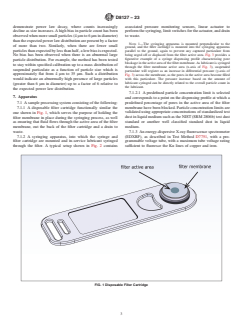
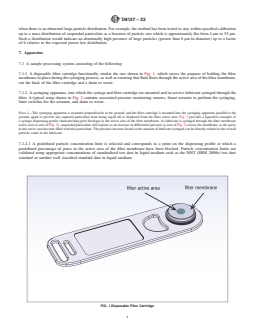
7.1.1 A disposable filter cartridge functionally similar the one shown in Fig. 1, which serves the purpose of holding the filter
membrane in place during the syringing process, as well as ensuring that fluid flows through the active area of the filter membrane,
out the back of the filter cartridge and a drain to waste.
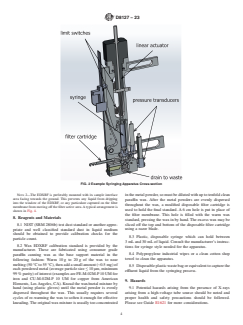
7.1.2 A syringing apparatus, into which the syringe and filter cartridge are mounted and in-service lubricant syringed through the
filter. A typical setup shown in Fig. 2 contains associated pressure monitoring sensors, linear actuator to perform the syringing,
limit switches for the actuator, and drain to waste.
NOTE 1—The syringing apparatus is mounted perpendicular to the ground, and the filter cartridge is mounted into the syringing apparatus parallel to the
ground, again to prevent any captured particulate from being urged off or displaced from the filter active area. Fig. 3 provides a figurative example of
a syringe dispensing profile characterizing pore blockage in the active area of the filter membrane. As lubricant is syringed through the filter membrane
active area (x-axis of Fig. 3), suspended particulate will register as an increase in differential pressure (y-axis of Fig. 3) across the membrane, as the pores
in the active area become filled with this particulate. The pressure increase based on the amount of lubricant syringed can be directly related to the overall
particle count in the lubricant.
7.1.2.1 A predefined particle concentration limit is selected and corresponds to a point on the dispensing profile at which a
predefined percentage of pores in the active area of the filter membrane have been blocked. Particle concentration limits are
validated using appropriate concentrations of standardized test dust in liquid medium such as the NIST (SRM 2806b) test dust
standard or another well classified
...