


ASTM E1879-22
(Guide)Standard Guide for Sensory Evaluation of Beverages Containing Alcohol
Standard Guide for Sensory Evaluation of Beverages Containing Alcohol
SIGNIFICANCE AND USE
4.1 This guide outlines considerations for selecting assessors who will evaluate alcoholic beverages and recommends procedures for the evaluation of specific alcoholic beverages.
4.2 This guide gives practical suggestions to maximize assessor safety and minimize the liabilities of the person or corporation responsible for administering sensory evaluations of alcoholic beverages, while recording assessors’ responses to those beverages using sound scientific principles.
4.3 This guide provides examples of informed consent forms for both Central Location Tests and Home Use Tests (see Appendix X2 – Appendix X4).
SCOPE
1.1 This guide provides guidelines specific to the sensory and consumer evaluation of alcoholic beverages, including but not limited to beer, wine, coolers, cocktails, ready to drinks, liqueurs, hard ciders, hard seltzers, and distilled spirits.
1.2 This guide covers assessor selection, sample preparation, serving protocols, and evaluation recommendations for specific alcoholic products.
1.3 This guide addresses safety, regulatory, and legal concerns, but does not cover all legal rules for alcohol and sensory evaluation around the world. It is the responsibility of the user to be aware of their current local laws and regulations, corporate policies and procedures, and confirm they haven’t changed since publication.
1.4 This guide does not cover the evaluation of raw materials or specific test methods.
1.5 This standard does not purport to address all of the safety concerns, if any, associated with its use. It is the responsibility of the user of this standard to establish appropriate safety, health, and environmental practices and determine the applicability of regulatory limitations prior to use.
1.6 This international standard was developed in accordance with internationally recognized principles on standardization established in the Decision on Principles for the Development of International Standards, Guides and Recommendations issued by the World Trade Organization Technical Barriers to Trade (TBT) Committee.
General Information
- Status
- Published
- Publication Date
- 28-Feb-2022
- Technical Committee
- E18 - Sensory Evaluation
- Drafting Committee
- E18.06 - Food and Beverage Evaluation
Relations
- Effective Date
- 15-Oct-2019
- Effective Date
- 01-Oct-2018
- Effective Date
- 15-Jun-2018
- Refers
ASTM E1871-17 - Standard Guide for Serving Protocol for Sensory Evaluation of Foods and Beverages - Effective Date
- 01-Sep-2017
- Effective Date
- 01-May-2017
- Effective Date
- 01-Jun-2016
- Effective Date
- 01-Dec-2015
- Effective Date
- 01-Jun-2015
- Effective Date
- 15-Jan-2015
- Effective Date
- 01-Nov-2013
- Effective Date
- 01-May-2013
- Effective Date
- 01-Nov-2012
- Effective Date
- 01-May-2012
- Effective Date
- 01-Dec-2011
- Effective Date
- 15-Apr-2011
Overview
ASTM E1879-22: Standard Guide for Sensory Evaluation of Beverages Containing Alcohol provides comprehensive guidelines on conducting sensory and consumer evaluations of alcoholic beverages. Developed by ASTM International, this standard outlines best practices for assessor selection, sample preparation, serving protocols, and evaluation procedures specific to alcohol-containing products. It addresses key safety, regulatory, and legal considerations to ensure both participant well-being and compliance with relevant laws. The guide is applicable to a wide range of alcoholic beverages, including beer, wine, coolers, cocktails, ready-to-drink options, liqueurs, hard ciders, hard seltzers, and distilled spirits.
Key Topics
Assessor Selection:
- Criteria for participation, such as legal drinking age verification
- Exclusion of individuals with contraindicated medical conditions or incompatible religious/moral beliefs
- Guidance to avoid involvement of habitual consumers or those using medications
Safety and Ethics:
- Informed consent forms for Central Location Tests and Home Use Tests
- Methods to maximize participant safety and minimize organizational liability
- Guidance on managing Blood Alcohol Concentration (BAC), serving volumes, and post-tasting waiting periods
Sample Preparation:
- Consistency in sample preparation, storage, and serving temperature across all sessions
- Recommendations for diluting high-proof spirits and using inert serving containers
- Handling carbonated and nitrogenated beverages to preserve product integrity
Serving Protocols:
- Appropriate serving volumes to control BAC and comply with local limits
- Use of pretested inert glassware or plasticware
- Maintaining appropriate serving temperatures for each beverage type
Evaluation Procedures:
- Palate cleanser usage and interstimulus interval recommendations
- Detailed sensory evaluation methods (visual, aroma, flavor, mouthfeel)
- Considerations for both trained and consumer assessors
Legal and Regulatory Compliance:
- Guidance on obtaining necessary permits and fulfilling labeling, shipping, and storage requirements
- Checklists for following alcohol service certifications and managing legal drinking age restrictions
Applications
Organizations in the alcoholic beverage industry, sensory science, product development, and quality control laboratories will benefit from implementing ASTM E1879-22. Typical applications include:
- Product Development: Conducting consistent consumer and expert tastings for new alcoholic beverages.
- Quality Control: Routine assessments to ensure product meeting specification and consumer expectations.
- Market Research: Structured sensory trials at central locations, bars, or participants’ homes to understand consumer preferences.
- Regulatory Compliance: Ensuring all sensory tests adhere to local, regional, and international regulations, including proper documentation and participant consent.
- Employee Training: Setting up in-house sensory panels with clear protocols for safety, liability, and accurate evaluations.
- Risk Management: Reducing potential health, legal, and ethical issues associated with alcohol consumption during sensory evaluations.
Related Standards
Those utilizing ASTM E1879-22 for sensory evaluation of alcoholic beverages may also find the following ASTM documents relevant:
- ASTM E253: Terminology Relating to Sensory Evaluation of Materials and Products
- ASTM E1871: Guide for Serving Protocol for Sensory Evaluation of Foods and Beverages
Additional best practices and protocols may be referenced in ASTM manuals MNL26 and STP758, as well as relevant governmental agency guidelines for alcohol control and public safety.
Keywords: ASTM E1879-22, sensory evaluation, alcoholic beverages, assessor selection, consumer testing, BAC, serving temperature, serving volume, informed consent, regulatory compliance, beverage safety, sensory protocol, product testing, alcohol standards.
Buy Documents
ASTM E1879-22 - Standard Guide for Sensory Evaluation of Beverages Containing Alcohol
REDLINE ASTM E1879-22 - Standard Guide for Sensory Evaluation of Beverages Containing Alcohol
Get Certified
Connect with accredited certification bodies for this standard

BSI Group
BSI (British Standards Institution) is the business standards company that helps organizations make excellence a habit.

Bureau Veritas
Bureau Veritas is a world leader in laboratory testing, inspection and certification services.

DNV
DNV is an independent assurance and risk management provider.
Sponsored listings
Frequently Asked Questions
ASTM E1879-22 is a guide published by ASTM International. Its full title is "Standard Guide for Sensory Evaluation of Beverages Containing Alcohol". This standard covers: SIGNIFICANCE AND USE 4.1 This guide outlines considerations for selecting assessors who will evaluate alcoholic beverages and recommends procedures for the evaluation of specific alcoholic beverages. 4.2 This guide gives practical suggestions to maximize assessor safety and minimize the liabilities of the person or corporation responsible for administering sensory evaluations of alcoholic beverages, while recording assessors’ responses to those beverages using sound scientific principles. 4.3 This guide provides examples of informed consent forms for both Central Location Tests and Home Use Tests (see Appendix X2 – Appendix X4). SCOPE 1.1 This guide provides guidelines specific to the sensory and consumer evaluation of alcoholic beverages, including but not limited to beer, wine, coolers, cocktails, ready to drinks, liqueurs, hard ciders, hard seltzers, and distilled spirits. 1.2 This guide covers assessor selection, sample preparation, serving protocols, and evaluation recommendations for specific alcoholic products. 1.3 This guide addresses safety, regulatory, and legal concerns, but does not cover all legal rules for alcohol and sensory evaluation around the world. It is the responsibility of the user to be aware of their current local laws and regulations, corporate policies and procedures, and confirm they haven’t changed since publication. 1.4 This guide does not cover the evaluation of raw materials or specific test methods. 1.5 This standard does not purport to address all of the safety concerns, if any, associated with its use. It is the responsibility of the user of this standard to establish appropriate safety, health, and environmental practices and determine the applicability of regulatory limitations prior to use. 1.6 This international standard was developed in accordance with internationally recognized principles on standardization established in the Decision on Principles for the Development of International Standards, Guides and Recommendations issued by the World Trade Organization Technical Barriers to Trade (TBT) Committee.
SIGNIFICANCE AND USE 4.1 This guide outlines considerations for selecting assessors who will evaluate alcoholic beverages and recommends procedures for the evaluation of specific alcoholic beverages. 4.2 This guide gives practical suggestions to maximize assessor safety and minimize the liabilities of the person or corporation responsible for administering sensory evaluations of alcoholic beverages, while recording assessors’ responses to those beverages using sound scientific principles. 4.3 This guide provides examples of informed consent forms for both Central Location Tests and Home Use Tests (see Appendix X2 – Appendix X4). SCOPE 1.1 This guide provides guidelines specific to the sensory and consumer evaluation of alcoholic beverages, including but not limited to beer, wine, coolers, cocktails, ready to drinks, liqueurs, hard ciders, hard seltzers, and distilled spirits. 1.2 This guide covers assessor selection, sample preparation, serving protocols, and evaluation recommendations for specific alcoholic products. 1.3 This guide addresses safety, regulatory, and legal concerns, but does not cover all legal rules for alcohol and sensory evaluation around the world. It is the responsibility of the user to be aware of their current local laws and regulations, corporate policies and procedures, and confirm they haven’t changed since publication. 1.4 This guide does not cover the evaluation of raw materials or specific test methods. 1.5 This standard does not purport to address all of the safety concerns, if any, associated with its use. It is the responsibility of the user of this standard to establish appropriate safety, health, and environmental practices and determine the applicability of regulatory limitations prior to use. 1.6 This international standard was developed in accordance with internationally recognized principles on standardization established in the Decision on Principles for the Development of International Standards, Guides and Recommendations issued by the World Trade Organization Technical Barriers to Trade (TBT) Committee.
ASTM E1879-22 is classified under the following ICS (International Classification for Standards) categories: 67.160.10 - Alcoholic beverages. The ICS classification helps identify the subject area and facilitates finding related standards.
ASTM E1879-22 has the following relationships with other standards: It is inter standard links to ASTM E253-19, ASTM E253-18a, ASTM E253-18, ASTM E1871-17, ASTM E253-17, ASTM E253-16, ASTM E253-15b, ASTM E253-15a, ASTM E253-15, ASTM E253-13a, ASTM E253-13, ASTM E253-12a, ASTM E253-12, ASTM E253-11a, ASTM E253-11. Understanding these relationships helps ensure you are using the most current and applicable version of the standard.
ASTM E1879-22 is available in PDF format for immediate download after purchase. The document can be added to your cart and obtained through the secure checkout process. Digital delivery ensures instant access to the complete standard document.
Standards Content (Sample)
This international standard was developed in accordance with internationally recognized principles on standardization established in the Decision on Principles for the
Development of International Standards, Guides and Recommendations issued by the World Trade Organization Technical Barriers to Trade (TBT) Committee.
Designation: E1879 − 22
Standard Guide for
Sensory Evaluation of Beverages Containing Alcohol
This standard is issued under the fixed designation E1879; the number immediately following the designation indicates the year of
original adoption or, in the case of revision, the year of last revision. A number in parentheses indicates the year of last reapproval. A
superscript epsilon (´) indicates an editorial change since the last revision or reapproval.
1. Scope E1871 Guide for Serving Protocol for Sensory Evaluation of
Foods and Beverages
1.1 This guide provides guidelines specific to the sensory
and consumer evaluation of alcoholic beverages, including but
3. Terminology
not limited to beer, wine, coolers, cocktails, ready to drinks,
liqueurs, hard ciders, hard seltzers, and distilled spirits.
3.1 For definitions of terms relating to this standard, see
Terminology E253.
1.2 This guide covers assessor selection, sample
preparation, serving protocols, and evaluation recommenda-
4. Significance and Use
tions for specific alcoholic products.
1.3 This guide addresses safety, regulatory, and legal 4.1 This guide outlines considerations for selecting asses-
concerns, but does not cover all legal rules for alcohol and
sors who will evaluate alcoholic beverages and recommends
sensory evaluation around the world. It is the responsibility of procedures for the evaluation of specific alcoholic beverages.
the user to be aware of their current local laws and regulations,
4.2 This guide gives practical suggestions to maximize
corporate policies and procedures, and confirm they haven’t
assessor safety and minimize the liabilities of the person or
changed since publication.
corporation responsible for administering sensory evaluations
1.4 This guide does not cover the evaluation of raw mate-
of alcoholic beverages, while recording assessors’responses to
rials or specific test methods.
those beverages using sound scientific principles.
1.5 This standard does not purport to address all of the
4.3 This guide provides examples of informed consent
safety concerns, if any, associated with its use. It is the
formsforbothCentralLocationTestsandHomeUseTests(see
responsibility of the user of this standard to establish appro-
Appendix X2 – Appendix X4).
priate safety, health, and environmental practices and deter-
mine the applicability of regulatory limitations prior to use.
5. Safety
1.6 This international standard was developed in accor-
dance with internationally recognized principles on standard- 5.1 MedicalCondition—Potential assessors must be in good
ization established in the Decision on Principles for the medical condition with no serious health problems. Inform
Development of International Standards, Guides and Recom- them that they should not participate on panels if they are
mendations issued by the World Trade Organization Technical taking prescription or over-the-counter medications that are
Barriers to Trade (TBT) Committee. contraindicated when combined with alcohol. It is recom-
mendedthatwomenwhoarepregnant,maybepregnant,trying
2. Referenced Documents to become pregnant, or nursing should not participate. Recruit-
2 ing should be conducted in such a way to ensure that those not
2.1 ASTM Standards:
meeting these medical requirements are excluded from partici-
E253 Terminology Relating to Sensory Evaluation of Mate-
pation.
rials and Products
5.2 A sufficient waiting period should be arranged before
assessorsareallowedtodriveoroperateheavymachineryafter
sampling test product(s).
This guide is under the jurisdiction of ASTM Committee E18 on Sensory
Evaluation and is the direct responsibility of Subcommittee E18.06 on Food and
5.3 All products should be stored in a place where they are
Beverage Evaluation.
Current edition approved March 1, 2022. Published March 2022. Originally
only accessible to individuals of legal drinking age.
approved in 1997. Last previous edition approved in 2021 as E1879 – 21. DOI:
10.1520/E1879-22. 5.4 Recommended Serving Volumes:
For referenced ASTM standards, visit the ASTM website, www.astm.org, or
5.4.1 Alcohol is measured in units of standard drinks.
contact ASTM Customer Service at service@astm.org. For Annual Book of ASTM
However, the amount of alcohol in a standard drink differs
Standards volume information, refer to the standard’s Document Summary page on
the ASTM website. betweencountries,socautionshouldbetakenifsensorytesting
Copyright © ASTM International, 100 Barr Harbor Drive, PO Box C700, West Conshohocken, PA 19428-2959. United States
E1879 − 22
is being conducted across different countries (1, 2). It is 5.4.5 If possible, sensory testing should occur earlier in the
easiest to convert between different countries’ standard drinks day to allow a waiting period if assessors are driving after
using grams (3). See Table 1 for examples of standard drink testing and need time for their BAC to reduce.
amounts from six different countries.
5.4.5.1 After drinking ceases, the BAC increases for a short
5.4.2 Standard drink equivalents are a unit of measurement
amount of time, then it slowly decreases at a rate of approxi-
frequently used to help consumers more easily understand the
mately 0.015 to 0.02 % per hour (see Table 4) (7, 8).
units of alcohol consumed. In the United States the standard
(1) Example: a 150 lb female consumes two drinks result-
drink of 14 grams of alcohol is 355 mL(12 oz) of 5 % beer, or
ing in a BAC of approximately 0.068 %. At the most
148 mL (5 oz) of 12 % wine, or 44 mL (1.5 oz) of 40 %
conservative elimination rate of 0.015 %, it will take 4.5 hours
distilled spirit (4). For several countries, the standard drink
after the drinking session for her BAC to go from ~0.068 to
amount and the equivalent standard drink in the United States
~0.0%.Tobedeemed‘sober,’BACisrequiredtobeat0.0and
can be found in Refs. (3) and (5); examples for six countries
legallevelsofBACforoperatingavehiclevarybycountryand
are given in Table 1 (3, 5).
locale and can be as low as 0.0.
5.4.3 Limit the sample volume for evaluation to an amount
5.4.5.2 In cases when a waiting time is not attainable, or in
whichwillensuretherespondentwillnothaveaBloodAlcohol
locations where no amount of alcohol is deemed acceptable for
Concentration (BAC) greater than the legal limit in the testing
driving, public transportation, a taxi, or a designated driver
locale.
should be arranged.
5.4.3.1 BAC levels are either reported as the mass of
5.4.5.3 Consideration should also be given to how much
alcohol per volume of blood (for example, United States,
alcohol may cause impairment, even if an assessor’s BAC is
France, and Poland) or the mass of alcohol by mass of blood
below the legal limit. Some individuals are more sensitive to
(for example, Norway and Russia). It is important to under-
the effects of alcohol and so both BAC and impairment limits
stand the units of BAC and know the BAC legal limit in
should be considered when serving samples.
countries, and regions within those countries, in which a
5.4.6 If there are concerns about assessors’ BAC before or
sensory study is being conducted (6).
after consuming products, their BAC may be measured, for
5.4.3.2 Tables2and3indicatehowtocalculatetheBACfor
example, with a breathalyzer.
males and females, respectively, based on the person’s weight
5.5 When using employees as assessors, special consider-
and number of drinks consumed (7). It can be used to calculate
ation must be taken when their work involves the operation of
the number of samples that can be served to assessors during a
equipment or any work task that can jeopardize the safety of
testing session.
others. Either do not allow these employees to be assessors or
5.4.4 Recommended serving volumes based on alcohol
arrange with employee management “waiting times” after
content can be calculated using the formula:
product evaluation before these employees can resume work
SA2 3SV2
SV1 5 (1) involving these safety-related work activities.
SA1
5.5.1 Considerservingfewersamplessotheassessor’sBAC
where:
is less that the legal limit if they drink alcohol every day as a
function of their work.
SA1 = sample alcohol content,
SV1 = total volume to be given to assessors = unknown,
5.6 Safety Data Sheets (SDS) for ethanol should be stored
SA2 = “standard drink” alcohol content, and
on the study site premises and made available upon request to
SV2 = “standard drink” volume.
participants. Additionally, SDS should be available for com-
NOTE 1—See Appendix X1 for further explanation and worked ex-
pounds used as reference standards or for sensory training.
amples using the formula.
5.4.4.1 If sample volume would result in a BAC above the 5.7 Additional resources specific to understanding the ef-
legal limit, testing should occur over multiple days. fects of age, weight, gender, and food consumption on rate of
5.4.4.2 Assessorsshouldnothaveconsumedalcoholtheday BAC change over time can be found in Ref. (9).
on which they are participating in a sensory test containing
alcoholic beverages. 6. Regulatory and Legal Liability
6.1 Investigate and meet country, state/provincial, and local
regulations whenever studies on alcoholic beverages are to be
The boldface numbers in parentheses refer to the list of references at the end of
conducted. Note that the type of alcoholic beverage (beer/malt,
this standard.
wine, or spirit) may influence the regulatory requirements or
the government agency that has jurisdiction.
TABLE 1 Grams Alcohol in Standard Drink for Six Countries
Standard Drink Amount
6.2 Look for regulatory information through government
Country
(g of Alcohol)
agencies. Some examples include:
Australia 10
6.2.1 Australia—Food Standards Australia New Zealand,
Chile 14
France 12 Australian Taxation Office (ATO) (10, 11).
Japan 19.75
6.2.2 Chile—Servicio Agrícola y Ganadero (SAG) (12).
South Africa 11.5
6.2.3 France—Republique Francaise Service-Public (13).
United States 14
6.2.4 Japan—National Tax Agency (14).
E1879 − 22
TABLE 2 Blood Alcohol Concentration (BAC, %) Chart for Males
A
Number of Standard USA Drinks Consumed
Weight(lb) 123456789 10
100 .043 .087 .130 .174 .217 .261 .304 .348 .391 .435
125 .034 .069 .103 .139 .173 .209 .242 .278 .312 .346
150 .029 .058 .087 .116 .145 .174 .203 .232 .261 .290
175 .025 .050 .075 .100 .125 .150 .175 .200 .225 .250
200 .022 .043 .065 .087 .108 .130 .152 .174 .195 .217
225 .019 .039 .058 .078 .097 .117 .136 .156 .175 .195
250 .017 .035 .052 .070 .087 .105 .122 .139 .156 .17
A
One standard USA drink of 14 grams of alcohol is 355 mL (12 oz) of 5 % beer, or 148 mL (5 oz) of 12 % wine, or 44 mL (1.5 oz) of 40 % distilled spirit.
TABLE 3 Blood Alcohol Concentration (BAC, %) Chart for Females
A
Number of Standard USA Drinks Consumed
Weight(lb) 123456789 10
100 0.05 0.101 0.152 0.203 0.253 .304 .355 0.406 .456 .507
125 0.04 0.08 .120 0.162 0.202 0.244 0.282 .324 .364 .404
150 0.034 0.068 0.101 0.135 0.169 0.203 0.237 .271 .304 .338
175 0.029 0.058 0.087 0.117 0.146 0.175 0.204 .233 .262 .292
200 0.026 0.05 0.076 0.101 0.126 0.152 0.177 .203 0.227 .253
225 0.022 0.045 0.068 0.091 0.113 0.136 0.159 .182 .204 0.227
250 0.02 0.041 0.061 0.082 0.101 .122 0.142 .162 .182 .2
A
One standard USA drink of 14 grams of alcohol is 355 mL (12 oz) of 5 % beer, or 148 mL (5 oz) of 12 % wine, or 44 mL (1.5 oz) of 40 % distilled spirit.
TABLE 4 Amount of Time to Reduce BAC (mg of alcohol per 100 mL of blood)
Hours since first drink 123456
Subtract from BAC .015 .030 .045 .060 .075 .09
6.2.5 South Africa: Department of Agriculture, Land 6.3.9 Serving food, which may be required in some loca-
Reform, and Rural Development (15). tions but prohibited in others.
6.2.6 United States—Federal Tax and Trade Bureau (TTB), 6.3.10 Travel of assessors, may require a designated driver
state/local Alcohol Beverage Commissions (ABCs), Food and or that assessors take a breathalyzer before, after or both for
Drug Administration (FDA), and Occupational Safety and participation.
Health Administration (OSHA) (16-18). 6.3.11 Disposing of unused packages.
6.2.7 Samples for testing should be processed in such a way
6.4 Research and meet requirements on types of testing
as to ensure taxes are being paid properly.
allowed which may also vary among locales in which testing is
6.3 Research and meet regulations for all aspects related to
beingconducted.Eachofthesemaybeallowedwithorwithout
the sensory testing of alcoholic beverages, including: compensation:
6.3.1 Obtaining permits and filling required documents.
6.4.1 Testing with consumers at a market research or
6.3.2 Preparing facility, such as posting government warn-
sensory product testing facility.
ings for the consumption of alcoholic beverages on test
6.4.2 Testing with consumers at a bar.
premises.
6.4.3 Testing with consumers in their home.
6.3.3 Labeling of products. Some examples include manda-
6.4.4 Testing using employees.
torydisclosuresonpackaging,labellingeachproductcontainer
6.4.5 Testing using trained panelists.
individually, or applying a “not for resale” label for Home Use
6.4.6 Testing with bartenders.
Testing products.
6.5 Ethical review boards may be considered or required for
6.3.4 Shipping and handling of samples including customs
example, Internal Review Board in the United States or a
clearance if product is being shipped between regions or
company’s legal department.
internationally.
6.3.5 Product procurement, such as any requirements that 6.6 There is a risk of legal liability whenever alcoholic
beverages are tested. To minimize these risks, it is recom-
products must be purchased in the same regulatory jurisdiction
(forexample,productmustbepurchasedinthestatethatitwill mended that a consent form be used for each product evalua-
tion session or test. These may be required in some locales.
be tested), and if prototypes can be tested or not.
6.3.6 Receiving product. Below is the information that should be in the consent form.
Examples are provided in Appendix X2 – Appendix X4.
6.3.7 Storing product.
6.3.8 Serving product: 6.6.1 Describe the nature of the study. For example, the
6.3.8.1 Alcohol serving certifications or use of a certified sentence, “You may or may not be served beverages that
bartender may be required for those serving alcohol. contain alcohol,” can be used to obtain informed consent.
E1879 − 22
6.6.2 Outline the time period over which testing will be (3)France—18 years old.
conducted. (4)Japan—20 years old.
6.6.3 Include all legally required alcohol warning informa- (5)South Africa—18 years old.
tion. (6)United States—21 years old.
6.6.4 Indicate that for the candidate to participate in the 7.2.1.3 For consumer or affective testing, ensure the time
study they must be in good health and are willing to participate frame of past consumption or purchase behavior only includes
as evidenced by the signing of the informed consent form. time in which the consumers were of legal drinking age.
6.6.5 Indicate that participants may be excluded from the 7.2.2 Drinking Habits—Product abuse is a criterion for
study for specific reasons including pregnancy, taking pre- exclusion for all alcoholic beverage tests. Additionally, asses-
scribed medications, current illnesses, and alcohol abuse. sors should arrive for testing having not had any alcoholic
Furthermore, indicate that if any of the exclusion circum- beverages the day of the sensory testing. Test administrators
stances arises during the course of the study it is the partici- should look for behavioral cues such as lowered inhibitions,
pant’s responsibility to bring it to the organizer’s attention. impaired judgement, slowed reactions, and loss of coordina-
This is particularly important for long-term studies, where tion.
periodic reviewing and signing of consent forms may be 7.2.3 Religious and Moral Considerations—Do not use
individuals if drinking alcoholic beverages interfere with or
necessary.
6.6.6 Under certain circumstances, include a list of ingredi- contradicts their religious or moral beliefs.
ents on the consent form mentioning all the products to be
tested as per local regulatory regulations, for example level or 8. Sample Preparation
range of alcohol, caffeine, aspartame, capsicum, sulfites, or
8.1 All test conditions and serving procedures are deter-
specific allergens.
mined by the test objective, test method, test design, and
6.6.7 Include statements indicating participants can be re-
decision risk. For example, consumer studies may require
moved from the study without consent at any time. Statements
preparing samples as they are typically consumed, whereas a
shouldalsobeincludedindicatingtheparticipantcanwithdraw
Quality Control based study may require samples be diluted to
at any time without consequences.
a specific amount.
6.6.8 Each participant is required to provide appropriate
8.1.1 Conditions and procedures should remain consistent
validation of legal age to consume alcoholic beverages. If legal
across testing whenever possible for comparison.
drinking age and legal purchase age are different in a particular
8.1.2 Pretest—A practice session may be conducted with a
locale, the higher should always be selected. Record this
few staff members or assessors to determine if the selected
validationontheconsentform.Notethatlawsconcerninglegal
preparation methods are appropriate for the purposes of the
drinking age vary by country and may vary within a country.
test.
6.6.9 Upon completion of reading the consent form, ensure
8.1.3 Product Variability—Variability exists in all products.
that the participant understands the form and has no questions.
How product variability is handled depends on the objective of
After being allowed ample time to review the contents of the
the test, the size of the effect one is attempting to measure, and
consent form, the participant must sign and date the consent
the risks associated with decision-making. Unless the test is
form in the presence of a witness.
designedtounderstandtheextentofproductvariability,thetest
variables should be controlled to minimize variation of the
7. Assessor Selection
stimuli to which each assessor is exposed. Variability should,
however, not be minimized to the extent where the sample is
7.1 Consider safety, regulatory, and liability issues as dis-
cussed in Sections 5 and 6 when selecting participants specifi- not representative of the typical variability found in the
product. See Guide E1871 for more.
callyforalcoholicbeveragetesting.Forgeneralinformationon
assessor selection criteria, consultASTMMNL26 andSTP758
8.2 Product age should be consistent among all samples and
(19, 20).
as fresh as possible unless this conflicts with the purpose of the
7.2 Special Considerations on Selection Criteria: study.
7.2.1 Age—All assessors must be of legal drinking age.
8.3 Consider a product’s exposure to the environment.
Confirm their age by using government-issued photo identifi-
Sunlight, indoor lighting, air ingress, temperature, contact
cationcards,suchasadriver’slicense,passport,orotherphoto
vibrations, and so forth can affect the physical and sensory
identification listing the assessor’s date of birth.
nature of a product.
7.2.1.1 In some countries, legal drinking age and legal
8.4 All storage containers should be inert. Further material
purchase age for alcoholic beverages may be different. The
considerations should be made based on the type of product.
higher of the two should be used.
7.2.1.2 A table of legal drinking ages around the world can 8.5 For carbonated beverages, pretest to determine appro-
be found on the website for the International Alliance for priate preparation and storage to avoid loss of carbonation.
Responsible Drinking (21). Some examples of ages in which Ideally a new package will be opened after a pre-determined
persons can freely (that is, not in the presence of a consenting set of time or an unopened or newly opened package is served
adult) consume and buy alcohol include: directly to the assessor. It is not recommended to combine
(1)Australia—18 years old. smaller package types into a larger one (for example, several
(2)Chile—18 years old. cans into a pitcher) as the carbonation will decrease more
E1879 − 22
quickly.Ifitisnecessarytocombinesmallercontainers,ensure 8.10.5 Provide detailed instructions to the assessor for
the larger container has a tight-fitting lid that will not allow storing and consuming products, including storage away from
CO to escape. those under legal drinking age.
8.10.6 If empty sample containers or unused product must
8.5.1 Similar procedures should be conducted for nitroge-
be returned to the sensory professional, provide instructions to
nated beverages.
the assessor detailing how to return them (for example,
8.6 For beverages stored and served at hot or cold
shipping or dropping off at a specified location).
temperatures, consider how to maintain appropriate tempera-
ture. Insulated flasks or carafes are recommended for hot
9. Serving Protocol
beverages to avoid imparting a “cooked” aroma, though hot
9.1 The assessor serving container should reflect the nature
plates or a hot water bath could also be used. For cold
of the study. For example, quality control studies may use
beverages, a refrigerator is recommended but an ice bath could
smaller containers, whereas consumer studies may use larger
also be used if the temperature can be regulated. Temperature
containers or have consumers drink directly from the package
measurements should be taken throughout testing and holding
as they might do for a canned beer.
of samples to ensure consistency in served product tempera-
ture.
9.2 If assessors will drink directly from the package, ensure
the package is clean prior to serving.
8.7 For room temperature products, ensure the room tem-
perature is not fluctuating between and within testing days.
9.3 If serving containers are being used instead of the
package itself, several aspects should be considered.
8.8 Dilution may be chosen for distilled spirits due to high
9.3.1 Assessor serving containers should be inert and odor-
proof; however, this dilution can affect the sensory properties
less. Glass is recommended but should be checked frequently
in some products.
and discarded if cracks or scratches are found as they can
8.8.1 Dilution amount should be determined according to
create a safety hazard and impart an odor. Plastic may also be
thepercentalcoholintheproductandshouldremainconsistent
used but should be pretested to confirm it is inert and odorless.
throughout testing.
9.3.2 Consider what shape and size of serving container
8.8.2 Dilute products with liquid that will impart minimal
would best suit the product category and the testing goals.
flavor, such as spring water, distilled water, or demineralized
9.3.3 For cleaning serving ware, if the product to be tested
water. Diluents should be pre-screened to ensure they do not
hasfoam(forexample,beer)consideremployingasterilization
contribute flavors. Consider combining water containers into a
step instead of detergent cleaner. If not properly rinsed,
common lot to minimize variability.
detergents can harm foam formation and stability.
8.9 Alcoholic products used with mixers can be presented
9.3.4 Consider the opacity of the serving container; some
straight or with the mixer (such as juice, cola or tonic water).
studies may want to prevent the assessor from viewing the
When a mixer is used, it is recommended to prepare a master
product and others may desire a visual evaluation through a
batch of the mixer or common lot purchased for the entire
transparent container.
study (best when mixer is carbonated, for example, cola or
9.3.5 Covers may be used to aid in aroma evaluation of the
tonic water). If this is not possible, the mixer should be
headspace if appropriate for the study, such as for quality
screened before use for flavor consistency and stability
control or descriptive analysis. It is not recommended to use
throughout the study.
coversforconsumerstudiesinordertobettermimicreal-world
evaluation scenarios.
8.10 Home UseTests (HUT) require different preparation to
ensure assessor instructions for receiving and consuming the
9.4 Beveragesshouldbeservedatatemperatureappropriate
product are as clear as possible.
for the product and test design. See Table 5 for guidelines on
8.10.1 Consider how samples will be received by the common alcoholic products, though pretesting to confirm
assessor. For example, samples may be picked up by the
serving temperature is recommended.Temperature consistency
assessor at a central location, delivered by the sensory between products of a similar style is more important than
professional, or shipped directly to the assessor.
achieving the exact recommended temperature.
9.4.1 Pretesting should be conducted to determine how long
8.10.2 If samples are being picked up by the assessor,
ensure the instructions to place the product out of any person’s a product may be in an assessor’s glass before the temperature
change is unacceptable. Alternatively, assessors may be asked
reach in the vehicle and inform the assessor it should not be
opened until they arrive home. to measure the temperature of their samples before they
consume them to ensure they are at the proper se
...
This document is not an ASTM standard and is intended only to provide the user of an ASTM standard an indication of what changes have been made to the previous version. Because
it may not be technically possible to adequately depict all changes accurately, ASTM recommends that users consult prior editions as appropriate. In all cases only the current version
of the standard as published by ASTM is to be considered the official document.
Designation: E1879 − 21 E1879 − 22
Standard Guide for
Sensory Evaluation of Beverages Containing Alcohol
This standard is issued under the fixed designation E1879; the number immediately following the designation indicates the year of
original adoption or, in the case of revision, the year of last revision. A number in parentheses indicates the year of last reapproval. A
superscript epsilon (´) indicates an editorial change since the last revision or reapproval.
1. Scope
1.1 This guide provides guidelines specific to the sensory and consumer evaluation of alcoholic beverages, including but not
limited to beer, wine, coolers, cocktails, ready to drinks, liqueurs, hard ciders, hard seltzers, and distilled spirits.
1.2 This guide covers assessor selection, sample preparation, serving protocols, and evaluation recommendations for specific
alcoholic products.
1.3 This guide addresses safety, regulatory, and legal concerns, but does not cover all legal rules for alcohol and sensory evaluation
around the world. It is the responsibility of the user to be aware of their current local laws and regulations, corporate policies and
procedures, and confirm they haven’t changed since publication.
1.4 This guide does not cover the evaluation of raw materials or specific test methods.
1.5 This standard does not purport to address all of the safety concerns, if any, associated with its use. It is the responsibility
of the user of this standard to establish appropriate safety, health, and environmental practices and determine the applicability of
regulatory limitations prior to use.
1.6 This international standard was developed in accordance with internationally recognized principles on standardization
established in the Decision on Principles for the Development of International Standards, Guides and Recommendations issued
by the World Trade Organization Technical Barriers to Trade (TBT) Committee.
2. Referenced Documents
2.1 ASTM Standards:
E253 Terminology Relating to Sensory Evaluation of Materials and Products
E1871 Guide for Serving Protocol for Sensory Evaluation of Foods and Beverages
3. Terminology
3.1 For definitions of terms relating to this standard, see Terminology E253.
This guide is under the jurisdiction of ASTM Committee E18 on Sensory Evaluation and is the direct responsibility of Subcommittee E18.06 on Food and Beverage
Evaluation.
Current edition approved Sept. 1, 2021March 1, 2022. Published November 2021March 2022. Originally approved in 1997. Last previous edition approved in 20202021
as E1879 – 20.E1879 – 21. DOI: 10.1520/E1879-21.10.1520/E1879-22.
For referenced ASTM standards, visit the ASTM website, www.astm.org, or contact ASTM Customer Service at service@astm.org. For Annual Book of ASTM Standards
volume information, refer to the standard’s Document Summary page on the ASTM website.
Copyright © ASTM International, 100 Barr Harbor Drive, PO Box C700, West Conshohocken, PA 19428-2959. United States
E1879 − 22
4. Significance and Use
4.1 This guide outlines considerations for selecting assessors who will evaluate alcoholic beverages and recommends procedures
for the evaluation of specific alcoholic beverages.
4.2 This guide gives practical suggestions to maximize assessor safety and minimize the liabilities of the person or corporation
responsible for administering sensory evaluations of alcoholic beverages. beverages, while recording assessors’ responses to those
beverages using sound scientific principles.
4.3 This guide provides examples of informed consent forms for both Central Location Tests and Home Use Tests (see Appendix
X2 – Appendix X4).
5. Safety
5.1 Medical Condition—Potential assessors must be in good medical condition with no serious health problems. Inform them that
they should not participate on panels if they are taking prescription or over-the-counter medications that are contraindicated when
combined with alcohol. It is recommended that women who are pregnant, may be pregnant, trying to become pregnant, or nursing
should not participate. Recruiting should be conducted in such a way to ensure that those not meeting these medical requirements
are excluded from participation.
5.2 A sufficient waiting period should be arranged before assessors are allowed to drive or operate heavy machinery after sampling
test product(s).
5.3 All products should be stored in a place where they are only accessible to individuals of legal drinking age.
5.4 Recommended Serving Volumes:
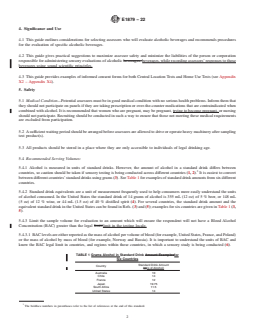
5.4.1 Alcohol is measured in units of standard drinks. However, the amount of alcohol in a standard drink differs between
countries, so caution should be taken if sensory testing is being conducted across different countries (1, 2). It is easiest to convert
between different countries’ standard drinks using grams (3). See Table 1 for examples of standard drink amounts from six different
countries.
5.4.2 Standard drink equivalents are a unit of measurement frequently used to help consumers more easily understand the units
of alcohol consumed. In the United States the standard drink of 14 grams of alcohol is 355 mL (12 oz) of 5 % beer, or 148 mL
(5 oz) of 12 % wine, or 44 mL (1.5 oz) of 40 % distilled spirit (4). For several countries, the standard drink amount and the
equivalent standard drink in the United States can be found in Refs. (3) and (5); examples for six countries are given in Table 1 (3,
5).
5.4.3 Limit the sample volume for evaluation to an amount which will ensure the respondent will not have a Blood Alcohol
Concentration (BAC) greater than the legal limit.limit in the testing locale.
5.4.3.1 BAC levels are either reported as the mass of alcohol per volume of blood (for example, United States, France, and Poland)
or the mass of alcohol by mass of blood (for example, Norway and Russia). It is important to understand the units of BAC and
know the BAC legal limit in countries, and regions within those countries, in which a sensory study is being conducted (6).
TABLE 1 Grams Alcohol in Standard Drink Amount Examplesfor
Six Countries
Standard Drink Amount
Country
(g)(g of Alcohol)
Australia 10
Chile 14
France 12
Japan 19.75
South Africa 11.5
United States 14
The boldface numbers in parentheses refer to the list of references at the end of this standard.
E1879 − 22
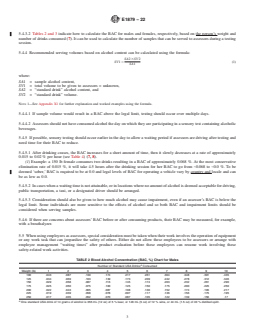
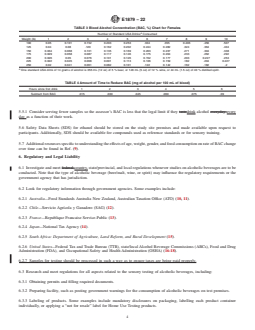
5.4.3.2 Tables 2 and 3 indicate how to calculate the BAC for males and females, respectively, based on the person’s weight and
number of drinks consumed (7). It can be used to calculate the number of samples that can be served to assessors during a testing
session.
5.4.4 Recommended serving volumes based on alcohol content can be calculated using the formula:
SA23SV2
SV15 (1)
SA1
where:
SA1 = sample alcohol content,
SV1 = total volume to be given to assessors = unknown,
SA2 = “standard drink” alcohol content, and
SV2 = “standard drink” volume.
NOTE 1—See Appendix X1 for further explanation and worked examples using the formula.
5.4.4.1 If sample volume would result in a BAC above the legal limit, testing should occur over multiple days.
5.4.4.2 Assessors should not have consumed alcohol the day on which they are participating in a sensory test containing alcoholic
beverages.
5.4.5 If possible, sensory testing should occur earlier in the day to allow a waiting period if assessors are driving after testing and
need time for their BAC to reduce.
5.4.5.1 After drinking ceases, the BAC increases for a short amount of time, then it slowly decreases at a rate of approximately
0.015 to 0.02 % per hour (see Table 4) (7, 8).
(1) Example: a 150 lb female consumes two drinks resulting in a BAC of approximately 0.068 %. At the most conservative
elimination rate of 0.015 %, it will take 4.5 hours after the drinking session for her BAC to go from ~0.068 to ~0.0 %. To be
deemed ‘sober,’ BAC is required to be at 0.0 and legal levels of BAC for operating a vehicle vary by country and locale and can
be as low as 0.0.
5.4.5.2 In cases when a waiting time is not attainable, or in locations where no amount of alcohol is deemed acceptable for driving,
public transportation, a taxi, or a designated driver should be arranged.
5.4.5.3 Consideration should also be given to how much alcohol may cause impairment, even if an assessor’s BAC is below the
legal limit. Some individuals are more sensitive to the effects of alcohol and so both BAC and impairment limits should be
considered when serving samples.
5.4.6 If there are concerns about assessors’ BAC before or after consuming products, their BAC may be measured, for example,
with a breathalyzer.
5.5 When using employees as assessors, special consideration must be taken when their work involves the operation of equipment
or any work task that can jeopardize the safety of others. Either do not allow these employees to be assessors or arrange with
employee management “waiting times” after product evaluation before these employees can resume work involving these
safety-related work activities.
TABLE 2 Blood Alcohol Concentration (BAC, %) Chart for Males
A
Number of Standard USA Drinks Consumed
Weight (lb) 1 2 3 4 5 6 7 8 9 10
100 .043 .087 .130 .174 .217 .261 .304 .348 .391 .435
125 .034 .069 .103 .139 .173 .209 .242 .278 .312 .346
150 .029 .058 .087 .116 .145 .174 .203 .232 .261 .290
175 .025 .050 .075 .100 .125 .150 .175 .200 .225 .250
200 .022 .043 .065 .087 .108 .130 .152 .174 .195 .217
225 .019 .039 .058 .078 .097 .117 .136 .156 .175 .195
250 .017 .035 .052 .070 .087 .105 .122 .139 .156 .17
A
One standard USA drink of 14 grams of alcohol is 355 mL (12 oz) of 5 % beer, or 148 mL (5 oz) of 12 % wine, or 44 mL (1.5 oz) of 40 % distilled spirit.
E1879 − 22
TABLE 3 Blood Alcohol Concentration (BAC, %) Chart for Females
A
Number of Standard USA Drinks Consumed
Weight (lb) 1 2 3 4 5 6 7 8 9 10
100 0.05 0.101 0.152 0.203 0.253 .304 .355 0.406 .456 .507
125 0.04 0.08 .120 0.162 0.202 0.244 0.282 .324 .364 .404
150 0.034 0.068 0.101 0.135 0.169 0.203 0.237 .271 .304 .338
175 0.029 0.058 0.087 0.117 0.146 0.175 0.204 .233 .262 .292
200 0.026 0.05 0.076 0.101 0.126 0.152 0.177 .203 0.227 .253
225 0.022 0.045 0.068 0.091 0.113 0.136 0.159 .182 .204 0.227
250 0.02 0.041 0.061 0.082 0.101 .122 0.142 .162 .182 .2
A
One standard USA drink of 14 grams of alcohol is 355 mL (12 oz) of 5 % beer, or 148 mL (5 oz) of 12 % wine, or 44 mL (1.5 oz) of 40 % distilled spirit.
TABLE 4 Amount of Time to Reduce BAC (mg of alcohol per 100 mL of blood)
Hours since first drink 1 2 3 4 5 6
Subtract from BAC .015 .030 .045 .060 .075 .09
5.5.1 Consider serving fewer samples so the assessor’s BAC is less that the legal limit if they tastedrink alcohol everyday every
day as a function of their work.
5.6 Safety Data Sheets (SDS) for ethanol should be stored on the study site premises and made available upon request to
participants. Additionally, SDS should be available for compounds used as reference standards or for sensory training.
5.7 Additional resources specific to understanding the effects of age, weight, gender, and food consumption on rate of BAC change
over time can be found in Ref. (9).
6. Regulatory and Legal Liability
6.1 Investigate and meet federal,country, state/provincial, and local regulations whenever studies on alcoholic beverages are to be
conducted. Note that the type of alcoholic beverage (beer/malt, wine, or spirit) may influence the regulatory requirements or the
government agency that has jurisdiction.
6.2 Look for regulatory information through government agencies. Some examples include:
6.2.1 Australia—Food Standards Australia New Zealand, Australian Taxation Office (ATO) (10, 11).
6.2.2 Chile—Servicio Agrícola y Ganadero (SAG) (12).
6.2.3 France—Republique Francaise Service-Public (13).
6.2.4 Japan—National Tax Agency (14).
6.2.5 South Africa: Department of Agriculture, Land Reform, and Rural Development (15).
6.2.6 United States—Federal Tax and Trade Bureau (TTB), state/local Alcohol Beverage Commissions (ABCs), Food and Drug
Administration (FDA), and Occupational Safety and Health Administration (OSHA) (16-18).
6.2.7 Samples for testing should be processed in such a way as to ensure taxes are being paid properly.
6.3 Research and meet regulations for all aspects related to the sensory testing of alcoholic beverages, including:
6.3.1 Obtaining permits and filling required documents.
6.3.2 Preparing facility, such as posting government warnings for the consumption of alcoholic beverages on test premises.
6.3.3 Labeling of products. Some examples include mandatory disclosures on packaging, labelling each product container
individually, or applying a “not for resale” label for Home Use Testing products.
E1879 − 22
6.3.4 Shipping and handling of samples including customs clearance if product is being shipped between regions or
internationally.
6.3.5 Product procurement, such as any requirements that products must be purchased in the same regulatory jurisdiction (for
example, product must be purchased in the state that it will be tested), and if prototypes can be tested or not.
6.3.6 Receiving product.
6.3.7 Storing product.
6.3.8 Serving product:
6.3.8.1 Alcohol serving certifications or use of a certified bartender may be required for those serving alcohol.
6.3.9 Serving food, which may be required in some locations but prohibited in others.
6.3.10 Travel of assessors, may require a designated driver or that assessors take a breathalyzer before, after or both for
participation.
6.3.11 Disposing of unused packages.
6.4 Research and meet requirements on types of testing allowed which may also vary among locales in which testing is being
conducted. Each of these may be allowed with or without compensation:
6.4.1 Testing with consumers at a market research or sensory product testing facility.
6.4.2 Testing with consumers at a bar.
6.4.3 Testing with consumers in their home.
6.4.4 Testing using employees.
6.4.5 Testing using trained panelists.
6.4.6 Testing with bartenders.
6.5 Ethical review boards may be considered or required for example, Internal Review Board in the United States or a company’s
legal department.
6.6 There is a risk of legal liability whenever alcoholic beverages are tested. To minimize these risks, it is recommended that a
consent form be used for each product evaluation session or test. These may be required in some locales. Below is the information
that should be in the consent form. Examples are provided in Appendix X2 – Appendix X4.
6.6.1 Describe the nature of the study. For example, the sentence, “You may or may not be served beverages that contain alcohol,”
can be used to obtain informed consent.
6.6.2 Outline the time period over which testing will be conducted.
6.6.3 Include all legally required alcohol warning information.
6.6.4 Indicate that for the candidate to participate in the study they must be in good health and are willing to participate as
evidenced by the signing of the informed consent form.
6.6.5 Indicate that participants may be excluded from the study for specific reasons including pregnancy, taking prescribed
medications, current illnesses, and alcohol abuse. Furthermore, indicate that if any of the exclusion circumstances arises during the
E1879 − 22
course of the study it is the participant’s responsibility to bring it to the organizer’s attention. This is particularly important for
long-term studies, where periodic reviewing and signing of consent forms may be necessary.
6.6.6 Under certain circumstances, include a list of ingredients on the consent form mentioning all the products to be tested as per
local regulatory regulations, for example level or range of alcohol, caffeine, aspartame, capsicum, sulfites, or specific allergens.
6.6.7 Include statements indicating participants can be removed from the study without consent at any time. Statements should
also be included indicating the participant can withdraw at any time.time without consequences.
6.6.8 Each participant is required to provide appropriate validation of legal age to consume alcoholic beverages. If legal drinking
age and legal purchase age are different in a particular locale, the higher should always be selected. Record this validation on the
consent form. Note that laws concerning legal drinking age vary by country and may vary within a country.
6.6.9 Upon completion of reading the consent form, ensure that the participant understands the form and has no questions. After
being allowed ample time to review the contents of the consent form, the participant must sign and date the consent form in the
presence of a witness.
7. Assessor Selection
7.1 Consider safety, regulatory, and liability issues as discussed in Sections 5 and 6 when selecting participants specifically for
alcoholic beverage testing. For general information on assessor selection criteria, consult ASTM MNL26 MNL 26 and STP758 STP
758 (19, 20).
7.2 Special Considerations on Selection Criteria:
7.2.1 Age—All assessors must be of legal drinking age. Confirm their age by using picture government-issued photo identification
cards, such as a driver’s license, passport, or other photo identification listing the assessor’s date of birth.
7.2.1.1 In some countries, legal drinking age and legal purchase age for alcoholic beverages may be different. The higher of the
two should be used.
7.2.1.2 A table of legal drinking ages around the world can be found on the website for the International Alliance for Responsible
Drinking (21). Some examples of ages in which persons can freely (that is, not in the presence of a consenting adult) consume and
buy alcohol include:
(1) Australia—18 years old.
(2) Chile—18 years old.
(3) France—18 years old.
(4) Japan—20 years old.
(5) South Africa—18 years old.
(6) United States—21 years old.
7.2.1.3 For consumer or affective testing, ensure the time frame of past consumption or purchase behavior only includes time in
which the consumers were of legal drinking age.
7.2.2 Drinking Habits—Product abuse is a criterion for exclusion for all alcoholic beverage tests. Assessors Additionally, assessors
should arrive for testing having not had any alcoholic beverages the day of the sensory testing. Do not use individuals who indicate
that they, on average, consume more than the recommended daily amount.Test administrators should look for behavioral cues such
as lowered inhibitions, impaired judgement, slowed reactions, and loss of coordination.
7.2.3 Religious and Moral Considerations—Do not use individuals if drinking alcoholic beverages interfere with or contradicts
their religious or moral beliefs.
8. Sample Preparation
8.1 All test conditions and serving procedures are determined by the test objective, test method, test design, and decision risk. For
example, consumer studies may require preparing samples as they are typically consumed, whereas a Quality Control based study
may require samples be diluted to a specific amount.
E1879 − 22
8.1.1 Conditions and procedures should remain consistent across testing whenever possible for comparison.
8.1.2 Pretest—A practice session may be conducted with a few staff members or assessors to determine if the selected preparation
methods are appropriate for the purposes of the test.
8.1.3 Product Variability—Variability exists in all products. How product variability is handled depends on the objective of the
test, the size of the effect one is attempting to measure, and the risks associated with decision-making. Unless the test is designed
to understand the extent of product variability, the test variables should be controlled to minimize variation of the stimuli to which
each assessor is exposed. Variability should, however, not be minimized to the extent where the sample is not representative of
the typical variability found in the product. See Guide E1871 for more.
8.2 Product age should be consistent among all samples and as fresh as possible unless this conflicts with the purpose of the study.
8.3 Consider a product’s exposure to the environment. Sunlight, indoor lighting, air ingress, temperature, contact vibrations, and
so forth can affect the physical and sensory nature of a product.
8.4 All storage containers should be inert. Further material considerations should be made based on the type of product.
8.5 For carbonated beverages, pretest to determine appropriate preparation and storage to avoid loss of carbonation. Ideally a new
package will be opened after a pre-determined set of time or an unopened or newly opened package is served directly to the
assessor. It is not recommended to combine smaller package types into a larger one (for example, several cans into a pitcher) as
the carbonation will decrease more quickly. If it is necessary to combine smaller containers, ensure the larger container has a
tight-fitting lid that will not allow CO to escape.
8.5.1 Similar procedures should be conducted for nitrogenated beverages.
8.6 For beverages stored and served at hot or cold temperatures, consider how to maintain appropriate temperature. Insulated
flasks or carafes are recommended for hot beverages to avoid imparting a “cooked” aroma, though hot plates or a hot water bath
could also be used. For cold beverages, a refrigerator is recommended but an ice bath could also be used if the temperature can
be regulated. Temperature measurements should be taken throughout testing and holding of samples to ensure consistency in
served product temperature.
8.7 For room temperature products, ensure the room temperature is not fluctuating between and within testing days.
8.8 Dilution may be chosen for distilled spirits due to high proof; however, this dilution can affect the sensory properties in some
products.
8.8.1 Dilution amount should be determined according to the percent alcohol in the product and should remain consistent
throughout testing.
8.8.2 Dilute products with liquid that will impart minimal flavor, such as spring water, distilled water, or demineralized water.
Diluents should be pre-screened to ensure they do not contribute flavors. Consider combining water containers into a common lot
to minimize variability.
8.9 Alcoholic products used with mixers can be presented straight or with the mixer (such as juice, cola or tonic water). When
a mixer is used, it is recommended to prepare a master batch of the mixer or common lot purchased for the entire study (best when
mixer is carbonated, for example, cola or tonic water). If this is not possible, the mixer should be screened before use for flavor
consistency and stability throughout the study.
8.10 Home Use Tests (HUT) require different preparation to ensure assessor instructions for receiving and consuming the product
are as clear as possible.
8.10.1 Consider how samples will be received by the assessor. For example, samples may be picked up by the assessor at a central
location, delivered by the sensory professional, or shipped directly to the assessor.
E1879 − 22
8.10.2 If samples are being picked up by the assessor, ensure the instructions to place the product out of any person’s reach in the
vehicle and inform the assessor it should not be opened until they arrive home.
8.10.3 Consider providing a cooler if samples must remain cold.
8.10.4 If samples are being shipped:
8.10.4.1 Ensure samples can be shipped legally. For example, in the United States some states do not allow alcohol to be shipped
across their borders or directly to consumers.
8.10.4.2 Consider shipping conditions (for example, time of delivery, temperature of shipment), and ensure product is received by
a person of legal drinking age.
8.10.5 Provide detailed instructions to the assessor for storing and consuming products, including storage away from those under
legal drinking age.
8.10.6 If empty sample containers or unused product must be returned to the sensory professional, provide instructions to the
assessor detailing how to return them (for example, shipping or dropping off at a specified location).
9. Serving Protocol
9.1 The assessor serving container should reflect the nature of the study. For example, quality control studies may use smaller
containers, whereas consumer studies may use larger containers or have consumers drink directly from the package as they might
do for a canned beer.
9.2 If assessors will drink directly from the package, ensure the package is clean prior to serving.
9.3 If serving containers are being used instead of the package itself, several aspects should be considered.
9.3.1 Assessor serving containers should be inert and odorless. Glass is recommended but should be checked frequently and
discarded if cracks or scratches are found as they can create a safety hazard and impart an odor. Plastic may also be used but should
be pretested to confirm it is inert and odorless.
9.3.2 Consider what shape and size of serving container would best suit the product category and the testing goals.
9.3.3 For cleaning serving ware, if the product to be tested has foam (for example, beer) consider employing a sterilization step
instead of detergent cleaner. If not properly rinsed, detergents can harm foam formation and stability.
9.3.4 Consider the opacity of the serving container; some studies may want to prevent the assessor from viewing the product and
others may desire a visual evaluation through a transparent container.
9.3.5 Covers may be used to aid in aroma evaluation of the headspace if appropriate for the study, such as for quality control or
descriptive analysis. It is not recommended to use covers for consumer studies in order to better mimic real-world evaluation
scenarios.
9.4 Beverages should be served at a temperature appropriate for the product and test design. See Table 5 for guidelines on common
alcoholic products, though pretesting to confirm serving temperature is recommended. Temperature consistency between products
of a similar style i
...
Questions, Comments and Discussion
Ask us and Technical Secretary will try to provide an answer. You can facilitate discussion about the standard in here.
Loading comments...