

ASTM D1108-21
(Test Method)Standard Test Method for Dichloromethane Solubles in Wood,
General Information
- Abstract
SIGNIFICANCE AND USE
2.1 Dichloromethane extractable content of wood is a measure of substances such as waxes, fats, resins, phytosterols, and nonvolatile hydrocarbons. The amount is influenced by seasoning or drying the wood.
SCOPE
1.1 This test method covers the determination of the dichloromethane soluble content of wood, which is a measure of the waxes, fats, resins, oils, and similar materials.
1.2 This standard does not purport to address all of the safety concerns, if any, associated with its use. It is the responsibility of the user of this standard to establish appropriate safety, health, and environmental practices and determine the applicability of regulatory limitations prior to use. Specific precautionary statements are given in 4.1.
1.3 This international standard was developed in accordance with internationally recognized principles on standardization established in the Decision on Principles for the Development of International Standards, Guides and Recommendations issued by the World Trade Organization Technical Barriers to Trade (TBT) Committee.
- Status
- Published
- Publication Date
- 31-Jan-2021
- Technical Committee
- D07 - Wood
- Drafting Committee
- D07.01 - Fundamental Test Methods and Properties




Overview
ASTM D1108-21 is a widely recognized standard developed by ASTM International for determining the dichloromethane solubles in wood. This test method is essential for quantifying the content of extractable substances such as waxes, fats, resins, oils, phytosterols, and nonvolatile hydrocarbons present in wood. Understanding the amount of these extractives is particularly important for professionals in wood science, pulp and paper industry, and materials quality assurance. The method is influenced by factors such as wood seasoning or drying, making it valuable for assessing the impact of preprocessing techniques on the composition of wood products.
Key Topics
- Purpose: The main objective of ASTM D1108-21 is to measure the proportion of substances in wood that are soluble in dichloromethane.
- Extractives Covered: This includes naturally occurring waxes, fats, resins, oils, phytosterols, and nonvolatile hydrocarbons.
- Test Procedure Overview:
- Use of Soxhlet extraction apparatus with dichloromethane solvent.
- Extraction of a ground, air-dried wood specimen for a specified time and temperature.
- Measurement and calculation of dichloromethane-soluble materials as a percentage of moisture-free wood.
- Safety Considerations: The standard highlights safety concerns regarding dichloromethane use. Proper fume hood ventilation, personal protective equipment, and awareness of chemical hazards are required.
Applications
- Wood Material Characterization: Useful for laboratories and manufacturers analyzing the quality and purity of raw and processed wood.
- Pulp and Paper Industry: Essential for quantifying extractives that may influence processing, product quality, and chemical requirements.
- Material Performance Analysis: Enables assessment of wood stability, workability, and susceptibility to finishes or treatments based on extractive content.
- Comparative Studies: Facilitates comparison between seasoning and drying methods, helping improve wood treatment and storage practices.
- Regulatory Compliance: Supports adherence to both national and international requirements for wood materials, especially where extractives can impact downstream processing or product performance.
Related Standards
Professionals using ASTM D1108-21 may also be interested in these related standards:
- TAPPI T 204: Standard method for solvent extractives of wood and pulp, closely aligned with the test approaches of ASTM D1108-21.
- ASTM D1107: Standard Test Method for Ethanol-Toluene Solubility of Wood.
- ASTM D1105: Standard Test Method for Preparation of Extractive-Free Wood.
- International Guidelines: Developed in accordance with World Trade Organization (WTO) Technical Barriers to Trade (TBT) Committee principles, ensuring harmonization with global best practices.
Practical Value
Using ASTM D1108-21 provides confidence in the consistent measurement of dichloromethane-soluble content in wood, supporting:
- Enhanced wood quality assessment
- Process optimization for wood products and pulp manufacturing
- Improved product consistency
- Objective basis for R&D, product development, and compliance audits
By adhering to this standard, organizations can ensure reliable, comparable results in wood chemical analysis, underpinning both quality control and research initiatives in the wood products sector.
Get Certified
Connect with accredited certification bodies for this standard

Gozdarski inštitut Slovenije
Slovenian Forestry Institute. Forest management certification support, timber testing.
Sponsored listings
Frequently Asked Questions
ASTM D1108-21 is a standard published by ASTM International. Its full title is "Standard Test Method for Dichloromethane Solubles in Wood<sup>,</sup >". This standard covers: SIGNIFICANCE AND USE 2.1 Dichloromethane extractable content of wood is a measure of substances such as waxes, fats, resins, phytosterols, and nonvolatile hydrocarbons. The amount is influenced by seasoning or drying the wood. SCOPE 1.1 This test method covers the determination of the dichloromethane soluble content of wood, which is a measure of the waxes, fats, resins, oils, and similar materials. 1.2 This standard does not purport to address all of the safety concerns, if any, associated with its use. It is the responsibility of the user of this standard to establish appropriate safety, health, and environmental practices and determine the applicability of regulatory limitations prior to use. Specific precautionary statements are given in 4.1. 1.3 This international standard was developed in accordance with internationally recognized principles on standardization established in the Decision on Principles for the Development of International Standards, Guides and Recommendations issued by the World Trade Organization Technical Barriers to Trade (TBT) Committee.
SIGNIFICANCE AND USE 2.1 Dichloromethane extractable content of wood is a measure of substances such as waxes, fats, resins, phytosterols, and nonvolatile hydrocarbons. The amount is influenced by seasoning or drying the wood. SCOPE 1.1 This test method covers the determination of the dichloromethane soluble content of wood, which is a measure of the waxes, fats, resins, oils, and similar materials. 1.2 This standard does not purport to address all of the safety concerns, if any, associated with its use. It is the responsibility of the user of this standard to establish appropriate safety, health, and environmental practices and determine the applicability of regulatory limitations prior to use. Specific precautionary statements are given in 4.1. 1.3 This international standard was developed in accordance with internationally recognized principles on standardization established in the Decision on Principles for the Development of International Standards, Guides and Recommendations issued by the World Trade Organization Technical Barriers to Trade (TBT) Committee.
ASTM D1108-21 is classified under the following ICS (International Classification for Standards) categories: 79.040 - Wood, sawlogs and sawn timber. The ICS classification helps identify the subject area and facilitates finding related standards.
ASTM D1108-21 is available in PDF format for immediate download after purchase. The document can be added to your cart and obtained through the secure checkout process. Digital delivery ensures instant access to the complete standard document.
Standards Content (Sample)
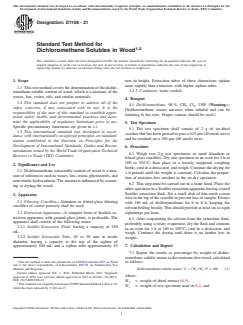
This international standard was developed in accordance with internationally recognized principles on standardization established in the Decision on Principles for the
Development of International Standards, Guides and Recommendations issued by the World Trade Organization Technical Barriers to Trade (TBT) Committee.
Designation: D1108 − 21
Standard Test Method for
1,2
Dichloromethane Solubles in Wood
This standard is issued under the fixed designation D1108; the number immediately following the designation indicates the year of
original adoption or, in the case of revision, the year of last revision. A number in parentheses indicates the year of last reapproval. A
superscript epsilon (´) indicates an editorial change since the last revision or reapproval.
1. Scope mm in height. Extraction tubes of these dimensions siphon
more rapidly than extractors with higher siphon tubes.
1.1 This test method covers the determination of the dichlo-
3.2.3 Condenser, water cooled.
romethane soluble content of wood, which is a measure of the
waxes, fats, resins, oils, and similar materials.
4. Reagent
1.2 This standard does not purport to address all of the
4.1 Dichloromethane, 98 %, CH Cl , USP. (Warning—
2 2
safety concerns, if any, associated with its use. It is the
Dichloromethane causes narcosis when inhaled and can be
responsibility of the user of this standard to establish appro-
irritating to the eyes. Proper caution should be used.)
priate safety, health, and environmental practices and deter-
mine the applicability of regulatory limitations prior to use.
5. Test Specimen
Specific precautionary statements are given in 4.1.
5.1 The test specimen shall consist of2gofair-dried
1.3 This international standard was developed in accor-
sawdustthathasbeengroundtopassa425-µm(40meshsieve)
dance with internationally recognized principles on standard-
and be retained on a 250-µm (60 mesh) sieve.
ization established in the Decision on Principles for the
Development of International Standards, Guides and Recom-
6. Procedure
mendations issued by the World Trade Organization Technical
6.1 Weigh two 2-g test specimens in tared Alundum or
Barriers to Trade (TBT) Committee.
fritted-glass crucibles. Dry one specimen in an oven for2hat
100 to 105°C; then place in a loosely stoppered weighing
2. Significance and Use
bottle, cool in a desiccator, and weigh. Continue the drying for
2.1 Dichloromethane extractable content of wood is a mea-
1-h periods until the weight is constant. Calculate the propor-
sure of substances such as waxes, fats, resins, phytosterols, and
tion of moisture-free sawdust in the air-dry specimen.
nonvolatile hydrocarbons.The amount is influenced by season-
6.2 This step must be carried out in a fume hood. Place the
ing or drying the wood.
other specimen in a Soxhlet extraction apparatus having a tared
Soxhlet extraction flask. Set a small disk of fine-mesh screen
3. Apparatus
wireinthetopofthecrucibletopreventlossofsample.Extract
3.1 Filtering Crucibles—Alundum or fritted-glass filtering
with 150 mL of dichloromethane for 6 to 8 h, keeping the
crucibles of coarse porosity shall be used.
solvent boiling briskly. This should provide at least six to eight
siphonings per hour.
3.2 Extraction Apparatus—A compact form of Soxhlet ex-
traction apparatus, with ground-glass joints, is preferable. The
6.3 After evaporating the solvent from the extraction flask,
apparatus shall consist of the following
...
This document is not an ASTM standard and is intended only to provide the user of an ASTM standard an indication of what changes have been made to the previous version. Because
it may not be technically possible to adequately depict all changes accurately, ASTM recommends that users consult prior editions as appropriate. In all cases only the current version
of the standard as published by ASTM is to be considered the official document.
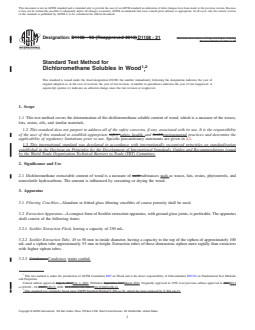
Designation: D1108 − 96 (Reapproved 2013) D1108 − 21 Technical Association of Pulp and Paper Industry
Standard Method T 204-os-76
Standard Test Method for
1,2
Dichloromethane Solubles in Wood
This standard is issued under the fixed designation D1108; the number immediately following the designation indicates the year of
original adoption or, in the case of revision, the year of last revision. A number in parentheses indicates the year of last reapproval. A
superscript epsilon (´) indicates an editorial change since the last revision or reapproval.
1. Scope
1.1 This test method covers the determination of the dichloromethane soluble content of wood, which is a measure of the waxes,
fats, resins, oils, and similar materials.
1.2 This standard does not purport to address all of the safety concerns, if any, associated with its use. It is the responsibility
of the user of this standard to establish appropriate safety safety, health, and healthenvironmental practices and determine the
applicability of regulatory limitations prior to use. Specific precautionary statements are given in 4.1.
1.3 This international standard was developed in accordance with internationally recognized principles on standardization
established in the Decision on Principles for the Development of International Standards, Guides and Recommendations issued
by the World Trade Organization Technical Barriers to Trade (TBT) Committee.
2. Significance and Use
2.1 Dichloromethane extractable content of wood is a measure of such substances such as waxes, fats, resins, phytosterols, and
nonvolatile hydrocarbons. The amount is influenced by seasoning or drying the wood.
3. Apparatus
3.1 Filtering Crucibles—Alundum or fritted-glass filtering crucibles of coarse porosity shall be used.
3.2 Extraction Apparatus—A compact form of Soxhlet extraction apparatus, with ground-glass joints, is preferable. The apparatus
shall consist of the following items:
3.2.1 Soxhlet Extraction Flask, having a capacity of 250 mL.
3.2.2 Soxhlet Extraction Tube, 45 to 50 mm in inside diameter, having a capacity to the top of the siphon of approximately 100
mL and a siphon tube approximately 55 mm in height. Extraction tubes of these dimensions siphon more rapidly than extractors
with higher siphon tubes.
3.2.3 Condenser.Condenser, water cooled.
This test method is under the jurisdiction of ASTM Committee D07 on Wood and is the direct responsibility of Subcommittee D07.01 on Fundamental Test Methods
and Properties.
Current edition approved Aug. 1, 2013Feb. 1, 2021. Published September 2013March 2021. Originally approved in 1950. Last previous edition approved in 20072013
as D1108 – 96 (2007).(2013). DOI: 10.1520/D1108-96R13.10.1520/D1108-21.
This standard was originally based upon TAPPI Standard Method T 204-os-76, which has been replaced by T 204 cm-17.
Copyright © ASTM International, 100 Barr Harbor Drive, PO Box C700, West Conshohocken, PA 19428-2959. United States
D1108 − 21
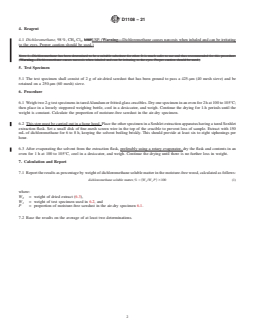
4. Reagent
4.1 Dichloromethane, 98 %, CH Cl , USPUSP. (Warning—Dichloromethane causes narcosis when inhaled and can be irritating
2 2
to the eyes. Proper caution should be used.)
NOTE 1—Dichloromethane has been determined to be a suitable substitute for ether. It is much safer to use and thus recommended for this pr
...