

ASTM F1058-16
(Specification)Standard Specification for Wrought 40Cobalt-20Chromium-16Iron-15Nickel-7Molybdenum Alloy Wire, Strip, and Strip Bar for Surgical Implant Applications (UNS R30003 and UNS R30008)
General Information
- Abstract
ABSTRACT
This specification covers the requirements for two grades of wrought 40cobalt-20chromium-16iron-15nickel- 7molybdenum alloy in the form of wire and strip used for the manufacture of surgical implants. The heat analysis shall conform to the prescribed chemical composition requirements of grade 1 or 2. The tensile strength, hardness, yield strength, elongation, and microstructure shall be tested to meet the requirements specified.
SCOPE
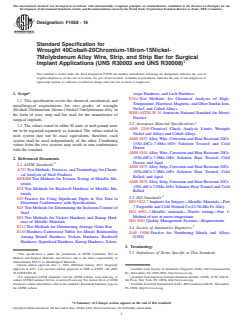
1.1 This specification covers the chemical, mechanical, and metallurgical requirements for two grades of wrought 40cobalt-20chromium-16iron-15nickel-7molybdenum alloy in the form of wire, strip and bar used for the manufacture of surgical implants.
1.2 The values stated in either SI units or inch-pound units are to be regarded separately as standard. The values stated in each system may not be exact equivalents; therefore, each system shall be used independently of the other. Combining values from the two systems may result in non-conformance with the standard.
- Status
- Published
- Publication Date
- 31-Oct-2016
- Technical Committee
- F04 - Medical and Surgical Materials and Devices
- Drafting Committee
- F04.12 - Metallurgical Materials
Buy Documents
ASTM F1058-16 - Standard Specification for Wrought 40Cobalt-20Chromium-16Iron-15Nickel-7Molybdenum Alloy Wire, Strip, and Strip Bar for Surgical Implant Applications (UNS R30003 and UNS R30008)
REDLINE ASTM F1058-16 - Standard Specification for Wrought 40Cobalt-20Chromium-16Iron-15Nickel-7Molybdenum Alloy Wire, Strip, and Strip Bar for Surgical Implant Applications (UNS R30003 and UNS R30008)
Overview
ASTM F1058-16: Standard Specification for Wrought 40Cobalt-20Chromium-16Iron-15Nickel-7Molybdenum Alloy Wire, Strip, and Strip Bar for Surgical Implant Applications (UNS R30003 and R30008) covers the requirements for two high-performance cobalt-chromium-nickel-molybdenum-iron alloy grades, provided as wire, strip, or bar, and used in the manufacture of surgical implants. Developed by ASTM Committee F04 on Medical and Surgical Materials and Devices, this specification ensures materials used in critical medical applications meet stringent chemical, mechanical, and metallurgical standards.
Key Topics
Material Grades and Forms
- Covers two alloy grades: Grade 1 (commonly known as Elgiloy, UNS R30003) and Grade 2 (commonly known as Phynox, UNS R30008).
- Specifies wrought forms: wire, strip, and strip bar, as well as bars of various sizes.
- Condition supplied may be annealed, cold worked, or cold worked and aged, depending on the intended application.
Chemical and Mechanical Requirements
- Prescribes strict chemical composition ranges for each grade, ensuring consistency and performance.
- Mechanical properties include minimum tensile strength, yield strength, elongation, and, optionally, hardness.
- Microstructural requirements ensure a homogeneous, fine-grained alloy with high corrosion and fatigue resistance.
Testing and Quality Assurance
- Requires validated test methods (e.g., for tensile strength, hardness, grain size, and microcleanliness).
- Calls for certified statements of compliance and detailed test reporting by suppliers.
- Mandates a quality management program conforming to standards such as ASQ C1 or ISO 9001.
Dual Unit Standardization
- Permits use of either SI or inch-pound units as standard, but prohibits mixing units within a single order to maintain accuracy and compliance.
Applications
Medical and Surgical Implants
- Specifically intended for components used in surgical implants, such as cardiovascular devices, orthopedic implants, and dental prostheses.
- Suitable for applications requiring high strength, superior corrosion and fatigue resistance, and biocompatibility with soft tissue and bone.
- The specified alloys are noted for successful long-term use in human implants, with a track record of satisfactory biological response when properly applied.
Component Manufacturing
- Specification guides manufacturers in producing consistent, high-quality alloy products for further processing into springs, wires, clips, and structural elements in medical devices.
- Enables designers to select appropriate material grades and conditions for specific implant load and durability requirements.
Related Standards
ASTM and Aerospace Material Standards
- ASTM A751: Chemical analysis methods for steel products.
- ASTM E8/E8M: Tension testing of metallic materials.
- ASTM E18: Rockwell hardness of metals.
- AMS 5833, 5834, 5875, 5876: Aerospace specifications for similar high-performance alloys.
ISO Standards
- ISO 5832-7: Forgeable and cold-formed Co-Cr-Ni-Mo-Fe alloys for surgery.
- ISO 6892-1: Tensile testing of metallic materials.
- ISO 9001: Quality management systems - requirements.
Quality Systems
- ASQ C1: General requirements for a quality program.
These related documents provide additional guidance for chemical analysis, mechanical testing, and quality assurance, ensuring rigorous material selection and manufacturing processes for surgical implants.
Keywords: ASTM F1058-16, cobalt-chromium alloy, surgical implant wire, strip, bar, UNS R30003, UNS R30008, medical device materials, biocompatibility, orthopedic implants, quality assurance, alloy standards.
Relations
- Effective Date
- 01-Nov-2016
- Effective Date
- 01-Jan-2024
- Effective Date
- 01-Nov-2023
- Effective Date
- 01-Jul-2018
- Effective Date
- 01-Jul-2017
- Effective Date
- 15-Jul-2016
- Effective Date
- 01-Feb-2015
- Effective Date
- 01-Mar-2014
- Effective Date
- 01-Jun-2013
- Effective Date
- 01-Dec-2012
- Effective Date
- 15-Nov-2012
- Effective Date
- 01-Dec-2011
- Effective Date
- 01-Nov-2011
- Effective Date
- 01-Oct-2011
- Effective Date
- 01-Jun-2011
Buy Documents
ASTM F1058-16 - Standard Specification for Wrought 40Cobalt-20Chromium-16Iron-15Nickel-7Molybdenum Alloy Wire, Strip, and Strip Bar for Surgical Implant Applications (UNS R30003 and UNS R30008)
REDLINE ASTM F1058-16 - Standard Specification for Wrought 40Cobalt-20Chromium-16Iron-15Nickel-7Molybdenum Alloy Wire, Strip, and Strip Bar for Surgical Implant Applications (UNS R30003 and UNS R30008)
Get Certified
Connect with accredited certification bodies for this standard

BSI Group
BSI (British Standards Institution) is the business standards company that helps organizations make excellence a habit.

TÜV Rheinland
TÜV Rheinland is a leading international provider of technical services.

TÜV SÜD
TÜV SÜD is a trusted partner of choice for safety, security and sustainability solutions.
Sponsored listings
Frequently Asked Questions
ASTM F1058-16 is a technical specification published by ASTM International. Its full title is "Standard Specification for Wrought 40Cobalt-20Chromium-16Iron-15Nickel-7Molybdenum Alloy Wire, Strip, and Strip Bar for Surgical Implant Applications (UNS R30003 and UNS R30008)". This standard covers: ABSTRACT This specification covers the requirements for two grades of wrought 40cobalt-20chromium-16iron-15nickel- 7molybdenum alloy in the form of wire and strip used for the manufacture of surgical implants. The heat analysis shall conform to the prescribed chemical composition requirements of grade 1 or 2. The tensile strength, hardness, yield strength, elongation, and microstructure shall be tested to meet the requirements specified. SCOPE 1.1 This specification covers the chemical, mechanical, and metallurgical requirements for two grades of wrought 40cobalt-20chromium-16iron-15nickel-7molybdenum alloy in the form of wire, strip and bar used for the manufacture of surgical implants. 1.2 The values stated in either SI units or inch-pound units are to be regarded separately as standard. The values stated in each system may not be exact equivalents; therefore, each system shall be used independently of the other. Combining values from the two systems may result in non-conformance with the standard.
ABSTRACT This specification covers the requirements for two grades of wrought 40cobalt-20chromium-16iron-15nickel- 7molybdenum alloy in the form of wire and strip used for the manufacture of surgical implants. The heat analysis shall conform to the prescribed chemical composition requirements of grade 1 or 2. The tensile strength, hardness, yield strength, elongation, and microstructure shall be tested to meet the requirements specified. SCOPE 1.1 This specification covers the chemical, mechanical, and metallurgical requirements for two grades of wrought 40cobalt-20chromium-16iron-15nickel-7molybdenum alloy in the form of wire, strip and bar used for the manufacture of surgical implants. 1.2 The values stated in either SI units or inch-pound units are to be regarded separately as standard. The values stated in each system may not be exact equivalents; therefore, each system shall be used independently of the other. Combining values from the two systems may result in non-conformance with the standard.
ASTM F1058-16 is classified under the following ICS (International Classification for Standards) categories: 11.040.40 - Implants for surgery, prosthetics and orthotics. The ICS classification helps identify the subject area and facilitates finding related standards.
ASTM F1058-16 has the following relationships with other standards: It is inter standard links to ASTM F1058-08, ASTM E8/E8M-24, ASTM E45-18a(2023), ASTM E18-18, ASTM E18-17, ASTM E8/E8M-16, ASTM E8/E8M-15, ASTM A751-14, ASTM E8/E8M-13, ASTM E18-12, ASTM E112-12, ASTM E8/E8M-11, ASTM E18-11, ASTM E45-11a, ASTM E45-11. Understanding these relationships helps ensure you are using the most current and applicable version of the standard.
ASTM F1058-16 is available in PDF format for immediate download after purchase. The document can be added to your cart and obtained through the secure checkout process. Digital delivery ensures instant access to the complete standard document.
Standards Content (Sample)
This international standard was developed in accordance with internationally recognized principles on standardization established in the Decision on Principles for the
Development of International Standards, Guides and Recommendations issued by the World Trade Organization Technical Barriers to Trade (TBT) Committee.
Designation:F1058 −16
Standard Specification for
Wrought 40Cobalt-20Chromium-16Iron-15Nickel-
7Molybdenum Alloy Wire, Strip, and Strip Bar for Surgical
Implant Applications (UNS R30003 and UNS R30008)
This standard is issued under the fixed designation F1058; the number immediately following the designation indicates the year of
original adoption or, in the case of revision, the year of last revision.Anumber in parentheses indicates the year of last reapproval.A
superscript epsilon (´) indicates an editorial change since the last revision or reapproval.
1. Scope* scope Hardness, and Leeb Hardness
E354 Test Methods for Chemical Analysis of High-
1.1 This specification covers the chemical, mechanical, and
Temperature,Electrical,Magnetic,andOtherSimilarIron,
metallurgical requirements for two grades of wrought
Nickel, and Cobalt Alloys
40cobalt-20chromium-16iron-15nickel-7molybdenum alloy in
IEEE/ASTM SI 10American National Standard for Metric
the form of wire, strip and bar used for the manufacture of
Practice
surgical implants.
2.2 Aerospace Material Specifications:
1.2 The values stated in either SI units or inch-pound units
AMS 2269 Chemical Check Analysis Limits Wrought
are to be regarded separately as standard. The values stated in
Nickel and Alloys and Cobalt Alloys
each system may not be exact equivalents; therefore, each
AMS 5833Alloy Wire, Corrosion and Heat Resistant 20Cr-
system shall be used independently of the other. Combining
15Ni-40Co-7.0Mo-16Fe Solution Treated and Cold
values from the two systems may result in non-conformance
Drawn
with the standard.
AMS 5834Alloy Wire, Corrosion and Heat Resistant 20Cr-
15Ni-40Co-7.0Mo-16Fe Solution Heat Treated, Cold
2. Referenced Documents
Drawn, and Aged
2.1 ASTM Standards:
AMS 5875Alloy Strip, Corrosion and Heat Resistant 20Cr-
A751Test Methods, Practices, and Terminology for Chemi-
15Ni-40Co-7.0Mo-16Fe Solution Heat Treated, Cold
cal Analysis of Steel Products
Rolled, and Aged
E8/E8MTest Methods for Tension Testing of Metallic Ma-
AMS 5876Alloy Strip, Corrosion and Heat Resistant 20Cr-
terials
15Ni-40Co-7.0Mo-16Fe Solution Heat Treated and Cold
E18Test Methods for Rockwell Hardness of Metallic Ma-
Rolled
terials
2.3 ISO Standards:
E29Practice for Using Significant Digits in Test Data to
ISO5832-7ImplantsforSurgery—MetallicMaterials—Part
Determine Conformance with Specifications
7 Forgeable and Cold Formed Co-Cr-Ni-Mo-Fe Alloy
E45Test Methods for Determining the Inclusion Content of
ISO 6892–1Metallic materials—Tensile testing—Part 1:
Steel
Method of test at room temperature
E92Test Methods for Vickers Hardness and Knoop Hard-
ISO 9001Quality Management Systems—Requirements
ness of Metallic Materials
E112Test Methods for Determining Average Grain Size
2.4 Society of Automotive Engineers:
E140Hardness Conversion Tables for Metals Relationship
SAE J1086Practice for Numbering Metals and Alloys
Among Brinell Hardness, Vickers Hardness, Rockwell
(UNS)
Hardness, Superficial Hardness, Knoop Hardness, Sclero-
3. Terminology
1 3.1 Definitions of Terms Specific to This Standard:
This specification is under the jurisdiction of ASTM Committee F04 on
Medical and Surgical Materials and Devices and is the direct responsibility of
Subcommittee F04.12 on Metallurgical Materials.
Current edition approved Nov. 1, 2016. Published January 2017. Originally
approved in 1991. Last previous edition approved in 2008 as F1058–08. DOI: Available from Society of Automotive Engineers (SAE), 400 Commonwealth
10.1520/F1058-16. Dr., Warrendale, PA 15096-0001, http://www.sae.org.
2 4
For referenced ASTM standards, visit the ASTM website, www.astm.org, or Available fromAmerican National Standards Institute (ANSI), 25 W. 43rd St.,
contact ASTM Customer Service at service@astm.org. For Annual Book of ASTM 4th Floor, New York, NY 10036, http://www.ansi.org.
Standards volume information, refer to the standard’s Document Summary page on AvailablefromSAEInternational(SAE),400CommonwealthDr.,Warrendale,
the ASTM website. PA 15096, http://www.sae.org.
*A Summary of Changes section appears at the end of this standard
Copyright © ASTM International, 100 Barr Harbor Drive, PO Box C700, West Conshohocken, PA 19428-2959. United States
F1058−16
TABLE 1 Chemical Requirements, Heat Analysis
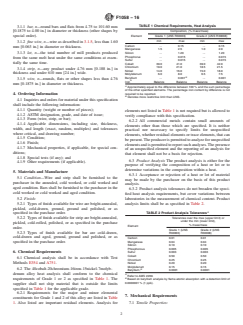
3.1.1 bar, n—round bars and flats from 4.75 to 101.60 mm
[0.1875 to 4.00 in.] in diameter or thickness (other shapes by Composition, (% mass/mass)
special order). Element Grade 1 (UNS R30003) Grade 2 (UNS R30008)
min max min max
3.1.2 fine wire, n—wire as described in 3.1.5, less than 1.60
Carbon . 0.15 . 0.15
mm [0.063 in.] in diameter or thickness.
Manganese 1.5 2.5 1.0 2.0
3.1.3 lot, n—the total number of mill products produced Silicon . 1.20 . 1.20
Phosphorus . 0.015 . 0.015
from the same melt heat under the same conditions at essen-
Sulfur . 0.015 . 0.015
tially the same time.
Cobalt 39.0 41.0 39.0 42.0
Chromium 19.0 21.0 18.5 21.5
3.1.4 strip, n—any product under 4.76 mm [0.188 in.] in
Nickel 14.0 16.0 15.0 18.0
thickness and under 610 mm [24 in.] wide.
Molybdenum 6.0 8.0 6.5 7.5
B
Beryllium . 0.001 . 0.001
3.1.5 wire, n—rounds, flats or other shapes less than 4.76
A
Iron Balance Balance Balance Balance
mm [0.1875 in.] in diameter or thickness.
A
Approximately equal to the difference between 100 % and the sum percentage
of the other specified elements. The percentage iron content by difference is not
4. Ordering Information required to be reported.
B
Denotes more restrictive limit than UNS.
4.1 Inquiriesandordersformaterialunderthisspecification
shall include the following information:
4.1.1 Quantity (weight or number of pieces);
elements not listed in Table 1 is not required but is allowed to
4.1.2 ASTM designation, grade, and date of issue;
verify compliance with this specification.
4.1.3 Form (wire, strip, or bar);
6.2.2 All commercial metals contain small amounts of
4.1.4 Applicable dimensions, including size, thickness,
elements other than those which are specified. It is neither
width, and length (exact, random, multiples) and tolerances
practical nor necessary to specify limits for unspecified
where critical, and drawing number;
elements,whetherresidualelementsortraceelements,thatcan
4.1.5 Condition;
bepresent.Theproducerispermittedtoanalyzeforunspecified
4.1.6 Finish;
elementsandispermittedtoreportsuchanalyses.Thepresence
4.1.7 Mechanical properties, if applicable, for special con-
of an unspecified element and the reporting of an analysis for
ditions;
that element shall not be a basis for rejection.
4.1.8 Special tests (if any); and
6.3 Product Analysis The product analysis is either for the
4.1.9 Other requirements (if applicable).
purpose of verifying the composition of a heat or lot or to
determine variations in the composition within a heat.
5. Materials and Manufacture
6.3.1 Acceptance or rejection of a heat or lot of material
5.1 Condition—Wire and strip shall be furnished to the
may be made by the purchaser on the basis of this product
purchaser in the annealed, cold worked, or cold worked and
analysis.
aged condition. Bars shall be furnished to the purchaser in the
6.3.2 Product analysis tolerances do not broaden the speci-
cold worked or cold worked and aged condition.
fied heat analysis requirements, but cover variations between
laboratories in the measurement of chemical content. Product
5.2 Finish:
analysis limits shall be as specified in Table 2.
5.2.1 Types of finish available for wire are bright-annealed,
pickled, cold-drawn, ground, ground and polished, or as
A
specified in the purchase order. TABLE 2 Product Analysis Tolerances
Tolerances over the max (upper limit) or
5.2.2 Types of finish available for strip are bright-annealed,
under the min (lower limit),
pickled, cold-rolled, polished, or as specified in the purchase
% mass/mass
Element
order.
Grade 1 (UNS Grade 2 (UNS
5.2.3 Types of finish available for bar are cold-drawn,
R30003) R30008)
cold-drawn and aged, ground, ground and polished, or as
Carbon 0.01 0.01
Manganese 0.04 0.04
specified in the purchase order.
Silicon 0.10 0.10
Phosphorous 0.005 0.005
6. Chemical Requirements
Sulfur 0.003 0.003
Cobalt 0.50 0.50
6.1 Chemical analysis shall be in accordance with Test
Chromium 0.25 0.25
Methods E354 and A751.
Nickel 0.20 0.20
Molybdenum 0.15 0.15
B
6.2 The 40cobalt-20chromium-16iron-15nickel-7molyb-
Beryllium, 0.0001 0.0001
denum alloy heat analysis shall conform to the chemical
A
Refer to AMS 2269.
B
requirements of Grade 1 or 2 as specified in Table 1. The Based on beryllium analysis by flame atomic absorption with a detection limit of
0.0000001 % (1 ppb).
supplier shall not ship material that is outside the limits
specified in Table 1 for the applicable grade.
6.2.1 Requirements for the major and minor elemental
7. Mechanical Requirements
constituents for Grade 1 and 2 of this alloy are listed in Table
1. Also listed are important residual elements. Analysis for 7.1 Tensile Properties:
F1058−16
A
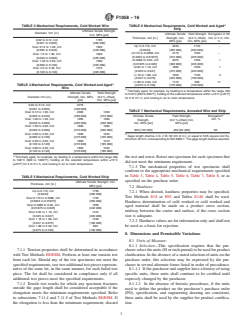
TABLE 3 Mechanical Requirements, Cold Worked Wire TABLE 6 Mechanical Requirements, Cold Worked and Aged
Strip
Ultimate Tensile Strength,
Diameter, mm [in.]
Ultimate Tensile Yield Strength Elongation in 50
min, MPa [psi]
Thickness, mm [in.] Strength, min, (0.2 % offset) mm or 2 in, min,
0.02 to 0.12, incl 1795
MPa [psi] min, MPa [psi] %
[0.001 to 0.005] [260 000]
Up to 0.110, incl 2240 1725 .
Over 0.12 to 1.00, incl 1655
[0.0043] [325 000] [250 000]
[0.005 to 0.040] [240 000]
>0.110 to 0.4688, incl 2170 1550 .
Over 1.0 to 1.50, incl 1620
[0.0043 to 0.01875] [315 000] [225 000]
[0.040 to 0.060] [235 000]
>0.4688 to 0.62, incl 2070 1550 1
Over 1.50 to 2.50, incl 1550
[0.01875 to 0.025] [300 000] [225 000]
[0.060 to 0.100] [225 000]
>0.62 to 1.18, incl 1895 1550 1
Over 2.5 to 3.50, incl 1515
[0.025 to 0.047] [275 000] [225 000]
[0.100 to 0.140] [220 000]
>1.18 to 1.88, incl 1550 1105 3
[0.047 to 0.075] [225 000] [160 000]
>1.88 to 2.50, incl 1170 690 17
A
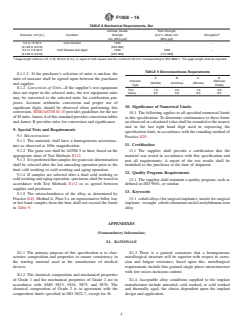
TABLE 4 Mechanical Requirements, Cold Worked and Aged [0.075 to 0.100] [170 000] [100 000]
Wire
A
Thermally aged, for example, by heating to a temperature within the range 455
Ultimate Tensile Yield Strength
to 510°C [850 to 950°F], holding at the selected temperature within ±15°C [±25°F]
Diameter mm [in.] Strength, min, MPa (0.2 % offset), 1
for 5 to 5 ⁄2 h, and cooling in air to room temperature.
[psi] min, MPa [psi]
0.02 to 0.12, incl 2275 .
[0.001 to 0.005] [330 000]
TABLE 7 Mechanical Requirements, Annealed Wire and Strip
Over 0.12 to 1.00, incl 2000 1450
A
[0.005 to 0.040] [290 000] [210 000]
Ultimate Tensile Yield Strength, Elongation
min, %
Over 1.00 to 1.50, incl 1965 1380
Strength, (0.2 % offset) min,
[0.040 to 0.060] [285 000] [200 000] min, MPa [psi] MPa [p
...
This document is not an ASTM standard and is intended only to provide the user of an ASTM standard an indication of what changes have been made to the previous version. Because
it may not be technically possible to adequately depict all changes accurately, ASTM recommends that users consult prior editions as appropriate. In all cases only the current version
of the standard as published by ASTM is to be considered the official document.
Designation: F1058 − 08 F1058 − 16
Standard Specification for
Wrought 40Cobalt-20Chromium-16Iron-15Nickel-
7Molybdenum Alloy Wire Wire, Strip, and Strip Bar for
Surgical Implant Applications (UNS R30003 and UNS
R30008)
This standard is issued under the fixed designation F1058; the number immediately following the designation indicates the year of
original adoption or, in the case of revision, the year of last revision. A number in parentheses indicates the year of last reapproval. A
superscript epsilon (´) indicates an editorial change since the last revision or reapproval.
1. Scope*
1.1 This specification covers the chemical, mechanical, and metallurgical requirements for two grades of wrought 40cobalt-
20chromium-16iron-15nickel-7molybdenum alloy in the form of wire wire, strip and stripbar used for the manufacture of surgical
implants.
1.2 The values stated in either SI units or inch-pound units are to be regarded separately as standard. The inch-pound equivalents
of the SI units in parentheses are for information only.values stated in each system may not be exact equivalents; therefore, each
system shall be used independently of the other. Combining values from the two systems may result in non-conformance with the
standard.
2. Referenced Documents
2.1 ASTM Standards:
A751 Test Methods, Practices, and Terminology for Chemical Analysis of Steel Products
E8E8/E8M Test Methods for Tension Testing of Metallic Materials
E18 Test Methods for Rockwell Hardness of Metallic Materials
E29 Practice for Using Significant Digits in Test Data to Determine Conformance with Specifications
E45 Test Methods for Determining the Inclusion Content of Steel
E92 Test Methods for Vickers Hardness and Knoop Hardness of Metallic Materials
E112 Test Methods for Determining Average Grain Size
E140 Hardness Conversion Tables for Metals Relationship Among Brinell Hardness, Vickers Hardness, Rockwell Hardness,
Superficial Hardness, Knoop Hardness, Scleroscope Hardness, and Leeb Hardness
E354 Test Methods for Chemical Analysis of High-Temperature, Electrical, Magnetic, and Other Similar Iron, Nickel, and
Cobalt Alloys
IEEE/ASTM SI 10 American National Standard for Metric Practice
2.2 Aerospace Material Specifications:
AMS 2269 Chemical Check Analysis Limits Wrought Nickel and Alloys and Cobalt Alloys
AMS 5833 Alloy Wire, Corrosion and Heat Resistant 20Cr-15Ni-40Co-7.0Mo-16Fe Solution Treated and Cold Drawn
AMS 5834 Alloy Wire, Corrosion and Heat Resistant 20Cr-15Ni-40Co-7.0Mo-16Fe Solution Heat Treated, Cold Drawn, and
Aged
AMS 5875 Alloy Strip, Corrosion and Heat Resistant 20Cr-15Ni-40Co-7.0Mo-16Fe Solution Heat Treated, Cold Rolled, and
Aged
AMS 5876 Alloy Strip, Corrosion and Heat Resistant 20Cr-15Ni-40Co-7.0Mo-16Fe Solution Heat Treated and Cold Rolled
2.3 American Society for Quality Standards:
ASQ C1 Specification of General Requirements for a Quality Program
This specification is under the jurisdiction of ASTM Committee F04 on Medical and Surgical Materials and Devices and is the direct responsibility of Subcommittee
F04.12 on Metallurgical Materials.
Current edition approved May 1, 2008Nov. 1, 2016. Published June 2008January 2017. Originally approved in 1991. Last previous edition approved in 20022008 as
F1058 – 02.F1058 – 08. DOI: 10.1520/F1058-08.10.1520/F1058-16.
For referenced ASTM standards, visit the ASTM website, www.astm.org, or contact ASTM Customer Service at service@astm.org. For Annual Book of ASTM Standards
volume information, refer to the standard’sstandard’s Document Summary page on the ASTM website.
Available from Society of Automotive Engineers (SAE), 400 Commonwealth Dr., Warrendale, PA 15096-0001, http://www.sae.org.
*A Summary of Changes section appears at the end of this standard
Copyright © ASTM International, 100 Barr Harbor Drive, PO Box C700, West Conshohocken, PA 19428-2959. United States
F1058 − 16
2.3 ISO Standards:
ISO 5832-7 Implants for Surgery—Metallic Materials—Part 7 Forgeable and Cold Formed Co-Cr-Ni-Mo-Fe Alloy
ISO 68926892–1 Metallic Materials—Tensile Testingmaterials—Tensile testing—Part 1: Method of test at room temperature
ISO 9001 Quality Management Systems—Requirements
2.4 Society of Automotive Engineers:
SAE J1086 Practice for Numbering Metals and Alloys (UNS)
3. Terminology
3.1 Definitions of Terms Specific to This Standard:
3.1.1 bar, n—round bars and flats from 4.75 to 101.60 mm [0.1875 to 4.00 in.] in diameter or thickness (other shapes by special
order).
3.1.2 fine wire, n—wire as described in 3.1.5, less than 1.60 mm [0.063 in.] in diameter or thickness.
3.1.3 lot, n—the total number of mill products produced from the same melt heat under the same conditions at essentially the
same time.
3.1.4 strip, n—any product under 4.76 mm [0.188 in.] in thickness and under 610 mm [24 in.] wide.
3.1.5 wire, n—rounds, flats or other shapes less than 4.76 mm [0.1875 in.] in diameter or thickness.
4. Ordering Information
4.1 Inquiries and orders for material under this specification shall include the following information:
4.1.1 Quantity (weight or number of pieces),pieces);
4.1.2 ASTM designation, grade, and date of issue,issue;
4.1.3 Form (wire (wire, strip, or strip),bar);
4.1.4 Applicable dimensions, including size, thickness, width, and length (exact, random, multiples) and tolerances where
critical, and drawing number,number;
4.1.5 Condition,Condition;
4.1.6 Finish,Finish;
4.1.7 Mechanical properties, if applicable, for special conditions,conditions;
4.1.8 Special tests (if any),any); and
4.1.9 Other requirements (if applicable).
5. Materials and Manufacture
5.1 Condition—Wire and strip shall be furnished to the purchaser in the annealed, cold worked, or cold worked and aged
condition. Bars shall be furnished to the purchaser in the cold worked or cold worked and aged condition.
5.2 Finish:
5.2.1 Types of finish available for wire are bright-annealed, pickled, cold-drawn, ground, ground and polished, or as specified
in the purchase order.
5.2.2 Types of finish available for strip are bright-annealed, pickled, cold-rolled, polished, or as specified in the purchase order.
5.2.3 Types of finish available for bar are cold-drawn, cold-drawn and aged, ground, ground and polished, or as specified in the
purchase order.
6. Chemical Requirements
6.1 Chemical analysis shall be in accordance with Test Methods E354 and A751.
6.2 The 40cobalt-20chromium-16iron-15nickel-7molyb-
denum alloy heat analysis shall conform to the chemical requirements of Grade 1 or 2 as specified in Table 1. The supplier shall
not ship material that is outside the limits specified in Table 1 for the applicable grade.
6.2.1 Requirements for the major and minor elemental constituents for Grade 1 and 2 of this alloy are listed in Table 1. Also
listed are important residual elements. Analysis for elements not listed in Table 1 is not required but is allowed to verify compliance
with this specification.
6.2.2 All commercial metals contain small amounts of elements other than those which are specified. It is neither practical nor
necessary to specify limits for unspecified elements, whether residual elements or trace elements, that can be present. The producer
is permitted to analyze for unspecified elements and is permitted to report such analyses. The presence of an unspecified element
and the reporting of an analysis for that element shall not be a basis for rejection.
Available from American Society for Quality (ASQ), 600 N. Plankinton Ave., Milwaukee, WI 53203, http://www.asq.org.
Available from American National Standards Institute (ANSI), 25 W. 43rd St., 4th Floor, New York, NY 10036, http://www.ansi.org.
Available from SAE International (SAE), 400 Commonwealth Dr., Warrendale, PA 15096, http://www.sae.org.
F1058 − 16
TABLE 1 Chemical Requirements, Heat Analysis
Composition, (% mass/mass)
Element Grade 1 (UNS R30003) Grade 2 (UNS R30008)
min max min max
Carbon . 0.15 . 0.15
Manganese 1.5 2.5 1.0 2.0
Silicon . 1.20 . 1.20
Phosphorus . 0.015 . 0.015
Sulfur . 0.015 . 0.015
Cobalt 39.0 41.0 39.0 42.0
Chromium 19.0 21.0 18.5 21.5
Nickel 14.0 16.0 15.0 18.0
Molybdenum 6.0 8.0 6.5 7.5
Beryllium . 0.10 . 0.001
B
Beryllium . 0.001 . 0.001
A
Iron Balance Balance Balance Balance
A
Approximately equal to the difference between 100 % and the sum percentage
of the other specified elements. The percentage iron content by difference is not
required to be reported.
B
Denotes more restrictive limit than UNS.
6.3 Product Analysis The product analysis is either for the purpose of verifying the composition of a heat or lot or to determine
variations in the composition within a heat.
6.3.1 Acceptance or rejection of a heat or lot of material may be made by the purchaser on the basis of this product analysis.
6.3.2 Product analysis tolerances do not broaden the specified heat analysis requirements, but cover variations between
laboratories in the measurement of chemical content. The manufacturer shall not ship material that is outside the limits specified
in Table 1. Product analysis limits shall be as specified in Table 2.
A
TABLE 2 Product Analysis Tolerances
Tolerances over the max (upper limit) or
under the min (lower limit),
% mass/mass
Element
Grade 1 (UNS Grade 2 (UNS
R30003) R30008)
Carbon 0.01 0.01
Manganese 0.04 0.04
Silicon 0.10 0.10
Phosphorous 0.005 0.005
Sulfur 0.003 0.003
Cobalt 0.50 0.50
Chromium 0.25 0.25
Nickel 0.20 0.20
Molybdenum 0.15 0.15
B
Beryllium, 0.010 0.0001
B
Beryllium, 0.0001 0.0001
A
Refer to AMS 2269.
B
Based on beryllium analysis by flame atomic absorption with a detection limit of
0.0000001 % (1 ppb).
6.3 Methods and practices relating to chemical analysis required by this specification shall be in accordance with Test Methods,
Practices, and Terminology A751.
7. Mechanical Requirements
7.1 Tensile Properties:
7.1.1 Perform tension tests per Tension properties shall be determined in accordance with Test Methods E8E8/E8M. Perform
at least one tension test from each lot. Should any of the test specimens not meet the specified requirements, test two additional
test pieces representative of the same lot, in the same manner, for each failed test piece. The lot shall be considered in compliance
only if all additional test pieces meet the specified requirements.
7.1.2 Tensile test results for which any specimen fractures outside the gage length shall be considered acceptable if the
elongation meets the minimum requirements specified. Refer to subsections 7.11.4 and 7.11.5 of Test Methods E8E8/E8M. If the
elongation is less than the minimum requirement, discard the test and retest. Retest one specimen for each specimen that did not
meet the minimum requirement.
7.1.3 The mechanical properties of test specimens shall conform to the appropriate mechanical requirements specified in Table
3, Table 4, Table 5, Table 6, Table 7or, Table 78. , or as specified on the purchase order
F1058 − 16
TABLE 3 Mechanical Requirements, Cold Worked Wire
Ultimate Tensile Strength,
Diameter, mm (in.)[in.]
min, MPa (psi)[psi]
0.02 to 0.12, incl 1795
(0.001 to 0.005) (260 000)
[0.001 to 0.005] [260 000]
Over 0.12 to 1.00, incl 1655
(0.005 to 0.040) (240 000)
[0.005 to 0.040] [240 000]
Over 1.0 to 1.50, incl 1620
(0.040 to 0.060) (235 000)
[0.040 to 0.060] [235 000]
Over 1.50 to 2.50, incl 1550
(0.060 to 0.100) (225 000)
[0.060 to 0.100] [225 000]
Over 2.5 to 3.50, incl 1515
(0.100 to 0.140) (220 000)
[0.100 to 0.140] [220 000]
A
TABLE 4 Mechanical Requirements, Cold Worked and Aged
Wire
Yield Strength
Ultimate Tensile
(0.2 % offset),
Diameter mm (in.)[in.] Strength, min, MPa
min, MPa
(psi)[psi]
(psi)[psi]
0.02 to 0.12, incl 2275 .
(0.001 to 0.005) (330 000)
[0.001 to 0.005] [330 000]
Over 0.12 to 1.00, incl 2000 1450
(0.005 to 0.040) (290 000) (210 000)
[0.005 to 0.040] [290 000] [210 000]
Over 1.00 to 1.50, incl 1965 1380
(0.040 to 0.060) (285 000) (200 000)
[0.040 to 0.060] [285 000] [200 000]
Over 1.50 to 2.00, incl 1895 1380
(0.060 to 0.080) (275 000) (200 000)
[0.060 to 0.080] [275 000] [200 000]
Over 2.00 to 2.50, incl 1895 134
...