

ASTM D7254-21
(Specification)Standard Specification for Polypropylene (PP) Siding
General Information
- Abstract
ABSTRACT
This specification establishes requirements and test methods for materials, impact strength, appearance, surface flame spread, and windload resistance of siding products manufactured from polypropylene material. The use of polypropylene recycled plastic in this product shall conform to the specified requirements. The siding shall be made principally of polypropylene compound, prepared from polypropylene homopolymer or copolymer. The polypropylene compound shall be compounded so as to provide the heat stability and weather exposure stability required for the siding market application.
SCOPE
1.1 This specification establishes requirements and test methods for materials, impact strength, appearance, surface flame spread, and wind load resistance of siding products manufactured from polypropylene material. Methods of indicating compliance with this specification are also provided.
1.2 The use of polypropylene recycled plastic in this product shall be in accordance with the requirements in Section 4.
1.3 Siding produced to this specification shall be installed in accordance with manufacturer’s installation instructions for the specific product to be installed.
Note 1: Information with regard to siding maintenance shall be obtained from the manufacturer.
1.4 The values stated in inch-pound units are to be regarded as the standard. The SI units given in parentheses are for information purposes only.
1.5 The following precautionary caveat pertains to the test method portion only, Section 6 of this specification: This standard does not purport to address all of the safety concerns, if any, associated with its use. It is the responsibility of the user of this standard to establish appropriate safety, health, and environmental practices and determine the applicability of regulatory limitations prior to use.
Note 2: There is no known ISO equivalent to this standard.
1.6 This international standard was developed in accordance with internationally recognized principles on standardization established in the Decision on Principles for the Development of International Standards, Guides and Recommendations issued by the World Trade Organization Technical Barriers to Trade (TBT) Committee.
- Status
- Published
- Publication Date
- 30-Nov-2021
- Technical Committee
- D20 - Plastics
- Drafting Committee
- D20.24 - Plastic Building Products
Overview
ASTM D7254-21 – Standard Specification for Polypropylene (PP) Siding provides requirements for siding products made primarily from polypropylene, intended for use as exterior cladding on buildings. This standard, published by ASTM International, specifies criteria for materials properties, visual appearance, impact resistance, weatherability, flame spread, and wind load resistance. It is widely referenced for ensuring the reliable performance, durability, and safety of polypropylene siding-both for new construction and renovation projects. This specification also outlines compliance marking, packaging, and installation considerations.
Key Topics
Materials and Manufacturing
- Requires siding to be produced mainly from polypropylene compounds, either homopolymer or copolymer.
- Permits the use of recycled polypropylene plastic, provided it meets all standard requirements.
Physical and Performance Requirements
- Impact Strength: Siding must demonstrate minimum impact resistance to prevent breakage under normal conditions.
- Weathering and Appearance: Siding must retain color and avoid surface issues such as checking, cracking, erosion, blistering, or flaking after prolonged outdoor exposure.
- Film Adhesion: Coatings, if present, must adhere well to the siding surface, passing specified adhesion tests.
- Wind Load Resistance: Siding products must sustain specified minimum static test pressures mimicking high-wind conditions, following ASTM test methods.
- Surface Flame Spread: Sets a maximum flame spread index for building safety.
Installation and Labeling
- Products must be installed per the manufacturer’s instructions to ensure compliance.
- Siding packages and panels must display compliance markings, including wind load design pressure ratings.
Testing and Compliance
- Includes references to test methods for various performance characteristics like weatherability, flame spread, and impact resistance.
- Uses both inch-pound and SI units for clarity in different regions.
Applications
ASTM D7254-21 polypropylene siding is used extensively in the building and construction industry for residential and light commercial structures, providing:
- Exterior Wall Cladding: Used as the outermost layer to protect building envelopes from weather while providing aesthetic options.
- New Construction & Renovation: Suitable for new projects and retrofits, especially where low maintenance and durability are priorities.
- Areas Requiring Enhanced Wind Resistance: With tested wind load pressure ratings, products are suitable for regions prone to high winds, storms, or hurricanes, ensuring code compliance.
- Sustainable Building Projects: The allowance for recycled polypropylene helps support green building initiatives by reducing environmental impact.
Properly installed polymer siding offers benefits such as resistance to moisture, insects, impact, and fading, while minimizing upkeep when compared to traditional siding materials like wood.
Related Standards
For product developers, contractors, and code officials, several related ASTM and industry standards guide the evaluation and installation of building sidings:
- ASTM D3679: Specification for Rigid Poly(Vinyl Chloride) (PVC) Siding
- ASTM D4101: Classification for Polypropylene Injection and Extrusion Materials
- ASTM D1435: Outdoor Weathering of Plastics
- ASTM D4226: Impact Resistance of Rigid Plastic Building Products
- ASTM D5206: Windload Resistance of Rigid Plastic Siding
- ASTM E84: Surface Burning Characteristics of Building Materials
- ASCE 7: Minimum Design Loads for Buildings and Other Structures (for wind load criteria)
- VSI Vinyl Siding Installation Manual: Best practices for installing vinyl and polymeric sidings.
For further guidance on polypropylene siding, consult relevant building codes such as the International Building Code (IBC) and International Residential Code (IRC).
Keywords: polypropylene siding, ASTM D7254, PP siding specification, plastic building products, exterior siding standards, wind load resistance, flame spread, siding installation, recycled polypropylene, weatherable siding products.
Relations
- Effective Date
- 01-Apr-2024
- Effective Date
- 01-Apr-2024
- Effective Date
- 01-Feb-2024
- Effective Date
- 01-Feb-2024
- Effective Date
- 01-Dec-2023
- Effective Date
- 01-Nov-2023
- Effective Date
- 01-Sep-2023
- Effective Date
- 01-Jan-2020
- Effective Date
- 15-Nov-2019
- Effective Date
- 01-Nov-2019
- Effective Date
- 01-Nov-2019
- Refers
ASTM D661-93(2019) - Standard Test Method for Evaluating Degree of Cracking of Exterior Paints - Effective Date
- 01-Oct-2019
- Refers
ASTM D660-93(2019) - Standard Test Method for Evaluating Degree of Checking of Exterior Paints - Effective Date
- 01-Oct-2019
- Effective Date
- 01-Oct-2019
- Effective Date
- 01-Aug-2019
Get Certified
Connect with accredited certification bodies for this standard

DIBt (Deutsches Institut für Bautechnik)
German Institute for Building Technology.
DIN CERTCO
DIN Group product certification.

Aboma Certification B.V.
Specialized in construction, metal, and transport sectors.
Sponsored listings
Frequently Asked Questions
ASTM D7254-21 is a technical specification published by ASTM International. Its full title is "Standard Specification for Polypropylene (PP) Siding". This standard covers: ABSTRACT This specification establishes requirements and test methods for materials, impact strength, appearance, surface flame spread, and windload resistance of siding products manufactured from polypropylene material. The use of polypropylene recycled plastic in this product shall conform to the specified requirements. The siding shall be made principally of polypropylene compound, prepared from polypropylene homopolymer or copolymer. The polypropylene compound shall be compounded so as to provide the heat stability and weather exposure stability required for the siding market application. SCOPE 1.1 This specification establishes requirements and test methods for materials, impact strength, appearance, surface flame spread, and wind load resistance of siding products manufactured from polypropylene material. Methods of indicating compliance with this specification are also provided. 1.2 The use of polypropylene recycled plastic in this product shall be in accordance with the requirements in Section 4. 1.3 Siding produced to this specification shall be installed in accordance with manufacturer’s installation instructions for the specific product to be installed. Note 1: Information with regard to siding maintenance shall be obtained from the manufacturer. 1.4 The values stated in inch-pound units are to be regarded as the standard. The SI units given in parentheses are for information purposes only. 1.5 The following precautionary caveat pertains to the test method portion only, Section 6 of this specification: This standard does not purport to address all of the safety concerns, if any, associated with its use. It is the responsibility of the user of this standard to establish appropriate safety, health, and environmental practices and determine the applicability of regulatory limitations prior to use. Note 2: There is no known ISO equivalent to this standard. 1.6 This international standard was developed in accordance with internationally recognized principles on standardization established in the Decision on Principles for the Development of International Standards, Guides and Recommendations issued by the World Trade Organization Technical Barriers to Trade (TBT) Committee.
ABSTRACT This specification establishes requirements and test methods for materials, impact strength, appearance, surface flame spread, and windload resistance of siding products manufactured from polypropylene material. The use of polypropylene recycled plastic in this product shall conform to the specified requirements. The siding shall be made principally of polypropylene compound, prepared from polypropylene homopolymer or copolymer. The polypropylene compound shall be compounded so as to provide the heat stability and weather exposure stability required for the siding market application. SCOPE 1.1 This specification establishes requirements and test methods for materials, impact strength, appearance, surface flame spread, and wind load resistance of siding products manufactured from polypropylene material. Methods of indicating compliance with this specification are also provided. 1.2 The use of polypropylene recycled plastic in this product shall be in accordance with the requirements in Section 4. 1.3 Siding produced to this specification shall be installed in accordance with manufacturer’s installation instructions for the specific product to be installed. Note 1: Information with regard to siding maintenance shall be obtained from the manufacturer. 1.4 The values stated in inch-pound units are to be regarded as the standard. The SI units given in parentheses are for information purposes only. 1.5 The following precautionary caveat pertains to the test method portion only, Section 6 of this specification: This standard does not purport to address all of the safety concerns, if any, associated with its use. It is the responsibility of the user of this standard to establish appropriate safety, health, and environmental practices and determine the applicability of regulatory limitations prior to use. Note 2: There is no known ISO equivalent to this standard. 1.6 This international standard was developed in accordance with internationally recognized principles on standardization established in the Decision on Principles for the Development of International Standards, Guides and Recommendations issued by the World Trade Organization Technical Barriers to Trade (TBT) Committee.
ASTM D7254-21 is classified under the following ICS (International Classification for Standards) categories: 91.060.10 - Walls. Partitions. Facades. The ICS classification helps identify the subject area and facilitates finding related standards.
ASTM D7254-21 has the following relationships with other standards: It is inter standard links to ASTM D5206-24, ASTM D3679-24, ASTM D883-24, ASTM D4101-24, ASTM E84-23d, ASTM D883-23, ASTM E84-23c, ASTM D883-20, ASTM D5206-19, ASTM D4226-19e1, ASTM D4226-19, ASTM D661-93(2019), ASTM D660-93(2019), ASTM D662-93(2019), ASTM D883-19c. Understanding these relationships helps ensure you are using the most current and applicable version of the standard.
ASTM D7254-21 is available in PDF format for immediate download after purchase. The document can be added to your cart and obtained through the secure checkout process. Digital delivery ensures instant access to the complete standard document.
Standards Content (Sample)
This international standard was developed in accordance with internationally recognized principles on standardization established in the Decision on Principles for the
Development of International Standards, Guides and Recommendations issued by the World Trade Organization Technical Barriers to Trade (TBT) Committee.
Designation: D7254 −21 An American National Standard
Standard Specification for
Polypropylene (PP) Siding
This standard is issued under the fixed designation D7254; the number immediately following the designation indicates the year of
original adoption or, in the case of revision, the year of last revision. A number in parentheses indicates the year of last reapproval. A
superscript epsilon (´) indicates an editorial change since the last revision or reapproval.
1. Scope* D660 Test Method for Evaluating Degree of Checking of
Exterior Paints
1.1 This specification establishes requirements and test
D661 Test Method for Evaluating Degree of Cracking of
methods for materials, impact strength, appearance, surface
Exterior Paints
flame spread, and wind load resistance of siding products
D662 Test Method for Evaluating Degree of Erosion of
manufactured from polypropylene material. Methods of indi-
Exterior Paints
cating compliance with this specification are also provided.
D714 Test Method for Evaluating Degree of Blistering of
1.2 The use of polypropylene recycled plastic in this prod-
Paints
uct shall be in accordance with the requirements in Section 4.
D772 Test Method for Evaluating Degree of Flaking (Scal-
ing) of Exterior Paints
1.3 Sidingproducedtothisspecificationshallbeinstalledin
accordancewithmanufacturer’sinstallationinstructionsforthe D883 Terminology Relating to Plastics
D1435 Practice for Outdoor Weathering of Plastics
specific product to be installed.
NOTE 1—Information with regard to siding maintenance shall be
D1600 TerminologyforAbbreviatedTermsRelatingtoPlas-
obtained from the manufacturer.
tics
1.4 The values stated in inch-pound units are to be regarded D3359 Test Methods for Rating Adhesion by Tape Test
D3679 Specification for Rigid Poly(Vinyl Chloride) (PVC)
as the standard. The SI units given in parentheses are for
information purposes only. Siding
D3892 Practice for Packaging/Packing of Plastics
1.5 The following precautionary caveat pertains to the test
D4101 Classification System and Basis for Specification for
method portion only, Section 6 of this specification: This
Polypropylene Injection and Extrusion Materials
standard does not purport to address all of the safety concerns,
D4226 Test Methods for Impact Resistance of Rigid Poly-
if any, associated with its use. It is the responsibility of the user
(Vinyl Chloride) (PVC) Building Products
of this standard to establish appropriate safety, health, and
D5033 GuideforDevelopmentofASTMStandardsRelating
environmental practices and determine the applicability of
to Recycling and Use of Recycled Plastics (Withdrawn
regulatory limitations prior to use.
2007)
NOTE 2—There is no known ISO equivalent to this standard.
D5206 Test Method for Windload Resistance of Rigid Plas-
1.6 This international standard was developed in accor-
tic Siding
dance with internationally recognized principles on standard-
E84 Test Method for Surface Burning Characteristics of
ization established in the Decision on Principles for the
Building Materials
Development of International Standards, Guides and Recom-
E631 Terminology of Building Constructions
mendations issued by the World Trade Organization Technical
G147 Practice for Conditioning and Handling of Nonmetal-
Barriers to Trade (TBT) Committee.
lic Materials for Natural and Artificial Weathering Tests
2.2 ASCE Standard:
2. Referenced Documents
ASCE7-10 MinimumDesignLoadsforBuildingsandOther
2.1 ASTM Standards: Structures
2.3 International Code Council:
International Building Code
This specification is under the jurisdiction of ASTM Committee D20 on
International Residential Code
Plastics and is the direct responsibility of Subcommittee D20.24 on Plastic Building
Products.
Current edition approved Dec. 1, 2021. Published December 2021. Originally
approved in 2007. Last previous edition approved in 2020 as D7254 – 20. The last approved version of this historical standard is referenced on
DOI:10.1520/D7254-21. www.astm.org.
2 4
For referenced ASTM standards, visit the ASTM website, www.astm.org, or Available from American Society of Civil Engineers (ASCE), 1801 Alexander
contact ASTM Customer Service at service@astm.org. For Annual Book of ASTM Bell Dr., Reston, VA 20191, http://www.asce.org.
Standards volume information, refer to the standard’s Document Summary page on Available from International Code Council (ICC), 500 New Jersey Ave., NW,
the ASTM website. 6th Floor, Washington, DC 20001, http://www.iccsafe.org.
*A Summary of Changes section appears at the end of this standard
Copyright © ASTM International, 100 Barr Harbor Drive, PO Box C700, West Conshohocken, PA 19428-2959. United States
D7254 − 21
2.4 Vinyl Siding Institute, Inc. 4.2 Where polypropylene recycled plastic as defined in
VSI Vinyl Siding Installation Manual (2015) Guide D5033 is used, the siding containing the polypropylene
2.5 Structural Building Components Association: recycled plastic shall meet all the requirements in the sections
ANSI/SBCAFS 100-2012 Standard Requirements for Wind on Terminology (Section 3), on Materials and Manufacture
Pressure Resistance of Foam Plastic Insulating Sheathing (Section 4), and on Physical Requirements (Section 5).
Used in Exterior Wall Covering Assemblies
4.3 The polypropylene compound shall be compounded so
as to provide the heat stability and weather exposure stability
3. Terminology
required for the siding market application.
3.1 Definitions are in accordance with Terminologies D883,
D1600, and E631, unless otherwise specified.
5. Physical Requirements
3.2 Definitions of Terms Specific to This Standard:
5.1 Impact Resistance—Siding shall have a minimum im-
3.2.1 polypropylene siding, n—a shaped material, made
pact strength of 35 in.-lbf when tested in accordance with 6.2.
principally from polypropylene homopolymer, or copolymer,
5.2 Weathering—The siding shall be free of any visual
which in some cases may contain fillers and/or reinforcements,
surface or structural changes such as checking, cracking,
that is used to clad exterior walls of buildings.
erosion,blisteringorflaking,(excludingchalking),whentested
3.2.2 self-supporting specimen, n—a specimen that remains
in accordance with 6.3.
in place by its own structural characteristics both before and
5.2.1 For siding having paint or other coating applied to the
during the fire test.
visible surface, samples with coating shall be weathered and
3.2.3 wind load design pressure rating, n—the maximum
visually evaluated, and shall meet the requirements of 5.2.
wind pressure that a polypropylene siding product is rated to
5.3 Film Adhesion—Siding having paint or other coating
withstand, based on testing under Test Method D5206.
applied to the visible surface shall comply with the following
3.2.4 standard wind load design pressure rating, n—the
when tested in accordance with 6.4.
wind load design pressure rating for a siding product when
5.3.1 The sum of all 10 ratings must total 38 or greater, with
installed: 1) over a sheathing material designed and attached
not more than two ratings lower than 3. If any of the 10 ratings
such that it is capable of resisting 100% of positive and
isa1or0,the siding is not qualified.
negative wind pressures occurring under design conditions at
5.4 Wind Load Resistance—The siding shall withstand a
the building location; and 2) with the standard fastening
minimum static test pressure and a standard wind load design
method specified in building codes, general installation
pressure rating shall be determined.
instructions, and the siding manufacturer’s instructions.
5.4.1 Minimum Test Pressure—The siding panel(s) shall be
3.2.5 alternative wind load design pressure rating, n—the
able to withstand a minimum static test pressure of 16.2
wind load design pressure rating for a siding product when
lbf/ft (776 Pa) when tested in accordance with 6.5. The
installed over a sheathing not designed and attached such that
average maximum sustained static pressure determined in 6.5
it is capable of resisting 100 % of positive and negative wind
shall be equal to or greater than this value.
pressures occurring under design conditions at the building
NOTE 3—The static pressure of 16.2 lbf/ft (776 Pa) was established to
location,orwhenthesidingisnotfastenedinthestandardway;
withstand structural loading conditions that occur in wind exposures of
as specified by the manufacturer
approximately 110 mph (177 km/h) (V ) for mean roof heights of 30 ft
ASD
3.2.5.1 Discussion—The standard test conditions,
(9.1 m) and less in exposure category B, and corresponds to 30.0
configuration, and fastening method used in this Specification
lbf/ft (1436 Pa) design pressure, to match the default wind design
are specified in 6.5, while alternative sheathing and installation
conditions of Table R703.3(1) in the 2015 International Residential Code.
NOTE 4—Refer to AnnexA1 for an explanation as to how the negative
conditions are specified by the manufacturer and must be
design pressure was established, and for applications where the effective
reflected in the product’s installation instructions. Alternative
negative design pressure as specified inASCE 7-10 is different from 30.0
ratings apply only when the specified sheathing and fastening
lbf/ft (1436 Pa) (for example, wind-zone areas greater than about 110
conditions are used. See Annex A1 for information on differ-
mph (177 km/h) (V ) (225 km/h (V )) or mean roof height above 30
ASD ULT
ences between the standard wind load design pressure rating ft (9.1 m), or exposures other than exposure category B).
and alternative wind load design pressure ratings, and how to
5.4.1.1 The design-pressure values can be negative (suction
determine standard and alternative design pressure ratings.
loads) or positive. The negative values are the largest in
3.2.6 temperate northern climate, n—in weather testing,a magnitude and are the values used for this specification.
North American metropolitan area testing site located within 5.4.2 Standard Wind Load Design Pressure Rating—The
73 to 100° W longitude and 37 to 45° N latitude. standard wind load design pressure rating shall be determined
from the results of testing in accordance with 6.5, using the
4. Materials and Manufacture
procedures described in Annex A1, section A1.3.
4.1 The siding shall be made principally of polypropylene
NOTE 5—The standard design pressure rating is valid for applications
compound, prepared from polypropylene homopolymer or
where the siding is installed over sheathing and its fastening that are
copolymer.
capable of independently resisting both positive and negative wind
pressures occurring under design conditions at the building location. For
applications over other sheathing, a different design pressure rating is
National Housing Center, 1201 15th Street NW, Suite 220, Washington, DC
20005, http://www.vinylsiding.org applicable, and is determined in accordance with AnnexA1, section A1.3.
6300 Enterprise Lane, Madison, WI 53719, http://www.sbcindustry.com Determination of a rating other than the standard design pressure rating is
D7254 − 21
not required by this section. commercial product is extruded, the laboratory specimen shall be ex-
truded; if the commercial product is injection molded, the laboratory
5.4.3 AlternativeDesignPressureRatings—Designpressure
specimen shall be injection molded, and so forth.
ratings other than the standard wind load design pressure
6.3.2.1 Samples of uncoated, monolayer profiles are per-
rating, for use with different sheathing materials or using
mitted to be exposed on either the back or front surface.
different installation or fastening, are permitted to be deter-
mined in accordance with testing under 6.5, using the proce-
NOTE 8—Samples of heavily-textured siding that will also be read by
dures in Annex A1. color measurement instruments for purposes of measuring color retention
may need to be exposed on the back side to minimize the effect of
5.5 Surface Flame Spread—The siding shall exhibit a flame
shadowing on the textured surface.
spreadindexnotexceeding200whentestedinaccordancewith
6.3.2.2 For siding that is coated or painted on the side that
6.6.
is visible after installation, coated or painted samples shall be
exposed.
6. Test Methods
6.3.3 Select a minimum of 4 specimens per sample per test
6.1 General—The inspection and test procedures contained
site to allow for 3 test specimens and 1 file specimen for each
in this section are used to determine the conformance of
sample evaluated.
products to the requirements of this specification.
6.3.4 Upon completion of the two-year outdoor exposure,
NOTE 6—Each producer who represents its products as conforming to
visually evaluate the exposed specimens for structural and
this specification typically uses statistically based sampling plans that are
surface changes in comparison with the file specimen in
appropriate for each manufacturing process to verify ongoing compliance.
accordance with the following Test Methods:
Specifications for quality control programs are beyond the scope of this
standard specification. Checking: ASTM D660
Cracking: ASTM D661
6.2 Impact Resistance:
Erosion: ASTM D662
6.2.1 Conditioning and Test Conditions—Condition the test Blistering: ASTM D714
Flaking (scaling): ASTM D772
specimen in accordance with Specification D4101 and test
Any defects observed but not included in the above: De-
under those conditions unless otherwise specified herein.
scribe the defect and rate as Mild, Moderate or Severe.
Conditioning time for tests shall be at least 4 hours.
6.2.2 Impact Test—Test impact resistance of siding in ac-
6.4 Film Adhesion—Conduct the test in accordance with
cordance with Test Method D4226, Procedure A, impactor
Method D3359, Procedure A, with the following conditions.
head configuration H.25. Increments of 4 in.-lb (for example,
6.4.1 Samples:
0.5 in. height increments with an 8 lb falling weight) shall be
6.4.1.1 Samples shall be representative of the products
used. Minimum sample dimensions shall be 1.5 by 1.5 inch.
evaluated. Samples shall be taken either from commercial
Samples shall be tested with the normally exposed surface
products or from laboratory samples. Laboratory samples shall
facing up.
be produced in the same manner as the commercial products to
6.3 Weatherability—Expose test specimens with a plywood be evaluated.
backing at an angle of 45° South in the northern hemisphere in
6.4.1.2 The sample size and number must allow for a total
accordance with Practices D1435 and G147 for two years in at
of 10 test replicates. Use of 10 individual specimens with a
least three widely different climatic areas. Test sites shall be
minimum size of 2 by 3 ⁄4 in. (51 by 95 mm) is required.
locatedinahot,dryclimate,suchasPhoenix,AZ;ahot,humid
Larger specimens, up to and including a full, uncut panel, are
climate such as Miami, FL; and a temperate, northern climate
permitted, so long as 10 different test areas on the panel are
such as Cleveland, OH or Louisville, KY.
provided for. Cut specimens shall be obtained from different,
6.3.1 Specimens shall be a minimum of 2 by 3 ⁄4 in. (51 by
randomly-selected portions of the panel.
95 mm).
6.4.2 Procedure:
6.3.2 Samples shall be representative of the product to be
6.4.2.1 Select 10 individual specimens or 10 random loca-
evaluated. Samples shall be taken either from commercial
tions on a panel for testing.
products or from laboratory samples. Laboratory samples shall
6.4.2.2 Follow the procedure in Method D3359, Procedure
be produced in the same manner as the commercial products to
A,withoutmakingtheX-cutoranyotherincisioncalledforby
be evaluated.
that procedure in Table 1 using the rating scale (and examples
as reference) for each test location.
NOTE7—Productionoflaboratorysamplesinthesamemannerincludes
use of the same method of forming the product. For example, if the 6.4.2.3 Report the rating for each test location or specimen.
D7254 − 21
TABLE 1 Rating Scale
6.5.2 Fastener Spacing—Asspecifiedbythemanufacturer’s
5 No peeling or removal installation instructions.
4 Trace peeling or removal at isolated locations, involving very small, discrete
6.5.3 Fasteners shall not be driven tightly against the siding.
flecks
Allow approximately ⁄32 in. (0.8 mm) clearance between the
fastener head and siding surface.
NOTE 10—The installation details described 6.4 conform to the mini-
mum requirements of the 2015 International Residential Code and
polypropylene-specific provisions of the VSI Vinyl Siding Installation
Manual. For installation methods that are inherently stronger than the
minimum requirements (such as closer fastener spacing, longer or thicker
fasteners, or greater penetration), no additional testing should be
3 Many small areas of removal
necessary, and the standard design pressure rating would apply to such
installations. If the manufacturer desires a higher design pressure rating
using inherently stronger installation, or for installations that are inher-
ently less strong (such as greater fastener spacing or smaller fasteners),
additional testing is needed. See 5.4.3.
6.6 Surface Flame Spread—Conduct the test on surface
flame spread characteristics in accordance with Test Method
2 Significant removal of large sections
E84. The test specimen shall either be self-supporting by its
own structural characteristics or held in place by added
supports along the test specimen surface.
7. Packaging and Package Marking
7.1 The siding shall be packed in such a manner as to
1 Removal from most of the area under the tape
provide reasonable protection against damage in ordinary
handling, transportation, and storage.
7.2 Provisions of Practice D3892 shall apply to this speci-
fication.
7.3 To aid identification of polypropylene siding conform-
ing to all requirements of this specification, producers and
0 Removal beyond the area of the tape
distributorsshallincludeastatementofcomplianceinconjunc-
tion with their name and address on product labels, invoices,
sales literature, and the like. Use the following statement, or
equivalent, when sufficient space is available: “This polypro-
pylene siding conforms to all the requirements established in
ASTM Specification D7254 developed cooperatively with the
industry and published by ASTM. Full responsibility for the
conformance of this product to the specification is assumed by
(name and address of producer or distributor).”
NOTE 9—Elcometer 99 tape was used in the development of this 7.4 Use the following abbreviated statement, or equivalent,
method and has been shown to meet the adhesive peel strength require-
when available space on labels is insufficient for the full
ments of Method D3359. Other tapes determined to be equivalent
statement: “Conforms to ASTM Specification D7254-XX
according to Method D3359 may be used.
(name and address of producer or distributor).”
6.5 Wind Load Resistance—Conduct the test on wind load
7.5 The standard wind load design pressure rating deter-
resistance of the finished siding in accordance with Test
mined in accordance with 5.4.2 shall be stated on the product
Method D5206. The average maximum sustained static test
orontheproductpackagebyoneofthemeansin7.5.1or7.5.2.
pressure determined from this testing is used in 5.4. For
7.5.1 The package shall be marked or labeled with the
purposes of determining compliance with the minimum test
standard wind load design pressure rating. The marking shall
pressure and standard design pressure requirements in 5.4, the
be in the format “StandardWind Load Design Pressure Rating:
test structure shall be constructed with vertical studs 16 inches
##.# psf (ASD)”.
on center, the siding in the test installation shall be installed
7 1
over wood sheathing with a nominal thickness of ⁄16 to ⁄2 in., 7.5.2 The standard design pressure rating shall be included
and fastened as follows: on a line imprint or other marking on the front (outward-
6.5.1 Fastener Type—Roofing nail, smooth shank. Unless facing) surface of all siding panels. It is not required that the
greater dimensions are specified in the manufacturer’s marking be visible after installation, provided that the marking
instructions,0.120in.( ⁄8in.nominal;3.2mm)shankdiameter, can be revealed and read by detaching the lower edge lock of
⁄16in.(7.9mm)headdiameter,lengthasnecessarytopenetrate an adjacent course, without removal of any fasteners. The
the thickness of the sheathing plus ⁄4 in. (6.4 mm). standard design pressure marking shall be stated at least once
D7254 − 21
per panel. The marking shall be in the format “St
...
This document is not an ASTM standard and is intended only to provide the user of an ASTM standard an indication of what changes have been made to the previous version. Because
it may not be technically possible to adequately depict all changes accurately, ASTM recommends that users consult prior editions as appropriate. In all cases only the current version
of the standard as published by ASTM is to be considered the official document.
Designation: D7254 − 20 D7254 − 21 An American National Standard
Standard Specification for
Polypropylene (PP) Siding
This standard is issued under the fixed designation D7254; the number immediately following the designation indicates the year of
original adoption or, in the case of revision, the year of last revision. A number in parentheses indicates the year of last reapproval. A
superscript epsilon (´) indicates an editorial change since the last revision or reapproval.
1. Scope*
1.1 This specification establishes requirements and test methods for materials, impact strength, appearance, surface flame spread,
and wind load resistance of siding products manufactured from polypropylene material. Methods of indicating compliance with
this specification are also provided.
1.2 The use of polypropylene recycled plastic in this product shall be in accordance with the requirements in Section 4.
1.3 Siding produced to this specification shall be installed in accordance with manufacturer’s installation instructions for the
specific product to be installed.
NOTE 1—Information with regard to siding maintenance shall be obtained from the manufacturer.
1.4 The values stated in inch-pound units are to be regarded as the standard. The SI units given in parentheses are for information
purposes only.
1.5 The following precautionary caveat pertains to the test method portion only, Section 6 of this specification: This standard
does not purport to address all of the safety concerns, if any, associated with its use. It is the responsibility of the user of this
standard to establish appropriate safety, health, and environmental practices and determine the applicability of regulatory
limitations prior to use.
NOTE 2—There is no known ISO equivalent to this standard.
1.6 This international standard was developed in accordance with internationally recognized principles on standardization
established in the Decision on Principles for the Development of International Standards, Guides and Recommendations issued
by the World Trade Organization Technical Barriers to Trade (TBT) Committee.
2. Referenced Documents
2.1 ASTM Standards:
D660 Test Method for Evaluating Degree of Checking of Exterior Paints
D661 Test Method for Evaluating Degree of Cracking of Exterior Paints
D662 Test Method for Evaluating Degree of Erosion of Exterior Paints
D714 Test Method for Evaluating Degree of Blistering of Paints
D772 Test Method for Evaluating Degree of Flaking (Scaling) of Exterior Paints
This specification is under the jurisdiction of ASTM Committee D20 on Plastics and is the direct responsibility of Subcommittee D20.24 on Plastic Building Products.
Current edition approved July 1, 2020Dec. 1, 2021. Published July 2020December 2021. Originally approved in 2007. Last previous edition approved in 20172020 as
D7254 – 17.D7254 – 20. DOI:10.1520/D7254-20.DOI:10.1520/D7254-21.
For referenced ASTM standards, visit the ASTM website, www.astm.org, or contact ASTM Customer Service at service@astm.org. For Annual Book of ASTM Standards
volume information, refer to the standard’s Document Summary page on the ASTM website.
*A Summary of Changes section appears at the end of this standard
Copyright © ASTM International, 100 Barr Harbor Drive, PO Box C700, West Conshohocken, PA 19428-2959. United States
D7254 − 21
D883 Terminology Relating to Plastics
D1435 Practice for Outdoor Weathering of Plastics
D1600 Terminology for Abbreviated Terms Relating to Plastics
D3359 Test Methods for Rating Adhesion by Tape Test
D3679 Specification for Rigid Poly(Vinyl Chloride) (PVC) Siding
D3892 Practice for Packaging/Packing of Plastics
D4101 Classification System and Basis for Specification for Polypropylene Injection and Extrusion Materials
D4226 Test Methods for Impact Resistance of Rigid Poly(Vinyl Chloride) (PVC) Building Products
D5033 Guide for Development of ASTM Standards Relating to Recycling and Use of Recycled Plastics (Withdrawn 2007)
D5206 Test Method for Windload Resistance of Rigid Plastic Siding
E84 Test Method for Surface Burning Characteristics of Building Materials
E631 Terminology of Building Constructions
G147 Practice for Conditioning and Handling of Nonmetallic Materials for Natural and Artificial Weathering Tests
2.2 ASCE Standard:
ASCE 7-10 Minimum Design Loads for Buildings and Other Structures
2.3 International Code Council:
International Building Code
International Residential Code
2.4 Vinyl Siding Institute, Inc.
VSI Vinyl Siding Installation Manual (2015)
2.5 Structural Building Components Association:
ANSI/SBCA FS 100-2012 Standard Requirements for Wind Pressure Resistance of Foam Plastic Insulating Sheathing Used in
Exterior Wall Covering Assemblies
3. Terminology
3.1 Definitions are in accordance with Terminologies D883, D1600, and E631, unless otherwise specified.
3.2 Definitions of Terms Specific to This Standard:
3.2.1 polypropylene siding, n—a shaped material, made principally from polypropylene homopolymer, or copolymer, which in
some cases may contain fillers and/or reinforcements, that is used to clad exterior walls of buildings.
3.2.2 self-supporting specimen, n—a specimen that remains in place by its own structural characteristics both before and during
the fire test.
3.2.3 wind load design pressure rating, n—the maximum wind pressure that a polypropylene siding product is rated to withstand,
based on testing under Test Method D5206.
3.2.4 standard wind load design pressure rating, n—the wind load design pressure rating for a siding product when installed: 1)
over a sheathing material designed and attached such that it is capable of resisting 100% of positive and negative wind pressures
occurring under design conditions at the building location; and 2) with the standard fastening method specified in building codes,
general installation instructions, and the siding manufacturer’s instructions.
3.2.5 alternative wind load design pressure rating, n—the wind load design pressure rating for a siding product when installed
over a sheathing not designed and attached such that it is capable of resisting 100 % of positive and negative wind pressures
occurring under design conditions at the building location, or when the siding is not fastened in the standard way; as specified by
the manufacturer
3.2.5.1 Discussion—
The standard test conditions, configuration, and fastening method used in this Specification are specified in 6.5, while alternative
sheathing and installation conditions are specified by the manufacturer and must be reflected in the product’s installation
instructions. Alternative ratings apply only when the specified sheathing and fastening conditions are used. See Annex A1 for
The last approved version of this historical standard is referenced on www.astm.org.
Available from American Society of Civil Engineers (ASCE), 1801 Alexander Bell Dr., Reston, VA 20191, http://www.asce.org.
Available from International Code Council (ICC), 500 New Jersey Ave., NW, 6th Floor, Washington, DC 20001, http://www.iccsafe.org.
National Housing Center, 1201 15th Street NW, Suite 220, Washington, DC 20005, http://www.vinylsiding.org
6300 Enterprise Lane, Madison, WI 53719, http://www.sbcindustry.com
D7254 − 21
information on differences between the standard wind load design pressure rating and alternative wind load design pressure ratings,
and how to determine standard and alternative design pressure ratings.
3.2.6 temperate northern climate, n—in weather testing, a North American metropolitan area testing site located within 73 to 100°
W longitude and 37 to 45° N latitude.
4. Materials and Manufacture
4.1 The siding shall be made principally of polypropylene compound, prepared from polypropylene homopolymer or copolymer.
4.2 Where polypropylene recycled plastic as defined in Guide D5033 is used, the siding containing the polypropylene recycled
plastic shall meet all the requirements in the sections on Terminology (Section 3), on Materials and Manufacture (Section 4), and
on Physical Requirements (Section 5).
4.3 The polypropylene compound shall be compounded so as to provide the heat stability and weather exposure stability required
for the siding market application.
5. Physical Requirements
5.1 Color—The color of the siding shall be within the defined color parameters for the specific color agreed upon between the
purchaser and the seller.
5.1 Impact Resistance—Siding shall have a minimum impact strength of 35 in.-lbf when tested in accordance with 6.2.
5.2 Weathering—The siding shall be free of any visual surface or structural changes such as checking, cracking, erosion, blistering
or flaking, (excluding chalking), when tested in accordance with 6.3.
5.2.1 For siding having paint or other coating applied to the visible surface, samples with coating shall be weathered and visually
evaluated, and shall meet the requirements of 5.35.2.
5.3 Film Adhesion—Siding having paint or other coating applied to the visible surface shall comply with the following when tested
in accordance with 6.4.
5.3.1 The sum of all 10 ratings must total 38 or greater, with not more than two ratings lower than 3. If any of the 10 ratings is
a 1 or 0, the siding is not qualified.
5.4 Wind Load Resistance—The siding shall withstand a minimum static test pressure and a standard wind load design pressure
rating shall be determined.
5.4.1 Minimum Test Pressure—The siding panel(s) shall be able to withstand a minimum static test pressure of 16.2 lbf/ft (776
Pa) when tested in accordance with 6.5. The average maximum sustained static pressure determined in 6.5 shall be equal to or
greater than this value.
NOTE 3—The static pressure of 16.2 lbf/ft (776 Pa) was established to withstand structural loading conditions that occur in wind exposures of
approximately 110 mph (177 km/h) (V ) for mean roof heights of 30 ft (9.1 m) and less in exposure category B, and corresponds to 30.0 lbf/ft (1436
ASD
Pa) design pressure, to match the default wind design conditions of Table R703.3(1) in the 2015 International Residential Code.
NOTE 4—Refer to Annex A1 for an explanation as to how the negative design pressure was established, and for applications where the effective negative
design pressure as specified in ASCE 7-10 is different from 30.0 lbf/ft (1436 Pa) (for example, wind-zone areas greater than about 110 mph (177 km/h)
(V ) (225 km/h (V )) or mean roof height above 30 ft (9.1 m), or exposures other than exposure category B).
ASD ULT
5.4.1.1 The design-pressure values can be negative (suction loads) or positive. The negative values are the largest in magnitude
and are the values used for this specification.
5.4.2 Standard Wind Load Design Pressure Rating—The standard wind load design pressure rating shall be determined from the
results of testing in accordance with 6.5, using the procedures described in Annex A1, section A1.3.
D7254 − 21
NOTE 5—The standard design pressure rating is valid for applications where the siding is installed over sheathing and its fastening that are capable of
independently resisting both positive and negative wind pressures occurring under design conditions at the building location. For applications over other
sheathing, a different design pressure rating is applicable, and is determined in accordance with Annex A1, section A1.3. Determination of a rating other
than the standard design pressure rating is not required by this section.
5.4.3 Alternative Design Pressure Ratings—Design pressure ratings other than the standard wind load design pressure rating, for
use with different sheathing materials or using different installation or fastening, are permitted to be determined in accordance with
testing under 6.5, using the procedures in Annex A1.
5.5 Surface Flame Spread—The siding shall exhibit a flame spread index not exceeding 200 when tested in accordance with 6.6.
6. Test Methods
6.1 General—The inspection and test procedures contained in this section are used to determine the conformance of products to
the requirements of this specification.
NOTE 6—Each producer who represents its products as conforming to this specification typically uses statistically based sampling plans that are
appropriate for each manufacturing process to verify ongoing compliance. Specifications for quality control programs are beyond the scope of this
standard specification. Additional sampling and testing of the product, as agreed upon between the purchaser and the manufacturer, are not precluded by
this section.
6.2 Impact Resistance:
6.2.1 Conditioning and Test Conditions—Condition the test specimen in accordance with Specification D4101 and test under those
conditions unless otherwise specified herein. Conditioning time for tests shall be at least 4 hours.
6.2.2 Impact Test—Test impact resistance of siding in accordance with Test Method D4226, Procedure A, impactor head
configuration H.25. Increments of 4 in.-lb (for example, 0.5 in. height increments with an 8 lb falling weight) shall be used.
Minimum sample dimensions shall be 1.5 by 1.5 inch. Samples shall be tested with the normally exposed surface facing up.
6.3 Weatherability—Expose test specimens with a plywood backing at an angle of 45° South in the northern hemisphere in
accordance with Practices D1435 and G147 for two years in at least three widely different climatic areas. Test sites shall be located
in a hot, dry climate, such as Phoenix, AZ; a hot, humid climate such as Miami, FL; and a temperate, northern climate such as
Cleveland, OH or Louisville, KY.
6.3.1 Specimens shall be a minimum of 2 by 3 ⁄4 in. (51 by 95 mm).
6.3.2 Samples shall be representative of the product to be evaluated. Samples shall be taken either from commercial products or
from laboratory samples. Laboratory samples shall be produced in the same manner as the commercial products to be evaluated.
NOTE 7—Production of laboratory samples in the same manner includes use of the same method of forming the product. For example, if the commercial
product is extruded, the laboratory specimen shall be extruded; if the commercial product is injection molded, the laboratory specimen shall be injection
molded, and so forth.
6.3.2.1 Samples of uncoated, monolayer profiles are permitted to be exposed on either the back or front surface.
NOTE 8—Samples of heavily-textured siding that will also be read by color measurement instruments for purposes of measuring color retention may need
to be exposed on the back side to minimize the effect of shadowing on the textured surface.
6.3.2.2 For siding that is coated or painted on the side that is visible after installation, coated or painted samples shall be exposed.
6.3.3 Select a minimum of 4 specimens per sample per test site to allow for 3 test specimens and 1 file specimen for each sample
evaluated.
6.3.4 Upon completion of the two-year outdoor exposure, visually evaluate the exposed specimens for structural and surface
changes in comparison with the file specimen in accordance with the following Test Methods:
D7254 − 21
Checking: ASTM D660
Cracking: ASTM D661
Erosion: ASTM D662
Blistering: ASTM D714
Flaking (scaling): ASTM D772
Any defects observed but not included in the above: Describe the defect and rate as Mild, Moderate or Severe.
6.4 Film Adhesion—Conduct the test in accordance with Method D3359, Procedure A, with the following conditions.
6.4.1 Samples:
6.4.1.1 Samples shall be representative of the products evaluated. Samples shall be taken either from commercial products or from
laboratory samples. Laboratory samples shall be produced in the same manner as the commercial products to be evaluated.
6.4.1.2 The sample size and number must allow for a total of 10 test replicates. Use of 10 individual specimens with a minimum
size of 2 by 3 ⁄4 in. (51 by 95 mm) is required. Larger specimens, up to and including a full, uncut panel, are permitted, so long
as 10 different test areas on the panel are provided for. Cut specimens shall be obtained from different, randomly-selected portions
of the panel.
6.4.2 Procedure:
6.4.2.1 Select 10 individual specimens or 10 random locations on a panel for testing.
6.4.2.2 Follow the procedure in Method D3359, Procedure A, without making the X-cut or any other incision called for by that
procedure in Table 1 using the rating scale (and examples as reference) for each test location.
6.4.2.3 Report the rating for each test location or specimen.
D7254 − 21
TABLE 1 Rating Scale
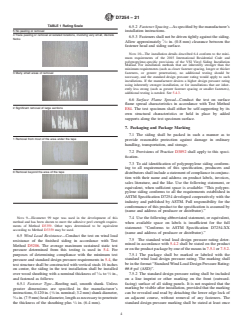
5 No peeling or removal
4 Trace peeling or removal at isolated locations, involving very small, discrete
flecks
3 Many small areas of removal
2 Significant removal of large sections
1 Removal from most of the area under the tape
0 Removal beyond the area of the tape
NOTE 9—Elcometer 99 tape was used in the development of this method and has been shown to meet the adhesive peel strength requirements of Method
D3359. Other tapes determined to be equivalent according to Method D3359 may be used.
6.5 Wind Load Resistance—Conduct the test on wind load resistance of the finished siding in accordance with Test Method D5206.
The average maximum sustained static test pressure determined from this testing is used in 5.55.4. For purposes of determining
compliance with the minimum test pressure and standard design pressure requirements in 5.55.4, the test structure shall be
constructed with vertical studs 16 inches on center, the siding in the test installation shall be installed over wood sheathing with
7 1
a nominal thickness of ⁄16 to ⁄2 in., and fastened as follows:
6.5.1 Fastener Type—Roofing nail, smooth shank. Unless greater dimensions are specified in the manufacturer’s instructions,
1 5
0.120 in. ( ⁄8 in. nominal; 3.2 mm) shank diameter, ⁄16 in. (7.9 mm) head diameter, length as necessary to penetrate the thickness
of the sheathing plus ⁄4 in. (6.4 mm).
6.5.2 Fastener Spacing—As specified by the manufacturer’s installation instructions.
6.5.3 Fasteners shall not be driven tightly against the siding. Allow approximately ⁄32 in. (0.8 mm) clearance between the fastener
head and siding surface.
D7254 − 21
NOTE 10—The installation details described 6.4 conform to the minimum requirements of the 2015 International Residential Code and polypropylene-
specific provisions of the VSI Vinyl Siding Installation Manual. For installation methods that are inherently stronger than the minimum requirements (such
as closer fastener spacing, longer or thicker fasteners, or greater penetration), no additional testing should be necessary, and the standard design pressure
rating would apply to such installations. If the manufacturer desires a higher design pressure rating using inherently stronger installation, or for
installations that are inherently less strong (such as greater fastener spacing or smaller fasteners), additional testing is needed. See 5.5.35.4.3.
6.6 Surface Flame Spread—Conduct the test on surface flame spread characteristics in accordance with Test Method E84. The test
specimen shall either be self-supporting by its own structural characteristics or held in place by added supports along the test
specimen surface.
7. Packaging and Package Marking
7.1 The siding shall be packed in such a manner as to provide reasonable protection against damage in ordinary handling,
transportation, and storage.
7.2 Provisions of Practice D3892 shall apply to this specification.
7.3 To aid identification of polypropylene siding conforming to all requirements of this specification, producers and distributors
shall include a statement of compliance in conjunction with their name and address on product labels, invoices, sales literature,
and the like. Use the following statement, or equivalent, when sufficient space is available: “This polypropylene siding conforms
to all the requirements established in ASTM Specification D7254 developed cooperatively with the industry and published by
ASTM. Full responsibility for the conformance of this product to the specification is assumed by (name and address of producer
or distributor).”
7.4 Use the following abbreviated statement, or equivalent, when available space on labels is insufficient for the full statement:
“Conforms to ASTM Specification D7254-XX (name and address of producer or distributor).”
7.5 The standard wind load design pressure rating determined in accordance with 5.5.25.4.2 shall be stated on the product or on
the product package by one of the means in 7.5.1 or 7.5.2.
7.5.1 The package shall be marked or labeled with the standard wind load design pressure rating. The marking shall be in the
format “Standard Wind Load Design Pressure Rating: ##.# psf (ASD)”.
7.5.2 The standard design pressure rating shall be included on a line imprint or other marking on the front (outward-facing) surface
of all siding panels. It is not required that the marking be visible after installation, provided that the marking can be revealed and
read by detaching the lower edge lock of an adjacent course, without rem
...