

ASTM D69-19
(Test Method)Standard Test Methods for Friction Tapes
General Information
- Abstract
SIGNIFICANCE AND USE
6.1 In most applications, a friction tape must have adequate adhesion to remain in place and function properly.
SCOPE
1.1 These test methods cover the methods and procedures for testing friction tapes. Such tapes consist of a woven fabric sheeting that has been impregnated with an adhesive insulating compound and cut into rolls of narrow width. These tapes are commonly used for protecting and binding in place, insulation applied to joints of electrical wires and cables, and for other mechanical purposes.
Note 1: The material specifications formerly included in these test methods are now contained in Specification D4514.
1.2 The test methods included in this standard are as follows:
Sections
Adhesion
6 – 11
Aged Adhesion
12 – 17
Breaking Strength
18 – 23
Dielectric Breakdown Voltage
24 – 29
Dimensions
30 – 35
Discoloration of Copper
36 – 40
Parallelism
41 – 45
1.3 Units—The values stated in SI units are the standard. The inch-pound units in parentheses are for information only. The values stated in each system are not necessarily exact equivalents; therefore, to ensure conformance with the standard, each system shall be used independently of the other, and values from the two systems shall not be combined.
1.4 This standard does not purport to address all of the safety concerns, if any, associated with its use. It is the responsibility of the user of this standard to establish appropriate safety, health, and environmental practices and determine the applicability of regulatory limitations prior to use.
Note 2: There is no equivalent IEC standard.
1.5 This international standard was developed in accordance with internationally recognized principles on standardization established in the Decision on Principles for the Development of International Standards, Guides and Recommendations issued by the World Trade Organization Technical Barriers to Trade (TBT) Committee.
- Status
- Published
- Publication Date
- 31-Jul-2019
- Technical Committee
- D09 - Electrical and Electronic Insulating Materials
- Drafting Committee
- D09.07 - Electrical Insulating Materials
Overview
ASTM D69-19: Standard Test Methods for Friction Tapes provides a comprehensive framework for assessing the properties and performance of friction tapes. These tapes are manufactured from woven fabric sheeting impregnated with an adhesive insulating compound and are normally supplied in rolls of narrow width. Friction tapes are widely used in electrical, mechanical, and industrial applications for binding, insulation of joints in electrical wires and cables, and protective covering. This standard outlines multiple test methods to evaluate the physical, electrical, and mechanical characteristics required for reliable performance in end-use environments.
Key Topics
ASTM D69-19 addresses a range of essential test methods, including:
- Adhesion: Measures the tape's ability to remain in place and function correctly, crucial for effective insulation and binding.
- Aged Adhesion: Evaluates adhesion retention after aging, which simulates prolonged storage and real-world exposures.
- Breaking Strength: Assesses the tape's mechanical strength and ability to withstand tensile forces without breaking.
- Dielectric Breakdown Voltage: Determines the voltage at which electrical insulation fails, useful for material comparison and quality control, though functional significance is limited in most mechanical applications.
- Dimensions: Ensures correct length, width, and thickness, critical for quality assurance and fulfillment of design criteria.
- Discoloration of Copper: Assesses the likelihood of adhesive compounds in the tape causing copper corrosion or discoloration, indicating the presence of sulfur compounds.
- Parallelism: Checks for uniform width and clean edges, minimizing fraying and ensuring product consistency.
All test procedures must follow strict guidelines for sampling, specimen preparation, conditioning, and the use of SI units as the standard measurement system.
Applications
Friction tape is essential in several industries and scenarios where robust mechanical and insulating properties are required:
- Electrical Work:
- Insulation and bundling of electrical wires and cable joints
- Protective covering for splices and terminations
- Mechanical Protection:
- Binding and securing components in motors, transformers, and panels
- Wrapping pipes and connections for mechanical integrity
- General Industrial Use:
- Temporary repairs and reinforcement of materials
- Securing and protecting hoses, conduits, and other assemblies
Organizations rely on ASTM D69-19 to ensure friction tapes meet required safety, performance, and quality standards in demanding environments.
Related Standards
For broader context or more specific requirements, the following ASTM standards are referenced or related to ASTM D69-19:
- ASTM D4514: Specification for Friction Tape (contains detailed material requirements)
- ASTM D149: Test Method for Dielectric Breakdown Voltage and Strength of Solid Electrical Insulating Materials
- ASTM D412: Test Methods for Vulcanized Rubber and Thermoplastic Elastomers - Tension
- ASTM D1711: Terminology Relating to Electrical Insulation
- ASTM D5423: Specification for Laboratory Ovens for Evaluation of Electrical Insulation
- ASTM D6054: Practice for Conditioning Electrical Insulating Materials for Testing
ASTM D69-19 is widely recognized and approved for use in many sectors, including by agencies of the U.S. Department of Defense. No direct equivalent exists in IEC standards, underlining its unique importance in international and domestic applications.
By following ASTM D69-19, manufacturers, users, and quality assurance professionals can ensure the reliability, safety, and suitability of friction tapes for diverse electrical and mechanical uses.
Relations
- Effective Date
- 01-Aug-2019
- Effective Date
- 01-Mar-2024
- Effective Date
- 01-Jan-2020
- Effective Date
- 01-Nov-2015
- Effective Date
- 01-Nov-2014
- Effective Date
- 01-May-2014
- Effective Date
- 01-Nov-2013
- Effective Date
- 01-Apr-2012
- Effective Date
- 01-Aug-2011
- Effective Date
- 01-May-2008
- Effective Date
- 01-Oct-2006
- Effective Date
- 01-Sep-2005
- Effective Date
- 01-Mar-2004
- Effective Date
- 10-Mar-2002
- Effective Date
- 10-Apr-2000
Get Certified
Connect with accredited certification bodies for this standard

IMQ S.p.A. (Certification)
Italian electrical product certification.

SLG Prüf- und Zertifizierungs GmbH
German testing and certification body.

UL Solutions
Global safety science company with testing, inspection and certification.
Sponsored listings
Frequently Asked Questions
ASTM D69-19 is a standard published by ASTM International. Its full title is "Standard Test Methods for Friction Tapes". This standard covers: SIGNIFICANCE AND USE 6.1 In most applications, a friction tape must have adequate adhesion to remain in place and function properly. SCOPE 1.1 These test methods cover the methods and procedures for testing friction tapes. Such tapes consist of a woven fabric sheeting that has been impregnated with an adhesive insulating compound and cut into rolls of narrow width. These tapes are commonly used for protecting and binding in place, insulation applied to joints of electrical wires and cables, and for other mechanical purposes. Note 1: The material specifications formerly included in these test methods are now contained in Specification D4514. 1.2 The test methods included in this standard are as follows: Sections Adhesion 6 – 11 Aged Adhesion 12 – 17 Breaking Strength 18 – 23 Dielectric Breakdown Voltage 24 – 29 Dimensions 30 – 35 Discoloration of Copper 36 – 40 Parallelism 41 – 45 1.3 Units—The values stated in SI units are the standard. The inch-pound units in parentheses are for information only. The values stated in each system are not necessarily exact equivalents; therefore, to ensure conformance with the standard, each system shall be used independently of the other, and values from the two systems shall not be combined. 1.4 This standard does not purport to address all of the safety concerns, if any, associated with its use. It is the responsibility of the user of this standard to establish appropriate safety, health, and environmental practices and determine the applicability of regulatory limitations prior to use. Note 2: There is no equivalent IEC standard. 1.5 This international standard was developed in accordance with internationally recognized principles on standardization established in the Decision on Principles for the Development of International Standards, Guides and Recommendations issued by the World Trade Organization Technical Barriers to Trade (TBT) Committee.
SIGNIFICANCE AND USE 6.1 In most applications, a friction tape must have adequate adhesion to remain in place and function properly. SCOPE 1.1 These test methods cover the methods and procedures for testing friction tapes. Such tapes consist of a woven fabric sheeting that has been impregnated with an adhesive insulating compound and cut into rolls of narrow width. These tapes are commonly used for protecting and binding in place, insulation applied to joints of electrical wires and cables, and for other mechanical purposes. Note 1: The material specifications formerly included in these test methods are now contained in Specification D4514. 1.2 The test methods included in this standard are as follows: Sections Adhesion 6 – 11 Aged Adhesion 12 – 17 Breaking Strength 18 – 23 Dielectric Breakdown Voltage 24 – 29 Dimensions 30 – 35 Discoloration of Copper 36 – 40 Parallelism 41 – 45 1.3 Units—The values stated in SI units are the standard. The inch-pound units in parentheses are for information only. The values stated in each system are not necessarily exact equivalents; therefore, to ensure conformance with the standard, each system shall be used independently of the other, and values from the two systems shall not be combined. 1.4 This standard does not purport to address all of the safety concerns, if any, associated with its use. It is the responsibility of the user of this standard to establish appropriate safety, health, and environmental practices and determine the applicability of regulatory limitations prior to use. Note 2: There is no equivalent IEC standard. 1.5 This international standard was developed in accordance with internationally recognized principles on standardization established in the Decision on Principles for the Development of International Standards, Guides and Recommendations issued by the World Trade Organization Technical Barriers to Trade (TBT) Committee.
ASTM D69-19 is classified under the following ICS (International Classification for Standards) categories: 29.035.20 - Plastics and rubber insulating materials. The ICS classification helps identify the subject area and facilitates finding related standards.
ASTM D69-19 has the following relationships with other standards: It is inter standard links to ASTM D69-12, ASTM D1711-24, ASTM D149-20, ASTM D1711-15, ASTM D1711-14a, ASTM D1711-14, ASTM D1711-13, ASTM D4514-12, ASTM D1711-11a, ASTM D1711-08, ASTM D4514-06, ASTM D5423-93(2005), ASTM D149-97a(2004), ASTM D1711-02, ASTM D4514-00. Understanding these relationships helps ensure you are using the most current and applicable version of the standard.
ASTM D69-19 is available in PDF format for immediate download after purchase. The document can be added to your cart and obtained through the secure checkout process. Digital delivery ensures instant access to the complete standard document.
Standards Content (Sample)
This international standard was developed in accordance with internationally recognized principles on standardization established in the Decision on Principles for the
Development of International Standards, Guides and Recommendations issued by the World Trade Organization Technical Barriers to Trade (TBT) Committee.
Designation: D69 − 19
Standard Test Methods for
Friction Tapes
This standard is issued under the fixed designation D69; the number immediately following the designation indicates the year of original
adoption or, in the case of revision, the year of last revision.Anumber in parentheses indicates the year of last reapproval.Asuperscript
epsilon (´) indicates an editorial change since the last revision or reapproval.
This standard has been approved for use by agencies of the U.S. Department of Defense.
1. Scope* mendations issued by the World Trade Organization Technical
Barriers to Trade (TBT) Committee.
1.1 These test methods cover the methods and procedures
for testing friction tapes. Such tapes consist of a woven fabric
2. Referenced Documents
sheeting that has been impregnated with an adhesive insulating
compound and cut into rolls of narrow width. These tapes are
2.1 ASTM Standards:
commonly used for protecting and binding in place, insulation
D149 Test Method for Dielectric Breakdown Voltage and
applied to joints of electrical wires and cables, and for other
Dielectric Strength of Solid Electrical Insulating Materials
mechanical purposes.
at Commercial Power Frequencies
D412 Test Methods forVulcanized Rubber andThermoplas-
NOTE 1—The material specifications formerly included in these test
tic Elastomers—Tension
methods are now contained in Specification D4514.
D1711 Terminology Relating to Electrical Insulation
1.2 The test methods included in this standard are as
D4514 Specification for Friction Tape
follows:
D5423 Specification for Forced-Convection Laboratory Ov-
Sections
ens for Evaluation of Electrical Insulation
Adhesion 6–11
D6054 Practice for Conditioning Electrical Insulating Mate-
Aged Adhesion 12–17
Breaking Strength 18–23
rials for Testing (Withdrawn 2012)
Dielectric Breakdown Voltage 24–29
Dimensions 30–35
3. Terminology
Discoloration of Copper 36–40
Parallelism 41–45
3.1 Definitions:
1.3 Units—The values stated in SI units are the standard.
3.1.1 For definitions of other terms used in this
The inch-pound units in parentheses are for information only.
specification, refer to Terminology D1711.
The values stated in each system are not necessarily exact
3.2 Definitions of Terms Specific to This Standard:
equivalents; therefore, to ensure conformance with the
3.2.1 adhesion, n—theresistanceofthetapetounwinditself
standard, each system shall be used independently of the other,
after being wound up under pressure, in accordance with this
and values from the two systems shall not be combined.
test method.
1.4 This standard does not purport to address all of the
3.2.2 breaking strength, n—the force required, per unit
safety concerns, if any, associated with its use. It is the
width, to break the tape when tested in accordance with this
responsibility of the user of this standard to establish appro-
test method.
priate safety, health, and environmental practices and deter-
3.2.3 conditioning, n—the exposure of the tape to the
mine the applicability of regulatory limitations prior to use.
influence of a prescribed atmosphere for a stipulated period of
NOTE 2—There is no equivalent IEC standard.
time.
1.5 This international standard was developed in accor-
3.2.4 length of tape in a roll, n—the number of linear yards
dance with internationally recognized principles on standard-
or meters of tape wound into a roll as measured in accordance
ization established in the Decision on Principles for the
with this test method.
Development of International Standards, Guides and Recom-
1 2
These test methods are under the jurisdiction of ASTM Committee D09 on For referenced ASTM standards, visit the ASTM website, www.astm.org, or
Electrical and Electronic Insulating Materials and are the direct responsibility of contact ASTM Customer Service at service@astm.org. For Annual Book of ASTM
Subcommittee D09.07 on Electrical Insulating Materials. Standards volume information, refer to the standard’s Document Summary page on
Current edition approved Aug. 1, 2019. Published August 2019. Originally the ASTM website.
approved in 1920. Last previous edition approved in 2012 as D69 – 12. DOI: The last approved version of this historical standard is referenced on
10.1520/D0069-19. www.astm.org.
*A Summary of Changes section appears at the end of this standard
Copyright © ASTM International, 100 Barr Harbor Drive, PO Box C700, West Conshohocken, PA 19428-2959. United States
D69−19
3.2.5 parallelism, n—the difference in width between two 7. Apparatus
mated ends of a tape that has been split in half, in accordance
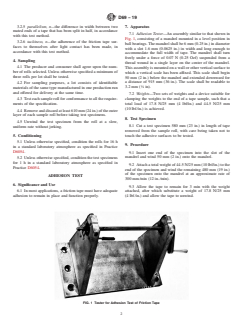
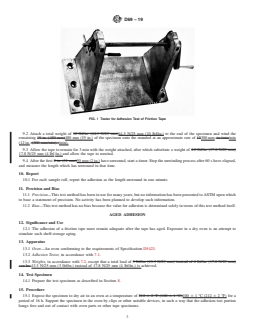
7.1 Adhesion Tester—An assembly similar to that shown in
with this test method.
Fig. 1, consisting of a mandrel mounted in a level position in
3.2.6 tackiness, n—the adherence of the friction tape sur-
ball bearings.The mandrel shall be 6 mm (0.25 in.) in diameter
faces to themselves after light contact has been made, in
with a slot 1.6 mm (0.0625 in.) in width and long enough to
accordance with this test method.
accommodate the full width of tape. The mandrel shall turn
freely under a force of 0.07 N (0.25 Ozf) suspended from a
4. Sampling
thread wound in a single layer on the center of the mandrel.
4.1 The producer and consumer shall agree upon the num-
This assembly is mounted on a wall or other vertical surface to
ber of rolls selected. Unless otherwise specified a minimum of
which a vertical scale has been affixed. This scale shall begin
three rolls per lot shall be tested.
50 mm (2 in.) below the mandrel and extended downward for
a distance of 915 mm (36 in.). The scale shall be readable to
4.2 For sampling purposes, a lot consists of identifiable
3.2 mm ( ⁄8 in).
materials of the same type manufactured in one production run
and offered for delivery at the same time.
7.2 Weights—Two sets of weights and a device suitable for
4.3 Test each sample roll for conformance to all the require- clamping the weights to the end of a tape sample, such that a
total load of 17.8 N/25 mm (4 lbf/in.) and 44.5 N/25 mm
ments of the specification.
(10 lbf⁄in.) is achieved.
4.4 Removeanddiscardatleast610mm(24in.)oftheouter
layer of each sample roll before taking test specimens.
8. Test Specimen
4.5 Unwind the test specimen from the roll at a slow,
8.1 Cut a test specimen 580 mm (23 in.) in length of tape
uniform rate without jerking.
removed from the sample roll, with care being taken not to
5. Conditioning touch the adhesive surfaces to be tested.
5.1 Unless otherwise specified, condition the rolls for 16 h
9. Procedure
in a standard laboratory atmosphere as specified in Practice
D6054.
9.1 Insert one end of the specimen into the slot of the
mandrel and wind 50 mm (2 in.) onto the mandrel.
5.2 Unless otherwise specified, condition the test specimens
for 1 h in a standard laboratory atmosphere as specified in
9.2 Attach a total weight of 44.5 N/25 mm (10 lbf/in.) to the
Practice D6054.
end of the specimen and wind the remaining 480 mm (19 in.)
of the specimen onto the mandrel at an approximate rate of
ADHESION TEST
300 mm⁄min (12 in.⁄min).
6. Significance and Use
9.3 Allow the tape to remain for 3 min with the weight
6.1 In most applications, a friction tape must have adequate attached, after which substitute a weight of 17.8 N/25 mm
adhesion to remain in place and function properly. (4 lbf⁄in.) and allow the tape to unwind.
FIG. 1 Tester for Adhesion Test of Friction Tape
D69−19
9.4 Afterthefirst50mm(2in.)haveunwound,startatimer. which to base a statement of precision. No activity has been
Stop the unwinding process after 60 s have elapsed, and planned to develop such information.
measure the length which has unwound in that time.
17.2 Bias—This test method has no bias because the value
for aged adhesion is determined solely in terms of this test
10. Report
method itself.
10.1 For each sample roll, report the adhesion as the length
unwound in one minute.
BREAKING STRENGTH
11. Precision and Bias
18. Significance and Use
11.1 Precision—This test method has been in use for many
18.1 The breaking strength of the tape is an indicator of
years, but no information has been presented to ASTM upon
uniform quality and the ability to withstand mechanical load in
which to base a statement of precision. No activity has been
service.
planned to develop such information.
11.2 Bias—This test method has no bias because the value
19. Apparatus
for adhesion is determined solely in terms of this test method
19.1 Tensile Testing Machine—Aconstant rate of elongation
itself.
type tensile machine as described in Test Methods D412.
AGED ADHESION
20. Test Specimen
12. Significance and Use
20.1 Test specimens shall consist of a single layer of tape
12.1 The adhesion of a friction tape must remain adequate
400mm(16in.)inlengthandthewidthofthetapeasreceived.
after the tape has aged. Exposure in a dry oven is an attempt to
simulate such shelf-storage aging.
21. Procedure
13. Apparatus
21.1 Measure the width of the specimen in accordance with
Section 33.
13.1 Oven—An oven conforming to the requirements of
Specification D5423.
21.2 Perform the test for breaking strength in accordance
with Test Methods D412, Method A.
13.2 Adhesion Tester, in accordance with 7.1.
21.3 Samples shall be tested as straight specimens unless
13.3 Weights,inaccordancewith7.2,exceptthatatotalload
otherwise noted.
of 13.3 N/25 mm (3 lbf/in.) instead of 17.8 N/25 mm (4 lbf/in.)
is achieved.
21.4 Set the initial distance between the jaws of the testing
machine at 300 mm (12 in.) and the rate of separation of the
14. Test Specimen
jaws at 5
...
This document is not an ASTM standard and is intended only to provide the user of an ASTM standard an indication of what changes have been made to the previous version. Because
it may not be technically possible to adequately depict all changes accurately, ASTM recommends that users consult prior editions as appropriate. In all cases only the current version
of the standard as published by ASTM is to be considered the official document.
Designation: D69 − 12 D69 − 19
Standard Test Methods for
Friction Tapes
This standard is issued under the fixed designation D69; the number immediately following the designation indicates the year of original
adoption or, in the case of revision, the year of last revision. A number in parentheses indicates the year of last reapproval. A superscript
epsilon (´) indicates an editorial change since the last revision or reapproval.
This standard has been approved for use by agencies of the U.S. Department of Defense.
1. Scope*
1.1 These test methods cover the methods and procedures for testing friction tapes. Such tapes consist of a woven fabric
sheeting that has been impregnated with an adhesive insulating compound and cut into rolls of narrow width. These tapes are
commonly used for protecting and binding in place, insulation applied to joints of electrical wires and cables, and for other
mechanical purposes.
NOTE 1—The material specifications formerly included in these test methods are now contained in Specification D4514.
1.2 The test methods included in this standard are as follows:
Sections
Adhesion 6 – 11
Aged Adhesion 12 – 17
Breaking Strength 18 – 23
Dielectric Breakdown Voltage 24 – 29
Dimensions 30 – 35
Discoloration of Copper 36 – 40
Parallelism 41 – 45
1.3 Units—The values stated in inch-poundSI units are the standard. The SIinch-pound units in parentheses are for information
only. The values stated in each system are not necessarily exact equivalents; therefore, to ensure conformance with the standard,
each system shall be used independently of the other, and values from the two systems shall not be combined.
1.4 This standard does not purport to address all of the safety concerns, if any, associated with its use. It is the responsibility
of the user of this standard to establish appropriate safety safety, health, and healthenvironmental practices and determine the
applicability of regulatory limitations prior to use.
NOTE 2—There is no equivalent IEC standard.
1.5 This international standard was developed in accordance with internationally recognized principles on standardization
established in the Decision on Principles for the Development of International Standards, Guides and Recommendations issued
by the World Trade Organization Technical Barriers to Trade (TBT) Committee.
2. Referenced Documents
2.1 ASTM Standards:
D149 Test Method for Dielectric Breakdown Voltage and Dielectric Strength of Solid Electrical Insulating Materials at
Commercial Power Frequencies
D412 Test Methods for Vulcanized Rubber and Thermoplastic Elastomers—Tension
D1711 Terminology Relating to Electrical Insulation
D4514 Specification for Friction Tape
D5423 Specification for Forced-Convection Laboratory Ovens for Evaluation of Electrical Insulation
D6054 Practice for Conditioning Electrical Insulating Materials for Testing (Withdrawn 2012)
These test methods are under the jurisdiction of ASTM Committee D09 on Electrical and Electronic Insulating Materials and are the direct responsibility of Subcommittee
D09.07 on Flexible and Rigid Electrical Insulating Materials.
Current edition approved April 1, 2012Aug. 1, 2019. Published April 2012August 2019. Originally approved in 1920. Last previous edition approved in 20062012 as
D69 – 06.D69 – 12. DOI: 10.1520/D0069-12.10.1520/D0069-19.
For referenced ASTM standards, visit the ASTM website, www.astm.org, or contact ASTM Customer Service at service@astm.org. For Annual Book of ASTM Standards
volume information, refer to the standard’s Document Summary page on the ASTM website.
The last approved version of this historical standard is referenced on www.astm.org.
*A Summary of Changes section appears at the end of this standard
Copyright © ASTM International, 100 Barr Harbor Drive, PO Box C700, West Conshohocken, PA 19428-2959. United States
D69 − 19
3. Terminology
3.1 Definitions:
3.1.1 For definitions of other terms used in this specification, refer to Terminology D1711.
3.2 Definitions of Terms Specific to This Standard:
3.2.1 adhesion, n—the resistance of the tape to unwind itself after being wound up under pressure, in accordance with this test
method.
3.2.2 breaking strength, n—the force required, per unit width, to break the tape when tested in accordance with this test method.
3.2.3 conditioning, n—the exposure of the tape to the influence of a prescribed atmosphere for a stipulated period of time.
3.2.4 length of tape in a roll, n—the number of linear yards or metresmeters of tape wound into a roll as measured in accordance
with this test method.
3.2.5 parallelism, n—the difference in width between two mated ends of a tape that has been split in half, in accordance with
this test method.
3.2.6 tackiness, n—the adherence of the friction tape surfaces to themselves after light contact has been made, in accordance
with this test method.
4. Sampling
4.1 The producer and consumer shall agree upon the number of rolls selected. Unless otherwise specified a minimum of three
rolls per lot shall be tested.
4.2 For sampling purposes, a lot consists of identifiable materials of the same type manufactured in one production run and
offered for delivery at the same time.
4.3 Test each sample roll for conformance to all the requirements of the specification.
4.4 Remove and discard at least 24 in. (610 mm)610 mm (24 in.) of the outer layer of each sample roll before taking test
specimens.
4.5 Unwind the test specimen from the roll at a slow, uniform rate without jerking.
5. Conditioning
5.1 Unless otherwise specified, condition the rolls for 16 h in a standard laboratory atmosphere as specified in Practice D6054.
5.2 Unless otherwise specified, condition the test specimens for 1 h in a standard laboratory atmosphere as specified in Practice
D6054.
ADHESION TEST
6. Significance and Use
6.1 In most applications, a friction tape must have adequate adhesion to remain in place and function properly.
7. Apparatus
7.1 Adhesion Tester—An assembly similar to that shown in Fig. 1, consisting of a mandrel mounted in a level position in ball
bearings. The mandrel shall be 0.25 in. (6.4 mm)6 mm (0.25 in.) in diameter with a slot approximately 0.0625 in. (1.6 mm) 1.6
mm (0.0625 in.) in width and long enough to accommodate the full width of tape. The mandrel shall turn freely under a force of
0.25 ozf (0.07 N)0.07 N (0.25 Ozf) suspended from a thread wound in a single layer on the center of the mandrel. This assembly
is mounted on a wall or other vertical surface to which a vertical scale has been affixed. This scale shall begin 2 in. (51 mm)50
mm (2 in.) below the mandrel and extended downward for a distance of 36 in. (915 mm).915 mm (36 in.). The scale shall be
1 1
readable to ⁄8 in. 3.2 mm ( ⁄8(3.2 mm). in).
7.2 Weights—Two sets of weights and a device suitable for clamping the weights to the end of a tape sample, such that a total
load of 4.0 lbf/in. (17.8 N/25 mm) and 10 lbf/in. (44.5 N/25 mm) can17.8 N/25 mm (4 lbf/in.) and 44.5 N/25 mm (10 lbf be⁄in.)
is achieved.
8. Test Specimen
8.1 Cut a test specimen 23 in. (580 mm)580 mm (23 in.) in length of tape removed from the sample roll, with care being taken
not to touch the adhesive surfaces to be tested.
9. Procedure
9.1 Insert one end of the specimen into the slot of the mandrel and wind 2 in. (51 mm)50 mm (2 in.) onto the mandrel.
D69 − 19
FIG. 1 Tester for Adhesion Test of Friction Tape
9.2 Attach a total weight of 10 lbf/in. (44.5 N/25 mm)44.5 N/25 mm (10 lbf/in.) to the end of the specimen and wind the
remaining 19 in. (480 mm)480 mm (19 in.) of the specimen onto the mandrel at an approximate rate of 12300 mm in./min⁄min
(12 in. (300 mm/min). ⁄min).
9.3 Allow the tape to remain for 3 min with the weight attached, after which substitute a weight of 4.0 lbf/in. (17.8 N/25 mm)
17.8 N/25 mm (4 lbf ⁄in.) and allow the tape to unwind.
9.4 After the first 2 in. (51 mm)50 mm (2 in.) have unwound, start a timer. Stop the unwinding process after 60 s have elapsed,
and measure the length which has unwound in that time.
10. Report
10.1 For each sample roll, report the adhesion as the length unwound in one minute.
11. Precision and Bias
11.1 Precision—This test method has been in use for many years, but no information has been presented to ASTM upon which
to base a statement of precision. No activity has been planned to develop such information.
11.2 Bias—This test method has no bias because the value for adhesion is determined solely in terms of this test method itself.
AGED ADHESION
12. Significance and Use
12.1 The adhesion of a friction tape must remain adequate after the tape has aged. Exposure in a dry oven is an attempt to
simulate such shelf-storage aging.
13. Apparatus
13.1 Oven—An oven conforming to the requirements of Specification D5423.
13.2 Adhesion Tester, in accordance with 7.1.
13.3 Weights, in accordance with 7.2, except that a total load of 3 lbf/in. (13.3 N/25 mm) instead of 4 lbf/in. (17.8 N/25 mm)
can be 13.3 N/25 mm (3 lbf/in.) instead of 17.8 N/25 mm (4 lbf/in.) is achieved.
14. Test Specimen
14.1 Prepare the test specimen as described in Section 8.
15. Procedure
15.1 Expose the specimen to dry air in an oven at a temperature of 212 6 2 °F (100 6 1 °C)100 6 1 °C (212 6 2 °F) for a
period of 16 h. Support the specimen in the oven by clips or other suitable devices, in such a way that the adhesion test portion
hangs free and out of contact with oven parts or other tape specimens.
D69 − 19
15.2 After aging, allow the specimens to condition at a temperature of 73.4 6 2 °F (23 6 1 °C)23 6 1 °C (73.4 6 2 °F) and
50 6 2 %10 % relative humidity for a period of not less than 4 h nor more than 8 h, during which the adhesive surface shall be
protected from contact with foreign material.
15.3 Test the specimen for adhesion following the procedure of Section 9, except that the load applied to unwind the tape shall
be 3 lbf/in. (13.3 N/25 mm) and not 4 lbf/in. (17.8 N/25 mm).13.3 N/25 mm (3 lbf/in.) and not 17.8 N/25 mm (4 lbf/in.).
16. Report
16.1 For each sample roll, report the aged adhesion as the length unwound in one minute.
17. Precision and Bias
17.1 Precision—This test method has been in use
...