

ASTM D710-19
(Specification)Standard Specification for Vulcanized Fibre Sheets, Rolls, Rods, and Tubes Used for Electrical Insulation
General Information
- Abstract
ABSTRACT
This specification covers vulcanized fibres in sheet, round rod, and round tube forms of bone, commercial, and electrical insulation grades. Fibres shall be tested appropriatedly and consequently conform to specified color, chemical composition, flexural strength, impact strength, tearing strength, compressive strength, water absorption, dielectric strength, bursting strength, density, Rockwell hardness, and dimensional and size requirements.
SCOPE
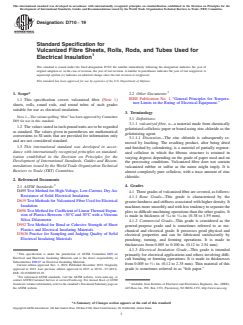
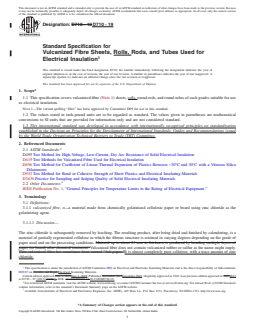
1.1 This specification covers vulcanized fibre (Note 1) sheets, rolls, round rods, and round tubes of such grades suitable for use as electrical insulation.
Note 1: The variant spelling “fibre” has been approved by Committee D09 for use in this standard.
1.2 The values stated in inch-pound units are to be regarded as standard. The values given in parentheses are mathematical conversions to SI units that are provided for information only and are not considered standard.
1.3 This international standard was developed in accordance with internationally recognized principles on standardization established in the Decision on Principles for the Development of International Standards, Guides and Recommendations issued by the World Trade Organization Technical Barriers to Trade (TBT) Committee.
- Status
- Published
- Publication Date
- 31-Oct-2019
- Technical Committee
- D09 - Electrical and Electronic Insulating Materials
- Drafting Committee
- D09.07 - Electrical Insulating Materials
Buy Documents
ASTM D710-19 - Standard Specification for Vulcanized Fibre Sheets, Rolls, Rods, and Tubes Used for Electrical Insulation
REDLINE ASTM D710-19 - Standard Specification for Vulcanized Fibre Sheets, Rolls, Rods, and Tubes Used for Electrical Insulation
Overview
ASTM D710-19: Standard Specification for Vulcanized Fibre Sheets, Rolls, Rods, and Tubes Used for Electrical Insulation provides a comprehensive framework for the classification, properties, and requirements of vulcanized fibre products used primarily as electrical insulation. This standard, developed by ASTM International, covers sheets, rolls, rods, and tubes across bone, commercial, and electrical insulation grades. Its requirements help ensure consistent material quality and reliable performance in electrical and mechanical applications within various industries.
Key Topics
- Material Types and Grades: The standard covers bone grade (hard, high-density and machinable), commercial grade (versatile general-purpose), and electrical insulation grade (superior for electrical insulation, also known as "fish paper").
- Physical and Electrical Properties: Requirements include color, chemical composition (cellulose content with minimal zinc chloride residue), flexural strength, impact strength, tearing strength, compressive strength, water absorption, dielectric strength, bursting strength, density, and Rockwell hardness.
- Dimensional Accuracy: Permissible variations in thickness, width, diameter, and length for all product forms are specified for manufacturing and quality control.
- Forms and Availability: Vulcanized fibre is available in sheets, rolls, rods, tubes, and laminated forms, with various colors including gray, black, red, white, and blue.
- Testing and Quality Assurance: Sampling and property testing are conducted per referenced ASTM test methods to ensure compliance.
- Workmanship and Storage: Materials must be free of blisters and major defects, with guidance on storage to maintain moisture equilibrium and prevent warpage or dimensional change.
Applications
ASTM D710-19 is widely used across industries where electrical insulation and reliable mechanical properties are critical:
- Electrical Equipment Manufacturing: Used for insulation barriers, spacers, slot liners, and arc chutes in transformers, circuit breakers, fuses, and switchgear.
- Motor and Generator Manufacturing: Provides slot insulation and phase separation.
- Automotive and Transportation: Suitable for electrical and mechanical insulation in components such as ignition systems and lighting.
- Consumer Electronics: Applied in various electrical devices requiring formable, durable, non-conductive barriers.
- General Industrial: Utilized for mechanical gaskets, washers, and templates where rigidity, machinability, and insulating properties are needed.
The availability of various grades allows engineers to select the most suitable material for specific electrical, mechanical, or fabrication demands.
Related Standards
ASTM D710-19 references multiple standards and practices to ensure comprehensive evaluation and performance:
- ASTM D495: Test Method for High-Voltage, Low-Current, Dry Arc Resistance of Solid Electrical Insulation
- ASTM D619: Test Methods for Vulcanized Fibre Used for Electrical Insulation
- ASTM D696: Test Method for Coefficient of Linear Thermal Expansion of Plastics
- ASTM D952: Test Method for Bond or Cohesive Strength of Sheet Plastics and Electrical Insulating Materials
- ASTM D3636: Practice for Sampling and Judging Quality of Solid Electrical Insulating Materials
- IEEE Publication No. 1: General Principles for Temperature Limits in the Rating of Electrical Equipment
Keywords: vulcanized fibre, electrical insulation, ASTM D710, fish paper, rigid rods, rigid sheets, rigid tubes, dielectric strength, insulation standards, electrical equipment insulation.
By adhering to ASTM D710-19, organizations ensure that vulcanized fibre products used for electrical insulation meet rigorous quality, safety, and performance expectations, supporting reliable and safe operation in a wide array of electrical and industrial systems.
Relations
- Effective Date
- 01-Nov-2019
- Effective Date
- 01-Apr-2019
- Effective Date
- 01-Apr-2016
- Effective Date
- 01-Mar-2013
- Effective Date
- 01-Mar-2013
- Effective Date
- 01-Jan-2013
- Effective Date
- 15-Apr-2011
- Effective Date
- 01-May-2010
- Effective Date
- 01-Nov-2008
- Effective Date
- 01-Jun-2006
- Effective Date
- 10-Apr-2003
- Effective Date
- 10-Apr-2002
- Effective Date
- 10-Apr-2002
- Effective Date
- 10-Sep-2000
- Effective Date
- 10-Oct-1999
Buy Documents
ASTM D710-19 - Standard Specification for Vulcanized Fibre Sheets, Rolls, Rods, and Tubes Used for Electrical Insulation
REDLINE ASTM D710-19 - Standard Specification for Vulcanized Fibre Sheets, Rolls, Rods, and Tubes Used for Electrical Insulation
Get Certified
Connect with accredited certification bodies for this standard

IMQ S.p.A. (Certification)
Italian electrical product certification.

SLG Prüf- und Zertifizierungs GmbH
German testing and certification body.

UL Solutions
Global safety science company with testing, inspection and certification.
Sponsored listings
Frequently Asked Questions
ASTM D710-19 is a technical specification published by ASTM International. Its full title is "Standard Specification for Vulcanized Fibre Sheets, Rolls, Rods, and Tubes Used for Electrical Insulation". This standard covers: ABSTRACT This specification covers vulcanized fibres in sheet, round rod, and round tube forms of bone, commercial, and electrical insulation grades. Fibres shall be tested appropriatedly and consequently conform to specified color, chemical composition, flexural strength, impact strength, tearing strength, compressive strength, water absorption, dielectric strength, bursting strength, density, Rockwell hardness, and dimensional and size requirements. SCOPE 1.1 This specification covers vulcanized fibre (Note 1) sheets, rolls, round rods, and round tubes of such grades suitable for use as electrical insulation. Note 1: The variant spelling “fibre” has been approved by Committee D09 for use in this standard. 1.2 The values stated in inch-pound units are to be regarded as standard. The values given in parentheses are mathematical conversions to SI units that are provided for information only and are not considered standard. 1.3 This international standard was developed in accordance with internationally recognized principles on standardization established in the Decision on Principles for the Development of International Standards, Guides and Recommendations issued by the World Trade Organization Technical Barriers to Trade (TBT) Committee.
ABSTRACT This specification covers vulcanized fibres in sheet, round rod, and round tube forms of bone, commercial, and electrical insulation grades. Fibres shall be tested appropriatedly and consequently conform to specified color, chemical composition, flexural strength, impact strength, tearing strength, compressive strength, water absorption, dielectric strength, bursting strength, density, Rockwell hardness, and dimensional and size requirements. SCOPE 1.1 This specification covers vulcanized fibre (Note 1) sheets, rolls, round rods, and round tubes of such grades suitable for use as electrical insulation. Note 1: The variant spelling “fibre” has been approved by Committee D09 for use in this standard. 1.2 The values stated in inch-pound units are to be regarded as standard. The values given in parentheses are mathematical conversions to SI units that are provided for information only and are not considered standard. 1.3 This international standard was developed in accordance with internationally recognized principles on standardization established in the Decision on Principles for the Development of International Standards, Guides and Recommendations issued by the World Trade Organization Technical Barriers to Trade (TBT) Committee.
ASTM D710-19 is classified under the following ICS (International Classification for Standards) categories: 29.035.20 - Plastics and rubber insulating materials. The ICS classification helps identify the subject area and facilitates finding related standards.
ASTM D710-19 has the following relationships with other standards: It is inter standard links to ASTM D710-13, ASTM D3636-19, ASTM D696-16, ASTM D3636-13a, ASTM D3636-13ae1, ASTM D3636-13, ASTM D3636-11, ASTM D952-10, ASTM D696-08, ASTM D3636-06, ASTM D696-03, ASTM D952-95, ASTM D952-02, ASTM D3636-00, ASTM D619-99(2004). Understanding these relationships helps ensure you are using the most current and applicable version of the standard.
ASTM D710-19 is available in PDF format for immediate download after purchase. The document can be added to your cart and obtained through the secure checkout process. Digital delivery ensures instant access to the complete standard document.
Standards Content (Sample)
This international standard was developed in accordance with internationally recognized principles on standardization established in the Decision on Principles for the
Development of International Standards, Guides and Recommendations issued by the World Trade Organization Technical Barriers to Trade (TBT) Committee.
Designation:D710 −19
Standard Specification for
Vulcanized Fibre Sheets, Rolls, Rods, and Tubes Used for
Electrical Insulation
This standard is issued under the fixed designation D710; the number immediately following the designation indicates the year of
original adoption or, in the case of revision, the year of last revision.Anumber in parentheses indicates the year of last reapproval.A
superscript epsilon (´) indicates an editorial change since the last revision or reapproval.
This standard has been approved for use by agencies of the U.S. Department of Defense.
1. Scope* 2.2 Other Documents:
IEEE Publication No. 1,“General Principles for Tempera-
1.1 This specification covers vulcanized fibre (Note 1)
ture Limits in the Rating of Electrical Equipment.”
sheets, rolls, round rods, and round tubes of such grades
suitable for use as electrical insulation.
3. Terminology
NOTE 1—The variant spelling “fibre” has been approved by Committee
3.1 Definitions:
D09 for use in this standard.
3.1.1 vulcanized fibre, n—a material made from chemically
1.2 The values stated in inch-pound units are to be regarded
gelatinized cellulosic paper or board using zinc chloride as the
as standard. The values given in parentheses are mathematical
gelatinizing agent.
conversions to SI units that are provided for information only
3.1.1.1 Discussion—The zinc chloride is subsequently re-
and are not considered standard.
moved by leaching. The resulting product, after being dried
1.3 This international standard was developed in accor-
and finished by calendering, is a material of partially regener-
dance with internationally recognized principles on standard-
ated cellulose in which the fibrous structure is retained in
ization established in the Decision on Principles for the
varying degrees depending on the grade of paper used and on
Development of International Standards, Guides and Recom-
the processing conditions. Vulcanized fibre does not contain
mendations issued by the World Trade Organization Technical
vulcanized rubber or sulfur as the name might imply. It is
Barriers to Trade (TBT) Committee.
almost completely pure cellulose, with a trace amount of zinc
chloride.
2. Referenced Documents
4. Grades
2.1 ASTM Standards:
D495Test Method for High-Voltage, Low-Current, DryArc
4.1 Threegradesofvulcanizedfibrearecovered,asfollows:
Resistance of Solid Electrical Insulation
4.1.1 Bone Grade—This grade is characterized by the
D619Test Methods forVulcanized Fibre Used for Electrical
greater hardness and stiffness associated with higher density. It
Insulation
machinesmoresmoothlyandwithlesstendencytoseparatethe
D696TestMethodforCoefficientofLinearThermalExpan-
plies in difficult machining operations than the other grades. It
sion of Plastics Between −30°C and 30°C with a Vitreous 1 1
is made in thickness of ⁄64 to ⁄16in. (0.38 to 1.59 mm).
Silica Dilatometer
4.1.2 Commercial Grade—This grade is considered as the
D952Test Method for Bond or Cohesive Strength of Sheet
general-purpose grade and is sometimes referred to as me-
Plastics and Electrical Insulating Materials
chanical and electrical grade. It possesses good physical and
D3636Practice for Sampling and Judging Quality of Solid
electrical properties and can be fabricated satisfactorily by
Electrical Insulating Materials
punching, turning, and forming operations. It is made in
thicknesses from 0.005 to 0.100in. (0.12 to 2.54 mm).
4.1.3 Electrical Insulation Grade—This grade is intended
This specification is under the jurisdiction of ASTM Committee D09 on
primarily for electrical applications and others involving diffi-
Electrical and Electronic Insulating Materials and is the direct responsibility of
cult bending or forming operations. It is made in thicknesses
Subcommittee D09.07 on Electrical Insulating Materials.
from 0.005 to ⁄32 in. (0.12 to 2.35 mm). Thin material of this
Current edition approved Nov. 1, 2019. Published December 2019. Originally
grade is sometimes referred to as “fish paper.”
approved in 1943. Last previous edition approved in 2013 as D710–97(2013).
DOI: 10.1520/D0710-19.
For referenced ASTM standards, visit the ASTM website, www.astm.org, or
contact ASTM Customer Service at service@astm.org. For Annual Book of ASTM
Standards volume information, refer to the standard’s Document Summary page on Available from Institute of Electrical and Electronics Engineers, Inc. (IEEE),
the ASTM website. 445 Hoes Ln., P.O. Box 1331, Piscataway, NJ 08854-1331, http://www.ieee.org.
*A Summary of Changes section appears at the end of this standard
Copyright © ASTM International, 100 Barr Harbor Drive, PO Box C700, West Conshohocken, PA 19428-2959. United States
D710−19
TABLE 2 Chemical Requirements
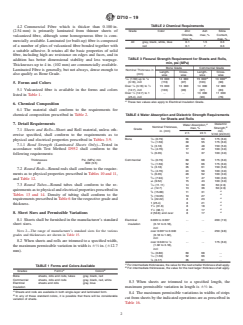
4.2 Commercial Fibre which is thicker than 0.100in.
(2.54mm) is primarily laminated from thinner sheets of Grade Color Zinc Ash Silica
Chloride, max, % Content,
vulcanized fibre, although some homogeneous fibre is com-
max, % max, %
mercially available. Laminated (or built-up) fibre is composed
All gray, black, white, blue 0.1 1.5 0.3
of a number of plies of vulcanized fibre bonded together with red 0.1 7 0.3
a suitable adhesive. It retains all the basic properties of solid
fibre, including high arc resistance on edges and faces, and in
TABLE 3 Flexural Strength Requirement for Sheets and Rolls,
addition has better dimensional stability and less warpage.
min, psi (MPa)
Thicknesses up to 4 in. (102 mm) are commercially available.
Bone Grade Commercial Grade
Laminated Fibre is generally, but not always, dense enough to
Nominal Thickness in.
Length- Cross- Length- Cross-
(mm)
also qualify as Bone Grade.
wise wise wise wise
A A
1 1
⁄16 (1.59) up to ⁄8 16 000 14 000 15 000 13 000
(103) (90)
(3.18), incl (110) (97)
5. Forms and Colors
1 1
Over ⁄8 (3.18) to ⁄2 15 000 13 000 14 000 12 000
(12.7), incl (103) (90) (97) (83)
5.1 Vulcanized fibre is available in the forms and colors
Over ⁄2 (12.7) to 1 . . 13 000 11 000
listed in Table 1.
(25.4), incl (90) (76)
A
These two values also apply to Electrical Insulation Grade.
6. Chemical Composition
6.1 The material shall conform to the requirements for
chemical composition prescribed in Table 2.
TABLE 4 Water Absorption and Dielectric Strength Requirements
for Sheets and Rolls
7. Detail Requirements A
Dielectric
Water Absorption,
B
Nominal Thickness,
max, %
Strength,
Grade
7.1 Sheets and Rolls—Sheet and Roll material, unless oth-
in. (mm) min,
2h 24h
V/mil (kV/mm)
erwise specified, shall conform to the requirements as to
Bone ⁄32 (0.79) 55 63 175 (6.9)
physical and electrical properties prescribed in Tables 3-9.
⁄16 (1.59) 30 55 175 (6.9)
7.1.1 Bond Strength (Laminated Sheets Only)—Tested in
⁄8 (3.18) 20 48 150 (5.9)
accordance with Test Method D952 shall conform to the ⁄16 (4.76) 17 42 100 (3.9)
⁄4 (6.35) 14 37 100 (3.9)
following requirements:
Thicknesses Psi, (MPa) min
Commercial ⁄32 (0.79) 60 68 175 (6.9)
All 800 (5.5) ⁄16 (1.59) 52 66 175 (6.9)
⁄8 (3.18) 35 61 150 (5.9)
7.2 Round Rods—Round rods shall conform to the require-
⁄16 (4.76) 24 56 100 (3.9)
ments as to physical properties prescribed in Tables 10 and 11,
⁄4 (6.35) 20 52 100 (3.9)
⁄16 (7.94) 17 47 100 (3.9)
and Table 12.
⁄8 (9.52) 15 43 100 (3.9)
7.3 Round Tubes—Round tubes shall conform to the re- ⁄16 (11.11) 14 39 50 (2.0)
⁄2 (12.7) 13 36 50 (2.0)
quirementsastophysicalandelectricalpropertiesprescribedin
A
⁄8 (15.88) 11 31
Tables 13 and 14. Density of tubing shall conform to the 3 A
⁄4 (19.05) 10 27
A
requirementsprescribedinTable6fortherespectivegradeand ⁄8 (22.22) 8 23
A
1 (25.4) 8 21
thickness.
A
1 ⁄4 (31.8) 8 18
A
1 ⁄2 (38.1) 8 17
A
8. Sheet Sizes and Permissible Variations 2 (50.8) and over 8 17
8.1 Sheets shall be furnished in the manufacturer’s standard
Electrical 0.005 to 0.007 . . 200 (7.9)
insulation (0.12 to 0.18),
sheet sizes.
incl
NOTE 2—The range of manufacturer’s standard sizes for the various over 0.007 to 0.040 . . 250 (9.8)
(0.18 to 1.02),
grades and thicknesses are shown in Table 15.
incl
8.2 When sheets and rolls are trimmed to a specified width, 1
over 0.040 to ⁄8 . . 175 (6.9)
(1.02 to 3.18),
the maximum permissible variation in width is 6 ⁄2 in. (612.7
incl
mm).
⁄32 (0.80) 60 68 .
⁄16 (1.59) 52 66 .
⁄8 (3.17) 35 61 .
A
Forintermediatethicknesses,thevalueforthenextsmallerthicknessshallapply.
TABLE 1 Forms and Colors Available
B
For intermediate thicknesses, the value for the next larger thickness shall apply.
A B
Grades Forms Colors
Bone sheets, rolls and rods, tubes gray, black, red
Commercial sheets, rolls and rods gray, black, red, white
8.3 When sheets are trimmed to a specified length, the
Electrical sheets and rolls gray, blue
Insulation maximum permissible variation in length is 6 ⁄2 in.
A
Sheets and rods are available in both single-layer and laminated form.
8.4 The maximum permissible variations in widths of strips
B
In any of these standard colors, it is possible that there will be considerable
cutfromsheetsbytheindicatedoperationsareasprescribedin
variation of shade.
Table 16.
D710−19
TABLE 5 Bursting Strength Requirements for Sheets and Rolls, TABLE 10 Tensile Strength Requirements for Round Rods, min,
min, psi (MPa) psi (MPa)
Nominal Nominal Diameter, in. (mm) Bone Grade Commercial Grade
Commercial Electrical Insula-
1 1
Thickness, in. Bone Grade ⁄8 to ⁄2 (3.18 to 12.7), incl 8500 (59) 8000 (55)
Grade tion Grade
(mm) Over ⁄2 (12.7) . 7000 (48)
0.005 (0.13) . . 65 (0.4)
0.007 (0.18) . . 95 (8.7)
0.010 (0.25) . 125 (0.9) 125 (0.9)
TABLE 11 Water Absorption Requirements for Round Rods
0.012 (0.30) . 150 (1.0) 150 (1.0)
Water Absorption,
0.015 (0.38) . 185 (1.3) 185 (1.3)
max, %
0.020 (0.51) . 250 (1.7) 250 (1.7) Grade Nominal Diameter, in. (mm)
0.030 (0.76) 325 (2.2) 375 (2.6) 375 (2.6)
2h 24h
0.045 (1.14) 470 (3.2) 560 (3.9) 560 (3.9)
1 3
Bone ⁄16 to ⁄16 (1.59 to 4.76), incl 35 75
0.060 (1.52) 550 (3.8) 750 (5.2) 750 (5.2)
3 1
over ⁄16 to ⁄4 (4.76 to 6.35), incl 15 50
1 3
Commercial ⁄16 to ⁄16 (1.59 to 4.76), incl 40 80
3A 3 1
over ⁄16 to ⁄2 (4.76 to 12.7), incl 20 60
TABLE 6 Density Requirements for Sheets and Rolls, min, g/cm
over ⁄2 to 1 (12.7 to 25.4), incl 10 30
Nominal Thickness or Diameter, in. Commercial Electric Insulation
over 1 8 25
(mm) Grade Grade
Under 0.010 (0.25) 0.95 0.95
0.010 to 0.015 incl, (0.25 to 0.38) 1.00 1.00
Over 0.015 to ⁄32 incl, (0.38 to 2.38) 1.15 1.15
TABLE 12 Density Requirements for Round Rods
3 1
Over ⁄32 to ⁄8 incl, (2.38 to 3.18) 1.20 1.20
1 5 Density g/cm ,
Over ⁄8 to ⁄8 incl, (3.18 to 15.88) 1.20 . . .
Grade Nominal Diameter, in. (mm)
5 min
Over ⁄8 to 1 incl, (15.88 to 25.4) 1.10 . . .
1 3
Over 1 to 1 ⁄4 incl, (25.4 to 31.8) 1.05 . . .
Bone ⁄16 to ⁄32 (1.59 to 2.38), incl 1.15
Over 1 ⁄4 (31.8) 1.01 . . .
over ⁄32 (2.38) 1.30
A
The minimum density of all forms and thicknesses of bone grade shall be 1.30
3 5
3 Commercial over ⁄32 to ⁄8 (2.38 to 15.88), incl 1.20
g/cm .
over ⁄8 to 1 (15.88 to 25.4), incl 1.10
over 1 to 1 ⁄4 (25.4 to 31.8), incl 1.05
over 1 ⁄4 (31.8) 1.01
TABLE 7 Tearing Strength Requirements for Sheets and Rolls,
Electric Insulation Grade
Nominal Thickness, Machine Direction, Cross Direction, TABLE 13 Compressive Strength Requirement for Round Tubes
in. (mm) min, g min, g
Axial Compressive
Nominal Wall Thickness,
0.005 (0.13) 75 100
Grade Strength, min, psi
A
in. (mm)
0.007 (0.18) 150 175
(MPa)
0.010 (0.25) 225 275 1
Bone and commercial up to ⁄8 (3.18), incl 11 000 (76)
0.012 (0.30) 275 335 1 5
over ⁄8 to ⁄16 (3.18 to 7.94), 12 000 (33)
0.015 (0.38) 350 425
incl
A
Wall thickness ⁄32 in. min; outside diameter 2.0 in. max.
TABLE 8 Impact Strength Requirements for Sheets
Impact Strength, Izod, Edgewise
Nominal Thickness, Notched, min, ft-lb/in. J/m of
Grade
in. (mm) notch
Lengthwise Crosswise
9.2 The maximum permissible variations in diameters of
1 1
Bone ⁄16 to ⁄4 (1.59 to 6.35) 1.4 (75) 1.0 (53)
rods are as shown in Table 18.
1 1
Commercial ⁄16 to ⁄4 (1.59 to 6.35) 1.6 (85) 1.2 (64)
1 1
Electrical insulation ⁄16 to ⁄8 (1.59 to 3.2) 1.6 (85) 1.2 (64)
9.3 The maximum permissible variations in lengths of
circular sawed pieces of rods are as shown in Table 19.
TABLE 9 Hardness Requirements for Sheets 1/16 in. (1.6 mm) or
10. Tube Sizes and Permissible Variations
More in Thickness
Grade Rockwell Hardness, min
10.1 ThesizesoftubingareasshowninTable20andTable
Bone R 80
21.
Commercial R 50
10.2 The maximum permissible variations in inside and
outside diameters of tubes are as shown in Table 22.
10.3 The maximum permissible variations in length of
circular sawed pieces of tubes are as shown in Table 23.
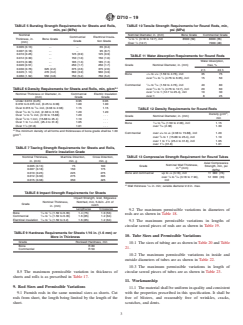
8.5 The maximum permissible variation in thickness of
sheets and rolls is as prescribed in Table 17.
11. Workmanship
9. Rod Sizes and Permissible Variations
11.1 The material shall be uniform in quality and consistent
9.1 Furnish rods in the same nominal sizes as sheets. Cut with the properties prescribed in this specification. It shall be
rods from sheet, the length being limited by the length of the free of blisters, and reasonably free of wrinkles, cracks,
sheet. scratches, and dents.
D710−19
TABLE 14 Water Absorption and Dielectric Strength Requirements for Round Tubes
Water Absorption, max, %
Dielectric Strength, min,
Grade Nominal Wall Thickness, in. (mm)
V/mil (kV/mm)
2h 24h
Bone and commercial up to ⁄16 (1.59) . . 175 (6.9)
1 1
over ⁄16 to ⁄8 (1.59 to 3.18), incl . . 150 (5.9)
1 1
⁄32 to ⁄8 (0.79 to 3.18), incl 50 75 .
1 1
over ⁄8 to ⁄4 (3.18 to 6.35), incl 20 50 100 (3.9)
1 5
over ⁄4 to ⁄16 (6.35 to 7.94), incl 10 25 100 (3.9)
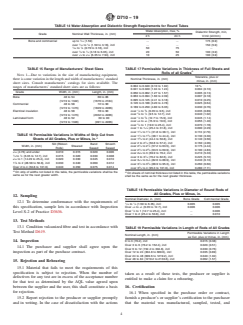
TABLE 15 Range of Manufacturers’ Sheet Sizes TABLE 17 Permissible Variations in Thickness of Full Sheets and
A
Rolls of all Grades
NOTE 1—Due to variations in the size of manufacturing equipment,
Tolerance, plus or
Nominal Thickness, in. (mm)
thereissomevariationinthelengthandwidthofmanufacturers’standard
minus, in. (mm)
sheet sizes. Consult manufacturers’ catalogs for sizes available. The
0.004 to 0.040 (0.10 to 1.02) 10 %
ranges of manufacturers’ standard sheet sizes are as follows:
0.041 to 0.049 (1.04 to 1.24) 0.004 (0.10)
Grade Width, in. (mm) Length, in. (mm)
0.050 to 0.062 (1.27 to 1.57) 0.005 (0.13)
0.063 to 0.094 (1.60 to 2.39) 0.007 (0.18)
Bone 48 to 54 66 to 86
0.095 to 0.125 (2.41 to 3.18) 0.010 (0.25)
(1219 to 1322) (1676 to 2184)
0.126 to 0.188 (3.20 to 4.78) 0.025 (0.64)
Commercial 48 to 58 72 to 90
0.189 to 0.250 (4.80 to 6.35) 0.030 (0.76)
(1219 to 1473) (1829 to 2286)
1 3
over ⁄4 to ⁄8 (6.35 to 9.5), incl 0.035 (0.89)
Electrical insulation 48 to 58 78 to 90
3 1
over ⁄8 to ⁄2 (9.5 to 12.7), incl 0.040 (1.02)
(1219 to 1473) (2032 to 2286)
1 5
over ⁄2 to ⁄8 (12.7 to 15.9), incl 0.045 (1.14)
Laminated form 48 to 52 39 to 90
5 3
over ⁄8 to ⁄4 (15.9 to 19.0), incl 0.055 (1.40)
(1219 to 1320) (991 to 2286)
over ⁄4 to 1 (19.0 to 25.4), incl 0.070 (1.78)
over 1 to 1 ⁄4 (25.4 to 31.8), incl 0.090 (2.29)
1 1
over 1 ⁄4 to 1 ⁄2 (31.8 to 38.1), incl 0.110 (2.79)
1 3
TABLE 16 Permissible Variations in Widths of Strip Cut from
ov
...
This document is not an ASTM standard and is intended only to provide the user of an ASTM standard an indication of what changes have been made to the previous version. Because
it may not be technically possible to adequately depict all changes accurately, ASTM recommends that users consult prior editions as appropriate. In all cases only the current version
of the standard as published by ASTM is to be considered the official document.
Designation: D710 − 13 D710 − 19
Standard Specification for
Vulcanized Fibre Sheets, Rolls, Rods, and Tubes Used for
Electrical Insulation
This standard is issued under the fixed designation D710; the number immediately following the designation indicates the year of
original adoption or, in the case of revision, the year of last revision. A number in parentheses indicates the year of last reapproval. A
superscript epsilon (´) indicates an editorial change since the last revision or reapproval.
This standard has been approved for use by agencies of the U.S. Department of Defense.
1. Scope*
1.1 This specification covers vulcanized fibre (Note 1) sheets, rolls, round rods, and round tubes of such grades suitable for use
as electrical insulation.
NOTE 1—The variant spelling “fibre” has been approved by Committee D09 for use in this standard.
1.2 The values stated in inch-pound units are to be regarded as standard. The values given in parentheses are mathematical
conversions to SI units that are provided for information only and are not considered standard.
1.3 This international standard was developed in accordance with internationally recognized principles on standardization
established in the Decision on Principles for the Development of International Standards, Guides and Recommendations issued
by the World Trade Organization Technical Barriers to Trade (TBT) Committee.
2. Referenced Documents
2.1 ASTM Standards:
D495 Test Method for High-Voltage, Low-Current, Dry Arc Resistance of Solid Electrical Insulation
D619 Test Methods for Vulcanized Fibre Used for Electrical Insulation
D696 Test Method for Coefficient of Linear Thermal Expansion of Plastics Between −30°C and 30°C with a Vitreous Silica
Dilatometer
D952 Test Method for Bond or Cohesive Strength of Sheet Plastics and Electrical Insulating Materials
D3636 Practice for Sampling and Judging Quality of Solid Electrical Insulating Materials
2.2 Other Documents:
IEEE Publication No. 1, “General Principles for Temperature Limits in the Rating of Electrical Equipment.”
3. Terminology
3.1 Definitions:
3.1.1 vulcanized fibre, n—a material made from chemically gelatinized cellulosic paper or board using zinc chloride as the
gelatinizing agent.
3.1.1.1 Discussion—
The zinc chloride is subsequently removed by leaching. The resulting product, after being dried and finished by calendering, is a
material of partially regenerated cellulose in which the fibrous structure is retained in varying degrees depending on the grade of
paper used and on the processing conditions. Material up to about 25 mm in thickness is produced by bonding multiple layers of
paper (or board) after chemical treatment. Vulcanized fibre does not contain vulcanized rubber or sulfur as the name might imply.
Thin vulcanized fibre has sometimes been termed “fish paper.”It is almost completely pure cellulose, with a trace amount of zinc
chloride.
This specification is under the jurisdiction of ASTM Committee D09 on Electrical and Electronic Insulating Materials and is the direct responsibility of Subcommittee
D09.07 on Flexible and Rigid Electrical Insulating Materials.
Current edition approved Nov. 1, 2013Nov. 1, 2019. Published November 2013December 2019. Originally approved in 1943. Last previous edition approved in 20092013
ε1
as D710 – 97 (2013).(2009) . DOI: 10.1520/D0710-13.10.1520/D0710-19.
For referenced ASTM standards, visit the ASTM website, www.astm.org, or contact ASTM Customer Service at service@astm.org. For Annual Book of ASTM Standards
volume information, refer to the standard’s Document Summary page on the ASTM website.
Available from Institute of Electrical and Electronics Engineers, Inc. (IEEE), 445 Hoes Ln., P.O. Box 1331, Piscataway, NJ 08854-1331, http://www.ieee.org.
*A Summary of Changes section appears at the end of this standard
Copyright © ASTM International, 100 Barr Harbor Drive, PO Box C700, West Conshohocken, PA 19428-2959. United States
D710 − 19
4. Grades
4.1 Three grades of vulcanized fibre are covered, as follows:
4.1.1 Bone Grade—This grade is characterized by the greater hardness and stiffness associated with higher density. It machines
more smoothly and with less tendency to separate the plies in difficult machining operations than the other grades. It is made in
1 1
thickness of ⁄64 to ⁄16 in. (0.79(0.38 to 6.351.59 mm).
4.1.2 Commercial Grade—This grade is considered as the general-purpose grade and is sometimes referred to as mechanical
and electrical grade. It possesses good physical and electrical properties and can be fabricated satisfactorily by punching, turning,
and forming operations. It is made in thicknesses from 0.0100.005 to ⁄4 in. (0.25 to 6.350.100 in. (0.12 to 2.54 mm).
4.1.3 Electrical Insulation Grade—This grade is intended primarily for electrical applications and others involving difficult
bending or forming operations. It is made in thicknesses from 0.0040.005 to ⁄32 in. (0.10(0.12 to 3.22.35 mm). Thin material of
this grade is sometimes referred to as “fish paper.”
4.2 The three grades of fibre are available in laminated sheet form in greater thicknesses than those listed inCommercial Fibre
which is thicker than 0.100 in. (2.54 mm) is primarily laminated from thinner sheets of vulcanized fibre, although 4.1.1 tosome
homogeneous 4.1.3. fibre is commercially available. Laminated (or built-up) fibre is composed of a number of plies of vulcanized
fibre bonded together with a suitable adhesive. It retains all the basic properties of solid fibre, including high arc resistance on edges
and faces, and in addition has better dimensional stability and less warpage. Laminated fibre is usually furnished when the
thickness is overThicknesses up to 4 in. (102 mm) are commercially available. ⁄4 in. (6.35 mm), and is potentially be furnished
in thicknesses down toLaminated Fibre is generally, but not always, dense enough to also qualify as ⁄8 in. (3.2 mm). Thicknesses
up to 4 in. (102 mm) are commercially available.Bone Grade.
4.3 Thin sheet material, up to ⁄16 in. thick is available in a lower density uncalendered condition which will not always meet
the requirements of this specification.
5. Forms and Colors
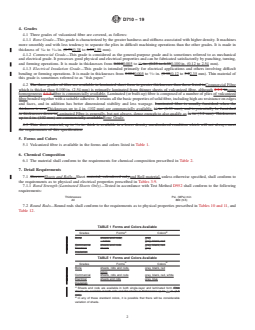
5.1 Vulcanized fibre is available in the forms and colors listed in Table 1.
6. Chemical Composition
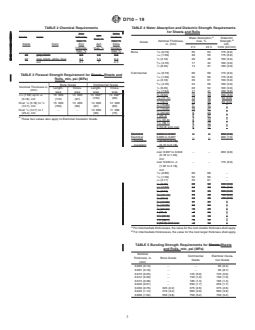
6.1 The material shall conform to the requirements for chemical composition prescribed in Table 2.
7. Detail Requirements
7.1 Sheets—Sheets and Rolls—Sheet material, calendered only,and Roll material, unless otherwise specified, shall conform to
the requirements as to physical and electrical properties prescribed in Tables 3-9.
7.1.1 Bond Strength (Laminated Sheets Only)—Tested in accordance with Test Method D952 shall conform to the following
requirements:
Thicknesses Psi, (MPa) min
All 800 (5.5)
7.2 Round Rods—Round rods shall conform to the requirements as to physical properties prescribed in Tables 10 and 11, and
Table 12.
TABLE 1 Forms and Colors Available
A B
Grades Forms Colors
Bone sheets and rods, gray
tubes gray, black, red
Commercial sheets and rods gray, black, red
Electrical sheets gray
Insulation
TABLE 1 Forms and Colors Available
A B
Grades Forms Colors
Bone sheets, rolls and rods, gray, black, red
tubes
Commercial sheets, rolls and rods gray, black, red, white
Electrical sheets and rolls gray, blue
Insulation
A
Sheets and rods are available in both single-layer and laminated form. Thin
sheets are available in both rolls and flat sheets in thicknesses up to ⁄16 in. (1.6
mm).
B
In any of these standard colors, it is possible that there will be considerable
variation of shade.
D710 − 19
TABLE 2 Chemical Requirements TABLE 4 Water Absorption and Dielectric Strength Requirements
for Sheets and Rolls
Zinc Silica
Ash
Grade Color Chloride, Content, A
Dielectric
Water Absorption,
max, %
B
Nominal Thickness,
max, % max, % max, %
Strength,
Grade
Grade Color Zinc Ash Silica in. (mm) min,
2 h 24 h
V/mil (kV/mm)
Chloride, max, % Content,
max, % max, % 1
Bone ⁄32 (0.79) 55 63 175 (6.9)
All gray, black 0.1 1.5 0.3
⁄16 (1.59) 30 55 175 (6.9)
All gray, black, white, blue 0.1 1.5 0.3
⁄8 (3.18) 20 48 150 (5.9)
red 0.1 7 0.3
⁄16 (4.76) 17 42 100 (3.9)
⁄4 (6.35) 14 37 100 (3.9)
Commercial ⁄32 (0.79) 60 68 175 (6.9)
TABLE 3 Flexural Strength Requirement for Sheets, Sheets and
⁄16 (1.59) 52 66 175 (6.9)
Rolls, min, psi (MPa) 1
⁄8 (3.18) 35 61 150 (5.9)
⁄16 (4.76) 24 56 100 (3.9)
Bone Grade Commercial Grade
Nominal Thickness in. 1
⁄4 (6.35) 20 52 100 (3.9)
Length- Cross- Length- Cross-
(mm)
⁄16 (7.94) 17 47 100 (3.9)
wise wise wise wise
A A
1 1 ⁄8 (9.52) 15 43 100 (3.9)
⁄16 (1.59) up to ⁄8 16 000 14 000 15 000 13 000
(103) (90) ⁄16 (11.11) 14 39 50 (2.0)
(3.18), incl (110) (97)
1 1 ⁄2 (12.7) 13 36 50 (2.0)
Over ⁄8 (3.18) to ⁄2 15 000 13 000 14 000 12 000
A
⁄8 (15.88) 11 31
(12.7), incl (103) (90) (97) (83)
A
1 ⁄4 (19.05) 10 27
Over ⁄2 (12.7) to 1 . . 13 000 11 000
A
⁄8 (22.22) 8 23
(25.4), incl (90) (76)
A
1 (25.4) 8 21
A
These two values also apply to Electrical Insulation Grade. A
1 ⁄4 (31.8) 8 18
A
1 ⁄2 (38.1) 8 17
A
2 (50.8) and over 8 17
Electrical 0.004 to 0.007 . . 200 (7.9)
Electrical 0.005 to 0.007 . . 200 (7.9)
insulation (0.10 to 0.18),
insulation (0.12 to 0.18),
incl
over 0.007 to 0.040 . . 250 (9.8)
(0.18 to 1.02),
incl
over 0.040 to ⁄8 . . 175 (6.9)
(1.02 to 3.18),
incl
⁄32 (0.80) 60 68 .
⁄16 (1.59) 52 66 .
⁄8 (3.17) 35 61 .
⁄4 (6.35) 20 52 100 (3.9)
⁄16 (7.94) 17 47 100 (3.9)
⁄8 (9.52) 15 43 100 (3.9)
⁄16 (11.11) 14 39 50 (2.0)
⁄2 (12.7) 13 36 50 (2.0)
A
⁄8 (15.88) 11 31
A
⁄4 (19.05) 10 27
A
⁄8 (22.22) 8 23
A
1 (25.4) 8 21
A
1 ⁄4 (31.8) 8 18
A
1 ⁄2 (38.1) 8 17
A
2 (50.8) and over 8 17
A
For intermediate thicknesses, the value for the next smaller thickness shall apply.
B
For intermediate thicknesses, the value for the next larger thickness shall apply.
TABLE 5 Bursting Strength Requirements for Sheets,Sheets
and Rolls, min, psi (MPa)
Nominal
Commercial Electrical Insula-
Thickness, in. Bone Grade
Grade tion Grade
(mm)
0.005 (0.13) . . 65 (0.4)
0.007 (0.18) . . 95 (8.7)
0.010 (0.25) . 125 (0.9) 125 (0.9)
0.012 (0.30) . 150 (1.0) 150 (1.0)
0.015 (0.38) . 185 (1.3) 185 (1.3)
0.020 (0.51) . 250 (1.7) 250 (1.7)
0.030 (0.76) 325 (2.2) 375 (2.6) 375 (2.6)
0.045 (1.14) 470 (3.2) 560 (3.9) 560 (3.9)
0.060 (1.52) 550 (3.8) 750 (5.2) 750 (5.2)
D710 − 19
3A
TABLE 6 Density Requirements for Sheets, min, g/cm
Commercial Grade Electric Insulation Grade
Nominal Thickness or
Uncalen- Calen- Uncalen- Calen-
Diameter, in. (mm)
dered dered dered dered
Under 0.010 (0.25) . . 0.90 1.00
0.010 to 0.015 incl, (0.25 + 0.38), 1.05 1.10 1.00 1.10
Over 0.015 to ⁄32 incl, (0.38 to 2.38), 1.10 1.15 1.10 1.15
3 1
Over ⁄32 to ⁄8 incl, (2.38 to 3.18), 1.15 1.20 1.15 1.20
1 5
Over ⁄8 to ⁄8 incl, (3.18 to 15.88), . 1.20 . .
Over ⁄8 to 1 incl, (15.88 to 25.4), . 1.10 . .
Over 1 to 1 ⁄4 incl, (25.4 to 31.8), . 1.05 . .
Over 1 ⁄4 (31.8) . 1.01 . .
3A
TABLE 6 Density Requirements for Sheets and Rolls, min, g/cm
Nominal Thickness or Diameter, in. Commercial Electric Insulation
(mm) Grade Grade
Under 0.010 (0.25) 0.95 0.95
0.010 to 0.015 incl, (0.25 to 0.38) 1.00 1.00
Over 0.015 to ⁄32 incl, (0.38 to 2.38) 1.15 1.15
3 1
Over ⁄32 to ⁄8 incl, (2.38 to 3.18) 1.20 1.20
1 5
Over ⁄8 to ⁄8 incl, (3.18 to 15.88) 1.20 . . .
Over ⁄8 to 1 incl, (15.88 to 25.4) 1.10 . . .
Over 1 to 1 ⁄4 incl, (25.4 to 31.8) 1.05 . . .
Over 1 ⁄4 (31.8) 1.01 . . .
A
The minimum density of all forms and thicknesses of bone grade shall be 1.30
g/cm .
TABLE 7 Tearing Strength Requirements for Sheets,Sheets
and Rolls, Electric Insulation Grade
Nominal Thickness, Machine Direction, Cross Direction,
in. (mm) min, g min, g
0.005 (0.13) 75 100
0.007 (0.18) 150 175
0.010 (0.25) 225 275
0.012 (0.30) 275 335
0.015 (0.38) 350 425
TABLE 8 Impact Strength Requirements for Sheets
Impact Strength, Izod, Edgewise
Nominal Thickness, Notched, min, ft-lb/in. J/m of
Grade
in. (mm) notch
Lengthwise Crosswise
1 1
Bone ⁄16 to ⁄4 (1.59 to 6.35) 1.4 (75) 1.0 (53)
1 1
Commercial ⁄16 to ⁄4 (1.59 to 6.35) 1.6 (85) 1.2 (64)
1 1
Electrical insulation ⁄16 to ⁄8 (1.59 to 3.2) 1.6 (85) 1.2 (64)
TABLE 9 Hardness Requirements for Sheets 1/16 in. (1.6 mm) or
More in Thickness
Grade Rockwell Hardness, min
Bone R 80
Commercial R 50
TABLE 10 Tensile Strength Requirements for Round Rods, min,
psi (MPa)
Nominal Diameter, in. (mm) Bone Grade Commercial Grade
1 1
⁄8 to ⁄2 (3.18 to 12.7), incl 8500 (59) 8000 (55)
Over ⁄2 (12.7) . 7000 (48)
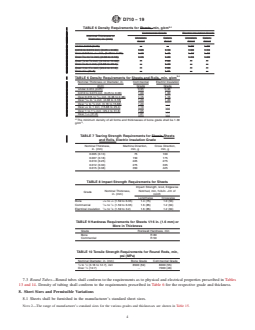
7.3 Round Tubes—Round tubes shall conform to the requirements as to physical and electrical properties prescribed in Tables
13 and 14. Density of tubing shall conform to the requirements prescribed in Table 6 for the respective grade and thickness.
8. Sheet Sizes and Permissible Variations
8.1 Sheets shall be furnished in the manufacturer’s standard sheet sizes.
NOTE 2—The range of manufacturer’s standard sizes for the various grades and thicknesses are shown in Table 15.
D710 − 19
TABLE 11 Water Absorption Requirements for Round Rods
Water Absorption,
max, %
Grade Nominal Diameter, in. (mm)
2 h 24 h
1 3
Bone ⁄16 to ⁄16 (1.59 to 4.76), incl 35 75
3 1
over ⁄16 to ⁄4 (4.76 to 6.35), incl 15 50
1 3
Commercial ⁄16 to ⁄16 (1.59 to 4.76), incl 40 80
3 1
over ⁄16 to ⁄2 (4.76 to 12.7), incl 20 60
over ⁄2 to 1 (12.7 to 25.4), incl 10 30
over 1 8 25
TABLE 12 Density Requirements for Round Rods
Density g/cm ,
Grade Nominal Diameter, in. (mm)
min
1 3
Bone ⁄16 to ⁄32 (1.59 to 2.38), incl 1.15
over ⁄32 (2.38) 1.30
3 5
Commercial over ⁄32 to ⁄8 (2.38 to 15.88), incl 1.20
over ⁄8 to 1 (15.88 to 25.4), incl 1.10
over 1 to 1 ⁄4 (25.4 to 31.8), incl 1.05
over 1 ⁄4 (31.8) 1.01
TABLE 13 Compressive Strength Requirement for Round Tubes
Axial Compressive
Nominal Wall Thickness,
Grade Strength, min, psi
A
in. (mm)
(MPa)
Bone and commercial up to ⁄8 (3.18), incl 11 000 (76)
1 5
over ⁄8 to ⁄16 (3.18 to 7.94), 12 000 (33)
incl
A 1
Wall thickness ⁄32 in. min; outside diameter 2.0 in. max.
8.2 When sheets and rolls are trimmed to a specified width, the maximum permissible variation in width is 6 ⁄2 in. (612.7 mm).
8.3 When sheets are trimmed to a specified length, the maximum permissible variation in length is 6 ⁄2 in.
8.4 The maximum permissible variations in widths of strips cut from sheets by the indicated operations are as prescribed in
Table 16.
8.5 The maximum permissible variation in thickness of full sheets and rolls is as prescribed in Table 17.
8.6 The maximum permissible variations in thickness of sheets cut in halves, thirds, or quarters are as shown in Table 17.
9. Rod Sizes and Permissible Variations
9.1 Furnish rods in the same nominal sizes as sheets. Cut rods from sheet, the length being limited by the length of the sheet.
9.2 The maximum permissible variations in diameters of rods are as shown in Table 18.
9.3 The maximum permissible variations in lengths of circular sawed pieces of rods are as shown in Table 19.
10. Tube Sizes and Permissible Variations
10.1 The sizes of tubing are as shown in Table 20 and Table 21.
10.2 The maximum permissible variations in inside and outside diameters of tubes are as shown in Table 22.
10.3 The maximum permissible variations in length of circular sawed pieces of tubes are as shown in Table 23.
11. Workmanship
11.1 The material shall be uniform in quality and consistent with the properties prescribed in this specification. It shall be free
of blisters, and reasonably free of wrinkles, cracks, scratches, and dents.
12. Sampling
12.1 To determine conformance with the requirements of this specification, sample lots in accordance with Inspection Level S-2
of Practice D3636.
D710 − 19
TABLE 14 Water Absorption and Dielectric Strength Requirements for Round Tubes
Water Absorption, max, %
Dielectric Strength, min,
Grade Nominal Wall Thickness, in. (mm)
V/mil (kV/mm)
2 h 24 h
Bone and commercial up to ⁄16 (1.59) . . 175 (6.9)
1 1
over ⁄16 to ⁄8 (1.59 to 3.18), incl . . 150 (5.9)
1 1
⁄32 to ⁄8 (0.79 to 3.18), incl 50 75 .
1 1
over ⁄8 to ⁄4 (3.18 to 6.35), incl 20 50 100 (3.9)
1 5
over ⁄4 to ⁄16 (6.35 to 7.94), incl 10 25 100 (3.9)
TABLE 15 Range of Manufacturers’ Sheet Sizes
NOTE 1—Due to variations in the size of manufacturing equipment,
there is some variation in the length and width of manufacturers’ standard
sheet sizes. Consult manufacturers’ catalogs for sizes available. The
ranges of manufacturers’ standard sheet sizes are as follows:
Grade Width, in. (mm) Length, in. (mm)
Bone 40 to 54 66 to 86
(1016 to 1322) (1676 to 2184)
Commercial 45 to 56 72 to 90
(1143 to 1422) (1829 to 2286)
Electrical insulation 46 to 56 80 to 90
(1168 to 1422) (2032 to 2286)
Laminated form 48 39 to 120
(1219) (991 to 3048)
TABLE 15 Range of Manufacturers’ Sheet Sizes
NOTE 1—Due to variations in the size of manufacturing equipment,
there is some variation in the length and width of manufacturers’ standard
sheet sizes. Consult manufacturers’ catalogs for sizes available. The
ranges of manufacturers’ standard sheet sizes are as follows:
Grade Width, in. (mm) Length, in. (mm)
Bone 48 to 54 66 to 86
(1219 to 1322) (1676 to 2184)
Commercial 48 to 58 72 to 90
(1219 to 1473) (1829 to 2286)
Electrical insulation 48 to 58 78 to 90
(1219 to 1473) (2032 to 2286)
Laminated form 48 to 52 39 to 90
(1219 to 1320) (991 to 2286)
TABLE 16 Permissible Variations in Widths of Strip Cut from
A
Sheets of All Grades, Plus or Minus, in.
Slit (Ribbon Band Smooth
Width, in. (mm) Sheared
Rolls) Sawed Sawed
⁄16 (4.76) and under 0.010 0.015 0.020 0.006
1 1
⁄4 to ⁄2 (6.35 to 12.7), incl 0.015 0.020 0.030 0.008
⁄16 to 1 (14.29 to 25.4), incl 0.020 0.030 0.045 0.010
1 ⁄8 to 2 (28.58 to 50.8), incl 0.030 0.040 0
...