

ASTM D4998-13(2021)
(Test Method)Standard Test Method for Evaluating Wear Characteristics of Tractor Hydraulic Fluids
General Information
- Abstract
SIGNIFICANCE AND USE
5.1 Many modern tractor designs use the hydraulic fluid to lubricate the transmission and final drive gears. This test method is used to assess the suitability of the tractor hydraulic fluids as lubricants for transmission and final drive gears of tractors.
SCOPE
1.1 This test method is used to screen lubricants for gear wear. It is primarily applicable to tractor hydraulic fluids but may be suitable for other applications.
1.2 The values stated in SI units are to be regarded as standard. No other units of measurement are included in this standard.
1.3 This standard does not purport to address all of the safety concerns, if any, associated with its use. It is the responsibility of the user of this standard to establish appropriate safety, health, and environmental practices and determine the applicability of regulatory limitations prior to use. Specific warning information is given in Sections 7 and 9.
1.4 This international standard was developed in accordance with internationally recognized principles on standardization established in the Decision on Principles for the Development of International Standards, Guides and Recommendations issued by the World Trade Organization Technical Barriers to Trade (TBT) Committee.
- Status
- Published
- Publication Date
- 30-Sep-2021
- Technical Committee
- D02 - Petroleum Products, Liquid Fuels, and Lubricants
- Drafting Committee
- D02.B0.03 - Automotive Gear Lubricants & Fluids
Overview
ASTM D4998-13(2021), titled Standard Test Method for Evaluating Wear Characteristics of Tractor Hydraulic Fluids, is a globally recognized ASTM standard that provides a laboratory procedure to screen the gear wear performance of tractor hydraulic fluids. Modern tractors often use hydraulic fluids not only as hydraulic mediums but also as essential lubricants for transmission and final drive gears. This standard is designed to evaluate the suitability of these fluids, ensuring their reliability in protecting critical gear systems under typical operating conditions. The methodology can also be relevant for other lubricants used in analogous gear systems.
Key Topics
- Purpose: Screens tractor hydraulic fluids for their ability to minimize wear on transmission and final drive gears.
- Scope:
- Primarily applies to tractor hydraulic fluids, but may be suitable for other lubricant applications.
- All measurements and results are based on SI units.
- Testing Methodology:
- Utilizes a modified FZG (Forschungsstelle für Zahnräder und Getriebebau) gear oil test machine.
- Test includes subjecting gears to controlled conditions of speed, torque, and temperature for a specified period (commonly 20 hours).
- Wear is evaluated by measuring gear mass loss and visually inspecting gear teeth for wear patterns such as scratches, scoring, or scuffing.
- Safety Note: Users must establish appropriate safety and environmental practices, particularly regarding handling solvents and operating test machinery.
Applications
- Tractor and Agricultural Equipment Maintenance: Ensures that hydraulic fluids used in farming equipment provide adequate protection against gear wear, contributing to longer service life and reduced maintenance costs.
- Lubricant Quality Control: Provides lubricant manufacturers and quality assurance professionals with a standard test for verifying the anti-wear properties of hydraulic fluids and transmission gear oils before market release.
- Research and Development: Offers R&D teams a reliable method to benchmark lubricant performance, support technical innovation, and develop fluids with superior protection.
- Fleet and Operations Management: Helps equipment operators and fleet managers select appropriate hydraulic fluids, promoting optimal machinery performance and minimizing costly breakdowns.
- Regulatory and Compliance Assessment: Supports compliance with industry and international quality requirements related to equipment lubrication and wear protection.
Related Standards
- ASTM D4175: Terminology Relating to Petroleum Products, Liquid Fuels, and Lubricants
- ASTM D235: Specification for Mineral Spirits (withdrawn)
- ASTM D323: Test Method for Vapor Pressure of Petroleum Products (Reid Method)
- ASTM D329: Specification for Acetone
- DIN 51354: Mechanical Testing of Gear Oils in the FZG Gear Test Machine
- DIN 3962: Specifications for the accuracy of gears
- DIN 50150: Testing of steel and cast steel - conversion table for hardness and tensile strength
- WTO TBT Principles: Ensures international harmonization of testing and conformity assessment procedures.
Practical Value
Adhering to ASTM D4998-13(2021) enables manufacturers, laboratories, and end-users to objectively assess and compare the wear-resistance performance of tractor hydraulic fluids. This supports informed decision-making regarding lubricant selection and helps maintain the operational efficiency and durability of agricultural machinery and similar gear systems. By following this internationally recognized test method, organizations can ensure product reliability, comply with industry standards, and ultimately improve equipment uptime and lifecycle value.
Keywords: ASTM D4998, tractor hydraulic fluids, gear wear test, FZG machine, lubricant evaluation, transmission fluid, anti-wear characteristics, agricultural machinery, transmission gear protection, international standards.
Relations
- Refers
ASTM D4175-23a - Standard Terminology Relating to Petroleum Products, Liquid Fuels, and Lubricants - Effective Date
- 15-Dec-2023
- Refers
ASTM D4175-23e1 - Standard Terminology Relating to Petroleum Products, Liquid Fuels, and Lubricants - Effective Date
- 01-Jul-2023
- Effective Date
- 01-Apr-2015
- Effective Date
- 01-Jun-2007
- Effective Date
- 01-Jun-2007
- Effective Date
- 01-Jun-2007
- Effective Date
- 01-Aug-2006
- Effective Date
- 10-Dec-2002
- Effective Date
- 10-Dec-2002
- Effective Date
- 10-Dec-1999
- Effective Date
- 10-Dec-1999
- Effective Date
- 10-Apr-1999
Get Certified
Connect with accredited certification bodies for this standard

Element Materials Technology
Materials testing and product certification.

ABS Group Brazil
ABS Group certification services in Brazil.

ABS Quality Evaluations Inc.
American Bureau of Shipping quality certification.
Sponsored listings
Frequently Asked Questions
ASTM D4998-13(2021) is a standard published by ASTM International. Its full title is "Standard Test Method for Evaluating Wear Characteristics of Tractor Hydraulic Fluids". This standard covers: SIGNIFICANCE AND USE 5.1 Many modern tractor designs use the hydraulic fluid to lubricate the transmission and final drive gears. This test method is used to assess the suitability of the tractor hydraulic fluids as lubricants for transmission and final drive gears of tractors. SCOPE 1.1 This test method is used to screen lubricants for gear wear. It is primarily applicable to tractor hydraulic fluids but may be suitable for other applications. 1.2 The values stated in SI units are to be regarded as standard. No other units of measurement are included in this standard. 1.3 This standard does not purport to address all of the safety concerns, if any, associated with its use. It is the responsibility of the user of this standard to establish appropriate safety, health, and environmental practices and determine the applicability of regulatory limitations prior to use. Specific warning information is given in Sections 7 and 9. 1.4 This international standard was developed in accordance with internationally recognized principles on standardization established in the Decision on Principles for the Development of International Standards, Guides and Recommendations issued by the World Trade Organization Technical Barriers to Trade (TBT) Committee.
SIGNIFICANCE AND USE 5.1 Many modern tractor designs use the hydraulic fluid to lubricate the transmission and final drive gears. This test method is used to assess the suitability of the tractor hydraulic fluids as lubricants for transmission and final drive gears of tractors. SCOPE 1.1 This test method is used to screen lubricants for gear wear. It is primarily applicable to tractor hydraulic fluids but may be suitable for other applications. 1.2 The values stated in SI units are to be regarded as standard. No other units of measurement are included in this standard. 1.3 This standard does not purport to address all of the safety concerns, if any, associated with its use. It is the responsibility of the user of this standard to establish appropriate safety, health, and environmental practices and determine the applicability of regulatory limitations prior to use. Specific warning information is given in Sections 7 and 9. 1.4 This international standard was developed in accordance with internationally recognized principles on standardization established in the Decision on Principles for the Development of International Standards, Guides and Recommendations issued by the World Trade Organization Technical Barriers to Trade (TBT) Committee.
ASTM D4998-13(2021) is classified under the following ICS (International Classification for Standards) categories: 75.120 - Hydraulic fluids. The ICS classification helps identify the subject area and facilitates finding related standards.
ASTM D4998-13(2021) has the following relationships with other standards: It is inter standard links to ASTM D4175-23a, ASTM D4175-23e1, ASTM D323-15, ASTM D329-07e1, ASTM D329-07, ASTM D235-02(2007), ASTM D323-06, ASTM D329-02, ASTM D235-02, ASTM D235-99, ASTM D329-99, ASTM D323-99a. Understanding these relationships helps ensure you are using the most current and applicable version of the standard.
ASTM D4998-13(2021) is available in PDF format for immediate download after purchase. The document can be added to your cart and obtained through the secure checkout process. Digital delivery ensures instant access to the complete standard document.
Standards Content (Sample)
This international standard was developed in accordance with internationally recognized principles on standardization established in the Decision on Principles for the
Development of International Standards, Guides and Recommendations issued by the World Trade Organization Technical Barriers to Trade (TBT) Committee.
Designation: D4998 − 13 (Reapproved 2021)
Standard Test Method for
Evaluating Wear Characteristics of Tractor Hydraulic Fluids
This standard is issued under the fixed designation D4998; the number immediately following the designation indicates the year of
original adoption or, in the case of revision, the year of last revision.Anumber in parentheses indicates the year of last reapproval.A
superscript epsilon (´) indicates an editorial change since the last revision or reapproval.
1. Scope 2.2 Deutsches Institut fur Normung (DIN):
DIN17210Part1:TolerancesforSpurGears;Tolerancesfor
1.1 This test method is used to screen lubricants for gear
the Deviation of Singly Determined Values
wear. It is primarily applicable to tractor hydraulic fluids but
DIN 3962Casehardened Steel; Material Specifications
may be suitable for other applications.
DIN50150TestingofSteelandCastSteelConversionTable
1.2 The values stated in SI units are to be regarded as
for Vickers Hardness, Brinell Hardness, Rockwell Hard-
standard. No other units of measurement are included in this
ness and Tensile Strength
standard.
DIN 51354Mechanical Testing of Gear Oils in the FZG
Gear Test Machine
1.3 This standard does not purport to address all of the
safety concerns, if any, associated with its use. It is the
3. Terminology
responsibility of the user of this standard to establish appro-
3.1 Definitions:
priate safety, health, and environmental practices and deter-
3.1.1 abrasive wear, n—wear due to hard particles or hard
mine the applicability of regulatory limitations prior to use.
protuberancesforcedagainstandmovingalongasolidsurface.
Specific warning information is given in Sections 7 and 9.
D4175
1.4 This international standard was developed in accor-
dance with internationally recognized principles on standard-
3.1.2 scoring, n—in tribology, a severe form of wear char-
ization established in the Decision on Principles for the
acterized by the formation of extensive grooves and scratches
Development of International Standards, Guides and Recom-
in the direction of sliding. D4175
mendations issued by the World Trade Organization Technical
3.1.3 scratches, n—the result of mechanical removal or
Barriers to Trade (TBT) Committee.
displacement, or both, of material from a surface by the action
of abrasive particles or protuberances sliding across the
2. Referenced Documents
surfaces. D4175
2.1 ASTM Standards:
3.1.4 scuffıng, n—in lubrication, damage caused by instan-
D235Specification for Mineral Spirits (Petroleum Spirits)
taneous localized welding between surfaces in relative motion
(Hydrocarbon Dry Cleaning Solvent) (Withdrawn 2021)
that does not result in immobilization of the parts. D4175
D323TestMethodforVaporPressureofPetroleumProducts
3.2 Definitions of Terms Specific to This Standard:
(Reid Method)
3.2.1 wear, n—the loss of material from contacting surfaces
D329Specification for Acetone
of the gear teeth.
D4175Terminology Relating to Petroleum Products, Liquid
Fuels, and Lubricants
4. Summary of Test Method
4.1 A modified FZG gear oil test machine is operated for
20h under controlled conditions of speed (100 r/min), torque
This test method is under the jurisdiction of ASTM Committee D02 on
(tenth stage), and temperature (121 °C). Test gears are lubri-
Petroleum Products, Liquid Fuels, and Lubricants and is the direct responsibility of
cated with the test oil.
Subcommittee D02.B0.03 on Automotive Gear Lubricants & Fluids.
Current edition approved Oct. 1, 2021. Published November 2021. Originally
4.2 Thetestgearsareweighedandvisuallyexaminedbefore
approved in 1989. Last previous edition approved in 2013 as D4998–13. DOI:
andafterthetest.Thegearmasslossandthevisuallyobserved
10.1520/D4998-13R21.
damagetothegearteethareusedtoevaluatethewearobtained
For referenced ASTM standards, visit the ASTM website, www.astm.org, or
contact ASTM Customer Service at service@astm.org. For Annual Book of ASTM
with the test fluid.
Standards volume information, refer to the standard’s Document Summary page on
the ASTM website.
3 4
The last approved version of this historical standard is referenced on DIN standards are available from American National Standards Institute
www.astm.org. (ANSI), 25 W. 43rd St., 4th Floor, New York, NY 10036, http://www.ansi.org.
Copyright © ASTM International, 100 Barr Harbor Drive, PO Box C700, West Conshohocken, PA 19428-2959. United States
D4998 − 13 (2021)
5. Significance and Use shaft speed of (100 6 3) r/min. Use the S23 torsional shaft in
assembling.Caremustbetakentoensuretheaccuracyofshaft
5.1 Many modern tractor designs use the hydraulic fluid to
alignment as described in 6.3.
lubricate the transmission and final drive gears. This test
method is used to assess the suitability of the tractor hydraulic
9. Procedure
fluids as lubricants for transmission and final drive gears of
9.1 FZG Test Machine Assembly —Assemble the test ma-
tractors.
chine according to the instructions given in Section 3, except
6. Apparatus
employ a modified, low speed drive motor as described in
Annex A1.
6.1 FZG Gear Oil Test Machine—The test machine is
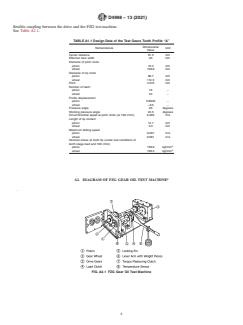
described in Annex A1 and illustrated in Fig. A2.1 and Fig.
NOTE 1—In addition to other precautions, machinery guards are
A3.1. supplied with the FZG test machine to protect personnel from hazards
associated with rotating machinery. These should be properly installed
6.2 Precision Test Gears—The test gears are standard FZG
before operating the equipment.
toothprofileAgearsasdescribedinAnnexA1andTableA1.1.
NOTE 2—In addition to other precautions, the electrical connections for
the drive motor and heater should be installed in accordance with the
6.3 Gear Case Heater—A 750 W gear case heater capable
current edition of the National Electrical Code.
of bringing the oil to test temperature in (20 to 25) min.
9.2 Machine Cleaning—Flush the test gear case and asso-
6.4 Temperature Controller—A proportional band-type
ciated parts with mineral spirits solvent (see 7.1). (Warning—
1000Wtemperaturecontrollerformaintainingtheoiltempera-
Combustible. Vapor harmful. Keep away from heat, sparks,
ture within 1°C of the desired test temperature. The thermo-
and open flame. Keep container closed. Use with adequate
couple is securely attached to the inside right wall of the gear
ventilation.Avoid prolonged breathing of vapor or spray mist.
case, 28 mm from the rear wall and 60 mm from the bottom,
Avoid prolonged or repeated skin contact.) Fill the gear case
projecting 15 mm into the gear case.
with mineral spirits solvent to a level that is above the shaft
6.5 Analytical Balance—An analytical balance with 2 kg center line. Manually rotate the shafts so that the bearings are
capacity and accurate within 1 mg for weighing test gears. rinsed. Drain mineral spirits solvent from the gear case. Refill
gear case with fresh mineral spirits solvent, manually rotate
6.6 Magnifying Lens, of 3 to 6 power.
shafts, and drain. Dry gear case with compressed air.
6.7 Compressed Air—551 kPa minimum.
9.3 Gear Condition—Examine the gear tooth faces with a
6.8 Steam Hot Plate, or bearing heater, with surface tem-
magnifying lens of 3 to 6 power. Do not use gears with
peratures below 75°C.
imperfections on the tooth faces.
9.4 Gear Cleaning—Wash the test gears in mineral spirits
7. Reagents and Materials
solvent,thenacetone(see7.2),andfinallyinpentane(see7.3).
7.1 Mineral Spirits Solvent—Commercial grade, conform-
After cleaning, handle the gears only with clean tongs or with
ing to the requirements of Specification D235.(Warning—
clean gloves. Allow the gears to dry. To prevent water
Flammable. Vapor harmful. Keep away from heat, sparks, and
condensation following gear cleaning, carefully warm the
open flame. Keep container closed. Use with adequate venti-
gears to room temperature with a clean, steam hot plate or
lation.Avoidprolongedbreathingofvapororspraymist.Avoid
bearing heater with surface temperature below 75 °C.
prolonged or repeated skin contact.)
9.5 Gear Weighing—Weigh the individual gears using an
7.2 Acetone—Commercialgrade,conformingtotherequire-
analyticalbalance.Thegearsshallbeclean,dry,andatambient
ments of Specification D329.(Warning—Flammable. Vapor
temperature. Record the mass of each gear, rounding to the
harmful. Keep away from heat, sparks, and open flame. Keep
nearest milligram. Add the mass of each gear and record the
container closed. Use with adequate ventilation. Avoid pro-
sum as initial total gear mass (TM).
i
longed breathing of vapor or spray mist. Avoid prolonged or
9.6 Gear Installation—Install the test gears.
repeated skin contact.)
9.7 Test Procedure—Fill the gear case with test fluid until
7.3 Pentane—Commercial grade n-pentane, conforming to
level with the shaft centerline. Install all machine guards in
therequirementsofTableA5.1.(Warning—Flammable.Vapor
their proper operating positions. Set the temperature controller
harmful. Keep away from heat, sparks, and open flame. Keep
to121°C.Withtheheateronandnotorqueapplied,startmotor
container closed. Use with adequate ventilation. Avoid pro-
to run at 100 r/min test speed. When temperature stabilizes at
longed breathing of vapor or spray mist. Avoid prolonged or
repeated skin contact.) (121 63)°C for (20 to 25) min, stop the motor and apply a
tenth stage load. The tenth stage load consists of applying a
8. Preparation of Apparatus
8.1 AssembletheFZGmachineaccordingtothe“Operating
The FZG testing machine gears, or suitable balance may be ordered from the
Instructions for the FZG Gear Oil Test Rig” except that the
following sources: Max Weiland, 8201 Sochtenau-Krotenmuhl, Germany, Strama
drive motor an
...