

ASTM D5270/D5270M-20
(Practice)Standard Practice for (Analytical Procedures) Determining Transmissivity and Storage Coefficient of Bounded, Nonleaky, Confined Aquifers
General Information
- Abstract
SIGNIFICANCE AND USE
5.1 Assumptions:
5.1.1 The well discharges at a constant rate.
5.1.2 Well is of infinitesimal diameter and is open through the full thickness of the aquifer.
5.1.3 The nonleaky confined aquifer is homogeneous, isotropic, and areally extensive except where limited by linear boundaries.
5.1.4 Discharge from the well is derived initially from storage in the aquifer; later, movement of water may be induced from a constant-head boundary into the aquifer.
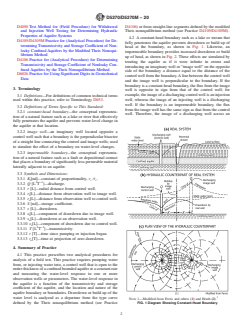
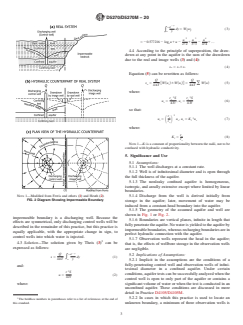
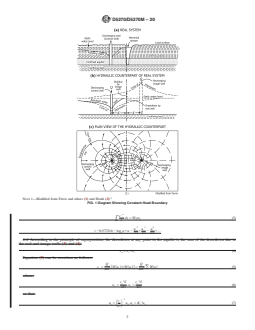
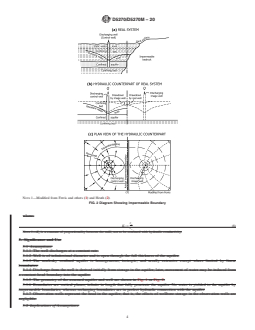
5.1.5 The geometry of the assumed aquifer and well are shown in Fig. 1 or Fig. 2.
5.1.6 Boundaries are vertical planes, infinite in length that fully penetrate the aquifer. No water is yielded to the aquifer by impermeable boundaries, whereas recharging boundaries are in perfect hydraulic connection with the aquifer.
5.1.7 Observation wells represent the head in the aquifer; that is, the effects of wellbore storage in the observation wells are negligible.
5.2 Implications of Assumptions:
5.2.1 Implicit in the assumptions are the conditions of a fully-penetrating control well and observation wells of infinitesimal diameter in a confined aquifer. Under certain conditions, aquifer tests can be successfully analyzed when the control well is open to only part of the aquifer or contains a significant volume of water or when the test is conducted in an unconfined aquifer. These conditions are discussed in more detail in Practice D4105/D4105M.
5.2.2 In cases in which this practice is used to locate an unknown boundary, a minimum of three observation wells is needed. If only two observation wells are available, two possible locations of the boundary are defined, and if only one observation well is used, a circle describing all possible locations of the image well is defined.
5.2.3 The effects of a constant-head boundary are often indistinguishable from the effects of a leaky, confined aquifer. Therefore, care must be taken to ensure that a correct conceptual model of the system has been created ...
SCOPE
1.1 This practice covers an analytical procedure for determining the transmissivity, storage coefficient, and possible location of boundaries for a confined aquifer with a linear boundary. This practice is used to analyze water-level or head data from one or more observation wells or piezometers during the pumping of water from a control well at a constant rate. This practice also applies to flowing artesian wells discharging at a constant rate. With appropriate changes in sign, this practice also can be used to analyze the effects of injecting water into a control well at a constant rate.
1.2 The analytical procedure in this practice is used in conjunction with the field procedure in Test Method D4050.
1.3 Limitations—The valid use of this practice is limited to determination of transmissivities and storage coefficients for aquifers in hydrogeologic settings with reasonable correspondence to the assumptions of the Theis nonequilibrium method (see Practice D4106) (see 5.1), except that the aquifer is limited in areal extent by a linear boundary that fully penetrates the aquifer. The boundary is assumed to be either a constant-head boundary (equivalent to a stream or lake that hydraulically fully penetrates the aquifer) or a no-flow (impermeable) boundary (equivalent to a contact with a significantly less permeable rock unit). The Theis nonequilibrium method is described in Practices D4105/D4105M and D4106.
1.4 Units—The values stated in either SI units or inch-pound units are to be regarded separately as standard. The values stated in each system may not be exact equivalents; therefore, each system shall be used independently of the other. Combining values from the two systems may result in nonconformance with the standard. Reporting of results in units other than SI shall not be regarded as nonconformance with this standard.
1.5 All observed and calculated values shall conform to the guidelines for significa...
- Status
- Published
- Publication Date
- 31-May-2020
- Technical Committee
- D18 - Soil and Rock
- Drafting Committee
- D18.21 - Groundwater and Vadose Zone Investigations
Buy Documents
ASTM D5270/D5270M-20 - Standard Practice for (Analytical Procedures) Determining Transmissivity and Storage Coefficient of Bounded, Nonleaky, Confined Aquifers
REDLINE ASTM D5270/D5270M-20 - Standard Practice for (Analytical Procedures) Determining Transmissivity and Storage Coefficient of Bounded, Nonleaky, Confined Aquifers
Overview
ASTM D5270/D5270M-20 is the internationally recognized standard practice for determining the transmissivity and storage coefficient of bounded, nonleaky confined aquifers. Developed by ASTM, this standard outlines analytical procedures used to assess groundwater movement and hydraulic characteristics in settings where aquifers are bounded by either constant-head or no-flow (impermeable) linear boundaries. This standard is critical for groundwater resource management, site characterization, and hydrogeologic investigations.
The practice involves analyzing water-level or head data collected from one or more observation wells or piezometers during controlled pumping or injection tests in a confined aquifer. Both flowing artesian wells and wells used for injection at a constant rate are covered. The standard may be applied to identify the location of unknown aquifer boundaries through data analysis.
Key Topics
ASTM D5270/D5270M-20 covers several essential topics related to confined aquifer test analysis:
- Aquifer Assumptions:
- Constant-rate discharge from the well.
- Well penetrates the full thickness of the aquifer and is of infinitesimal diameter.
- Aquifer is homogeneous, isotropic, and bounded by linear boundaries, which are either fully-penetrating constant-head or impermeable.
- Initial discharge is from storage, followed by potential inflows from boundaries.
- Observation wells are used to measure response, with wellbore storage considered negligible.
- Data Collection and Measurement:
- Use of field data from one or more observation wells or piezometers during pumping/injection tests.
- Emphasis on rigorous measurement practices and proper equipment selection.
- Analytical Methods:
- Application of the Theis nonequilibrium method and its modified form for test data evaluation.
- Use of type curves, graphical data plot matching, and calculation techniques for determining transmissivity and storage coefficients.
- Procedures for calculating boundary locations using the image well concept.
- Boundary Identification:
- Identification and distinction between constant-head boundaries (e.g., lakes, rivers) and impermeable boundaries (e.g., faults, geologic contacts).
- Requirement for multiple observation wells for accurate boundary location determination.
- Result Presentation:
- Comprehensive reporting guidelines, including description of test set-up, data plots, interpretations, and qualitative evaluation of results.
Applications
This standard is widely utilized in the following practical scenarios:
- Groundwater Resource Assessment:
- Determining aquifer capacity and sustainable yield by quantifying transmissivity and storage.
- Hydrogeologic Site Characterization:
- Accurate modeling of groundwater flow and boundary effects for water supply, construction, or contamination remediation projects.
- Environmental Engineering:
- Assessing the behavior of aquifers adjacent to surface waterbodies, barriers, or other geological features impacting groundwater flow.
- Location of Unknown Boundaries:
- Using observed data to infer the position of aquifer boundaries, essential for groundwater modeling and management.
- Combination with Field Practices:
- Works in conjunction with ASTM D4050 (field procedure), ensuring that both field data collection and analytical interpretation are harmonized for reliable aquifer evaluation.
Related Standards
Several ASTM standards are referenced or closely related to ASTM D5270/D5270M-20, supporting a comprehensive approach to aquifer testing and groundwater analysis:
- ASTM D653 - Terminology Relating to Soil, Rock, and Contained Fluids
- ASTM D3740 - Minimum Requirements for Agencies Engaged in Testing and/or Inspection of Soil and Rock
- ASTM D4043 - Guide for Selection of Aquifer Test Method
- ASTM D4050 - Field Procedure for Withdrawal and Injection Well Testing
- ASTM D4105/D4105M - Analytical Procedure for Nonleaky Confined Aquifers (Modified Theis Method)
- ASTM D4106 - Analytical Procedure for Nonleaky Confined Aquifers (Theis Nonequilibrium Method)
- ASTM D6026 - Practice for Using Significant Digits in Geotechnical Data
Keywords: transmissivity, storage coefficient, bounded aquifer, confined aquifer, aquifer tests, groundwater, image well, observation well, well testing, ASTM standards, hydrogeology.
By following ASTM D5270/D5270M-20, practitioners gain a reliable framework for extracting critical hydraulic properties and boundary information necessary for groundwater management and resource planning.
Relations
- Effective Date
- 01-Nov-2023
- Effective Date
- 01-Jan-2020
- Effective Date
- 01-Oct-2019
- Effective Date
- 01-Jan-2017
- Effective Date
- 15-Apr-2015
- Effective Date
- 15-Apr-2015
- Effective Date
- 01-Aug-2014
- Effective Date
- 01-Jun-2014
- Effective Date
- 01-May-2012
- Effective Date
- 01-Mar-2012
- Effective Date
- 01-Sep-2011
- Effective Date
- 01-Sep-2011
- Effective Date
- 01-Aug-2010
- Effective Date
- 01-Mar-2010
- Effective Date
- 01-Jan-2009
Buy Documents
ASTM D5270/D5270M-20 - Standard Practice for (Analytical Procedures) Determining Transmissivity and Storage Coefficient of Bounded, Nonleaky, Confined Aquifers
REDLINE ASTM D5270/D5270M-20 - Standard Practice for (Analytical Procedures) Determining Transmissivity and Storage Coefficient of Bounded, Nonleaky, Confined Aquifers
Get Certified
Connect with accredited certification bodies for this standard

CIS Institut d.o.o.
Personal Protective Equipment (PPE) certification body. Notified Body NB-2890 for EU Regulation 2016/425 PPE.

Kiwa BDA Testing
Building and construction product certification.
Kmetijski inštitut Slovenije
Agricultural Institute of Slovenia. Soil testing, plant health, agricultural product analysis.
Sponsored listings
Frequently Asked Questions
ASTM D5270/D5270M-20 is a standard published by ASTM International. Its full title is "Standard Practice for (Analytical Procedures) Determining Transmissivity and Storage Coefficient of Bounded, Nonleaky, Confined Aquifers". This standard covers: SIGNIFICANCE AND USE 5.1 Assumptions: 5.1.1 The well discharges at a constant rate. 5.1.2 Well is of infinitesimal diameter and is open through the full thickness of the aquifer. 5.1.3 The nonleaky confined aquifer is homogeneous, isotropic, and areally extensive except where limited by linear boundaries. 5.1.4 Discharge from the well is derived initially from storage in the aquifer; later, movement of water may be induced from a constant-head boundary into the aquifer. 5.1.5 The geometry of the assumed aquifer and well are shown in Fig. 1 or Fig. 2. 5.1.6 Boundaries are vertical planes, infinite in length that fully penetrate the aquifer. No water is yielded to the aquifer by impermeable boundaries, whereas recharging boundaries are in perfect hydraulic connection with the aquifer. 5.1.7 Observation wells represent the head in the aquifer; that is, the effects of wellbore storage in the observation wells are negligible. 5.2 Implications of Assumptions: 5.2.1 Implicit in the assumptions are the conditions of a fully-penetrating control well and observation wells of infinitesimal diameter in a confined aquifer. Under certain conditions, aquifer tests can be successfully analyzed when the control well is open to only part of the aquifer or contains a significant volume of water or when the test is conducted in an unconfined aquifer. These conditions are discussed in more detail in Practice D4105/D4105M. 5.2.2 In cases in which this practice is used to locate an unknown boundary, a minimum of three observation wells is needed. If only two observation wells are available, two possible locations of the boundary are defined, and if only one observation well is used, a circle describing all possible locations of the image well is defined. 5.2.3 The effects of a constant-head boundary are often indistinguishable from the effects of a leaky, confined aquifer. Therefore, care must be taken to ensure that a correct conceptual model of the system has been created ... SCOPE 1.1 This practice covers an analytical procedure for determining the transmissivity, storage coefficient, and possible location of boundaries for a confined aquifer with a linear boundary. This practice is used to analyze water-level or head data from one or more observation wells or piezometers during the pumping of water from a control well at a constant rate. This practice also applies to flowing artesian wells discharging at a constant rate. With appropriate changes in sign, this practice also can be used to analyze the effects of injecting water into a control well at a constant rate. 1.2 The analytical procedure in this practice is used in conjunction with the field procedure in Test Method D4050. 1.3 Limitations—The valid use of this practice is limited to determination of transmissivities and storage coefficients for aquifers in hydrogeologic settings with reasonable correspondence to the assumptions of the Theis nonequilibrium method (see Practice D4106) (see 5.1), except that the aquifer is limited in areal extent by a linear boundary that fully penetrates the aquifer. The boundary is assumed to be either a constant-head boundary (equivalent to a stream or lake that hydraulically fully penetrates the aquifer) or a no-flow (impermeable) boundary (equivalent to a contact with a significantly less permeable rock unit). The Theis nonequilibrium method is described in Practices D4105/D4105M and D4106. 1.4 Units—The values stated in either SI units or inch-pound units are to be regarded separately as standard. The values stated in each system may not be exact equivalents; therefore, each system shall be used independently of the other. Combining values from the two systems may result in nonconformance with the standard. Reporting of results in units other than SI shall not be regarded as nonconformance with this standard. 1.5 All observed and calculated values shall conform to the guidelines for significa...
SIGNIFICANCE AND USE 5.1 Assumptions: 5.1.1 The well discharges at a constant rate. 5.1.2 Well is of infinitesimal diameter and is open through the full thickness of the aquifer. 5.1.3 The nonleaky confined aquifer is homogeneous, isotropic, and areally extensive except where limited by linear boundaries. 5.1.4 Discharge from the well is derived initially from storage in the aquifer; later, movement of water may be induced from a constant-head boundary into the aquifer. 5.1.5 The geometry of the assumed aquifer and well are shown in Fig. 1 or Fig. 2. 5.1.6 Boundaries are vertical planes, infinite in length that fully penetrate the aquifer. No water is yielded to the aquifer by impermeable boundaries, whereas recharging boundaries are in perfect hydraulic connection with the aquifer. 5.1.7 Observation wells represent the head in the aquifer; that is, the effects of wellbore storage in the observation wells are negligible. 5.2 Implications of Assumptions: 5.2.1 Implicit in the assumptions are the conditions of a fully-penetrating control well and observation wells of infinitesimal diameter in a confined aquifer. Under certain conditions, aquifer tests can be successfully analyzed when the control well is open to only part of the aquifer or contains a significant volume of water or when the test is conducted in an unconfined aquifer. These conditions are discussed in more detail in Practice D4105/D4105M. 5.2.2 In cases in which this practice is used to locate an unknown boundary, a minimum of three observation wells is needed. If only two observation wells are available, two possible locations of the boundary are defined, and if only one observation well is used, a circle describing all possible locations of the image well is defined. 5.2.3 The effects of a constant-head boundary are often indistinguishable from the effects of a leaky, confined aquifer. Therefore, care must be taken to ensure that a correct conceptual model of the system has been created ... SCOPE 1.1 This practice covers an analytical procedure for determining the transmissivity, storage coefficient, and possible location of boundaries for a confined aquifer with a linear boundary. This practice is used to analyze water-level or head data from one or more observation wells or piezometers during the pumping of water from a control well at a constant rate. This practice also applies to flowing artesian wells discharging at a constant rate. With appropriate changes in sign, this practice also can be used to analyze the effects of injecting water into a control well at a constant rate. 1.2 The analytical procedure in this practice is used in conjunction with the field procedure in Test Method D4050. 1.3 Limitations—The valid use of this practice is limited to determination of transmissivities and storage coefficients for aquifers in hydrogeologic settings with reasonable correspondence to the assumptions of the Theis nonequilibrium method (see Practice D4106) (see 5.1), except that the aquifer is limited in areal extent by a linear boundary that fully penetrates the aquifer. The boundary is assumed to be either a constant-head boundary (equivalent to a stream or lake that hydraulically fully penetrates the aquifer) or a no-flow (impermeable) boundary (equivalent to a contact with a significantly less permeable rock unit). The Theis nonequilibrium method is described in Practices D4105/D4105M and D4106. 1.4 Units—The values stated in either SI units or inch-pound units are to be regarded separately as standard. The values stated in each system may not be exact equivalents; therefore, each system shall be used independently of the other. Combining values from the two systems may result in nonconformance with the standard. Reporting of results in units other than SI shall not be regarded as nonconformance with this standard. 1.5 All observed and calculated values shall conform to the guidelines for significa...
ASTM D5270/D5270M-20 is classified under the following ICS (International Classification for Standards) categories: 13.060.10 - Water of natural resources. The ICS classification helps identify the subject area and facilitates finding related standards.
ASTM D5270/D5270M-20 has the following relationships with other standards: It is inter standard links to ASTM D3740-23, ASTM D4050-20, ASTM D3740-19, ASTM D4043-17, ASTM D4106-15, ASTM D4105/D4105M-15e1, ASTM D653-14, ASTM D4050-14, ASTM D3740-12a, ASTM D3740-12, ASTM D3740-11, ASTM D653-11, ASTM D4043-96(2010)e1, ASTM D3740-10, ASTM D653-09. Understanding these relationships helps ensure you are using the most current and applicable version of the standard.
ASTM D5270/D5270M-20 is available in PDF format for immediate download after purchase. The document can be added to your cart and obtained through the secure checkout process. Digital delivery ensures instant access to the complete standard document.
Standards Content (Sample)
This international standard was developed in accordance with internationally recognized principles on standardization established in the Decision on Principles for the
Development of International Standards, Guides and Recommendations issued by the World Trade Organization Technical Barriers to Trade (TBT) Committee.
Designation: D5270/D5270M −20
Standard Practice for
(Analytical Procedures) Determining Transmissivity and
Storage Coefficient of Bounded, Nonleaky, Confined
Aquifers
This standard is issued under the fixed designation D5270/D5270M; the number immediately following the designation indicates the
year of original adoption or, in the case of revision, the year of last revision. A number in parentheses indicates the year of last
reapproval. A superscript epsilon (´) indicates an editorial change since the last revision or reapproval.
1. Scope* 1.5 All observed and calculated values shall conform to the
guidelines for significant digits and rounding established in
1.1 This practice covers an analytical procedure for deter-
Practice D6026.
mining the transmissivity, storage coefficient, and possible
location of boundaries for a confined aquifer with a linear 1.6 This practice offers a set of instructions for performing
boundary. This practice is used to analyze water-level or head one or more specific operations. This document cannot replace
datafromoneormoreobservationwellsorpiezometersduring education or experience and should be used in conjunction
the pumping of water from a control well at a constant rate. with professional judgment. Not all aspects of the practice may
This practice also applies to flowing artesian wells discharging be applicable in all circumstances. This ASTM standard is not
at a constant rate. With appropriate changes in sign, this intended to represent or replace the standard of care by which
practice also can be used to analyze the effects of injecting the adequacy of a given professional service must be judged,
water into a control well at a constant rate. nor should this document be applied without the consideration
of a project’s many unique aspects. The word “Standard” in
1.2 The analytical procedure in this practice is used in
the title of this document means only that the document has
conjunction with the field procedure in Test Method D4050.
been approved through the ASTM consensus process.
1.3 Limitations—The valid use of this practice is limited to
1.7 This standard does not purport to address all of the
determination of transmissivities and storage coefficients for
safety concerns, if any, associated with its use. It is the
aquifers in hydrogeologic settings with reasonable correspon-
responsibility of the user of this standard to establish appro-
dence to the assumptions of the Theis nonequilibrium method
priate safety, health, and environmental practices and deter-
(seePracticeD4106)(see5.1),exceptthattheaquiferislimited
mine the applicability of regulatory limitations prior to use.
in areal extent by a linear boundary that fully penetrates the
1.8 This international standard was developed in accor-
aquifer. The boundary is assumed to be either a constant-head
dance with internationally recognized principles on standard-
boundary (equivalent to a stream or lake that hydraulically
ization established in the Decision on Principles for the
fully penetrates the aquifer) or a no-flow (impermeable)
Development of International Standards, Guides and Recom-
boundary (equivalent to a contact with a significantly less
mendations issued by the World Trade Organization Technical
permeable rock unit). The Theis nonequilibrium method is
Barriers to Trade (TBT) Committee.
described in Practices D4105/D4105M and D4106.
1.4 Units—The values stated in either SI units or inch-
2. Referenced Documents
pound units are to be regarded separately as standard. The
2.1 ASTM Standards:
values stated in each system may not be exact equivalents;
D653Terminology Relating to Soil, Rock, and Contained
therefore,eachsystemshallbeusedindependentlyoftheother.
Fluids
Combining values from the two systems may result in noncon-
D3740Practice for Minimum Requirements for Agencies
formance with the standard. Reporting of results in units other
Engaged in Testing and/or Inspection of Soil and Rock as
than SI shall not be regarded as nonconformance with this
Used in Engineering Design and Construction
standard.
D4043Guide for Selection of Aquifer Test Method in
Determining Hydraulic Properties by Well Techniques
This practice is under the jurisdiction of ASTM Committee D18 on Soil and
Rock and is the direct responsibility of Subcommittee D18.21 on Groundwater and
Vadose Zone Investigations. For referenced ASTM standards, visit the ASTM website, www.astm.org, or
Current edition approved June 1, 2020. Published June 2020. Originally contact ASTM Customer Service at service@astm.org. For Annual Book of ASTM
approved in 1992. Last previous edition approved in 2014 as D5270–96 (2014). Standards volume information, refer to the standard’s Document Summary page on
DOI: 10.1520/D5270_D5270M-20. the ASTM website.
*A Summary of Changes section appears at the end of this standard
Copyright © ASTM International, 100 Barr Harbor Drive, PO Box C700, West Conshohocken, PA 19428-2959. United States
D5270/D5270M − 20
D4050Test Method for (Field Procedure) for Withdrawal D4106) or from straight-line segments defined by the modified
and Injection Well Testing for Determining Hydraulic Theis nonequilibrium method (see Practice D4105/D4105M).
Properties of Aquifer Systems
4.2 Aconstant-head boundary such as a lake or stream that
D4105/D4105MPractice for (Analytical Procedure) for De-
fully penetrates the aquifer prevents drawdown or build up of
termining Transmissivity and Storage Coefficient of Non-
head at the boundary, as shown in Fig. 1. Likewise, an
leaky ConfinedAquifers by the Modified Theis Nonequi-
impermeable boundary provides increased drawdown or build
librium Method
up of head, as shown in Fig. 2. These effects are simulated by
D4106Practice for (Analytical Procedure) for Determining
treating the aquifer as if it were infinite in extent and
Transmissivity and Storage Coefficient of Nonleaky Con-
introducing an imaginary well or “image well” on the opposite
fined Aquifers by the Theis Nonequilibrium Method
side of the boundary a distance equal to the distance of the
D6026Practice for Using Significant Digits in Geotechnical
controlwellfromtheboundary.Alinebetweenthecontrolwell
Data
and the image well is perpendicular to the boundary. If the
boundary is a constant-head boundary, the flux from the image
3. Terminology
well is opposite in sign from that of the control well; for
example,theimageofadischargingcontrolwellisaninjection
3.1 Definitions—For definitions of common technical terms
well, whereas the image of an injecting well is a discharging
used within this practice, refer to Terminology D653.
well. If the boundary is an impermeable boundary, the flux
3.2 Definitions of Terms Specific to This Standard:
from the image well has the same sign as that from the control
3.2.1 constant-head boundary—the conceptual representa-
well. Therefore, the image of a discharging well across an
tion of a natural feature such as a lake or river that effectively
fully penetrates the aquifer and prevents water-level change in
the aquifer at that location.
3.2.2 image well—an imaginary well located opposite a
control well such that a boundary is the perpendicular bisector
of a straight line connecting the control and image wells; used
to simulate the effect of a boundary on water-level changes.
3.2.3 impermeable boundary—the conceptual representa-
tion of a natural feature such as a fault or depositional contact
that places a boundary of significantly less-permeable material
laterally adjacent to an aquifer.
3.3 Symbols and Dimensions:
3.3.1 K[nd]—constant of proportionality, r ⁄r .
l i r
3 −1
3.3.2 Q [L T ]—discharge.
3.3.3 r [L]—radial distance from control well.
3.3.4 r[L]—distance from observation well to image well.
i
3.3.5 r [L]—distance from observation well to control well.
r
3.3.6 S [nd]—storage coefficient.
3.3.7 s [L]—drawdown.
3.3.8 s[L]—component of drawdown due to image well.
i
3.3.9 s [L]—drawdown at an observation well.
o
3.3.10 s [L]—component of drawdown due to control well.
r
2 −1
3.3.11 T [L T ]—transmissivity.
3.3.12 t [T]—time since pumping or injection began.
3.3.13 t [T]—time at projection of zero drawdown.
o
4. Summary of Practice
4.1 This practice prescribes two analytical procedures for
analysis of a field test. This practice requires pumping water
from, or injecting water into, a control well that is open to the
entirethicknessofaconfinedboundedaquiferataconstantrate
and measuring the water-level response in one or more
observation wells or piezometers. The water-level response in
the aquifer is a function of the transmissivity and storage
coefficient of the aquifer, and the location and nature of the
aquifer boundary or boundaries. Drawdown or build up of the
water level is analyzed as a departure from the type curve
NOTE 1—Modified from Ferris and others (1) and Heath (2).
defined by the Theis nonequilibrium method (see Practice FIG. 1 Diagram Showing Constant-Head Boundary
D5270/D5270M − 20
2y
` e
dy 5 W~u! (3)
*
u
y
2 3 4
u u u
520.577216 2 log u1u 2 1 2 1…
e
2!2 3!3 4!4
4.4 According to the principle of superposition, the draw-
down at any point in the aquifer is the sum of the drawdown
due to the real and image wells (3) and (4):
s 5 s 6s (4)
o r i
Equation (5) can be rewritten as follows:
Q Q
s 5 W u 6W u 5 W u (5)
@ ~ ! ~ !# ~ !
o r i (
4πT 4πT
where:
2 2
r S r S
r i
u 5 , u 5 (6)
r i
4Tt 4Tt
so that:
r
i
u 5 u , u 5 K u (7)
S D
i r i l r
r
r
where:
r
i
K 5 (8)
l
r
r
NOTE 1—K is a constant of proportionality between the radii, not to be
l
confused with hydraulic conductivity.
5. Significance and Use
5.1 Assumptions:
5.1.1 The well discharges at a constant rate.
5.1.2 Well is of infinitesimal diameter and is open through
the full thickness of the aquifer.
5.1.3 The nonleaky confined aquifer is homogeneous,
isotropic, and areally extensive except where limited by linear
boundaries.
NOTE 1—Modified from Ferris and others (1) and Heath (2).
5.1.4 Discharge from the well is derived initially from
FIG. 2 Diagram Showing Impermeable Boundary
storage in the aquifer; later, movement of water may be
induced from a constant-head boundary into the aquifer.
5.1.5 The geometry of the assumed aquifer and well are
shown in Fig. 1 or Fig. 2.
impermeable boundary is a discharging well. Because the
5.1.6 Boundaries are vertical planes, infinite in length that
effects are symmetrical, only discharging control wells will be
fullypenetratetheaquifer.Nowaterisyieldedtotheaquiferby
described in the remainder of this practice, but this practice is
impermeableboundaries,whereasrechargingboundariesarein
equally applicable, with the appropriate change in sign, to
perfect hydraulic connection with the aquifer.
control wells into which water is injected.
5.1.7 Observation wells represent the head in the aquifer;
4.3 Solution—The solution given by Theis (3) can be
that is, the effects of wellbore storage in the observation wells
expressed as follows:
are negligible.
2y
Q ` e
5.2 Implications of Assumptions:
s 5 * dy (1)
u
4πT y
5.2.1 Implicit in the assumptions are the conditions of a
fully-penetrating control well and observation wells of infini-
and:
tesimal diameter in a confined aquifer. Under certain
r S
conditions,aquifertestscanbesuccessfullyanalyzedwhenthe
u 5 (2)
4Tt
control well is open to only part of the aquifer or contains a
significant volume of water or when the test is conducted in an
where:
unconfined aquifer. These conditions are discussed in more
detail in Practice D4105/D4105M.
5.2.2 In cases in which this practice is used to locate an
The boldface numbers in parentheses refer to a list of references at the end of
this standard. unknown boundary, a minimum of three observation wells is
D5270/D5270M − 20
needed. If only two observation wells are available, two Method D4050) and analyzing the field data, as addressed in
possible locations of the boundary are defined, and if only one this practice. Record information in accordance with Practice
observation well is used, a circle describing all possible D6026.
locations of the image well is defined.
7.2 Analysis of the field data consists of two steps: deter-
5.2.3 The effects of a constant-head boundary are often
mination of the properties of the aquifer and the nature and
indistinguishable from the effects of a leaky, confined aquifer.
distance to the image well from each observation well, and
Therefore, care must be taken to ensure that a correct concep-
determination of the location of the boundary.
tualmodelofthesystemhasbeencreatedpriortoanalyzingthe
7.3 Two methods of analysis can be used to determine the
test. See Guide D4043.
aquifer properties and the nature and distance to the image
NOTE 2—Slug and pumping tests implicitly assume a porous medium. well. One method is based on the Theis nonequilibrium
Fractured rock and carbonate settings may not provide meaningful data
method; the other method is based on the modified Theis
and information.
nonequilibrium method.
7.3.1 Theis Nonequilibrium Method—ExpressionsinEq5-8
5.3 Practice D3740 provides evaluation factors for the
are used to generate a family of curves of 1/u versus ∑ W (u)
activities in this standard.
r
for values of K for recharging and discharging image wells as
l
NOTE 3—The quality of the result produced by this standard is
shown in Fig. 3(4). Table 1 gives values of W(u) versus 1/u.
dependent on the competence of the personnel performing it, and the
Thistablemaybeusedtocreateatableof ∑W(u)versus 1/ufor
suitability of the equipment and facilities used. Agencies that meet the
each value of K by picking values for W(u ) and W(u), and
criteria of Practice D3740 are generally considered capable of competent l r i
computing the ∑ W(u) for each value of 1/u.
and objective testing/sampling/inspection/etc. Users of this standard are
cautioned that compliance with Practice D3740 does not in itself assure
7.3.1.1 Transmissivity, storage coefficient, and the possible
reliable results. Reliable results depend on many factors; Practice D3740
location of one or more boundaries are calculated from
provides a means of evaluating some of those factors.
parameters determined from the match point and a curve
selected from a family of type curves.
6. Apparatus
7.3.2 Modified Theis Nonequilibrium Method—The sum of
6.1 Analysis of the data from the field procedure (see Test the terms to the right of log u in Eq 3 is not significant when
e
u becomes small, that is, equal to or less than 0.01.
Method D4050) by this practice requires that the control well
and observation wells meet the requirements specified in the
NOTE 5—The limiting value for u of less than 0.01 may be excessively
following subsections.
restrictive in some applications. The errors for small values of u, from
Kruseman and DeRidder (7) are as follows:
6.2 Construction of Control Well—Installthecontrolwellin
Error less than, %: 1 2 5 10
theaquiferandequipwithapumpcapableofdischargingwater
For u smaller than: 0.03 0.05 0.1 0.15
from the well at a constant rate for the duration of the test.
7.3.2.1 The value of u decreases as time, t, increases and
Preferably, the control well should be open throughout the full
decreases as radial distance, r, decreases. Therefore, for large
thickness of the aquifer. If the control well partially penetrates
values of t and small values of r, the terms to the right of log u
e
the aquifer, take special precautions in the placement or design
in Eq 3 may be neglected, as recognized by Theis (3). The
of observation wells (see 5.2.1).
modified Theis equation can then be written as follows:
6.3 Construction of Observation Wells and Piezometers—
...
This document is not an ASTM standard and is intended only to provide the user of an ASTM standard an indication of what changes have been made to the previous version. Because
it may not be technically possible to adequately depict all changes accurately, ASTM recommends that users consult prior editions as appropriate. In all cases only the current version
of the standard as published by ASTM is to be considered the official document.
Designation: D5270 − 96 (Reapproved 2014) D5270/D5270M − 20
Standard Test Method Practice for
(Analytical Procedures) Determining Transmissivity and
Storage Coefficient of Bounded, Nonleaky, Confined
Aquifers
This standard is issued under the fixed designation D5270;D5270/D5270M; the number immediately following the designation indicates
the year of original adoption or, in the case of revision, the year of last revision. A number in parentheses indicates the year of last
reapproval. A superscript epsilon (´) indicates an editorial change since the last revision or reapproval.
1. Scope
1.1 This test method covers an analytical procedure for determining the transmissivity, storage coefficient, and possible location
of boundaries for a confined aquifer with a linear boundary. This test method is used to analyze water-level or head data from one
or more observation wells or piezometers during the pumping of water from a control well at a constant rate. This test method also
applies to flowing artesian wells discharging at a constant rate. With appropriate changes in sign, this test method also can be used
to analyze the effects of injecting water into a control well at a constant rate.
1.2 The analytical procedure in this test method is used in conjunction with the field procedure in Test Method D4050.
1.3 Limitations—The valid use of this test method is limited to determination of transmissivities and storage coefficients for
aquifers in hydrogeologic settings with reasonable correspondence to the assumptions of the Theis nonequilibrium method (see
Test Method D4106) (see 5.1), except that the aquifer is limited in areal extent by a linear boundary that fully penetrates the aquifer.
The boundary is assumed to be either a constant-head boundary (equivalent to a stream or lake that hydraulically fully penetrates
the aquifer) or a no-flow (impermeable) boundary (equivalent to a contact with a significantly less permeable rock unit). The Theis
nonequilibrium method is described in Test Methods D4105 and D4106.
1.4 The values stated in SI units are to be regarded as standard. No other units of measurement are included in this standard.
1.5 This standard does not purport to address all of the safety concerns, if any, associated with its use. It is the responsibility
of the user of this standard to establish appropriate safety and health practices and determine the applicability of regulatory
limitations prior to use.
2. Referenced Documents
2.1 ASTM Standards:
D653 Terminology Relating to Soil, Rock, and Contained Fluids
D3740 Practice for Minimum Requirements for Agencies Engaged in Testing and/or Inspection of Soil and Rock as Used in
Engineering Design and Construction
D4043 Guide for Selection of Aquifer Test Method in Determining Hydraulic Properties by Well Techniques
D4050 Test Method for (Field Procedure) for Withdrawal and Injection Well Testing for Determining Hydraulic Properties of
Aquifer Systems
D4105 Practice for (Analytical Procedure) for Determining Transmissivity and Storage Coefficient of Nonleaky Confined
Aquifers by the Modified Theis Nonequilibrium Method
D4106 Practice for (Analytical Procedure) for Determining Transmissivity and Storage Coefficient of Nonleaky Confined
Aquifers by the Theis Nonequilibrium Method
D6026 Practice for Using Significant Digits in Geotechnical Data
3. Terminology
3.1 Definitions—For definitions of general technical terms used within this practice, refer to Terminology D653.
3.2 Definitions of Terms Specific to This Standard:
This test method practice is under the jurisdiction of ASTM Committee D18 on Soil and Rock and is the direct responsibility of Subcommittee D18.21 on Groundwater
and Vadose Zone Investigations.
Current edition approved Feb. 1, 2014June 1, 2020. Published February 2014June 2020. Originally approved in 1992. Last previous edition approved in 20082014 as
D5270 – 96 (2014). (2008). DOI: 10.1520/D5270-96R14.10.1520/D5270_D5270M-20.
For referenced ASTM standards, visit the ASTM website, www.astm.org, or contact ASTM Customer Service at service@astm.org. For Annual Book of ASTM Standards
volume information, refer to the standard’s Document Summary page on the ASTM website.
Copyright © ASTM International, 100 Barr Harbor Drive, PO Box C700, West Conshohocken, PA 19428-2959. United States
D5270/D5270M − 20
3.2.1 constant-head boundary—the conceptual representation of a natural feature such as a lake or river that effectively fully
penetrates the aquifer and prevents water-level change in the aquifer at that location.
3.2.2 equipotential line—a line connecting points of equal hydraulic head. A set of such lines provides a contour map of a
potentiometric surface.
3.2.3 image well—an imaginary well located opposite a control well such that a boundary is the perpendicular bisector of a
straight line connecting the control and image wells; used to simulate the effect of a boundary on water-level changes.
3.2.4 impermeable boundary—the conceptual representation of a natural feature such as a fault or depositional contact that
places a boundary of significantly less-permeable material laterally adjacent to an aquifer.
3.3 Symbols and Dimensions:
3.3.1 K [nd]—constant of proportionality, r ⁄r .
l i r
3 −1
3.3.2 Q [L T ]—discharge.
3.3.3 r [L]—radial distance from control well.
3.3.4 r [L]—distance from observation well to image well.
i
3.3.5 r [L]—distance from observation well to control well.
r
3.3.6 S [nd]—storage coefficient.
3.3.7 s [L]—drawdown.
3.3.8 s [L]—component of drawdown due to image well.
i
3.3.9 s [L]—drawdown at an observation well.
o
3.3.10 s [L]—component of drawdown due to control well.
r
2 −1
3.3.11 T [L T ]—transmissivity.
3.3.12 t [T]—time since pumping or injection began.
3.3.13 t [T]—time at projection of zero drawdown.
o
4. Summary of Test Method
4.1 This test method prescribes two analytical procedures for analysis of a field test. This test method requires pumping water
from, or injecting water into, a control well that is open to the entire thickness of a confined bounded aquifer at a constant rate
and measuring the water-level response in one or more observation wells or piezometers. The water-level response in the aquifer
is a function of the transmissivity and storage coefficient of the aquifer, and the location and nature of the aquifer boundary or
boundaries. Drawdown or build up of the water level is analyzed as a departure from the type curve defined by the Theis
nonequilibrium method (see Test Method D4106) or from straight-line segments defined by the modified Theis nonequilibrium
method (see Test Method D4105).
4.2 A constant-head boundary such as a lake or stream that fully penetrates the aquifer prevents drawdown or build up of head
at the boundary, as shown in Fig. 1. Likewise, an impermeable boundary provides increased drawdown or build up of head, as
shown in Fig. 2. These effects are simulated by treating the aquifer as if it were infinite in extent and introducing an imaginary
well or “image well” on the opposite side of the boundary a distance equal to the distance of the control well from the boundary.
A line between the control well and the image well is perpendicular to the boundary. If the boundary is a constant-head boundary,
the flux from the image well is opposite in sign from that of the control well; for example, the image of a discharging control well
is an injection well, whereas the image of an injecting well is a discharging well. If the boundary is an impermeable boundary,
the flux from the image well has the same sign as that from the control well. Therefore, the image of a discharging well across
an impermeable boundary is a discharging well. Because the effects are symmetrical, only discharging control wells will be
described in the remainder of this test method, but this test method is equally applicable, with the appropriate change in sign, to
control wells into which water is injected.
4.3 Solution—The solution given by Theis (3) can be expressed as follows:
2y
Q `e
s 5 * dy (1)
u
4πT y
and:
r S
u 5 (2)
4Tt
where:
The boldface numbers in parentheses refer to a list of references at the end of this standard.
D5270/D5270M − 20
NOTE 1—Modified from Ferris and others (1) and Heath (2).
FIG. 1 Diagram Showing Constant-Head Boundary
2y
`e
dy 5 W~u! (3)
*
u
y
2 3 4
u u u
520.577216 2 log u1u 2 1 2 1…
e
2!2 3!3 4!4
4.4 According to the principle of superposition, the drawdown at any point in the aquifer is the sum of the drawdown due to
the real and image wells (3) and (4):
s 5 s 6s (4)
o r i
Equation (5) can be rewritten as follows:
Q Q
s 5 @W~u !6W~u !# 5 W~u! (5)
o r i (
4πT 4πT
where:
2 2
r S r S
r i
u 5 , u 5 (6)
r i
4Tt 4Tt
so that:
r
i
u 5 u , u 5 K u (7)
S D
i r i l r
r
r
D5270/D5270M − 20
NOTE 1—Modified from Ferris and others (1) and Heath (2).
FIG. 2 Diagram Showing Impermeable Boundary
where:
r
i
K 5 (8)
l
r
r
NOTE 1—K is a constant of proportionality between the radii, not to be confused with hydraulic conductivity.
l
5. Significance and Use
5.1 Assumptions:
5.1.1 The well discharges at a constant rate.
5.1.2 Well is of infinitesimal diameter and is open through the full thickness of the aquifer.
5.1.3 The nonleaky confined aquifer is homogeneous, isotropic, and areally extensive except where limited by linear
boundaries.
5.1.4 Discharge from the well is derived initially from storage in the aquifer; later, movement of water may be induced from
a constant-head boundary into the aquifer.
5.1.5 The geometry of the assumed aquifer and well are shown in Fig. 1 or Fig. 2.
5.1.6 Boundaries are vertical planes, infinite in length that fully penetrate the aquifer. No water is yielded to the aquifer by
impermeable boundaries, whereas recharging boundaries are in perfect hydraulic connection with the aquifer.
5.1.7 Observation wells represent the head in the aquifer; that is, the effects of wellbore storage in the observation wells are
negligible.
5.2 Implications of Assumptions:
D5270/D5270M − 20
5.2.1 Implicit in the assumptions are the conditions of a fully-penetrating control well and observation wells of infinitesimal
diameter in a confined aquifer. Under certain conditions, aquifer tests can be successfully analyzed when the control well is open
to only part of the aquifer or contains a significant volume of water or when the test is conducted in an unconfined aquifer. These
conditions are discussed in more detail in Test Method D4105.
5.2.2 In cases in which this test method is used to locate an unknown boundary, a minimum of three observation wells is needed.
If only two observation wells are available, two possible locations of the boundary are defined, and if only one observation well
is used, a circle describing all possible locations of the image well is defined.
5.2.3 The effects of a constant-head boundary are often indistinguishable from the effects of a leaky, confined aquifer. Therefore,
care must be taken to ensure that a correct conceptual model of the system has been created prior to analyzing the test. See Guide
D4043.
5.3 Practice D3740 provides evaluation factors for the activities in this standard.
NOTE 2—The quality of the result produced by this standard is dependent on the competence of the personnel performing it, and the suitability of the
equipment and facilities used. Agencies that meet the criteria of Practice D3740 are generally considered capable of competent and objective
testing/sampling/inspection/etc. Users of this standard are cautioned that compliance with Practice D3740 does not in itself assure reliable results. Reliable
results depend on many factors; Practice D3740 provides a means of evaluating some of those factors.
6. Apparatus
6.1 Analysis of the data from the field procedure (see Test Method D4050) by this test method requires that the control well
and observation wells meet the requirements specified in the following subsections.
6.2 Construction of Control Well—Install the control well in the aquifer and equip with a pump capable of discharging water
from the well at a constant rate for the duration of the test. Preferably, the control well should be open throughout the full thickness
of the aquifer. If the control well partially penetrates the aquifer, take special precautions in the placement or design of observation
wells (see 5.2.1).
6.3 Construction of Observation Wells and Piezometers—Construct one or more observation wells or piezometers at specified
distances from the control well.
6.4 Location of Observation Wells and Piezometers —Wells may be located at any distance from the control well within the area
of influence of pumping. However, if vertical flow components are expected to be significant near the control well and if partially
penetrating observation wells are to be used, the observation wells should be located at a distance beyond the effect of vertical flow
components. If the aquifer is unconfined, constraints are imposed on the distance to partially penetrating observation wells and on
the validity of early time measurements (see Test Method D4106).
NOTE 3—To ensure that the effects of the boundary may be observed during the tests, some of the wells should be located along lines parallel to the
suspected boundary, no farther from the boundary than the control well.
7. Procedure
7.1 The general procedure consists of conducting the field procedure for withdrawal or injection wells tests (see Test Method
D4050) and analyzing the field data, as addressed in this test method. Record information in accordance with Practice D6026.
7.2 Analysis of the field data consists of two steps: determination of the properties of the aquifer and the nature and distance
to the image well from each observation well, and determination of the location of the boundary.
7.3 Two methods of analysis can be used to determine the aquifer properties and the nature and distance to the image well. One
method is based on the Theis nonequilibrium method; the other method is based on the modified Theis nonequilibrium method.
7.3.1 Theis Nonequilibrium Method—Expressions in Eq 5-8 are used to generate a family of curves of 1/u versus ∑ W( u) for
r
values of K for recharging and discharging image wells as shown in Fig. 3 (4).Table 1 gives values of W(u) versus 1/u. This table
l
may be used to create a table of ∑W(u) versus 1/u for each value of K by picking values for W(u ) and W(u ), and computing the
l r i
∑ W(u) for the each value of 1/u.
7.3.1.1 Transmissivity, storage coefficient, and the possible location of one or more boundaries are calculated from parameters
determined from the match point and a curve selected from a family of type curves.
7.3.2 Modified Theis Nonequilibrium Method—The sum of the terms to the right of log u in Eq 3 is not significant when u
e
becomes small, that is, equal to or less than 0.01.
NOTE 4—The limiting value for u of less than 0.01 may be excessively restrictive in some applications. The errors for small values of u, from Kruseman
and DeRidder (7) are as follows:
Error less than, %: 1 2 5 10
For u smaller than: 0.03 0.05 0.1 0.15
7.3.2.1 The value of u decreases as time, t, increases and decreases as radial distance, r, decreases. Therefore, for large values
of t and small values of r, the terms to the right of log u in Eq 3 may be neglected, as recognized by Theis (3). The modified Theis
e
equation can then be written as follows:
D5270/D5270M − 20
NOTE 1—From Stallman (4).
FIG. 3 Family of Type Curves for the Solution of the Modified Theis Formula
TABLE 1 Values of Theis equation W(u) for values of 1/u (6)
−1 2 3 4 4 4
1/u 1/u × 10 1 10 10 10 10 10 10
A
1.0 0.00000 0.21938 1.82292 4.03793 6.33154 8.63322 10.93572 13.23830
1.2 0.00003 0.29255 1.98932 4.21859 6.51369 8.81553 11.11804 13.42062
1.5 0.00017 0.39841 2.19641 4.44007 6.73667 9.03866 11.34118 13.64376
2.0 0.00115 0.55977 2.46790 4.72610 7.02419 9.32632 11.62886 13.93144
2.5 0.00378 0.70238 2.68126 4.94824 7.24723 9.54945 11.85201 14.15459
3.0 0.00857 0.82889 2.85704 5.12990 7.42949 9.73177 12.03433 14.33691
3.5 0.01566 0.94208 3.00650 5.28357 7.58359 9.88592 12.18847 14.49106
4.0 0.02491 1.04428 3.13651 5.41675 7.71708 10.01944 12.32201 14.62459
5.0 0.04890 1.22265 3.35471 5.63939 7.94018 10.24258 12.54515 14.84773
6.0 0.07833 1.37451 3.53372 5.82138 8.12247 10.42490 12.72747 15.03006
7.0 0.11131 1.50661 3.68551 5.97529 8.27659 10.57905 12.88162 15.18421
8.0 0.14641 1.62342 3.81727 6.10865 8.41011 10.71258 13.01515 15.31774
9.0 0.18266 1.72811 3.93367 6.22629 8.52787 10.83036 13.13294 13.43551
1 1 9 10 11 12 13 14
1/u 1/u × 10 10 10 10 10 10 10 10
1.0 15.54087 17.84344 20.14604 22.44862 24.75121 27.05379 29.35638 31.65897
1.2 15.72320 18.02577 20.32835 22.63094 24.93353 27.23611 29.53870 31.84128
1.5 15.94634 18.24892 20.55150 22.85408 25.15668 27.45926 29.76184 32.06442
2.0 16.23401 18.53659 20.83919 23.14177 25.44435 27.74693 30.04953 32.35211
2.5 16.45715 18.75974 21.06233 23.36491 25.66750 27.97008 30.27267 32.57526
3.0 16.63948 18.94206 21.24464 23.54723 25.84982 28.15240 30.45499 32.75757
3.5 16.79362 19.09621 21.39880 23.70139 26.00397 28.30655 30.60915 32.91173
4.0 16.92715 19.22975 21.53233 23.83492 26.13750 28.44008 30.74268 33.04526
5.0 17.15030 19.45288 21.75548 24.05806 26.36054 23.66322 30.96582 33.26840
6.0 17.33263 19.63521 21.93779 24.24039 26.54297 28.84555 31.14813 33.45071
7.0 17.48677 19.78937 22.09195 24.39453 26.69711 28.99969 31.30229 33.60487
8.0 17.62030 19.92290 22.22548 24.52806 26.83064 29.13324 31.43582 33.73840
9.0 17.73808 20.04068 22.34326 24.64584 29.94843 29.25102 31.55360 33.85619
A
Value shown as 0.00000 is nonzero but less than 0.000005.
Q r S
s 5 20.577216 2 log (9)
S S DD
e
4πT 4Tt
from which it has been shown by Lohman (5) that:
2.3Q
T 5 (10)
4πΔs
D5270/D5270M − 20
where:
Δs = the drawdown (measured or projected) over one log cycle of time.
8. Calculation and Interpretation of Results
8.1 Determine the aquifer properties and the nature and distance to the image well by either the Theis nonequilibrium method
or the modified Theis method.
8.1.1 Theis Nonequilibrium Method—The graphical procedure for solution by the Theis nonequilibrium method is based on the
relationship between ∑W(u) and s, and between 1/u and t/r .
8.1.1.1 Plot the log of values of ∑W(u) on the vertical coordinate and 1/u on the horizontal coordinate. Plot a family of curves
for several values of K , for both recharging and discharging images. This plot (see Fig. 3) is referred to as a family of type curves.
l
Plots of the family of type curves are contained in (4) and (5).
8.1.1.2 Plot values of the log of drawdown, s, on the vertical coordinate versus the log of t/r on the horizontal coordinate. Use
a different symbol for data from each observation well.
8.1.1.3 Overlay the data plot on the type curve plot and, while the coordinate axes are held parallel, shift the plot to align the
data with the type curve. The data points for small values of t/r should fall on or near the central (standard) type curve, and larger
values of t/r should fall on curves representing different values of K , ordinarily a different value of K for each observation well.
l l
8.1.1.4 Select and record the values of ∑W(u), 1/u, s, and t/r for a point (called the match point) common to both the type curve
and the data plot. For convenience, the point may be selected where ∑W(u) and 1/u are major axes, that is, 0.1, 1.0, 10.0, etc.
Record a value of K for each observation well.
l
8.1.1.5 Using the match point coordinates, determine the transmissivity and storage coefficient from the following equations:
Q
T 5 W u (11)
~ !
(
4πs
and:
S 5 4T t/r u (12)
~ !
8.1.1.6 For each observation well, determine the distance to the image well, r , using the following:
i
r 5 K r (13)
i l r
8.1.2 Modified Theis Method—The graphical procedure for solution by the modified Theis nonequilibrium method is based on
the relationship between sand log t using Eq 10.
8.1.2.1 Plot values of s for each observation well or piezometer on the vertical (arithmetic) coordinate and values of the log of
t on the horizontal (logarithmic) coordinate. For values of t that are sufficiently large such that u is less than 0.01, the points should
fall on a straight line. At larger values of t, the points will begin to diverge from the straight line due to the effects of the nearest
boundary (see Fig. 4). A constant-head boundary will cause decreased drawdown, and measurements will fall above the projected
straight line, whereas an impermeable boundary will cause increased drawdown and points will fall below the projected line. Note
that an impermeable boundary doubles the slope of the drawdown plot.
8.1.2.2 Draw a straight line through the initial straight-line part of the data where u < 0.01 and the effects of boundary are not
yet apparent. The drawdown over one log cycle of time (measured or projected) Δ s, is used to calculate transmissivity from Eq
10. This method of calculating hydraulic properties is prescribed in more detail in Test Method D4105.
8.1.2.3 Determine the storage coefficient from the semilogarithmic plot of drawdown versus log time by a method proposed
by Jacob (8), where:
FIG. 4 Semilogarithmic Plot of Drawdown Versus Time Showing Effects of an Impermeable Boundary
D5270/D5270M − 20
2.3Q 2.25Tt
s 5 log (14)
S D
10 2
4πT r S
Project the initial straight-line part of the curve to the left until it intercepts the line of zero drawdown. Taking s = 0 atthe
zero-drawdown intercept of the straight-line plot of drawdown versus log time:
2.25 Tt
S 5 (15)
r
where:
t = the value of time at the projection of zero.
o
Additional discussion of the limits of the modified Theis nonequilibrium method is found in Test Method D4105.
8.1.2.4 Select a convenient value of s within the initial straight-line part of the plot. Because the drawdown has not yet been
affected by the boundary, s = s . Note the value of t that corresponds to this value of s .
r r r
8.1.2.5 Graphically extend the initial straight-line part of the curve to the right. The departure of the measured drawdown from
the extended straight line is the drawdown due to the presence of the boundary, the image-well drawdown, s . Select a point within
i
the second straight-line part of the curve such that s = s and note the value of time, t , at which s is found.
i r i i
2 2
8.1.2.6 Because t and t were selected such that s = s , u is equal to u and r S/4Tt = r S/4Tt , so that:
r i r i r i r r i i
r t
i i
K 5 5Π(16)
l
r t
r r
Determine the radius to the image well using Eq 13.
8.2 Determine Location of Boundary:
8.2.1 On a map showing the locations of the control and observation wells, with a compass describe a circle around each
observation well. The radius of the circle should be the radius to the image well, r , from that observation well.
i
8.2.2 The image well is located at the intersection of the circles. If the circles do not intersect exactly, the most probable location
is the centroid of the intersections.
8.2.3 Draw a straight line between the control well and the image well. The boundary is represented by the perpendicular
bisector of this line.
9. Report: Records
9.1 Prepare a report including the following information:
9.1.1 Introduction—The introductory section is intended to present the scope and purpose of this test method for determining
transmissivity, storage coefficient, and boundary location in a confined nonleaky aquifer. Summarize the field hydrogeologic
conditions and the field equipment and instrumentation including the construction of the control well and observation wells, the
method of measurement of discharge and water levels, and the duration of the test and pumping rates. Discuss the rationale for
selecting a method that incorporates the effects of boundaries.
9.1.2 Hydrogeologic Setting—Review the information available on the hydrogeology of the site. Include driller’s logs and
geologist’s description of drill cuttings. Interpret and describe the hydrogeology of the site as it pertains to the selection of this
test method for conducting and analyzing an aquifer test. Compare the hydrogeologic characteristics of the site as they conform
and differ from those assumed in the solution to the aquifer test method. In particular, locate all possible boundaries and describe
their characteristics.
9.1.3 Scope of Aquifer Test:
9.1.3.1 Equipment—Report the field installation and equipment for the aquifer test, including the construction, diameter, depth
of screened interval, and location of control well and pumping equipment, and the construction, diameter, depth, and screened
interval of observation wells or piezometers.
9.1.3.2 Instrumentation—Report the field instrumentation for observing water levels, pumping rate, barometric changes, and
other environmental conditions pertinent to the test. Include a list of measuring devices used during the test, the manufacturer’s
name, model number, and basic specifications for each major item, and the name and date of the last calibration, if applicable.
9.1.3.3 Testing Procedures—State the steps taken in conducting pretest, drawdown, and recovery phases of the test. Include the
frequency of measurements of discharge rate, water level in observation wells, and other environmental data recorded during the
testing procedure.
9.1.4 Presentation of Interpretation of Test Results:
9.1.4.1 Data—Present tables of data collected during the test. Show methods of adjusting water levels for barometric changes
or other back groundwater level changes and calculation of drawdown.
9.1.4.2 Data Plots—Present data plots used in analysis of the data. Show overlays of data plots and type curves with match
points and corresponding values of parameters at match points. Show values of K , selected for each observation well.
l
9.1.4.3 Calculation—Show calculation of transmissivity, storage coefficient, radius to image well and radius to boundary.
D5270/D5270M − 20
9.1.5 Evaluate qualitatively the overall accuracy of the test on the basis of the adequacy of instrumentation and observations
of stress and response, and the conformance of the hydrogeologic conditions and the performance of the test to the model
assumptions.
10. Precision and Bias
10.1 It is not practicable to specify the precision of this test method because the response of aquifer systems during aquifer tests
is dependent upon ambient system stresses. No statement can be made about bias because no true reference values exist.
11. Keywords
11.1 aquifer boundaries; aquifer tests; aquifers; confined aquifers; control wells; groundwater; hydraulic properties; image
wells; observation wells; storage coefficient; transmissivity
REFERENCES
(1) Ferris, J. G., Knowles, D. B., Brown, R. H., and Stalman, R. W., “Theory of Aquifer Tests,” U.S. Geological Survey Water-Supply Paper 1536-E,
1962, pp. 69–174.
(2) Heath, R. W., “Basic Ground-Water Hydrology,” U.S. Geological Survey Water Supply-Paper 2220, 1983.
(3) Theis, C. V., “The Relation Between the Lowering of the Piezometric Surface and the Rate and Duration of Discharge of a Well Using Ground-Water
Storage,” American Geophysical Union Transactions, Vol 16, Part 2, 1935, pp. 519–524.
(4) Stallman, Robert W., “Type Curves for the Solution of Single-Boundary Problems,” in “Shortcuts and Special Problems in Aquifer Tests,” Ray,
Bentall, Compiler, U.S. Geological Survey Water-Supply Paper 1545-C, 1963, pp. 45–47.
(5) Lohman, S. W., “Ground-Water Hydraulics,” U.S. Geological Survey Professional Paper 708, 1972.
(6) Reed, J. E., “Type Curves for Selected Problems of Flow to Wells in Confined Aquifers,” U.S. Geological Survey Techniques of Water Resources
Investigations, Book 3, Ch. B3, 1980.
(7) Kruseman, G. P., and DeRidder, N. A., “Analysis and Evaluation of Pumping Test Data,” Inter. Inst. for Land Reclamation and Improvement, Bull.
47, Wageningen, The Netherlands, 2000.
(8) Jacob, C. E., “The Recovery Method for Determining the Coefficient of Transmissibility,” in Bentall, Ray, Compiler, “Determining Permeability of
Water-Table Aquifers,” U.S. Geological Survey Water-Supply Paper 1536-I, 1963, pp. 283–292.
ASTM International takes no position respecting the validity of any patent rights asserted in connection with any item mentioned
in this standard. Users of this standard are expressly advised that determination of the validity of any such patent rights, and the risk
of infringement of such rights, are entirely their own responsibility.
This standard is subject to r
...