


ASTM D4530-15(2020)
(Test Method)Standard Test Method for Determination of Carbon Residue (Micro Method)
Standard Test Method for Determination of Carbon Residue (Micro Method)
SIGNIFICANCE AND USE
5.1 The carbon residue value of the various petroleum materials serves as an approximation of the tendency of the material to form carbonaceous type deposits under degradation conditions similar to those used in the test method, and can be useful as a guide in manufacture of certain stocks. However, care needs to be exercised in interpreting the results.
5.2 This test method offers advantages of better control of test conditions, smaller samples, and less operator attention compared to Test Method D189, to which it is equivalent.
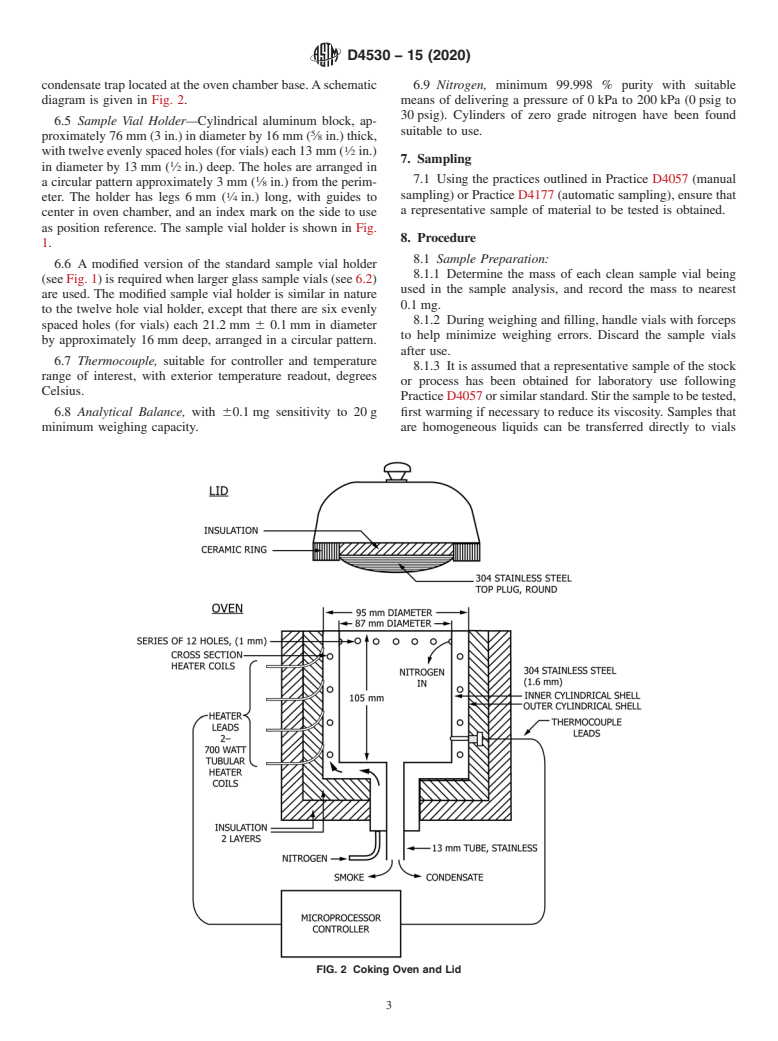
5.3 Up to twelve samples may be run simultaneously, including a control sample when the vial holder shown in Fig. 1 is used exclusively for sample analysis.
FIG. 1 Sample Vial Holder and Vial
SCOPE
1.1 This test method covers the determination of the amount of carbon residue (see Note 1) formed after evaporation and pyrolysis of petroleum materials under certain conditions and is intended to provide some indication of the relative coke forming tendency of such materials.
1.2 The test results are equivalent to the Conradson Carbon Residue test (see Test Method D189).
Note 1: This procedure is a modification of the original method and apparatus for carbon residue of petroleum materials, where it has been demonstrated that thermogravimetry is another applicable technique.2 However, it is the responsibility of the operator to establish operating conditions to obtain equivalent results when using thermogravimetry.
1.3 This test method is applicable to petroleum products that partially decompose on distillation at atmospheric pressure and was tested for carbon residue values of 0.10 % to 30 % (m/m). Samples expected to be below 0.10 weight % (m/m) residue should be distilled to remove 90 % (V/V) of the flask charge (see Section 9). The 10 % bottoms remaining is then tested for carbon residue by this test method.
1.4 Ash-forming constituents, as defined by Test Method D482, or non-volatile additives present in the sample will add to the carbon residue value and be included as part of the total carbon residue value reported.
1.5 Also in diesel fuel, the presence of alkyl nitrates, such as amyl nitrate, hexyl nitrate, or octyl nitrate, causes a higher carbon residue value than observed in untreated fuel, which may lead to erroneous conclusions as to the coke-forming propensity of the fuel. The presence of alkyl nitrate in the fuel may be detected by Test Method D4046.
1.6 The values stated in SI units are to be regarded as standard. No other units of measurement are included in this standard.
1.6.1 Exception—6.4 and 6.5 include inch-pound units.
1.7 WARNING—Mercury has been designated by many regulatory agencies as a hazardous substance that can cause serious medical issues. Mercury, or its vapor, has been demonstrated to be hazardous to health and corrosive to materials. Use Caution when handling mercury and mercury-containing products. See the applicable product Safety Data Sheet (SDS) for additional information. The potential exists that selling mercury or mercury-containing products, or both, is prohibited by local or national law. Users must determine legality of sales in their location.
1.8 This standard does not purport to address all of the safety concerns, if any, associated with its use. It is the responsibility of the user of this standard to establish appropriate safety, health, and environmental practices and to determine the applicability of regulatory limitations prior to use. For specific warning statements, see 8.2.3 and 8.4.
1.9 This international standard was developed in accordance with internationally recognized principles on standardization established in the Decision on Principles for the Development of International Standards, Guides and Recommendations issued by the World Trade Organization Technical Barriers to Trade (TBT) Committee.
General Information
Standards Content (Sample)
This international standard was developed in accordance with internationally recognized principles on standardization established in the Decision on Principles for the
Development of International Standards, Guides and Recommendations issued by the World Trade Organization Technical Barriers to Trade (TBT) Committee.
Designation: D4530 − 15 (Reapproved 2020)
Standard Test Method for
1
Determination of Carbon Residue (Micro Method)
This standard is issued under the fixed designation D4530; the number immediately following the designation indicates the year of
original adoption or, in the case of revision, the year of last revision. A number in parentheses indicates the year of last reapproval. A
superscript epsilon (´) indicates an editorial change since the last revision or reapproval.
This standard has been approved for use by agencies of the U.S. Department of Defense.
1. Scope 1.7 WARNING—Mercury has been designated by many
regulatory agencies as a hazardous substance that can cause
1.1 Thistestmethodcoversthedeterminationoftheamount
serious medical issues. Mercury, or its vapor, has been dem-
of carbon residue (see Note 1) formed after evaporation and
onstrated to be hazardous to health and corrosive to materials.
pyrolysis of petroleum materials under certain conditions and
Use Caution when handling mercury and mercury-containing
is intended to provide some indication of the relative coke
products. See the applicable product Safety Data Sheet (SDS)
forming tendency of such materials.
for additional information. The potential exists that selling
1.2 The test results are equivalent to the Conradson Carbon
mercury or mercury-containing products, or both, is prohibited
Residue test (see Test Method D189).
by local or national law. Users must determine legality of sales
in their location.
NOTE 1—This procedure is a modification of the original method and
apparatus for carbon residue of petroleum materials, where it has been
1.8 This standard does not purport to address all of the
2
demonstrated that thermogravimetry is another applicable technique.
safety concerns, if any, associated with its use. It is the
However, it is the responsibility of the operator to establish operating
responsibility of the user of this standard to establish appro-
conditions to obtain equivalent results when using thermogravimetry.
priate safety, health, and environmental practices and to
1.3 Thistestmethodisapplicabletopetroleumproductsthat
determine the applicability of regulatory limitations prior to
partially decompose on distillation at atmospheric pressure and
use. For specific warning statements, see 8.2.3 and 8.4.
was tested for carbon residue values of 0.10 % to 30 % (m/m).
1.9 This international standard was developed in accor-
Samples expected to be below 0.10 weight % (m⁄m) residue
dance with internationally recognized principles on standard-
should be distilled to remove 90 % (V/V) of the flask charge
ization established in the Decision on Principles for the
(see Section 9). The 10 % bottoms remaining is then tested for
Development of International Standards, Guides and Recom-
carbon residue by this test method.
mendations issued by the World Trade Organization Technical
1.4 Ash-forming constituents, as defined by Test Method
Barriers to Trade (TBT) Committee.
D482, or non-volatile additives present in the sample will add
to the carbon residue value and be included as part of the total
2. Referenced Documents
carbon residue value reported. 3
2.1 ASTM Standards:
1.5 Alsoindieselfuel,thepresenceofalkylnitrates,suchas
D189 Test Method for Conradson Carbon Residue of Petro-
amyl nitrate, hexyl nitrate, or octyl nitrate, causes a higher leum Products
carbon residue value than observed in untreated fuel, which
D482 Test Method for Ash from Petroleum Products
may lead to erroneous conclusions as to the coke-forming D4046 Test Method for Alkyl Nitrate in Diesel Fuels by
4
propensity of the fuel. The presence of alkyl nitrate in the fuel
Spectrophotometry (Withdrawn 2019)
may be detected by Test Method D4046. D4057 Practice for Manual Sampling of Petroleum and
Petroleum Products
1.6 The values stated in SI units are to be regarded as
D4177 Practice for Automatic Sampling of Petroleum and
standard. No other units of measurement are included in this
Petroleum Products
standard.
E1 Specification for ASTM Liquid-in-Glass Thermometers
1.6.1 Exception—6.4 and 6.5 include inch-pound units.
E133 Specification for Distillation Equipment
1
This test method is under the jurisdiction of ASTM Committee D02 on
3
Petroleum Products, Liquid Fuels, and Lubricants and is the direct responsibility of For referenced ASTM standards, visit the ASTM website, www.astm.org, or
Subcommittee D02.06 on Analysis of Liquid Fuels and Lubricants. contact ASTM Customer Service at service@astm.org. For Annual Book of ASTM
Current edition approved May 1, 2020. Published June 2020. Originally Standards volume information, refer to the standard’s Document Summary page
...
Questions, Comments and Discussion
Ask us and Technical Secretary will try to provide an answer. You can facilitate discussion about the standard in here.