

ASTM C1220-21
(Test Method)Standard Test Method for Static Leaching of Monolithic Waste Forms for Disposal of Radioactive Waste
General Information
- Abstract
SIGNIFICANCE AND USE
5.1 This test method can be used to provide a measure of the reactivity of a material in a dilute solution in which the test response is dominated by the dissolution or leaching of the test specimen. It can be used to compare the dissolution or leaching behaviors of candidate radioactive waste forms and to study the reactions during static exposure to dilute solutions in which solution feed-back effects can be maintained negligible, depending on the test conditions.
5.2 The test is suitable for application to natural minerals, simulated waste form materials, and radioactive waste form material specimens.
5.3 Data from this test may form part of the larger body of data that is necessary in the logical approach to long-term prediction of waste form behavior, as described in Practice C1174. In particular, measured solution concentrations and characterizations of altered surfaces may be used in the validation of geochemical modeling codes.
5.4 This test method excludes the use of crushed or powdered specimens and organic materials.
5.5 Several reference test parameter values and reference leachant solutions are specified to facilitate the comparison of results of tests conducted with different materials and at different laboratories. However, other test parameter values and leachant solution compositions can be used to characterize the specimen reactivity.
5.5.1 Tests can be conducted with different leachant compositions to simulate groundwaters, buffer the leachate pH as the specimen dissolves, or measure the common ion effect of particular solutes.
5.5.2 Tests can be conducted to measure the effects of various test parameter values on the specimen response, including time, temperature, and S/V ratio. Tests conducted for different durations and at various temperatures provide insight into the reaction kinetics. Tests conducted at different S/V ratio provide insight into chemical affinity (solution feed-back effects) and the approach to saturation.
...
SCOPE
1.1 This test method provides a measure of the chemical durability of a simulated or radioactive monolithic waste form, such as a glass, ceramic, cement (grout), or cermet, in a test solution at temperatures
1.2 This test method can be used to characterize the dissolution or leaching behaviors of various simulated or radioactive waste forms in various leachants under the specific conditions of the test based on analysis of the test solution. Data from this test are used to calculate normalized elemental mass loss values from specimens exposed to aqueous solutions at temperatures
1.3 The test is conducted under static conditions in a constant solution volume and at a constant temperature. The reactivity of the test specimen is determined from the amounts of components released and accumulated in the solution over the test duration. A wide range of test conditions can be used to study material behavior, including various leachant composition, specimen surface area-to-leachant volume ratios, temperatures, and test durations.
1.4 Three leachant compositions and four reference test matrices of test conditions are recommended to characterize materials behavior and facilitate interlaboratory comparisons of tests results.
1.5 Specimen surfaces may become altered during this test. Although not part of the test method, it is recommended that these altered surface regions be examined to characterize chemical and physical changes due to the reaction of waste forms during static exposure to solutions.
1.6 This test method is not recommended for evaluating metallic materials, the degradation of which includes oxidation reactions that are not controlled by this test method.
1.7 This test method must be performed in accordance with all applicable quality assurance requirements for acceptance of the data.
1.8 The values stated in SI units are to be regarded as standard. Other units of measurement are included for r...
- Status
- Published
- Publication Date
- 30-Sep-2021
- Technical Committee
- C26 - Nuclear Fuel Cycle
- Drafting Committee
- C26.13 - Spent Fuel and High Level Waste
Buy Documents
ASTM C1220-21 - Standard Test Method for Static Leaching of Monolithic Waste Forms for Disposal of Radioactive Waste
REDLINE ASTM C1220-21 - Standard Test Method for Static Leaching of Monolithic Waste Forms for Disposal of Radioactive Waste
Overview
ASTM C1220-21: Standard Test Method for Static Leaching of Monolithic Waste Forms for Disposal of Radioactive Waste establishes a uniform procedure for assessing the chemical durability and leaching behavior of monolithic waste forms, such as glass, ceramic, cement (grout), or cermet, under controlled laboratory conditions. This standard is vital for the nuclear industry, waste management facilities, and environmental laboratories involved in the long-term disposal of radioactive waste. By providing a consistent methodology, ASTM C1220-21 enables accurate comparisons across materials and testing laboratories, supporting informed decisions about waste form selection and repository safety.
Key Topics
Purpose and Scope
- Measures the dissolution or leaching of monolithic specimens (not powders or organics) under static, low surface area-to-volume (S/V) ratio conditions at temperatures below 100°C.
- Applicable to both simulated and actual radioactive waste forms as well as relevant natural minerals.
- Excludes metallic materials, as oxidation processes are not addressed.
Test Procedure Overview
- Test specimen of known geometry is immersed in a fixed volume of leachant within a sealed vessel.
- Test is conducted at a controlled constant temperature for a defined duration without agitation.
- Post-test, leachate is analyzed for pH, dissolved, and colloidal constituents to quantify release rates.
- Various leachant solutions (e.g., reference brine, silicate, actual groundwater) and test parameters can be tailored to simulate repository conditions or explore reaction mechanisms.
Data Collection and Use
- Data enable calculation of normalized elemental mass loss, a critical parameter for chemical durability assessment.
- Results are used to support geochemical modeling and long-term predictions of waste form performance.
- Altered specimen surfaces are often examined post-test to understand chemical and physical changes.
Quality and Comparability
- Reference test matrices and leachants are specified to facilitate interlaboratory comparison and regulatory acceptance.
- Precise quality assurance, cleaning, and calibration requirements are provided to ensure reproducibility and reliability of analytic results.
- Standard aligns with international standards development principles.
Applications
Radioactive Waste Disposal
- Assesses the integrity of waste forms intended for deep geological repositories or long-term surface storage.
- Supports safety cases by demonstrating retention of radionuclides within waste packages over time.
Material Qualification and Comparison
- Compares the leach resistance of different candidate waste forms, advancing the selection of optimal materials for immobilization of high-level radioactive waste.
- Assists in qualifying newly developed waste forms or treatment processes before their adoption in nuclear waste programs.
Geochemical Modeling Validation
- Provides empirical inputs (e.g., solution concentrations, surface alteration data) for validating geochemical simulations used in performance assessments of waste repositories.
Regulatory and Quality Assurance
- Enables waste management organizations to meet national and international regulatory requirements for waste form durability documentation.
- Provides a standardized protocol critical for contract specifications and interlaboratory studies.
Related Standards
- ASTM C1109 - Practice for Analysis of Aqueous Leachates from Nuclear Waste Materials
- ASTM C1174 - Guide for Evaluation of Long-Term Behavior of Materials Used in Engineered Barrier Systems (EBS) for Geological Disposal
- ASTM C859 - Terminology Relating to Nuclear Materials
- ASTM D1193 - Specification for Reagent Water
- ASTM D1293 - Test Methods for pH of Water
- ASTM E3 - Guide for Preparation of Metallographic Specimens
- EPA SW-846A - Test Methods for Evaluating Solid Waste, Physical/Chemical Methods
By implementing ASTM C1220-21, stakeholders ensure robust, reproducible data for the evaluation and comparison of waste form durability, enhancing the safety and effectiveness of nuclear waste containment and supporting compliance with global best practices in radioactive waste management.
Relations
- Effective Date
- 01-Jan-2024
- Effective Date
- 01-Dec-2023
- Effective Date
- 15-Feb-2020
- Effective Date
- 01-Jul-2017
- Effective Date
- 01-Jun-2015
- Effective Date
- 15-Jun-2014
- Effective Date
- 15-Jan-2014
- Effective Date
- 01-Jun-2013
- Effective Date
- 01-May-2013
- Effective Date
- 01-Apr-2013
- Effective Date
- 01-Jan-2012
- Effective Date
- 01-Nov-2010
- Effective Date
- 01-Oct-2010
- Effective Date
- 01-Aug-2010
- Effective Date
- 01-Feb-2010
Buy Documents
ASTM C1220-21 - Standard Test Method for Static Leaching of Monolithic Waste Forms for Disposal of Radioactive Waste
REDLINE ASTM C1220-21 - Standard Test Method for Static Leaching of Monolithic Waste Forms for Disposal of Radioactive Waste
Get Certified
Connect with accredited certification bodies for this standard

DNV
DNV is an independent assurance and risk management provider.

Lloyd's Register
Lloyd's Register is a global professional services organisation specialising in engineering and technology.
DNV Energy Systems
Energy and renewable energy certification.
Sponsored listings
Frequently Asked Questions
ASTM C1220-21 is a standard published by ASTM International. Its full title is "Standard Test Method for Static Leaching of Monolithic Waste Forms for Disposal of Radioactive Waste". This standard covers: SIGNIFICANCE AND USE 5.1 This test method can be used to provide a measure of the reactivity of a material in a dilute solution in which the test response is dominated by the dissolution or leaching of the test specimen. It can be used to compare the dissolution or leaching behaviors of candidate radioactive waste forms and to study the reactions during static exposure to dilute solutions in which solution feed-back effects can be maintained negligible, depending on the test conditions. 5.2 The test is suitable for application to natural minerals, simulated waste form materials, and radioactive waste form material specimens. 5.3 Data from this test may form part of the larger body of data that is necessary in the logical approach to long-term prediction of waste form behavior, as described in Practice C1174. In particular, measured solution concentrations and characterizations of altered surfaces may be used in the validation of geochemical modeling codes. 5.4 This test method excludes the use of crushed or powdered specimens and organic materials. 5.5 Several reference test parameter values and reference leachant solutions are specified to facilitate the comparison of results of tests conducted with different materials and at different laboratories. However, other test parameter values and leachant solution compositions can be used to characterize the specimen reactivity. 5.5.1 Tests can be conducted with different leachant compositions to simulate groundwaters, buffer the leachate pH as the specimen dissolves, or measure the common ion effect of particular solutes. 5.5.2 Tests can be conducted to measure the effects of various test parameter values on the specimen response, including time, temperature, and S/V ratio. Tests conducted for different durations and at various temperatures provide insight into the reaction kinetics. Tests conducted at different S/V ratio provide insight into chemical affinity (solution feed-back effects) and the approach to saturation. ... SCOPE 1.1 This test method provides a measure of the chemical durability of a simulated or radioactive monolithic waste form, such as a glass, ceramic, cement (grout), or cermet, in a test solution at temperatures 1.2 This test method can be used to characterize the dissolution or leaching behaviors of various simulated or radioactive waste forms in various leachants under the specific conditions of the test based on analysis of the test solution. Data from this test are used to calculate normalized elemental mass loss values from specimens exposed to aqueous solutions at temperatures 1.3 The test is conducted under static conditions in a constant solution volume and at a constant temperature. The reactivity of the test specimen is determined from the amounts of components released and accumulated in the solution over the test duration. A wide range of test conditions can be used to study material behavior, including various leachant composition, specimen surface area-to-leachant volume ratios, temperatures, and test durations. 1.4 Three leachant compositions and four reference test matrices of test conditions are recommended to characterize materials behavior and facilitate interlaboratory comparisons of tests results. 1.5 Specimen surfaces may become altered during this test. Although not part of the test method, it is recommended that these altered surface regions be examined to characterize chemical and physical changes due to the reaction of waste forms during static exposure to solutions. 1.6 This test method is not recommended for evaluating metallic materials, the degradation of which includes oxidation reactions that are not controlled by this test method. 1.7 This test method must be performed in accordance with all applicable quality assurance requirements for acceptance of the data. 1.8 The values stated in SI units are to be regarded as standard. Other units of measurement are included for r...
SIGNIFICANCE AND USE 5.1 This test method can be used to provide a measure of the reactivity of a material in a dilute solution in which the test response is dominated by the dissolution or leaching of the test specimen. It can be used to compare the dissolution or leaching behaviors of candidate radioactive waste forms and to study the reactions during static exposure to dilute solutions in which solution feed-back effects can be maintained negligible, depending on the test conditions. 5.2 The test is suitable for application to natural minerals, simulated waste form materials, and radioactive waste form material specimens. 5.3 Data from this test may form part of the larger body of data that is necessary in the logical approach to long-term prediction of waste form behavior, as described in Practice C1174. In particular, measured solution concentrations and characterizations of altered surfaces may be used in the validation of geochemical modeling codes. 5.4 This test method excludes the use of crushed or powdered specimens and organic materials. 5.5 Several reference test parameter values and reference leachant solutions are specified to facilitate the comparison of results of tests conducted with different materials and at different laboratories. However, other test parameter values and leachant solution compositions can be used to characterize the specimen reactivity. 5.5.1 Tests can be conducted with different leachant compositions to simulate groundwaters, buffer the leachate pH as the specimen dissolves, or measure the common ion effect of particular solutes. 5.5.2 Tests can be conducted to measure the effects of various test parameter values on the specimen response, including time, temperature, and S/V ratio. Tests conducted for different durations and at various temperatures provide insight into the reaction kinetics. Tests conducted at different S/V ratio provide insight into chemical affinity (solution feed-back effects) and the approach to saturation. ... SCOPE 1.1 This test method provides a measure of the chemical durability of a simulated or radioactive monolithic waste form, such as a glass, ceramic, cement (grout), or cermet, in a test solution at temperatures 1.2 This test method can be used to characterize the dissolution or leaching behaviors of various simulated or radioactive waste forms in various leachants under the specific conditions of the test based on analysis of the test solution. Data from this test are used to calculate normalized elemental mass loss values from specimens exposed to aqueous solutions at temperatures 1.3 The test is conducted under static conditions in a constant solution volume and at a constant temperature. The reactivity of the test specimen is determined from the amounts of components released and accumulated in the solution over the test duration. A wide range of test conditions can be used to study material behavior, including various leachant composition, specimen surface area-to-leachant volume ratios, temperatures, and test durations. 1.4 Three leachant compositions and four reference test matrices of test conditions are recommended to characterize materials behavior and facilitate interlaboratory comparisons of tests results. 1.5 Specimen surfaces may become altered during this test. Although not part of the test method, it is recommended that these altered surface regions be examined to characterize chemical and physical changes due to the reaction of waste forms during static exposure to solutions. 1.6 This test method is not recommended for evaluating metallic materials, the degradation of which includes oxidation reactions that are not controlled by this test method. 1.7 This test method must be performed in accordance with all applicable quality assurance requirements for acceptance of the data. 1.8 The values stated in SI units are to be regarded as standard. Other units of measurement are included for r...
ASTM C1220-21 is classified under the following ICS (International Classification for Standards) categories: 13.280 - Radiation protection; 27.120.30 - Fissile materials and nuclear fuel technology. The ICS classification helps identify the subject area and facilitates finding related standards.
ASTM C1220-21 has the following relationships with other standards: It is inter standard links to ASTM C859-24, ASTM C1109-23, ASTM C1174-20, ASTM C1174-17, ASTM C1109-10(2015), ASTM C859-14a, ASTM C859-14, ASTM C859-13a, ASTM C859-13, ASTM C1174-07(2013), ASTM D1293-12, ASTM C859-10b, ASTM C1109-10, ASTM C859-10a, ASTM C859-10. Understanding these relationships helps ensure you are using the most current and applicable version of the standard.
ASTM C1220-21 is available in PDF format for immediate download after purchase. The document can be added to your cart and obtained through the secure checkout process. Digital delivery ensures instant access to the complete standard document.
Standards Content (Sample)
This international standard was developed in accordance with internationally recognized principles on standardization established in the Decision on Principles for the
Development of International Standards, Guides and Recommendations issued by the World Trade Organization Technical Barriers to Trade (TBT) Committee.
Designation: C1220 − 21
Standard Test Method for
Static Leaching of Monolithic Waste Forms for Disposal of
Radioactive Waste
This standard is issued under the fixed designation C1220; the number immediately following the designation indicates the year of
original adoption or, in the case of revision, the year of last revision.Anumber in parentheses indicates the year of last reapproval.A
superscript epsilon (´) indicates an editorial change since the last revision or reapproval.
1. Scope 1.7 This test method must be performed in accordance with
all applicable quality assurance requirements for acceptance of
1.1 This test method provides a measure of the chemical
the data.
durability of a simulated or radioactive monolithic waste form,
1.8 The values stated in SI units are to be regarded as
such as a glass, ceramic, cement (grout), or cermet, in a test
standard. Other units of measurement are included for refer-
solution at temperatures <100 °C under low specimen surface-
ence only, with the following exceptions:
area-to-leachant volume (S/V) ratio conditions.
1.8.1 Grit size used in this standard can be converted to the
1.2 This test method can be used to characterize the disso-
corresponding µm values using the current revision of Guide
lutionorleachingbehaviorsofvarioussimulatedorradioactive
E3.
waste forms in various leachants under the specific conditions
1.8.2 Appendix X2 describes the usage of a model of saw
ofthetestbasedonanalysisofthetestsolution.Datafromthis
forwhichcomponentsandinstrumentsareimperialunitbased;
test are used to calculate normalized elemental mass loss
imperial units are used in this section.
values from specimens exposed to aqueous solutions at tem-
1.9 This standard does not purport to address all of the
peratures <100 °C.
safety concerns, if any, associated with its use. It is the
1.3 The test is conducted under static conditions in a
responsibility of the user of this standard to establish appro-
constant solution volume and at a constant temperature. The
priate safety, health, and environmental practices and deter-
reactivity of the test specimen is determined from the amounts
mine the applicability of regulatory limitations prior to use.
of components released and accumulated in the solution over
For a specific hazard statement, see 7.3.2.
thetestduration.Awiderangeoftestconditionscanbeusedto
1.10 This international standard was developed in accor-
study material behavior, including various leachant
dance with internationally recognized principles on standard-
composition, specimen surface area-to-leachant volume ratios,
ization established in the Decision on Principles for the
temperatures, and test durations.
Development of International Standards, Guides and Recom-
mendations issued by the World Trade Organization Technical
1.4 Three leachant compositions and four reference test
Barriers to Trade (TBT) Committee.
matrices of test conditions are recommended to characterize
materials behavior and facilitate interlaboratory comparisons
2. Referenced Documents
of tests results.
2.1 ASTM Standards:
1.5 Specimen surfaces may become altered during this test.
C859Terminology Relating to Nuclear Materials
Although not part of the test method, it is recommended that
C1109Practice for Analysis of Aqueous Leachates from
these altered surface regions be examined to characterize
Nuclear Waste Materials Using Inductively Coupled
chemical and physical changes due to the reaction of waste
Plasma-Atomic Emission Spectroscopy
forms during static exposure to solutions.
C1174Guide for Evaluation of Long-Term Behavior of
1.6 This test method is not recommended for evaluating
Materials Used in Engineered Barrier Systems (EBS) for
metallicmaterials,thedegradationofwhichincludesoxidation
Geological Disposal of High-Level Radioactive Waste
reactions that are not controlled by this test method.
D1193Specification for Reagent Water
D1293Test Methods for pH of Water
E3Guide for Preparation of Metallographic Specimens
ThistestmethodisunderthejurisdictionofASTMCommitteeC26onNuclear
Fuel Cycle and is the direct responsibility of Subcommittee C26.13 on Spent Fuel
and High Level Waste. For referenced ASTM standards, visit the ASTM website, www.astm.org, or
Current edition approved Oct. 1, 2021. Published December 2021. Originally contact ASTM Customer Service at service@astm.org. For Annual Book of ASTM
approved in 1992. Last previous edition approved in 2017 as C1220–17. DOI: Standards volume information, refer to the standard’s Document Summary page on
10.1520/C1220-21. the ASTM website.
Copyright © ASTM International, 100 Barr Harbor Drive, PO Box C700, West Conshohocken, PA 19428-2959. United States
C1220 − 21
2.2 EPA Standard: cool before being opened.Aliquots of the leachate solution are
SW-846A Test Methods for Evaluating Solid Waste, removed and analyzed for pH and various dissolved and
Physical/Chemical Methods colloidal components that were released from the specimen
during the test. The concentrations of dissolved soluble com-
3. Terminology
ponentsareusedtodeterminetheextentofreaction.Aseparate
3.1 Refer to Terminology C859 for additional terminology test is conducted to provide data for each test condition
(duration, temperature, S/V ratio, leachant composition, etc.).
that may not be listed below.
Although it is not a part of the test method, it is recommended
3.2 Definitions of Terms Specific to This Standard:
that the reacted test specimens be examined for changes in the
3.2.1 accumulated dose, n—the sum of the absorbed doses
composition and structures of the near-surface regions for
received by the system considered regardless of whether it is
correlations with the solution results and to study the reaction
exposed to radiation in a continuous or discontinuous fashion.
mechanism.
3.2.2 actinide, n—any element with atomic number of 89 to
103.
5. Significance and Use
3.2.3 high-purity water, n—purified water conforming with
5.1 Thistestmethodcanbeusedtoprovideameasureofthe
the requirements given in Specification D1193 for Type I or
reactivity of a material in a dilute solution in which the test
Type II water.
responseisdominatedbythedissolutionorleachingofthetest
3.2.4 leachate, n—in leach tests, general term for the
specimen.Itcanbeusedtocomparethedissolutionorleaching
solution resulting from a test in which a solid is contacted by
behaviorsofcandidateradioactivewasteformsandtostudythe
a solution and leaches or dissolves.
reactions during static exposure to dilute solutions in which
3.2.5 leaching, v—the preferential loss of soluble compo- solution feed-back effects can be maintained negligible, de-
nents from a solid material into a solution leaving a residual
pending on the test conditions.
phase that is depleted in those components, but structurally
5.2 The test is suitable for application to natural minerals,
unchanged.
simulated waste form materials, and radioactive waste form
3.2.6 monolithic specimen, n—specimen that is physically
material specimens.
one coherent piece, as opposed to powdered specimens that
5.3 Data from this test may form part of the larger body of
consist of many small pieces of irregular configuration. A
data that is necessary in the logical approach to long-term
monolithic specimen may consist of several individual phases,
prediction of waste form behavior, as described in Practice
but they must be bound in a stable coherent configuration.
C1174. In particular, measured solution concentrations and
3.2.7 nuclear waste form, n—solid material in which radio-
characterizations of altered surfaces may be used in the
active wastes have been immobilized.
validation of geochemical modeling codes.
3.2.8 precision of a measurement process, n—the expected
5.4 This test method excludes the use of crushed or pow-
dispersion of values obtained using a measurement process
dered specimens and organic materials.
under prescribed conditions, usually represented as a standard
deviation or relative standard deviation. 5.5 Several reference test parameter values and reference
leachant solutions are specified to facilitate the comparison of
3.3 Abbreviations:
results of tests conducted with different materials and at
3.3.1 EDX—energy-dispersive x-ray fluorescence (instru-
differentlaboratories.However,othertestparametervaluesand
ment or analysis).
leachant solution compositions can be used to characterize the
3.3.2 ISE—ion selective electrode.
specimen reactivity.
3.3.3 PTFE—polytetrafluoroethylene.
5.5.1 Tests can be conducted with different leachant com-
3.3.4 SEM—scanning electron microscopy (or microscope). positions to simulate groundwaters, buffer the leachate pH as
the specimen dissolves, or measure the common ion effect of
3.3.5 TEM—transmission electron microscopy (or micro-
particular solutes.
scope).
5.5.2 Tests can be conducted to measure the effects of
3.3.6 XRD—x-ray diffraction (or diffractometer).
various test parameter values on the specimen response,
includingtime,temperature,andS/Vratio.Testsconductedfor
4. Summary of Test Method
different durations and at various temperatures provide insight
4.1 A specimen of known geometric surface area (S) is
intothereactionkinetics.TestsconductedatdifferentS/Vratio
immersed in a known volume of leachant (V) in a test vessel
provide insight into chemical affinity (solution feed-back
that is sealed and placed in an oven (or other controlled-
effects) and the approach to saturation.
temperature device) set at a defined temperature for a defined
time period without agitation. After the prescribed time 5.6 Eitheraeratedordeaeratedsolutionsmaybeusedinthis
test method except when testing highly radioactive specimens.
interval, the vessel is removed from the oven and allowed to
Deaerated solutions are mandatory in tests conducted with
highly radioactive specimens to minimize the effects of nitro-
AvailablefromUnitedStatesEnvironmentalProtectionAgency(EPA),William
gen radiolysis. Preparation of deaerated leachants is addressed
Jefferson Clinton Bldg., 1200 Pennsylvania Ave., NW, Washington, DC 20460,
http://www.epa.gov. in 7.2.2.
C1220 − 21
5.7 Control of the oxygen fugacity is not part of this test the vessel and leachate are expected to moderate the variance
method. Such control and measurement may be required for in the specimen temperature, but the oven should remain
specific uses of test data but are beyond the scope of this test closed as much as possible.
method.
6.2.3 The locations of test vessels should be mapped to
facilitate their retrieval when the tests are terminated. Place-
5.8 Tests can be conducted using vessels compatible with
mentsshouldminimizetheneedtodisturbneighboringvessels
the test specimen, leachant, and test environment. Corrosion
when retrieving vessels.
resistant materials shall be used for tests with corrosive brines.
Radiation-resistantmaterialsshallbeusedfortestsinradiation
6.3 Test Vessel and Specimen Support—Steel, titanium,
fields wherein the accumulated absorbed dose will exceed
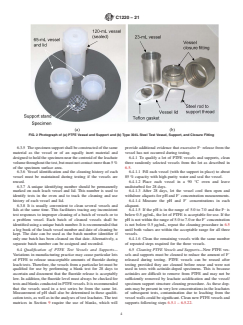
fused silica, or PTFE vessels and specimen supports (Fig. 2)
100Gy (10 rad, see Note 1).
canbeused.Vesselsshallbeselectedtobecompatiblewiththe
NOTE 1—Additional requirements to the test method apply when using
test specimen material, leachant, and the radiation field.
a highly radioactive waste form specimen, as indicated in the procedure.
6.3.1 When testing is performed in radiation fields expected
to yield an absorbed dose of less than 100 Gy (10 rad), PTFE
6. Apparatus and Analytical Requirements
vessels shall be qualified for use (see 6.4). PTFE vessels shall
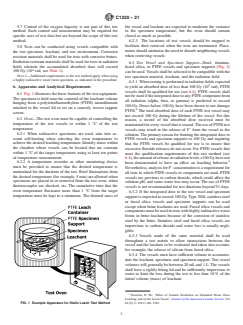
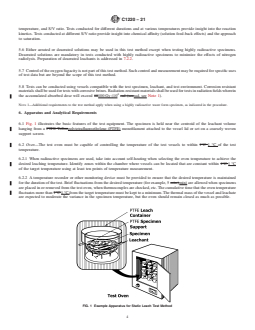
6.1 Fig.1illustratesthebasicfeaturesofthetestequipment.
notbeusediftheintegrateddosetoanyPTFEcomponentfrom
The specimen is held near the centroid of the leachant volume
all radiation (alpha, beta, or gamma) is predicted to exceed
hanging from a polytetrafluoroethylene (PTFE) monofilament
100Gy. Doses below 100Gy have been shown to not damage
attached to the vessel lid or set on a coarsely woven support
PTFE. The total absorbed dose of each PTFE test vessel may
screen.
not exceed 100 Gy during the lifetime of the vessel. For this
6.2 Oven—The test oven must be capable of controlling the
reason, a record of the absorbed dose received must be
temperature of the test vessels to within 1 °C of the test
maintainedforeveryvesselthatisreused.TheuseofPTFEtest
–
temperature.
vessels may result in the release of F from the vessel to the
6.2.1 When radioactive specimens are used, take into ac-
solution.Theprimaryreasonforlimitingtheintegrateddoseto
count self-heating when selecting the oven temperature to
PTFE vessels and specimen supports to 100 Gy and requiring
achievethedesiredleachingtemperature.Identifyzoneswithin
that the PTFE vessels be qualified for use is to ensure that
the chamber where vessels can be located that are constant
excessive fluoride releases do not occur. For PTFE vessels that
within 1 °C of the target temperature using at least ten points
meet the qualification requirements of this test method (see
of temperature measurement.
6.4),theamountofreleaseatradiationlevels<100Gyhavenot
6.2.2 A temperature recorder or other monitoring device
been demonstrated to have an effect on leaching behavior.
–
must be provided to ensure that the desired temperature is
Nevertheless,analysisforF concentrationisarequirementfor
maintained for the duration of the test. Brief fluctuations from
all tests in which PTFE vessels or components are used. PTFE
thedesiredtemperature(forexample,5min)areallowedwhen
vessels are pervious to carbon dioxide, which could affect the
specimens are placed in or removed from the test oven, when
solution pH, and some water loss may occur.The use of PTFE
thermocouples are checked, etc. The cumulative time that the
vessels is not recommended for test durations beyond 91 days.
oven temperature fluctuates more than 1 °C from the target
6.3.2 If the integrated dose to the test vessel and specimen
temperature must be kept to a minimum. The thermal mass of
supportisexpectedtoexceed100Gy,Type304Lstainlesssteel
or fused silica vessels and specimen supports can be used
except when brine leachants are used. Fused silica vessels and
componentsmustbeusedintestswithhighlyradioactivewaste
forms in brine leachants because of the corrosion of stainless
steel by the brine. Stainless steel and fused silica vessels are
impervious to carbon dioxide and water loss is usually negli-
gible.
6.3.3 Vessels made of the same material shall be used
throughout a test matrix to allow interactions between the
vessel and the leachate to be evaluated and taken into account,
for example, the release of silicon from fused silica.
6.3.4 The vessels must have sufficient volume to accommo-
date the leachant, specimen, and specimen support.Test vessel
volumeswillgenerallybebetween20mLand1L.Thevessels
shall have a tightly fitting lid and be sufficiently impervious to
water to limit the loss during the test to less than 10% of the
initial volume (mass) of leachant.
Strachan, D. M., “Effect of Gamma Irradiation on Simulated Waste Glass
Leaching and on the Leach Vessel,” Journal of the American Ceramic Society,Vol
FIG. 1 Example Apparatus for Static Leach Test Method 66 [9], C-158-C-160, 1983.
C1220 − 21
FIG. 2 Photograph of (a) PTFE Vessel and Support and (b) Type 304L Steel Test Vessel, Support, and Closure Fitting
–
6.3.5 Thespecimensupportshallbeconstructedofthesame provide additional evidence that excessive F release from the
material as the vessel or of an equally inert material and vessel has not occurred during testing.
designedtoholdthespecimennearthecentroidoftheleachate 6.4.1 To qualify a lot of PTFE vessels and supports, clean
volumethroughoutthetest,butmustnotcontactmorethan5% three randomly selected vessels from the lot as described in
of the specimen surface area. 6.5.
6.3.6 Vessel identification and the cleaning history of each 6.4.1.1 Fill each vessel (with the support in place) to about
vessel must be maintained during testing if the vessels are 85% capacity with high-purity water and seal the vessel.
reused. 6.4.1.2 Place each vessel in a 90 °C oven and leave
6.3.7 A unique identifying number should be permanently undisturbed for 28 days.
marked on each leach vessel and lid. This number is used to 6.4.1.3 After 28 days, let the vessel cool then open and
–
identify tests in the oven and to track the cleaning and use withdraw aliquots for pH and F concentration measurements.
–
history of each vessel and lid. 6.4.1.4 Measure the pH and F concentrations in each
6.3.8 It is usually convenient to clean several vessels and aliquant.
–
lids at the same time. This facilitates tracing any inconsistent 6.4.1.5 If the pH is in the range of 5.0 to 7.0 and the F is
test responses to improper cleaning of a batch of vessels or to below 0.5 µg/mL, the lot of PTFE is acceptable for use. If the
–
a problem vessel. Each batch of cleaned vessels shall be pH is not within the range of 5.0 to 7.0 or the F concentration
identifiedusingauniquebatchnumber.Itisrecommendedthat is not below 0.5 µg/mL, repeat the cleaning procedure in 6.5
a log book of the leach vessel number and date of cleaning be until both values are within the acceptable range for all three
kept. The date can be used as the batch number identifier if vessels.
only one batch has been cleaned on that date. Alternatively, a 6.4.1.6 Clean the remaining vessels with the same number
separate batch number can be assigned and recorded. of repeated steps required for the three vessels.
6.4 Qualification of PTFE Test Vessels and Supports— 6.5 Cleaning PTFE Vessels and Supports—New PTFE ves-
–
Variations in manufacturing practice may cause particular lots sels and supports must be cleaned to reduce the amount of F
of PTFE to release unacceptable amounts of fluoride during released during testing. PTFE vessels can be reused after
leach tests.Therefore, the vessels from a particular lot must be testing provided they are cleaned before reuse and were not
qualified for use by performing a blank test for 28 days to used in tests with actinide-doped specimens. This is because
ascertain and document that the fluoride release is acceptably actinides are difficult to remove from PTFE and may not be
low. In addition, the fluoride level must always be checked for sufficiently removed by leachate acidification and the vessel/
testsandblanksconductedinPTFEvessels.Itisrecommended specimen support structure cleaning procedure. As these dop-
that the vessels used in a test series be from the same lot. antsmaybepresentinverylowconcentrationsintheleachates
Measurement of pH shall also be determined in these qualifi- of subsequent tests, contamination due to leaching from the
cationtests,aswellasintheanalysesoftestleachates.Thetest vessel walls could be significant. Clean new PTFE vessels and
matrices in Section 9 require the use of blanks, which will supports following steps 6.5.1 – 6.5.22.
C1220 − 21
6.5.1 Heat new PTFE test vessels and supports, but not fine 6.7 Clean Used PTFE Vessels and Supports—Clean used
monofilament used to suspend test specimens, in a 200°C 6 PTFE vessels and supports following steps 6.7.1 – 6.7.11.
10 °C oven for one week prior to cleaning.
6.7.1 Rinse vessels, lids, and supports with fresh high-
6.5.2 Rinsevessels,lids,andsupportswithfreshhigh-purity purity water. Use at least three vessel volumes of water for
wateratambienttemperature.Useatleastthreevesselvolumes each vessel.
to rinse each vessel.
6.7.2 Soakvesselsandsupportsfor1hin0.16mol/LHNO
6.5.3 Fillvesselsapproximately90%fullofasolutionwith (HNO mass fraction of 1 %) at 90°C 6 10 °C.
a mass faction of NaOH equal to 5 % and tighten lids. 6.7.3 Remove vessels and supports and discard acid soak
6.5.4 Place PTFE vessels rated to 0.5 MPa or higher in an solution.
oven preheated to 110°C 6 10 °C. Place PTFE vessels not
6.7.4 Rinse vessels and supports again as specified in step
rated to 0.5 MPa in an oven preheated to 95°C 6 2 °C. 6.7.1.
6.5.5 Retighten the vessel lids after 12h to 24 h in oven. 6.7.5 Soak vessels and supports for1hin high-purity water
6.5.6 After7daysinoven,removevesselsandallowtocool at 90°C 6 10 °C.
to room temperature. 6.7.6 Remove vessels and supports and allow to dry.
6.7.7 Fill the vessels with supports in place approximately
6.5.7 Remove lids carefully and dispose of NaOH solution.
90% full with fresh high-purity water. Close the lids and hold
6.5.8 Rinse vessels and lids in fresh high-purity water two
for at least 16 h at 90°C 6 2 °C and then measure the pH of
times.
the water in each vessel.
6.5.9 Place vessels and lids in fresh, boiling high-purity
6.7.8 Takeanaliquantofthewaterfromatleasttwovessels
water for a minimum of 1 h.
–
from each vessel batch and measure the F concentration.
6.5.10 Remove vessels and lids and discard water.
6.7.9 Repeat steps 6.7.4 – 6.7.8 until the pH is in the range
6.5.11 Repeat steps 6.5.8 – 6.5.10.
–
of 5.0 to 7.0 and the F concentration is <0.5 µg/mL.
6.5.12 Allow vessels and lids to air dry for a minimum of
6.7.10 If the pH and fluoride requirements cannot be
16hat90°C 6 10 °C.
achieved after three repetitions of steps 6.7.4 – 6.7.8, then
6.5.13 Fill vessels about 90% full with fresh high-purity
repeat the cleaning procedure starting at step 6.7.1.
water at ambient temperature.
6.7.11 Dryvesselsandlidsat90°C 610°Cforaminimum
6.5.14 Tighten lids and place vessels in oven preheated to
of 16 h and store inside a clean environment until used.
90°C 6 2 °C for a minimum of 16 h.
6.5.15 Remove vessels and allow to cool to room tempera-
6.8 Clean New Fused Silica Vessels—Clean fused silica
ture.
vessels following steps 6.8.1 – 6.8.10.
6.5.16 Take an aliquant of liquid from each vessel and
6.8.1 Rinsevessels,lids,andsupportswithfreshhigh-purity
measure pH.
water. Use at least three vessel volumes of water for each
6.5.17 If the pH is below 5, repeat steps 6.5.1 – 6.5.16 until vessel.
the pH is above 5.
6.8.2 Soakvesselsandsupportsfor1hin0.16mol/LHNO
6.5.18 If the pH is above 7, repeat steps 6.5.8 – 6.5.16.
(HNO mass fraction of 1 %) at 90°C 6 10 °C.
6.5.19 If the pH is between 5.0 and 7.0 take an aliquant and
6.8.3 Rinse again as specified in 6.8.1.
–
measure the F concentration.
6.8.4 Soak for1hin high-purity water at 90°C 6 10 °C.
–
6.5.20 If the F concentration is >0.5 µg/mL, repeat steps
6.8.5 Remove vessels and discard water. Allow vessels to
6.5.8 – 6.5.19.
dry.
–
6.5.21 If the F is still >0.5 µg/mL after performing steps
6.8.6 Fill the vessels approximately 90% full with fresh
6.5.8 – 6.5.19 twice, repeat steps 6.5.1 – 6.5.19.
high-puritywaterwithsupportinplace.Closethelidsandhold
–
6.5.22 If the F concentration is <0.5 µg/mL, a vessel is for at least 16 h at 90°C 6 2 °C.
acceptable for use.
6.8.7 Take an aliquant of the water from each vessel and
measure the pH.
6.6 Cleaning of New PTFE Gaskets—Clean new PTFE
6.8.8 Repeat steps 6.8.4 – 6.8.7 until the pH is in the range
gaskets to be used with stainless steel vessel following steps
of 5.0 to 7.0.
6.6.1 – 6.6.6.
6.8.9 If the pH requirement cannot be achieved by three
6.6.1 Handle the gaskets only with clean tongs, forceps, or
repetitions of steps 6.8.4 – 6.8.7, then repeat the cleaning
gloves.
procedure starting at step 6.8.1.
6.6.2 Clean each gasket ultrasonically in 95% ethanol for
6.8.10 Dryvesselsandlidsat90°C 610°Cforaminimum
approximately 10 min.
of 16 h and store inside a clean environment until used.
6.6.3 Clean each gasket with high-purity water at ambient
temperature for approximately 3 min.
6.9 Clean New Stainless Steel Vessels—Clean new stainless
6.6.4 Bake each gasket in an oven at 200°C 6 10 °C for a
steel vessels using steps 6.9.1 – 6.9.13.
minimum of 4 h.
6.9.1 Degrease new Type 304L stainless steel vessels and
6.6.5 Immerse each gasket in fresh high-purity water in a lids without gaskets and ultrasonicate in 95% ethanol for
boiling water bath for a minimum of 2 h.
approximately 5 min to remove any residual grease or oil left
from machining operations:
6.6.6 Dry gaskets at 90°C 6 10 °C for a minimum of 16
h and store in a clean environment until needed. 6.9.2 Rinsevesselsandlidsthreetimesinhigh-puritywater.
C1220 − 21
6.9.3 Submerge vessels and lids in 0.16 mol/L HNO 6.10.8 For stainless steel vessels, take an aliquant to
(HNO mass fraction of 1 %) for1hat90°C 6 10 °C. measure the Si content of the solution.
6.10.9 If the pH is not in the range of 5.0 to 7.0, the
6.9.4 Remove vessels and lids and discard acid soak solu-
measured radioactivity is not at the background level, or
tion.
Si>1mg⁄kg is detected for stainless steel vessels, repeat steps
6.9.5 Rinse vessels and lids three times with high-purity
6.10.2 – 6.10.8.
water at ambient temperature.
6.10.10 If three repetitions of steps 6.10.2 – 6.10.8 do not
6.9.6 Remove vessels and lids and discard water. Allow
resultinapHwithintherangeof5.0to7.0,radioactivitybelow
vessels and lids to dry.
detection, and Si<1mg⁄kg for stainless steel vessels, then
6.9.7 Submerge the vessels and lids in fresh high-purity
repeat the cleaning starting at step 6.10.1.
water for1hat90°C 6 10 °C.
6.10.11 Dry vessels, lids, and gaskets at 90°C 6 2 °C for a
6.9.8 Rinse with fresh high-purity water at ambient tem-
minimum of 16 h and store in a clean environment until
perature.
needed.
6.9.9 Fill the vessel 80% to 90% full with high-purity
6.11 Cleaning Solution Bottles—Solution bottles that will
water. Close the lid and leave in a 90°C 6 2 °C oven for a
be used to contain analytical samples should be cleaned before
minimum of 16 h.
use. Clean solution bottles using steps 6.11.1 – 6.11.3.
6.9.10 Remove the vessels from the oven and let cool to
6.11.1 Rinse bottles three times with a dilute nitric acid
room temperature. Take aliquant of the water and measure the
solution (approx. HNO mass fraction of 2%). For each rinse,
pH. 3
fillbottletoabout10%bottlevolume,placecaponbottle,and
6.9.11 IfthepHisnotintherangeof5.0to7.0,repeatsteps
shake to rinse all surfaces. Dispose of solution.
6.9.5 – 6.9.10
6.11.2 Rinse bottles three times with high-purity water. For
6.9.12 If the pH is not in the range of 5.0 to 7.0 after 3
eachrinse,fillbottletoabout25%bottlevolume,placecapon
repetitions of steps 6.9.5 – 6.9.10, repeat the cleaning steps
bottle, and shake to rinse all surfaces. Dispose of rinse water.
starting at step 6.9.1.
6.11.3 Dry bottle and cap in oven, then place cap on bottle
6.9.13 Dry the vessels in a 90°C 6 10 °C oven for a
and store until use.
minimum of 16 h and then cool to room temperature. If the
6.12 Mass Measurement—Material masses shall be deter-
vessels are not used immediately, close the vessels and store in
mined with balances that provide the following accuracies,
a clean environment until needed.
depending on the materials being weighed:
6.10 Cleaning Used Stainless Steel and Used Fused Silica
Vessels—Whenstainlesssteelorfusedsilicavesselsareusedin
tests with radioactive specimens, residual contamination may
TABLE 1 Required Accuracy for Mass Determinations
be present. The vessels shall be cleaned before reuse using
Leachant and vessels within 0.25 % of the leachant mass
0.16mol⁄L HNO (HNO mass fraction of 1%) and high-
Chemical reagents used within 1 % of the reagent mass
3 3
to prepare leachant
purity water until the level of the radioactive element of
Test specimens within 0.5 mg
interest in the water is below the detectable level using the
analytical method to be employed for concentration measure-
ment of the leachate. Stainless steel vessels are also checked
for Si contamination before reuse. Clean used stainless steel
6.13 Volume Measurement—Measureleachantvolumesgra-
vessels using steps 6.10.1 – 6.10.11.
vimetrically or with pipettes, burettes, or flasks calibrated as
6.10.1 Rinse the vessel and lid with high-purity water.
described in Table 1.
6.10.2 Fill the vessel 80% to 90% full with 0.16 mol/L
6.14 Solution Analysis—Measure solute concentrations us-
HNO (HNO mass fraction of 1 %). Seal the vessel and place
3 3
ing equipment standardized with standards traceable to NIST,
in an oven at 90°C 6 2 °C to digest for a minimum of 16 h to
preferably, or other recognized organizations, such as EPA or
dissolve radionuclides adhering to the interior of the vessel.
USGS.
6.10.3 Check the resulting solution for radioactivity. Repeat
6.14.1 Determineandreportprecisionandbiasforanalyses.
step 6.10.2 until the radioactivity of the solution is reduced to
Although analytical results should normally be accurate within
below the background levels.
10% when checked by individual measurements on reference
6.10.4 Remove the gasket and discard. Rinse vessels and
solutions, this may not be possible when concentrations in the
lids thoroughly with high-purity water at ambient temperature.
solution are near detection limits.The detection limits for each
Take precautions to prevent contamination of the vessel inte-
analysis must accompany the reported result.
riorwithanyradionuclidespresentontheexteriorofthevessel
6.14.2 Various analytical techniques can be used to deter-
or in the work environment.
mine the solute concentrations in leachates, including induc-
6.10.5 Fill the vessel 80% to 90% full with fresh high-
tively coupled plasma spectroscopy (see Practice C1109 or
puritywater.Closethelidusinganew,cleanedgasket(seestep
EPA SW-846A, or both), direct current plasma spectroscopy,
6.6) and place in oven at 90°C 6 2 °C for at least 24 h.
atomic absorption emission spectroscopy, and neutron activa-
6.10.6 Remove vessels from oven, then take an aliquant of
tion. Selection of a specific technique depends on specific test
the water and measure the pH.
objectivesandtheparticularsolutesofinterest.Forradioactive
6.10.7 Take another aliquant and measure the radioactivity. elements such as actinides and fission products, where small
C1220 − 21
TABLE 2 Required Calibration Schedule
Measurement Device Frequency Check and Methods
Temperature thermocouple or thermometer 6 months
NIST standard or ice/boiling water
Voltage electronics or temperature probe (without sensor) 6 months
against a calibrated millivolt source
Length micrometer 6 months
standard foils, gage blocks
Mass balance 3 months
NIST standard masses
Chemical concentration analytical method 3 months
NIST standards, where possible, 2 times daily (routine),
secondary standards
before use with commercial or NIST buffer solutions, and at
intervals of 60 min during measurements
pH pH meter See Test Methods D1293 and 6.11 for guidance
Volume volumetric flasks use certified flasks or before use by measuring the mass of
pure water contained
pipettes before use by measuring the mass of pure water transferred
Activity counting techniques twice a day, before and after counting NIST or NIST-traceable
standard isotope source for radionuclide of interest
amounts may be of interest, radiochemistry/radiation counting Good laboratory practice should be used at all times to
may be needed or desirable.
minimize contamination of the leachant.
6.14.3 Analyzing blanks and simulated leachates with test
7.1.1 Althoughanyleachantcanbeusedintests,recipesfor
solutions helps ensure that high-quality data are obtained.
a reference brine leachant and a reference silicate leachant are
provided to facilitate comparisons of test results from different
6.15 pH Measurement—Measure the pH to an accuracy of
laboratories. The reference brine and silicate leachant compo-
0.1 unit using an electrode and meter calibrated with commer-
sitions are not intended to represent any particular ground
cialbuffersorbuffersobtainedfromNIST.FollowTestMethod
waters.
D1293, Method A to make this measurement.
6.15.1 When measuring the pH of a deaerated solution,
7.1.2 Blank tests must be conducted with all leachants to
conduct the measurement under an argon atmosphere.
measure the stability of the leachant under the test conditions
6.15.2 When measuring the pH of a brine solution, the
and interactions with the vessel and support.
measured value will be affected by a significant liquid junction
7.1.3 The density of all leachants should be measured to
potential that is sensitive to the ionic strength and the activity
permit the addition of leachant to the individual leach tests by
coefficient of hydrogen that will different significantly from
weight rather than by volume.
unity. These effects lead to large uncertainties in the measured
7.2 High-purity Water—The water referred to in this proce-
values. They are discussed in more detail in Appendix X1.
dure is air-saturated reagent water Type I or II conforming to
6.16 Calibration and Standards—Calibrate all instruments
Specification D1193.
used in these tests prior to use and check periodically to
7.2.1 Radiolysis of gases dissolved in water can become an
minimize possible errors due to drift. Table 2 shows the
important factor in tests with radioactive materials. Therefore,
methods and the minimum frequency of calibration for the
deaerated leachants should be used in tests with radioactive
various devices used. Use standardized procedures that are
specimens.
published by recognized authorities such as NIST or ASTM.
7.2.2 To deaerate high-purity water for use in leachant
7. Leachant Preparation and Storage
preparation, boil high-purity water for 15 min while purging
with argon. Immediately place the hot water under an argon
7.1 General Chemicals and Procedures—Use chemicals of
atmosphere to cool. Prepare the leachants as described below
reagentgradeorbetterthatconformtothespecificationsofthe
using the cooled, deaerated water in an argon atmosphere.
Committee on Analytical Reagents of the American Chemical
7.2.3 The density of pure air-free water at 23 °C is
Society, where such specifications are available. It is recom-
0.9976g⁄cm .
mended that the assays of each chemical be assessed to
determine if impurities, once the leachant is prepared, will
7.3 Preparation of Reference Brine Leachant—Prepare the
exceed detection limits of the analysis system to be used. If
reference brine by dissolving 48.2 g KCl, 90.0 g NaCl, and
impurities will cause detection limits to be exceeded, obtain a
116.0 g MgCl (247.9 g MgCl ·6H O) in enough high-purity
2 2 2
different batch of the chemical or use an ultrapure chemical.
water to make approximately 900 mL of solution. Adjust the
pH to fall within the range of 6.4 to 6.6 by dropwise addition
of 0.01 mol/L NaOH or 0.01 mol/L HCl. Then add water to
Reagent Chemicals, American Chemical Society Specifications, American
Chemical Society, Washington, DC. For suggestions on the testing of reagents not
make 1.00 L of solution. Analyze the leachant to verify the
listed by the American Chemical Society, see Analar Standards for Laboratory
compositionandtodetermineimpurityconcentrations.Discard
Chemicals, BDH Ltd., Poole, Dorset, U.K., and the United States Pharmacopeia
the leachant if the concentration of any constituent is in error
and National Formulary, U.S. Pharmacopeial Convention, Inc. (USPC), Rockville,
MD. by more than 10% from the recipe concentration, which is
C1220 − 21
+ + 2+
35.4 g/L Na , 54.9 mg/L K , 29.6 mg/L Mg , and 164mg⁄L 8. Test Specimen Preparation
–
Cl (neglecting the Na and Cl added as NaOH and HCI).
8.1 Test specimens may be either fabricated individually or
7.3.1 The density of the brine leachant should be measured
cut from larger samples of the waste-form material.
to permit the addition of aliquots of brine leachant to the
8.1.1 When cutting a specimen from a larger sample, avoid
individual leach tests by weight rather than by volume.
the use of wax or adhesives to hold the sample being cut. If
7.3.2 Caution—When using brine in radiation fields, hy-
adhesive materials must be used, none of the surfaces of the
drogen gas will be generated and may pressurize the test
resulting test specimen shall be surfaces to which the adhesive
vessel. Take the appropriate precautions when making such
was applied.
studies. Use appropriate pressure-rated test vessels or vessels
8.1.2 Sawing and cutting test specimens for tests to be
withgasvents,orboth.Also,sincechloridebrinescanbecome
conducted in deaerated solutions need not be done in an argon
very corrosive under high radiation fields, use caution when
atmosphere. However, a final specimen cleaning step must be
selecting the test vessel material.
carried out under an argon atmosphere using deaerated high-
7.4 Preparation of Reference Silicate Water Leachant—
purity water.
Prepare the silicate water leachant by dissolving 0.179 g
8.1.3 The surfaces of individually fabricated test specimens
NaHCO and 0.096 g SiO ·2H O in enough high-purity water
3 2 2
maynotberepresentativeofthebulkmaterialduetoformation
to make about 900 mLof solution.Adjust the pH to within 0.1
ofasurfaceskin,andtheresponsesofsuchspecimensmaynot
unit of 7.5 with 0.01 mol/LHCl.Add water to make 1.00 Lof
be representative of the bulk material. If separate specimens
solution.
arecastforeachtest,theusershoulddeterminetheeffectofthe
7.4.1 Analyze an aliquant of the leachant to verify the
as-castsurfacebycomparingresultsoftestsconductedwithan
composition(27.1mg/LSi)andtodetermineimpurityconcen-
as-cast specimen and a cut specimen without the outer layer
trations. Discard the leachant if the concentration of any
has been removed.
constituent is in error by more than 10%.
7.4.2 The density of the silicate water leachant should be 8.2 Characterization of Source Material—The source mate-
measured to permit the addition of aliquots of leachant to the rial is the sample from which test specimens are extracted. If
individual leach tests by weight rather than by volume. possible document the fabrication method and fabrication
conditions for the source material and provide information on
7.5 Repository Water Leachants—When actual ground wa-
howtestspecimenswereselected.Theresearchermustinclude
ters or leachants that are representative of specific repository
information on the chemical and radiochemical (if applicable)
waters are used, the rigor with which the data characterizing
composition and compositional variations of the source mate-
the water are obtained must be the same as for the three
rial. This information should be obtained from bulk chemical
reference leachants. Record the type of repository water used,
and radiochemical analyses. Include information on chemical-
whereandwhenitwasobtainedorhowitwaspreparedifmade
composition variations within the fabricated material, as well
up in the laboratory, results of its chemical composition
as within and between specimens. For certain radioactive
analysis, the presence of colloidal material, etc. of any precipi-
samples, autoradiography may be necessary to determine the
tates that may have been formed in the blanks during the test.
distribution of alpha-emitting isotopes. The researcher may
7.5.1 Analyze an aliquant of the leachant to measure the
also wish to characterize the source material with optical
composition.
microscopy, XRD, SEM-EDX,TEM, or other analytical meth-
7.5.2 Thedensityofthegroundwatershouldbemeasuredto
ods to document microcracking, phase identification, relative
permit the addition of aliquots to the individual leach tests by
concentrations of phases, and homogeneity between test speci-
weight rather than by volume.
mens.
7.6 Other Leachants—Other leachant solutions are useful
8.2.1 For specimens in which an as-fabricated surface is to
when using the test to study the waste form degradation
beleached,analysisofasurfacecross-sectionbySEM-EDXor
mechanismandmeasuringmodelparameters.Forexample,pH
other applicable surface spectroscopy techniques is also re-
buffer solutions can be used to measure the effect of pH on the
quired to determine whether the surface composition differs
testresponseandleachantswithaddedcomponentscanbeused
from the bulk composition. If differences do exist, the possible
to measure common ion (solution feed-back) effects.
effects on the test results should be discussed with the test
results.
7.7 Leachant Storage—Use polyethylene or polypropylene
bottles with tight-fitting lids to store the leachants. Clean
8.2.2 When the waste form source material is a heteroge-
bottles before use following the cleaning steps given in 6.11.
neousormultiphasematerial,itmaynotbepossibletoproduce
7.7.1 Use the leachant immediately or store in a sealed test specimens exposing equal amounts of all phases to the
vesseluntilbeginningthetest.Iftheleachantisnotusedwithin
leachants in a test series. In this case, the test operator must
one month after it is prepared, report the storage time and document the differences between the test specimens that are
verify the composition by analysis before use in tests. Natural
used to ensure that the test specimens contain a representative
groundwatersshouldbestoredinadarklocationtopreventthe distributionofthedifferentphases.Thisshouldbedocumented
growth of algae.
with optical microscopy, SEM-EDX, or other applicable tech-
7.7.2 Store deaerated solutions in a tightly sealed container niques. Individual particles of component phases may be large
with an argon atmosphere above the liquid level and for no enough relative to the dimensions of the test specimen to
longer than one week. estimate the exposed area.
C1220 − 21
8.3 Test Specimens—The test specimen is preferably pre- 400grit, and 600 grit paper (and with finer grits) to produce a
pared as a regularly shaped monolith, either a tablet (with six uniform and reproducible surface finish. Jigs can be con-
flatsurfaces)oradisksuchthatthesurfaceareaexposedtothe structed to hold specimens during polishing and automatic
leachant can be easily calculated from the geometry and polishers can be used.
measured dimensions.
8.5.1 Place polishing paper of desired grit on polishing
8.3.1 All surfaces must be prepared in a consistent manner wheel and lubricate well with water (or absolute alcohol).
using either an abrasive saw or an alternative technology to
Gently press sample face to be polished near center of paper
provide a reproducible surface finish (200 grit, 320 grit, and start wheel at low speed. Maintaining sample orientation,
600grit, or other surface finish). The surface finish will affect
slowly rotate the sample around the paper in direction counter
the test response of many materials. to wheel rotation moving towards the outside edge of wheel
8.3.1.1 Samples having a tabular shape allow for the best
and then back towards the center. This motion subjects the
control of the surface finish. sample to polishing in all directions. The force needed to hold
8.3.1.2 The preferred surface finish will depend on the
the sample will vary with the hardness of the material, the grit
material being tested. sizeofthepolishingpaper,andthespeedofthewheel.Because
it is likely that hand-held samples will be pulled loose during
8.4 Specimen Cutting—When specimens are prepared from
polishing (especially when using coarse grit paper), drains in
alargersample,useasawtopreparetabularspecimenoracore
the tray beneath the wheel should be covered with a screen to
drill and saw to prepare disk samples.
prevent the loss of samples. The speed of the polishing wheel
8.4.1 The saw blade should be appropriate for the material
should be kept low enough to avoid binding and pulling the
being cut. For example, a 200grit diamond-impregnated cut-
specimen, but high enough to effectively polish it.
ting surface is appropriate for most glasses.
8.5.2 Rinse the specimen with water (or absolute ethanol)
8.4.2 Use water as the cutting fluid unless the material is
and inspect the scratches on the specimen for uniformity in
known or suspected to contain a water-soluble phase, in which
depth and directional randomness.
case absolute ethanol or another polar fluid (for example,
8.5.3 Repeat steps 8.5.1 and 8.5.2 with a finer grit size
kerosene or cyclohexane) should be used as the cutting fluid.
paper. The polishing times required to achieve a uniform
Experiments can be conducted to measure the extent to which
surface usually increase with finer grit paper. For example, 10
the sample dissolves in the cutting fluid.
seconds may be adequate for achieving a 240 grit finish
8.4.3 The size or exact shape of the specimen is not critical,
whereas several minutes may be required to attain a 600 grit
provided the geometric sur
...
This document is not an ASTM standard and is intended only to provide the user of an ASTM standard an indication of what changes have been made to the previous version. Because
it may not be technically possible to adequately depict all changes accurately, ASTM recommends that users consult prior editions as appropriate. In all cases only the current version
of the standard as published by ASTM is to be considered the official document.
Designation: C1220 − 17 C1220 − 21
Standard Test Method for
Static Leaching of Monolithic Waste Forms for Disposal of
Radioactive Waste
This standard is issued under the fixed designation C1220; the number immediately following the designation indicates the year of
original adoption or, in the case of revision, the year of last revision. A number in parentheses indicates the year of last reapproval. A
superscript epsilon (´) indicates an editorial change since the last revision or reapproval.
1. Scope
1.1 This test method provides a measure of the chemical durability of a simulated or radioactive monolithic waste form, such as
a glass, ceramic, cement (grout), or cermet, in a test solution at temperatures <100°C <100 °C under low specimen surface-
area-to-leachant volume (S/V) ratio conditions.
1.2 This test method can be used to characterize the dissolution or leaching behaviors of various simulated or radioactive waste
forms in various leachants under the specific conditions of the test based on analysis of the test solution. Data from this test are
used to calculate normalized elemental mass loss values from specimens exposed to aqueous solutions at temperatures
<100°C.<100 °C.
1.3 The test is conducted under static conditions in a constant solution volume and at a constant temperature. The reactivity of
the test specimen is determined from the amounts of components released and accumulated in the solution over the test duration.
A wide range of test conditions can be used to study material behavior, including various leachant composition, specimen surface
area-to-leachant volume ratios, temperatures, and test durations.
1.4 Three leachant compositions and four reference test matrices of test conditions are recommended to characterize materials
behavior and facilitate interlaboratory comparisons of tests results.
1.5 Specimen surfaces may become altered during this test. Although not part of the test method, it is recommended that these
altered surface regions be examined to characterize chemical and physical changes due to the reaction of waste forms during static
exposure to solutions.
1.6 This test method is not recommended for evaluating metallic materials, the degradation of which includes oxidation reactions
that are not controlled by this test method.
1.7 This test method must be performed in accordance with all applicable quality assurance requirements for acceptance of the
data.
1.8 The values stated in SI units are to be regarded as standard. No other Other units of measurement are included in this
standard.for reference only, with the following exceptions:
This test method is under the jurisdiction of ASTM Committee C26 on Nuclear Fuel Cycle and is the direct responsibility of Subcommittee C26.13 on Spent Fuel and
High Level Waste.
Current edition approved Nov. 15, 2017Oct. 1, 2021. Published December 2017December 2021. Originally approved in 1992. Last previous edition approved in 20102017
as C1220 – 10.C1220 – 17. DOI: 10.1520/C1220-17.10.1520/C1220-21.
Copyright © ASTM International, 100 Barr Harbor Drive, PO Box C700, West Conshohocken, PA 19428-2959. United States
C1220 − 21
1.8.1 Grit size used in this standard can be converted to the corresponding μm values using the current revision of Guide E3.
1.8.2 Appendix X2 describes the usage of a model of saw for which components and instruments are imperial unit based; imperial
units are used in this section.
1.9 This standard does not purport to address all of the safety concerns, if any, associated with its use. It is the responsibility
of the user of this standard to establish appropriate safety, health, and environmental practices and determine the applicability of
regulatory limitations prior to use. For a specific hazard statement, see 7.3.2.
1.10 This international standard was developed in accordance with internationally recognized principles on standardization
established in the Decision on Principles for the Development of International Standards, Guides and Recommendations issued
by the World Trade Organization Technical Barriers to Trade (TBT) Committee.
2. Referenced Documents
2.1 ASTM Standards:
C859 Terminology Relating to Nuclear Materials
C1109 Practice for Analysis of Aqueous Leachates from Nuclear Waste Materials Using Inductively Coupled Plasma-Atomic
Emission Spectroscopy
C1174 Guide for Evaluation of Long-Term Behavior of Materials Used in Engineered Barrier Systems (EBS) for Geological
Disposal of High-Level Radioactive Waste
D1193 Specification for Reagent Water
D1293 Test Methods for pH of Water
E3 Guide for Preparation of Metallographic Specimens
2.2 EPA Document:Standard:
SW-846A Test Methods for Evaluating Solid Waste, Physical/Chemical Methods
3. Terminology
3.1 Please refer Refer to Terminology C859 for additional terminology that may not be listed below.
3.2 Definitions:Definitions of Terms Specific to This Standard:
3.2.1 accumulated dose, n—the sum of the absorbed doses received by the system considered regardless of whether it is exposed
to radiation in a continuous or discontinuous fashion.
3.2.2 actinide, n—any element with atomic number of 89 to 103.
3.2.3 high-purity water, n—purified water conforming with the requirements given in Specification D1193 for Type I or Type II
water.
3.2.4 leachate, n—in leach tests, general term for the solution resulting from a test in which a solid is contacted by a solution and
leaches or dissolves.
3.2.5 leaching, v—the preferential loss of soluble components from a solid material into a solution leaving a residual phase that
is depleted in those components, but structurally unchanged.
3.2.6 monolithic specimen, n—specimen that is physically one coherent piece, as opposed to powdered specimens that consist of
many small pieces of irregular configuration. A monolithic specimen may consist of several individual phases, but they must be
bound in a stable coherent configuration.
3.2.7 nuclear waste form, n—solid material in which radioactive wastes have been immobilized.
For referenced ASTM standards, visit the ASTM website, www.astm.org, or contact ASTM Customer Service at service@astm.org. For Annual Book of ASTM Standards
volume information, refer to the standard’s Document Summary page on the ASTM website.
SW846A, 3rd Ed., Revision 1, U.S. Environmental Protection Agency, Washington, DC, December 1987.Available from United States Environmental Protection Agency
(EPA), William Jefferson Clinton Bldg., 1200 Pennsylvania Ave., NW, Washington, DC 20460, http://www.epa.gov.
C1220 − 21
3.2.8 precision of a measurement process, n—the expected dispersion of values obtained using a measurement process under
prescribed conditions, usually represented as a standard deviation or relative standard deviation.
3.3 Abbreviations:
3.3.1 EDX—energy-dispersive x-ray fluorescence (instrument or analysis).
3.3.2 ISE—ion selective electrode.
3.3.3 PTFE—polytetrafluoroethylene.
3.3.4 SEM—scanning electron microscopy (or microscope).
3.3.5 TEM—transmission electron microscopy (or microscope).
3.3.6 XRD—x-ray diffraction (or diffractometer).
4. Summary of Test Method
4.1 A specimen of known geometric surface area (S) is immersed in a known volume of leachant (V) in a test vessel that is sealed
and placed in an oven (or other controlled-temperature device) set at a defined temperature for a defined time period without
agitation. After the prescribed time interval, the vessel is removed from the oven and allowed to cool before being opened. Aliquots
of the leachate solution are removed and analyzed for pH and various dissolved and colloidal components that were released from
the specimen during the test. The concentrations of dissolved soluble components are used to determine the extent of reaction. A
separate test is conducted to provide data for each test condition (duration, temperature, S/V ratio, leachant composition, etc.).
Although it is not a part of the test method, it is recommended that the reacted test specimens be examined for changes in the
composition and structures of the near-surface regions for correlations with the solution results and to study the reaction
mechanism.
5. Significance and Use
5.1 This test method can be used to provide a measure of the reactivity of a material in a dilute solution in which the test response
is dominated by the dissolution or leaching of the test specimen. It can be used to compare the dissolution or leaching behaviors
of candidate radioactive waste forms and to study the reactions during static exposure to dilute solutions in which solution
feed-back effects can be maintained negligible, depending on the test conditions.
5.2 The test is suitable for application to natural minerals, simulated waste form materials, and radioactive waste form material
specimens.
5.3 Data from this test may form part of the larger body of data that is necessary in the logical approach to long-term prediction
of waste form behavior, as described in Practice C1174. In particular, measured solution concentrations and characterizations of
altered surfaces may be used in the validation of geochemical modeling codes.
5.4 This test method excludes the use of crushed or powdered specimens and organic materials.
5.5 Several reference test parameter values and reference leachant solutions are specified to facilitate the comparison of results
of tests conducted with different materials and at different laboratories. However, other test parameter values and leachant solution
compositions can be used to characterize the specimen reactivity.
5.5.1 Tests can be conducted with different leachant compositions to simulate groundwaters, buffer the leachate pH as the
specimen dissolves, or measure the common ion effect of particular solutes.
5.5.2 Tests can be conducted to measure the effects of various test parameter values on the specimen response, including time,
C1220 − 21
temperature, and S/V ratio. Tests conducted for different durations and at various temperatures provide insight into the reaction
kinetics. Tests conducted at different S/V ratio provide insight into chemical affinity (solution feed-back effects) and the approach
to saturation.
5.6 Either aerated or deaerated solutions may be used in this test method except when testing highly radioactive specimens.
Deaerated solutions are mandatory in tests conducted with highly radioactive specimens to minimize the effects of nitrogen
radiolysis. Preparation of deaerated leachants is addressed in 7.2.2.
5.7 Control of the oxygen fugacity is not part of this test method. Such control and measurement may be required for specific uses
of test data but are beyond the scope of this test method.
5.8 Tests can be conducted using vessels compatible with the test specimen, leachant, and test environment. Corrosion resistant
materials shall be used for tests with corrosive brines. Radiation-resistant materials shall be used for tests in radiation fields wherein
the accumulated absorbed dose will exceed 10100 Gy (10 rad (seerad, see Note 1).
NOTE 1—Additional requirements to the test method apply when using a highly radioactive waste form specimen, as indicated in the procedure.
6. Apparatus and Analytical Requirements
6.1 Fig. 1 illustrates the basic features of the test equipment. The specimen is held near the centroid of the leachant volume
hanging from a PTFE Teflonpolytetrafluoroethylene (PTFE) monofilament attached to the vessel lid or set on a coarsely woven
support screen.
6.2 Oven—The test oven must be capable of controlling the temperature of the test vessels to within 1°C 1 °C of the test
temperature.
6.2.1 When radioactive specimens are used, take into account self-heating when selecting the oven temperature to achieve the
desired leaching temperature. Identify zones within the chamber where vessels can be located that are constant within 1°C 1 °C
of the target temperature using at least ten points of temperature measurement.
6.2.2 A temperature recorder or other monitoring device must be provided to ensure that the desired temperature is maintained
for the duration of the test. Brief fluctuations from the desired temperature (for example, 5 min.)min) are allowed when specimens
are placed in or removed from the test oven, when thermocouples are checked, etc. The cumulative time that the oven temperature
fluctuates more than 1°C 1 °C from the target temperature must be kept to a minimum. The thermal mass of the vessel and leachate
are expected to moderate the variance in the specimen temperature, but the oven should remain closed as much as possible.
FIG. 1 Example Apparatus for Static Leach Test Method
C1220 − 21
6.2.3 The locations of test vessels should be mapped to facilitate their retrieval when the tests are terminated. Placements should
minimize the need to disturb neighboring vessels when retrieving vessels.
6.3 Test Vessel and Specimen Support—Steel, titanium, fused silica, or polytetrafluoroethylene (PTFE) Teflon PTFE vessels and
specimen supports (Fig. 2) can be used. Vessels shall be selected to be compatible with the test specimen material, leachant, and
the radiation field.
6.3.1 When testing is performed in radiation fields expected to yield an absorbed dose of less than 10100 Gy (10 rad,rad), PTFE
vessels shall be qualified for use (see 6.4). PTFE vessels shall not be used if the integrated dose to any PTFE component from all
4 4
radiation (alpha, beta, or gamma) is predicted to exceed 10100 Gy. rad (100 Gy). Doses below 10100 Gy rad have been shown
4 4
to not damage PTFE. The total absorbed dose of each PTFE test vessel may not exceed 10100 rad (100 Gy) Gy during the
lifetime of the vessel. For this reason, a record of the absorbed dose received must be maintained for every vessel that is reused.
–
The use of PTFE test vessels may result in the release of F from the vessel to the solution. The primary reason for limiting the
integrated dose to PTFE vessels and specimen supports to 10100 radGy and requiring that the PTFE vessels be qualified for use
is to ensure that excessive fluoride releases do not occur. For PTFE vessels that meet the qualification requirements of this test
method (see 6.4), the amount of release at radiation levels <10<100 radGy have not been demonstrated to have an effect on
4 –
leaching behavior. Nevertheless, analysis for F concentration is a requirement for all tests in which PTFE vessels or components
are used. TeflonPTFE vessels are pervious to carbon dioxide, which could affect the solution pH, and some water loss may occur.
The use of TeflonPTFE vessels is not recommended for test durations beyond 91 days.
6.3.2 If the integrated dose to the test vessel and specimen support is expected to exceed 10100 rad,Gy, Type 304L stainless steel
or fused silica vessels and specimen supports can be used except when brine leachants are used. Fused silica vessels and
components must be used in tests with highly radioactive waste forms in brine leachants because of the corrosion of stainless steel
by the brine. Stainless steel and fused silica vessels are impervious to carbon dioxide and water loss is usually negligible.
6.3.3 Vessels made of the same material shall be used throughout a test matrix to allow interactions between the vessel and the
leachate to be evaluated and taken into account, for example, the release of silicon from fused silica.
FIG. 2 Photograph of (a) PTFE Teflon Vessel and Support and (b) Type 304L Steel Test Vessel, Support, and Closure Fitting
Strachan, D. M., “Effect of Gamma Irradiation on Simulated Waste Glass Leaching and on the Leach Vessel,” Journal of the American Ceramic Society, Vol 66 [9],
C-158-C-160, 1983.
C1220 − 21
6.3.4 The vessels must have sufficient volume to accommodate the leachant, specimen, and specimen support. Test vessel volumes
will generally be between 20 mL and 1 L. The vessels shall have a tightly fitting lid and be sufficiently impervious to water to limit
the loss during the test to less than 10 % of the initial volume (mass) of leachant.
6.3.5 The specimen support shall be constructed of the same material as the vessel or of an equally inert material and designed
to hold the specimen near the centroid of the leachate volume throughout the test, but must not contact more than 5 % of the
specimen surface area.
6.3.6 Vessel identification and the cleaning history of each vessel must be maintained during testing if the vessels are reused.
6.3.7 A unique identifying number should be permanently marked on each leach vessel and lid. This number is used to identify
tests in the oven and to track the cleaning and use history of each vessel and lid.
6.3.8 It is usually convenient to clean several vessels and lids at the same time. This facilitates tracing any inconsistent test
responses to improper cleaning of a batch of vessels or to a problem vessel. Each batch of cleaned vessels shall be identified using
a unique batch number. It is recommended that a log book of the leach vessel number and date of cleaning be kept. The date can
be used as the batch number identifier if only one batch has been cleaned on that date. Alternatively, a separate batch number can
be assigned and recorded.
6.4 Qualification of PTFE Teflon Test Vessels and Supports—Variations in manufacturing practice may cause particular lots of
PTFE Teflon to release unacceptable amounts of fluoride during leach tests. Therefore, the vessels from a particular lot must be
qualified for use by performing a blank test for 28 days to ascertain and document that the fluoride release is acceptably low. In
addition, the fluoride level must always be checked for tests and blanks conducted in PTFE Teflon vessels. It is recommended that
the vessels used in a test series be from the same lot. Measurement of pH shall also be determined in these qualification tests, as
well as in the analyses of test leachates. The test matrices in Section 9 require the use of blanks, which will provide additional
–
evidence that excessive F release from the vessel has not occurred during testing.
6.4.1 To qualify a lot of PTFE vessels and supports, clean three randomly selected vessels from the lot as described in 6.5.
6.4.1.1 Fill each vessel (with the support in place) to about 85 % capacity with demineralizedhigh-purity water and seal the vessel.
6.4.1.2 Place each vessel in a 90°C 90 °C oven and leave undisturbed for 28 days.
–
6.4.1.3 After 28 days, let the vessel cool then open and withdraw aliquots for pH and F concentration measurements.
–
6.4.1.4 Measure the pH and F concentrations in each aliquant.
–
6.4.1.5 If the pH is in the range of 5.0 to 7.0 and the F is below 0.5 μg/mL, the lot of PTFE is acceptable for use. If the pH is
–
not within the range of 5.0 to 7.0 or the F concentration is not below 0.5 μg/mL, repeat the cleaning procedure in 6.5 until both
values are within the acceptable range for all three vessels.
6.4.1.6 Clean the remaining vessels with the same number of repeated steps required for the three vessels.
–
6.5 Cleaning PTFE Vessels and Supports—New PTFE vessels and supports must be cleaned to reduce the amount of F released
during testing. PTFE vessels can be reused after testing provided they are cleaned before reuse and were not used in tests with
actinide-doped specimens. This is because actinides are difficult to remove from PTFE and may not be sufficiently removed by
leachate acidification and the vessel/specimen support structure cleaning procedure. As these dopants may be present in very low
concentrations in the leachates of subsequent tests, contamination due to leaching from the vessel walls could be significant. Clean
new PTFE Teflon vessels and supports following steps 6.5.1 – 6.5.22.
6.5.1 Heat new PTFE test vessels and supports, but not fine monofilament used to suspend test specimens, in a 200200 °C 6 10°C
10 °C oven for one week prior to cleaning.
6.5.2 Rinse vessels, lids, and supports with fresh high-purity water at ambient temperature. Use at least three vessel volumes to
rinse each vessel.
C1220 − 21
6.5.3 Fill vessels approximately 90 % full with 5 wt % NaOH solution of a solution with a mass faction of NaOH equal to 5 %
and tighten lids.
6.5.4 Place PTFE vessels rated to 0.5 MPa or higher in an oven preheated to 110110 °C 6 10°C. 10 °C. Place PTFE vessels not
rated to 0.5 MPa in an oven preheated to 9595 °C 6 2°C.2 °C.
6.5.5 Retighten the vessel lids after 1212 h to 24 h in oven.
6.5.6 After 7 days in oven, remove vessels and allow to cool to room temperature.
6.5.7 Remove lids carefully and dispose of NaOH solution.
6.5.8 Rinse vessels and lids in fresh high-purity water two times.
6.5.9 Place vessels and lids in fresh, boiling high-purity water for a minimum of 1 h.
6.5.10 Remove vessels and lids and discard water.
6.5.11 Repeat steps 6.5.8 – 6.5.10.
6.5.12 Allow vessels and lids to air dry for a minimum of 16 h 16 h at 9090 °C 6 10°C.10 °C.
6.5.13 Fill vessels about 90 % full with fresh high-purity water at ambient temperature.
6.5.14 Tighten lids and place vessels in oven preheated to 9090 °C 6 2°C 2 °C for a minimum of 16 h.
6.5.15 Remove vessels and allow to cool to room temperature.
6.5.16 Take an aliquant of liquid from each vessel and measure pH.
6.5.17 If the pH is below 5, repeat steps 6.5.1 – 6.5.16 until the pH is above 5.
6.5.18 If the pH is above 7, repeat steps 6.5.8 – 6.5.16.
–
6.5.19 If the pH is between 5.0 and 7.0 take an aliquant and measure the F concentration.
–
6.5.20 If the F concentration is >0.5 μg/mL, repeat steps 6.5.8 – 6.5.19.
–
6.5.21 If the F is still >0.5 μg/mL after performing steps 6.5.8 – 6.5.19 twice, repeat steps 6.5.1 – 6.5.19.
–
6.5.22 If the F concentration is <0.5 μg/mL, a vessel is acceptable for use.
6.6 Cleaning of New PTFE Gaskets—Clean new PTFE Teflon gaskets to be used with stainless steel vessel following steps 6.6.1
– 6.6.6.
6.6.1 Handle the gaskets only with clean tongs, forceps, or gloves.
6.6.2 Clean each gasket ultrasonically in 95 % ethanol for approximately 10 min.
6.6.3 Clean each gasket with high-purity water at ambient temperature for approximately 3 min.
6.6.4 Bake each gasket in an oven at 200200 °C 6 10°C 10 °C for a minimum of 4 h.
6.6.5 Immerse each gasket in fresh high-purity water in a boiling water bath for a minimum of 2 h.
6.6.6 Dry gaskets at 9090 °C 6 10°C 10 °C for a minimum of 16 h and store in a clean environment until needed.
C1220 − 21
6.7 Clean Used PTFE Teflon Vessels and Supports—Clean used PTFE vessels and supports following steps 6.7.1 – 6.7.11.
6.7.1 Rinse vessels, lids, and supports with fresh high-purity water. Use at least three vessel volumes of water for each vessel.
6.7.2 Soak vessels and supports for 1 h in 0.16 Mmol/L HNO (1(HNO wt % HNOmass fraction ) at 90 6 10°C. of 1 %) at 90 °C
3 3 3
6 10 °C.
6.7.3 Remove vessels and supports and discard acid soak solution.
6.7.4 Rinse vessels and supports again as specified in step 6.7.1.
6.7.5 Soak vessels and supports for 1 h in high-purity water at 9090 °C 6 10°C.10 °C.
6.7.6 Remove vessels and supports and allow to dry.
6.7.7 Fill the vessels with supports in place approximately 90 % full with fresh high-purity water. Close the lids and hold for at
least 16 h at 9090 °C 6 2°C 2 °C and then measure the pH of the water in each vessel.
–
6.7.8 Take an aliquant of the water from at least two vessels from each vessel batch and measure the F concentration.
–
6.7.9 Repeat steps 6.7.4 – 6.7.8 until the pH is in the range of 5.0 to 7.0 and the F concentration is <0.5 μg/mL.
6.7.10 If the pH and fluoride requirements cannot be achieved after three repetitions of steps 6.7.4 – 6.7.8, then repeat the cleaning
procedure starting at step 6.7.1.
6.7.11 Dry vessels and lids at 9090 °C 6 10°C 10 °C for a minimum of 16 h and store inside a clean environment until used.
6.8 Clean New Fused Silica Vessels—Clean fused silica vessels following steps 6.8.1 – 6.8.10.
6.8.1 Rinse vessels, lids, and supports with fresh high-purity water. Use at least three vessel volumes of water for each vessel.
6.8.2 Soak vessels and supports for 1 h in 0.16 Mmol/L HNO (1(HNO wt % HNOmass fraction ) at 90 6 10°C. of 1 %) at 90 °C
3 3 3
6 10 °C.
6.8.3 Rinse again as specified in 6.8.1.
6.8.4 Soak for 1 h in high-purity water at 9090 °C 6 10°C.10 °C.
6.8.5 Remove vessels and discard water. Allow vessels to dry.
6.8.6 Fill the vessels approximately 90 % full with fresh high-purity water with support in place. Close the lids and hold for at
least 16 h at 9090 °C 6 2°C.2 °C.
6.8.7 Take an aliquant of the water from each vessel and measure the pH.
6.8.8 Repeat steps 6.8.4 – 6.8.7 until the pH is in the range of 5.0 to 7.0.
6.8.9 If the pH requirement cannot be achieved by three repetitions of steps 6.8.4 – 6.8.7, then repeat the cleaning procedure
starting at step 6.8.1.
6.8.10 Dry vessels and lids at 9090 °C 6 10°C 10 °C for a minimum of 16 h and store inside a clean environment until used.
6.9 Clean New Stainless Steel Vessels—Clean new stainless steel vessels using steps 6.9.1 – 6.9.13.
6.9.1 Degrease new Type 304L stainless steel vessels and lids without gaskets and ultrasonicate in 95 % ethanol for approximately
5 min to remove any residual grease or oil left from machining operations:
C1220 − 21
6.9.2 Rinse vessels and lids three times in high-purity water.
6.9.3 Submerge vessels and lids in 0.16 Mmol/L HNO (1(HNO wt % HNOmass fraction of ) 1 %) for 1 h at 9090 °C 6 10°C.10
3 3 3
°C.
6.9.4 Remove vessels and lids and discard acid soak solution.
6.9.5 Rinse vessels and lids three times with high-purity water at ambient temperature.
6.9.6 Remove vessels and lids and discard water. Allow vessels and lids to dry.
6.9.7 Submerge the vessels and lids in fresh high-purity water for 1 h at 9090 °C 6 10°C.10 °C.
6.9.8 Rinse with fresh high-purity water at ambient temperature.
6.9.9 Fill the vessel 8080 % to 90 % full with high-purity water. Close the lid and leave in a 9090 °C 6 2°C 2 °C oven for a
minimum of 16 h.
6.9.10 Remove the vessels from the oven and let cool to room temperature. Take aliquant of the water and measure the pH.
6.9.11 If the pH is not in the range of 5.0 to 7.0, repeat steps 6.9.5 – 6.9.10
6.9.12 If the pH is not in the range of 5.0 to 7.0 after 3 repetitions of steps 6.9.5 – 6.9.10, repeat the cleaning steps starting at step
6.9.1.
6.9.13 Dry the vessels in a 9090 °C 6 10°C 10 °C oven for a minimum of 16 h and then cool to room temperature. If the vessels
are not used immediately, close the vessels and store in a clean environment until needed.
6.10 Cleaning Used Stainless Steel and Used Fused Silica Vessels—When stainless steel or fused silica vessels are used in tests
with radioactive specimens, residual contamination may be present. The vessels shall be cleaned before reuse using 0.160.16 mol
M ⁄L HNO (1(HNO wt % HNOmass fraction ) of 1 %) and high-purity water until the level of the radioactive element of interest
3 3 3
in the water is below the detectable level using the analytical method to be employed for concentration measurement of the
leachate. Stainless steel vessels are also checked for Si contamination before reuse. Clean used stainless steel vessels using steps
6.10.1 – 6.10.11.
6.10.1 Rinse the vessel and lid with high-purity water.
6.10.2 Fill the vessel 8080 % to 90 % full with 0.16 Mmol/L HNO (1(HNO wt % HNOmass fraction ). of 1 %). Seal the vessel
3 3 3
and place in an oven at 9090 °C 6 2°C 2 °C to digest for a minimum of 16 h to dissolve radionuclides adhering to the interior
of the vessel.
6.10.3 Check the resulting solution for radioactivity. Repeat step 6.10.2 until the radioactivity of the solution is reduced to below
the background levels.
6.10.4 Remove the gasket and discard. Rinse vessels and lids thoroughly with high-purity water at ambient temperature. Take
precautions to prevent contamination of the vessel interior with any radionuclides present on the exterior of the vessel or in the
work environment.
6.10.5 Fill the vessel 8080 % to 90 % full with fresh high-purity water. Close the lid using a new, cleaned gasket (see step 6.6)
and place in oven at 9090 °C 6 2°C 2 °C for at least 24 h.
6.10.6 Remove vessels from oven, then take an aliquant of the water and measure the pH.
6.10.7 Take another aliquant and measure the radioactivity.
6.10.8 For stainless steel vessels, take an aliquant to measure the Si content of the solution.
C1220 − 21
6.10.9 If the pH is not in the range of 5.0 to 7.0, the measured radioactivity is not at the background level, or SiSi >1 mg >1 ppm
⁄kg is detected for stainless steel vessels, repeat steps 6.10.2 – 6.10.8.
6.10.10 If three repetitions of steps 6.10.2 – 6.10.8 do not result in a pH within the range of 5.0 to 7.0, radioactivity below
detection, and SiSi <1 mg <1 ppm ⁄kg for stainless steel vessels, then repeat the cleaning starting at step 6.10.1.
6.10.11 Dry vessels, lids, and gaskets at 9090 °C 6 2°C 2 °C for a minimum of 16 h and store in a clean environment until needed.
6.11 Cleaning Solution Bottles—Solution bottles that will be used to contain analytical samples should be cleaned before use.
Clean solution bottles using steps 6.11.1 – 6.11.3.
6.11.1 Rinse bottles three times with a dilute nitric acid solution (~2 wt %).(approx. HNO mass fraction of 2 %). For each rinse,
fill bottle to about 10 % bottle volume, place cap on bottle, and shake to rinse all surfaces. Dispose of solution.
6.11.2 Rinse bottles three times with reagent grade (demineralized) high-purity water. For each rinse, fill bottle to about 25 %
bottle volume, place cap on bottle, and shake to rinse all surfaces. Dispose of rinse water.
6.11.3 Dry bottle and cap in oven, then place cap on bottle and store until use.
6.12 Mass Measurement—Material masses shall be determined with balances that provide the following accuracies, depending on
the materials being weighed:
TABLE 1 Required Accuracy for Mass Determinations
Leachant and vessels within 0.25 % of the leachant mass
Chemical reagents used within 1 % of the reagent mass
to prepare leachant
Test specimens within 0.5 mg
6.13 Volume Measurement—Measure leachant volumes gravimetrically or with pipettes, burettes, or flasks calibrated as described
in Table 1.
6.14 Solution Analysis—Measure solute concentrations using equipment standardized with standards traceable to NIST,
preferably, or other recognized organizations, such as EPA or USGS.
6.14.1 Determine and report precision and bias for analyses. Although analytical results should normally be accurate within 10 %
when checked by individual measurements on reference solutions, this may not be possible when concentrations in the solution
are near detection limits. The detection limits for each analysis must accompany the reported result.
6.14.2 Various analytical techniques can be used to determine the solute concentrations in leachates, including inductively
coupled plasma spectroscopy (see Practice C1109 or EPA SW-846A, or both), direct current plasma spectroscopy, atomic
absorption emission spectroscopy, and neutron activation. Selection of a specific technique depends on specific test objectives and
the particular solutes of interest. For radioactive elements such as actinides and fission products, where small amounts may be of
interest, radiochemistry/radiation counting may be needed or desirable.
6.14.3 Analyzing blanks and simulated leachates with test solutions helps ensure that high-quality data are obtained.
6.15 pH Measurement—Measure the pH to an accuracy of 0.1 unit using an electrode and meter calibrated with commercial
buffers or buffers obtained from NIST. Follow Test Method D1293, Method A to make this measurement.
6.15.1 When measuring the pH of a deaerated solution, conduct the measurement under an argon atmosphere.
6.15.2 When measuring the pH of a brine solution, the measured value will be affected by a significant liquid junction potential
that is sensitive to the ionic strength and the activity coefficient of hydrogen that will different significantly from unity. These
effects lead to large uncertainties in the measured values. They are discussed in more detail in Appendix X1.
C1220 − 21
TABLE 2 Required Calibration Schedule
Measurement Device Frequency Check and Methods
Temperature thermocouple or thermometer 6 months
NIST standard or ice/boiling water
Voltage electronics or temperature probe (without sensor) 6 months
against a calibrated millivolt source
Length micrometer 6 months
standard foils, gage blocks
Mass balance 3 months
NIST standard masses
Chemical concentration analytical method 3 months
NIST standards, where possible, 2 times daily (routine),
secondary standards
before use with commercial or NIST buffer solutions, and at
intervals of 60 min during measurements
pH pH meter See Test Methods D1293 and 6.11 for guidance
Volume volumetric flasks use certified flasks or before use by measuring the mass of
pure water contained
pipettes before use by measuring the mass of pure water transferred
Activity counting techniques twice a day, before and after counting NIST or NIST-traceable
standard isotope source for radionuclide of interest
6.16 Calibration and Standards—Calibrate all instruments used in these tests prior to use and check periodically to minimize
possible errors due to drift. Table 2 shows the methods and the minimum frequency of calibration for the various devices used.
Use standardized procedures that are published by recognized authorities such as NIST or ASTM.
7. Leachant Preparation and Storage
7.1 General Chemicals and Procedures—Use chemicals of reagent grade or better that conform to the specifications of the
Committee on Analytical Reagents of the American Chemical Society, where such specifications are available. It is recommended
that the assays of each chemical be assessed to determine if impurities, once the leachant is prepared, will exceed detection limits
of the analysis system to be used. If impurities will cause detection limits to be exceeded, obtain a different batch of the chemical
or use an ultrapure chemical. Good laboratory practice should be used at all times to minimize contamination of the leachant.
7.1.1 Although any leachant can be used in tests, recipes for a reference brine leachant and a reference silicate leachant are
provided to facilitate comparisons of test results from different laboratories. The reference brine and silicate leachant compositions
are not intended to represent any particular ground waters.
7.1.2 Blank tests must be conducted with all leachants to measure the stability of the leachant under the test conditions and
interactions with the vessel and support.
7.1.3 The density of all leachants should be measured to permit the addition of leachant to the individual leach tests by weight
rather than by volume.
7.2 DemineralizedHigh-purity Water—The water referred to in this procedure is air-saturated reagent water Type I or II
conforming to Specification D1193, with a total impurity level, including organics, of less than 0.1 mg/L.
7.2.1 Radiolysis of gases dissolved in water can become an important factor in tests with radioactive materials. Therefore,
deaerated leachants should be used in tests with radioactive specimens.
7.2.2 To deaerate demineralizedhigh-purity water for use in leachant preparation, boil high-purity water for 15 min while purging
with argon. Immediately place the hot water under an argon atmosphere to cool. Prepare the leachants as described below using
the cooled, deaerated water in an argon atmosphere.
7.2.3 The density of pure air-free water at 23ºC23 °C is 0.9976 0.9976 g g/cm⁄cm .
Reagent Chemicals, American Chemical Society Specifications, American Chemical Society, Washington, DC. For suggestions on the testing of reagents not listed by
the American Chemical Society, see Analar Standards for Laboratory Chemicals, BDH Ltd., Poole, Dorset, U.K., and the United States Pharmacopeia and National
Formulary, U.S. Pharmacopeial Convention, Inc. (USPC), Rockville, MD.
C1220 − 21
7.3 Preparation of Reference Brine Leachant—Prepare the reference brine by dissolving 48.2 g KCl, 90.0 g NaCl, and 116.0 g
MgCl (247.9 g MgCl ·6H O) in enough demineralizedhigh-purity water to make approximately 900 mL of solution. Adjust the
2 2 2
pH to fall within the range of 6.4 to 6.6 by dropwise addition of 0.01 Mmol/L NaOH or 0.01 Mmol/L HCl. Then add water to make
1.00 L of solution. Analyze the leachant to verify the composition and to determine impurity concentrations. Discard the leachant
+
if the concentration of any constituent is in error by more than 10 % from the recipe concentration, which is 35.4 gg/L Na /L,, 54.9
+ 2+
mgmg/L K /L,, 29.6 mgmg/L Mg /L,, and
–
164164 mg mg ⁄L Cl /L (neglecting the Na and Cl added as NaOH and HCI).
7.3.1 The density of the brine leachant should be measured to permit the addition of aliquots of brine leachant to the individual
leach tests by weight rather than by volume.
7.3.2 Caution—When using brine in radiation fields, hydrogen gas will be generated and may pressurize the test vessel. Take the
appropriate precautions when making such studies. Use appropriate pressure-rated test vessels or vessels with gas vents, or both.
Also, since chloride brines can become very corrosive under high radiation fields, use caution when selecting the test vessel
material.
7.4 Preparation of Reference Silicate Water Leachant—Prepare the silicate water leachant by dissolving 0.179 g NaHCO and
0.096 g SiO ·2H O in enough demineralizedhigh-purity water to make about 900 mL of solution. Adjust the pH to within 0.1 unit
2 2
of 7.5 with 0.01 Mmol/L HCl. Add water to make 1.00 L of solution.
7.4.1 Analyze an aliquant of the leachant to verify the composition (27.1 mg Si/L)mg/L Si) and to determine impurity
concentrations. Discard the leachant if the concentration of any constituent is in error by more than 10 %.
7.4.2 The density of the silicate water leachant should be measured to permit the addition of aliquots of leachant to the individual
leach tests by weight rather than by volume.
7.5 Repository Water Leachants—When actual ground waters or leachants that are representative of specific repository waters are
used, the rigor with which the data characterizing the water are obtained must be the same as for the three reference leachants.
Record the type of repository water used, where and when it was obtained or how it was prepared if made up in the laboratory,
results of its chemical composition analysis, the presence of colloidal material, etc. of any precipitates that may have been formed
in the blanks during the test.
7.5.1 Analyze an aliquant of the leachant to measure the composition.
7.5.2 The density of the ground water should be measured to permit the addition of aliquots to the individual leach tests by weight
rather than by volume.
7.6 Other Leachants—Other leachant solutions are useful when using the test to study the waste form degradation mechanism and
measuring model parameters. For example, pH buffer solutions can be used to measure the effect of pH on the test response and
leachants with added components can be used to measure common ion (solution feed-back) effects.
7.7 Leachant Storage—Use polyethylene or polypropylene bottles with tight-fitting lids to store the leachants. Clean bottles before
use following the cleaning steps given in 6.11.
7.7.1 Use the leachant immediately or store in a sealed vessel until beginning the test. If the leachant is not used within one month
after it is prepared, report the storage time and verify the composition by analysis before use in tests. Natural groundwaters should
be stored in a dark location to prevent the growth of algae.
7.7.2 Store deaerated solutions in a tightly sealed container with an argon atmosphere above the liquid level and for no longer than
one week.
8. Test Specimen Preparation
8.1 Test specimens may be either fabricated individually or cut from larger samples of the waste-form material.
C1220 − 21
8.1.1 When cutting a specimen from a larger sample, avoid the use of wax or adhesives to hold the sample being cut. If adhesive
materials must be used, none of the surfaces of the resulting test specimen shall be surfaces to which the adhesive was applied.
8.1.2 Sawing and cutting test specimens for tests to be conducted in deaerated solutions need not be done in an argon atmosphere.
However, a final specimen cleaning step must be carried out under an argon atmosphere using deaerated deionizedhigh-purity
water.
8.1.3 The surfaces of individually fabricated test specimens may not be representative of the bulk material due to formation of
a surface skin, and the responses of such specimens may not be representative of the bulk material. If separate specimens are cast
for each test, the user should determine the effect of the as-cast surface by comparing results of tests conducted with an as-cast
specimen and a cut specimen without the outer layer has been removed.
8.2 Characterization of Source Material—The source material is the sample from which test specimens are extracted. If possible
document the fabrication method and fabrication conditions for the source material and provide information on how test specimens
were selected. The researcher must include information on the chemical and radiochemical (if applicable) composition and
compositional variations of the source material. This information should be obtained from bulk chemical and radiochemical
analyses. Include information on chemical-composition variations within the fabricated material, as well as within and between
specimens. For certain radioactive samples, autoradiography may be necessary to determine the distribution of alpha-emitting
isotopes. The researcher may also wish to characterize the source material with optical microscopy, XRD, SEM-EDX, TEM, or
other analytical methods to document microcracking, phase identification, relative concentrations of phases, and homogeneity
between test specimens.
8.2.1 For specimens in which an as-fabricated surface is to be leached, analysis of a surface cross-section by SEM-EDX or other
applicable surface spectroscopy techniques is also required to determine whether the surface composition differs from the bulk
composition. If differences do exist, the possible effects on the test results should be discussed with the test results.
8.2.2 When the waste form source material is a heterogeneous or multiphase material, it may not be possible to produce test
specimens exposing equal amounts of all phases to the leachants in a test series. In this case, the test operator must document the
differences between the test specimens that are used to ensure that the test specimens contain a representative distribution of the
different phases. This should be documented with optical microscopy, SEM-EDX, or other applicable techniques. Individual
particles of component phases may be large enough relative to the dimensions of the test specimen to estimate the exposed area.
8.3 Test Specimens—The test specimen is preferably prepared as a regularly shaped monolith, either a tablet (with six flat surfaces)
or a disk such that the surface area exposed to the leachant can be easily calculated from the geometry and measured dimensions.
8.3.1 All surfaces must be prepared in a consistent manner using either an abrasive saw or an alternative technology to provide
a reproducible surface finish (200, 320, 600 grit (200 grit, 320 grit, 600 grit, or other surface finish). The surface finish will affect
the test response of many materials.
8.3.1.1 Samples having a tabular shape allow for the best control of the surface finish.
8.3.1.2 The preferred surface finish will depend on the material being tested.
8.4 Specimen Cutting—When specimens are prepared from a larger sample, use a saw to prepare tabular specimen or a core drill
and saw to prepare disk samples.
8.4.1 The saw blade should be appropriate f
...