


ASTM A1070-16(2022)
(Specification)Standard Specification for Cast and Sintered Alnico Permanent Magnets
Standard Specification for Cast and Sintered Alnico Permanent Magnets
ABSTRACT
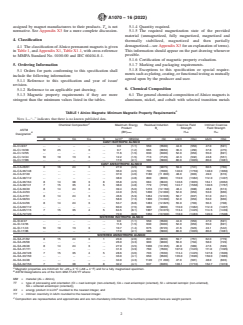
This specification covers technically important, commercially available, magnetically hard, cast and sintered permanent magnets known commonly as Alnico. Alnico magnets have approximate magnetic properties of residual magnetic induction from 0.52 T (5200 G) to 1.35 T (13500 G) and coercivity from 38 kA/m (475 Oe) to 175 kA/m (2200 Oe). Their specific magnetic hysteresis behavior (demagnetization curves) can be characterized using Test Method A977/A977M.
SCOPE
1.1 This specification covers technically important, commercially available, magnetically hard, cast and sintered permanent magnets known commonly as Alnico.
1.2 Alnico magnets have approximate magnetic properties of residual magnetic induction, Br, from 0.52 T (5200 G) to 1.35 T (13500 G) and coercivity, HcB, from 38 kA/m (475 Oe) to 175 kA/m (2200 Oe). Their specific magnetic hysteresis behavior (demagnetization curves) can be characterized using Test Method A977/A977M.
1.3 The values stated in SI units are to be regarded as standard. The values given in parentheses are mathematical conversions to customary (cgs-emu and inch-pound) units which are provided for information only and are not considered standard.
1.4 This standard does not purport to address all of the safety concerns, if any, associated with its use. It is the responsibility of the user of this standard to establish appropriate safety, health, and environmental practices and determine the applicability of regulatory limitations prior to use.
1.5 This international standard was developed in accordance with internationally recognized principles on standardization established in the Decision on Principles for the Development of International Standards, Guides and Recommendations issued by the World Trade Organization Technical Barriers to Trade (TBT) Committee.
General Information
- Status
- Published
- Publication Date
- 30-Jun-2022
- Technical Committee
- A06 - Magnetic Properties
- Drafting Committee
- A06.02 - Material Specifications
Relations
- Effective Date
- 01-Dec-2023
- Effective Date
- 01-Jun-2020
- Effective Date
- 15-Oct-2019
- Effective Date
- 15-Jun-2019
- Effective Date
- 15-Feb-2019
- Effective Date
- 01-Jun-2018
- Effective Date
- 15-Oct-2017
- Effective Date
- 01-Jul-2017
- Effective Date
- 01-May-2016
- Effective Date
- 01-May-2016
- Effective Date
- 01-Oct-2015
- Effective Date
- 01-Oct-2014
- Effective Date
- 01-May-2013
- Refers
ASTM A340-03a(2011) - Standard Terminology of Symbols and Definitions Relating to Magnetic Testing - Effective Date
- 01-May-2011
- Effective Date
- 01-Nov-2007
Overview
ASTM A1070-16(2022), Standard Specification for Cast and Sintered Alnico Permanent Magnets, is a comprehensive international standard from ASTM International detailing the technical requirements for Alnico permanent magnets. This specification covers both cast and sintered Alnico magnets, which are widely used in demanding applications requiring hard magnetic materials with excellent thermal stability. The standard specifies minimum magnetic properties, recommended testing methods, material classifications, and guidelines for ordering, packaging, and certification of Alnico magnets.
Key Topics
- Material Scope: Applies to both cast and sintered Alnico magnets, including isotropic and anisotropic types.
- Magnetic Properties: Establishes ranges for key parameters:
- Residual magnetic induction (Br) from 0.52 T (5200 G) to 1.35 T (13500 G)
- Coercivity (HcB) from 38 kA/m (475 Oe) to 175 kA/m (2200 Oe)
- Classification: Provides a standardized system for identifying grades based on energy product and intrinsic coercivity.
- Testing Methods: Recommends characterization using ASTM A977/A977M for magnetic hysteresis behavior, with provisions for other mutually agreed methods (e.g., Helmholtz coil testing).
- Chemical and Physical Properties: Lists general, non-mandatory chemical composition (aluminum, nickel, cobalt, iron, with select transition metals) and physical properties, including density, thermal stability, and mechanical characteristics.
- Measurement Units: SI units are designated as standard, with inch-pound and cgs values provided for reference only.
- Safety and Regulatory Guidance: Advises users to establish safe, health-conscious, and environmentally responsible practices compliant with local regulations.
Applications
Alnico magnets specified under ASTM A1070-16(2022) are designed for a broad range of practical industrial, automotive, and electronic uses where permanent magnetic properties are critical. Key application areas include:
- Sensors and Instrumentation: Used in electrical measuring devices, sensors, and gauges requiring stable magnetic performance over varying temperatures.
- Electromagnetic Assemblies: Incorporated in motors, generators, relays, and actuators where high coercivity and thermal resistance are essential.
- Magnetic Holding Devices: Preferred for magnetic chucks, clamps, and separation equipment due to their mechanical robustness.
- Audio Equipment: Utilized in speakers, pickups, and microphones for consistent audio performance.
- Aerospace and Automotive: Selected for components exposed to harsh temperature fluctuations and environmental stresses.
- Calibration and Laboratory: Used in test equipment requiring repeatable, stable magnetic fields.
Related Standards
To ensure compatibility and comprehensive quality assurance, ASTM A1070-16(2022) references several related standards:
- ASTM A340: Terminology of Symbols and Definitions Relating to Magnetic Testing
- ASTM A977/A977M: Test Method for Magnetic Properties of High-Coercivity Permanent Magnet Materials Using Hysteresigraphs
- MMPA Standard No. 0100-00: Standard Specifications for Permanent Magnet Materials (cross-referenced for grade classifications)
- IEC 60404-8-1: Magnetic Materials Part 8: Specifications for Magnetically Hard Materials
Practical Value
Implementing ASTM A1070-16(2022) ensures:
- Consistent Quality: Manufacturers and buyers can specify, purchase, and test Alnico magnets with confidence in their magnetic performance and reliability.
- Regulatory Compliance: Adopts internationally recognized trade principles, supporting global commerce and procurement.
- Clear Communication: Standardized terminology and classification reduce ambiguity in supply chains and product documentation.
- Reliability in Critical Applications: The focus on minimum property values, robust testing, and stability under thermal and mechanical stress makes Alnico magnets a trusted choice for safety-sensitive or precision roles.
By adhering to ASTM A1070-16(2022), stakeholders benefit from internationally recognized best practices in specifying, producing, and using cast and sintered Alnico permanent magnets for advanced magnetic solutions.
Get Certified
Connect with accredited certification bodies for this standard

Intertek Testing Services NA Inc.
Intertek certification services in North America.

UL Solutions
Global safety science company with testing, inspection and certification.

ANCE
Mexican certification and testing association.
Sponsored listings
Frequently Asked Questions
ASTM A1070-16(2022) is a technical specification published by ASTM International. Its full title is "Standard Specification for Cast and Sintered Alnico Permanent Magnets". This standard covers: ABSTRACT This specification covers technically important, commercially available, magnetically hard, cast and sintered permanent magnets known commonly as Alnico. Alnico magnets have approximate magnetic properties of residual magnetic induction from 0.52 T (5200 G) to 1.35 T (13500 G) and coercivity from 38 kA/m (475 Oe) to 175 kA/m (2200 Oe). Their specific magnetic hysteresis behavior (demagnetization curves) can be characterized using Test Method A977/A977M. SCOPE 1.1 This specification covers technically important, commercially available, magnetically hard, cast and sintered permanent magnets known commonly as Alnico. 1.2 Alnico magnets have approximate magnetic properties of residual magnetic induction, Br, from 0.52 T (5200 G) to 1.35 T (13500 G) and coercivity, HcB, from 38 kA/m (475 Oe) to 175 kA/m (2200 Oe). Their specific magnetic hysteresis behavior (demagnetization curves) can be characterized using Test Method A977/A977M. 1.3 The values stated in SI units are to be regarded as standard. The values given in parentheses are mathematical conversions to customary (cgs-emu and inch-pound) units which are provided for information only and are not considered standard. 1.4 This standard does not purport to address all of the safety concerns, if any, associated with its use. It is the responsibility of the user of this standard to establish appropriate safety, health, and environmental practices and determine the applicability of regulatory limitations prior to use. 1.5 This international standard was developed in accordance with internationally recognized principles on standardization established in the Decision on Principles for the Development of International Standards, Guides and Recommendations issued by the World Trade Organization Technical Barriers to Trade (TBT) Committee.
ABSTRACT This specification covers technically important, commercially available, magnetically hard, cast and sintered permanent magnets known commonly as Alnico. Alnico magnets have approximate magnetic properties of residual magnetic induction from 0.52 T (5200 G) to 1.35 T (13500 G) and coercivity from 38 kA/m (475 Oe) to 175 kA/m (2200 Oe). Their specific magnetic hysteresis behavior (demagnetization curves) can be characterized using Test Method A977/A977M. SCOPE 1.1 This specification covers technically important, commercially available, magnetically hard, cast and sintered permanent magnets known commonly as Alnico. 1.2 Alnico magnets have approximate magnetic properties of residual magnetic induction, Br, from 0.52 T (5200 G) to 1.35 T (13500 G) and coercivity, HcB, from 38 kA/m (475 Oe) to 175 kA/m (2200 Oe). Their specific magnetic hysteresis behavior (demagnetization curves) can be characterized using Test Method A977/A977M. 1.3 The values stated in SI units are to be regarded as standard. The values given in parentheses are mathematical conversions to customary (cgs-emu and inch-pound) units which are provided for information only and are not considered standard. 1.4 This standard does not purport to address all of the safety concerns, if any, associated with its use. It is the responsibility of the user of this standard to establish appropriate safety, health, and environmental practices and determine the applicability of regulatory limitations prior to use. 1.5 This international standard was developed in accordance with internationally recognized principles on standardization established in the Decision on Principles for the Development of International Standards, Guides and Recommendations issued by the World Trade Organization Technical Barriers to Trade (TBT) Committee.
ASTM A1070-16(2022) is classified under the following ICS (International Classification for Standards) categories: 29.100.10 - Magnetic components. The ICS classification helps identify the subject area and facilitates finding related standards.
ASTM A1070-16(2022) has the following relationships with other standards: It is inter standard links to ASTM A340-23a, ASTM A977/A977M-07(2020), ASTM A340-19b, ASTM A340-19a, ASTM A340-19, ASTM A340-18, ASTM A340-17a, ASTM A340-17, ASTM A340-16e1, ASTM A340-16, ASTM A340-15, ASTM A340-14, ASTM A977/A977M-07(2013), ASTM A340-03a(2011), ASTM A977/A977M-07. Understanding these relationships helps ensure you are using the most current and applicable version of the standard.
ASTM A1070-16(2022) is available in PDF format for immediate download after purchase. The document can be added to your cart and obtained through the secure checkout process. Digital delivery ensures instant access to the complete standard document.
Standards Content (Sample)
This international standard was developed in accordance with internationally recognized principles on standardization established in the Decision on Principles for the
Development of International Standards, Guides and Recommendations issued by the World Trade Organization Technical Barriers to Trade (TBT) Committee.
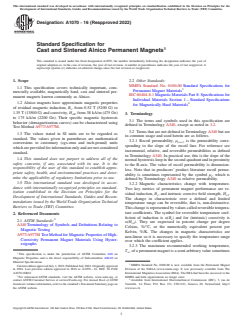
Designation:A1070 −16 (Reapproved 2022)
Standard Specification for
Cast and Sintered Alnico Permanent Magnets
This standard is issued under the fixed designation A1070; the number immediately following the designation indicates the year of
original adoption or, in the case of revision, the year of last revision. A number in parentheses indicates the year of last reapproval. A
superscript epsilon (´) indicates an editorial change since the last revision or reapproval.
1. Scope 2.2 Other Standards:
MMPA Standard No. 0100-00 Standard Specifications for
1.1 This specification covers technically important, com-
Permanent Magnet Materials
mercially available, magnetically hard, cast and sintered per-
IEC 60404-8-1 Magnetic Materials Part 8: Specifications for
manent magnets known commonly as Alnico.
Individual Materials Section 1 – Standard Specifications
1.2 Alnico magnets have approximate magnetic properties
for Magnetically Hard Materials
of residual magnetic induction, B , from 0.52 T (5200 G) to
r
1.35 T (13500 G) and coercivity, H , from 38 kA/m (475 Oe)
cB 3. Terminology
to 175 kA/m (2200 Oe). Their specific magnetic hysteresis
3.1 The terms and symbols used in this specification are
behavior (demagnetization curves) can be characterized using
defined in Terminology A340, except as noted in 3.2.
Test Method A977/A977M.
3.2 Terms that are not defined in Terminology A340 but are
1.3 The values stated in SI units are to be regarded as
in common usage and used herein are as follows.
standard. The values given in parentheses are mathematical
3.2.1 Recoil permeability, µ , is the permeability corre-
(rec)
conversions to customary (cgs-emu and inch-pound) units
sponding to the slope of the recoil line. For reference see
whichareprovidedforinformationonlyandarenotconsidered
incremental, relative, and reversible permeabilities as defined
standard.
in Terminology A340. In practical use, this is the slope of the
1.4 This standard does not purport to address all of the
normal hysteresis loop in the second quadrant and in proximity
safety concerns, if any, associated with its use. It is the
to the B-axis. The value of recoil permeability is dimension-
responsibility of the user of this standard to establish appro-
less. Note that in producers’ product literature recoil perme-
priate safety, health, and environmental practices and deter-
ability is sometimes represented by the symbol µ , which is
r
mine the applicability of regulatory limitations prior to use.
defined by Terminology A340 as relative permeability.
1.5 This international standard was developed in accor-
3.2.2 Magnetic characteristics change with temperature.
dance with internationally recognized principles on standard-
Two key metrics of permanent magnet performance are re-
ization established in the Decision on Principles for the
sidual induction, B , and intrinsic coercive field strength, H .
r cJ
Development of International Standards, Guides and Recom-
The change in characteristic over a defined and limited
mendations issued by the World Trade Organization Technical
temperature range can be reversible, that is, non-destructive.
Barriers to Trade (TBT) Committee.
Thischangeisrepresentedbyvaluescalledreversibletempera-
ture coefficients. The symbol for reversible temperature coef-
2. Referenced Documents
ficient of induction is α(B ) and for (intrinsic) coercivity is
2 r
2.1 ASTM Standards:
α(H ). They are expressed in percent change per degree
cJ
A340 Terminology of Symbols and Definitions Relating to
Celsius, %/°C, or the numerically equivalent percent per
Magnetic Testing
Kelvin, %/K. The changes in magnetic characteristics are
A977/A977M Test Method for Magnetic Properties of High-
non-linear so it is necessary to specify the temperature range
Coercivity Permanent Magnet Materials Using Hyster-
over which the coefficient applies.
esigraphs
3.2.3 The maximum recommended working temperature,
T , of a permanent magnet is a semi-arbitrary value sometimes
w
This specification is under the jurisdiction of ASTM Committee A06 on
Magnetic Properties and is the direct responsibility of Subcommittee A06.02 on
Material Specifications.
Current edition approved July 1, 2022. Published July 2022. Originally approved MMPA Standard No. 0100-00 is now available from the Permanent Magnet
in 2016. Last previous edition approved in 2016 as A1070 – 16. DOI: 10.1520/ Division of the SMAA (www.smma.org). It was previously available from The
A1070-16R22. International MagneticsAssociation (IMA). The IMAhad been the successor to the
For referenced ASTM standards, visit the ASTM website, www.astm.org, or MMPA and both organizations no longer exist.
contact ASTM Customer Service at service@astm.org. For Annual Book of ASTM Available from International Electrotechnical Commission (IEC), 3, rue de
Standards volume information, refer to the standard’s Document Summary page on Varembé, 1st Floor, P.O. Box 131, CH-1211, Geneva 20, Switzerland, http://
the ASTM website. www.iec.ch.
Copyright © ASTM International, 100 Barr Harbor Drive, PO Box C700, West Conshohocken, PA 19428-2959. United States
A1070−16 (2022)
assigned by magnet manufacturers to their products. T is not 5.1.4 Quantity required.
w
normative. See Appendix X3 for a more complete discussion. 5.1.5 The required magnetization state of the provided
material (unmagnetized, fully magnetized, magnetized and
4. Classification
thermally stabilized, magnetized and then partially
demagnetized—see Appendix X3 for an explanation of terms).
4.1 The classification ofAlnico permanent magnets is given
This information should appear on the part drawing whenever
in Table 1, and Appendix X1, Table X1.1, with cross-reference
possible.
to MMPA Standard No. 0100-00 and IEC 60404-8-1.
5.1.6 Certification of magnetic property evaluation.
5. Ordering Information 5.1.7 Marking and packaging requirements.
5.1.8 Exceptions to this specification or special require-
5.1 Orders for parts conforming to this specification shall
mentssuchasplating,coating,orfunctionaltestingasmutually
include the following information:
agreed upon by the producer and user.
5.1.1 Reference to this specification and year of issue/
revision.
6. Chemical Composition
5.1.2 Reference to an applicable part drawing.
5.1.3 Magnetic property requirements if they are more 6.1 The general chemical composition ofAlnico magnets is
stringent than the minimum values listed in the tables. aluminum, nickel, and cobalt with selected transition metals
A
TABLE 1 Alnico Magnets: Minimum Magnetic Property Requirements
NOTE 1—“.” indicates that there is no known published data.
C
Chemical Composition Maximum Energy Residual Induction Coercive Field Intrinsic Coercive
Product B Strength Field Strength
r
ASTM
(BH) H H
B max cB cJ
Designation
Al Ni Co Cu Ti kJ/m (MGOe) mT (G) kA/m (Oe) kA/m (Oe)
CAST ISOTROPIC ALNICO
AL-CI-9/47 . . . . . 9.0 (1.1) 550 (5500) 44.0 (553) 47.0 (591)
AL-CI-10/38 12 25 . 3 . 9.7 (1.2) 665 (6650) 36.3 (456) 37.8 (475)
AL-CI-12/55 . . . . . 11.6 (1.5) 630 (6300) 52.0 (653) 55.0 (691)
AL-CI-12/44 10 19 13 3 . 12.2 (1.5) 713 (7125) 42.3 (532) 43.8 (551)
AL-CI-17/86 . . . . . 17.0 (2.1) 580 (5800) 80.0 (1005) 86.0 (1081)
CAST ANISOTROPIC ALNICO
AL-CA-28/61 8 16 24 3 1 27.9 (3.5) 998 (9975) 59.0 (741) 60.5 (760)
AL-CA-36/148 . . . . . 36.0 (4.5) 700 (7000) 140.0 (1759) 148.0 (1860)
AL-CA-37/49 . . . . . 37.0 (4.6) 1180 (11 800) 48.0 (603) 49.0 (616)
AL-CA-38/112 . . . . . 38.0 (4.8) 800 (8000) 110.0 (1382) 112.0 (1407)
AL-CA-36/164 8 14 38 3 8 35.8 (4.5) 684 (6840) 143.6 (1805) 164.1 (2062)
AL-CA-38/141 7 15 35 4 5 38.0 (4.8) 779 (7790) 124.7 (1568) 140.6 (1767)
AL-CA-39/49 8 14 24 3 . 39.4 (5.0) 1216 (12 160) 48.4 (608) 48.8 (613)
AL-CA-44/53 . . . . . 44.0 (5.5) 1200 (12 000) 52.0 (653) 53.0 (666)
AL-CA-47/51 8 14 24 3 . 46.6 (5.9) 1264 (12 635) 50.7 (637) 51.0 (641)
AL-CA-58/53 . . . . . 58.0 (7.3) 1300 (13 000) 52.0 (653) 53.0 (666)
AL-CA-54/56 8 14 24 3 . 53.7 (6.8) 1283 (12 825) 55.9 (703) 56.3 (708)
AL-CA-60/112 . . . . . 60.0 (7.5) 900 (9000) 110.0 (1382) 112.0 (1407)
AL-CA-65/115 7 15 35 4 5 64.5 (8.1) 1007 (10 070) 113.4 (1425) 114.5 (1439)
AL-CA-72/120 . . . . . 72.0 (9.0) 1050 (10 500) 118.0 (1483) 120.0 (1508)
SINTERED ISOTROPIC ALNICO
AL-SI-9/47 . . . . . 9.0 (1.1) 550 (5500) 44.0 (553) 47.0 (591)
AL-SI-12/55 . . . . . 11.6 (1.5) 630 (6300) 52.0 (653) 55.0 (691)
AL-SI-11/43 10 19 13 3 . 10.7 (1.4) 675 (6745) 41.6 (523) 43.1 (542)
AL-SI-17/86 . . . . . 17.0 (2.1) 580 (5800) 80.0 (1005) 86.0 (1081)
SINTERED ANISOTROPIC ALNICO
AL-SA-21/62 8 15 24 3 1 20.8 (2.6) 893 (8930) 59.7 (751) 62.0 (779)
AL-SA-26/58 . . . . . 26.0 (3.3) 900 (9000) 56.0 (704) 58.0 (729)
AL-SA-28/48 8 14 24 3 . 27.9 (3.5) 1036 (10 355) 46.9 (589) 47.6 (599)
AL-SA-31/111 . . . . . 31.0 (3.9) 760 (7600) 107.0 (1345) 111.0 (1395)
AL-SA-29/128 7 15 35 4 5 28.6 (3.6) 703 (7030) 113.4 (1425) 127.8 (1606)
AL-SA-33/150 . . . . . 33.0 (4.1) 650 (6500) 135.0 (1696) 150.0 (1885)
AL-SA-34/48 . . . . . 34.0 (4.3) 1120 (11 200) 47.0 (591) 48.0 (603)
AL-SA-32/153 7 14 38 3 8 32.2 (4.1) 637 (6365) 136.1 (1710) 152.7 (1919)
A
Magnetic properties are minimum for +20 ± 2 °C (+68 ± 4 °F) and for a fully magnetized specimen.
B
ASTM Designations are of the form MM-TT-XX/YY where:
MM = material (AL = Alnico),
TT = type of processing and orientation (CI = cast isotropic (non-oriented), CA = cast anisotropic (oriented), SI = sintered isotropic (non-oriented),
SA = sintered anisotropic (oriented)),
XX = energy product in k/J/m rounded to the nearest integer, and
YY = intrinsic coercivity in kA/m rounded to the nearest integer.
C
Composition are representative and approximate and are non-mandatory information. The numbers presented here are weight percent.
A1070−16 (2022)
and minor constituents and the balance of the composition 8.4.5 Other test methods may be utilized as agreed to
being iron.Approximate chemical compositions for each grade betweenproduceranduser.Suchtestsmayincludeopencircuit
are listed in Table 1 and are typical but not mandatory. magnetization Helmholtz test (refer to Appendix X3), field
strength measurements in a defined magnetic circuit or mag-
7. Physical and Mechanical Properties
netic flux density measurements adjacent to the magnet sur-
7.1 Typical thermal and physical properties are listed in face.
Appendix X2, Table X2.1.
8.4.6 Due to the ease with which the magnetic field of
Alnico magnets can be affected, the producer and user should
7.2 Physical density values are given for information pur-
agree on methods to prevent unintended changes from occur-
poses only and are not mandatory.
ring. These preventive measures may include the use of
7.3 Alnico magnets are used for their magnetic characteris-
keepers across the magnet poles, spacing within packaging to
tics. The end-use application should not rely on them for
prevent like poles from affecting each other, or other agreed-to
structural purposes due to low tensile and flexural strength.
methods.
These materials are brittle and can chip or break easily.
Magnetic properties may also be affected by physical stress.
9. Workmanship, Finish, and Appearance
8. Magnetic Property Requirements
9.1 Dimensions and tolerances shall be as specified on the
magnet drawing and must be agreed upon between the pro-
8.1 Magnetic properties are listed in Table 1.
ducer and user.
8.2 The values of essential magnetic properties listed in the
table are specified minimum values at +20 6 2 °C (+68 6
9.2 Porosity and voids are common in Alnico magnets and
4 °F), determined after magnetizing to saturation in closed shall not in themselves constitute reason for rejection unless
magnetic circuit.
agreed upon between producer and user. Allowable defects
shall be defined and documented in writing as part of the
8.3 The specified values of magnetic properties are valid
ordering or contracting process.
only for magnet test specimens with a uniform cross-section
along the axis of magnetization. Properties for anisotropic
9.3 Magnets shall be free of loose chips and surface residue
(magneticallyoriented)magnetsaremeasuredalongtheaxisof
which may interfere with assembly or proper device function.
preferred orientation.
9.4 Chips shall be acceptable if no more than 10 % of any
8.4 Because of the nature of permanent magnet production,
surface identified as a magnetic pole surface is removed unless
magnetic testing of each lot is strongly recommended, espe-
otherwise agreed to by producer and user.
ciallyforapplicationswherethemagnetperformanceisclosely
9.5 Cracks visible to the naked eye shall not be permitted
specified. Such magnetic property evaluations shall be con-
unless otherwise agreed to by producer and user.
ductedinthemannerdescribedbelow.Wherethemagnetshape
is not suitable for magnetic testing, a specimen shall be cut
10. Sampling
from the magnet using appropriate slicing and grinding
techniques,payingattentiontoanymagneticorientationwithin
10.1 Unless otherwise agreed to between producer and user,
the magnet.
a lot shall consist of parts of the same form and dimensions,
8.4.1 The magnetic properties shall be determined in accor-
produced from a single furnace melt (cast Alnico) or mixed
dance with Test Method A977/A977M, or by using a suitable,
powder batch or sintering run (sintered Alnico), and from an
mutually agreed upon magnetometric method.
unchanged process, without discontinuity in production, and
8.4.2 When magnets are being purchased in the fully
submitted for inspection at one time.
magnetized condition, the testing shall determine the magnetic
properties from the as-received magnetization state, followed 10.2 The producer and user shall agree upon a representa-
tive number of specimens for testing. Typically, a suitable
by magnetization to saturation and testing of the magnetic
properties from the fully magnetized condition. number of parts, as mutually agreed upon between producer
and user, shall be randomly selected from each lot. It is
8.4.3 When magnets are being purchased in the unmagne-
tized condition or in an unknown state of magnetization, the advisable to test a minimum of two parts from each lot, and
more if there is reason to suspect that the magnetic properties
test laboratory shall magnetize the test specimen(s) to satura-
tion in the same orientation as the received specimens’ are not uniform throughout the lot.
indicated direction of magnetization and measure the magnetic
properties from this fully magnetized condition. 11. Rejection and Rehearing
8.4.4 When magnets are being purchased in a calibrated,
11.1 Parts that fail to conform to the requirements of this
stabilized, or “knocked-down” condition, magnets should be
specification shall be rejected. Rejection should be reported to
handled with care to prevent exposure to externally applied
the producer promptly and in writing. In case of dissatisfaction
fields. Refer to Appendix X3 for an explanation of these terms.
with the results of the test, the producer may make a claim for
During testing using Test Method A977/A977M and to avoid
a rehearing.
changing the magnetization state of the material prior to test,
the measurement should proceed in the second quadrant only 11.2 The disposition of rejected parts shall be subject to
without attempting to saturate the magnet specimen. agreement between the producer and user.
A1070−16 (2022)
12. Certification 13.3 Ma
...
Questions, Comments and Discussion
Ask us and Technical Secretary will try to provide an answer. You can facilitate discussion about the standard in here.
Loading comments...