

ASTM D8392-22
(Practice)Standard Practice for Calibration and Verification of Direct Imaging Analyzers Used for Particle Size and Shape Analysis of Catalytic Materials
General Information
- Abstract
SIGNIFICANCE AND USE
5.1 Particle size and shape are important in predicting the performance of catalytic materials. They influence the bulk density of the final product and thereby the effectiveness of performance.
5.2 Establishing a verification reference for the analyzer that is commercially available and dimensionally reliable to close tolerances enables different analyzers to be easily checked to equivalent standards.
5.3 This practice may also be followed to analyze catalytic materials for quality manufacturing purposes. Sections 9 and 10 instruct on sample count determination as well as sampling recommendations. Test Method D6299 may be utilized to monitor performance of the analyzer in measuring the size and shape of catalytic materials.
SCOPE
1.1 This practice covers the calibration and verification of Dynamic Imaging Analyzers (analyzers) using catalytic and non-catalytic reference materials. The measurement range of analyzers covers from 500 µm to 20 000 µm.
1.2 This practice may also be used to analyze catalytic materials once the analyzer has been calibrated and verified.
1.3 Units—The values stated in SI units are to be regarded as standard; however, English and mesh units are also acceptable with conversions provided in Appendix X3.
1.4 This standard does not purport to address all of the safety concerns, if any, associated with its use. It is the responsibility of the user of this standard to establish appropriate safety, health, and environmental practices and determine the applicability of regulatory limitations prior to use.
1.5 This international standard was developed in accordance with internationally recognized principles on standardization established in the Decision on Principles for the Development of International Standards, Guides and Recommendations issued by the World Trade Organization Technical Barriers to Trade (TBT) Committee.
- Status
- Published
- Publication Date
- 31-Jul-2022
- Technical Committee
- D32 - Catalysts
- Drafting Committee
- D32.02 - Physical-Mechanical Properties
Overview
ASTM D8392-22 is the standard practice established by ASTM International for the calibration and verification of direct (dynamic) imaging analyzers used in the particle size and shape analysis of catalytic materials. This standard ensures accurate, consistent measurement results by defining processes for calibrating and verifying analyzers using both catalytic and non-catalytic reference materials. The coverage includes analyzers with a measurement range from 500 µm to 20,000 µm, supporting both SI and Imperial units.
Precise particle size and shape measurements are critical for predicting the performance of catalytic materials, influencing product properties such as bulk density and, consequently, effectiveness in applications. ASTM D8392-22 provides robust protocols for quality assurance and enables consistent performance monitoring across different analyzer systems.
Key Topics
- Calibration and Verification: The standard outlines procedures for calibrating imaging analyzers using traceable reference materials (such as cylindrical particles and precision-grade glass spheres). Both calibration and verification steps rely on reference materials with tightly controlled dimensions.
- Particle Size and Shape Analysis: Focuses on measuring key particle characteristics, including length, width, aspect ratio, and convexity, to provide a comprehensive understanding of catalytic material properties.
- Quality Assurance: Supports systematic evaluation of particle analysis systems by standardizing verification processes, enabling manufacturers to monitor instrument performance and control product quality consistently.
- Sampling and Reporting: Guidance is offered for obtaining representative samples and determining the minimum particle count necessary for statistically valid analysis, referencing applicable ISO methods for sample size determination.
- Safety and Best Practices: Encourages users to establish safety and environmental practices tailored to their operations, as the standard does not cover all possible safety concerns.
Applications
ASTM D8392-22 is principally applied in:
- Catalyst Manufacturing and Quality Control: Ensuring batch-to-batch consistency in particle size and shape, which is essential for product performance in catalytic processes.
- Analyzer Performance Monitoring: Routine verification of instrument accuracy for laboratories and production facilities working with particulate catalytic and non-catalytic materials.
- Research and Development: Supporting the development of new catalytic materials by providing reliable data on particle morphology.
- Third-Party Testing and Auditing: Providing a common reference standard for contract labs and auditors to assess analyzer performance.
- Standardized Reporting: Facilitating the exchange of comparable particle characterization results among manufacturers, laboratories, and regulatory bodies.
Related Standards
For a comprehensive approach to particle size and shape analysis and instrument verification, consider the following related standards:
- ASTM D6299: Practice for Applying Statistical Quality Assurance and Control Charting Techniques to Evaluate Analytical Measurement System Performance
- ASTM D3766: Terminology Relating to Catalysts and Catalysis
- ASTM E2589: Terminology Relating to Nonsieving Methods of Powder Characterization
- ASTM E105: Guide for Probability Sampling of Materials
- ISO 13322-1: Particle Size Analysis - Image Analysis Methods
- ISO 9276-6: Representation of Results of Particle Size Analysis – Part 6: Descriptive and Quantitative Representation of Particle Shape and Morphology
- DIN 66141: Representation of Particle Size Distributions
Keywords: particle size analysis, catalytic materials, direct imaging analyzer, calibration, verification, quality control, ASTM D8392-22, particle shape, reference material, catalyst manufacturing, analyzer performance monitoring
By implementing ASTM D8392-22, organizations can achieve improved reliability in particle analysis, promoting product quality, process efficiency, and compliance with international best practices.
Relations
- Effective Date
- 01-Feb-2024
- Effective Date
- 01-Jan-2024
- Effective Date
- 01-Dec-2023
- Refers
ASTM E2589-23a - Standard Terminology Relating to Nonsieving Methods of Powder Characterization - Effective Date
- 01-Sep-2023
- Effective Date
- 01-Nov-2018
- Effective Date
- 15-Dec-2017
- Effective Date
- 15-Nov-2017
- Effective Date
- 01-Jan-2017
- Effective Date
- 01-Oct-2013
- Effective Date
- 01-Mar-2013
- Refers
ASTM E2589-11 - Standard Terminology Relating to Nonsieving Methods of Powder Characterization - Effective Date
- 01-Apr-2011
- Effective Date
- 01-Oct-2010
- Effective Date
- 01-Mar-2010
- Effective Date
- 01-Mar-2010
- Refers
ASTM E2589-09a - Standard Terminology Relating to Nonsieving Methods of Powder Characterization - Effective Date
- 15-Dec-2009
Get Certified
Connect with accredited certification bodies for this standard

IMP NDT d.o.o.
Non-destructive testing services. Radiography, ultrasonic, magnetic particle, penetrant, visual inspection.
Inštitut za kovinske materiale in tehnologije
Institute of Metals and Technology. Materials testing, metallurgical analysis, NDT.
Q Techna d.o.o.
NDT and quality assurance specialist. 30+ years experience. NDT personnel certification per ISO 9712, nuclear and thermal power plant inspections, QA/
Sponsored listings
Frequently Asked Questions
ASTM D8392-22 is a standard published by ASTM International. Its full title is "Standard Practice for Calibration and Verification of Direct Imaging Analyzers Used for Particle Size and Shape Analysis of Catalytic Materials". This standard covers: SIGNIFICANCE AND USE 5.1 Particle size and shape are important in predicting the performance of catalytic materials. They influence the bulk density of the final product and thereby the effectiveness of performance. 5.2 Establishing a verification reference for the analyzer that is commercially available and dimensionally reliable to close tolerances enables different analyzers to be easily checked to equivalent standards. 5.3 This practice may also be followed to analyze catalytic materials for quality manufacturing purposes. Sections 9 and 10 instruct on sample count determination as well as sampling recommendations. Test Method D6299 may be utilized to monitor performance of the analyzer in measuring the size and shape of catalytic materials. SCOPE 1.1 This practice covers the calibration and verification of Dynamic Imaging Analyzers (analyzers) using catalytic and non-catalytic reference materials. The measurement range of analyzers covers from 500 µm to 20 000 µm. 1.2 This practice may also be used to analyze catalytic materials once the analyzer has been calibrated and verified. 1.3 Units—The values stated in SI units are to be regarded as standard; however, English and mesh units are also acceptable with conversions provided in Appendix X3. 1.4 This standard does not purport to address all of the safety concerns, if any, associated with its use. It is the responsibility of the user of this standard to establish appropriate safety, health, and environmental practices and determine the applicability of regulatory limitations prior to use. 1.5 This international standard was developed in accordance with internationally recognized principles on standardization established in the Decision on Principles for the Development of International Standards, Guides and Recommendations issued by the World Trade Organization Technical Barriers to Trade (TBT) Committee.
SIGNIFICANCE AND USE 5.1 Particle size and shape are important in predicting the performance of catalytic materials. They influence the bulk density of the final product and thereby the effectiveness of performance. 5.2 Establishing a verification reference for the analyzer that is commercially available and dimensionally reliable to close tolerances enables different analyzers to be easily checked to equivalent standards. 5.3 This practice may also be followed to analyze catalytic materials for quality manufacturing purposes. Sections 9 and 10 instruct on sample count determination as well as sampling recommendations. Test Method D6299 may be utilized to monitor performance of the analyzer in measuring the size and shape of catalytic materials. SCOPE 1.1 This practice covers the calibration and verification of Dynamic Imaging Analyzers (analyzers) using catalytic and non-catalytic reference materials. The measurement range of analyzers covers from 500 µm to 20 000 µm. 1.2 This practice may also be used to analyze catalytic materials once the analyzer has been calibrated and verified. 1.3 Units—The values stated in SI units are to be regarded as standard; however, English and mesh units are also acceptable with conversions provided in Appendix X3. 1.4 This standard does not purport to address all of the safety concerns, if any, associated with its use. It is the responsibility of the user of this standard to establish appropriate safety, health, and environmental practices and determine the applicability of regulatory limitations prior to use. 1.5 This international standard was developed in accordance with internationally recognized principles on standardization established in the Decision on Principles for the Development of International Standards, Guides and Recommendations issued by the World Trade Organization Technical Barriers to Trade (TBT) Committee.
ASTM D8392-22 is classified under the following ICS (International Classification for Standards) categories: 19.120 - Particle size analysis. Sieving. The ICS classification helps identify the subject area and facilitates finding related standards.
ASTM D8392-22 has the following relationships with other standards: It is inter standard links to ASTM D3766-24a, ASTM D3766-24, ASTM D6299-23a, ASTM E2589-23a, ASTM D3766-08(2018), ASTM D6299-17b, ASTM D6299-17a, ASTM D6299-17, ASTM D6299-13e1, ASTM D3766-08(2013), ASTM E2589-11, ASTM E105-10, ASTM D6299-10e2, ASTM D6299-10, ASTM E2589-09a. Understanding these relationships helps ensure you are using the most current and applicable version of the standard.
ASTM D8392-22 is available in PDF format for immediate download after purchase. The document can be added to your cart and obtained through the secure checkout process. Digital delivery ensures instant access to the complete standard document.
Standards Content (Sample)
This international standard was developed in accordance with internationally recognized principles on standardization established in the Decision on Principles for the
Development of International Standards, Guides and Recommendations issued by the World Trade Organization Technical Barriers to Trade (TBT) Committee.
Designation: D8392 −22
Standard Practice for
Calibration and Verification of Direct Imaging Analyzers
Used for Particle Size and Shape Analysis of Catalytic
Materials
This standard is issued under the fixed designation D8392; the number immediately following the designation indicates the year of
original adoption or, in the case of revision, the year of last revision. A number in parentheses indicates the year of last reapproval. A
superscript epsilon (´) indicates an editorial change since the last revision or reapproval.
1. Scope 2.2 DIN Standard:
66141 Representation of Particle Size Distributions – Basic
1.1 This practice covers the calibration and verification of
Standard
Dynamic Imaging Analyzers (analyzers) using catalytic and
2.3 ISO Standards:
non-catalytic reference materials. The measurement range of
9276-6 Representation of Results of Particle SizeAnalysis –
analyzers covers from 500 µm to 20 000 µm.
Part 6: Descriptive and Quantitative Representation of
1.2 This practice may also be used to analyze catalytic
Particle Shape and Morphology
materials once the analyzer has been calibrated and verified.
13322-1 Particle SizeAnalysis – ImageAnalysis Methods –
1.3 Units—The values stated in SI units are to be regarded Part 1: Static Image Analysis Methods
as standard; however, English and mesh units are also accept-
3. Terminology
able with conversions provided in Appendix X3.
3.1 ReferenceTerminologiesD3766andE2589forstandard
1.4 This standard does not purport to address all of the
definitions.
safety concerns, if any, associated with its use. It is the
responsibility of the user of this standard to establish appro- 3.2 Non-standard Particle Shape Definitions and Defini-
priate safety, health, and environmental practices and deter-
tions of Terms Specific to This Standard
mine the applicability of regulatory limitations prior to use. 3.2.1 aspect ratio, n—equal to the particle width divided by
1.5 This international standard was developed in accor- the particle length (see Appendix X1).
dance with internationally recognized principles on standard-
3.2.2 particle convexity, n—a measurement, from 0 to 1, of
ization established in the Decision on Principles for the
the actual particle area to the area within the convex perimeter
Development of International Standards, Guides and Recom-
(see X1.4).
mendations issued by the World Trade Organization Technical
3.3 Non-standard Particle Size Definitions and Definitions
Barriers to Trade (TBT) Committee.
of Terms Specific to This Standard
3.3.1 particle length, n—the maximum feret that is perpen-
2. Referenced Documents
dicular to the particle width of the two-dimensionally imaged
2.1 ASTM Standards:
particle (see Appendix X1).
D3766 Terminology Relating to Catalysts and Catalysis
3.3.2 particle width, n—the minimum area bisector of the
D6299 Practice for Applying Statistical Quality Assurance
two-dimensionally imaged particle and signified by X ,
Ma min
and Control Charting Techniques to Evaluate Analytical
minimum Martin diameter (see Appendix X1).
Measurement System Performance
E105 Guide for Probability Sampling of Materials
NOTE 1—Imaging terminology is known to have multiple phrasings
E2589 Terminology Relating to Nonsieving Methods of throughout industry. Appendix X1 and Appendix X2 describe, in detail,
what these terms represent with regard to this practice.
Powder Characterization
4. Summary of Practice
4.1 The general principle of operation of the analyzer is the
This practice is under the jurisdiction of ASTM Committee D32 on Catalysts
and is the direct responsibility of Subcommittee D32.02 on Physical-Mechanical
transport of catalytic material from a loading container through
Properties.
Current edition approved Aug. 1, 2022. Published September 2022. DOI:
10.1520/D8392-22. Available from Deutsches Institut für Normung e.V.(DIN), Am DIN-Platz,
For referenced ASTM standards, visit the ASTM website, www.astm.org, or Burggrafenstrasse 6, 10787 Berlin, Germany, http://www.din.de.
contact ASTM Customer Service at service@astm.org. For Annual Book of ASTM Available from International Organization for Standardization (ISO), ISO
Standards volume information, refer to the standard’s Document Summary page on Central Secretariat, Chemin de Blandonnet 8, CP 401, 1214 Vernier, Geneva,
the ASTM website. Switzerland, https://www.iso.org.
Copyright © ASTM International, 100 Barr Harbor Drive, PO Box C700, West Conshohocken, PA 19428-2959. United States
D8392 − 22
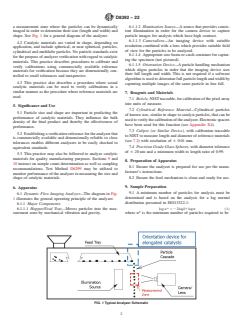
a measurement zone where the particles can be dynamically 6.1.1.2 Illumination Source—Asource that provides consis-
imaged in order to determine their size (length and width) and tent illumination in order for the camera device to capture
shape. See Fig. 1 for a general diagram of the analyzer. particle images for analysis which have high contrast.
6.1.1.3 Camera/lens—An imaging device with suitable
4.2 Catalytic materials are varied in shape, depending on
resolution combined with a lens which provides suitable field
application, and include spherical, or near spherical, particles,
of view for the particles to be analyzed.
cylindrical and multilobe particles. No particle standards exist
6.1.1.4 Appropriate size basin or catch container for captur-
for the purpose of analyzer verification with regard to catalytic
ing the specimen (not pictured).
materials. This practice describes procedures to calibrate and
6.1.1.5 Orientation Device—Aparticlehandlingmechanism
verify calibrations using commercially available reference
which aligns particles in order that the imaging device sees
materials for verification because they are dimensionally con-
their full length and width. This is not required if a software
trolled to small tolerances and inexpensive.
algorithm is used to determine full particle length and width by
4.3 This practice also describes a procedure where actual
capturing multiple images of the same particle in free fall.
catalytic materials can be used to verify calibrations in a
similar manner as the procedure where reference materials are
7. Reagents and Materials
used.
7.1 Reticle,NISTtraceable,forcalibrationofthepixelarray
into units of measure.
5. Significance and Use
7.2 Cylindrical Reference Material—Cylindrical particles
5.1 Particle size and shape are important in predicting the
of known size, similar in shape to catalyst particles, that can be
performance of catalytic materials. They influence the bulk
usedtoverifythecalibrationoftheanalyzer.Electronicspacers
density of the final product and thereby the effectiveness of
have been used for this function (see Appendix X4).
performance.
7.3 Caliper (or Similar Device), with calibration traceable
5.2 Establishingaverificationreferencefortheanalyzerthat
to NIST to measure length and diameter of reference materials
is commercially available and dimensionally reliable to close
(see 7.2) with resolution of 6 0.01 mm.
tolerances enables different analyzers to be easily checked to
7.4 Precision Grade Glass Spheres, with diameter tolerance
equivalent standards.
of 6 20 um and a minimum width to length ratio of 0.99.
5.3 This practice may also be followed to analyze catalytic
materials for quality manufacturing purposes. Sections 9 and
8. Preparation of Apparatus
10 instruct on sample count determination as well as sampling
8.1 Ensure the analyzer is prepared for use per the manu-
recommendations. Test Method D6299 may be utilized to
facturer’s instructions.
monitor performance of the analyzer in measuring the size and
shape of catalytic materials. 8.2 Ensure the feed mechanism is clean and ready for use.
9. Sample Preparation
6. Apparatus
9.1 A minimum number of particles for analysis must be
6.1 Dynamic Flow Imaging Analyzer—The diagram in Fig.
determined and is based on the analysis for a log normal
1 illustrates the general operating principle of the analyzer.
distribution presented in ISO13322-1:
6.1.1 Major Components:
6.1.1.1 Hopper/Feed Tray—Moves particles into the mea-
log n*522logδ1logw (1)
surement zone by mechanical vibration and gravity. where n* is the minimum number of particles required to be
FIG. 1 TypicalAnalyzer Schematic
D8392 − 22
analyzed, δ is the relative error, and w is a calculated param-
standard deviation will be used to calculate the minimum
eter based on the standard deviation of the distribution. An
number of particles required per Section 9.
example calculation is given in Appendix X4.
10.3.2 Analyze the selected sample per the instructions of
9.2 Test samples should be obtained from larger composites
11.1.
by riffling or splitting in accordance with STP447A or another
10.4 Verification, Procedure B—It is also acceptable to
similar means with the goal of obtaining samples with size
perform verification studies using actual catalytic materials.
distributions that are representative of the larger composites.
The procedure is very close to that described in 10.2 and 10.3.
Also refer to Guide E105 for constructing a sampling plan.
10.4.1 Estimate the standard deviation of particle width and
length for the particular material to be tested. The distribution
10. Apparatus Calibration and Verification
in the length and width will likely be characteristic of a normal
10.1 Calibration:
curve, and so ISO13322-1 can be used to calculate the number
10.1.1 See the analyzer manufacturer’s instructions for cali-
of particles to be measured by the analyzer given the estimated
brating.
standard deviation and a desired confidence level for these
10.1.2 Calibration fixtures must be traceable to NIST.
dimensions (see Appendix X4).
10.4.2 Obtain a representative sample of the catalyst mate-
10.2 Verification, Procedure A:
rial per 9.2.
10.2.1 Non-Spherical Elongated Shapes
10.4.3 Analyze the obtained sample per the procedure of
10.2.1.1 Use the cylindrical reference material (see 7.2)to
Section 11.
verify the calibration of the analyzer. Select three sizes of
spacer widths (see 3.3.2) that cover the range of measurement
11. Procedure
anticipated. Spacer widths in the following ranges are recom-
mended: ≥ 0.5 mm and ≤ 2 mm, ≥ 4 mm and ≤ 6 mm, and ≥
11.1 Procedure A – Reference Materials:
8 mm and ≤ 10 mm.
11.1.1 Place the sample of referenc
...