


ASTM D6063-96(2006)
(Guide)Standard Guide for Sampling of Drums and Similar Containers by Field Personnel
Standard Guide for Sampling of Drums and Similar Containers by Field Personnel
SCOPE
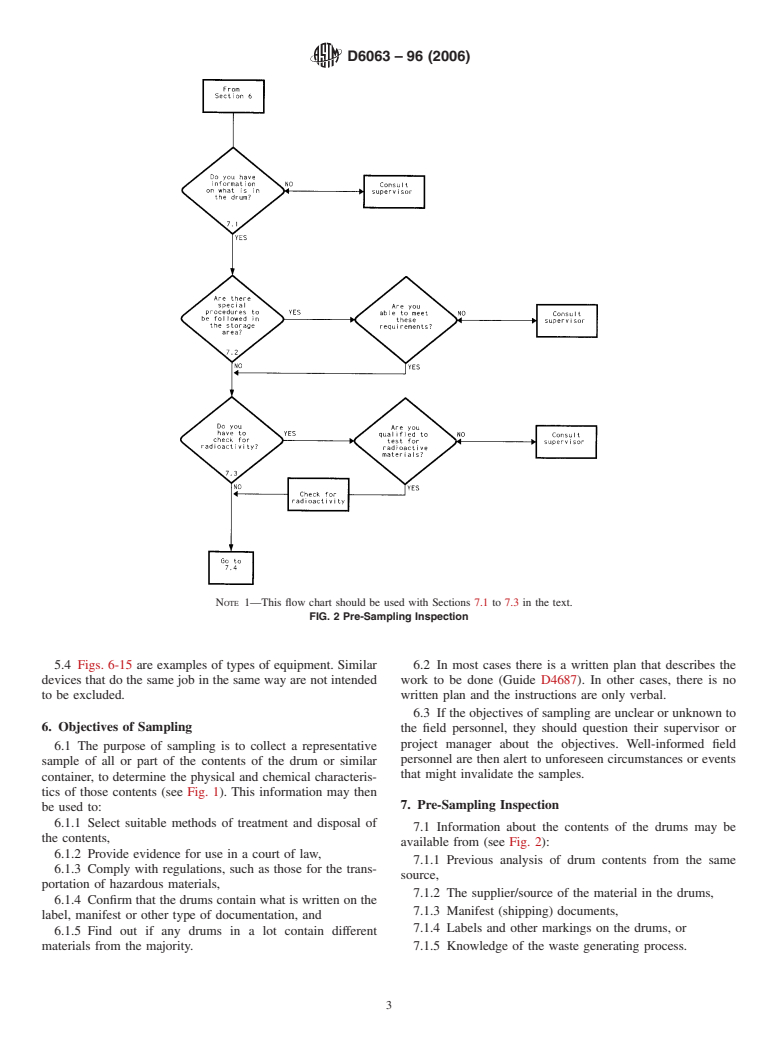
1.1 This guide covers information, including flow charts, for field personnel to follow in order to collect samples from drums and similar containers.
1.2 The purpose of this guide is to help field personnel in planning and obtaining samples from drums and similar containers, using equipment and techniques that will ensure that the objectives of the sampling activity will be met. It can also be used as a training tool.
This standard does not purport to address all of the safety concerns, if any, associated with its use. It is the responsibility of the user of this standard to establish appropriate safety and health practices and determine the applicability of regulatory limitations prior to use. See specific Warnings in 7.4.3 and 7.4.4.
General Information
Relations
Standards Content (Sample)
NOTICE: This standard has either been superseded and replaced by a new version or withdrawn.
Contact ASTM International (www.astm.org) for the latest information
Designation:D6063–96 (Reapproved 2006)
Standard Guide for
Sampling of Drums and Similar Containers by Field
1
Personnel
This standard is issued under the fixed designation D6063; the number immediately following the designation indicates the year of
original adoption or, in the case of revision, the year of last revision. A number in parentheses indicates the year of last reapproval. A
superscript epsilon (´) indicates an editorial change since the last revision or reapproval.
1. Scope D4823 Guide for Core Sampling Submerged, Unconsoli-
dated Sediments
1.1 Thisguidecoversinformation,includingflowcharts,for
D4840 Guide for Sample Chain-of-Custody Procedures
field personnel to follow in order to collect samples from
D5088 Practice for Decontamination of Field Equipment
drums and similar containers.
Used at Waste Sites
1.2 The purpose of this guide is to help field personnel in
D5283 Practice for Generation of Environmental Data Re-
planning and obtaining samples from drums and similar
lated to Waste Management Activities: Quality Assurance
containers, using equipment and techniques that will ensure
and Quality Control Planning and Implementation
that the objectives of the sampling activity will be met. It can
D5358 Practice for Sampling with a Dipper or Pond Sam-
also be used as a training tool.
pler
1.3 This standard does not purport to address all of the
D5451 Practice for Sampling Using a Trier Sampler
safety concerns, if any, associated with its use. It is the
D5495 Practice for Sampling With a Composite Liquid
responsibility of the user of this standard to establish appro-
Waste Sampler (COLIWASA)
priate safety and health practices and determine the applica-
bility of regulatory limitations prior to use. See specific
3. Terminology
Warnings in 7.4.3 and 7.4.4.
3.1 Definitions:
3
2. Referenced Documents 3.1.1 bung, n—usually a 2-in. (5-cm) or ⁄4-in. (1.3-cm)
2
diameter threaded plug specifically designed to close a bung
2.1 ASTM Standards:
hole.
C783 Practice for Core Sampling of Graphite Electrodes
3.1.2 bung hole, n—an opening in a barrel or drum through
D1452 PracticeforSoilExplorationandSamplingbyAuger
which it can be filled, emptied or vented.
Borings
3.1.3 consolidated solid, n—as used in this guide, a com-
D1586 Test Method for Penetration Test (SPT) and Split-
pact solid not easily compressed or broken into smaller
Barrel Sampling of Soils
portions.
D1587 Practice forThin-WalledTube Sampling of Soils for
3.1.4 drum, n—when used in the flow charts in this guide,
Geotechnical Purposes
thewordimpliesanydrum,barrelornon-bulkcontainerof5to
D2113 Practice for Rock Core Drilling and Sampling of
110 gal (19 to 400 L) capacity.
Rock for Site Investigation
3.1.5 representative sample, n—a sample collected such
D4448 Guide for Sampling Ground-Water Monitoring
that it reflects one or more characteristics of interest of the lot
Wells
or population from which it was collected.
D4687 Guide for General Planning of Waste Sampling
3.1.6 sample, n—one or more items or portions collected
D4700 Guide for Soil Sampling from the Vadose Zone
from a lot or population.
3.1.7 sampler, n—the device used to obtain a sample.
1
This guide is under the jurisdiction of ASTM Committee D34 on Waste
3.1.8 sludge, n—as used in this guide, any mixture of solids
Management and is the direct responsibility of Subcommittee D34.01.02 on
that settles out of solution; sludges contain liquids that are not
Sampling Techniques.
apparent as free liquids.
Current edition approved Oct. 1, 2006. Published October 2006. Originally
approved in 1996. Last previous edition approved in 2006 as D6063 – 96 (2006).
3.1.9 unconsolidated solid, n—as used in this guide, unce-
DOI: 10.1520/D6063-96R06.
mented or uncompacted material that is easily separated into
2
For referenced ASTM standards, visit the ASTM website, www.astm.org, or
smaller portions.
contact ASTM Customer Service at service@astm.org. For Annual Book of ASTM
Standards volume information, refer to the standard’s Document Summary page on
the ASTM website.
Copyright © ASTM International, 100 Barr Harbor Drive, PO Box C700, West Conshohocken, PA 19428-2959, United States.
1
---------------------- Page: 1 ----------------------
D6063–96 (2006)
3.1.10 work plans, n—plans that are specific to sampling at before submitting them for chemical analysis or physical
a particular site; examples are Health and Safety Plans and testing, or both. Incorrect sampling can invalidate resulting
Sampling and Analysis Plans.
data.
5.2 This guide may be used by personnel who have no
4. Summary of Guide
formal workplan. It draws their attention to issues that must be
4.1 This guide uses a decision-tree format to lead persons
addressed before, during, and after taking a sample. It provides
intending to sample waste materials from drums and similar
guidance in choos
...
Questions, Comments and Discussion
Ask us and Technical Secretary will try to provide an answer. You can facilitate discussion about the standard in here.