

ASTM B828-23
(Practice)Standard Practice for Making Capillary Joints by Soldering of Copper and Copper Alloy Tube and Fittings
General Information
- Abstract
SIGNIFICANCE AND USE
5.1 The techniques described herein are used to produce leak-tight soldered joints between copper and copper alloy tube and fittings, either in shop operations or in the field. Skill and knowledge on the part of the operator or mechanic are required to obtain a satisfactorily soldered joint.
SCOPE
1.1 This practice covers a procedure for making capillary joints by soldering of copper and copper alloy tube and fittings.
1.2 This procedure is applicable to pressurized systems such as plumbing, heating, air conditioning, refrigeration, mechanical, fire sprinkler, and other similar systems. ASME B31.5 and B31.9 reference the techniques used for satisfactory joint preparation. It is also used in the assembly of nonpressurized systems such as drainage, waste, and vent.
1.3 It is not applicable to the assembly of electrical or electronic systems.
1.4 Tube and fittings are manufactured within certain tolerances to provide for the small variations in dimensions associated with manufacturing practice. Applicable specifications are listed in Appendix X1.
1.5 A variety of solders are available that will produce sound, leak-tight joints. Choice of solder will depend upon the type of application and on local codes. For potable water systems, only lead-free solders shall be used, some of which are described in Specification B32.
1.6 The values stated in inch-pound units are to be regarded as standard. The values given in parentheses are mathematical conversions to SI units that are provided for information only and are not considered standard.
1.7 This standard does not purport to address all of the safety concerns, if any, associated with its use. It is the responsibility of the user of this standard to establish appropriate safety, health, and environmental practices and determine the applicability of regulatory limitations prior to use. For hazard statements, see the warning statements in 6.4.1, 6.6.1, and 6.6.3.
1.8 This international standard was developed in accordance with internationally recognized principles on standardization established in the Decision on Principles for the Development of International Standards, Guides and Recommendations issued by the World Trade Organization Technical Barriers to Trade (TBT) Committee.
- Status
- Published
- Publication Date
- 30-Nov-2023
- Technical Committee
- B05 - Copper and Copper Alloys
- Drafting Committee
- B05.04 - Pipe and Tube
Buy Documents
ASTM B828-23 - Standard Practice for Making Capillary Joints by Soldering of Copper and Copper Alloy Tube and Fittings
REDLINE ASTM B828-23 - Standard Practice for Making Capillary Joints by Soldering of Copper and Copper Alloy Tube and Fittings
Overview
ASTM B828-23, issued by ASTM International, sets out the standard practice for making capillary joints by soldering copper and copper alloy tube and fittings. This document details procedures for achieving reliable, leak-tight soldered joints for a range of piping systems, with guidance relevant for both shop and field operations. The standard is widely recognized for ensuring quality and safety in pressurized and nonpressurized piping applications, such as plumbing, heating, air conditioning, refrigeration, and fire sprinkler systems.
The document emphasizes the importance of operator skill and procedural adherence. It highlights the need for choosing suitable materials and techniques based on application requirements and local codes, including the exclusive use of lead-free solders for potable water systems.
Key Topics
- Capillary Soldering Process: Describes a step-by-step approach for preparing and assembling copper and copper alloy tube and fittings, emphasizing measuring, cutting, reaming, cleaning, fluxing, assembly, heating, solder application, and post-soldering cleaning.
- System Coverage: Applicable to both pressurized (e.g., potable water, HVAC, mechanical) and nonpressurized systems (e.g., drainage, waste, vent).
- Material Compatibility: Covers tolerances of tube and fittings to ensure proper capillary action, referencing ASTM and ASME specifications.
- Solder Selection: Stresses the use of a variety of solders suitable for specific applications, with potable water systems requiring lead-free solder per Specification B32.
- Safety Guidance: Outlines the operator’s responsibility for safety, health, and environmental practices, referring to relevant ANSI standards and code requirements.
- Dimensional Standards: Provides information on manufacturing tolerances and dimensional references necessary for achieving optimal joint quality.
Applications
This standard is essential for professionals involved in the installation and maintenance of piping systems that utilize copper and copper alloys. Key application areas include:
- Plumbing Systems: Ensures leak-tight and durable joints for potable and non-potable water lines, complying with local codes and using approved, lead-free solder.
- Heating and Air Conditioning: Guides the assembly of heating, ventilation, and air conditioning (HVAC) system piping, focusing on both high and low-pressure systems.
- Refrigeration: Details reliable joint preparation needed for refrigeration tube assemblies, referencing ASME B31.5 for refrigeration piping.
- Fire Sprinkler and Mechanical Systems: Supports safe and effective assembly of fire suppression and general mechanical piping infrastructure.
- Drainage, Waste, and Vent (DWV) Systems: Covers the assembly requirements for nonpressurized systems, ensuring proper flow and longevity of joints.
Related Standards
- ASTM B32: Specification for solder metals, including lead-free options for potable water.
- ASTM B88 & B88M: Specification for seamless copper water tube in both inch-pound and metric sizes.
- ASTM B75/B75M, B68/B68M, B280, B306, B447, B640: Specifications for various types and applications of copper tube.
- ASTM B813: Specification for liquid and paste fluxes used during soldering.
- ASME B31.5 and B31.9: Codes for refrigeration piping and building services piping.
- ASME B16.18, B16.22, B16.23, B16.29: Standards for copper and copper alloy solder joint fittings.
- ANSI Z49.1: Safety in welding and cutting, referenced for health and safety practices.
- ASTM B846: Terminology for copper and copper alloys.
Practical Value
Complying with ASTM B828-23 ensures that copper piping systems achieve reliable performance, leak resistance, and long service life. The standard helps minimize installation errors, improves safety outcomes, and promotes compliance with accepted engineering practices and local regulations. Its procedural clarity and coverage of both safety and quality make it indispensable for contractors, engineers, inspectors, and others involved in the design, installation, and maintenance of copper tubing systems.
For more detailed requirements, consult the latest ASTM B828-23 document and referenced specifications.
Relations
- Effective Date
- 01-Dec-2023
- Effective Date
- 01-Dec-2023
- Effective Date
- 01-Dec-2023
- Effective Date
- 01-Dec-2023
- Effective Date
- 01-Dec-2023
- Effective Date
- 01-Dec-2023
Buy Documents
ASTM B828-23 - Standard Practice for Making Capillary Joints by Soldering of Copper and Copper Alloy Tube and Fittings
REDLINE ASTM B828-23 - Standard Practice for Making Capillary Joints by Soldering of Copper and Copper Alloy Tube and Fittings
Get Certified
Connect with accredited certification bodies for this standard

Institut za varilstvo d.o.o. (Welding Institute)
Slovenia's leading welding institute since 1952. ISO 3834, EN 1090, pressure equipment certification, NDT personnel, welder qualification. Only IIW Au
Sponsored listings
Frequently Asked Questions
ASTM B828-23 is a standard published by ASTM International. Its full title is "Standard Practice for Making Capillary Joints by Soldering of Copper and Copper Alloy Tube and Fittings". This standard covers: SIGNIFICANCE AND USE 5.1 The techniques described herein are used to produce leak-tight soldered joints between copper and copper alloy tube and fittings, either in shop operations or in the field. Skill and knowledge on the part of the operator or mechanic are required to obtain a satisfactorily soldered joint. SCOPE 1.1 This practice covers a procedure for making capillary joints by soldering of copper and copper alloy tube and fittings. 1.2 This procedure is applicable to pressurized systems such as plumbing, heating, air conditioning, refrigeration, mechanical, fire sprinkler, and other similar systems. ASME B31.5 and B31.9 reference the techniques used for satisfactory joint preparation. It is also used in the assembly of nonpressurized systems such as drainage, waste, and vent. 1.3 It is not applicable to the assembly of electrical or electronic systems. 1.4 Tube and fittings are manufactured within certain tolerances to provide for the small variations in dimensions associated with manufacturing practice. Applicable specifications are listed in Appendix X1. 1.5 A variety of solders are available that will produce sound, leak-tight joints. Choice of solder will depend upon the type of application and on local codes. For potable water systems, only lead-free solders shall be used, some of which are described in Specification B32. 1.6 The values stated in inch-pound units are to be regarded as standard. The values given in parentheses are mathematical conversions to SI units that are provided for information only and are not considered standard. 1.7 This standard does not purport to address all of the safety concerns, if any, associated with its use. It is the responsibility of the user of this standard to establish appropriate safety, health, and environmental practices and determine the applicability of regulatory limitations prior to use. For hazard statements, see the warning statements in 6.4.1, 6.6.1, and 6.6.3. 1.8 This international standard was developed in accordance with internationally recognized principles on standardization established in the Decision on Principles for the Development of International Standards, Guides and Recommendations issued by the World Trade Organization Technical Barriers to Trade (TBT) Committee.
SIGNIFICANCE AND USE 5.1 The techniques described herein are used to produce leak-tight soldered joints between copper and copper alloy tube and fittings, either in shop operations or in the field. Skill and knowledge on the part of the operator or mechanic are required to obtain a satisfactorily soldered joint. SCOPE 1.1 This practice covers a procedure for making capillary joints by soldering of copper and copper alloy tube and fittings. 1.2 This procedure is applicable to pressurized systems such as plumbing, heating, air conditioning, refrigeration, mechanical, fire sprinkler, and other similar systems. ASME B31.5 and B31.9 reference the techniques used for satisfactory joint preparation. It is also used in the assembly of nonpressurized systems such as drainage, waste, and vent. 1.3 It is not applicable to the assembly of electrical or electronic systems. 1.4 Tube and fittings are manufactured within certain tolerances to provide for the small variations in dimensions associated with manufacturing practice. Applicable specifications are listed in Appendix X1. 1.5 A variety of solders are available that will produce sound, leak-tight joints. Choice of solder will depend upon the type of application and on local codes. For potable water systems, only lead-free solders shall be used, some of which are described in Specification B32. 1.6 The values stated in inch-pound units are to be regarded as standard. The values given in parentheses are mathematical conversions to SI units that are provided for information only and are not considered standard. 1.7 This standard does not purport to address all of the safety concerns, if any, associated with its use. It is the responsibility of the user of this standard to establish appropriate safety, health, and environmental practices and determine the applicability of regulatory limitations prior to use. For hazard statements, see the warning statements in 6.4.1, 6.6.1, and 6.6.3. 1.8 This international standard was developed in accordance with internationally recognized principles on standardization established in the Decision on Principles for the Development of International Standards, Guides and Recommendations issued by the World Trade Organization Technical Barriers to Trade (TBT) Committee.
ASTM B828-23 is classified under the following ICS (International Classification for Standards) categories: 23.040.15 - Non-ferrous metal pipes. The ICS classification helps identify the subject area and facilitates finding related standards.
ASTM B828-23 has the following relationships with other standards: It is inter standard links to ASTM B828-16, ASTM B280-23, ASTM B640-12a(2021), ASTM B88-22, ASTM B306-20, ASTM B88M-20. Understanding these relationships helps ensure you are using the most current and applicable version of the standard.
ASTM B828-23 is available in PDF format for immediate download after purchase. The document can be added to your cart and obtained through the secure checkout process. Digital delivery ensures instant access to the complete standard document.
Standards Content (Sample)
This international standard was developed in accordance with internationally recognized principles on standardization established in the Decision on Principles for the
Development of International Standards, Guides and Recommendations issued by the World Trade Organization Technical Barriers to Trade (TBT) Committee.
Designation: B828 − 23
Standard Practice for
Making Capillary Joints by Soldering of Copper and Copper
Alloy Tube and Fittings
This standard is issued under the fixed designation B828; the number immediately following the designation indicates the year of
original adoption or, in the case of revision, the year of last revision. A number in parentheses indicates the year of last reapproval. A
superscript epsilon (´) indicates an editorial change since the last revision or reapproval.
1. Scope* Development of International Standards, Guides and Recom-
mendations issued by the World Trade Organization Technical
1.1 This practice covers a procedure for making capillary
Barriers to Trade (TBT) Committee.
joints by soldering of copper and copper alloy tube and fittings.
1.2 This procedure is applicable to pressurized systems such
2. Referenced Documents
as plumbing, heating, air conditioning, refrigeration,
2.1 ASTM Standards:
mechanical, fire sprinkler, and other similar systems. ASME
B32 Specification for Solder Metal
B31.5 and B31.9 reference the techniques used for satisfactory
B68/B68M Specification for Seamless Copper Tube, Bright
joint preparation. It is also used in the assembly of nonpres-
Annealed
surized systems such as drainage, waste, and vent.
B75/B75M Specification for Seamless Copper Tube
1.3 It is not applicable to the assembly of electrical or
B88 Specification for Seamless Copper Water Tube
electronic systems.
B88M Specification for Seamless Copper Water Tube (Met-
1.4 Tube and fittings are manufactured within certain toler-
ric)
ances to provide for the small variations in dimensions
B280 Specification for Seamless Copper Tube for Air Con-
associated with manufacturing practice. Applicable specifica-
ditioning and Refrigeration Field Service
tions are listed in Appendix X1.
B306 Specification for Copper Drainage Tube (DWV)
1.5 A variety of solders are available that will produce
B447 Specification for Welded Copper Tube
sound, leak-tight joints. Choice of solder will depend upon the
B640 Specification for Welded Copper Tube for Air Condi-
type of application and on local codes. For potable water
tioning and Refrigeration Service
systems, only lead-free solders shall be used, some of which
B813 Specification for Liquid and Paste Fluxes for Solder-
are described in Specification B32.
ing of Copper and Copper Alloy Tube
1.6 The values stated in inch-pound units are to be regarded
B846 Terminology for Copper and Copper Alloys
as standard. The values given in parentheses are mathematical 3
2.2 ASME Documents:
conversions to SI units that are provided for information only
ASME B31.5 Refrigeration Piping
and are not considered standard.
ASME B31.9 Building Services Piping
1.7 This standard does not purport to address all of the
ASME B16.18 Cast Copper Alloy Solder Joint Pressure
safety concerns, if any, associated with its use. It is the
Fittings
responsibility of the user of this standard to establish appro-
ASME B16.22 Wrought Copper and Copper Alloy Solder
priate safety, health, and environmental practices and deter-
Joint Pressure Fittings
mine the applicability of regulatory limitations prior to use.
ASME B16.23 Cast Copper Alloy Solder Joint Drainage
For hazard statements, see the warning statements in 6.4.1,
Fittings—DWV
6.6.1, and 6.6.3.
ASME B16.29 Wrought Copper and Copper Alloy Solder
1.8 This international standard was developed in accor-
Joint Drainage Fittings—DWV
dance with internationally recognized principles on standard-
ization established in the Decision on Principles for the
For referenced ASTM standards, visit the ASTM website, www.astm.org, or
This practice is under the jurisdiction of ASTM Committee B05 on Copper and contact ASTM Customer Service at service@astm.org. For Annual Book of ASTM
Copper Alloys and is the direct responsibility of Subcommittee B05.04 on Pipe and Standards volume information, refer to the standard’s Document Summary page on
Tube. the ASTM website.
Current edition approved Dec. 1, 2023. Published December 2023. Originally Available from American Society of Mechanical Engineers (ASME), ASME
approved in 1992. Last previous edition approved in 2016 as B828 – 16. DOI: International Headquarters, Two Park Ave., New York, NY 10016-5990, http://
10.1520/B0828-23. www.asme.org.
*A Summary of Changes section appears at the end of this standard
Copyright © ASTM International, 100 Barr Harbor Drive, PO Box C700, West Conshohocken, PA 19428-2959. United States
B828 − 23
2.3 ANSI Document:
ANSI Z49.1 Safety in Welding and Cutting
3. Terminology
3.1 For definitions of terms related to copper and copper
alloys, refer to Terminology B846.
3.2 Definitions of Terms Specific to This Standard:
3.2.1 soldering, n—a group of joining processes that pro-
duce coalescence of materials by heating them to the soldering
temperature and by using a filler metal (solder) having a
liquidus not exceeding 840 °F (450 °C) and below the solidus
of the base metals.
3.2.1.1 Discussion—In actual practice, most soldering is
done at temperatures from about 350 °F to 660 °F (177 °C to
349 °C).
FIG. 1 Measuring
4. Summary of Practice
4.1 To consistently make satisfactory joints, the following
sequence of joint preparation and operations shall be followed:
(1) Measuring and cutting,
(2) Reaming,
(3) Cleaning,
(4) Fluxing,
(5) Assembly and support,
(6) Heating,
(7) Applying the solder, and
(8) Cooling and cleaning.
5. Significance and Use
5.1 The techniques described herein are used to produce
leak-tight soldered joints between copper and copper alloy tube
and fittings, either in shop operations or in the field. Skill and
knowledge on the part of the operator or mechanic are required FIG. 2 Cutting
to obtain a satisfactorily soldered joint.
6. Procedure 6.2.1 Ream all cut tube ends to the full inside diameter of
the tube to remove the small burr created by the cutting
6.1 Measuring and Cutting:
operation. Failure to remove this rough edge by reaming is a
6.1.1 Accurately measure the length of each tube segment
leading cause of erosion-corrosion that occurs as a result of
(Fig. 1) to ensure joint quality. If the tube is too short, it will not
local turbulence and increased local flow velocity in the tube.
reach all the way into the cup of the fitting and a proper joint
A properly reamed piece of tube provides a smooth surface for
cannot be made. If the tube segment is too long, the possibility
better flow.
exists that system strain that negatively affects service life will
6.2.2 Remove any burrs on the outside of the tube ends
be introduced.
created by the cutting operation to ensure proper entrance of
6.1.2 Cut the tube to the measured lengths using tools that
the tube into the fitting cup.
provide a square cut, for example, a disk-type tube cutter (Fig.
6.2.3 Tools used to ream tube ends include the reaming
2), a hacksaw, an abrasive wheel, or with a stationary or
blade on the tube cutter, half-round or round files (Fig. 3), a
portable band saw. Avoid deforming the tube during cutting.
pocket knife (Fig. 4), and a suitable deburring tool (Fig. 5).
Regardless of method, the cut shall be made square with the
With soft (annealed) tube, care must be taken not to deform the
run of the tube, so that the tube will seat properly in the fitting
tube end by applying too much pressure.
cup.
6.2.4 Soft temper tube, if deformed, shall be brought back to
6.2 Reaming:
its proper roundness and dimensions with a sizing tool. This
tool consists of a plug and sizing ring.
6.3 Cleaning:
Available from American National Standards Institute (ANSI), 25 W. 43rd St.,
6.3.1 Clean all oxides and surface soil from the tube ends
4th Floor, New York, NY 10036, http://www.ansi.org.
and fitting cups. The removal of all oxides and surface soil is
American Welding Society Welding Handbook, Welding Processes, 8th ed., Vol
2, American Welding Society, 8669 NW 36 Street, #130, Miami, FL 33166-6672. crucial to proper flow of solder metal into the joint. Unremoved
B828 − 23
FIG. 6 Cleaning: Sand Cloth
FIG. 3 Reaming: File
FIG. 7 Cleaning: Abrasive Pad
FIG. 4 Reaming: Pocket Knife
FIG. 8 Cleaning: Abrasive Pad
FIG. 5 Reaming: Deburring Tool
oxides, surface soil, and oils will interfere with capillary 6.3.3 Clean the fitting cups by using abrasive cloth, abrasive
action, lessen the strength of the joint, and cause failure. pads (Fig. 8), or a properly sized fitting brush (Fig. 9).
6.3.2 Lightly abrade the tube ends using sand cloth (Fig. 6) 6.3.4 The capillary space between tube and fitting is ap-
or nylon abrasive pads (Fig. 7) for a distance slightly more than proximately 0.004 in. (0.1 mm). Solder metal fills this gap by
the depth of the fitting cups. capillary action. This spacing is critical for the solder metal to
-
...
This document is not an ASTM standard and is intended only to provide the user of an ASTM standard an indication of what changes have been made to the previous version. Because
it may not be technically possible to adequately depict all changes accurately, ASTM recommends that users consult prior editions as appropriate. In all cases only the current version
of the standard as published by ASTM is to be considered the official document.
Designation: B828 − 16 B828 − 23
Standard Practice for
Making Capillary Joints by Soldering of Copper and Copper
Alloy Tube and Fittings
This standard is issued under the fixed designation B828; the number immediately following the designation indicates the year of
original adoption or, in the case of revision, the year of last revision. A number in parentheses indicates the year of last reapproval. A
superscript epsilon (´) indicates an editorial change since the last revision or reapproval.
1. Scope*
1.1 This practice describescovers a procedure for making capillary joints by soldering of copper and copper alloy tube and fittings.
1.2 This procedure is applicable to pressurized systems such as plumbing, heating, air conditioning, refrigeration, mechanical, fire
sprinkler, and other similar systems. ASME B31.5 and B31.9 reference the techniques used for satisfactory joint preparation. It is
also used in the assembly of nonpressurized systems such as drainage, waste, and vent.
1.3 It is not applicable to the assembly of electrical or electronic systems.
1.4 Tube and fittings are manufactured within certain tolerances to provide for the small variations in dimensions associated with
manufacturing practice. Applicable specifications are listed in Appendix X1.
1.5 A variety of solders are available that will produce sound, leak-tight joints. Choice of solder will depend upon the type of
application and on local codes. For potable water systems, only lead-free solders shall be used, some of which are described in
Specification B32.
1.6 The values stated in inch-pound units are to be regarded as standard. The values given in parentheses are mathematical
conversions to SI units that are provided for information only and are not considered standard.
1.7 This standard does not purport to address all of the safety concerns, if any, associated with its use. It is the responsibility
of the user of this standard to establish appropriate safety and healthsafety, health, and environmental practices and determine
the applicability of regulatory limitations prior to use. For hazard statements, see the warning statements in 6.4.1, 6.6.1, and 6.6.3.
1.8 This international standard was developed in accordance with internationally recognized principles on standardization
established in the Decision on Principles for the Development of International Standards, Guides and Recommendations issued
by the World Trade Organization Technical Barriers to Trade (TBT) Committee.
2. Referenced Documents
2.1 ASTM Standards:
B32 Specification for Solder Metal
B68/B68M Specification for Seamless Copper Tube, Bright Annealed
This practice is under the jurisdiction of ASTM Committee B05 on Copper and Copper Alloys and is the direct responsibility of Subcommittee B05.04 on Pipe and Tube.
Current edition approved June 1, 2016Dec. 1, 2023. Published June 2016December 2023. Originally approved in 1992. Last previous edition approved in 20102016 as
B828 – 02 (2010).B828 – 16. DOI: 10.1520/B0828-16.10.1520/B0828-23.
For referenced ASTM standards, visit the ASTM website, www.astm.org, or contact ASTM Customer Service at service@astm.org. For Annual Book of ASTM Standards
volume information, refer to the standard’s Document Summary page on the ASTM website.
*A Summary of Changes section appears at the end of this standard
Copyright © ASTM International, 100 Barr Harbor Drive, PO Box C700, West Conshohocken, PA 19428-2959. United States
B828 − 23
B75/B75M Specification for Seamless Copper Tube
B88 Specification for Seamless Copper Water Tube
B88M Specification for Seamless Copper Water Tube (Metric)
B280 Specification for Seamless Copper Tube for Air Conditioning and Refrigeration Field Service
B306 Specification for Copper Drainage Tube (DWV)
B447 Specification for Welded Copper Tube
B640 Specification for Welded Copper Tube for Air Conditioning and Refrigeration Service
B641 Specification for Seamless and Welded Copper Distribution Tube (Type D) (Withdrawn 1996)
B716 Specification for Welded Copper Water Tube (Withdrawn 1994)
B716M Specification for Welded Copper Water Tube (Metric) (Withdrawn 1994)
B813 Specification for Liquid and Paste Fluxes for Soldering of Copper and Copper Alloy Tube
B846 Terminology for Copper and Copper Alloys
2.2 ASME Documents:
ASME B31.5 Refrigeration Piping
ASME B31.9 Building Services Piping
ASME B16.18 Cast Copper Alloy Solder Joint Pressure Fittings
ASME B16.22 Wrought Copper and Copper Alloy Solder Joint Pressure Fittings
ASME B16.23 Cast Copper Alloy Solder Joint Drainage Fittings—DWV
ASME B16.29 Wrought Copper and Copper Alloy Solder Joint Drainage Fittings—DWV
2.3 ANSI Document:
ANSI Z49.1 Safety in Welding and Cutting
3. Terminology
3.1 For definitions of terms related to copper and copper alloys, refer to Terminology B846.
3.2 Definitions of Terms Specific to This Standard:
3.2.1 soldering—soldering, n—a group of joining processes that produce coalescence of materials by heating them to the soldering
temperature and by using a filler metal (solder) having a liquidus not exceeding 840°F (450°C)840 °F (450 °C) and below the
solidus of the base metals.
3.2.1.1 Discussion—
In actual practice, most soldering is done at temperatures from about 350 to 660°F (177 to 349°C).350 °F to 660 °F (177 °C to
349 °C).
4. Summary of Practice
4.1 To consistently make satisfactory joints, the following sequence of joint preparation and operations shall be followed:
(1) measuringMeasuring and cutting,
(2) reaming,Reaming,
(3) cleaning,Cleaning,
(4) fluxing,Fluxing,
(5) assemblyAssembly and support,
(6) heating,Heating,
(7) applyingApplying the solder, and
(8) coolingCooling and cleaning.
5. Significance and Use
5.1 The techniques described herein are used to produce leak-tight soldered joints between copper and copper alloy tube and
fittings, either in shop operations or in the field. Skill and knowledge on the part of the operator or mechanic are required to obtain
a satisfactorily soldered joint.
Available from American Society of Mechanical Engineers (ASME), ASME International Headquarters, Two Park Ave., New York, NY 10016-5990, http://
www.asme.org.
Available from American National Standards Institute (ANSI), 25 W. 43rd St., 4th Floor, New York, NY 10036, http://www.ansi.org.
American Welding Society Welding Handbook, Welding Processes, 8th ed., Vol 2, American Welding Society, 8669 NW 36 Street, #130, Miami, FL 33166-6672.
B828 − 23
6. Procedure
6.1 Measuring and Cutting:
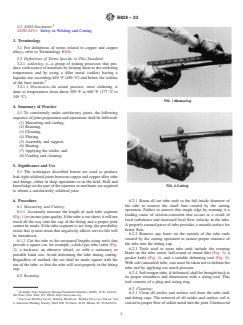
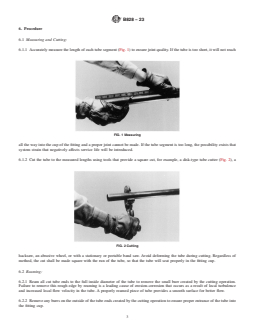
6.1.1 Accurately measure the length of each tube segment (Fig. 1) to ensure joint quality. If the tube is too short, it will not reach
FIG. 1 Measuring
all the way into the cup of the fitting and a proper joint cannot be made. If the tube segment is too long, the possibility exists that
system strain that negatively affects service life will be introduced.
6.1.2 Cut the tube to the measured lengths using tools that provide a square cut, for example, a disk-type tube cutter (Fig. 2), a
FIG. 2 Cutting
hacksaw, an abrasive wheel, or with a stationary or portable band saw. Avoid deforming the tube during cutting. Regardless of
method, the cut shall be made square with the run of the tube, so that the tube will seat properly in the fitting cup.
6.2 Reaming:
6.2.1 Ream all cut tube ends to the full inside diameter of the tube to remove the small burr created by the cutting operation.
Failure to remove this rough edge by reaming is a leading cause of erosion-corrosion that occurs as a result of local turbulence
and increased local flow velocity in the tube. A properly reamed piece of tube provides a smooth surface for better flow.
6.2.2 Remove any burrs on the outside of the tube ends created by the cutting operation to ensure proper entrance of the tube into
the fitting cup.
B828 − 23
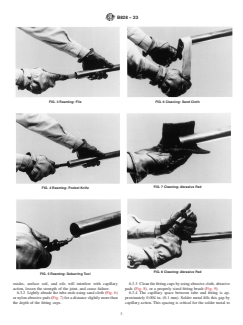
6.2.3 Tools used to ream tube ends include the reaming blade on the tube cutter, half-round or round files (Fig. 3), a pocket knife
(Fig. 4), and a suitable deburring tool (Fig. 5). With soft (annealed) tube, care must be taken not to deform the tube end by applying
too much pressure.
6.2.4 Soft temper tube, if deformed, shall be brought back to its proper roundness and dimensions with a sizing tool. This tool
consists of a plug and sizing ring.
6.3 Cleaning:
6.3.1 Clean all oxides and surface soil from the tube ends and fitting cups. The removal of all oxides and surface soil is crucial
to proper flow of solder metal into the joint. Unremoved oxides, surface soil, and oils will interfere with capillary action, lessen
the strength of the joint, and cause failure.
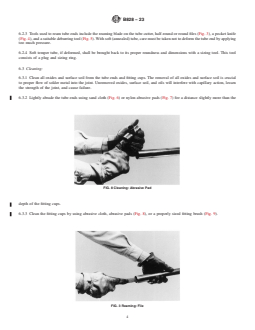
6.3.2 Lightly abrade the tube ends using sand cloth (Fig. 6) or nylon abrasive pads (Fig. 7) for a distance slightly more than the
FIG. 8 Cleaning: Abrasive Pad
depth of the fitting cups.
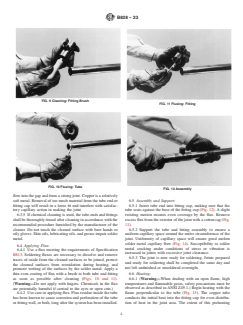
6.3.3 Clean the fitting cups by using abrasive cloth, abrasive pads (Fig. 8), or a properly sized fitting brush (Fig. 9).
FIG. 3 Reaming: File
B828 − 23
FIG. 4 Reaming: Pocket Knife
FIG. 5 Reaming: Deburring Tool
FIG. 6 Cleaning: Sand Cloth
6.3.4 The capillary space between tube and fitting is approximately 0.004 in. (0.1 mm). Solder metal fills this gap by capillary
action. This spacing is critical for the solder metal to flow into the gap and form a strong joint. Copper is a relatively soft metal.
Removal of too much material from the tube end or fitting cup will result in a loose fit and interfere with satisfactory capillary
action in making the joint.
B828 − 23
FIG. 7 Cleaning: Abrasive Pad
FIG. 9 Cleaning: Fitting Brush
6.3.5 If chemical cleaning is used, the tube ends and fittings shall be thoroughly rinsed after cleaning in accordance with the
recomme
...