

ASTM B1018-21
(Specification)Standard Specification for Seamless Copper-Iron Tube for Air Conditioning and Refrigeration Field Service
General Information
- Abstract
SCOPE
1.1 This specification establishes the requirements for seamless copper-iron tube intended for use in the connection, repairs, or alternations of air conditioning or refrigeration units in the field.
1.2 The tube shall be produced from the following copper alloy:
Copper UNS No.
C19400
1.3 The values stated in inch-pound units are to be regarded as standard. The values given in parentheses are mathematical conversions to SI units that are provided for information only and are not considered standard.
1.4 The following safety caveat pertains only to the test method(s) described in this specification:
1.4.1 This standard does not purport to address all of the safety concerns, if any, associated with its use. It is the responsibility of the user of this standard to establish appropriate safety, health, and environmental practices and determine the applicability of regulatory limitations prior to use.
1.5 This international standard was developed in accordance with internationally recognized principles on standardization established in the Decision on Principles for the Development of International Standards, Guides and Recommendations issued by the World Trade Organization Technical Barriers to Trade (TBT) Committee.
- Status
- Published
- Publication Date
- 14-Feb-2021
- Technical Committee
- B05 - Copper and Copper Alloys
- Drafting Committee
- B05.04 - Pipe and Tube
Overview
ASTM B1018-21: Standard Specification for Seamless Copper-Iron Tube for Air Conditioning and Refrigeration Field Service is an internationally recognized standard developed by ASTM International. This specification sets forth the requirements for seamless copper-iron tubes, specifically those made from Copper UNS No. C19400 alloy. Intended for use in the installation, repair, or alteration of air conditioning and refrigeration units in the field, this standard provides crucial guidance for manufacturers, installers, and inspectors seeking consistent quality and performance across field service applications.
Key Topics
Scope and Material
Defines requirements for seamless copper-iron tubes for connection, repair, or modification of HVAC&R (heating, ventilation, air conditioning, and refrigeration) units, covering tubes produced from UNS C19400.Ordering and Application Details
Specifies essential ordering information, including product designation, alloy, temper, dimensions, method of supply (straight lengths or coils), and intended application.Mechanical and Chemical Requirements
Outlines minimum standards for tensile and yield strength, chemical composition, and wall thickness for tubes, ensuring durability and reliability under specified pressure conditions.Testing and Inspection
Establishes protocols for expansion (pin) testing, cleanness testing of internal surfaces, eddy-current tests for detecting discontinuities, and chemical analysis. Provides for retesting and rejection criteria to ensure full compliance.Dimensions and Tolerances
Covers wall thickness, diameter, straightness, roundness, and other permissible variations as referenced from ASTM B251/B251M, ensuring compatibility and fit in field installations.Workmanship and Finish
Requires tubes to be free from defects, while accepting minor blemishes that do not interfere with their intended function.Marking and Packaging
Details product marking (standard number, size, alloy, temper, manufacturer, pressure/temperature range, date) and packaging requirements to support safe, traceable shipments.
Applications
Field Service in Air Conditioning and Refrigeration
The primary application is for seamless copper-iron tubing used during onsite installation, connection, repair, or alteration of HVAC and refrigeration systems. The specification supports field technicians in maintaining system reliability and regulatory compliance.Mechanical and Building Services
Contractors and engineers rely on ASTM B1018-21 to select appropriate tubing that meets mechanical, chemical, and cleanliness requirements for high-performance HVAC systems.Government and Regulatory Compliance
The standard is referenced in U.S. government agency procurement and for ASME Boiler and Pressure Vessel Code applications, supporting procurement consistency across major projects.Quality Assurance in Manufacturing and Distribution
Manufacturers and quality managers use this standard to benchmark and certify seamless copper-iron tube products intended for demanding refrigeration and air conditioning applications.
Related Standards
- ASTM B251/B251M - General requirements for wrought seamless copper and copper-alloy tube used as a reference for tolerances, dimensions, and other requirements.
- ASTM B153 - Test method for expansion (pin test) of copper and copper-alloy tubing.
- ASTM E8/E8M - Test methods for tension testing of metallic materials.
- ASTM E243 - Practice for electromagnetic (eddy-current) examination of copper and copper-alloy tubes.
- ASTM B846 - Terminology for copper and copper alloys.
- ASME Boiler and Pressure Vessel Code - Certification and procurement purposes when required.
Keywords: seamless copper-iron tube, ASTM B1018-21, air conditioning tube, refrigeration field service, HVAC tubing standards, copper UNS C19400, copper-iron alloy, mechanical property requirements, field service tubing, HVAC installation standards.
Relations
- Effective Date
- 01-Jan-2024
- Effective Date
- 01-Aug-2019
- Effective Date
- 01-Jan-2019
- Effective Date
- 01-Jun-2018
- Effective Date
- 01-Oct-2017
- Effective Date
- 15-Jul-2016
- Effective Date
- 01-Feb-2015
- Effective Date
- 01-Dec-2013
- Effective Date
- 01-Jun-2013
- Effective Date
- 01-Dec-2011
- Effective Date
- 01-Jun-2011
- Effective Date
- 01-Jan-2011
- Effective Date
- 01-Jan-2011
- Effective Date
- 01-Oct-2010
- Effective Date
- 15-Nov-2009
Get Certified
Connect with accredited certification bodies for this standard

Institut za varilstvo d.o.o. (Welding Institute)
Slovenia's leading welding institute since 1952. ISO 3834, EN 1090, pressure equipment certification, NDT personnel, welder qualification. Only IIW Au
Sponsored listings
Frequently Asked Questions
ASTM B1018-21 is a technical specification published by ASTM International. Its full title is "Standard Specification for Seamless Copper-Iron Tube for Air Conditioning and Refrigeration Field Service". This standard covers: SCOPE 1.1 This specification establishes the requirements for seamless copper-iron tube intended for use in the connection, repairs, or alternations of air conditioning or refrigeration units in the field. 1.2 The tube shall be produced from the following copper alloy: Copper UNS No. C19400 1.3 The values stated in inch-pound units are to be regarded as standard. The values given in parentheses are mathematical conversions to SI units that are provided for information only and are not considered standard. 1.4 The following safety caveat pertains only to the test method(s) described in this specification: 1.4.1 This standard does not purport to address all of the safety concerns, if any, associated with its use. It is the responsibility of the user of this standard to establish appropriate safety, health, and environmental practices and determine the applicability of regulatory limitations prior to use. 1.5 This international standard was developed in accordance with internationally recognized principles on standardization established in the Decision on Principles for the Development of International Standards, Guides and Recommendations issued by the World Trade Organization Technical Barriers to Trade (TBT) Committee.
SCOPE 1.1 This specification establishes the requirements for seamless copper-iron tube intended for use in the connection, repairs, or alternations of air conditioning or refrigeration units in the field. 1.2 The tube shall be produced from the following copper alloy: Copper UNS No. C19400 1.3 The values stated in inch-pound units are to be regarded as standard. The values given in parentheses are mathematical conversions to SI units that are provided for information only and are not considered standard. 1.4 The following safety caveat pertains only to the test method(s) described in this specification: 1.4.1 This standard does not purport to address all of the safety concerns, if any, associated with its use. It is the responsibility of the user of this standard to establish appropriate safety, health, and environmental practices and determine the applicability of regulatory limitations prior to use. 1.5 This international standard was developed in accordance with internationally recognized principles on standardization established in the Decision on Principles for the Development of International Standards, Guides and Recommendations issued by the World Trade Organization Technical Barriers to Trade (TBT) Committee.
ASTM B1018-21 is classified under the following ICS (International Classification for Standards) categories: 23.040.15 - Non-ferrous metal pipes. The ICS classification helps identify the subject area and facilitates finding related standards.
ASTM B1018-21 has the following relationships with other standards: It is inter standard links to ASTM E8/E8M-24, ASTM B846-19a, ASTM B846-19, ASTM E243-18, ASTM B251/B251M-17, ASTM E8/E8M-16, ASTM E8/E8M-15, ASTM E243-13, ASTM E8/E8M-13, ASTM E8/E8M-11, ASTM B846-11a, ASTM B153-11, ASTM B846-11, ASTM B900-04(2010), ASTM B846-09a. Understanding these relationships helps ensure you are using the most current and applicable version of the standard.
ASTM B1018-21 is available in PDF format for immediate download after purchase. The document can be added to your cart and obtained through the secure checkout process. Digital delivery ensures instant access to the complete standard document.
Standards Content (Sample)
This international standard was developed in accordance with internationally recognized principles on standardization established in the Decision on Principles for the
Development of International Standards, Guides and Recommendations issued by the World Trade Organization Technical Barriers to Trade (TBT) Committee.
Designation:B1018 −21
Standard Specification for
Seamless Copper-Iron Tube for Air Conditioning and
Refrigeration Field Service
This standard is issued under the fixed designation B1018; the number immediately following the designation indicates the year of
original adoption or, in the case of revision, the year of last revision. A number in parentheses indicates the year of last reapproval. A
superscript epsilon (´) indicates an editorial change since the last revision or reapproval.
1. Scope B153 Test Method for Expansion (Pin Test) of Copper and
Copper-Alloy Pipe and Tubing
1.1 Thisspecificationestablishestherequirementsforseam-
B251/B251M Specification for General Requirements for
less copper-iron tube intended for use in the connection,
Wrought Seamless Copper and Copper-Alloy Tube
repairs, or alternations of air conditioning or refrigeration units
B846 Terminology for Copper and Copper Alloys
in the field.
B900 Practice for Packaging of Copper and Copper Alloy
1.2 The tube shall be produced from the following copper
Mill Products for U.S. Government Agencies
alloy:
E8/E8M Test Methods for Tension Testing of Metallic Ma-
Copper UNS No.
terials
E54 Test Methods for ChemicalAnalysis of Special Brasses
C19400
and Bronzes (Withdrawn 2002)
1.3 The values stated in inch-pound units are to be regarded
E62 Test Methods for Chemical Analysis of Copper and
as standard. The values given in parentheses are mathematical 3
CopperAlloys(PhotometricMethods)(Withdrawn2010)
conversions to SI units that are provided for information only
E243 Practice for Electromagnetic (Eddy Current) Examina-
and are not considered standard.
tion of Copper and Copper-Alloy Tubes
1.4 The following safety caveat pertains only to the test
E478 Test Methods for ChemicalAnalysis of CopperAlloys
method(s) described in this specification:
2.2 ASME Standard:
1.4.1 This standard does not purport to address all of the
ASME Boiler and Pressure Vessel Code Application
safety concerns, if any, associated with its use. It is the
3. General Requirements
responsibility of the user of this standard to establish appro-
priate safety, health, and environmental practices and deter- 3.1 The following sections of Specification B251/B251M
mine the applicability of regulatory limitations prior to use. constitute a part of this specification:
3.1.1 Sampling,
1.5 This international standard was developed in accor-
3.1.2 Number of tests and retests,
dance with internationally recognized principles on standard-
3.1.3 Dimensions and permissible variations,
ization established in the Decision on Principles for the
3.1.4 Test specimens, and
Development of International Standards, Guides and Recom-
3.1.5 Significance of numerical limits.
mendations issued by the World Trade Organization Technical
Barriers to Trade (TBT) Committee.
3.2 Whenasectionwithanidenticaltitletothosereferenced
in 3.1 appears in this specification and is in conflict with the
2. Referenced Documents
section appearing in Specification B251/B251M, the section in
this specification shall prevail.
2.1 ASTM Standards:
4. Terminology
ThisspecificationisunderthejurisdictionofASTMCommitteeB05onCopper
4.1 Definitions—For definitions of terms related to copper
and CopperAlloys and is the direct responsibility of Subcommittee B05.04 on Pipe
and copper alloys, refer to Terminology B846.
and Tube.
Current edition approved Feb. 15, 2021. Published March 2021. DOI: 10.1520/
B1018-21. The last approved version of this historical standard is referenced on
For referenced ASTM standards, visit the ASTM website, www.astm.org, or www.astm.org.
contact ASTM Customer Service at service@astm.org. For Annual Book of ASTM Available from American Society of Mechanical Engineers (ASME), ASME
Standards volume information, refer to the standard’s Document Summary page on International Headquarters, Two Park Ave., New York, NY 10016-5990, http://
the ASTM website. www.asme.org.
Copyright © ASTM International, 100 Barr Harbor Drive, PO Box C700, West Conshohocken, PA 19428-2959. United States
B1018−21
TABLE 1 Chemical Composition—Weight %
Composition %
Copper or Copper Alloy
UNS No.
Copper Iron Zinc Lead, max Phosphorus
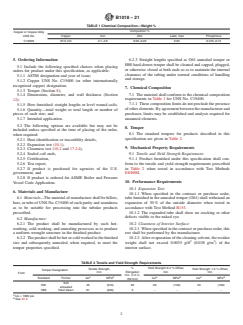
C19400 97.0 min 2.1–2.6 0.05–0.20 0.03 0.015–0.15
5. Ordering Information 6.2.3 Straight lengths specified as O61 annealed temper or
H80 hard-drawn temper shall be cleaned and capped, plugged,
5.1 Include the following specified choices when placing
or otherwise closed at both ends so as to maintain the internal
orders for product under this specification, as applicable:
cleanness of the tubing under normal conditions of handling
5.1.1 ASTM designation and year of issue;
and storage.
5.1.2 Copper UNS No. C19400 (or other internationally
recognized copper) designation;
7. Chemical Composition
5.1.3 Temper (Section 8);
7.1 The material shall conform to the chemical composition
5.1.4 Dimensions, diameter, and wall thickness (Section
requirements in Table 1 for UNS No. C19400.
12);
7.1.1 These composition limits do not preclude the presence
5.1.5 How furnished: straight lengths or level wound coils;
ofotherelements.Byagreementbetweenthemanufacturerand
5.1.6 Quantity—total weight or total length or number of
purchaser, limits may be established and analysis required for
pieces of each size; and
unnamed elements.
5.1.7 Intended application.
5.2 The following options are available but may not be
8. Temper
included unless specified at the time of placing of the order,
8.1 The standard tempers for products described in this
when required:
specification are given in Table 2.
5.2.1 Heat identification or traceability details,
5.2.2 Expansion test (10.1),
9. Mechanical Property Requirements
5.2.3 Cleanness test (10.2 and 17.2.4),
5.2.4 Sealed coil ends, 9.1 Tensile and Yield Strength Requirement:
5.2.5 Certification, 9.1.1 Product furnished under this specification shall con-
5.2.6 Test report, form to the tensile and yield strength requirements prescribed
5.2.7 If product is purchased for agencies of the U.S. in Table 2 when tested in accordance with Test Methods
government, and E8/E8M.
5.2.8 If product is ordered for ASME Boiler and Pressure
10. Performance Requirements
Vessel Code Application.
10.1 Expansion Test:
6. Materials and Manufacture
10.1.1 When specified in the contract or purchase order,
6.1 Materials—The material of manufacture shall be billets, tube furnished in the annealed temper (O61) shall withstand an
bars, or tube of UNS No. C19400 of such purity and soundness expansion of 30 % of the outside diameter when tested in
as to be suitable for processing into the tubular products accordance with Test Method B153.
prescribed. 10.1.2 The expanded tube shall show no cracking or other
defects visible to the naked eye.
6.2 Manufacture:
6.2.1 The product shall be manufactured by such hot- 10.2 Cleanness of Interior Surface:
working, cold-working, and annealing processes as to produce 10.2.1 When specified in the contract or purchase order, this
a uniform wrought structure in the finished product. test shall be performed by the manufacturer.
6.2.2 Theproductshallbehotorcoldworkedtothefinished 10.2.2 After evaporation of the cleaning solvent, the residue
2 2
size and subsequently annealed, when required, to meet the weight shall not exceed 0.0035 g/ft (0.038 g/m)ofthe
temper properties specified. interior surface.
TABLE 2 Tensile and Yield Strength Requirements
% Yield Strength 0.2 % Offset,
Tensile Strength, Yield Strength 1.0 % Offset,
Temper Designation
Elongation min
min min
Form
min. in 2 in.
A B A B A B
Standard Former ksi MPa ksi MPa ksi MPa
(50 mm)
Soft
O61 45 (310) 30 20 (140) 23 (160)
annealed
H80 Hard drawn 61 (420) 5 . . . .
A
ksi = 1000 psi.
B
See X1.2.
B1018−21
11. Other Requirements 13. Workmanship, Finish, and Appearance
11.1 Nondestructive Testing Requirements: 13.1 Thefinishedtubeshallbefreeofdefects,butblemishes
11.1.1 Electromagnetic (Eddy-Current) Examination: of a nature that do not interfere with the intended applications
are acceptable.
11.1.1.1 Each tube up to and including 2 ⁄8 in. (66.7 mm) in
outside diameter shall be subjected to examination.
14. Sampling
11.1.1.2 Tubes that do not actuate the signaling device on
the testing unit, after having been adjusted to provide informa-
14.1 Refer to sampling section in Specification B251/
tion on the suitability of the tube for the intended application,
B251M.
shall conform to the requirements of this test. Testing shall be
in accordance with Practice E243.
15. Number of Tests and Retests
11.1.1.3 Testing of coiled lengths shall be subject to nego-
15.1 Test:
tiation between the manufacturer and the purchaser.
15.1.1 Chemical Analysis—Chemical composition shall be
11.1.1.4 For tubes too large for the testing unit, the test
determined in accordance with the element mean of the results
method to be used shall be by agreement between the manu-
from at least two replicate analyses of the sample(s).
facturer and the purchaser.
11.1.1.5 Eddy-current discontinuities will be identified on
15.2 Retest:
level wound coils for subsequent removal by the purchaser.
15.2.1 When requested by the manufacturer or supplier, a
11.1.1.6 At the customer’s discretion, the permissible num-
retestshallbepermittedwhenresultsofthetestobtainedbythe
ber of identified eddy-current discontinuities per coil may be
purchaser fail to conform to the requirements of the product
specified.
specification.
11.2 When specified in the contract or purchase order, 15.2.2 The retest shall be as directed in the product speci-
product purchased for agencies of the U.S. government shall
fication for the initial test, except the number of test specimens
conform to the requirements stipulated in the Supplementary shall be twice that normally required for the specified test.
Requirements.
15.2.3 All test specimens shall conform to the product
specification requirement(s) in retest. Failure to conform shall
12. Dimensions, Mass, and Permissible Variations
be cause for rejection.
12.1 The wall thicknesses shall be as described in Tables 3
16. Specimen Preparation
and 4 of this specification.
16.1 Chemical Analysis—Preparation of the analytical
12.2 The tolerances for product described by this specifica-
specimens for the determination of chemical composition shall
tion shall be as specified in Specification B251/B251M with
be the responsibility of the reporting laboratory.
particular reference to the following tables and related subsec-
tions:
16.2 Tensile—Tensile test specimens shall be of the full
12.2.1 Tolerances for Diameter—Refer to Tables 5 and 6.
section of the tube and shall conform with the requirements of
12.2.2 Length Tolerances—Refer to Tables 9 and 10.
theTest Specimen section ofTest Methods E8/E8M, unless the
12.2.3 Straightness Tolerance—Refer to Tables 13 and 14.
limitation of the testing machine precludes the use of such a
12.2.4 Roundness—Refer to 5.4.1. specimen in which case a test specimen conforming to Type
No. 1 of Fig. 13 in Test Methods E8/E8M shall be used.
12.2.5 Squareness of Cut—Refer to 5.6.1.
12.3 Wall Thicknesses—ThetolerancesinTables3and4are 16.3 Electromagnetic (Eddy-Current) Test—Tubes for this
plus and minus. test require no special preparation.
A
TABLE 3 Standard Wall Thickness, in. (mm), for 1160 psi (80 bar ) Pressure Level of Refrigerant on Inside of Tube
NOTE 1—Tubes produced in accordance with Table 3 are furnished in straight lengths.
OD, in. (mm) Nom. Wall, in. (mm) Tolerance, in. (mm)
0.375 (9.525) 0.024 (0.60) 0.002 (0.05)
0.500 (12.7) 0.024 (0.60) 0.002 (0.05)
0.625 (15.875) 0.029 (0.73) 0.0025 (0.06)
0.750 (19.05) 0.035 (0.90) 0.004 (0.09)
0.875 (22.225) 0.041 (1.03) 0.004 (0.09)
1.125 (28.575) 0.051 (1.30) 0.004 (0.09)
1.375 (34.925) 0.062 (1.58) 0.004 (0.10)
1.625 (41.275) 0.072 (1.84) 0.004 (0.10)
2.125 (53.975) 0.097 (2.46) 0.007 (0.18)
2.625 (66.675) 0.118 (2.99) 0.007 (0.18)
A
See X1.3.
1 psi = 0.06895 bar.
B1018−21
A
TABLE 4 Standard Wall Thickness, in. (mm), for 1885 psi (130 bar ) Pressure Level of Refrigerant on Inside of Tube
NOTE 1—Tubes produced in accordance with Table 4 are furnished in straight lengths.
OD, in. (mm) Nom. Wall, in. (mm) Tolerance, in. (mm)
0.375 (9.525) 0.028 (0.7) 0.002 (0.06)
0.500 (12.7) 0.037 (0.93) 0.003 (0.08)
0.625 (15.875) 0.045 (1.14) 0.003 (0.08)
0.750 (19.05) 0.054 (1.37) 0.004 (0.09)
0.875 (22.225) 0.063 (1.59) 0.004 (0.10)
1.125 (28.575) 0.079 (2.01) 0.004 (0.10)
1.375 (34.925) 0.097 (2.46) 0.005 (0.13)
1.625 (41.275) 0.115 (2.91) 0.006 (0.15)
2.125 (53.975) 0.150 (3.80) 0.008 (0.20)
2.625 (66.675) 0.186 (4.73) 0.011 (0.28)
A
See X1.3.
1 psi = 0.06895 bar.
16.4 Expansion Test—Test specimens shall be prepared in 17.2.3.1 Each tube up to and including 2 ⁄8 in. (66.7 mm) in
accordance with the Test Specimen section of Test Method
outsidediametershallbesubjectedtoeddy-currenttest.Testing
B153. shall follow the procedures in Practice E243. Tubes shall be
passed through an eddy-current test unit adjusted to provide
17. Test Methods
information on the suitability of the tube for the intended
17.1 Chemical Analyses: application.
17.1.1 In cases of disagreement, test methods for chemical
17.2.3.2 Eithernotchdepthordrilledholestandardsshallbe
analysis shall be subject to agreement between the manufac-
used:
turer or supplier and the purch
...