

ASTM D4340-19
(Test Method)Standard Test Method for Corrosion of Cast Aluminum Alloys in Engine Coolants Under Heat-Rejecting Conditions
General Information
- Abstract
SIGNIFICANCE AND USE
4.1 It is essential that engine coolants prevent heat-transfer corrosion of aluminum cylinder heads during engine operation. Any corrosion products formed may deposit on interior radiator surfaces, reducing heat-transfer efficiency of the radiator. Overheating and boil-over of the cooling system may then occur.
4.2 This test method provides a means for selectively screening unused engine coolants and will readily distinguish those coolants that are unsuitable for use with aluminum cylinder head engines. However, satisfactory performance of a coolant in this test method does not ensure adequate long-term service performance. Additional, more comprehensive evaluations with simulated service, dynamometer, and vehicle tests should be used to establish the long-term effectiveness of the coolant.
SCOPE
1.1 This test method covers a laboratory screening procedure for evaluating the effectiveness of engine coolants in combating corrosion of aluminum casting alloys under heat-transfer conditions that may be present in aluminum cylinder head engines.
1.2 The values stated in SI units are to be regarded as standard. The values given in parentheses after SI units are provided for information only and are not considered standard.
1.3 This standard does not purport to address all of the safety concerns, if any, associated with its use. It is the responsibility of the user of this standard to establish appropriate safety, health, and environmental practices and determine the applicability of regulatory limitations prior to use. Specific precautionary statements are given in Sections 11 and 12.
1.4 This international standard was developed in accordance with internationally recognized principles on standardization established in the Decision on Principles for the Development of International Standards, Guides and Recommendations issued by the World Trade Organization Technical Barriers to Trade (TBT) Committee.
- Status
- Published
- Publication Date
- 30-Apr-2019
- Technical Committee
- D15 - Engine Coolants and Related Fluids
- Drafting Committee
- D15.06 - Glassware Performance Tests
Buy Documents

ASTM D4340-19 - Standard Test Method for Corrosion of Cast Aluminum Alloys in Engine Coolants Under Heat-Rejecting Conditions
REDLINE ASTM D4340-19 - Standard Test Method for Corrosion of Cast Aluminum Alloys in Engine Coolants Under Heat-Rejecting Conditions
Overview
ASTM D4340-19 is an international standard test method issued by ASTM International, specifically developed for assessing the corrosion of cast aluminum alloys in engine coolants under heat-rejecting conditions. This test method is essential for the automotive and engine manufacturing industries, as it evaluates the capacity of engine coolants to prevent heat-transfer corrosion of aluminum cylinder heads-a critical factor for engine efficiency and longevity.
Engine coolants are expected to safeguard aluminum components from corrosion during engine operation. If ineffective, corrosion products may form and deposit on radiator surfaces, diminishing heat-transfer efficiency and potentially leading to engine overheating and coolant boil-over. ASTM D4340-19 establishes a laboratory-based screening procedure that helps manufacturers and laboratories determine the suitability of unused engine coolants for use in engines with aluminum cylinder heads.
Key Topics
- Corrosion Evaluation: Focuses on measuring the corrosion rate of cast aluminum alloys subjected to heat transfer conditions in the presence of engine coolants.
- Screening of Engine Coolants: Provides a comparative procedure for distinguishing suitable and unsuitable coolants for aluminum engines by quantifying corrosion.
- Testing Conditions: Simulates actual engine temperatures and pressures, maintaining an aluminum specimen at 135°C (275°F) and 193 kPa (28 psi) for 168 hours.
- Sample Preparation and Measurement: Involves careful specimen cleaning, drying, and weighing to ensure repeatable and accurate results.
- Reporting Results: Requires detailed documentation of corrosion rate, sample appearance, and coolant pH after testing, enhancing traceability and decision-making.
- Safety and Compliance: Emphasizes the importance of safety, health, and environmental practices consistent with regulatory and ASTM guidelines.
Applications
ASTM D4340-19 is widely used in several contexts:
- Engine Coolant Manufacturers: As a screening tool, this method helps manufacturers qualify new coolant formulations for compatibility with modern engine designs featuring aluminum cylinder heads.
- Automotive OEMs: Assists original equipment manufacturers in specifying coolant requirements to prevent corrosion-induced failures in vehicles.
- Quality Assurance Laboratories: Enables routine screening of engine coolants to ensure compliance with industry standards for corrosion inhibition.
- Research & Development: Supports innovation by providing researchers with a standardized means to evaluate corrosion prevention in advanced engine cooling systems.
- Regulatory and Product Certification: Used for certification and regulatory compliance to demonstrate that engine coolants meet necessary performance criteria for aluminum protection.
It is important to note that while this test serves as an effective laboratory screening tool for unused coolants, long-term service performance requires further assessment through simulated service, dynamometer, and full vehicle testing for comprehensive evaluation.
Related Standards
ASTM D4340-19 aligns and interacts with several related standards and practices, including:
- ASTM D1176: Practice for Sampling and Preparing Aqueous Solutions of Engine Coolants or Antirusts for Testing Purposes.
- ASTM D3306: Standard Specification for Glycol Base Engine Coolant for Automobile and Light-Duty Service.
- ASTM D1384: Standard Test Method for Corrosion Test for Engine Coolants in Glassware.
- SAE Standards: Various Society of Automotive Engineers (SAE) standards governing engine cooling systems and coolant formulations.
Keywords: ASTM D4340-19, cast aluminum alloy corrosion, engine coolant testing, heat-transfer corrosion, aluminum cylinder head, laboratory screening, automotive coolant standard, coolant corrosion inhibition, engine overheating prevention.
By adopting ASTM D4340-19, organizations ensure that their engine coolant products are rigorously screened for compatibility with cast aluminum components, improving engine reliability and customer confidence.
Relations
- Effective Date
- 01-May-2019
- Effective Date
- 01-Oct-2019
- Effective Date
- 01-Apr-2014
- Effective Date
- 01-Apr-2008
- Effective Date
- 10-Apr-1998
- Effective Date
- 10-Apr-1998
- Effective Date
- 01-May-2019
- Effective Date
- 01-May-2019
- Effective Date
- 01-May-2019
- Effective Date
- 01-May-2019
- Effective Date
- 01-May-2019
Buy Documents
ASTM D4340-19 - Standard Test Method for Corrosion of Cast Aluminum Alloys in Engine Coolants Under Heat-Rejecting Conditions
REDLINE ASTM D4340-19 - Standard Test Method for Corrosion of Cast Aluminum Alloys in Engine Coolants Under Heat-Rejecting Conditions
Get Certified
Connect with accredited certification bodies for this standard

Element Materials Technology
Materials testing and product certification.

Inštitut za kovinske materiale in tehnologije
Institute of Metals and Technology. Materials testing, metallurgical analysis, NDT.
Sponsored listings
Frequently Asked Questions
ASTM D4340-19 is a standard published by ASTM International. Its full title is "Standard Test Method for Corrosion of Cast Aluminum Alloys in Engine Coolants Under Heat-Rejecting Conditions". This standard covers: SIGNIFICANCE AND USE 4.1 It is essential that engine coolants prevent heat-transfer corrosion of aluminum cylinder heads during engine operation. Any corrosion products formed may deposit on interior radiator surfaces, reducing heat-transfer efficiency of the radiator. Overheating and boil-over of the cooling system may then occur. 4.2 This test method provides a means for selectively screening unused engine coolants and will readily distinguish those coolants that are unsuitable for use with aluminum cylinder head engines. However, satisfactory performance of a coolant in this test method does not ensure adequate long-term service performance. Additional, more comprehensive evaluations with simulated service, dynamometer, and vehicle tests should be used to establish the long-term effectiveness of the coolant. SCOPE 1.1 This test method covers a laboratory screening procedure for evaluating the effectiveness of engine coolants in combating corrosion of aluminum casting alloys under heat-transfer conditions that may be present in aluminum cylinder head engines. 1.2 The values stated in SI units are to be regarded as standard. The values given in parentheses after SI units are provided for information only and are not considered standard. 1.3 This standard does not purport to address all of the safety concerns, if any, associated with its use. It is the responsibility of the user of this standard to establish appropriate safety, health, and environmental practices and determine the applicability of regulatory limitations prior to use. Specific precautionary statements are given in Sections 11 and 12. 1.4 This international standard was developed in accordance with internationally recognized principles on standardization established in the Decision on Principles for the Development of International Standards, Guides and Recommendations issued by the World Trade Organization Technical Barriers to Trade (TBT) Committee.
SIGNIFICANCE AND USE 4.1 It is essential that engine coolants prevent heat-transfer corrosion of aluminum cylinder heads during engine operation. Any corrosion products formed may deposit on interior radiator surfaces, reducing heat-transfer efficiency of the radiator. Overheating and boil-over of the cooling system may then occur. 4.2 This test method provides a means for selectively screening unused engine coolants and will readily distinguish those coolants that are unsuitable for use with aluminum cylinder head engines. However, satisfactory performance of a coolant in this test method does not ensure adequate long-term service performance. Additional, more comprehensive evaluations with simulated service, dynamometer, and vehicle tests should be used to establish the long-term effectiveness of the coolant. SCOPE 1.1 This test method covers a laboratory screening procedure for evaluating the effectiveness of engine coolants in combating corrosion of aluminum casting alloys under heat-transfer conditions that may be present in aluminum cylinder head engines. 1.2 The values stated in SI units are to be regarded as standard. The values given in parentheses after SI units are provided for information only and are not considered standard. 1.3 This standard does not purport to address all of the safety concerns, if any, associated with its use. It is the responsibility of the user of this standard to establish appropriate safety, health, and environmental practices and determine the applicability of regulatory limitations prior to use. Specific precautionary statements are given in Sections 11 and 12. 1.4 This international standard was developed in accordance with internationally recognized principles on standardization established in the Decision on Principles for the Development of International Standards, Guides and Recommendations issued by the World Trade Organization Technical Barriers to Trade (TBT) Committee.
ASTM D4340-19 is classified under the following ICS (International Classification for Standards) categories: 77.120.10 - Aluminium and aluminium alloys. The ICS classification helps identify the subject area and facilitates finding related standards.
ASTM D4340-19 has the following relationships with other standards: It is inter standard links to ASTM D4340-10, ASTM D1176-14(2019), ASTM D1176-14, ASTM D1176-98(2008), ASTM D1176-98, ASTM D1176-98(2002), ASTM D3306-21, ASTM D7933-22, ASTM D7714-11(2021), ASTM D5752-10(2017), ASTM D7518-20. Understanding these relationships helps ensure you are using the most current and applicable version of the standard.
ASTM D4340-19 is available in PDF format for immediate download after purchase. The document can be added to your cart and obtained through the secure checkout process. Digital delivery ensures instant access to the complete standard document.
Standards Content (Sample)
This international standard was developed in accordance with internationally recognized principles on standardization established in the Decision on Principles for the
Development of International Standards, Guides and Recommendations issued by the World Trade Organization Technical Barriers to Trade (TBT) Committee.
Designation: D4340 − 19
Standard Test Method for
Corrosion of Cast Aluminum Alloys in Engine Coolants
Under Heat-Rejecting Conditions
This standard is issued under the fixed designation D4340; the number immediately following the designation indicates the year of
original adoption or, in the case of revision, the year of last revision.Anumber in parentheses indicates the year of last reapproval.A
superscript epsilon (´) indicates an editorial change since the last revision or reapproval.
1. Scope heads while exposed to an engine coolant under a pressure of
193 kPa (28 psi). The temperature of the aluminum specimen
1.1 This test method covers a laboratory screening proce-
is maintained at 135°C (275°F) and the test is continued for 1
dure for evaluating the effectiveness of engine coolants in
week (168 h). The effectiveness of the coolant for preventing
combating corrosion of aluminum casting alloys under heat-
corrosion of the aluminum under heat-transfer conditions
transfer conditions that may be present in aluminum cylinder
(hereafterreferredtoasheat-transfercorrosion)isevaluatedon
head engines.
the basis of the weight change of the test specimen.
1.2 The values stated in SI units are to be regarded as
standard. The values given in parentheses after SI units are 4. Significance and Use
provided for information only and are not considered standard.
4.1 It is essential that engine coolants prevent heat-transfer
1.3 This standard does not purport to address all of the
corrosionofaluminumcylinderheadsduringengineoperation.
safety concerns, if any, associated with its use. It is the Any corrosion products formed may deposit on interior radia-
responsibility of the user of this standard to establish appro-
tor surfaces, reducing heat-transfer efficiency of the radiator.
priate safety, health, and environmental practices and deter- Overheating and boil-over of the cooling system may then
mine the applicability of regulatory limitations prior to use.
occur.
Specific precautionary statements are given in Sections 11 and
4.2 This test method provides a means for selectively
12.
screening unused engine coolants and will readily distinguish
1.4 This international standard was developed in accor-
those coolants that are unsuitable for use with aluminum
dance with internationally recognized principles on standard-
cylinder head engines. However, satisfactory performance of a
ization established in the Decision on Principles for the
coolant in this test method does not ensure adequate long-term
Development of International Standards, Guides and Recom-
service performance.Additional, more comprehensive evalua-
mendations issued by the World Trade Organization Technical
tions with simulated service, dynamometer, and vehicle tests
Barriers to Trade (TBT) Committee.
should be used to establish the long-term effectiveness of the
coolant.
2. Referenced Documents
2.1 ASTM Standards: 5. Apparatus
D1176Practice for Sampling and Preparing Aqueous Solu-
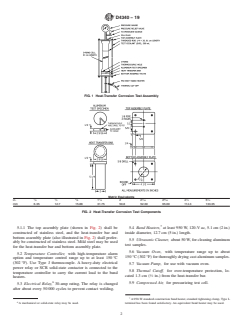
5.1 Heat-Transfer Corrosion Cell—The assembled corro-
tionsofEngineCoolantsorAntirustsforTestingPurposes
sioncellisshownschematicallyinFig.1.Itisassembledfrom
components, some of which require glass blowing or machin-
3. Summary of Test Method
ing. The glass O-ring cell shall be constructed from two glass
3.1 In this test method, a heat flux is established through a
O-ring joints joined to an additional middle section of glass
cast aluminum alloy typical of that used for engine cylinder
tubing of the same diameter to make a total length of 53 cm
(21in.).Heat-resistantO-rings shallbeused.Internalpressure
shall be monitored using a suitable pressure gauge, and a
This test method is under the jurisdiction ofASTM Committee D15 on Engine
pressure-relief valve shall be installed to protect against
Coolants and Related Fluids and is the direct responsibility of Subcommittee
D15.06 on Glassware Performance Tests.
bursting.
Current edition approved May 1, 2019. Published June 2019. Last previous
edition approved in 2010 as D4340–10. DOI: 10.1520/D4340–19.
2 3
For referenced ASTM standards, visit the ASTM website, www.astm.org, or O-ring joints with a low coefficient of expansion may be used.
contact ASTM Customer Service at service@astm.org. For Annual Book of ASTM High-strength glass with a low coefficient of expansion may be used.
Standards volume information, refer to the standard’s Document Summary page on Silicone O-rings may also be satisfactory. Polytetrafluoroethylene is not
the ASTM website. suitable due to a high creep rate at the test temperature.
Copyright © ASTM International, 100 Barr Harbor Drive, PO Box C700, West Conshohocken, PA 19428-2959. United States
D4340 − 19
FIG. 1 Heat-Transfer Corrosion Test Assembly
Metric Equivalents
1 1 5 1 1 9 1 1
in. ⁄4 ⁄2 ⁄8 1 ⁄4 22 ⁄16 2 ⁄16 4 ⁄2 5 ⁄4
mm 6.35 12.7 15.88 31.75 50.8 52.39 65.09 114.3 133.35
FIG. 2 Heat-Transfer Corrosion Test Components
5.1.1 The top assembly plate (shown in Fig. 2) shall be 5.4 Band Heaters, at least 950 W, 120-V ac, 5.1cm (2in.)
constructed of stainless steel, and the heat-transfer bar and inside diameter, 12.7cm (5in.) length.
bottom assembly plate (also illustrated in Fig. 2) shall prefer-
5.5 Ultrasonic Cleaner, about50W,forcleaningaluminum
ably be constructed of stainless steel. Mild steel may be used
test samples.
for the heat-transfer bar and bottom assembly plate.
5.6 Vacuum Oven, with temperature range up to about
5.2 Temperature Controller, with high-temperature alarm
150°C(302°F)forthoroughlydryingcastaluminumsamples.
option and temperature control range up to at least 150°C
(302°F). Use Type J thermocouple. A heavy-duty electrical
5.7 Vacuum Pump, for use with vacuum oven.
power relay or SCR solid-state contactor is connected to the
5.8 Thermal Cutoff, for over-temperature protection, lo-
temperature controller to carry the current load to the band
cated 1.3 cm ( ⁄2 in.) from the heat-transfer bar.
heaters.
5.9 Compressed Air, for pressurizing test cell.
5.3 Electrical Relay, 30-amp rating. The relay is changed
after about every 50000 cycles to prevent contact welding.
A950-Wstandard construction band heater, standard tightening clamp,Type L
A mechanical or solid-state relay may be used. terminal has been found satisfactory. An equivalent band heater may be used.
D4340 − 19
5.10 Clear Plastic Safety Shield, for protection against glass cell for each test. To help ensure that the O-rings are
bursting. properlyseated,applyasmallamountofthetestsolutiontothe
glass O-ring groove for lubrication. Avoid overtightening of
6. Sampling
the threaded rod nuts.
6.1 The engine coolant concentrate shall be sampled in
11.2 Starting the Test—Transfer 500 mL of test coolant
accordance with Test Method D1176.
solution into the test cell, screw the plug in the hole, and
tighten. Place the safety shield around the cell, (see Warning)
7. Metal Test Specimen
pressurizethecellto138kPa(20psi)withcompressedair,and
7.1 Cast Aluminum, conforming to UNS A03190 is used.
turn the band heater on. Provision must be made for a pressure
Specimen size is 6.5 cm (2.6 in.) in diameter, 1.3 cm (0.5 in.)
risewithincreaseintemperature.Adjustthepressuregradually
thick. Fig. 2 illustrates location of the thermocouple holes.
sothatwhenthetemperaturereachesthepropervalue,thefinal
pressure is 193 kPa (28 psi). (Warning—Despite the presence
8. Test Solution
ofasafetyreliefvalve,testcellshaveburstunderpressure.Use
8.1 Dissolve 165 mg of reagent grade sodium chloride in
of a safety shiel
...
This document is not an ASTM standard and is intended only to provide the user of an ASTM standard an indication of what changes have been made to the previous version. Because
it may not be technically possible to adequately depict all changes accurately, ASTM recommends that users consult prior editions as appropriate. In all cases only the current version
of the standard as published by ASTM is to be considered the official document.
Designation: D4340 − 10 D4340 − 19
Standard Test Method for
Corrosion of Cast Aluminum Alloys in Engine Coolants
Under Heat-Rejecting Conditions
This standard is issued under the fixed designation D4340; the number immediately following the designation indicates the year of
original adoption or, in the case of revision, the year of last revision. A number in parentheses indicates the year of last reapproval. A
superscript epsilon (´) indicates an editorial change since the last revision or reapproval.
1. Scope
1.1 This test method covers a laboratory screening procedure for evaluating the effectiveness of engine coolants in combating
corrosion of aluminum casting alloys under heat-transfer conditions that may be present in aluminum cylinder head engines.
1.2 The values stated in SI units are to be regarded as standard. The values given in parentheses after SI units are provided for
information only and are not considered standard.
1.3 This standard does not purport to address all of the safety concerns, if any, associated with its use. It is the responsibility
of the user of this standard to establish appropriate safety safety, health, and healthenvironmental practices and determine the
applicability of regulatory limitations prior to use. Specific precautionary statements are given in Sections 11 and 12.
1.4 This international standard was developed in accordance with internationally recognized principles on standardization
established in the Decision on Principles for the Development of International Standards, Guides and Recommendations issued
by the World Trade Organization Technical Barriers to Trade (TBT) Committee.
2. Referenced Documents
2.1 ASTM Standards:
D1176 Practice for Sampling and Preparing Aqueous Solutions of Engine Coolants or Antirusts for Testing Purposes
3. Summary of Test Method
3.1 In this test method, a heat flux is established through a cast aluminum alloy typical of that used for engine cylinder heads
while exposed to an engine coolant under a pressure of 193 kPa (28 psi). The temperature of the aluminum specimen is maintained
at 135°C (275°F)135 °C (275 °F) and the test is continued for 1 week (168 h). The effectiveness of the coolant for preventing
corrosion of the aluminum under heat-transfer conditions (hereafter referred to as heat-transfer corrosion) is evaluated on the basis
of the weight change of the test specimen.
4. Significance and Use
4.1 It is essential that engine coolants prevent heat-transfer corrosion of aluminum cylinder heads during engine operation. Any
corrosion products formed may deposit on interior radiator surfaces, reducing heat-transfer efficiency of the radiator. Overheating
and boil-over of the cooling system may then occur.
4.2 This test method provides a means for selectively screening unused engine coolants and will readily distinguish those
coolants that are unsuitable for use with aluminum cylinder head engines. However, satisfactory performance of a coolant in this
test method does not ensure adequate long-term service performance. Additional, more comprehensive evaluations with simulated
service, dynamometer, and vehicle tests should be used to establish the long-term effectiveness of the coolant.
5. Apparatus
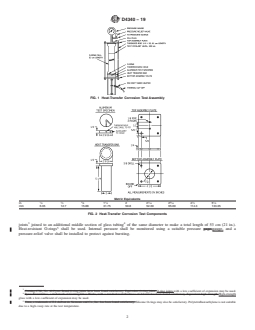
5.1 Heat-Transfer Corrosion Cell—The assembled corrosion cell is shown schematically in Fig. 1. It is assembled from
components, some of which require glass blowing or machining. The glass O-ring cell shall be constructed from two glass O-ring
This test method is under the jurisdiction of ASTM Committee D15 on Engine Coolants and Related Fluids and is the direct responsibility of Subcommittee D15.06 on
Glassware Performance Tests.
Current edition approved Dec. 1, 2010May 1, 2019. Published January 2011June 2019. Last previous edition approved in 20072010 as D4340 – 96D4340(2007).–10. DOI:
10.1520/D4340-10.10.1520/D4340–19.
For referenced ASTM standards, visit the ASTM website, www.astm.org, or contact ASTM Customer Service at service@astm.org. For Annual Book of ASTM Standards
volume information, refer to the standard’sstandard’s Document Summary page on the ASTM website.
Copyright © ASTM International, 100 Barr Harbor Drive, PO Box C700, West Conshohocken, PA 19428-2959. United States
D4340 − 19
FIG. 1 Heat-Transfer Corrosion Test Assembly
Metric Equivalents
1 1 5 1 1 9 1 1
in. ⁄4 ⁄2 ⁄8 1 ⁄4 2 2 ⁄16 2 ⁄16 4 ⁄2 5 ⁄4
mm 6.35 12.7 15.88 31.75 50.8 52.39 65.09 114.3 133.35
FIG. 2 Heat-Transfer Corrosion Test Components
3 4
joints joined to an additional middle section of glass tubing of the same diameter to make a total length of 53 cm (21 in.).
Heat-resistant O-rings shall be used. Internal pressure shall be monitored using a suitable pressure gage,gauge, and a
pressure-relief valve shall be installed to protect against bursting.
Corning 6780, No. 40 Pyrex Brand O-ring joints have been found satisfactory. Equivalent O-ring joints O-ring joints with a low coefficient of expansion may be used.
Pyrex Brand Glass, a trademark of Corning Glass Works, with a standard wall thickness of 2.0 mm has been found satisfactory. Equivalent high-strength High-strength
glass with a low coefficient of expansion may be used.
Viton, a trademark of E.I. duPont de Nemours and Co., Inc. has been found satisfactory. Silicone O-rings may also be satisfactory. Polytetrafluoroethylene is not suitable
due to a high creep rate at the test temperature.
D4340 − 19
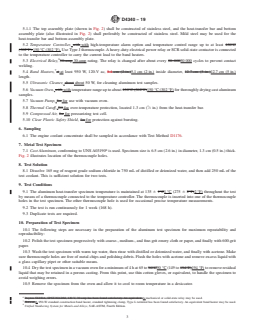
5.1.1 The top assembly plate (shown in Fig. 2) shall be constructed of stainless steel, and the heat-transfer bar and bottom
assembly plate (also illustrated in Fig. 2) shall preferably be constructed of stainless steel. Mild steel may be used for the
heat-transfer bar and bottom assembly plate.
5.2 Temperature Controller, with with high-temperature alarm option and temperature control range up to at least 150°C
(302°F).150 °C (302 °F). Use Type J thermocouple. A heavy-duty electrical power relay or SCR solid-state contactor is connected
to the temperature controller to carry the current load to the band heaters.
5.3 Electrical Relay, 30-amp 30-amp rating. The relay is changed after about every 50 00050 000 cycles to prevent contact
welding.
5.4 Band Heaters, at at least 950 W, 120-V ac, 5.1-cm (2-in.)5.1 cm (2 in.) inside diameter, 12.7-cm (5-in.)12.7 cm (5 in.)
length.
5.5 Ultrasonic Cleaner, about about 50 W, for cleaning aluminum test samples.
5.6 Vacuum Oven, with with temperature range up to about 150°C (302°F)150 °C (302 °F) for thoroughly drying cast aluminum
samples.
5.7 Vacuum Pump, for for use with vacuum oven.
5.8 Thermal Cutoff, for for over-temperature protection, located 1.3 cm ( ⁄2 in.) from the heat-transfer bar.
5.9 Compressed Air, for for pressurizing test cell.
5.10 Clear Plastic Safety Shield, for for protection against bursting.
6. Sampling
6.1 The engine coolant concentrate shall be sampled in accordance with Test Method D1176.
7. Metal Test Specimen
7.1 Cast Aluminum, conforming to UNS A03190 is used. Specimen size is 6.5 cm (2.6 in.) in diameter, 1.3 cm (0.5 in.) thick.
Fig. 2 illustrates location of the thermocouple holes.
8. Test Solution
8.1 Dissolve 165 mg of reagent grade sodium chloride in 750 mL of distilled or deionized water, and then add 250 mL of the
test coolant. This is sufficient solution for two tests.
9. Test Conditions
9.1 The aluminum heat-transfer specimen temperature is maintained at 135 6 1°C1 °C (275 6 2°F)2 °F) throughout the test
by means of a thermocouple connected to the temperature controller. The thermocouple is inserted into one of the thermocouple
holes in the test specimen. The other thermocouple hole is used for occasional precise temperature measurements.
9.2 The test is run continuously for 1 week (168 h).
9.3 Duplicate tests are required.
10. Preparation of Test Specimen
10.1 The following steps are necessary in the preparation of the aluminum test specimen for maximum repeatability and
reproducibility:
10.2 Polish the test specimen progressively with coarse-, medium-, and fine-grit emery cloth or paper, and finally with 600-grit
paper.
10.3 Wash the test specimen with warm tap water, then rinse with distilled or deionized water, and finally with acetone. Make
sure thermocouple holes are free of metal chips and polishing debris. Flush the holes with acetone and remove excess liquid with
a glass capillary pipet or other suitable means.
10.4 Dry the test specimen in a vacuum oven for a minimum of 4 h at 65 to 90°C90 °C (149 to 194°F)194 °F) to remove residual
liquid that may be retained in a porous casting. From this point, use thin cotton gloves, or equivalent
...