

ASTM D7518-20
(Specification)Standard Specification for 1,3 Propanediol (PDO) Base Engine Coolant for Automobile and Light-Duty Service
General Information
- Abstract
ABSTRACT
This specification covers the requirements for propanediol base engine coolant used in automobiles or other light-duty service cooling systems. Engine coolant concentrates or prediluted propanediol base engine coolant shall be formulated with propanediol, water, suitable corrosion inhibitors, dye, and a foam suppressor. The coolants shall conform to the general requirements for color and effect on nonmetals. Coolants shall be formulated using water that meets the requirements for the following properties: chlorides, sulfate, hardness, ph, and iron. Glycol-base coolant concentrates and prediluted coolants shall conform to the following physical and chemical requirements for each coolant type: relative density, freezing point, boiling point, ash content, pH, chloride, water mass, reserve alkalinity, and effects on automobile finish. All coolant concentrates and prediluted coolants shall conform to the performance requirements such as corrrosion in glassware, simulated service test, corrosion of cast aluminum alloys at heat-rejecting surfaces, foaming, and cavitation-erosion.
SCOPE
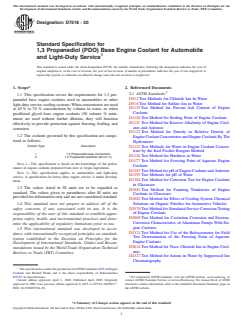
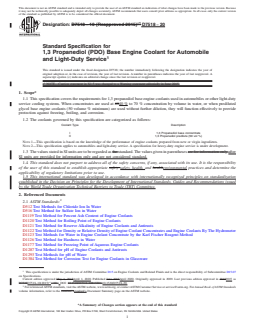
1.1 This specification covers the requirements for 1,3 propanediol base engine coolants used in automobiles or other light-duty service cooling systems. When concentrates are used at 40 % to 70 % concentration by volume in water, or when prediluted glycol base engine coolants (50 volume % minimum) are used without further dilution, they will function effectively to provide protection against freezing, boiling, and corrosion.
1.2 The coolants governed by this specification are categorized as follows:
Coolant Type
Description
I
1,3 Propanediol base concentrate
II
1,3 Propanediol predilute (50 vol %)
Note 1: This specification is based on the knowledge of the performance of engine coolants prepared from new or virgin ingredients.
Note 2: This specification applies to automobiles and light-duty service. A specification for heavy-duty engine service is under development.
1.3 The values stated in SI units are to be regarded as standard. The values given in parentheses after SI units are provided for information only and are not considered standard.
1.4 This standard does not purport to address all of the safety concerns, if any, associated with its use. It is the responsibility of the user of this standard to establish appropriate safety, health, and environmental practices and determine the applicability of regulatory limitations prior to use.
1.5 This international standard was developed in accordance with internationally recognized principles on standardization established in the Decision on Principles for the Development of International Standards, Guides and Recommendations issued by the World Trade Organization Technical Barriers to Trade (TBT) Committee.
- Status
- Published
- Publication Date
- 31-Mar-2020
- Technical Committee
- D15 - Engine Coolants and Related Fluids
- Drafting Committee
- D15.07 - Specifications
Buy Documents
ASTM D7518-20 - Standard Specification for 1,3 Propanediol (PDO) Base Engine Coolant for Automobile and Light-Duty Service
REDLINE ASTM D7518-20 - Standard Specification for 1,3 Propanediol (PDO) Base Engine Coolant for Automobile and Light-Duty Service
Overview
ASTM D7518-20 is the internationally recognized standard specification for 1,3 propanediol (PDO) base engine coolants intended for automobiles and other light-duty service cooling systems. Published by ASTM International, this standard details the requirements for both coolant concentrates and prediluted engine coolant formulations based on 1,3-propanediol. The specification addresses the essential characteristics that ensure coolant products provide effective protection against freezing, boiling, and corrosion, thus supporting optimal engine and cooling system performance.
Formulations under this standard are designed for use either as concentrates (to be diluted to 40%–70% by volume) or as prediluted coolants (with a minimum of 50% volume PDO base), providing flexibility and reliability for automotive cooling system protection.
Key Topics
- Coolant Categories: Two product types are defined-Type I (1,3 propanediol base concentrate) and Type II (1,3 propanediol base prediluted coolant).
- Formulation Requirements: Coolants must be composed of PDO that meets ASTM D7388, water of prescribed quality, corrosion inhibitors, foam suppressors, and dyes.
- Water Quality: For prediluted coolants, water used must meet strict limits for chlorides, sulfate, hardness, pH, and iron content to minimize corrosion risk and scaling.
- Physical and Chemical Properties: Specifications cover relative density, freezing and boiling points, pH, ash content, chloride content, and reserve alkalinity.
- Performance Criteria: Products are tested for corrosion in glassware, service simulation, aluminum alloy corrosion at heat-rejecting surfaces, foaming, and cavitation-erosion resistance.
- Compatibility and Safety: Formulations must not adversely affect non-metals or automotive finishes and should include appropriate cautionary labeling.
Applications
ASTM D7518-20 coolants are formulated specifically for:
- Passenger cars and light-duty vehicles with standard cooling systems.
- Environments requiring reliable freeze, boil, and corrosion protection.
- Use cases where prediluted coolants are desired for direct system filling, reducing complexity in service operations.
- Maintenance scenarios in which the long-term stability and compatibility of the coolant with system materials and finishes is critical.
- Systems where water quality is a concern, as the standard details acceptable water quality ranges to avoid introducing contaminants that increase corrosion or scaling risks.
Best practices include following vehicle manufacturer recommendations for coolant concentration, using deionized or distilled water for dilution, and performing routine maintenance checks as outlined in the standard's appendices.
Related Standards
Several ASTM standards are referenced for testing and compatibility, including:
- ASTM D7388 – Specification for PDO purity requirements.
- ASTM D1384 – Corrosion testing in glassware.
- ASTM D1120, D1177, D6660 – Test methods for boiling point and freezing point.
- ASTM D1121, D1287, D1293 – Procedures for pH and reserve alkalinity measurement.
- ASTM D2809, D4340, D2570 – Methods for evaluating corrosion, cavitation/erosion, and simulated service performance.
- ASTM D1882 – Assessing effects on automotive finishes.
- ASTM D512, D516, D1126 – Water quality test methods for chloride, sulfate, and hardness content.
- Federal Method 2540B – Testing total dissolved solids in water.
Adherence to these related standards ensures that 1,3-propanediol-based engine coolant products provide reliable, safe, and effective performance in modern automotive and light-duty cooling systems.
Relations
- Effective Date
- 01-Apr-2020
- Effective Date
- 01-Jan-2024
- Effective Date
- 15-May-2020
- Refers
ASTM D1121-11(2020) - Standard Test Method for Reserve Alkalinity of Engine Coolants and Antirusts - Effective Date
- 01-Jan-2020
- Effective Date
- 01-Jan-2020
- Refers
ASTM D1384-05(2019) - Standard Test Method for Corrosion Test for Engine Coolants in Glassware - Effective Date
- 01-Oct-2019
- Effective Date
- 01-May-2019
- Effective Date
- 01-Mar-2018
- Effective Date
- 01-Nov-2017
- Effective Date
- 01-Nov-2017
- Effective Date
- 01-Apr-2017
- Effective Date
- 01-Apr-2016
- Effective Date
- 01-Apr-2016
- Effective Date
- 01-Apr-2016
- Effective Date
- 01-Jul-2014
Buy Documents
ASTM D7518-20 - Standard Specification for 1,3 Propanediol (PDO) Base Engine Coolant for Automobile and Light-Duty Service
REDLINE ASTM D7518-20 - Standard Specification for 1,3 Propanediol (PDO) Base Engine Coolant for Automobile and Light-Duty Service
Get Certified
Connect with accredited certification bodies for this standard

ECOCERT
Organic and sustainability certification.

Eurofins Food Testing Global
Global leader in food, environment, and pharmaceutical product testing.

Intertek Bangladesh
Intertek certification and testing services in Bangladesh.
Sponsored listings
Frequently Asked Questions
ASTM D7518-20 is a technical specification published by ASTM International. Its full title is "Standard Specification for 1,3 Propanediol (PDO) Base Engine Coolant for Automobile and Light-Duty Service". This standard covers: ABSTRACT This specification covers the requirements for propanediol base engine coolant used in automobiles or other light-duty service cooling systems. Engine coolant concentrates or prediluted propanediol base engine coolant shall be formulated with propanediol, water, suitable corrosion inhibitors, dye, and a foam suppressor. The coolants shall conform to the general requirements for color and effect on nonmetals. Coolants shall be formulated using water that meets the requirements for the following properties: chlorides, sulfate, hardness, ph, and iron. Glycol-base coolant concentrates and prediluted coolants shall conform to the following physical and chemical requirements for each coolant type: relative density, freezing point, boiling point, ash content, pH, chloride, water mass, reserve alkalinity, and effects on automobile finish. All coolant concentrates and prediluted coolants shall conform to the performance requirements such as corrrosion in glassware, simulated service test, corrosion of cast aluminum alloys at heat-rejecting surfaces, foaming, and cavitation-erosion. SCOPE 1.1 This specification covers the requirements for 1,3 propanediol base engine coolants used in automobiles or other light-duty service cooling systems. When concentrates are used at 40 % to 70 % concentration by volume in water, or when prediluted glycol base engine coolants (50 volume % minimum) are used without further dilution, they will function effectively to provide protection against freezing, boiling, and corrosion. 1.2 The coolants governed by this specification are categorized as follows: Coolant Type Description I 1,3 Propanediol base concentrate II 1,3 Propanediol predilute (50 vol %) Note 1: This specification is based on the knowledge of the performance of engine coolants prepared from new or virgin ingredients. Note 2: This specification applies to automobiles and light-duty service. A specification for heavy-duty engine service is under development. 1.3 The values stated in SI units are to be regarded as standard. The values given in parentheses after SI units are provided for information only and are not considered standard. 1.4 This standard does not purport to address all of the safety concerns, if any, associated with its use. It is the responsibility of the user of this standard to establish appropriate safety, health, and environmental practices and determine the applicability of regulatory limitations prior to use. 1.5 This international standard was developed in accordance with internationally recognized principles on standardization established in the Decision on Principles for the Development of International Standards, Guides and Recommendations issued by the World Trade Organization Technical Barriers to Trade (TBT) Committee.
ABSTRACT This specification covers the requirements for propanediol base engine coolant used in automobiles or other light-duty service cooling systems. Engine coolant concentrates or prediluted propanediol base engine coolant shall be formulated with propanediol, water, suitable corrosion inhibitors, dye, and a foam suppressor. The coolants shall conform to the general requirements for color and effect on nonmetals. Coolants shall be formulated using water that meets the requirements for the following properties: chlorides, sulfate, hardness, ph, and iron. Glycol-base coolant concentrates and prediluted coolants shall conform to the following physical and chemical requirements for each coolant type: relative density, freezing point, boiling point, ash content, pH, chloride, water mass, reserve alkalinity, and effects on automobile finish. All coolant concentrates and prediluted coolants shall conform to the performance requirements such as corrrosion in glassware, simulated service test, corrosion of cast aluminum alloys at heat-rejecting surfaces, foaming, and cavitation-erosion. SCOPE 1.1 This specification covers the requirements for 1,3 propanediol base engine coolants used in automobiles or other light-duty service cooling systems. When concentrates are used at 40 % to 70 % concentration by volume in water, or when prediluted glycol base engine coolants (50 volume % minimum) are used without further dilution, they will function effectively to provide protection against freezing, boiling, and corrosion. 1.2 The coolants governed by this specification are categorized as follows: Coolant Type Description I 1,3 Propanediol base concentrate II 1,3 Propanediol predilute (50 vol %) Note 1: This specification is based on the knowledge of the performance of engine coolants prepared from new or virgin ingredients. Note 2: This specification applies to automobiles and light-duty service. A specification for heavy-duty engine service is under development. 1.3 The values stated in SI units are to be regarded as standard. The values given in parentheses after SI units are provided for information only and are not considered standard. 1.4 This standard does not purport to address all of the safety concerns, if any, associated with its use. It is the responsibility of the user of this standard to establish appropriate safety, health, and environmental practices and determine the applicability of regulatory limitations prior to use. 1.5 This international standard was developed in accordance with internationally recognized principles on standardization established in the Decision on Principles for the Development of International Standards, Guides and Recommendations issued by the World Trade Organization Technical Barriers to Trade (TBT) Committee.
ASTM D7518-20 is classified under the following ICS (International Classification for Standards) categories: 71.100.45 - Refrigerants and antifreezes. The ICS classification helps identify the subject area and facilitates finding related standards.
ASTM D7518-20 has the following relationships with other standards: It is inter standard links to ASTM D7518-10(2015)e1, ASTM D1384-24, ASTM D5931-20, ASTM D1121-11(2020), ASTM D1287-11(2020), ASTM D1384-05(2019), ASTM D4340-19, ASTM D6130-11(2018), ASTM D5931-13(2017), ASTM D1881-17, ASTM D1122-16(2017)e1, ASTM D1120-16, ASTM D1177-16, ASTM D1122-16, ASTM D6660-01(2014)e1. Understanding these relationships helps ensure you are using the most current and applicable version of the standard.
ASTM D7518-20 is available in PDF format for immediate download after purchase. The document can be added to your cart and obtained through the secure checkout process. Digital delivery ensures instant access to the complete standard document.
Standards Content (Sample)
This international standard was developed in accordance with internationally recognized principles on standardization established in the Decision on Principles for the
Development of International Standards, Guides and Recommendations issued by the World Trade Organization Technical Barriers to Trade (TBT) Committee.
Designation:D7518 −20
Standard Specification for
1,3 Propanediol (PDO) Base Engine Coolant for Automobile
and Light-Duty Service
This standard is issued under the fixed designation D7518; the number immediately following the designation indicates the year of
original adoption or, in the case of revision, the year of last revision.Anumber in parentheses indicates the year of last reapproval.A
superscript epsilon (´) indicates an editorial change since the last revision or reapproval.
1. Scope* 2. Referenced Documents
2.1 ASTM Standards:
1.1 This specification covers the requirements for 1,3 pro-
D512Test Methods for Chloride Ion In Water
panediol base engine coolants used in automobiles or other
D516Test Method for Sulfate Ion in Water
light-dutyservicecoolingsystems.Whenconcentratesareused
D1119Test Method for Percent Ash Content of Engine
at 40% to 70 % concentration by volume in water, or when
Coolants
prediluted glycol base engine coolants (50 volume % mini-
D1120Test Method for Boiling Point of Engine Coolants
mum) are used without further dilution, they will function
D1121Test Method for ReserveAlkalinity of Engine Cool-
effectively to provide protection against freezing, boiling, and
ants and Antirusts
corrosion.
D1122Test Method for Density or Relative Density of
1.2 The coolants governed by this specification are catego-
EngineCoolantConcentratesandEngineCoolantsByThe
rized as follows:
Hydrometer
Coolant Type Description
D1123Test Methods for Water in Engine Coolant Concen-
trate by the Karl Fischer Reagent Method
I 1,3 Propanediol base concentrate
D1126Test Method for Hardness in Water
II 1,3 Propanediol predilute (50 vol %)
D1177Test Method for Freezing Point of Aqueous Engine
NOTE 1—This specification is based on the knowledge of the perfor-
Coolants
mance of engine coolants prepared from new or virgin ingredients.
D1287TestMethodforpHofEngineCoolantsandAntirusts
NOTE 2—This specification applies to automobiles and light-duty
D1293Test Methods for pH of Water
service. A specification for heavy-duty engine service is under develop-
D1384Test Method for Corrosion Test for Engine Coolants
ment.
in Glassware
1.3 The values stated in SI units are to be regarded as
D1881Test Method for Foaming Tendencies of Engine
standard. The values given in parentheses after SI units are
Coolants in Glassware
providedforinformationonlyandarenotconsideredstandard.
D1882Test Method for Effect of Cooling System Chemical
Solutions on Organic Finishes for Automotive Vehicles
1.4 This standard does not purport to address all of the
D2570TestMethodforSimulatedServiceCorrosionTesting
safety concerns, if any, associated with its use. It is the
of Engine Coolants
responsibility of the user of this standard to establish appro-
D2809Test Method for Cavitation Corrosion and Erosion-
priate safety, health, and environmental practices and deter-
Corrosion Characteristics of Aluminum Pumps With En-
mine the applicability of regulatory limitations prior to use.
gine Coolants
1.5 This international standard was developed in accor-
D3321Test Method for Use of the Refractometer for Field
dance with internationally recognized principles on standard-
Test Determination of the Freezing Point of Aqueous
ization established in the Decision on Principles for the
Engine Coolants
Development of International Standards, Guides and Recom-
D3634Test Method for Trace Chloride Ion in Engine Cool-
mendations issued by the World Trade Organization Technical
ants
Barriers to Trade (TBT) Committee.
D4327Test Method forAnions in Water by Suppressed Ion
Chromatography
ThisspecificationisunderthejurisdictionofASTMCommitteeD15onEngine
Coolants and Related Fluids and is the direct responsibility of Subcommittee
D15.07 on Specifications. For referenced ASTM standards, visit the ASTM website, www.astm.org, or
Current edition approved April 1, 2020. Published April 2020. Originally contact ASTM Customer Service at service@astm.org. For Annual Book of ASTM
ɛ1
approved in 2009. Last previous edition approved in 2015 as D7518–10(2015) . Standards volume information, refer to the standard’s Document Summary page on
DOI: 10.1520/D7518–20. the ASTM website.
*A Summary of Changes section appears at the end of this standard
Copyright © ASTM International, 100 Barr Harbor Drive, PO Box C700, West Conshohocken, PA 19428-2959. United States
D7518−20
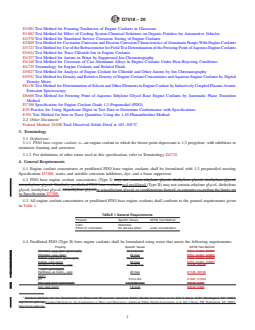
TABLE 1 General Requirements
D4340TestMethodforCorrosionofCastAluminumAlloys
in Engine Coolants Under Heat-Rejecting Conditions Property Specific Values ASTM Test Method
D4725TerminologyforEngineCoolantsandRelatedFluids Color Distinctive .
Effect on nonmetals No adverse effect under consideration
D5827Test Method for Analysis of Engine Coolant for
Chloride and Other Anions by Ion Chromatography
D5931Test Method for Density and Relative Density of
Engine Coolant Concentrates and Aqueous Engine Cool-
ants by Digital Density Meter
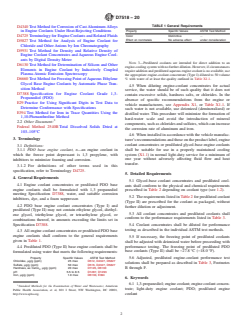
NOTE 3—Prediluted coolants are intended for direct addition to an
D6130Test Method for Determination of Silicon and Other
engine-coolingsystemwithnofurtherdilution.However,ifcircumstances
Elements in Engine Coolant by Inductively Coupled
requireadditionandpredilutedaqueousenginecoolantisnoavailable,use
Plasma-Atomic Emission Spectroscopy
the appropriate engine-coolant concentrate (Type I) diluted to 50 volume
% with water of at least the quality outlined in Table X1.1.
D6660Test MethodforFreezingPointofAqueous Ethylene
Glycol Base Engine Coolants by Automatic Phase Tran-
4.5 When diluting engine-coolant concentrates for actual
sition Method
service, the water should be of such quality that it does not
D7388 Specification for Engine Coolant Grade 1,3-
contain excessive solids, hardness salts, or chlorides. In the
Propanediol (PDO)
absence of specific recommendations from the engine or
E29Practice for Using Significant Digits in Test Data to
vehicle manufacturers, see Appendix X1,or Table X1.1.If
Determine Conformance with Specifications
such water is not available, use deionized (demineralized) or
E394Test Method for Iron in Trace Quantities Using the
distilled water. This procedure will minimize the formation of
1,10-Phenanthroline Method
hard-water scale and avoid the introduction of mineral
2.2 Other Document:
components,suchaschloridesandsulfates,whichcanincrease
Federal Method 2540BTotal Dissolved Solids Dried at
the corrosion rate of aluminum and iron.
103–105°C
4.6 Wheninstalledinaccordancewiththevehiclemanufac-
3. Terminology
turer’srecommendationsandthoseontheproductlabel,engine
coolant concentrates or prediluted glycol-base engine coolants
3.1 Definitions:
shall be suitable for use in a properly maintained cooling
3.1.1 PDO base engine coolant, n—an engine coolant in
system (X1.1) in normal light-duty service for a minimum of
which the freeze point depressant is 1,3 propylene, with
one year without adversely affecting fluid flow and heat
inhibitors to minimize foaming and corrosion.
transfer.
3.1.2 For definitions of other terms used in this
specification, refer to Terminology D4725.
5. Detailed Requirements
4. General Requirements
5.1 Glycol-base coolant concentrates and prediluted cool-
4.1 Engine coolant concentrates or prediluted PDO base
ants shall conform to the physical and chemical requirements
engine coolants shall be formulated with 1,3 propanediol
prescribed in Table 2 depending on coolant type (see 1.2).
meeting Specification D7388, water, and suitable corrosion
5.2 TherequirementslistedinTable2forpredilutedcoolant
inhibitors, dye, and a foam suppressor.
(Type II) are prescribed for the coolant as packaged, without
4.2 PDO base engine coolant concentrates (Type I) and
further dilution or adjustment.
prediluted (Type II) may not contain ethylene glycol, diethyl-
5.3 All coolant concentrates and prediluted coolants shall
ene glycol, triethylene glycol, or tetraethylene glycol, or
conform to the performance requirements listed in Table 3.
combinations thereof, in amounts exceeding the limits set in
Specification D7388.
5.4 Coolant concentrates shall be diluted for performance
testing as described in the individual ASTM test methods.
4.3 All engine coolant concentrates or prediluted PDO base
engine coolants shall conform to the general requirements
5.5 If necessary, the freezing point of prediluted coolants
given in Table 1.
shall be adjusted with deionized water before proceeding with
performance testing. The freezing point of prediluted PDO
4.4 Prediluted PDO (Type II) base engine coolants shall be
base coolants (Type II) shall be −27.8°C (−18.0°F).
formulated using water that meets the following requirements:
Property Specific Values ASTM Test Method
5.6 Adjusted, prediluted engine-coolant performance test
Chlorides, µg/g (ppm) 25 max D512, D4327, D5827
solutions shall be prepared as described in Table 3, Footnotes
Sulfate, µg/g (ppm) 50 max D516, D4327, D5827
B through F.
Hardness, as CaCo , µg/g (ppm) 20 max D1126, D6130
pH 5.5 to 8.5 D1287, D1293
Iron, µg/g (ppm) 1.0 max D6130, E394
6. Keywords
6.1 1,3-propanediol;enginecoolant;enginecoolantconcen-
Standard Methods for the Examination of Water and Wastewater, American
trate; light-duty engine coolant; PDO; prediluted engine
Public Health Association, et al, 801 I Street, NW Washington, DC 20001,
http://www.apha.org. coolant
D7518−20
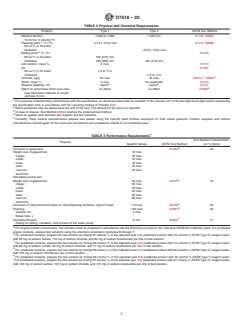
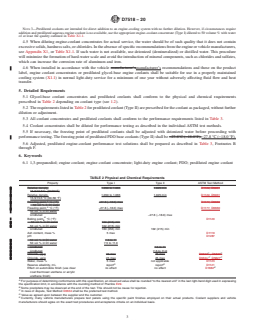
TABLE 2 Physical and Chemical Requirements
Property Type I Type II ASTM Test Method
Relative density, 1.050 to 1.065 1.025 min D1122, D5931
15.5/15.5 °C (60 ⁄60 °F)
A
Freezing point, °C (°F): −27.8 (−18.0) max D1177, D6660
50 vol % in DI water
Undiluted −27.8 (−18.0) max
B
Boiling point, °C (°F): D1120
50 vol % in DI water 102 (215) min
Undiluted 180 (356) min 102 (215) min
Ash content, mass % 5 max D1119
pH: D1287
50 vol % in DI water 7.5 to 11.0
Undiluted 7.5to11.0
C C
Chloride, µg/g 25 max 25 max D3634, D5827
Water, mass % 5 max not applicable D1123
D D
Reserve alkalinity, mL report report D1121
E
Effect on automobile finish (use clear no
...
This document is not an ASTM standard and is intended only to provide the user of an ASTM standard an indication of what changes have been made to the previous version. Because
it may not be technically possible to adequately depict all changes accurately, ASTM recommends that users consult prior editions as appropriate. In all cases only the current version
of the standard as published by ASTM is to be considered the official document.
´1
Designation: D7518 − 10 (Reapproved 2015) D7518 − 20
Standard Specification for
1,3 Propanediol (PDO) Base Engine Coolant for Automobile
and Light-Duty Service
This standard is issued under the fixed designation D7518; the number immediately following the designation indicates the year of
original adoption or, in the case of revision, the year of last revision. A number in parentheses indicates the year of last reapproval. A
superscript epsilon (´) indicates an editorial change since the last revision or reapproval.
ε NOTE—Caution statement in X1.5 was changed to a Warning statement editorially in June 2015.
1. Scope*
1.1 This specification covers the requirements for 1,3 propanediol base engine coolants used in automobiles or other light-duty
service cooling systems. When concentrates are used at 4040 % to 70 % concentration by volume in water, or when prediluted
glycol base engine coolants (50 volume % minimum) are used without further dilution, they will function effectively to provide
protection against freezing, boiling, and corrosion.
1.2 The coolants governed by this specification are categorized as follows:
Coolant Type Description
I 1,3 Propanediol base concentrate
II 1,3 Propanediol predilute (50 vol %)
NOTE 1—This specification is based on the knowledge of the performance of engine coolants prepared from new or virgin ingredients.
NOTE 2—This specification applies to automobiles and light-duty service. A specification for heavy-duty engine service is under development.
1.3 The values stated in SI units are to be regarded as the standard. The values given in parentheses are for information only.after
SI units are provided for information only and are not considered standard.
1.4 This standard does not purport to address all of the safety concerns, if any, associated with its use. It is the responsibility
of the user of this standard to establish appropriate safety safety, health, and healthenvironmental practices and determine the
applicability of regulatory limitations prior to use.
1.5 This international standard was developed in accordance with internationally recognized principles on standardization
established in the Decision on Principles for the Development of International Standards, Guides and Recommendations issued
by the World Trade Organization Technical Barriers to Trade (TBT) Committee.
2. Referenced Documents
2.1 ASTM Standards:
D512 Test Methods for Chloride Ion In Water
D516 Test Method for Sulfate Ion in Water
D1119 Test Method for Percent Ash Content of Engine Coolants
D1120 Test Method for Boiling Point of Engine Coolants
D1121 Test Method for Reserve Alkalinity of Engine Coolants and Antirusts
D1122 Test Method for Density or Relative Density of Engine Coolant Concentrates and Engine Coolants By The Hydrometer
D1123 Test Methods for Water in Engine Coolant Concentrate by the Karl Fischer Reagent Method
D1126 Test Method for Hardness in Water
D1177 Test Method for Freezing Point of Aqueous Engine Coolants
D1287 Test Method for pH of Engine Coolants and Antirusts
D1293 Test Methods for pH of Water
D1384 Test Method for Corrosion Test for Engine Coolants in Glassware
This specification is under the jurisdiction of ASTM Committee D15 on Engine Coolants and Related Fluids and is the direct responsibility of Subcommittee D15.07
on Specifications.
Current edition approved May 1, 2015April 1, 2020. Published June 2015April 2020. Originally approved in 2009. Last previous edition approved in 20102015 as
ɛ1
D7518D7518–10(2015) – 10. . DOI: 10.1520/D7518-10R15E01.10.1520/D7518–20.
For referenced ASTM standards, visit the ASTM website, www.astm.org, or contact ASTM Customer Service at service@astm.org. For Annual Book of ASTM Standards
volume information, refer to the standard’sstandard’s Document Summary page on the ASTM website.
*A Summary of Changes section appears at the end of this standard
Copyright © ASTM International, 100 Barr Harbor Drive, PO Box C700, West Conshohocken, PA 19428-2959. United States
D7518 − 20
D1881 Test Method for Foaming Tendencies of Engine Coolants in Glassware
D1882 Test Method for Effect of Cooling System Chemical Solutions on Organic Finishes for Automotive Vehicles
D2570 Test Method for Simulated Service Corrosion Testing of Engine Coolants
D2809 Test Method for Cavitation Corrosion and Erosion-Corrosion Characteristics of Aluminum Pumps With Engine Coolants
D3321 Test Method for Use of the Refractometer for Field Test Determination of the Freezing Point of Aqueous Engine Coolants
D3634 Test Method for Trace Chloride Ion in Engine Coolants
D4327 Test Method for Anions in Water by Suppressed Ion Chromatography
D4340 Test Method for Corrosion of Cast Aluminum Alloys in Engine Coolants Under Heat-Rejecting Conditions
D4725 Terminology for Engine Coolants and Related Fluids
D5827 Test Method for Analysis of Engine Coolant for Chloride and Other Anions by Ion Chromatography
D5931 Test Method for Density and Relative Density of Engine Coolant Concentrates and Aqueous Engine Coolants by Digital
Density Meter
D6130 Test Method for Determination of Silicon and Other Elements in Engine Coolant by Inductively Coupled Plasma-Atomic
Emission Spectroscopy
D6660 Test Method for Freezing Point of Aqueous Ethylene Glycol Base Engine Coolants by Automatic Phase Transition
Method
D7388 Specification for Engine Coolant Grade 1,3-Propanediol (PDO)
E29 Practice for Using Significant Digits in Test Data to Determine Conformance with Specifications
E394 Test Method for Iron in Trace Quantities Using the 1,10-Phenanthroline Method
2.2 Other Document:
Federal Method 2540B Total Dissolved Solids Dried at 103–105°C
3. Terminology
3.1 Definitions:
3.1.1 PDO base engine coolant, n—an engine coolant in which the freeze point depressant is 1,3 propylene, with inhibitors to
minimize foaming and corrosion.
3.1.2 For definitions of other terms used in this specification, refer to Terminology D4725.
4. General Requirements
4.1 Engine coolant concentrates or prediluted PDO base engine coolants shall be formulated with 1,3 propanediol meeting
Specification D7388, water, and suitable corrosion inhibitors, dye, and a foam suppressor.
4.2 PDO base engine coolant concentrates (Type I) may not contain ethylene glycol, diethylene glycol, triethylene glycol,
tetraethylene glycol. Similarly, prediulted PDO base coolants and prediluted (Type II) may not contain ethylene glycol, diethylene
glycol, triethylene glycol, tetraethylene glycol.or tetraethylene glycol, or combinations thereof, in amounts exceeding the limits set
in Specification D7388.
4.3 All engine coolant concentrates or prediluted PDO base engine coolants shall conform to the general requirements given
in Table 1.
TABLE 1 General Requirements
Property Specific Values ASTM Test Method
Color Distinctive .
Effect on nonmetals No adverse effect under consideration
4.4 Prediluted PDO (Type II) base engine coolants shall be formulated using water that meets the following requirements:
Property Specific Values ASTM Test Method
Chlorides, μg/g (ppm (grains/gal)) 25 (1.5) max D512, D4327, D5827
Chlorides, μg/g (ppm) 25 max D512, D4327, D5827
Sulfate, μg/g (ppm (grains/gal)) 50 (3.0) max D516, D4327, D5827
Sulfate, μg/g (ppm) 50 max D516, D4327, D5827
Hardness, as CaCo , μg/g 20 (1.2) max D1126, D6130
(ppm (grains/gal))
Hardness, as CaCo , μg/g 20 max D1126, D6130
(ppm)
pH 5.5 to 8.5 D1287, D1293
Iron, μg/g (ppm (grains/gal)) 1.0 (0.06) max D6130, E394
Iron, μg/g (ppm) 1.0 max D6130, E394
Standard Methods for the Examination of Water and Wastewater. American Public Health Association, et al, 801 I Street, N.W. Washington, DC 20001,
http://www.apha.org.Standard Methods for the Examination of Water and Wastewater, American Public Health Association, et al, 801 I Street, NW Washington, DC 20001,
http://www.apha.org.
D7518 − 20
NOTE 3—Prediluted coolants are intended for direct addition to an engine-cooling system with no further dilution. However, if circumstances require
addition and prediluted aqueous engine coolant is no available, use the appropriate engine-coolant concentrate (Type I) diluted to 50 volume % with water
of at least the quality outlined in Table X1.1.
4.5 When diluting engine-coolant concentrates for actual service, the water should be of such quality that it does not contain
excessive solids, hardness salts, or chlorides. In the absence of specific recommendations from the engine or vehicle manufacturers,
see Appendix X1, or Table X1.1. If such water is not available, use deionized (demineralized) or distilled water. This procedure
will minimize the formation of hard-water scale and avoid the introduction of mineral components, such as chlorides and sulfates,
which can increase the corrosion rate of aluminum and iron.
4.6 When installed in accordance with the vehicle manufacturer’smanufacturer’s recommendations and those on the product
label, engine coolant concentrates or prediluted glycol-base engine coolants shall be suitable for use in a properly maintained
cooling system (X1.1) in normal light-duty service for a minimum of one year without adversely affecting fluid flow and heat
transfer.
5. Detailed Requirements
5.1 Glycol-base coolant concentrates and prediluted coolants shall conform to the physical and chemical requirements
prescribed in Table 2 depending on coolant type (see 1.2).
5.2 The requirements listed in Table 2 for prediluted coolant (Type II) are prescribed for the coolant as packaged, without further
dilution or adjustment.
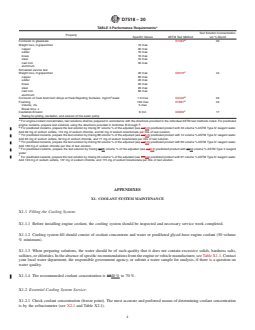
5.3 All coolant concentrates and prediluted coolants shall conform to the performance requirements listed in Table 3.
5.4 Coolant concentrates shall be diluted for performance testing as described in the individual ASTM test methods.
5.5 If necessary, the freezing point of prediluted coolants shall be adjusted with deionized water before proceeding with
performance testing. The freezing point of prediluted PDO base coolants (Type II) shall be −27.8°C (−18.0°F).−27.8 °C (−18.0 °F).
5.6 Adjusted, prediluted engine-coolant performance test solutions shall be prepared as described in Table 3, Footnotes B
through F.
6. Keywords
6.1 1,3-propanediol; engine coolant; engine coolant concentrate; light-duty engine coolant; PDO; prediluted engine coolant
TABLE 2 Physical and Chemical Requirements
Property Type I Type II ASTM Test Method
Relative density, 1.050 to 1.065 1.025 min D1122, D5931
15.5/15.5°C (60/60°F)
Relative density, 1.050 to 1.065 1.025 min D1122, D5931
15.5/15.5 °C (60 ⁄60 °F)
A
Freezing point, °C (°F): −27.8 (−18.0) max D1177, D6660
50 vol % in DI water
A
Freezing point, °C (°F): −27.8 (−18.0) max D1177, D6660
50 vol % in DI water
Undiluted −27.8 (−18.0) max
B
Boiling point, °C (°F): D1120
50 vol % in DI water 102 (215) min
50 vol % in DI water 102 (215) min
Undiluted 180 (356) min 102 (215) min
Ash content, mass % 5 max D1119
pH: D1287
50 vol % in DI water 7.5 to 11
50 vol % in DI water 7.5 to 11.0
Un
...