

ASTM E702-21
(Specification)Standard Specification for Municipal Ferrous Scrap
General Information
- Abstract
ABSTRACT
This specification covers the chemical and physical requirements of municipal ferrous scrap that are intended for use by such industries listed as follows: copper industry, iIron and steel foundries, iron and steel production, detinning industry, and ferroalloy industry. Municipal ferrous scrap shall conform to the requirements as to chemical composition for the respective end uses prescribed. Also, municipal ferrous scrap shall conform to the physical properties for the respective end uses prescribed.
SCOPE
1.1 This specification covers the chemical and physical requirements of municipal ferrous scrap that are intended for use by such industries listed as follows:
1.1.1 Copper industry (precipitation process),
1.1.2 Iron and steel foundries,
1.1.3 Iron and steel production,
1.1.4 Detinning industry, and
1.1.5 Ferroalloy industry.
1.2 The values stated in inch-pound units are to be regarded as standard. The values given in parentheses are mathematical conversions to SI units that are provided for information only and are not considered standard.
1.3 Questions concerning material rejection, downgrading, and retesting based on failure to meet the requirements of this specification shall be dealt with through contractual arrangements between the purchaser and the supplier.
1.4 This international standard was developed in accordance with internationally recognized principles on standardization established in the Decision on Principles for the Development of International Standards, Guides and Recommendations issued by the World Trade Organization Technical Barriers to Trade (TBT) Committee.
- Status
- Published
- Publication Date
- 30-Apr-2021
- Technical Committee
- D34 - Waste Management
- Drafting Committee
- D34.03 - Treatment, Recovery and Reuse
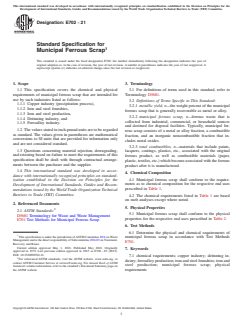


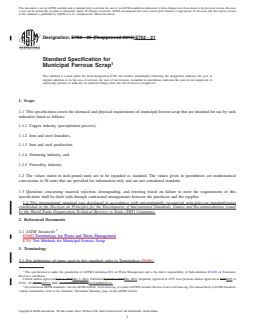
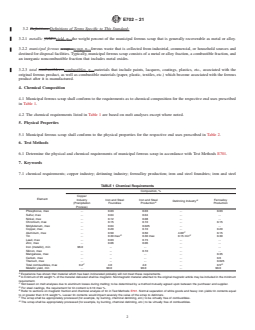


Overview
ASTM E702-21: Standard Specification for Municipal Ferrous Scrap provides comprehensive requirements for the chemical composition and physical properties of municipal ferrous scrap. This standard is widely utilized by industries such as the copper industry (precipitation process), iron and steel foundries, iron and steel production, detinning, and ferroalloy production. By defining uniform criteria for municipal ferrous scrap, ASTM E702-21 facilitates its responsible and efficient use in industrial applications, promoting material recovery and sustainability.
Key Topics
- Chemical Composition: The standard prescribes maximum and minimum levels for key elements such as phosphorus, sulfur, nickel, chromium, molybdenum, copper, aluminum, tin, lead, zinc, iron, silicon, manganese, carbon, and titanium. Requirements are tailored to specific industry applications, helping to ensure end-product quality and process efficiency.
- Physical Characteristics: Municipal ferrous scrap must meet requirements for bulk density, form (loose, baled, shredded), and magnetic fraction, with criteria depending on industry end-use. For example, scrap for iron and steel production requires higher bulk density, while material for the detinning industry may demand specific size ranges and virtually no combustibles.
- Material Processing: The standard addresses appropriate processing methods, such as incineration or chemical detinning, to achieve required levels of combustibles and metallic yield. A minimum of 95% of delivered material must be magnetic in certain cases, ensuring suitability for specific recycling processes.
- Testing and Evaluation: Determination of compliance is guided by referenced ASTM test methods (such as ASTM E701), covering both chemical and physical property evaluation.
- Terminology and Rejection: Relevant terminology is standardized to promote clear industry communication, and the specification describes procedures for dealing with nonconforming materials, including options for retesting, downgrading, or contractual resolution.
Applications
ASTM E702-21 supports a broad range of industries that depend on the reliable supply of municipal ferrous scrap:
- Copper Industry (Precipitation Process): Utilizes ferrous scrap as a reagent or feedstock, where controlled chemical purity improves process outcomes.
- Iron and Steel Foundries: Use municipal ferrous scrap as a raw material for casting new products, requiring consistent composition and bulk density.
- Iron and Steel Production: Scrap serves as a vital feedstock, and adherence to physical and chemical properties helps optimize melting and alloying processes.
- Detinning Industry: Employs ferrous scrap in the recovery of metals from tin-coated items; specific limits on tin, combustibles, and size are essential.
- Ferroalloy Industry: Depends on scrap with defined chemical specifications for use as feedstock in alloy production.
By ensuring that recycled municipal ferrous scrap meets stringent standards, ASTM E702-21 helps manufacturers improve operational efficiency, reduce waste, and support the circular economy.
Related Standards
- ASTM D5681: Terminology for Waste and Waste Management - provides definitions for terms related to scrap and materials recycling.
- ASTM E701: Test Methods for Municipal Ferrous Scrap - outlines procedures for assessing chemical and physical properties relevant to compliance with ASTM E702-21.
Additional international and regional standards may also be applied in conjunction with ASTM E702-21 to address specific regulatory or contractual requirements in the management and reuse of ferrous scrap.
Keywords: municipal ferrous scrap, ASTM E702-21, chemical requirements, physical requirements, iron and steel production, copper industry, detinning industry, ferroalloy, scrap recycling standards, material recovery, waste management.
Relations
- Effective Date
- 01-Nov-2023
- Effective Date
- 01-Nov-2018
- Effective Date
- 01-Nov-2018
- Effective Date
- 01-Sep-2017
- Effective Date
- 01-Nov-2016
- Effective Date
- 01-Feb-2016
- Effective Date
- 01-Feb-2013
- Effective Date
- 01-Jan-2010
- Effective Date
- 01-Jul-2009
- Effective Date
- 01-Sep-2008
- Effective Date
- 01-Feb-2005
- Effective Date
- 01-Sep-2004
- Effective Date
- 01-Sep-2004
- Effective Date
- 10-Sep-1999
- Effective Date
- 10-Jun-1998
Get Certified
Connect with accredited certification bodies for this standard

CIS Institut d.o.o.
Personal Protective Equipment (PPE) certification body. Notified Body NB-2890 for EU Regulation 2016/425 PPE.

Kiwa BDA Testing
Building and construction product certification.
Kmetijski inštitut Slovenije
Agricultural Institute of Slovenia. Soil testing, plant health, agricultural product analysis.
Sponsored listings
Frequently Asked Questions
ASTM E702-21 is a technical specification published by ASTM International. Its full title is "Standard Specification for Municipal Ferrous Scrap". This standard covers: ABSTRACT This specification covers the chemical and physical requirements of municipal ferrous scrap that are intended for use by such industries listed as follows: copper industry, iIron and steel foundries, iron and steel production, detinning industry, and ferroalloy industry. Municipal ferrous scrap shall conform to the requirements as to chemical composition for the respective end uses prescribed. Also, municipal ferrous scrap shall conform to the physical properties for the respective end uses prescribed. SCOPE 1.1 This specification covers the chemical and physical requirements of municipal ferrous scrap that are intended for use by such industries listed as follows: 1.1.1 Copper industry (precipitation process), 1.1.2 Iron and steel foundries, 1.1.3 Iron and steel production, 1.1.4 Detinning industry, and 1.1.5 Ferroalloy industry. 1.2 The values stated in inch-pound units are to be regarded as standard. The values given in parentheses are mathematical conversions to SI units that are provided for information only and are not considered standard. 1.3 Questions concerning material rejection, downgrading, and retesting based on failure to meet the requirements of this specification shall be dealt with through contractual arrangements between the purchaser and the supplier. 1.4 This international standard was developed in accordance with internationally recognized principles on standardization established in the Decision on Principles for the Development of International Standards, Guides and Recommendations issued by the World Trade Organization Technical Barriers to Trade (TBT) Committee.
ABSTRACT This specification covers the chemical and physical requirements of municipal ferrous scrap that are intended for use by such industries listed as follows: copper industry, iIron and steel foundries, iron and steel production, detinning industry, and ferroalloy industry. Municipal ferrous scrap shall conform to the requirements as to chemical composition for the respective end uses prescribed. Also, municipal ferrous scrap shall conform to the physical properties for the respective end uses prescribed. SCOPE 1.1 This specification covers the chemical and physical requirements of municipal ferrous scrap that are intended for use by such industries listed as follows: 1.1.1 Copper industry (precipitation process), 1.1.2 Iron and steel foundries, 1.1.3 Iron and steel production, 1.1.4 Detinning industry, and 1.1.5 Ferroalloy industry. 1.2 The values stated in inch-pound units are to be regarded as standard. The values given in parentheses are mathematical conversions to SI units that are provided for information only and are not considered standard. 1.3 Questions concerning material rejection, downgrading, and retesting based on failure to meet the requirements of this specification shall be dealt with through contractual arrangements between the purchaser and the supplier. 1.4 This international standard was developed in accordance with internationally recognized principles on standardization established in the Decision on Principles for the Development of International Standards, Guides and Recommendations issued by the World Trade Organization Technical Barriers to Trade (TBT) Committee.
ASTM E702-21 is classified under the following ICS (International Classification for Standards) categories: 13.030.10 - Solid wastes. The ICS classification helps identify the subject area and facilitates finding related standards.
ASTM E702-21 has the following relationships with other standards: It is inter standard links to ASTM D5681-23, ASTM E701-80(2018), ASTM D5681-18, ASTM D5681-17, ASTM D5681-16a, ASTM D5681-16, ASTM D5681-13, ASTM E701-80(2010), ASTM D5681-09, ASTM D5681-08, ASTM E701-80(2005), ASTM D5681-98a(2004)e1, ASTM D5681-98a(2004), ASTM E701-80(1999), ASTM D5681-98ae1. Understanding these relationships helps ensure you are using the most current and applicable version of the standard.
ASTM E702-21 is available in PDF format for immediate download after purchase. The document can be added to your cart and obtained through the secure checkout process. Digital delivery ensures instant access to the complete standard document.
Standards Content (Sample)
This international standard was developed in accordance with internationally recognized principles on standardization established in the Decision on Principles for the
Development of International Standards, Guides and Recommendations issued by the World Trade Organization Technical Barriers to Trade (TBT) Committee.
Designation:E702 −21
Standard Specification for
Municipal Ferrous Scrap
This standard is issued under the fixed designation E702; the number immediately following the designation indicates the year of
original adoption or, in the case of revision, the year of last revision. A number in parentheses indicates the year of last reapproval. A
superscript epsilon (´) indicates an editorial change since the last revision or reapproval.
1. Scope 3. Terminology
1.1 This specification covers the chemical and physical 3.1 For definitions of terms used in this standard, refer to
requirements of municipal ferrous scrap that are intended for Terminology D5681.
use by such industries listed as follows:
3.2 Definitions of Terms Specific to This Standard:
1.1.1 Copper industry (precipitation process),
3.2.1 metallic yield, n—the weight percent of the municipal
1.1.2 Iron and steel foundries,
ferrous scrap that is generally recoverable as metal or alloy.
1.1.3 Iron and steel production,
3.2.2 municipal ferrous scrap, n—ferrous waste that is
1.1.4 Detinning industry, and
collected from industrial, commercial, or household sources
1.1.5 Ferroalloy industry.
and destined for disposal facilities. Typically, municipal fer-
1.2 The values stated in inch-pound units are to be regarded
rous scrap consists of a metal or alloy fraction, a combustible
as standard. The values given in parentheses are mathematical
fraction, and an inorganic noncombustible fraction that in-
conversions to SI units that are provided for information only
cludes metal oxides.
and are not considered standard.
3.2.3 total combustibles, n—materials that include paints,
1.3 Questions concerning material rejection, downgrading,
lacquers, coatings, plastics, etc., associated with the original
and retesting based on failure to meet the requirements of this
ferrous product, as well as combustible materials (paper,
specification shall be dealt with through contractual arrange-
plastic, textiles, etc.) which become associated with the ferrous
ments between the purchaser and the supplier.
product after it is manufactured.
1.4 This international standard was developed in accor-
4. Chemical Composition
dance with internationally recognized principles on standard-
4.1 Municipal ferrous scrap shall conform to the require-
ization established in the Decision on Principles for the
ments as to chemical composition for the respective end uses
Development of International Standards, Guides and Recom-
prescribed in Table 1.
mendations issued by the World Trade Organization Technical
Barriers to Trade (TBT) Committee.
4.2 The chemical requirements listed in Table 1 are based
on melt analyses except where noted.
2. Referenced Documents
5. Physical Properties
2.1 ASTM Standards:
5.1 Municipal ferrous scrap shall conform to the physical
D5681 Terminology for Waste and Waste Management
properties for the respective end uses prescribed in Table 2.
E701 Test Methods for Municipal Ferrous Scrap
6. Test Methods
6.1 Determine the physical and chemical requirements of
This specification is under the jurisdiction ofASTM Committee D34 on Waste
municipal ferrous scrap in accordance with Test Methods
Management and is the direct responsibility of Subcommittee D34.03 on Treatment,
E701.
Recovery and Reuse.
Current edition approved May 1, 2021. Published May 2021. Originally
7. Keywords
approved in 1979. Last previous edition approved in 2015 as E702 – 85 (2015).
DOI: 10.1520/E0702-21.
7.1 chemical requirements; copper industry; detinning in-
For referenced ASTM standards, visit the ASTM website, www.astm.org, or
dustry; ferroalloy production; iron and steel foundries; iron and
contact ASTM Customer Service at service@astm.org. For Annual Book of ASTM
steel production; municipal ferrous scrap; physical
Standards volume information, refer to the standard’s Document Summary page on
the ASTM website. requirements
Copyright © ASTM International, 100 Barr Harbor Drive, PO Box C700, West Conshohocken, PA 19428-2959. United States
E702−21
TABLE 1 Chemical Requirements
Composit
...
This document is not an ASTM standard and is intended only to provide the user of an ASTM standard an indication of what changes have been made to the previous version. Because
it may not be technically possible to adequately depict all changes accurately, ASTM recommends that users consult prior editions as appropriate. In all cases only the current version
of the standard as published by ASTM is to be considered the official document.
Designation: E702 − 85 (Reapproved 2015) E702 − 21
Standard Specification for
Municipal Ferrous Scrap
This standard is issued under the fixed designation E702; the number immediately following the designation indicates the year of
original adoption or, in the case of revision, the year of last revision. A number in parentheses indicates the year of last reapproval. A
superscript epsilon (´) indicates an editorial change since the last revision or reapproval.
1. Scope
1.1 This specification covers the chemical and physical requirements of municipal ferrous scrap that are intended for use by such
industries listed as follows:
1.1.1 Copper industry (precipitation process),
1.1.2 Iron and steel foundries,
1.1.3 Iron and steel production,
1.1.4 Detinning industry, and
1.1.5 Ferroalloy industry.
1.2 The values stated in inch-pound units are to be regarded as standard. The values given in parentheses are mathematical
conversions to SI units that are provided for information only and are not considered standard.
1.3 Questions concerning material rejection, downgrading, and retesting based on failure to meet the requirements of this
specification shall be dealt with through contractual arrangements between the purchaser and the supplier.
1.4 This international standard was developed in accordance with internationally recognized principles on standardization
established in the Decision on Principles for the Development of International Standards, Guides and Recommendations issued
by the World Trade Organization Technical Barriers to Trade (TBT) Committee.
2. Referenced Documents
2.1 ASTM Standards:
D5681 Terminology for Waste and Waste Management
E701 Test Methods for Municipal Ferrous Scrap
3. Terminology
3.1 For definitions of terms used in this standard, refer to Terminology D5681.
This specification is under the jurisdiction of ASTM Committee D34 on Waste Management and is the direct responsibility of Subcommittee D34.03 on Treatment,
Recovery and Reuse.
Current edition approved Sept. 1, 2015May 1, 2021. Published September 2015May 2021. Originally approved in 1979. Last previous edition approved in 20102015 as
E702 – 85 (2010).(2015). DOI: 10.1520/E0702-85R15.10.1520/E0702-21.
For referenced ASTM standards, visit the ASTM website, www.astm.org, or contact ASTM Customer Service at service@astm.org. For Annual Book of ASTM Standards
volume information, refer to the standard’s Document Summary page on the ASTM website.
Copyright © ASTM International, 100 Barr Harbor Drive, PO Box C700, West Conshohocken, PA 19428-2959. United States
E702 − 21
3.2 Definitions:Definitions of Terms Specific to This Standard:
3.2.1 metallic yield—yield, n—the weight percent of the municipal ferrous scrap that is generally recoverable as metal or alloy.
3.2.2 municipal ferrous scrap—scrap, n—ferrous waste that is collected from industrial, commercial, or household sources and
destined for disposal facilities. Typically, municipal ferrous scrap consists of a metal or alloy fraction, a combustible fraction, and
an inorganic noncombustible fraction that includes metal oxides.
3.2.3 total combustibles—combustibles, n—materials that include paints, lacquers, coatings, plastics, etc., associated with the
original ferrous product, as well as combustible materials (paper, plastic, textiles, etc.) which become associated with the ferrous
product after it is manufactured.
4. Chemical Composition
4.1 Municipal ferrous scrap shall conform to the requirements as to chemical composition for the respective end uses prescribed
in Table 1.
4.2 The chemical requirements listed in Table 1 are based on melt analyses except where noted.
5. Physical Properties
5.1 Municipal ferrous scrap shall conform to the physical properties for the respective end uses prescribed in Table 2.
6. Test Methods
6.1 Determine the physical and chemical requirements of municipal ferrous scrap in accordance with Test Methods E701.
7. Keywords
7.1 chemical requirements; copper industry; detinning industry; ferroalloy production; iron and steel foundries; iron and steel
TABLE 1 Chemical Requirements
Composition, %
Copper
Element
Industry Iron and Steel Iron and Steel Ferroalloy
B
Detinning In
...