

ASTM D6617-21
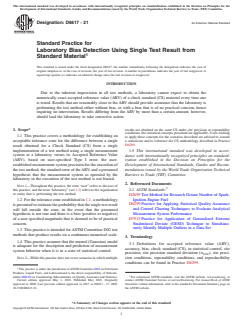
(Practice)Standard Practice for Laboratory Bias Detection Using Single Test Result from Standard Material
General Information
- Abstract
SIGNIFICANCE AND USE
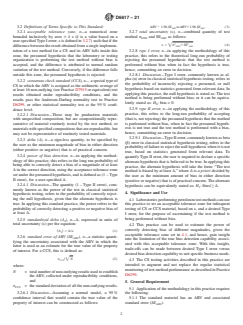
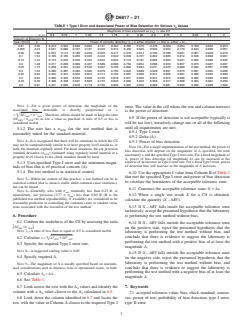
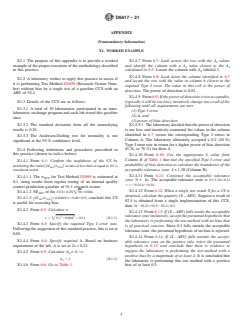
4.1 Laboratories performing petroleum test methods can use this practice to set an acceptable tolerance zone for infrequent testing of CS or CCS material, based on ε, and a desired Type I error, for the purpose of ascertaining if the test method is being performed without bias.
4.2 This practice can be used to estimate the power of correctly detecting bias of different magnitudes, given the acceptable tolerance zone set in 4.1, and hence, gain insight into the limitation of the true bias detection capability associated with this acceptable tolerance zone. With this insight, trade-offs can be made between desired Type I error versus desired bias detection capability to suit specific business needs.
4.3 The CS testing activities described in this practice are intended to augment and not replace the regular statistical monitoring of test method performance as described in Practice D6299.
SCOPE
1.1 This practice covers a methodology for establishing an acceptable tolerance zone for the difference between a single result obtained for a Check Standard (CS) from a single implementation of a test method using a single measurement system at a laboratory versus its Accepted Reference Value (ARV), based on user-specified Type I error, the user-established measurement system precision for the execution of the test method, the standard error of the ARV, and a presumed hypothesis that the measurement system as operated by the laboratory in the execution of the test method is not biased.
Note 1: Throughout this practice, the term “user” refers to the user of this practice, and the term “laboratory” (see 1.1) refers to the organization or entity that is performing the test method.
1.2 For the tolerance zone established in 1.1, a methodology is presented to estimate the probability that the single test result will fall outside the zone, in the event that the presumed hypothesis is not true and there is a bias (positive or negative) of a user-specified magnitude that is deemed to be of practical concern.
1.3 This practice is intended for ASTM Committee D02 test methods that produce results on a continuous numerical scale.
1.4 This practice assumes that the normal (Gaussian) model is adequate for the description and prediction of measurement system behavior when it is in a state of statistical control.
Note 2: While this practice does not cover scenarios in which multiple results are obtained on the same CS under site precision or repeatability conditions, the statistical concepts presented are applicable. Users wishing to apply these concepts for the scenarios described are advised to consult a statistician and to reference the CS methodology described in Practice D6299.
1.5 This international standard was developed in accordance with internationally recognized principles on standardization established in the Decision on Principles for the Development of International Standards, Guides and Recommendations issued by the World Trade Organization Technical Barriers to Trade (TBT) Committee.
- Status
- Published
- Publication Date
- 30-Apr-2021
- Technical Committee
- D02 - Petroleum Products, Liquid Fuels, and Lubricants
- Drafting Committee
- D02.94 - Coordinating Subcommittee on Quality Assurance and Statistics
Buy Documents
ASTM D6617-21 - Standard Practice for Laboratory Bias Detection Using Single Test Result from Standard Material
REDLINE ASTM D6617-21 - Standard Practice for Laboratory Bias Detection Using Single Test Result from Standard Material
Overview
ASTM D6617-21: Standard Practice for Laboratory Bias Detection Using Single Test Result from Standard Material provides a standardized methodology for detecting laboratory bias in petroleum testing laboratories. This practice is crucial for quality assurance by establishing clear guidelines for evaluating single test results obtained from check standards (CS) against their accepted reference values (ARV). ASTM D6617-21 assists laboratories in the detection and management of systematic errors, promoting reliable and unbiased test results, especially when conducting infrequent tests on certified or consensus check standards.
Key Topics
Acceptable Tolerance Zone: The standard outlines how to establish an acceptable tolerance zone for the difference between a test result and the ARV of a check standard. The zone is set based on user-specified precision, total uncertainty (ε), and desired Type I error rate. This provides a threshold to determine if a test method is being performed without bias.
Bias Detection Power: Laboratories can use ASTM D6617-21 to estimate the probability (power) of correctly detecting a significant bias, enabling evaluations of test method performance and guiding decisions about needed corrective actions.
Statistical Principles: The practice relies on classical statistical hypothesis testing concepts, especially the notions of Type I and Type II errors, and assumes measurement systems are normally distributed and in statistical control.
Flexibility and Customization: Users can tailor key parameters (such as acceptable bias magnitude and Type I error level) to fit specific business or regulatory requirements, balancing detection sensitivity and the risk of false positives.
Applications
ASTM D6617-21 is primarily used by laboratories performing petroleum and chemical test methods that yield continuous numerical results. Its main applications include:
- Quality Control in Petroleum Testing: Ensuring that test methods for fuels, lubricants, and petroleum products are implemented without significant laboratory bias.
- Infrequent Check Standard Testing: Providing a clear decision framework for when only single test results are available from standard materials.
- Statistical Auditing and Accreditation: Supporting compliance with quality assurance standards and laboratory accreditation requirements.
- Risk Management: Allowing laboratories to understand the trade-offs between detection capability (sensitivity to bias) and the likelihood of false positives (Type I error).
By following ASTM D6617-21, laboratories can detect potential biases early, minimize operational risks, and maintain confidence in analytical data.
Related Standards
ASTM D6617-21 is most effective when implemented alongside other quality assurance and statistical monitoring standards:
- ASTM D6299 - Practice for Applying Statistical Quality Assurance and Control Charting Techniques to Evaluate Analytical Measurement System Performance: Used for regular monitoring and statistical control of lab measurement systems.
- ASTM D7915 - Practice for Application of Generalized Extreme Studentized Deviate (GESD) Technique to Simultaneously Identify Multiple Outliers: Supports outlier detection in test data, relevant for validating check standard results.
- ASTM D2699 - Test Method for Research Octane Number of Spark-Ignition Engine Fuel: An example of a petroleum test method where ASTM D6617-21 can be applied.
Practical Value
Implementing ASTM D6617-21 provides laboratories with:
- Clear statistical procedures for bias detection using single test results
- Quantitative metrics to support data quality and decision making
- Confidence in test method accuracy, supporting business, regulatory, and operational objectives
By ensuring laboratory bias is identified and managed, this standard is essential for petroleum testing laboratories committed to maintaining analytical excellence and regulatory compliance.
Keywords: laboratory bias detection, ASTM D6617-21, check standard, accepted reference value, statistical quality control, petroleum test methods, measurement uncertainty, Type I error, analytical accuracy.
Relations
- Effective Date
- 01-Mar-2024
- Effective Date
- 01-Dec-2023
- Refers
ASTM D2699-23b - Standard Test Method for Research Octane Number of Spark-Ignition Engine Fuel - Effective Date
- 01-Nov-2023
- Refers
ASTM D2699-23a - Standard Test Method for Research Octane Number of Spark-Ignition Engine Fuel - Effective Date
- 01-Oct-2023
- Effective Date
- 15-Dec-2017
- Effective Date
- 15-Nov-2017
- Effective Date
- 01-Jan-2017
- Effective Date
- 01-Dec-2016
- Effective Date
- 01-Jul-2015
- Effective Date
- 01-May-2014
- Refers
ASTM D2699-13b - Standard Test Method for Research Octane Number of Spark-Ignition Engine Fuel - Effective Date
- 01-Oct-2013
- Effective Date
- 01-Oct-2013
- Refers
ASTM D2699-13a - Standard Test Method for Research Octane Number of Spark-Ignition Engine Fuel - Effective Date
- 01-Jun-2013
- Effective Date
- 01-May-2013
- Effective Date
- 01-Mar-2010
Buy Documents
ASTM D6617-21 - Standard Practice for Laboratory Bias Detection Using Single Test Result from Standard Material
REDLINE ASTM D6617-21 - Standard Practice for Laboratory Bias Detection Using Single Test Result from Standard Material
Get Certified
Connect with accredited certification bodies for this standard

IMP NDT d.o.o.
Non-destructive testing services. Radiography, ultrasonic, magnetic particle, penetrant, visual inspection.
Inštitut za kovinske materiale in tehnologije
Institute of Metals and Technology. Materials testing, metallurgical analysis, NDT.
Q Techna d.o.o.
NDT and quality assurance specialist. 30+ years experience. NDT personnel certification per ISO 9712, nuclear and thermal power plant inspections, QA/
Sponsored listings
Frequently Asked Questions
ASTM D6617-21 is a standard published by ASTM International. Its full title is "Standard Practice for Laboratory Bias Detection Using Single Test Result from Standard Material". This standard covers: SIGNIFICANCE AND USE 4.1 Laboratories performing petroleum test methods can use this practice to set an acceptable tolerance zone for infrequent testing of CS or CCS material, based on ε, and a desired Type I error, for the purpose of ascertaining if the test method is being performed without bias. 4.2 This practice can be used to estimate the power of correctly detecting bias of different magnitudes, given the acceptable tolerance zone set in 4.1, and hence, gain insight into the limitation of the true bias detection capability associated with this acceptable tolerance zone. With this insight, trade-offs can be made between desired Type I error versus desired bias detection capability to suit specific business needs. 4.3 The CS testing activities described in this practice are intended to augment and not replace the regular statistical monitoring of test method performance as described in Practice D6299. SCOPE 1.1 This practice covers a methodology for establishing an acceptable tolerance zone for the difference between a single result obtained for a Check Standard (CS) from a single implementation of a test method using a single measurement system at a laboratory versus its Accepted Reference Value (ARV), based on user-specified Type I error, the user-established measurement system precision for the execution of the test method, the standard error of the ARV, and a presumed hypothesis that the measurement system as operated by the laboratory in the execution of the test method is not biased. Note 1: Throughout this practice, the term “user” refers to the user of this practice, and the term “laboratory” (see 1.1) refers to the organization or entity that is performing the test method. 1.2 For the tolerance zone established in 1.1, a methodology is presented to estimate the probability that the single test result will fall outside the zone, in the event that the presumed hypothesis is not true and there is a bias (positive or negative) of a user-specified magnitude that is deemed to be of practical concern. 1.3 This practice is intended for ASTM Committee D02 test methods that produce results on a continuous numerical scale. 1.4 This practice assumes that the normal (Gaussian) model is adequate for the description and prediction of measurement system behavior when it is in a state of statistical control. Note 2: While this practice does not cover scenarios in which multiple results are obtained on the same CS under site precision or repeatability conditions, the statistical concepts presented are applicable. Users wishing to apply these concepts for the scenarios described are advised to consult a statistician and to reference the CS methodology described in Practice D6299. 1.5 This international standard was developed in accordance with internationally recognized principles on standardization established in the Decision on Principles for the Development of International Standards, Guides and Recommendations issued by the World Trade Organization Technical Barriers to Trade (TBT) Committee.
SIGNIFICANCE AND USE 4.1 Laboratories performing petroleum test methods can use this practice to set an acceptable tolerance zone for infrequent testing of CS or CCS material, based on ε, and a desired Type I error, for the purpose of ascertaining if the test method is being performed without bias. 4.2 This practice can be used to estimate the power of correctly detecting bias of different magnitudes, given the acceptable tolerance zone set in 4.1, and hence, gain insight into the limitation of the true bias detection capability associated with this acceptable tolerance zone. With this insight, trade-offs can be made between desired Type I error versus desired bias detection capability to suit specific business needs. 4.3 The CS testing activities described in this practice are intended to augment and not replace the regular statistical monitoring of test method performance as described in Practice D6299. SCOPE 1.1 This practice covers a methodology for establishing an acceptable tolerance zone for the difference between a single result obtained for a Check Standard (CS) from a single implementation of a test method using a single measurement system at a laboratory versus its Accepted Reference Value (ARV), based on user-specified Type I error, the user-established measurement system precision for the execution of the test method, the standard error of the ARV, and a presumed hypothesis that the measurement system as operated by the laboratory in the execution of the test method is not biased. Note 1: Throughout this practice, the term “user” refers to the user of this practice, and the term “laboratory” (see 1.1) refers to the organization or entity that is performing the test method. 1.2 For the tolerance zone established in 1.1, a methodology is presented to estimate the probability that the single test result will fall outside the zone, in the event that the presumed hypothesis is not true and there is a bias (positive or negative) of a user-specified magnitude that is deemed to be of practical concern. 1.3 This practice is intended for ASTM Committee D02 test methods that produce results on a continuous numerical scale. 1.4 This practice assumes that the normal (Gaussian) model is adequate for the description and prediction of measurement system behavior when it is in a state of statistical control. Note 2: While this practice does not cover scenarios in which multiple results are obtained on the same CS under site precision or repeatability conditions, the statistical concepts presented are applicable. Users wishing to apply these concepts for the scenarios described are advised to consult a statistician and to reference the CS methodology described in Practice D6299. 1.5 This international standard was developed in accordance with internationally recognized principles on standardization established in the Decision on Principles for the Development of International Standards, Guides and Recommendations issued by the World Trade Organization Technical Barriers to Trade (TBT) Committee.
ASTM D6617-21 is classified under the following ICS (International Classification for Standards) categories: 19.020 - Test conditions and procedures in general. The ICS classification helps identify the subject area and facilitates finding related standards.
ASTM D6617-21 has the following relationships with other standards: It is inter standard links to ASTM D2699-24, ASTM D6299-23a, ASTM D2699-23b, ASTM D2699-23a, ASTM D6299-17b, ASTM D6299-17a, ASTM D6299-17, ASTM D2699-16, ASTM D2699-15, ASTM D7915-14, ASTM D2699-13b, ASTM D6299-13e1, ASTM D2699-13a, ASTM D2699-13, ASTM D6299-10e2. Understanding these relationships helps ensure you are using the most current and applicable version of the standard.
ASTM D6617-21 is available in PDF format for immediate download after purchase. The document can be added to your cart and obtained through the secure checkout process. Digital delivery ensures instant access to the complete standard document.
Standards Content (Sample)
This international standard was developed in accordance with internationally recognized principles on standardization established in the Decision on Principles for the
Development of International Standards, Guides and Recommendations issued by the World Trade Organization Technical Barriers to Trade (TBT) Committee.
Designation: D6617 − 21 An American National Standard
Standard Practice for
Laboratory Bias Detection Using Single Test Result from
Standard Material
This standard is issued under the fixed designation D6617; the number immediately following the designation indicates the year of
original adoption or, in the case of revision, the year of last revision.Anumber in parentheses indicates the year of last reapproval.A
superscript epsilon (´) indicates an editorial change since the last revision or reapproval.
INTRODUCTION
Due to the inherent imprecision in all test methods, a laboratory cannot expect to obtain the
numerically exact accepted reference value (ARV) of a check standard (CS) material every time one
is tested. Results that are reasonably close to theARV should provide assurance that the laboratory is
performing the test method either without bias, or with a bias that is of no practical concern, hence
requiring no intervention. Results differing from the ARV by more than a certain amount, however,
should lead the laboratory to take corrective action.
results are obtained on the same CS under site precision or repeatability
1. Scope*
conditions,thestatisticalconceptspresentedareapplicable.Userswishing
1.1 This practice covers a methodology for establishing an
to apply these concepts for the scenarios described are advised to consult
acceptable tolerance zone for the difference between a single
a statistician and to reference the CS methodology described in Practice
D6299.
result obtained for a Check Standard (CS) from a single
implementation of a test method using a single measurement
1.5 This international standard was developed in accor-
system at a laboratory versus its Accepted Reference Value dance with internationally recognized principles on standard-
(ARV), based on user-specified Type I error, the user-
ization established in the Decision on Principles for the
established measurement system precision for the execution of Development of International Standards, Guides and Recom-
the test method, the standard error of theARV, and a presumed
mendations issued by the World Trade Organization Technical
hypothesis that the measurement system as operated by the Barriers to Trade (TBT) Committee.
laboratory in the execution of the test method is not biased.
2. Referenced Documents
NOTE 1—Throughout this practice, the term “user” refers to the user of
this practice, and the term “laboratory” (see 1.1) refers to the organization 2.1 ASTM Standards:
or entity that is performing the test method.
D2699Test Method for Research Octane Number of Spark-
Ignition Engine Fuel
1.2 Forthetolerancezoneestablishedin1.1,amethodology
D6299Practice for Applying Statistical Quality Assurance
ispresentedtoestimatetheprobabilitythatthesingletestresult
and Control Charting Techniques to Evaluate Analytical
will fall outside the zone, in the event that the presumed
Measurement System Performance
hypothesis is not true and there is a bias (positive or negative)
D7915Practice for Application of Generalized Extreme
of a user-specified magnitude that is deemed to be of practical
Studentized Deviate (GESD) Technique to Simultane-
concern.
ously Identify Multiple Outliers in a Data Set
1.3 ThispracticeisintendedforASTMCommitteeD02test
methods that produce results on a continuous numerical scale.
3. Terminology
1.4 This practice assumes that the normal (Gaussian) model
3.1 Definitions for accepted reference value (ARV),
is adequate for the description and prediction of measurement
accuracy, bias, check standard (CS), in statistical control, site
system behavior when it is in a state of statistical control.
precision, site precision standard deviation (σ ), site preci-
SITE
NOTE2—Whilethispracticedoesnotcoverscenariosinwhichmultiple
sion conditions, repeatability conditions, and reproducibility
conditions can be found in Practice D6299.
This practice is under the jurisdiction ofASTM Committee D02 on Petroleum
Products, Liquid Fuels, and Lubricantsand is the direct responsibility of Subcom-
mittee D02.94 on Coordinating Subcommittee on QualityAssurance and Statistics. For referenced ASTM standards, visit the ASTM website, www.astm.org, or
Current edition approved May 1, 2021. Published May 2021. Originally contact ASTM Customer Service at service@astm.org. For Annual Book of ASTM
approved in 2000. Last previous edition approved in 2017 as D6617–17. DOI: Standards volume information, refer to the standard’s Document Summary page on
10.1520/D6617-21. the ASTM website.
*A Summary of Changes section appears at the end of this standard
Copyright © ASTM International, 100 Barr Harbor Drive, PO Box C700, West Conshohocken, PA 19428-2959. United States
D6617 − 21
3.2 Definitions of Terms Specific to This Standard: ARV 2 1.96 SE toARV11.96 SE (3)
ARV ARV
3.2.1 acceptable tolerance zone, n—a numerical zone
3.2.7 total uncertainty (ε), n—combined quantity of test
bounded inclusively by zero 6 k ε (k is a value based on a
method σ and SE as follows:
SITE ARV
user-specifiedTypeIerror;εisdefinedin3.2.7)suchthatifthe
2 2
ε 5 =σ 1SE (4)
SITE ARV
differencebetweentheresultobtainedfromasingleimplemen-
tation of a test method for a CS and its ARV falls inside this 3.2.8 type I error, n—in applying the methodology of this
zone, the presumed hypothesis that the laboratory or testing practice, this refers to the theoretical long-run probability of
organization is performing the test method without bias is rejecting the presumed hypothesis that the test method is
accepted, and the difference is attributed to normal random performed without bias when in fact the hypothesis is true,
variation of the test method. Conversely, if the difference falls hence, committing an error in decision.
3.2.8.1 Discussion—Type I error, commonly known as al-
outside this zone, the presumed hypothesis is rejected.
pha (α) error in classical statistical hypothesis testing, refers to
3.2.2 consensus check standard (CCS), n—aspecialtypeof
the probability of incorrectly rejecting a presumed, or null
CS in which theARV is assigned as the arithmetic average of
hypothesis based on statistics generated from relevant data. In
atleast16non-outlying(seePracticeD7915orequivalent)test
applying this practice, the null hypothesis is stated as:The test
results obtained under reproducibility conditions, and the
method is being performed without bias; or it can be equiva-
results pass the Anderson-Darling normality test in Practice
lently stated as: H : bias=0.
D6299, or other statistical normality test at the 95% confi-
3.2.9 type II error, n—in applying the methodology of this
dence level.
practice, this refers to the long-run probability of accepting
3.2.2.1 Discussion—These may be production materials
(thatis,notrejecting)thepresumedhypothesisthatthemethod
with unspecified composition, but are compositionally repre-
is performed without bias, when in fact the presumed hypoth-
sentative of material routinely tested by the test method, or
esis is not true and the test method is performed with a bias,
materialswithspecifiedcompositionsthatarereproducible,but
hence, committing an error in decision.
may not be representative of routinely tested materials.
3.2.9.1 Discussion—TypeIIerror,commonlyknownasbeta
3.2.3 delta (∆), n—a sign-less quantity, to be specified by
(β) error in classical statistical hypothesis testing, refers to the
the user as the minimum magnitude of bias in either direction
probabilityoffailuretorejectthenullhypothesiswhenitisnot
(either positive or negative) that is of practical concern.
true, based on statistics generated from relevant data. To
3.2.4 power of bias detection, n—in applying the method-
quantify Type II error, the user is required to declare a specific
ology of this practice, this refers to the long run probability of
alternate hypothesis that is believed to be true. In applying this
being able to correctly detect a bias of a magnitude of at least
practice, the alternate hypothesis will take the form: “The test
∆ in the correct direction, using the acceptance tolerance zone
method is biased by at least∆,” where∆ is a priori decided by
set under the presumed hypothesis, and is defined as (1–Type
the user as the minimum amount of bias in either direction
II error), for a user-specified ∆.
(positiveornegative)thatisofpracticalconcern.Thealternate
3.2.4.1 Discussion—The quantity (1–Type II error), com-
hypothesis can be equivalently stated as: H :|bias|≥∆.
monly known as the power of the test in classical statistical
4. Significance and Use
hypothesis testing, refers to the probability of correctly reject-
ing the null hypothesis, given that the alternate hypothesis is
4.1 Laboratoriesperformingpetroleumtestmethodscanuse
true. In applying this standard practice, the power refers to the
this practice to set an acceptable tolerance zone for infrequent
probability of correctly detecting a positive or negative bias of
testing of CS or CCS material, based on ε, and a desired Type
at least ∆.
I error, for the purpose of ascertaining if the test method is
being performed without bias.
3.2.5 standardized delta (∆ ), n—∆, expressed in units of
S
total uncertainty (ε) per the equation:
4.2 This practice can be used to estimate the power of
correctly detecting bias of different magnitudes, given the
∆ 5∆/ε (1)
~ !
S
acceptable tolerance zone set in 4.1, and hence, gain insight
3.2.6 standard error of ARV (SE ), n—a statistic quanti-
ARV
into the limitation of the true bias detection capability associ-
fying the uncertainty associated with the ARV in which the
ated with this acceptable tolerance zone. With this insight,
latter is used as an estimate for the true value of the property
trade-offs can be made between desired Type I error versus
of interest. For a CCS, this is defined as:
desiredbiasdetectioncapabilitytosuitspecificbusinessneeds.
=
σ / N (2)
CCS
4.3 The CS testing activities described in this practice are
intended to augment and not replace the regular statistical
where:
monitoringoftestmethodperformanceasdescribedinPractice
N = totalnumberofnon-outlyingresultsusedtoestablish
D6299.
the ARV, collected under reproducibility conditions,
and
5. General Requirement
σ = thestandarddeviationofallthenon-outlyingresults.
CCS
5.1 Application of the methodology in this practice requires
3.2.6.1 Discussion—Assuming a normal model, a 95% the following:
confidence interval that would contain the true value of the 5.1.1 The standard material has an ARV and associated
property of interest can be constructed as follows: standard error (SE ).
ARV
D6617 − 21
TABLE 1 Type I Error and Associated Power of Bias Detection for Various ∆ Values
s
Magnitude of bias expressed as (∆ ) => see 6.5
s
∆ => 0.5 0.75
...
This document is not an ASTM standard and is intended only to provide the user of an ASTM standard an indication of what changes have been made to the previous version. Because
it may not be technically possible to adequately depict all changes accurately, ASTM recommends that users consult prior editions as appropriate. In all cases only the current version
of the standard as published by ASTM is to be considered the official document.
Designation: D6617 − 17 D6617 − 21 An American National Standard
Standard Practice for
Laboratory Bias Detection Using Single Test Result from
Standard Material
This standard is issued under the fixed designation D6617; the number immediately following the designation indicates the year of
original adoption or, in the case of revision, the year of last revision. A number in parentheses indicates the year of last reapproval. A
superscript epsilon (´) indicates an editorial change since the last revision or reapproval.
INTRODUCTION
Due to the inherent imprecision in all test methods, a laboratory cannot expect to obtain the
numerically exact accepted reference value (ARV) of a check standard (CS) material every time one
is tested. Results that are reasonably close to the ARV should provide assurance that the laboratory is
performing the test method either without bias, or with a bias that is of no practical concern, hence
requiring no intervention. Results differing from the ARV by more than a certain amount, however,
should lead the laboratory to take corrective action.
1. Scope*
1.1 This practice covers a methodology for establishing an acceptable tolerance zone for the difference between the a single result
obtained for a Check Standard (CS) from a single implementation of a test method on a Check Standard (CS) and its ARV, using
a single measurement system at a laboratory versus its Accepted Reference Value (ARV), based on user-specified Type I error, the
user-established test method precision, measurement system precision for the execution of the test method, the standard error of
the ARV, and a presumed hypothesis that the laboratory is performing the test method without bias.measurement system as
operated by the laboratory in the execution of the test method is not biased.
NOTE 1—Throughout this practice, the term “user” refers to the user of this practice, and the term “laboratory” (see 1.1) refers to the organization or entity
that is performing the test method.
1.2 For the tolerance zone established in 1.1, a methodology is presented to estimate the probability that the single test result will
fall outside the zone, in the event that the presumed hypothesis is not true and there is a bias (positive or negative) of a
user-specified magnitude that is deemed to be of practical concern.
1.3 This practice is intended for ASTM Committee D02 test methods that produce results on a continuous numerical scale.
1.4 This practice assumes that the normal (Gaussian) model is adequate for the description and prediction of measurement system
behavior when it is in a state of statistical control.
NOTE 2—While this practice does not cover scenarios in which multiple results are obtained on the same CS under site precision or repeatability
conditions, the statistical concepts presented are applicable. Users wishing to apply these concepts for the scenarios described are advised to consult a
statistician and to reference the CS methodology described in Practice D6299.
This practice is under the jurisdiction of ASTM Committee D02 on Petroleum Products, Liquid Fuels, and Lubricantsand is the direct responsibility of Subcommittee
D02.94 on Coordinating Subcommittee on Quality Assurance and Statistics.
Current edition approved May 1, 2017May 1, 2021. Published May 2017May 2021. Originally approved in 2000. Last previous edition approved in 20132017 as
D6617 – 13.D6617 – 17. DOI: 10.1520/D6617-17.10.1520/D6617-21.
*A Summary of Changes section appears at the end of this standard
Copyright © ASTM International, 100 Barr Harbor Drive, PO Box C700, West Conshohocken, PA 19428-2959. United States
D6617 − 21
1.5 This international standard was developed in accordance with internationally recognized principles on standardization
established in the Decision on Principles for the Development of International Standards, Guides and Recommendations issued
by the World Trade Organization Technical Barriers to Trade (TBT) Committee.
2. Referenced Documents
2.1 ASTM Standards:
D2699 Test Method for Research Octane Number of Spark-Ignition Engine Fuel
D6299 Practice for Applying Statistical Quality Assurance and Control Charting Techniques to Evaluate Analytical Measure-
ment System Performance
D7915 Practice for Application of Generalized Extreme Studentized Deviate (GESD) Technique to Simultaneously Identify
Multiple Outliers in a Data Set
3. Terminology
3.1 Definitions for accepted reference value (ARV), accuracy, bias, check standard (CS), in statistical control, site precision, site
precision standard deviation (σ ), site precision conditions, repeatability conditions, and reproducibility conditions can be found
SITE
in Practice D6299.
3.2 Definitions of Terms Specific to This Standard:
3.2.1 acceptable tolerance zone, n—a numerical zone bounded inclusively by zero 6 k ε (k is a value based on a user-specified
Type I error; ε is defined in 3.2.7) such that if the difference between the result obtained from a single implementation of a test
method for a CS and its ARV falls inside this zone, the presumed hypothesis that the laboratory or testing organization is
performing the test method without bias is accepted, and the difference is attributed to normal random variation of the test method.
Conversely, if the difference falls outside this zone, the presumed hypothesis is rejected.
3.2.2 consensus check standard (CCS), n— a special type of CS in which the ARV is assigned as the arithmetic average of at least
16 non-outlying (see Practice D7915 or equivalent) test results obtained under reproducibility conditions, and the results pass the
Anderson-Darling normality test in Practice D6299, or other statistical normality test at the 95 % confidence level.
3.2.2.1 Discussion—
These may be production materials with unspecified composition, but are compositionally representative of material routinely
tested by the test method, or materials with specified compositions that are reproducible, but may not be representative of routinely
tested materials.
3.2.3 delta (Δ), n—a sign-less quantity, to be specified by the user as the minimum magnitude of bias in either direction (either
positive or negative) that is of practical concern.
3.2.4 power of bias detection, n—in applying the methodology of this practice, this refers to the long run probability of being able
to correctly detect a bias of a magnitude of at least Δ in the correct direction, using the acceptance tolerance zone set under the
presumed hypothesis, and is defined as (1 – Type II error), for a user-specified Δ.
3.2.4.1 Discussion—
The quantity (1 – Type II error), commonly known as the power of the test in classical statistical hypothesis testing, refers to the
probability of correctly rejecting the null hypothesis, given that the alternate hypothesis is true. In applying this standard practice,
the power refers to the probability of correctly detecting a positive or negative bias of at least Δ.
3.2.5 standardized delta (Δ ) , ), n—Δ, expressed in units of total uncertainty (ε) per the equation:
S
Δ 5 Δ/ε (1)
~ !
S
3.2.6 standard error of ARV (SE ) , ), n—a statistic quantifying the uncertainty associated with the ARV in which the latter is
ARV
used as an estimate for the true value of the property of interest. For a CCS, this is defined as:
σ /= N (2)
CCS
For referenced ASTM standards, visit the ASTM website, www.astm.org, or contact ASTM Customer Service at service@astm.org. For Annual Book of ASTM Standards
volume information, refer to the standard’s Document Summary page on the ASTM website.
D6617 − 21
where:
N = total number of non-outlying results used to establish the ARV, collected under reproducibility conditions, and
σ = the standard deviation of all the non-outlying results.
CCS
3.2.6.1 Discussion—
Assuming a normal model, a 95 % confidence interval that would contain the true value of the property of interest can be
constructed as follows:
ARV 2 1.96 SE to ARV11.96 SE (3)
ARV ARV
3.2.7 total uncertainty (ε), n—combined quantity of test method σ and SE as follows:
SITE ARV
2 2
ε5=σ 1SE (4)
SITE ARV
3.2.8 type I error, n—in applying the methodology of this practice, this refers to the theoretical long-run probability of rejecting
the presumed hypothesis that the test method is performed without bias when in fact the hypothesis is true, hence, committing an
error in decision.
3.2.8.1 Discussion—
Type I error, commonly known as alpha (α) error in classical statistical hypothesis testing, refers to the probability of incorrectly
rejecting a presumed, or null hypothesis based on statistics generated from relevant data. In applying this practice, the null
hypothesis is stated as: The test method is being performed without bias; or it can be equivalently stated as: H : bias = 0.
3.2.9 type II error, n—in applying the methodology of this practice, this refers to the long-run probability of accepting (that is, not
rejecting) the presumed hypothesis that the method is performed without bias, when in fact the presumed hypothesis is not true
and the test method is performed with a bias, hence, committing an error in decision.
3.2.9.1 Discussion—
Type II error, commonly known as beta (β) error in classical statistical hypothesis testing, refers to the probability of failure to
reject the null hypothesis when it is not true, based on statistics generated from relevant data. To quantify Type II error, the user
is required to declare a specific alternate hypothesis that is believed to be true. In applying this practice, the alternate hypothesis
will take the form: “The test method is biased by at least Δ,” where Δ is a priori decided by the user as the minimum amount of
bias in either direction (positive or negative) that is of practical concern. The alternate hypothesis can be equivalently stated as:
H : |bias| ≥ Δ.
4. Significance and Use
4.1 Laboratories performing petroleum test methods can use this practice to set an acceptable tolerance zone for infrequent testing
of CS or CCS material, based on ε, and a desired Type I error, for the purpose of ascertaining if the test method is being performed
without bias.
4.2 This practice can be used to estimate the power of correctly detecting bias of different magnitudes, given the acceptable
tolerance zone set in 4.1, and hence, gain insight into the limitation of the true bias detection capability associated with this
acceptable tolerance zone. With this insight, trade-offs can be made between desired Type I error versus desired bias detection
capability to suit specific business needs.
4.3 The CS testing activities described in this practice are intended to augment and not replace the regular statistical monitoring
of test method performance as described in Practice D6299.
5. General Requirement
5.1 Application of the methodology in this practice requires the following:
5.1.1 The standard material has an ARV and associated standard error (SE ).
ARV
2 2
NOTE 3—For a given power of detection, the magnitude of the associated bias detectable is directly proportio
...