


ASTM F3659-24
(Guide)Standard Guide for Bioinks Used in Bioprinting
Standard Guide for Bioinks Used in Bioprinting
SIGNIFICANCE AND USE
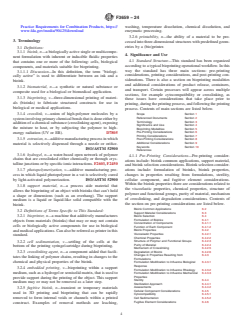
4.1 Standard Structure—This standard has been organized according to a typical bioprinting operational workflow. In this way the standard has three main sections: pre-printing considerations, printing considerations, and post-printing considerations. There is also a section on bioprinting modalities and additional considerations of product release, containers, and transport. Certain processes will appear across multiple sections, for example cytocompatibility or crosslinking, as these issues have considerations that take place prior to printing, during the printing process, and following the printing process. Contents of main sections are listed below.
Scope
Section 1
Referenced Documents
Section 2
Terminology
Section 3
Significance and Use
Section 4
Bioprinting Modalities
Section 5
Pre-Printing Considerations
Section 6
Printing Considerations
Section 7
Post-Printing Considerations
Section 8
Additional Considerations
Section 9
Keywords
Section 10
References
4.1.1 Pre-Printing Considerations—Pre-printing considerations include: bioink common applications, support material, and bioink selection considerations. Bioink selection considerations include: formulation of bioinks, bioink properties, changes in properties resulting from formulations, sterility, cellular component, and fugitive element considerations. Within the bioink properties there are considerations related to the viscoelastic properties, chemical properties, structure of polymer and functional groups, purity of material, mechanism of crosslinking, and degradation considerations. Contents of the section on pre-printing considerations are listed below.
Bioink Common Applications
6.2
Support Material Considerations
6.3
Bioink Selection
6.4
Formulation of Bioinks
6.4.1
Concentration of Components
6.4.1.1
...
SCOPE
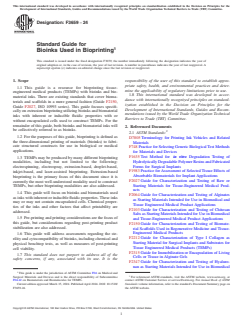
1.1 This guide is a resource for bioprinting tissue-engineered medical products (TEMPs) with bioinks and biomaterial inks. There are existing standards that cover biomaterials and scaffolds in a more general fashion (Guide F2150, Guide F2027, ISO 10993 series). This guide focuses specifically on extrusion bioprinting utilizing bioinks and biomaterial inks with inherent or inducible fluidic properties with or without encapsulated cells used to construct TEMPs. For the remainder of this guide, both bioinks and biomaterial inks will be collectively referred to as bioinks.
1.2 For the purposes of this guide, bioprinting is defined as the three-dimensional printing of materials (bioinks) to fabricate structured constructs for use in biological or medical applications.
1.3 TEMPs may be produced by many different bioprinting modalities, including but not limited to the following: electrospinning, electrospray, extrusion-based, droplet-based, inkjet-based, and laser-assisted bioprinting. Extrusion-based bioprinting is the primary focus of this document since it is currently the most well-understood modality used to construct TEMPs, but other bioprinting modalities are also addressed.
1.4 This guide will focus on bioinks and biomaterials used as inks with inherent or inducible fluidic properties. These inks may or may not contain encapsulated cells. Chemical properties of the inks and other factors that affect printability are addressed.
1.5 Pre-printing and printing considerations are the focus of this guide, but considerations regarding post-printing product stabilization are also addressed.
1.6 This guide will address assessments regarding the sterility and cytocompatibility of bioinks, including chemical and physical benchtop tests, as well as measures of post-printing cell viability.
1.7 This standard does not purport to address all of the safety concerns, if any, associated with its use. It is the responsi...
General Information
- Status
- Published
- Publication Date
- 14-Mar-2024
- Technical Committee
- F04 - Medical and Surgical Materials and Devices
- Drafting Committee
- F04.42 - Biomaterials and Biomolecules for TEMPs
Overview
ASTM F3659-24: Standard Guide for Bioinks Used in Bioprinting provides a foundational resource for professionals in the field of tissue engineering and regenerative medicine. This standard, developed by ASTM International, is specifically designed for the use of bioinks and biomaterial inks in bioprinting tissue-engineered medical products (TEMPs). While bioprinting encompasses various additive manufacturing technologies, this guide focuses primarily on extrusion-based bioprinting, which is currently the most widely used modality for constructing functional biological structures.
The guide is structured to follow the operational workflow typical in bioprinting, dividing considerations into pre-printing, printing, and post-printing stages. It addresses important topics including bioink formulation, material properties, printability, cytocompatibility, sterilization, and handling, as well as guidance on supporting modalities and product transport.
Key Topics
Pre-Printing Considerations
- Selection of appropriate bioinks based on application and desired properties
- Formulation aspects: concentration and function of each component, sterility, and cellular compatibility
- Assessment of bioink properties such as viscosity, chemical structure, crosslinking mechanisms, and degradation
- Evaluation of support materials necessary for complex structural bioprinting
Printing Considerations
- Factors affecting printability, including the impact of cells and materials on extrusion or deposition processes
- Maintenance of cell viability and distribution during the printing process
- Control of temperature, cell shearing, and stabilization of the printed construct
- Application and removal of support materials during embedded or suspended bioprinting
Post-Printing Considerations
- Stabilization of the printed tissue through techniques such as crosslinking, temperature-induced assembly, or evaporation
- Methods for safely removing provisional materials without affecting construct integrity or cell function
- Assessment of final product fidelity, including structural integrity and cell health
Additional Considerations
- Product release testing, including sterility, cytocompatibility, and particle contamination
- Storage and transport requirements for bioink containers, with a focus on maintaining material stability and sterility
Applications
ASTM F3659-24 is aimed at a wide range of stakeholders in bioprinting and regenerative medicine, including:
- Medical Device Developers: Ensures consistent quality and safety in the manufacturing of tissue-engineered medical products using bioprinting.
- Bioprinting Laboratories: Provides protocols for optimizing bioink formulations and print workflows to achieve reproducible results.
- Quality Assurance Teams: Offers guidance on the evaluation of sterility, cytocompatibility, and storage stability for bioinks.
- Researchers: Supports innovation in developing new bioink formulations and bioprinting modalities for emerging medical and research applications.
- Regulatory Professionals: Facilitates alignment with international standards for medical product approval and manufacturing practices.
Bioprinting applications addressed by this guide include fabrication of cartilage, bone, vascular constructs, and new tissue types for both research and clinical use. The standard supports the evolving needs in tissue engineering, drug testing platforms, and regenerative therapies.
Related Standards
ASTM F3659-24 references a comprehensive set of standards for bioink and bioprinting workflows, including:
- General Biomaterials and Scaffolds: ASTM F2150, ASTM F2027, ISO 10993 series
- Material and Cell Viability Testing: ASTM F748, ASTM F1635, ASTM F2739
- Bioink Component Standards: ASTM F2064 (Alginates), ASTM F2103 (Chitosan), ASTM F2212 (Collagen)
- Quality and Sterility: ISO 13485, ISO 9001, ISO 11135, ISO 11137 series
- Device Packaging and Transport: ISO 11607-1, ISO 21973
- Cleanroom and Biocontamination: ISO 14644 series, ISO 14698 series
Additional best practice guidance is referenced from the United States Pharmacopeia and relevant US FDA regulations for good manufacturing practice.
By following ASTM F3659-24, organizations can ensure the effective and safe use of bioinks in bioprinting, supporting reproducible outcomes in tissue engineering and accelerating innovation in biomedical applications.
Frequently Asked Questions
ASTM F3659-24 is a guide published by ASTM International. Its full title is "Standard Guide for Bioinks Used in Bioprinting". This standard covers: SIGNIFICANCE AND USE 4.1 Standard Structure—This standard has been organized according to a typical bioprinting operational workflow. In this way the standard has three main sections: pre-printing considerations, printing considerations, and post-printing considerations. There is also a section on bioprinting modalities and additional considerations of product release, containers, and transport. Certain processes will appear across multiple sections, for example cytocompatibility or crosslinking, as these issues have considerations that take place prior to printing, during the printing process, and following the printing process. Contents of main sections are listed below. Scope Section 1 Referenced Documents Section 2 Terminology Section 3 Significance and Use Section 4 Bioprinting Modalities Section 5 Pre-Printing Considerations Section 6 Printing Considerations Section 7 Post-Printing Considerations Section 8 Additional Considerations Section 9 Keywords Section 10 References 4.1.1 Pre-Printing Considerations—Pre-printing considerations include: bioink common applications, support material, and bioink selection considerations. Bioink selection considerations include: formulation of bioinks, bioink properties, changes in properties resulting from formulations, sterility, cellular component, and fugitive element considerations. Within the bioink properties there are considerations related to the viscoelastic properties, chemical properties, structure of polymer and functional groups, purity of material, mechanism of crosslinking, and degradation considerations. Contents of the section on pre-printing considerations are listed below. Bioink Common Applications 6.2 Support Material Considerations 6.3 Bioink Selection 6.4 Formulation of Bioinks 6.4.1 Concentration of Components 6.4.1.1 ... SCOPE 1.1 This guide is a resource for bioprinting tissue-engineered medical products (TEMPs) with bioinks and biomaterial inks. There are existing standards that cover biomaterials and scaffolds in a more general fashion (Guide F2150, Guide F2027, ISO 10993 series). This guide focuses specifically on extrusion bioprinting utilizing bioinks and biomaterial inks with inherent or inducible fluidic properties with or without encapsulated cells used to construct TEMPs. For the remainder of this guide, both bioinks and biomaterial inks will be collectively referred to as bioinks. 1.2 For the purposes of this guide, bioprinting is defined as the three-dimensional printing of materials (bioinks) to fabricate structured constructs for use in biological or medical applications. 1.3 TEMPs may be produced by many different bioprinting modalities, including but not limited to the following: electrospinning, electrospray, extrusion-based, droplet-based, inkjet-based, and laser-assisted bioprinting. Extrusion-based bioprinting is the primary focus of this document since it is currently the most well-understood modality used to construct TEMPs, but other bioprinting modalities are also addressed. 1.4 This guide will focus on bioinks and biomaterials used as inks with inherent or inducible fluidic properties. These inks may or may not contain encapsulated cells. Chemical properties of the inks and other factors that affect printability are addressed. 1.5 Pre-printing and printing considerations are the focus of this guide, but considerations regarding post-printing product stabilization are also addressed. 1.6 This guide will address assessments regarding the sterility and cytocompatibility of bioinks, including chemical and physical benchtop tests, as well as measures of post-printing cell viability. 1.7 This standard does not purport to address all of the safety concerns, if any, associated with its use. It is the responsi...
SIGNIFICANCE AND USE 4.1 Standard Structure—This standard has been organized according to a typical bioprinting operational workflow. In this way the standard has three main sections: pre-printing considerations, printing considerations, and post-printing considerations. There is also a section on bioprinting modalities and additional considerations of product release, containers, and transport. Certain processes will appear across multiple sections, for example cytocompatibility or crosslinking, as these issues have considerations that take place prior to printing, during the printing process, and following the printing process. Contents of main sections are listed below. Scope Section 1 Referenced Documents Section 2 Terminology Section 3 Significance and Use Section 4 Bioprinting Modalities Section 5 Pre-Printing Considerations Section 6 Printing Considerations Section 7 Post-Printing Considerations Section 8 Additional Considerations Section 9 Keywords Section 10 References 4.1.1 Pre-Printing Considerations—Pre-printing considerations include: bioink common applications, support material, and bioink selection considerations. Bioink selection considerations include: formulation of bioinks, bioink properties, changes in properties resulting from formulations, sterility, cellular component, and fugitive element considerations. Within the bioink properties there are considerations related to the viscoelastic properties, chemical properties, structure of polymer and functional groups, purity of material, mechanism of crosslinking, and degradation considerations. Contents of the section on pre-printing considerations are listed below. Bioink Common Applications 6.2 Support Material Considerations 6.3 Bioink Selection 6.4 Formulation of Bioinks 6.4.1 Concentration of Components 6.4.1.1 ... SCOPE 1.1 This guide is a resource for bioprinting tissue-engineered medical products (TEMPs) with bioinks and biomaterial inks. There are existing standards that cover biomaterials and scaffolds in a more general fashion (Guide F2150, Guide F2027, ISO 10993 series). This guide focuses specifically on extrusion bioprinting utilizing bioinks and biomaterial inks with inherent or inducible fluidic properties with or without encapsulated cells used to construct TEMPs. For the remainder of this guide, both bioinks and biomaterial inks will be collectively referred to as bioinks. 1.2 For the purposes of this guide, bioprinting is defined as the three-dimensional printing of materials (bioinks) to fabricate structured constructs for use in biological or medical applications. 1.3 TEMPs may be produced by many different bioprinting modalities, including but not limited to the following: electrospinning, electrospray, extrusion-based, droplet-based, inkjet-based, and laser-assisted bioprinting. Extrusion-based bioprinting is the primary focus of this document since it is currently the most well-understood modality used to construct TEMPs, but other bioprinting modalities are also addressed. 1.4 This guide will focus on bioinks and biomaterials used as inks with inherent or inducible fluidic properties. These inks may or may not contain encapsulated cells. Chemical properties of the inks and other factors that affect printability are addressed. 1.5 Pre-printing and printing considerations are the focus of this guide, but considerations regarding post-printing product stabilization are also addressed. 1.6 This guide will address assessments regarding the sterility and cytocompatibility of bioinks, including chemical and physical benchtop tests, as well as measures of post-printing cell viability. 1.7 This standard does not purport to address all of the safety concerns, if any, associated with its use. It is the responsi...
ASTM F3659-24 is available in PDF format for immediate download after purchase. The document can be added to your cart and obtained through the secure checkout process. Digital delivery ensures instant access to the complete standard document.
Standards Content (Sample)
This international standard was developed in accordance with internationally recognized principles on standardization established in the Decision on Principles for the
Development of International Standards, Guides and Recommendations issued by the World Trade Organization Technical Barriers to Trade (TBT) Committee.
Designation: F3659 − 24
Standard Guide for
Bioinks Used in Bioprinting
This standard is issued under the fixed designation F3659; the number immediately following the designation indicates the year of
original adoption or, in the case of revision, the year of last revision. A number in parentheses indicates the year of last reapproval. A
superscript epsilon (´) indicates an editorial change since the last revision or reapproval.
1. Scope responsibility of the user of this standard to establish appro-
priate safety, health, and environmental practices and deter-
1.1 This guide is a resource for bioprinting tissue-
mine the applicability of regulatory limitations prior to use.
engineered medical products (TEMPs) with bioinks and bio-
1.8 This international standard was developed in accor-
material inks. There are existing standards that cover bioma-
dance with internationally recognized principles on standard-
terials and scaffolds in a more general fashion (Guide F2150,
ization established in the Decision on Principles for the
Guide F2027, ISO 10993 series). This guide focuses specifi-
Development of International Standards, Guides and Recom-
cally on extrusion bioprinting utilizing bioinks and biomaterial
mendations issued by the World Trade Organization Technical
inks with inherent or inducible fluidic properties with or
Barriers to Trade (TBT) Committee.
without encapsulated cells used to construct TEMPs. For the
remainder of this guide, both bioinks and biomaterial inks will
2. Referenced Documents
be collectively referred to as bioinks.
2.1 ASTM Standards:
1.2 For the purposes of this guide, bioprinting is defined as
D7805 Terminology for Printing Ink Vehicles and Related
the three-dimensional printing of materials (bioinks) to fabri-
Materials
cate structured constructs for use in biological or medical
F748 Practice for Selecting Generic Biological Test Methods
applications.
for Materials and Devices
F1635 Test Method for in vitro Degradation Testing of
1.3 TEMPs may be produced by many different bioprinting
Hydrolytically Degradable Polymer Resins and Fabricated
modalities, including but not limited to the following:
Forms for Surgical Implants
electrospinning, electrospray, extrusion-based, droplet-based,
F1983 Practice for Assessment of Selected Tissue Effects of
inkjet-based, and laser-assisted bioprinting. Extrusion-based
Absorbable Biomaterials for Implant Applications
bioprinting is the primary focus of this document since it is
F2027 Guide for Characterization and Testing of Raw or
currently the most well-understood modality used to construct
Starting Materials for Tissue-Engineered Medical Prod-
TEMPs, but other bioprinting modalities are also addressed.
ucts
1.4 This guide will focus on bioinks and biomaterials used
F2064 Guide for Characterization and Testing of Alginates
as inks with inherent or inducible fluidic properties. These inks
as Starting Materials Intended for Use in Biomedical and
may or may not contain encapsulated cells. Chemical proper-
Tissue Engineered Medical Product Applications
ties of the inks and other factors that affect printability are
F2103 Guide for Characterization and Testing of Chitosan
addressed.
Salts as Starting Materials Intended for Use in Biomedical
1.5 Pre-printing and printing considerations are the focus of
and Tissue-Engineered Medical Product Applications
this guide, but considerations regarding post-printing product
F2150 Guide for Characterization and Testing of Biomate-
stabilization are also addressed.
rial Scaffolds Used in Regenerative Medicine and Tissue-
Engineered Medical Products
1.6 This guide will address assessments regarding the ste-
F2212 Guide for Characterization of Type I Collagen as
rility and cytocompatibility of bioinks, including chemical and
Starting Material for Surgical Implants and Substrates for
physical benchtop tests, as well as measures of post-printing
Tissue Engineered Medical Products (TEMPs)
cell viability.
F2315 Guide for Immobilization or Encapsulation of Living
1.7 This standard does not purport to address all of the
Cells or Tissue in Alginate Gels
safety concerns, if any, associated with its use. It is the
F2347 Guide for Characterization and Testing of Hyaluro-
nan as Starting Materials Intended for Use in Biomedical
This guide is under the jurisdiction of ASTM Committee F04 on Medical and
Surgical Materials and Devices and is the direct responsibility of Subcommittee For referenced ASTM standards, visit the ASTM website, www.astm.org, or
F04.42 on Biomaterials and Biomolecules for TEMPs. contact ASTM Customer Service at service@astm.org. For Annual Book of ASTM
Current edition approved March 15, 2024. Published April 2024. DOI: 10.1520/ Standards volume information, refer to the standard’s Document Summary page on
F3659-24. the ASTM website.
Copyright © ASTM International, 100 Barr Harbor Drive, PO Box C700, West Conshohocken, PA 19428-2959. United States
F3659 − 24
and Tissue Engineered Medical Product Applications ISO 10993-6 Biological evaluation of medical devices—Part
F2450 Guide for Assessing Microstructure of Polymeric 6: Tests for local effects after implementation
Scaffolds for Use in Tissue-Engineered Medical Products
ISO 10993-7 Biological evaluation of medical devices—Part
F2475 Guide for Biocompatibility Evaluation of Medical
7: Ethylene oxide sterilization residual
Device Packaging Materials
ISO 10993-9 Biological evaluation of medical devices—Part
F2603 Guide for Interpreting Images of Polymeric Tissue
9: Framework for identification and quantification of
Scaffolds
potential degradation products
F2739 Guide for Quantifying Cell Viability and Related
ISO 10993-10 Biological evaluation of medical devices—
Attributes within Biomaterial Scaffolds
Part 10: Tests for irritation and skin sensitization
F2902 Guide for Assessment of Absorbable Polymeric Im-
ISO 10993-11 Biological evaluation of medical devices—
plants
Part 11: Tests for systemic toxicity
F2997 Practice for Quantification of Calcium Deposits in
ISO 10993-12 Biological evaluation of medical devices—
Osteogenic Culture of Progenitor Cells Using Fluorescent
Part 12: Sample preparation and reference materials
Image Analysis
ISO 10993-13 Biological evaluation of medical devices—
F2998 Guide for Using Fluorescence Microscopy to Quan-
Part 13: Identification and quantification of degradation
tify the Spread Area of Fixed Cells (Withdrawn 2023)
products from polymeric medical devices
F3089 Guide for Characterization and Standardization of
ISO 10993-14 Biological evaluation of medical devices—
Polymerizable Collagen-Based Products and Associated
Part 14: Identification and quantification of degradation
Collagen-Cell Interactions
products from ceramics
F3106 Guide for in vitro Osteoblast Differentiation Assays
ISO 10993-15 Biological evaluation of medical devices—
F3224 Test Method for Evaluating Growth of Engineered
Part 15: Identification and quantification of degradation
Cartilage Tissue using Magnetic Resonance Imaging
products from metals and alloys
F3259 Guide for Micro-computed Tomography of Tissue
ISO 10993-17 Biological evaluation of medical devices—
Engineered Scaffolds
Part 17: Establishment of allowable limits for leachable
F3354 Guide for Evaluating Extracellular Matrix Decellu-
substances
larization Processes
ISO 10993-18 Biological evaluation of medical devices—
F3510 Guide for Characterizing Fiber-Based Constructs for
Part 18: Chemical characterization of materials
Tissue-Engineered Medical Products
ISO 10993-19 Biological evaluation of medical devices—
F3515 Guide for Characterization and Testing of Porcine
Fibrinogen as a Starting Material for Use in Biomedical Part 19: Physico-chemical, morphological and topographi-
and Tissue-Engineered Medical Product Applications cal characterization of materials
4 ISO 10993-20 Biological evaluation of medical devices—
2.2 ISO Standards:
Part 20: Principles and methods for immunotoxicology
ISO/ASTM 52900 Additive manufacturing—General
testing of medical devices
principles—Fundamentals and vocabulary
ISO 10993-22 Biological evaluation of medical devices—
ISO 7198 Cardiovascular Implants and Extracorporeal
Part 22: Guidance on nanomaterials
Systems—Vascular Protheses—Tubular Vascular Grafts
ISO 11135 Sterilization of health care products—Ethylene
and Vascular Patches
oxide—Requirements for the development validation and
ISO 9000 Quality management systems—Fundamentals and
vocabulary routine control of a sterilization process for medical
devices
ISO 9001 Quality management systems—Requirements
ISO 10993-1 Biological evaluation of medical devices—Part ISO 11137-1 Sterilization of health care products—
1: Evaluation and testing within a risk management Radiation—Part 1: Requirements for development, vali-
process
dation and routine control of a sterilization process for
ISO 10993-2 Biological evaluation of medical devices—Part
medical devices
2: Animal welfare requirements
ISO 11137-2 Sterilization of health care products—
ISO 10993-3 Biological evaluation of medical devices—Part
Radiation—Part 2: Establishing the sterilization dose
3: Tests for genotoxicity, carcinogenicity and reproductive
ISO 11607-1 Packaging for terminally sterilized medical
toxicity
devices—Part 1: Requirements for materials, sterile bar-
ISO 10993-4 Biological evaluation of medical devices—Part
rier systems and packaging systems
4: Selection of tests for interactions with blood
ISO 11607-2 Packaging for terminally sterilized medical
ISO 10993-5 Biological evaluation of medical devices—Part
devices—Part 2: Validation requirements for forming,
5: Tests for in vitro cytotoxicity
sealing and assembly processes
ISO 11737-1 Sterilization of health care products—
Microbiological methods—Part 1: Determination of a
The last approved version of this historical standard is referenced on
population of microorganisms on products
www.astm.org.
ISO 13019 Tissue-engineered medical products—
Available from International Organization for Standardization (ISO), ISO
Quantification of sulfated glycosaminoglycans (sGAG)
Central Secretariat, Chemin de Blandonnet 8, CP 401, 1214 Vernier, Geneva,
Switzerland, https://www.iso.org. for evaluation of chondrogenesis
F3659 − 24
ISO 13408-1 Aseptic processing of health care products— ISO 14698-2 Cleanrooms and associated controlled
Part 1: General requirements environments—Biocontamination control Part 2: Evalua-
tion and interpretation of biocontamination data
ISO 13408-2 Aseptic processing of health care products—
ISO 16379 Tissue-engineered medical products—
Part 2: Sterilizing filtration
Evaluation of Anisotropic Structure of Articular Cartilage
ISO 13408-3 Aseptic processing of health care products—
Using DT (Diffusion Tensor)—MR Imaging
Part 3: Lyophilization
ISO 17668-1 Sterilization of health care products—Moist
ISO 13408-4 Aseptic processing of health care products—
heat—Part 1: Requirements for the development, valida-
Part 4: Clean-in-place technologies
tion and routine control of a sterilization process for
ISO 13408-5 Aseptic processing of health care products—
medical devices
Part 5: Sterilization in place
ISO 20399-1 Biotechnology—Ancillary materials present
ISO 13408-6 Aseptic processing of health care products—
during the production of cellular therapeutic products-
Part 6: Isolator systems
Part 1: General requirements
ISO 13408-7 Aseptic processing of health care products—
ISO 20399-2 Biotechnology—Ancillary materials present
Part 7: Alternative processes for medical devices and
during the production of cellular therapeutic products-
combination products
Part 2: Best practice guidance for ancillary material
ISO 13485 Medical devices—Quality management
suppliers
systems—Requirements for regulatory purposes
ISO 20399-3 Biotechnology—Ancillary materials present
ISO 14644-1 Cleanrooms and associated controlled
during the production of cellular therapeutic products-
environments—Part 1: Classification of air cleanliness by
Part 3: Best practice guidance for ancillary material users
particle concentration
ISO 21560 General requirements of tissue-engineered medi-
ISO 14644-2 Cleanrooms and associated controlled
cal products
environments—Part 2: Monitoring to provide evidence of
ISO 21973 Biotechnology—General requirements for trans-
cleanroom performance related to air cleanliness by par-
portation of cells for therapeutic use
ticle concentration
2.3 USP Standards:
ISO 14644-3 Cleanrooms and associated controlled
USP <61> Microbiological Examination of Nonsterile Prod-
environments—Part 3: Test methods
ucts
ISO 14644-4 Cleanrooms and associated controlled
USP <71> Sterility Tests
environments—Part 4: Design construction and start-up
USP <85> Bacterial Endotoxins Test
ISO 14644-5 Cleanrooms and associated controlled
USP <161> Medical Devices—Bacterial Endotoxin and Py-
environments—Part 5: Operations
rogen Tests
ISO 14644-7 Cleanrooms and associated controlled
USP <1043> Ancillary Materials for Cell, Gene, and Tissue-
environments—Part 7: Separative devices (clean air
Engineered Products
hoods, gloveboxes, isolators and mini-environments)
2.4 Other Documents:
ISO 14644-8 Cleanrooms and associated controlled
21 CFR 210 Current Good Manufacturing Practice in
environments—Part 8: Classification of air cleanliness by
Manufacturing, Processing, Packaging, or Holding of
chemical concentration (ACC)
Drugs; General
ISO 14644-9 Cleanrooms and associated controlled
21 CFR 211 Current Good Manufacturing Practice for Fin-
environments—Part 9: Classification of surface cleanli-
ished Pharmaceuticals
ness by particle concentration
21 CFR 610.12 General Biological Products Standards—
ISO 14644-10 Cleanrooms and associated controlled
Sterility
environments—Part 10: Classification of surface cleanli-
21 CFR 820 Quality System Regulation
ness by chemical concentration
21 CFR 1271 Human Cells, Tissues and Cellular and Tissue
ISO 14644-13 Cleanrooms and associated controlled
Based Products
environments—Part 13: Cleaning of surfaces to achieve
21 CFR 1271.210 Human Cells, Tissues and Cellular and
defined levels of cleanliness in terms of particle and
Tissue Based Products; Suppliers and Reagents
chemical classifications
FDA Guidance on 10993-1 Guidance for Industry and Food
ISO 14644-14 Cleanrooms and associated controlled
and Drug Administration Staff: Use of International Stan-
environments—Part 14: Assessment of suitability for use
dard ISO 10993-1, “Biological evaluation of medical
of equipment and materials by airborne chemical concen- devices—Part 1: Evaluation and testing within a risk
tration management process” https://www.fda.gov/media/85865/
ISO 14644-15 Cleanrooms and associated controlled download
environments—Part 15: Assessment of suitability for use FDA Guidance on GMP for Combination Products Guidance
for Industry and FDA Staff Current Good Manufacturing
of equipment and materials by airborne chemical concen-
tration
ISO 14698-1 Cleanrooms and associated controlled
environments—Biocontamination control Part 1: General 5
Available from U.S. Pharmacopeial Convention (USP), 12601 Twinbrook
principles and methods Pkwy., Rockville, MD 20852-1790, http://www.usp.org.
F3659 − 24
Practice Requirements for Combination Products, https:// washing, temperature dissolution, chemical dissolution, and
www.fda.gov/media/90425/download enzymatic processing.
3.2.6 printability, n—the ability of a material to be pro-
3. Terminology
cessed into three-dimensional structures with predefined geom-
etries by a (bio)printer.
3.1 Definitions:
3.1.1 bioink, n—a biologically active single or multicompo-
4. Significance and Use
nent formulation with inherent or inducible fluidic properties
4.1 Standard Structure—This standard has been organized
that contains one or more of the following: cells, biological
according to a typical bioprinting operational workflow. In this
components, and materials suitable for bioprinting.
way the standard has three main sections: pre-printing
3.1.1.1 Discussion—In this definition, the term “biologi-
considerations, printing considerations, and post-printing con-
cally active” is used to differentiate between an ink and a
siderations. There is also a section on bioprinting modalities
bioink.
and additional considerations of product release, containers,
3.1.2 biomaterial, n—a synthetic or natural substance or
and transport. Certain processes will appear across multiple
composite used for a biological or biomedical application.
sections, for example cytocompatibility or crosslinking, as
3.1.3 bioprinting, v—three-dimensional printing of materi-
these issues have considerations that take place prior to
als (bioinks) to fabricate structured constructs for use in
printing, during the printing process, and following the printing
biological or medical applications.
process. Contents of main sections are listed below.
3.1.4 crosslink, v—union of high-polymer molecules by a
Scope Section 1
Referenced Documents Section 2
system involving primary chemical bonds that is done either by
Terminology Section 3
addition of a chemical substance (crosslinking agent), exposing
Significance and Use Section 4
the mixture to heat, or by subjecting the polymer to high-
Bioprinting Modalities Section 5
Pre-Printing Considerations Section 6
energy radiation (UV or EB). D7805
Printing Considerations Section 7
3.1.5 extrusion, n—additive manufacturing process in which
Post-Printing Considerations Section 8
Additional Considerations Section 9
material is selectively dispensed through a nozzle or orifice.
Keywords Section 10
ISO/ASTM 52900
References
3.1.6 hydrogel, n—a water-based open network of polymer
4.1.1 Pre-Printing Considerations—Pre-printing consider-
chains that are crosslinked either chemically or through crys-
ations include: bioink common applications, support material,
talline junctions or by specific ionic interactions. F2603, F2450
and bioink selection considerations. Bioink selection consider-
ations include: formulation of bioinks, bioink properties,
3.1.7 photopolymerization, v—additive manufacturing pro-
cess in which liquid photopolymer in a vat is selectively cured changes in properties resulting from formulations, sterility,
by light-activated polymerization. ISO/ASTM 52900 cellular component, and fugitive element considerations.
Within the bioink properties there are considerations related to
3.1.8 support material, n—a process aide material that
the viscoelastic properties, chemical properties, structure of
allows the bioprinting of an object with bioinks that can’t hold
polymer and functional groups, purity of material, mechanism
a shape or dimensions (such as an overhang). The support
of crosslinking, and degradation considerations. Contents of
medium is a liquid or liquid-like solid compatible with the
the section on pre-printing considerations are listed below.
bioink.
Bioink Common Applications 6.2
3.2 Definitions of Terms Specific to This Standard:
Support Material Considerations 6.3
3.2.1 bioprinter, n—a machine that additively manufactures Bioink Selection 6.4
Formulation of Bioinks 6.4.1
objects from materials (bioinks) that may or may not contain
Concentration of Components 6.4.1.1
cells or biologically active components for use in biological
Function of Each Component 6.4.1.2
Bioink Properties 6.4.2
and medical applications. Can also be referred as printer in this
Viscoelastic Properties 6.4.2.1
standard.
Chemical Properties 6.4.2.2
Structure of Polymer and Functional Groups 6.4.2.3
3.2.2 cell sedimentation, v—settling of the cells at the
Purity of Material 6.4.2.4
bottom of the printing syringe/cartridge during bioprinting.
Mechanism of Crosslinking 6.4.2.5
Degradation of Bioink 6.4.2.6
3.2.3 crosslinking agent, n—a component added that facili-
Changes in Properties Resulting from 6.4.3
tates the linking of polymer chains, resulting in changes to the
Formulations
chemical and physical properties of the bioink.
Formulation Modification to Influence Biological 6.4.3.1
Response
3.2.4 embedded printing, v—bioprinting within a support
Formulation Modification to Influence Rheology 6.4.3.2
medium, such as a hydrogel or semisolid matrix, that is used to
Formulation Modification to Influence Mechanical 6.4.3.3
Properties
provide support during the printing of the object. This support
Sterility 6.4.4
medium may or may not be removed as a later step.
Sterilization Approach 6.4.4.1
Assessments 6.4.4.2
3.2.5 fugitive bioink, n—transient or temporary materials
Cellular Component Considerations 6.4.5
used in 3D printing and bioprinting that can be rapidly
Cytocompatibility 6.4.5.1
removed to form internal voids or channels within a printed Cell Sedimentation 6.4.5.2
Fugitive Element Considerations 6.4.6
construct. Examples of removal methods are leaching,
F3659 − 24
4.1.2 Printing Considerations—Printing considerations in- 4.1.4 Additional Considerations—Additional considerations
clude: printability, specifically bioink considerations, cellular include: discussion on product release, container, and transport
component, support material, stabilization, and aseptic printing considerations. Container considerations focus mainly on the
considerations. Within the cellular component section consid- storage stability of bioinks, transfer of bioinks to the print
erations cover cell viability, temperature, cell shearing, cell cartridge, as well as container closing integrity and assessing
distribution, sedimentation, and concentration in the bioink. the quality of the container. Contents of the section on
Contents of the section on printing considerations are listed additional considerations are listed below.
below.
Product Release Considerations 9.2
Bioink-Specific Release Considerations 9.2.1
Printability 7.2
Sterility Assurance 9.2.2
Bioink Considerations 7.2.1
Adventitious Agent and Pyrogen Testing 9.2.3
Effect of Cells on Printability 7.2.1.1
Functional Testing 9.2.4
Effect of Biomaterials on Printability 7.2.1.2
Particle Testing 9.2.5
Temperature 7.2.2
Container Considerations 9.3
Assessments 7.2.3
Storage Stability of Bioinks 9.3.1
Cellular Component Considerations 7.3
Transfer of Bioinks to the Print Cartridge 9.3.2
Viability of Cells During the Printing Process 7.3.1
Preparing the Working Station 9.3.2.1
Temperature 7.3.2
Maintenance of Sterility 9.3.2.2
Cell Shearing 7.3.3
Physical Challenges 9.3.2.3
Cell Distribution in the Bioink 7.3.4
Additional Container Considerations 9.3.3
Cell Sedimentation 7.3.4.1
Container Closure Integrity 9.3.3.1
Cell Concentration 7.3.5
Extractables and Leachables 9.3.3.2
Support Material Considerations 7.4
Particulates 9.3.3.3
Printed Support Material 7.4.1
Container Opacity 9.3.3.4
Support Material Used as an Embedding Medium 7.4.2
Transport 9.4
Stabilization 7.5
Cytocompatibility 7.5.1
5. Bioprinting Modalities
Crosslinking 7.5.2
Temperature 7.5.3
5.1 Several factors drive the selection of bioprinting
Aseptic Printing Considerations 7.6
technologies, including but not limited to cost, ease of use,
4.1.3 Post-Printing Considerations—Post-printing consid-
material capabilities, resolution, and fabrication speed. The
erations include: post-print bioink, stabilization, and consider-
operation of any of the bioprinting platforms needs bioinks
ations for removal of provisional components and materials.
with a particular set of properties. Specific parameters must be
Post-printing stabilization focuses on the modalities (such as
considered when designing a bioink for a particular bioprinting
crosslinking, temperature-induced self-assembly, and evapora-
method, for example, extrusion bioprinting needs shear-
tion) as well as stabilization effects on the cell health, function,
thinning materials. Generally, within these modalities the
and modification of properties. The considerations for removal
resolution and speed are primarily governed by the bioink
of provisional components and materials include the types of
properties (for example, photoinitiator concentration, optical
components, timing and method of removal, and the removal
density) and processing parameters (for example, laser
effects. Contents of the section on post-printing considerations
intensity, energy, exposure duration). Although general char-
are listed below.
acteristics of typical bioprinting modalities are described
Post-Print Bioink Considerations 8.2
herein, processes and capabilities may vary across specific
Structural Fidelity 8.2.1
implementations.
Viability of Cells 8.2.2
Biomaterial Properties 8.2.3
5.2 Extrusion-Based Bioprinting—Extrusion-based direct-
Cell Sedimentation 8.2.4
Cell Morphology 8.2.5 write 3D printing (EDP) techniques, including bioplotting and
Stabilization Considerations 8.3
microextrusion printing, consist of robotically controlled de-
Stabilization Modalities 8.3.1
position of a viscous material as continuous filaments (1). The
Crosslinking 8.3.1.1
Temperature-Induced Self-Assembly 8.3.1.2 material is stored in a reservoir and is dispensed through a
Evaporation 8.3.1.3
nozzle onto a substrate as either a self-supporting construct or,
Stabilization Effects 8.3.2
in the case of embedded printing, within a bath of another
Cell Health and Function 8.3.2.1
Modification of Mechanical Properties 8.3.2.2 supporting material. The driving mechanism for material
Considerations for Removal of Provisional 8.4
extrusion is generally either pneumatic or mechanical. The 3D
Components and Materials
construct is created layer-by-layer by depositing two-
Types of Components 8.4.1
Support Components 8.4.1.1 dimensional layers by moving the nozzle and substrate relative
Bioink Elements 8.4.1.2
to one another. The subsequent layers are printed by moving
Support Bath Materials 8.4.1.3
the stage or the nozzle in the z-direction, with the deposited
Timing of Removal 8.4.2
Method of Removal 8.4.3
layer serving as the foundation for the next layer. The 3D
Chemical Removal 8.4.3.1
construct can also be created freeform by depositing bioinks
Temperature-Based Removal 8.4.3.2
through some combination of x-, y-, and z-direction motion,
Physical Removal 8.4.3.3
Removal Effects 8.4.4
Structural Fidelity 8.4.4.1
Cell Health and Function 8.4.4.2 6
The boldface numbers in parentheses refer to the list of references at the end of
Modification of Properties 8.4.4.3
this standard.
F3659 − 24
for example during embedded printing. The 3D construct is experiences a force due to the applied voltage between the
stabilized by various processes including material phase nozzle and the collector. Once this force overcomes the fluid
transition, physical, and chemical crosslinking mechanisms. A surface tension, a continuous jet is drawn towards the collector.
few systems use multiple print heads to facilitate serial Appropriate levels of fluid flow rate, voltage, and collector
deposition of several materials. EDP processes are compatible distance are used in EDW processes to prevent the whipping
with a wide range of fluid properties and can create constructs instability in the jet, typically associated with traditional
with varying resolution, sizes, and cell densities. electrospinning, as it is collected onto the collector. The
relative motion between the nozzle and collector is governed
5.3 Droplet-Based Bioprinting—Droplet-based bioprinting
by a computer-aided toolpath characteristic of additive manu-
techniques, including inkjet printing, acoustic jet printing, and
facturing. Depending on the nature of the material, solidifica-
micro-valve printing, involve creating 3D constructs by layer-
tion of the fluid jet can be achieved via cooling, solvent
on-layer deposition of controlled volumes of fluid droplets in
evaporation, or chemical crosslinking using coagulation baths.
targeted spatial locations. The droplets can be produced in two
Bioink properties (for example, rheology, thermal
modes, a continuous mode where the ongoing generation of
conductivity), ribbon properties (for example, optical
droplets produces a jet, or in a droplet-on-demand mode where
transparency, thermal conductivity, thickness of bioink
the droplets are generated only when needed for printing.
coating), and processing parameters (for example, laser
Thermal or acoustic forces are used to eject droplets of the fluid
intensity, energy, and exposure duration) impact the resolution.
through a print head with a valve. The print head is heated
It should be noted that EDW processes are not typically
electrically or contains a piezoelectric crystal that produces
suitable for processing bioinks containing living cells due to
acoustic waves to produce pulses of pressure that force the
high solution temperature, solution volatility, and/or process-
droplets from the valve at regular intervals. The print heads can
induced shear stresses.
be combined in an adjustable array format to facilitate simul-
taneous printing of multiple cells and materials. 3D constructs 5.6 Laser-Assisted Bioprinting—Laser-assisted bioprinting
may be created by printing binder droplets onto a powder bed
refers to a set of direct writing processes including laser-
(called binder jetting) or a photopolymer/monomer/oligomer induced forward transfer (LIFT), biological laser processing
which is subsequently crosslinked (called material jetting).
(BioLP), and matrix-assisted pulsed laser evaporation direct
These techniques enable high-throughput printing, high writing (MAPLE DW) that utilize a pulsed laser to deposit
resolution, inexpensiveness, and high reproducibility, but suf-
bioinks onto a substrate. Central to the process is a glass or
fer from limited material availability due to the requirement for
quartz ribbon that is coated with the bioink. The nanoseconds
the biological material to be in liquid form. Droplet-based
laser with UV or near-UV wavelength scans the ribbon causing
approaches can also be sensitive to the density or volume
rapid volatilization of the bioink and ejection of droplets or a
fraction of suspended particles (including cells), which can
plume which transfers material onto a receiving substrate. The
affect the droplet formation process.
receiving substrate may be coated with a supportive material to
enable cellular adhesion and sustained growth after cell trans-
5.4 Vat Photopolymerization-Based Bioprinting—Vat
fer from the ribbon. Laser-assisted bioprinting processes can
photopolymerization-based bioprinting processes including
typically enable single cell deposition and achieve picoscale to
stereolithography (SLA), digital light processing (DLP), and
microscale resolution. Bioink properties (for example,
two-photon polymerization (2PP) involve selective crosslink-
rheology, thermal conductivity), ribbon properties (for
ing of photosensitive bioinks using an appropriate mode and
example, optical transparency, thermal conductivity, thickness
wavelength of irradiation. The bioink is contained in a vat, and
of bioink coating), and processing parameters (for example,
photopolymerization is achieved by layerwise scanning of a
laser intensity, energy, and exposure duration) impact the
laser beam (SLA), layerwise projection of images using a
resolution.
digital micromirror device (DLP), or by direct writing using
ultrashort laser pulses (2PP). Vat photopolymerization-based
6. Pre-Printing Considerations
processes can typically offer a higher resolution and faster
speed than many other bioprinting processes. Bioink properties
6.1 Prior to performing a bioprint, there are important
(for example, rheology, thermal conductivity), ribbon proper-
pre-print considerations to take into account. For example:
ties (for example, optical transparency, thermal conductivity,
6.1.1 Establish if the bioink will include live cells. If so, is
thickness of bioink coating), and processing parameters (for
the same bioink that includes the cells being used to provide
example, laser intensity, energy, and exposure duration) impact
the scaffold structural portion of the print, or will a separate
the resolution. Due to the requirement of photosensitivity, the
bioink be used for structural printing and the cells subsequently
current library of bioinks suitable for vat photopolymerization
deposited within the scaffold either during the print (perhaps on
is limited compared to that of other bioprinting processes.
a layer-by-layer basis or via a dual-head printer)?
5.5 Electrostatic Direct Writing (EDW) Bioprinting— 6.1.2 Establish if a bioink with cells will provide the desired
structural properties needed for the print.
Electrostatic direct writing (EDW) techniques including melt
electrowriting, electrohydrodynamic printing, and near-field 6.1.3 Establish if the bioink with cells will provide the
appropriate cell density required for the given application or if
electrospinning use an electric field for the generation of a
continuous, stable fluid jet that is collected onto a computer- subsequent cell culture and proliferation will be required.
controlled translating collector. The fluid (for example, melt, 6.1.4 Establish the effects of the printing process on cell
solution, gel) extruded at a low flow rate through a nozzle viability.
F3659 − 24
6.1.5 Establish how the print will be removed from the print dissolved separately in buffers such as sterile phosphate buffer
bed (that is, will the print require crosslinking in order to give saline (PBS) at temperatures around 25 °C. Optimization of the
it the mechanical properties necessary to remove it from the
components’ concentrations are application, materials, and
print bed). printing system specific. For example, concentrations of the
components affect the viscosity which can impact printability
6.1.6 Establish if the print will need to undergo post-
of the materials and fidelity of the printed structures; in
processing. If so, will the process selected kill cells in the print,
addition, at higher concentrations the stiffness of the material
and if so, should such prints be printed without cells, fixed, and
may be deleterious to cells (4). Importantly, these compositions
subsequently seeded with cells?
will vary based on the cell systems (that is, cell-based
6.2 Bioink Common Applications—Common bioink appli-
strategies such as cell clusters, microvessels, etc.) and polym-
cations include bioprinting 3D tissue constructs (ISO 21560,
erization methods used. After cells are mixed with the alginate
21 CFR 1271). The most frequently reported bioprinted tissues
solution, the resulting alginate-cell mixture is often placed into
are cartilage (Test Method F3224, ISO 13019), bone (Practice
a calcium chloride solution at low concentrations (1 to 2 %
F2997, Guide F3106, ISO 16379), and vasculature (ISO 7198)
CaCl ). Then, the gelatin, methylcellulose, or other polymer-
(2). Other applications will likely be developed in the future.
izing agents are used to increase viscosity of the bioink to
6.3 Support Material Considerations—In general 3D
prepare its printability. Table 1 displays the main bioink
printing, material supports are often printed with a thinner
components, their properties, typical concentrations, and func-
infill/shape and function to support overhanging parts of the
tions.
print (typically 45° overhang or greater). The thinner infill
6.4.1.2 Function of Each Component—When considering
makes them easier to break off after the print is complete.
which bioink formulation to use, it is important to consider the
Depending on the bioink, the bioink may not be able to support
function of the independent components as well as the com-
itself without an external support material (for example,
pounding functions within a bioink. For example, as mentioned
collagen bioinks that are printed into a gelatin support bath—
in 6.4.1, alginate is one of the commonly used aspects of
this freeform reversible embedding of suspended hydrogels is
current bioink formulations due to its biocompatibility and
called “FRESH” printing (3)) or being crosslinked.
instantaneous ability to crosslink with cations such as calcium.
Importantly, alginate is structurally like natural extracellular
6.4 Bioink Selection—Bioink types vary in their source,
matrices and provides a stiffness to the matrix which function-
composition, and optical, rheological, mechanical, chemical,
ally facilitates cell differentiation and growth. Gelatin,
and other properties (for example, viscosity, gelation time, etc).
methylcellulose, or alginate are frequently mixed to improve
Bioink selection is critical in the bioprinting process as the user
overall viscosity of the bioink construct, as well as improving
needs to choose a suitable bioink that will provide the intended
unstable/erratic degradation of the matrix, facilitating cell-cell
biochemical and physical cues to promote cellular growth,
interaction, and increasing cell viability (Guide F2739) (5).
development, and proliferation (Practices F748 and F1983;
Gelatin is primarily used due to its identical composition to
Guides F2027 and F2150). The selection of the bioink will also
naturally occurring collagen. Moreover, gelatin can function-
dictate the type of bioprinter and bioprinter modality that will
ally mimic the native ECM and provides temporary support to
be required for manufacturing the desired construct.
the bioink, allowing for the production of channels, vessels, or
6.4.1 Formulation of Bioinks—Bioink formulations vary
other vasculature to promote cellular networking. Another
according to their base components, which include hydrogel-
well-known, highly used bioprinting formulation includes the
based, protein-based, polysaccharides, decellularized extracel-
use of collagen (Guides F2212 and F3089), a key element to
lular matrix-based (dECM), synthetic polymer-based bioinks,
the native ECM (particularly in cartilage) that confers unique
and combinations thereof. Each of these methods (Guide
biocompatibility and prevents immunological rejection. Lastly,
F3354) has its own benefits and drawbacks involving construc-
gelatin methacryloyl (GelMA) plays an important role in
tion of the scaffolding system and regeneration/replacement of
bioink formulations as well. This component confers suitable
the natural extracellular matrix. Currently, the most common
rheological and mechanical properties, improving the crosslink
bioink formulations in 3D bioprinting involve using collagen-
ability of hydrogel formations.
based substances (like gelatin) or alginate, a naturally occur-
ring polysaccharide acquired from brown seaweeds, which is 6.4.2 Bioink Properties—While bioink properties vary de-
characterized by an overall negative charge and lack of
pending on their respective formulations, the key fundamental
integrin-binding sites, enabling easy crosslinking with cations principles are their crosslinking capabilities, which provide
such as calcium (Guides F2064 and F2315). To facilitate cell
mechanical strength and stiffness to mimic cell and tissue
growth, chemically modified alginates with arginyl-glycyl-
mechanical properties, and the rheological properties of the
aspartic acid (RGD) peptides are typically used, as these
materials used, which can assist in bioink printability while
peptides display integrin-binding capabilities. Together with
also improving cell viability and function (7). Enhancing
the alginate’s crosslinking properties, this formulation enables
crosslinking capabilities (typically through the use of bioink
the construction of tissue-mimetic 3D matrices composed of
components such as GelMA) allows for significant cell viabil-
living cells and other biodegradable materials.
ity (in many cases, >90 %) and induction of differentiation
6.4.1.1 Concentration of Components—As mentioned in among various cell types to mimic in vivo tissue systems. In
6.4.1, bioinks are often composed of alginate and gelatin at a some cases, cell proliferation and viability has been observed
variety of concentrations. These components are typically for two or more weeks, which demonstrates how favorable
F3659 − 24
TABLE 1 Major Components of Bioink Formulations Including Their Properties, Typical Concentrations, and Functions (6)
Component Properties Concentrations Functions
Alginate (F2064, F2315) Naturally occurring, non-toxic, biodegradable, ~1–4 % w/v Enables the entrapment of water and other
non-immunogenic linear, highly biocompatible molecules, provides defense mechanism for
with other substances encapsulated cells, and is highly compatible
with other components, enabling different hy-
drogel components depending on desired
properties/cells used
Gelatin Identical composition to naturally occurring Between 8–15 % w/v Functions to mimic the innate cellular ECM to
collagen provide temporary support for the creation of
channels, vessels, or vasculature
GelMA Confers excellent rheological properties; bio- Between 4–10 % w/v Improves crosslink-ability of hydrogels for tis-
compatibility and tunable biodegradation sue engineering via a two-step crosslinking
process (reversible thermal gelation and per-
manent photo-crosslinking)
Hyaluronic Acid (F2347) Anionic, non-sulfated glycosaminoglycan 0–1 % w/w Useful for skin tissue engineering as it is a
present in connective and neural tissues major component in connective and neural
tissues
Cellulose Obtained as fibers from natural resources, 9 mg ⁄mL final concentra- Can be used to prepare hydrogels with a va-
confer mechanical properties to hydrogels; tion or 2 % w/v riety of structures/properties
confers biocompatibility due to abundance of
hydroxyl groups
Collagen (F2212, F3089) Main component of mammalian extracellular 3–70 mg/mL final Improves biocompatibility of hydrogel mixture
matrix (i.e., connective tissues as cartilage); concentration and prevents immunological rejection, a sig-
uniquely biocompatible and has low immuno- nificant limitation to current clinical use cases
genicity of hydrogels
Polyethylene glycol Confers hydrophilicity to the hydrogel; good ~1 % w/v Useful for vascular tissue, bone tissue, and/or
(PEG)-derivatives mechanical stability cartilage tissues
Agarose Comparable to gelatin according to thermal 1.5 % w/v Provides great support for chondrogenic dif-
behavior, mimicking the ECM; low gelling ferentiation in MSCs
temperature; high mechanical strength
Polyethylene glycol (PEG) Confers hydrophilicity to the hydrogel 20 % base polymer; Facilitates exchange of cell nutrients and
10 % PEG crosslinker waste due to inherent molecular structure
Chitosan Naturally obtained, biodegradable polymer 3–5 % w/v Widely used in bone tissue repair engineering
similar to many other components of the applications. Positively charged, enabling hy-
ECM; low mechanical properties, slow drophobic interactions with gel components to
gelation, and antimicrobial activity; some are promote cell encapsulation
insoluble in water
Fibrinogen (Fibrin) (F3515) Main ECM protein in blood clots and forms 1–100 mg/mL Improves biocompatibility of hydrogel mixture,
when fibrinogen is enzymatically crosslinked rapid enzymatic gelation that does not dam-
by Thrombin into fibrin; confers biocompatibil- age cells
ity through multiple cell and growth factor
binding domains
dECM (decellularized ex- Multiple components of extracellular matrix 3–70 mg/mL final Improves biocompatibility of hydrogel mixture
tracellular matrix) (F3354) typically derived from a specific tissue (e.g., concentration and prevents immunological rejection, a sig-
bladder, muscle, skin); uniquely biocompatible nificant limitation to current clinical use cases
and has low immunogenicity of hydrogels, tissue specific factors that can
improve regeneration
bioinks are for promoting cell growth. PEG/gelatin/hyaluronic- nected polymer chains into a crosslinked network, where the
based bioinks display exceptional cellular adhesion properties pore size, pore interconnectivity, and polymer chemistry influ-
as well, as they mimic the natural extracellular matrix and ence cell motility and the diffusion of nutrients and metabolites
enhance cell viability to a greater degree. Numerous natural (8). Other important bioink factors relate to the bioprinting
(and some synthetic) bioink formulations are biodegradable process, specifically, the printing parameters, structure, and
and have little impact on cellular microenvironment. Concern- resolution, which all impact the final printing results. For
ing rheological propert
...
Questions, Comments and Discussion
Ask us and Technical Secretary will try to provide an answer. You can facilitate discussion about the standard in here.
Loading comments...