

ASTM F2108-17(2022)
(Practice)Standard Practice for Inspection of Transparent Parts by Prism
General Information
- Abstract
SIGNIFICANCE AND USE
4.1 Prisms are useful tools for viewing areas otherwise obstructed or hidden from normal viewing. For example, transparency bolt holes, voids, and delaminations that are covered by edge strips or frames can be seen through a prism. The prism, once put against the transparency, with a coupling agent to wet the surfaces, allows viewing of the area below where the prism is placed.
SCOPE
1.1 Aerospace transparencies undergo high stresses induced by flight, environmental, or other factors. The transparency attachment points are especially subject to fatigue. These areas of fatigue are often obstructed or hidden from normal inspection. An inspector, following the techniques described in this practice, shall use a prism to view damage located near transparency bolt holes, voids, and delamination that are hidden by edge strips or frames.
1.2 The purpose of this practice is to provide acceptable methods for performing prism inspections of transparent materials with specific emphasis on aircraft windscreens and canopies. Caveats and lessons learned from experience are included to assist authors in writing tailored inspection instructions for specific applications.
1.3 This standard does not purport to address all of the safety concerns, if any, associated with its use. It is the responsibility of the user of this standard to establish appropriate safety, health, and environmental practices and determine the applicability of regulatory limitations prior to use.
1.4 This international standard was developed in accordance with internationally recognized principles on standardization established in the Decision on Principles for the Development of International Standards, Guides and Recommendations issued by the World Trade Organization Technical Barriers to Trade (TBT) Committee.
- Status
- Published
- Publication Date
- 30-Apr-2022
- Technical Committee
- F07 - Aerospace and Aircraft
- Drafting Committee
- F07.08 - Transparent Enclosures and Materials
Overview
ASTM F2108-17(2022), "Standard Practice for Inspection of Transparent Parts by Prism," provides standardized methods for inspecting transparent materials, with a particular focus on aerospace transparencies such as aircraft windscreens and canopies. Developed by ASTM, this practice addresses the challenge of inspecting areas that are usually hidden or obstructed, such as the attachment points of transparencies, which are prone to stress and fatigue. The standard details how using a prism and an optical coupling agent allows examiners to visually access and assess hidden regions for defects like cracks, delaminations, and voids.
Key Topics
Principle of Prism Inspection: Prisms are optical elements that, when placed against a transparent surface with a coupling agent, allow inspectors to view obstructed or concealed areas beneath the surface. This method is particularly important for revealing damage around bolt holes or beneath edge strips and frames.
Inspection Procedure:
- Clean both the transparency and prism using appropriate solutions to avoid scratches.
- Apply a suitable coupling agent (e.g., USP grade glycerol) to ensure optical contact.
- Place the prism gently on the area of interest and use a light source as required for optimal visibility.
- Alter viewing angles and move the prism as needed to inspect the entire area, looking for anomalies such as cracks, delaminations, and voids.
Types of Flaws Detected:
- Cracks emerging from bolt holes or edges
- Delaminations within multi-layered transparencies
- Voids or resin-rich areas at bondlines or beneath edge strips
- Dimensional and alignment tolerances in newly installed transparencies
Documentation: The standard outlines recommended data to collect, including inspector information, inspection results (e.g., presence of delamination, cracks, or voids), and photographic evidence captured through the prism.
Applications
Aerospace Maintenance: This standard is essential for routine and in-depth inspection of aircraft windshields, canopies, and other transparent structures. It helps maintenance personnel detect early signs of stress-induced damage, thus improving safety and prolonging the lifespan of critical components.
Manufacturing Quality Control: Prism inspection techniques are valuable for verifying correct installation and bonding of transparent materials in production environments. This includes checking for proper alignment, absence of voids, and dimensional accuracy at attachment points.
Forensics and Failure Analysis: The method enables investigators to uncover hidden defects or failure points in returned, failed, or in-service transparencies.
Related Standards
- ASTM F3002: Standard Guide for Evaluating Aircraft Cockpit Windshield Transparency
- ASTM E233: Standard Practice for Inspection of Large, Accessible Areas of Transparent Materials
- SAE AIR1377: Aerospace Recommended Practice for the Inspection of Aircraft Transparencies
Practical Value
Implementing ASTM F2108-17(2022) ensures high reliability in detecting otherwise hidden damage in transparent aerospace components. Using prisms for transparency inspection enhances the capability to prevent undetected degradation, supports compliance with regulatory and safety requirements, and ultimately contributes to the integrity and longevity of aircraft transparencies. This standard is a critical reference for aerospace maintenance crews, quality assurance engineers, and manufacturers seeking to uphold industry best practices for the inspection of transparent materials.
Keywords: prism inspection, transparency inspection, aerospace standards, laminate delamination, crack detection, windscreen inspection, ASTM F2108, aircraft transparency, quality assurance
Get Certified
Connect with accredited certification bodies for this standard

IMP NDT d.o.o.
Non-destructive testing services. Radiography, ultrasonic, magnetic particle, penetrant, visual inspection.
Inštitut za kovinske materiale in tehnologije
Institute of Metals and Technology. Materials testing, metallurgical analysis, NDT.
Q Techna d.o.o.
NDT and quality assurance specialist. 30+ years experience. NDT personnel certification per ISO 9712, nuclear and thermal power plant inspections, QA/
Sponsored listings
Frequently Asked Questions
ASTM F2108-17(2022) is a standard published by ASTM International. Its full title is "Standard Practice for Inspection of Transparent Parts by Prism". This standard covers: SIGNIFICANCE AND USE 4.1 Prisms are useful tools for viewing areas otherwise obstructed or hidden from normal viewing. For example, transparency bolt holes, voids, and delaminations that are covered by edge strips or frames can be seen through a prism. The prism, once put against the transparency, with a coupling agent to wet the surfaces, allows viewing of the area below where the prism is placed. SCOPE 1.1 Aerospace transparencies undergo high stresses induced by flight, environmental, or other factors. The transparency attachment points are especially subject to fatigue. These areas of fatigue are often obstructed or hidden from normal inspection. An inspector, following the techniques described in this practice, shall use a prism to view damage located near transparency bolt holes, voids, and delamination that are hidden by edge strips or frames. 1.2 The purpose of this practice is to provide acceptable methods for performing prism inspections of transparent materials with specific emphasis on aircraft windscreens and canopies. Caveats and lessons learned from experience are included to assist authors in writing tailored inspection instructions for specific applications. 1.3 This standard does not purport to address all of the safety concerns, if any, associated with its use. It is the responsibility of the user of this standard to establish appropriate safety, health, and environmental practices and determine the applicability of regulatory limitations prior to use. 1.4 This international standard was developed in accordance with internationally recognized principles on standardization established in the Decision on Principles for the Development of International Standards, Guides and Recommendations issued by the World Trade Organization Technical Barriers to Trade (TBT) Committee.
SIGNIFICANCE AND USE 4.1 Prisms are useful tools for viewing areas otherwise obstructed or hidden from normal viewing. For example, transparency bolt holes, voids, and delaminations that are covered by edge strips or frames can be seen through a prism. The prism, once put against the transparency, with a coupling agent to wet the surfaces, allows viewing of the area below where the prism is placed. SCOPE 1.1 Aerospace transparencies undergo high stresses induced by flight, environmental, or other factors. The transparency attachment points are especially subject to fatigue. These areas of fatigue are often obstructed or hidden from normal inspection. An inspector, following the techniques described in this practice, shall use a prism to view damage located near transparency bolt holes, voids, and delamination that are hidden by edge strips or frames. 1.2 The purpose of this practice is to provide acceptable methods for performing prism inspections of transparent materials with specific emphasis on aircraft windscreens and canopies. Caveats and lessons learned from experience are included to assist authors in writing tailored inspection instructions for specific applications. 1.3 This standard does not purport to address all of the safety concerns, if any, associated with its use. It is the responsibility of the user of this standard to establish appropriate safety, health, and environmental practices and determine the applicability of regulatory limitations prior to use. 1.4 This international standard was developed in accordance with internationally recognized principles on standardization established in the Decision on Principles for the Development of International Standards, Guides and Recommendations issued by the World Trade Organization Technical Barriers to Trade (TBT) Committee.
ASTM F2108-17(2022) is classified under the following ICS (International Classification for Standards) categories: 19.100 - Non-destructive testing. The ICS classification helps identify the subject area and facilitates finding related standards.
ASTM F2108-17(2022) is available in PDF format for immediate download after purchase. The document can be added to your cart and obtained through the secure checkout process. Digital delivery ensures instant access to the complete standard document.
Standards Content (Sample)
This international standard was developed in accordance with internationally recognized principles on standardization established in the Decision on Principles for the
Development of International Standards, Guides and Recommendations issued by the World Trade Organization Technical Barriers to Trade (TBT) Committee.
Designation: F2108 − 17 (Reapproved 2022)
Standard Practice for
Inspection of Transparent Parts by Prism
This standard is issued under the fixed designation F2108; the number immediately following the designation indicates the year of
original adoption or, in the case of revision, the year of last revision. A number in parentheses indicates the year of last reapproval. A
superscript epsilon (´) indicates an editorial change since the last revision or reapproval.
1. Scope 2.1.3 edge attachment, n—the means of fastening the side
edges of a transparency to the aircraft structure. Edge attach-
1.1 Aerospace transparencies undergo high stresses induced
ments also include expansion joints and any other connection
by flight, environmental, or other factors. The transparency
between the transparency and the aircraft structure.
attachment points are especially subject to fatigue. These areas
2.1.4 prism, n—a transparent optical element with polished
of fatigue are often obstructed or hidden from normal inspec-
plane faces for the entrance and exit sides. Prisms use
tion. An inspector, following the techniques described in this
refraction or internal reflection or both to change the direction
practice, shall use a prism to view damage located near
of the propagation of light.
transparency bolt holes, voids, and delamination that are
hidden by edge strips or frames.
3. Summary of Practice
1.2 The purpose of this practice is to provide acceptable
3.1 Prism inspections shall be performed with the aid of a
methods for performing prism inspections of transparent ma-
prism and a wetting agent. The wetting agent is between the
terials with specific emphasis on aircraft windscreens and
prism and transparency to ensure good visibility.The examiner
canopies. Caveats and lessons learned from experience are
looks through the prism to see the area of the transparency
included to assist authors in writing tailored inspection instruc-
below the prism. The exam is best done without bright
tions for specific applications.
sunlight, which causes glare. The examiner changes his angle
1.3 This standard does not purport to address all of the
of view and inspects the area seen in the prism. A trained eye
safety concerns, if any, associated with its use. It is the
can detect anomalies such as cracks, delaminations, and voids.
responsibility of the user of this standard to establish appro-
4. Significance and Use
priate safety, health, and environmental practices and deter-
mine the applicability of regulatory limitations prior to use. 4.1 Prisms are useful tools for viewing areas otherwise
1.4 This international standard was developed in accor- obstructed or hidden from normal viewing. For example,
dance with internationally recognized principles on standard- transparency bolt holes, voids, and delaminations that are
ization established in the Decision on Principles for the covered by edge strips or frames can be seen through a prism.
Development of International Standards, Guides and Recom- The prism, once put against the transparency, with a coupling
mendations issued by the World Trade Organization Technical agent to wet the surfaces, allows viewing of the area below
Barriers to Trade (TBT) Committee. where the prism is placed.
5. Apparatus
2. Terminology
5.1 Prism—Material shall be of the same hardness as or
2.1 Definitions of Terms Specific to This Standard:
softer than the transparency to avoid scratches. The angles of
2.1.1 coupler, n—a liquid refractive index-matching agent
theprismshallbesetsoastomaximizetheviewingarea.Inthe
or wetting agent (for example, glycerol) used to create optical
case of a complex shape, the position of the inspector’s head
contact (coupling) between the prism and transparency.
and potential interference problems shall be considered to
2.1.2 delamination, n—the separation of a laminate into its
ensure the inspector can look through the prism at the proper
constituent parts. An edge delamination is open to the lami-
angles. A typical prism is a 30º–60º–90º triangle, although the
nate’s free edge. An internal delamination is contained within
prism does not need to be triangular; a simple rectagon shape
the laminate.
is also suitable.
5.2 Flashlight—A high output, halogen bulb works best.
This practice is under the jurisdiction of ASTM Committee F07 on Aerospace
5.3 Cover—To allow the inspector to shade the inspection
andAircraft and is the direct responsibility of Subcommittee F07.08 on Transparent
area if the inspection is done in bright sunlight.
Enclosures and Materials.
Current edition approved May 1, 2022. Published June 2022. Originally
6. Reagents
approved in 2001. Last previous edition approved in 2017 as F2108 – 17. DOI:
10.1520/F2108-17R22. 6.1 Use glycerol (USPGrade) as a coupler or wetting agent.
Copyright © ASTM International, 100 Barr Harbor Drive, PO Box C700, West Conshohocken, PA 19428-2959. United States
F2108 − 17 (2022)
6.1.1 The wetting agent shall not harm the transparency (for
example, cause crazing), shall be clear, and shall have a high
enough viscosity to stay in place reasonably well.
6.2 Use distilled water.
7. Procedure
7.1 Use methods shall be approved by the procuring agency
or parts manufacturer. One example is to use a water rinse to
clean the area of the transparency thoroughly where the prism
will be placed. Assure the prism is also clean. Any debris will
cause scratches to the delicate optical surfaces.
7.1.1 Clean the prism with standard optical cleaning solu-
tions appropriate for the material from which it is made. See
Note 1.
7.2 If using glycerol, store it in a cool dry place, such as a
refrigerator designated for chemicals, so it will be thicker.
Apply several drops of coupler to the side of the prism that
goes against the transparency. Ensure there is enough coupling
FIG. 2 Standard Nomenclature
between the prism and transparency to allow a good viewing
area. (Warning—Do not allow the prism to slide along the
transparency with no wetting agent between them or scratches
will occur.)
canopy keeps air out of the coupler and allows the coupler to
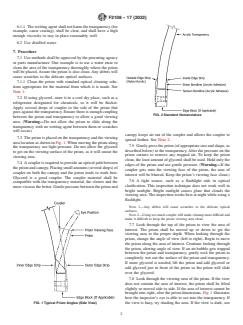
7.3 The prism is placed on the transparency and the viewing
spread farther. See Note 2.
area location as shown in Fig. 1.When moving the prism along
7.5 Gently press the prism (of appropriate size and shape, as
the transparency use light pressure. Do not allow the glycerol
described below) to the transparency.Alter the pressure on the
to get on the viewing surface of the prism, as it will smear the
prism corners to remove any trapped air. To keep the prism
viewing area.
clean, the least amount of glycerol shall be used. Hold only the
7.4 Acoupler is required to provide an optical path between
edges of the prism and use gentle pressure. (Warning—If the
theprismandcanopy.Placingsmallamounts(severaldrops)of
coupler gets onto the viewing face of the prism, the area of
coupler on both the canopy and the prism tends to work best.
interest will be blurred. Keep the prism’s viewing face clean.)
Glycerol is a good coupler. The coupler material shall be
7.6 A light source, such as a flashlight aids in optical
compatible with the transparency material, the clearer and the
clarification. This inspection technique does not work well in
more viscous the better. Gentle pressure between the prism and
bright sunlight. Bright sunlight causes glare that clouds the
viewing area. The inspection works best at night while using a
flashlight.
NOTE 1—Any debris will cause scratches to the delicate optical
surfaces.
NOTE 2—Using too much coupler will make cleanup more difficult and
make it difficult to keep the prism viewing area clean.
7.7 Look through the top of the prism to view the area of
interest. The prism shall be moved up or down to get the
viewing area to the proper depth. When looking through t
...