

ASTM D3453-20
(Specification)Standard Specification for Flexible Cellular Materials—Urethane for Furniture and Automotive Cushioning, Bedding, and Similar Applications
General Information
- Abstract
ABSTRACT
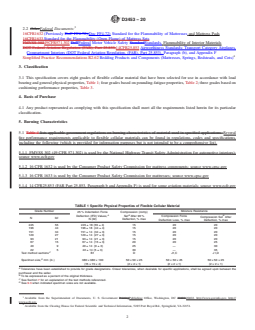
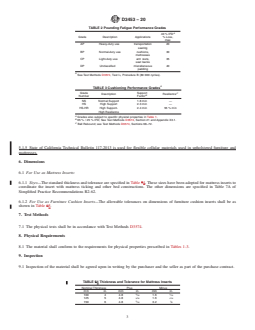
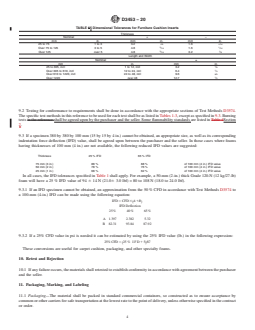
This specification covers flexible cellular urethane materials intended for such uses as inserts for furniture cushions, mattresses, and similar applications. The material and dimensional requirements and methods of tests for specific properties of load bearing, compression set, humid age resistance, pounding fatigue resistance, support factor and resilience are prescribed. This specification covers eight grades of flexible cellular material that may be selected for use in accordance with load bearing and general physical properties, four grades based on pounding-fatigue properties, and three grades based on cushioning performance properties.
SCOPE
1.1 This specification covers flexible cellular urethane materials intended for such uses as inserts for furniture cushions, mattresses, and similar applications.
1.2 This specification provides material and dimensional requirements and methods of tests for specific properties of load bearing, compression set, humid age resistance, pounding fatigue resistance, support factor and resilience.
1.3 This specification includes references to government regulations for burning characteristics of flexible cellular material used in specified applications.
1.4 The values stated in SI units are to be regarded as the standard. The values given in parentheses are for information only.
1.5 This standard does not purport to address all of the safety concerns, if any, associated with its use. It is the responsibility of the user of this standard to establish appropriate safety, health, and environmental practices and determine the applicability of regulatory limitations prior to use.
Note 1: There is no equivalent ISO standard.
1.6 This international standard was developed in accordance with internationally recognized principles on standardization established in the Decision on Principles for the Development of International Standards, Guides and Recommendations issued by the World Trade Organization Technical Barriers to Trade (TBT) Committee.
- Status
- Published
- Publication Date
- 31-Aug-2020
- Technical Committee
- D20 - Plastics
- Drafting Committee
- D20.22 - Cellular Materials - Plastics and Elastomers
Buy Documents

ASTM D3453-20 - Standard Specification for Flexible Cellular Materials—Urethane for Furniture and Automotive Cushioning, Bedding, and Similar Applications
REDLINE ASTM D3453-20 - Standard Specification for Flexible Cellular Materials—Urethane for Furniture and Automotive Cushioning, Bedding, and Similar Applications
Overview
ASTM D3453-20 is the standard specification for flexible cellular urethane materials used in furniture, automotive cushioning, bedding, and similar applications. Developed by ASTM International, this standard outlines requirements for material properties, grading, testing methods, and conformity for manufacturers, purchasers, and end-users. The document helps ensure uniform performance, safety, and reliability in products such as mattress inserts, upholstered furniture cushions, vehicle seating, and specialty foams.
Key Topics
- Material and Dimensional Requirements: Specifies physical characteristics needed for flexible cellular urethane, such as density, thickness, and allowable tolerances for furniture and bedding applications.
- Performance Properties: Prescribes methods and criteria for evaluating:
- Load bearing capacity
- Compression set
- Humid age resistance
- Pounding fatigue resistance
- Support factor
- Resilience
- Grading System: Defines:
- Eight grades based on load bearing and general physical properties
- Four grades classified by pounding-fatigue performance
- Three cushioning performance grades based on support and resilience
- Fire Safety and Regulatory Compliance: References key flammability regulations applicable to urethane materials, including:
- FMVSS 302 (automotive interiors)
- 16 CFR 1632 & 1633 (mattresses and pads)
- 14 CFR 25.853 (aviation materials)
- California Technical Bulletins (upholstered furniture)
- Test Methods: Requires compliance with ASTM D3574 for evaluating properties, as well as other related test standards for burning characteristics and surface flammability.
- Labeling and Packaging: Establishes guidelines for marking, packaging, and labeling to verify conformance with ASTM D3453-20.
Applications
This standard is essential across several industries, guiding the selection, manufacturing, and quality control of flexible polyurethane foam materials. Primary applications include:
- Furniture Manufacturing: Ensures consistency and quality for seat cushions, armrests, and backs in sofas, chairs, and commercial seating.
- Mattress Production: Guides the production and grading of foam components used in mattresses, mattress pads, and bedding inserts, ensuring long-term comfort and durability.
- Automotive Industry: Used for interior seating, padding, and other comfort-related components in vehicles, with strict adherence to physical and fire-retardant properties.
- Aviation and Transport: Applies to compartment interiors and safety padding under stringent regulatory requirements for performance and fire safety.
- Specialty and Miscellaneous Foams: Useful for packing, carpet underlays, and equipment padding where specific cushioning or support properties are required.
Manufacturers, suppliers, and product designers rely on ASTM D3453-20 to meet customer expectations, regulatory mandates, and industry standards for performance and safety.
Related Standards
To ensure comprehensive compliance and quality control when using flexible cellular urethane materials, consider these related standards:
- ASTM D3574: Test Methods for Flexible Cellular Materials - Slab, Bonded, and Molded Urethane Foams
- ASTM D3675: Test Method for Surface Flammability of Flexible Cellular Materials Using a Radiant Heat Source
- FMVSS 302 (49 CFR 571.302): Flammability of Interior Materials for Automotive Applications
- 16 CFR 1632 & 1633: Flammability Standards for Mattresses and Mattress Pads
- 14 CFR 25.853: Airworthiness Standards for Compartment Interiors in Aviation
- California Technical Bulletins 117, 121, 129, 603: Flammability Requirements for Upholstered Furniture and Mattresses
ASTM D3453-20 is a key standard for stakeholders across furniture, bedding, automotive, and aviation industries who require reliable, high-quality, and safe flexible urethane foam materials. By adhering to this standard, organizations support better product performance, safety, and regulatory compliance.
Relations
- Effective Date
- 01-Sep-2020
- Effective Date
- 01-May-2017
- Effective Date
- 01-Mar-2017
- Effective Date
- 01-Nov-2016
- Effective Date
- 01-May-2016
- Effective Date
- 01-Mar-2014
- Effective Date
- 01-Oct-2012
- Effective Date
- 01-Dec-2011
- Effective Date
- 01-Sep-2011
- Effective Date
- 01-Sep-2009
- Effective Date
- 01-Apr-2009
- Effective Date
- 01-Aug-2008
- Effective Date
- 01-Jul-2008
- Effective Date
- 01-Nov-2005
- Effective Date
- 01-Jul-2005
Buy Documents
ASTM D3453-20 - Standard Specification for Flexible Cellular Materials—Urethane for Furniture and Automotive Cushioning, Bedding, and Similar Applications
REDLINE ASTM D3453-20 - Standard Specification for Flexible Cellular Materials—Urethane for Furniture and Automotive Cushioning, Bedding, and Similar Applications
Get Certified
Connect with accredited certification bodies for this standard

DIN CERTCO
DIN Group product certification.

Smithers Quality Assessments
US management systems and product certification.
Sponsored listings
Frequently Asked Questions
ASTM D3453-20 is a technical specification published by ASTM International. Its full title is "Standard Specification for Flexible Cellular Materials—Urethane for Furniture and Automotive Cushioning, Bedding, and Similar Applications". This standard covers: ABSTRACT This specification covers flexible cellular urethane materials intended for such uses as inserts for furniture cushions, mattresses, and similar applications. The material and dimensional requirements and methods of tests for specific properties of load bearing, compression set, humid age resistance, pounding fatigue resistance, support factor and resilience are prescribed. This specification covers eight grades of flexible cellular material that may be selected for use in accordance with load bearing and general physical properties, four grades based on pounding-fatigue properties, and three grades based on cushioning performance properties. SCOPE 1.1 This specification covers flexible cellular urethane materials intended for such uses as inserts for furniture cushions, mattresses, and similar applications. 1.2 This specification provides material and dimensional requirements and methods of tests for specific properties of load bearing, compression set, humid age resistance, pounding fatigue resistance, support factor and resilience. 1.3 This specification includes references to government regulations for burning characteristics of flexible cellular material used in specified applications. 1.4 The values stated in SI units are to be regarded as the standard. The values given in parentheses are for information only. 1.5 This standard does not purport to address all of the safety concerns, if any, associated with its use. It is the responsibility of the user of this standard to establish appropriate safety, health, and environmental practices and determine the applicability of regulatory limitations prior to use. Note 1: There is no equivalent ISO standard. 1.6 This international standard was developed in accordance with internationally recognized principles on standardization established in the Decision on Principles for the Development of International Standards, Guides and Recommendations issued by the World Trade Organization Technical Barriers to Trade (TBT) Committee.
ABSTRACT This specification covers flexible cellular urethane materials intended for such uses as inserts for furniture cushions, mattresses, and similar applications. The material and dimensional requirements and methods of tests for specific properties of load bearing, compression set, humid age resistance, pounding fatigue resistance, support factor and resilience are prescribed. This specification covers eight grades of flexible cellular material that may be selected for use in accordance with load bearing and general physical properties, four grades based on pounding-fatigue properties, and three grades based on cushioning performance properties. SCOPE 1.1 This specification covers flexible cellular urethane materials intended for such uses as inserts for furniture cushions, mattresses, and similar applications. 1.2 This specification provides material and dimensional requirements and methods of tests for specific properties of load bearing, compression set, humid age resistance, pounding fatigue resistance, support factor and resilience. 1.3 This specification includes references to government regulations for burning characteristics of flexible cellular material used in specified applications. 1.4 The values stated in SI units are to be regarded as the standard. The values given in parentheses are for information only. 1.5 This standard does not purport to address all of the safety concerns, if any, associated with its use. It is the responsibility of the user of this standard to establish appropriate safety, health, and environmental practices and determine the applicability of regulatory limitations prior to use. Note 1: There is no equivalent ISO standard. 1.6 This international standard was developed in accordance with internationally recognized principles on standardization established in the Decision on Principles for the Development of International Standards, Guides and Recommendations issued by the World Trade Organization Technical Barriers to Trade (TBT) Committee.
ASTM D3453-20 is classified under the following ICS (International Classification for Standards) categories: 83.100 - Cellular materials. The ICS classification helps identify the subject area and facilitates finding related standards.
ASTM D3453-20 has the following relationships with other standards: It is inter standard links to ASTM D3453-12, ASTM D3675-17, ASTM D3574-17, ASTM D3574-16, ASTM D3675-16, ASTM D3675-14, ASTM D3675-12, ASTM D3574-11, ASTM D3675-11, ASTM D3675-09a, ASTM D3675-09, ASTM D3675-08, ASTM D3574-08, ASTM D3675-05, ASTM D3574-05. Understanding these relationships helps ensure you are using the most current and applicable version of the standard.
ASTM D3453-20 is available in PDF format for immediate download after purchase. The document can be added to your cart and obtained through the secure checkout process. Digital delivery ensures instant access to the complete standard document.
Standards Content (Sample)
This international standard was developed in accordance with internationally recognized principles on standardization established in the Decision on Principles for the
Development of International Standards, Guides and Recommendations issued by the World Trade Organization Technical Barriers to Trade (TBT) Committee.
Designation:D3453 −20
Standard Specification for
Flexible Cellular Materials—Urethane for Furniture and
Automotive Cushioning, Bedding, and Similar Applications
This standard is issued under the fixed designation D3453; the number immediately following the designation indicates the year of
original adoption or, in the case of revision, the year of last revision. A number in parentheses indicates the year of last reapproval. A
superscript epsilon (´) indicates an editorial change since the last revision or reapproval.
This standard has been approved for use by agencies of the U.S. Department of Defense.
1. Scope* D3574 Test Methods for Flexible Cellular Materials—Slab,
Bonded, and Molded Urethane Foams
1.1 This specification covers flexible cellular urethane ma-
D3675 Test Method for Surface Flammability of Flexible
terials intended for such uses as inserts for furniture cushions,
Cellular Materials Using a Radiant Heat Energy Source
mattresses, and similar applications.
2.2 Federal Documents:
1.2 This specification provides material and dimensional
16CFR1632 (Previously Doc FF4-72) Standard for the
requirements and methods of tests for specific properties of
Flammability of Mattresses and Mattress Pads
load bearing, compression set, humid age resistance, pounding
16CFR1633 Standard for the Flammability (Open Flame) of
fatigue resistance, support factor and resilience.
Mattress Sets
49CFR571.302 Federal Motor Vehicle Safety Standards,
1.3 This specification includes references to government
regulations for burning characteristics of flexible cellular Flammability of Interior Materials
14CFR25.853 Airworthiness Standards: Transport Category
material used in specified applications.
Airplanes, Compartment Interiors (DOT Federal Aviation
1.4 The values stated in SI units are to be regarded as the
Regulation, (FAR), Part 25.853), Paragraph (b), and Ap-
standard. The values given in parentheses are for information
pendix F
only.
Simplified Practice Recommendations R2-62 Bedding Prod-
1.5 This standard does not purport to address all of the
ucts and Components (Mattresses, Springs, Bedsteads,
safety concerns, if any, associated with its use. It is the 4
and Cots)
responsibility of the user of this standard to establish appro-
priate safety, health, and environmental practices and deter- 3. Classification
mine the applicability of regulatory limitations prior to use.
3.1 Thisspecificationcoverseightgradesofflexiblecellular
material that have been selected for use in accordance with
NOTE 1—There is no equivalent ISO standard.
load bearing and general physical properties, Table 1; four
1.6 This international standard was developed in accor-
grades based on pounding-fatigue properties, Table 2; three
dance with internationally recognized principles on standard-
grades based on cushioning performance properties, Table 3.
ization established in the Decision on Principles for the
Development of International Standards, Guides and Recom-
4. Basis of Purchase
mendations issued by the World Trade Organization Technical
4.1 Any product represented as complying with this speci-
Barriers to Trade (TBT) Committee.
fication shall meet all the requirements listed herein for its
particular classification.
2. Referenced Documents
2.1 ASTM Standards:
5. Burning Characteristics
5.1 Several fire performance requirements applicable to
flexible cellular materials can be found in regulations, codes
This specification is under the jurisdiction of ASTM Committee D20 on
and specifications, including the following (which is provided
Plastics and is the direct responsibility of Subcommittee D20.22 on Cellular
for information purposes but is not intended to be a compre-
Materials - Plastics and Elastomers.
Current edition approved Sept. 1, 2020. Published September 2020. Originally
hensive list).
approved in 1976. Last previous edition approved in 2012 as D3453 – 12. DOI:
10.1520/D3453-20.
2 3
For referenced ASTM standards, visit the ASTM website, www.astm.org, or AvailablefromtheSuperintendentofDocuments,U.S.GovernmentPublishing
contact ASTM Customer Service at service@astm.org. For Annual Book of ASTM Office, Washington, DC 20402, http://www.govinfo.gov, http://www.ecfr.gov.
Standards volume information, refer to the standard’s Document Summary page on Available from the Clearing House for Federal Scientific and Technical
the ASTM website. Information, 5285 Port Royal Rd., Springfield, VA 22151.
*A Summary of Changes section appears at the end of this standard
Copyright © ASTM International, 100 Barr Harbor Drive, PO Box C700, West Conshohocken, PA 19428-2959. United States
D3453−20
TABLE 1 Specific Physical Properties of Flexible Cellular Material
Grade Number Moisture Resistance
25 % Indentation Force Compression (comp)
A B
B
Deflection (IFD) Values, Set After 90 % Compression Force
Compression Set After
Nlbf
N (lbf) Deflection, % max
Deflection, % max
Deflection Loss, % max
245 55 245 ± 18 (55 ± 4) 15 20 20
196 44 196 ± 18 (44 ± 4) 15 20 20
151 34 151 ± 14 (34 ± 3) 15 20 20
120 27 120 ± 14 (27 ± 3) 15 20 20
93 21 93 ± 14 (21 ± 3) 15 20 20
67 15 67 ± 14 (15 ± 3) 20 20 25
40 9 40±14 (9±3) 25 — 30
22 5 22±14(5±3) 30 — 35
C
Test method sections B1 D J1,C J1,D
D
Specimen size, mm(in.) 380×380×100 50×50×25 50×50×25 50×50×25
(15×15×4) (2×2×1) (2×2×1) (2×2×1)
A
Tolerances have been established to provide for grade designations. Closer tolerances, when desirable for specific applications, shall be agreed upon between the
purchaser and the seller.
B
To be expressed as a percent of the original thickness.
C
See Section 7 for an explanation of the test methods referenced.
D
See 9.3 when indicated specimen sizes are not available.
TABLE 2 Pounding Fatigue Performance Grades
6.1.1 Sizes—The standard thickness and tolerance are speci-
A
40 % IFD fied in Table 4. These sizes have been adopted for mattress
Grade Description Applications % Loss,
inserts to coordinate the insert with mattress ticking and other
max
bed constructions. The other dimensions are specified in Table
AP Heavy-duty use transportation 20
seating 7A of Simplified Practice Recommendations R2-62.
BP Normal-duty use cushions, 30
6.1.2 For Use as Furniture Cushion Inserts—The allowable
mattresses
tolerances on dimensions of furniture cushion inserts shall be
CP Light-duty use arm rests, 35
seat backs
as shown in Table 5.
DP Unclassified miscellaneous 40
padding
7. Test Methods
A
See Test Methods D3574, Test I , Procedure B (80 000 cycles
...
This document is not an ASTM standard and is intended only to provide the user of an ASTM standard an indication of what changes have been made to the previous version. Because
it may not be technically possible to adequately depict all changes accurately, ASTM recommends that users consult prior editions as appropriate. In all cases only the current version
of the standard as published by ASTM is to be considered the official document.
Designation: D3453 − 12 D3453 − 20
Standard Specification for
Flexible Cellular Materials—Urethane for Furniture and
Automotive Cushioning, Bedding, and Similar Applications
This standard is issued under the fixed designation D3453; the number immediately following the designation indicates the year of
original adoption or, in the case of revision, the year of last revision. A number in parentheses indicates the year of last reapproval. A
superscript epsilon (´) indicates an editorial change since the last revision or reapproval.
This standard has been approved for use by agencies of the U.S. Department of Defense.
1. Scope*
1.1 This specification covers flexible cellular urethane materials intended for such uses as inserts for furniture cushions,
mattresses, and similar applications.
1.2 This specification provides material and dimensional requirements and methods of tests for specific properties of load bearing,
compression set, humid age resistance, pounding fatigue resistance, support factor and resilience.
1.3 This specification includes references to government regulations for burning characteristics of flexible cellular material used
in specified applications.
1.4 The values stated in SI units are to be regarded as the standard. The values given in parentheses are for information only.
1.5 This standard does not purport to address all of the safety concerns, if any, associated with its use. It is the responsibility
of the user of this standard to establish appropriate safety safety, health, and healthenvironmental practices and determine the
applicability of regulatory limitations prior to use.
NOTE 1—There is no equivalent ISO standard.
NOTE 1—There is no equivalent ISO standard.
1.6 This international standard was developed in accordance with internationally recognized principles on standardization
established in the Decision on Principles for the Development of International Standards, Guides and Recommendations issued
by the World Trade Organization Technical Barriers to Trade (TBT) Committee.
2. Referenced Documents
2.1 ASTM Standards:
D3574 Test Methods for Flexible Cellular Materials—Slab, Bonded, and Molded Urethane Foams
D3675 Test Method for Surface Flammability of Flexible Cellular Materials Using a Radiant Heat Energy Source
This specification is under the jurisdiction of ASTM Committee D20 on Plastics and is the direct responsibility of Subcommittee D20.22 on Cellular Materials - Plastics
and Elastomers.
Current edition approved Oct. 1, 2012Sept. 1, 2020. Published November 2012September 2020. Originally approved in 1976. Last previous edition approved in 20072012
as D3453 - 07.D3453 – 12. DOI: 10.1520/D3453-12.10.1520/D3453-20.
For referenced ASTM standards, visit the ASTM website, www.astm.org, or contact ASTM Customer Service at service@astm.org. For Annual Book of ASTM Standards
volume information, refer to the standard’s Document Summary page on the ASTM website.
*A Summary of Changes section appears at the end of this standard
Copyright © ASTM International, 100 Barr Harbor Drive, PO Box C700, West Conshohocken, PA 19428-2959. United States
D3453 − 20
2.2 OtherFederal Documents:
16CFR1632 (Previously DoC FF4-72),Doc FF4-72) Standard for the Flammability of Mattresses and Mattress Pads
16CFR1633 Standard for the Flammability (Open Flame) of Mattress Sets
FMVSS 30249CFR571.302 DoTFederal Motor Vehicle Safety StandardStandards, Flammability of Interior Materials
DOT Federal Aviation Regulation (FAR), Part 25.853,14CFR25.853 Airworthiness Standards: Transport Category Airplanes,
Compartment Interiors (DOT Federal Aviation Regulation, (FAR), Part 25.853), Paragraph (b), and Appendix F
Simplified Practice Recommendations R2-62 Bedding Products and Components (Mattresses, Springs, Bedsteads, and Cots)
3. Classification
3.1 This specification covers eight grades of flexible cellular material that have been selected for use in accordance with load
bearing and general physical properties, Table 1; four grades based on pounding-fatigue properties, Table 2; three grades based on
cushioning performance properties, Table 3.
4. Basis of Purchase
4.1 Any product represented as complying with this specification shall meet all the requirements listed herein for its particular
classification.
5. Burning Characteristics
5.1 Table 4 lists applicable government regulations on burning characteristics of material used in specified applications. Several
fire performance requirements applicable to flexible cellular materials can be found in regulations, codes and specifications,
including the following (which is provided for information purposes but is not intended to be a comprehensive list).
5.1.1 FMVSS 302 (49 CFR 571.302) is used by the National Highway Transit Safety Administration for automotive interiors);
source www.ecfr.gov
5.1.2 16 CFR 1632 is used by the Consumer Product Safety Commission for mattress components; source www.cpsc.gov
5.1.3 16 CFR 1633 is used by the Consumer Product Safety Commission for mattresses; source www.cpsc.gov
5.1.4 14 CFR25.853 (FAR Part 25.853, Paragraph b and Appendix F) is used for some aviation materials; source www.ecfr.gov
TABLE 1 Specific Physical Properties of Flexible Cellular Material
Grade Number Moisture Resistance
25 % Indentation Force Compression (comp)
A B
B
Deflection (IFD) Values, Set After 90 %
Compression Force
Compression Set After
N lbf
N (lbf) Deflection, % max
Deflection Loss, % max Deflection, % max
245 55 245 ± 18 (55 ± 4) 15 20 20
196 44 196 ± 18 (44 ± 4) 15 20 20
151 34 151 ± 14 (34 ± 3) 15 20 20
120 27 120 ± 14 (27 ± 3) 15 20 20
93 21 93 ± 14 (21 ± 3) 15 20 20
67 15 67 ± 14 (15 ± 3) 20 20 25
40 9 40 ± 14 (9 ± 3) 25 — 30
22 5 22 ± 14 (5 ± 3) 30 — 35
C
Test method sections B1 D J1,C J1,D
D
Specimen size, mm (in.) 380 × 380 × 100 50 × 50 × 25 50 × 50 × 25 50 × 50 × 25
(15 × 15 × 4) (2 × 2 × 1) (2 × 2 × 1) (2 × 2 × 1)
A
Tolerances have been established to provide for grade designations. Closer tolerances, when desirable for specific applications, shall be agreed upon between the
purchaser and the seller.
B
To be expressed as a percent of the original thickness.
C
See Section 7 for an explanation of the test methods referenced.
D
See 9.3 when indicated specimen sizes are not available.
Available from the Superintendent of Documents, U. S. Government PrintingPublishing Office, Washington, DC 20402.20402, http://www.govinfo.gov, http://
www.ecfr.gov.
Available from the Clearing House for Federal Scientific and Technical Information, 5285 Port Royal Rd., Springfield, VA 22151.
D3453 − 20
TABLE 2 Pounding Fatigue Performance Grades
A
40 % IFD
Grade Description Applications % Loss,
max
AP Heavy-duty use transportation 20
seating
BP Normal-duty use cushions, 30
mattresses
CP Light-duty use arm rests, 35
seat backs
DP Unclassified miscellaneous 40
padding
A
See Test Methods D3574, Test I , Procedure B (80 000 cycles).
A
TABLE 3 Cushioning Performance Grades
Grade Support
C
Description Resilience
B
Number Factor
NS Normal Support 1.8 min —
HS High Support 2.3 min —
HS-HR High Support- 2.4 min 55 % min
High Resilience
A
Grades also subject to specific physical properties in Table 1.
B
65 % / 25 % IFD; See Test Methods D3574, Section 21 and Appendix X3.1.
C
Ball Rebound; see Test Methods D3574, Sections 68–72.
5.1.5 State of California Technical Bulletin 117-2013 is used for flexible cellular materials used in upholstered furniture and
mattresses.
6. Dimensions
6.1 For Use as Mattress Inserts:
6.1.1 Sizes—The standard thickness and tolerance are specified in Table 54. These sizes have been adopted for mattress inserts to
coordinate the insert with mattress ticking and other bed constructions. The other dimensions are specified in Table 7A of
Simplified Practice Recommendations R2-62.
6.1.2 For Use as Furniture Cushion Inserts—The allowable tolerances on dimensions of f
...