

ASTM F2897-23a
(Specification)Standard Specification for Tracking and Traceability Encoding System of Natural Gas Distribution Components (Pipe, Tubing, Fittings, Valves, and Appurtenances)
General Information
- Abstract
ABSTRACT
This specification defines requirements for the data used in the tracking and traceability base-62 encoding system. It provides the format of the resultant code to characterize various components used in fuel gas piping systems. In this specification, the final output is a 16 digit alpha-numeric code that defines a standardized approach or methodology for encoding certain characteristics of components that have been established based on consensus recommendations from the respective stakeholder group members. The gas distribution component traceability identifier is also provided in this specification wherein the gas distribution component traceability identifier shall be comprised of sixteen alphanumeric characters that specify respective attributes for a given component. The gas distribution component traceability identifiers also include identifications of component manufacturer, identification of component manufacturer's lot code, the component production date, the component material, the component size, and the component type.
SCOPE
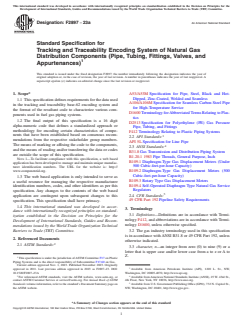
1.1 This specification defines requirements for the data used in the tracking and traceability base-62 encoding system and the format of the resultant code to characterize various components used in fuel gas piping systems.
1.2 The final output of this specification is a 16 digit alpha-numeric code that defines a standardized approach or methodology for encoding certain characteristics of components that have been established based on consensus recommendations from the respective stakeholder group members. The means of marking or affixing the code to the components, and the means of reading and/or transferring the data or codes are outside the scope of this specification.
Note 1: To facilitate compliance with this specification, a web based application has been developed to manage and maintain unique manufacturer identification numbers. The URL for the website is: http://www.componentid.org.
1.3 The web based application is only intended to serve as a useful resource for managing the respective manufacturer identification numbers, codes, and other identifiers as per this specification. Any changes to the contents of the web based application are contingent upon subsequent changes to this specification. This specification shall have primacy.
1.4 This international standard was developed in accordance with internationally recognized principles on standardization established in the Decision on Principles for the Development of International Standards, Guides and Recommendations issued by the World Trade Organization Technical Barriers to Trade (TBT) Committee.
- Status
- Published
- Publication Date
- 31-Oct-2023
- Technical Committee
- F17 - Plastic Piping Systems
- Drafting Committee
- F17.60 - Gas
Buy Documents
ASTM F2897-23a - Standard Specification for Tracking and Traceability Encoding System of Natural Gas Distribution Components (Pipe, Tubing, Fittings, Valves, and Appurtenances)
REDLINE ASTM F2897-23a - Standard Specification for Tracking and Traceability Encoding System of Natural Gas Distribution Components (Pipe, Tubing, Fittings, Valves, and Appurtenances)
Overview
ASTM F2897-23a is the standard specification developed by ASTM International for implementing a tracking and traceability encoding system for natural gas distribution components. This standard applies to a broad range of components-including pipe, tubing, fittings, valves, and appurtenances-used in fuel gas piping systems. ASTM F2897-23a establishes a precise, consensus-driven methodology for encoding crucial data about gas distribution components within a standardized 16-character alphanumeric identifier using a base-62 encoding system. This system is fundamental to supporting product traceability, safety, and data management needs throughout the gas distribution industry.
Key Topics
Unique Component Identification
Each natural gas distribution component is marked with a 16-character alphanumeric code generated using base-62 encoding. This code represents a standardized set of attributes for traceability, supporting efficient record-keeping and regulatory compliance.Encoding System Structure
The 16-character identifier encodes key component details such as:- Manufacturer identification
- Lot code
- Production date
- Material type
- Component type
- Component size
- Base-62 index
This systematic approach ensures that all relevant metadata for a component can be quickly ascertained for quality control, recalls, or audit purposes.
Consensus-Driven Methodology
The framework and attribute definitions of the encoding system are based on recommendations from industry stakeholders, ensuring broad acceptance and utility across manufacturers and gas utilities.Web-Based Registration and Verification
To support compliance and consistency, a designated web portal (componentid.org) manages unique manufacturer identification codes and serves as a reference for registered data.
Applications
ASTM F2897-23a is applied in several ways within the natural gas industry and by related supply chain participants:
Compliance and Regulatory Reporting
Provides a uniform system for meeting regulatory requirements regarding the tracking and traceability of gas distribution components (e.g., supporting 49 CFR Part 192 pipeline safety regulations).Manufacturing and Quality Control
Enables manufacturers to assign, manage, and update unique identifiers to each batch or lot of components, streamlining quality assurance, warranty management, and traceability in case of recalls.Installation and Maintenance
Field personnel and utilities can use the encoded identifiers to quickly access vital information about gas distribution pipes, fittings, valves, and related components during installation, inspection, or maintenance, improving operational efficiency and safety.Data Integration and Asset Management
The standardized code is designed for compatibility with industry databases, GIS systems, and enterprise asset management platforms, promoting seamless digital transformation and lifecycle tracking from production through end-of-life.
Related Standards
ASTM F2897-23a interacts with a variety of other industry and regulatory standards, including:
- ASTM D2513: Specification for Polyethylene (PE) Gas Pressure Pipe, Tubing, and Fittings
- ASTM F412: Terminology Relating to Plastic Piping Systems
- API 5L: Specification for Line Pipe
- ANSI B31.8: Gas Transmission and Distribution Piping Systems
- 49 CFR Part 192: U.S. Pipeline Safety Requirements
- CSA B137.4: Polyethylene (PE) piping systems for gas services (referenced in supplemental requirements)
These referenced standards ensure interoperability, consistent terminology, and technical alignment within the gas distribution and pipeline safety domain.
Keywords: ASTM F2897-23a, natural gas distribution, traceability, encoding system, tracking, gas pipeline components, pipe identification, base-62 encoding, regulatory compliance, asset management.
Relations
- Effective Date
- 01-Nov-2023
- Effective Date
- 01-Mar-2024
- Effective Date
- 01-Jul-2022
- Effective Date
- 01-Jul-2020
- Effective Date
- 01-Nov-2019
- Refers
ASTM D1600-18 - Standard Terminology for Abbreviated Terms Relating to Plastics (Withdrawn 2024) - Effective Date
- 01-Jan-2018
- Effective Date
- 01-Nov-2023
- Effective Date
- 01-Nov-2023
- Referred By
ASTM F2785-21 - Standard Specification for Polyamide 12 Gas Pressure Pipe, Tubing, and Fittings - Effective Date
- 01-Nov-2023
- Effective Date
- 01-Nov-2023
- Effective Date
- 01-Nov-2023
- Effective Date
- 01-Nov-2023
- Effective Date
- 01-Nov-2023
- Referred By
ASTM F2138-12(2017) - Standard Specification for Excess Flow Valves for Natural Gas Service - Effective Date
- 01-Nov-2023
- Referred By
ASTM D2513-20 - Standard Specification for Polyethylene (PE) Gas Pressure Pipe, Tubing, and Fittings - Effective Date
- 01-Nov-2023
Buy Documents
ASTM F2897-23a - Standard Specification for Tracking and Traceability Encoding System of Natural Gas Distribution Components (Pipe, Tubing, Fittings, Valves, and Appurtenances)
REDLINE ASTM F2897-23a - Standard Specification for Tracking and Traceability Encoding System of Natural Gas Distribution Components (Pipe, Tubing, Fittings, Valves, and Appurtenances)
Get Certified
Connect with accredited certification bodies for this standard

DIBt (Deutsches Institut für Bautechnik)
German Institute for Building Technology.
DIN CERTCO
DIN Group product certification.

Aboma Certification B.V.
Specialized in construction, metal, and transport sectors.
Sponsored listings
Frequently Asked Questions
ASTM F2897-23a is a technical specification published by ASTM International. Its full title is "Standard Specification for Tracking and Traceability Encoding System of Natural Gas Distribution Components (Pipe, Tubing, Fittings, Valves, and Appurtenances)". This standard covers: ABSTRACT This specification defines requirements for the data used in the tracking and traceability base-62 encoding system. It provides the format of the resultant code to characterize various components used in fuel gas piping systems. In this specification, the final output is a 16 digit alpha-numeric code that defines a standardized approach or methodology for encoding certain characteristics of components that have been established based on consensus recommendations from the respective stakeholder group members. The gas distribution component traceability identifier is also provided in this specification wherein the gas distribution component traceability identifier shall be comprised of sixteen alphanumeric characters that specify respective attributes for a given component. The gas distribution component traceability identifiers also include identifications of component manufacturer, identification of component manufacturer's lot code, the component production date, the component material, the component size, and the component type. SCOPE 1.1 This specification defines requirements for the data used in the tracking and traceability base-62 encoding system and the format of the resultant code to characterize various components used in fuel gas piping systems. 1.2 The final output of this specification is a 16 digit alpha-numeric code that defines a standardized approach or methodology for encoding certain characteristics of components that have been established based on consensus recommendations from the respective stakeholder group members. The means of marking or affixing the code to the components, and the means of reading and/or transferring the data or codes are outside the scope of this specification. Note 1: To facilitate compliance with this specification, a web based application has been developed to manage and maintain unique manufacturer identification numbers. The URL for the website is: http://www.componentid.org. 1.3 The web based application is only intended to serve as a useful resource for managing the respective manufacturer identification numbers, codes, and other identifiers as per this specification. Any changes to the contents of the web based application are contingent upon subsequent changes to this specification. This specification shall have primacy. 1.4 This international standard was developed in accordance with internationally recognized principles on standardization established in the Decision on Principles for the Development of International Standards, Guides and Recommendations issued by the World Trade Organization Technical Barriers to Trade (TBT) Committee.
ABSTRACT This specification defines requirements for the data used in the tracking and traceability base-62 encoding system. It provides the format of the resultant code to characterize various components used in fuel gas piping systems. In this specification, the final output is a 16 digit alpha-numeric code that defines a standardized approach or methodology for encoding certain characteristics of components that have been established based on consensus recommendations from the respective stakeholder group members. The gas distribution component traceability identifier is also provided in this specification wherein the gas distribution component traceability identifier shall be comprised of sixteen alphanumeric characters that specify respective attributes for a given component. The gas distribution component traceability identifiers also include identifications of component manufacturer, identification of component manufacturer's lot code, the component production date, the component material, the component size, and the component type. SCOPE 1.1 This specification defines requirements for the data used in the tracking and traceability base-62 encoding system and the format of the resultant code to characterize various components used in fuel gas piping systems. 1.2 The final output of this specification is a 16 digit alpha-numeric code that defines a standardized approach or methodology for encoding certain characteristics of components that have been established based on consensus recommendations from the respective stakeholder group members. The means of marking or affixing the code to the components, and the means of reading and/or transferring the data or codes are outside the scope of this specification. Note 1: To facilitate compliance with this specification, a web based application has been developed to manage and maintain unique manufacturer identification numbers. The URL for the website is: http://www.componentid.org. 1.3 The web based application is only intended to serve as a useful resource for managing the respective manufacturer identification numbers, codes, and other identifiers as per this specification. Any changes to the contents of the web based application are contingent upon subsequent changes to this specification. This specification shall have primacy. 1.4 This international standard was developed in accordance with internationally recognized principles on standardization established in the Decision on Principles for the Development of International Standards, Guides and Recommendations issued by the World Trade Organization Technical Barriers to Trade (TBT) Committee.
ASTM F2897-23a is classified under the following ICS (International Classification for Standards) categories: 91.140.40 - Gas supply systems. The ICS classification helps identify the subject area and facilitates finding related standards.
ASTM F2897-23a has the following relationships with other standards: It is inter standard links to ASTM F2897-23, ASTM A53/A53M-24, ASTM A53/A53M-22, ASTM A53/A53M-20, ASTM A106/A106M-19a, ASTM D1600-18, ASTM F2509-15(2019), ASTM F2968/F2968M-21, ASTM F2785-21, ASTM F1948-20, ASTM F2945-18(2023), ASTM F1924-19, ASTM F1973-21, ASTM F2138-12(2017), ASTM D2513-20. Understanding these relationships helps ensure you are using the most current and applicable version of the standard.
ASTM F2897-23a is available in PDF format for immediate download after purchase. The document can be added to your cart and obtained through the secure checkout process. Digital delivery ensures instant access to the complete standard document.
Standards Content (Sample)
This international standard was developed in accordance with internationally recognized principles on standardization established in the Decision on Principles for the
Development of International Standards, Guides and Recommendations issued by the World Trade Organization Technical Barriers to Trade (TBT) Committee.
Designation: F2897 − 23a An American National Standard
Standard Specification for
Tracking and Traceability Encoding System of Natural Gas
Distribution Components (Pipe, Tubing, Fittings, Valves, and
Appurtenances)
This standard is issued under the fixed designation F2897; the number immediately following the designation indicates the year of
original adoption or, in the case of revision, the year of last revision. A number in parentheses indicates the year of last reapproval. A
superscript epsilon (´) indicates an editorial change since the last revision or reapproval.
1. Scope* A53/A53M Specification for Pipe, Steel, Black and Hot-
Dipped, Zinc-Coated, Welded and Seamless
1.1 This specification defines requirements for the data used
A106/A106M Specification for Seamless Carbon Steel Pipe
in the tracking and traceability base-62 encoding system and
for High-Temperature Service
the format of the resultant code to characterize various com-
D1600 Terminology for Abbreviated Terms Relating to Plas-
ponents used in fuel gas piping systems.
tics
1.2 The final output of this specification is a 16 digit
D2513 Specification for Polyethylene (PE) Gas Pressure
alpha-numeric code that defines a standardized approach or
Pipe, Tubing, and Fittings
methodology for encoding certain characteristics of compo-
F412 Terminology Relating to Plastic Piping Systems
nents that have been established based on consensus recom- 3
2.2 API Standards:
mendations from the respective stakeholder group members.
API 5L Specification for Line Pipe
The means of marking or affixing the code to the components,
2.3 ANSI Standards:
and the means of reading and/or transferring the data or codes
B31.8 Gas Transmission and Distribution Piping System
are outside the scope of this specification.
B1.20.1 1983 Pipe Threads, General Purpose, Inch
NOTE 1—To facilitate compliance with this specification, a web based
B109.1 Diaphragm-Type Gas Displacement Meters (Under
application has been developed to manage and maintain unique manufac-
500 Cubic-feet-per-hour Capacity)
turer identification numbers. The URL for the website is: http://
www.componentid.org.
B109.2 Diaphragm-Type Gas Displacement Meters (500
Cubic-feet-per-hour Capacity)
1.3 The web based application is only intended to serve as
B109.3 Rotary Type Gas Displacement Meters
a useful resource for managing the respective manufacturer
B109.4 Self-Operated Diaphragm Type Natural Gas Service
identification numbers, codes, and other identifiers as per this
Regulators
specification. Any changes to the contents of the web based
2.4 CFR Standards:
application are contingent upon subsequent changes to this
specification. This specification shall have primacy. 49 CFR Part 192 Pipeline Safety Requirements
1.4 This international standard was developed in accor-
3. Terminology
dance with internationally recognized principles on standard-
3.1 Definitions—Definitions are in accordance with Termi-
ization established in the Decision on Principles for the
nology F412, and abbreviations are in accordance with Termi-
Development of International Standards, Guides and Recom-
nology D1600, unless otherwise specified.
mendations issued by the World Trade Organization Technical
Barriers to Trade (TBT) Committee.
3.2 The gas industry terminology used in this specification
is in accordance with ANSI B31.8 or 49 CFR Part 192, unless
2. Referenced Documents
otherwise indicated.
2.1 ASTM Standards:
3.3 character, n—an integer from zero (0) to nine (9) or a
letter that is upper case and/or lower case from a to z or A to
Z.
This specification is under the jurisdiction of ASTM Committee F17 on Plastic
Piping Systems and is the direct responsibility of Subcommittee F17.60 on Gas.
Current edition approved Nov. 1, 2023. Published November 2023. Originally
approved in 2011. Last previous edition approved in 2023 as F2897–23. DOI: Available from American Petroleum Institute (API), 1220 L. St., NW,
10.1520/F2897–23A Washington, DC 20005-4070, http://www.api.org.
2 4
For referenced ASTM standards, visit the ASTM website, www.astm.org, or Available from American National Standards Institute (ANSI), 25 W. 43rd St.,
contact ASTM Customer Service at service@astm.org. For Annual Book of ASTM 4th Floor, New York, NY 10036, http://www.ansi.org.
Standards volume information, refer to the standard’s Document Summary page on Available from U.S. Government Publishing Office (GPO), 732 N. Capitol St.,
the ASTM website. NW, Washington, DC 20401, http://www.gpo.gov.
*A Summary of Changes section appears at the end of this standard
Copyright © ASTM International, 100 Barr Harbor Drive, PO Box C700, West Conshohocken, PA 19428-2959. United States
F2897 − 23a
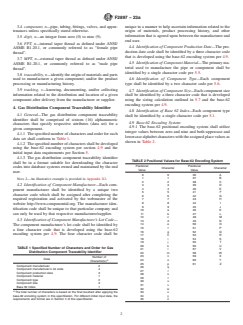
3.4 component, n—pipe, tubing, fittings, valves, and appur- unique in a manner to help ascertain information related to the
tenances unless specifically stated otherwise. origin of materials, product processing history, and other
information that is agreed upon between the manufacturer and
3.5 digit, n—an integer from zero (0) to nine (9).
end user.
3.6 FPT, n—internal taper thread as defined under ANSI/
4.4 Identification of Component Production Date—The pro-
ASME B1.20.1, or commonly referred to as “female pipe
duction date code shall be identified by a three character code
thread”.
that is developed using the base-62 encoding system per 4.9.
3.7 MPT, n—external taper thread as defined under ANSI/
4.5 Identification of Component Material—The primary ma-
ASME B1.20.1, or commonly referred to as “male pipe
terial used to manufacture the pipe or component shall be
thread”.
identified by a single character code per 5.5.
3.8 traceability, n—identify the origin of materials and parts
used to manufacturer a given component; and/or the product 4.6 Identification of Component Type—Each component
processing or manufacturing history. type shall be identified by a two character code per 5.6.
3.9 tracking, v—knowing, documenting, and/or collecting
4.7 Identification of Component Size—Each component size
information related to the distribution and location of a given
shall be identified by a three character code that is developed
component after delivery from the manufacturer or supplier.
using the sizing calculation outlined in 5.7 and the base-62
encoding system per 4.9.
4. Gas Distribution Component Traceability Identifier
4.8 Identification of Base 62 Index—Each component type
4.1 General—The gas distribution component traceability
shall be identified by a single character code per 5.1.
identifier shall be comprised of sixteen (16) alphanumeric
4.9 Base-62 Encoding System:
characters that specify respective attributes (data set) for a
4.9.1 The base-62 positional encoding system shall utilize
given component.
integer values between zero and nine and both uppercase and
4.1.1 The specified number of characters and order for each
lowercase alphabet characters with the assigned place values as
data set shall conform to Table 1.
shown in Table 2.
4.1.2 The specified number of characters shall be developed
using the base-62 encoding system per section 4.9 and the
initial input data requirements per Section 5.
4.1.3 The gas distribution component traceability identifier
TABLE 2 Positional Values for Base-62 Encoding System
shall be in a format suitable for downloading the character
Positional Positional
codes into database systems owned and maintained by the end
Character Character
Value Value
user.
0 0 36 A
1 1 37 B
NOTE 2—An illustrative example is provided in Appendix X2.
2 2 38 C
4.2 Identification of Component Manufacturer—Each com- 3 3 39 D
4 4 40 E
ponent manufacturer shall be identified by a unique two
5 5 41 F
character code which shall be assigned after completing the
6 6 42 G
required registration and activated by the webmaster of the
7 7 43 H
8 8 44 I
website http://www.componentid.org. The manufacturer iden-
9 9 45 J
tification code shall be unique to that particular company and
10 a 46 K
can only be used by that respective manufacturer/supplier. 11 b 47 L
12 c 48 M
4.3 Identification of Component Manufacturer’s Lot Code—
13 d 49 N
14 e 50 O
The component manufacturer’s lot code shall be identified by
15 f 51 P
a four character code that is developed using the base-62
16 g 52 Q
encoding system per 4.9. The four character code shall be
17 h 53 R
18 i 54 S
19 j 55 T
20 k 56 U
TABLE 1 Specified Number of Characters and Order for Gas
21 l 57 V
Distribution Component Traceability Identifier
22 m 58 W
23 n 59 X
Number of
Data
A
24 o 60 Y
Character(s)
25 p 61 Z
Component manufacturer 2
26 q
Component manufacturer’s lot code 4
27 r
Component production date 3
28 s
Component material 1
29 t
Component type 2
30 u
Component size 3
31 v
Base 62 Index 1
32 w
A
33 x
The total number of characters is based on the final resultant after applying the
base-62 encoding system in this specification. For different initial input data, the 34 y
35 z
requirements and format are in Section 5 of this specification.
F2897 − 23a
NOTE 7—For example, the date input represented by 23410 implies the
4.9.2 The assigned place values shown in Table 2 shall be
234th day of 2010.
used to convert the initial input data into the final alphanumeric
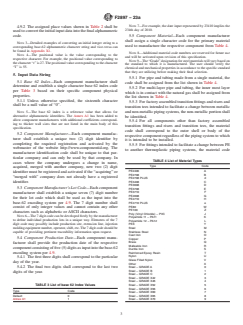
code. 5.5 Component Material—Each component manufacturer
shall assign a single character code for the primary material
NOTE 3—Detailed examples of converting an initial integer string to a
used to manufacture the respective component from Table 4.
corresponding base-62 alphanumeric character string and vice-versa can
be found in Appendix X1.
NOTE 8—Additional material code numbers are reserved for future use
NOTE 4—The positional value is the value corresponding to the
and will be activated upon revision of this specification.
respective character. For example, the positional value corresponding to
NOTE 9—The “Grade” designation for steel materials will vary based on
the character “r” is 27. The positional value corresponding to the character
the standard to which it is manufactured. The user should verify the
“T” is 55.
chemical and mechanical properties in accordance to the specific standard
that they are utilizing before making their final selection.
5. Input Data String
5.5.1 For pipe and tubing made from a single material, the
5.1 Base 62 Index—Each component manufacturer shall
code shall be assigned from the list shown in Table 4.
determine and establish a single character base 62 index code
5.5.2 For multi-layer pipe and tubing, the inner most layer
per Table 3 based on their specific component physical
which is in contact with the natural gas shall be assigned from
properties.
the list shown in Table 4.
5.1.1 Unless otherwise specified, the sixteenth character
5.5.3 For factory assembled transition fittings and risers and
shall be a null value of “0”.
transition tees intended to facilitate a change between metallic
and non-metallic piping systems, the non-metallic portion shall
NOTE 5—The base 62 index is a reference value that allows for
alternative alphanumeric identifiers. The Annex A1 has been added to
be identified.
allow component manufacturers with additional coefficients correspond-
5.5.4 For all components other than factory assembled
ing to thicker wall sizes that are not listed in the main body of this
transition fittings and risers and transition tees, the material
specification.
code shall correspond to the outer shell or body of the
5.2 Component Manufacturer—Each component manufac-
respective component regardless of the piping system to which
turer shall establish a unique two (2) digit identifier by
it is intended to be installed.
completing the required registration and activated by the
5.5.5 For fittings intended to facilitate a change between PE
webmaster of the website http://www.componentid.org. The
to another thermoplastic piping systems, the material code
manufacturer identification code shall be unique to that par-
ticular company and can only be used by that company. In
TABLE 4 List of Material Types
cases where the company undergoes a change in name,
Type Code
acquired, merged with another company, new two (2) digit
PE2406 A
identifier must be registered and activated if the “acquiring” or
PE2708 B
“merged with” company does not already have a registered
PE2708 PLUS d
identifier. PE3408 C
PE3608 D
5.3 Component Manufacturer’s Lot Code—Each component
PE3708 E
PE3710 F
manufacturer shall establish a unique seven (7) digit number
PE4608 G
for their lot code which shall be used as the input into the
PE4710 H
base-62 encoding system per 4.9. The 7 digit number shall
PE4710 PLUS e
PE80 W
consist of only integer values and cannot contain any other
PE100 Z
characters such as alphabetic or ASCII characters.
Poly (Vinyl Chloride) – PVC J
NOTE 6—The 7 digit code can be developed freely by the manufacturer
Polyamide 11 – PA11 K
to define individual production lots in a unique way. Elements of the 7
Polyamide 12 – PA12 L
digit code may possibly include production site, extrusion line, injection
PEX Y
Steel M
molding equipment number, operator, shift, etc. The 7 digit code should be
Stainless Steel N
capable of providing pertinent traceability information upon request.
Cast Iron O
5.4 Component Production Date—Each component manu-
Copper P
Brass Q
facturer shall provide the production date of the respective
Malleable Iron R
component consisting of five (5) digits as input into the base-62
Ductile Iron S
encoding system per 4.9.
Reinforced Epoxy Resin T
Nylon U
5.4.1 The first three digits shall correspond to the particular
Glass Filled Nylon V
day of the year.
Other X
5.4.2 The final two digits shall correspond to the last two Steel – GRADE A 0
Steel – GRADE B 1
digits of the year.
Steel – GRADE C 2
Steel – GRADE X42 3
Steel – GRADE X46 4
Steel – GRADE X52 5
TABLE 3 List of base 62 Index Values
Steel – GRADE X56 6
Type Code
Steel – GRADE X60 7
Default 0 Steel – GRADE X65 8
Annex A1 1 Steel – GRADE X70 9
F2897 − 23a
shall correspond to the outer shell or body of the respective D .D (2)
2 1
component connecting to the PE pipe.
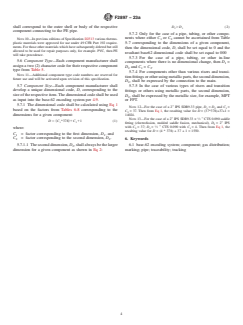
5.7.2 Only for the case of a pipe, tubing, or other compo-
NOTE 10—In previous editions of Specification D2513 various thermo- nents where either C or C cannot be ascertained from Table
1 2
plastic materials were approved for use under 49 CFR Part 192 require-
5-7 corresponding to the dimensions of a given component,
ments. For those other materials which have subsequently deleted but still
then the dimensional code, D, shall be set equal to 0 and the
allowed to be used for repair purposes only, for example. PVC, then PE
resultant base62 dimensional code shall be set equal to 000
will take precedence.
5.7.3 For the case of a pipe, tubing, or other in-line
5.6 Component Type—Each component manufacturer shall
components where there is no dimensional change, then D =
assign a two (2) character code for their respective component
D and C = C .
2 1 2
type from Table 5.
5.7.4 For components other than various risers and transi-
NOTE 11—Additional component type code numbers are reserved for
tion fittings or other using metallic parts, the second dimension,
future use and will be activated upon revision of this specification.
D , shall be expressed by the connection to the main.
5.7 Component Size—Each component manufacturer shall
5.7.5 In the case of various types of risers and transition
develop a unique dimensional code, D, corresponding to the
fittings or others using metallic parts, the second dimension,
size of the respective item. The dimensional code shall be used
D , shall be expressed by the metallic size, for example, MPT
as input into the base-62 encoding system per 4.9.
or FPT.
5.7.1 The dimensional code shall be calculated using Eq 1
NOTE 12—For the case of a 2” IPS SDR9.33 pipe, D = D and C =
1 2 1
based on the factors from Tables 6-8 corresponding to the
C = 37. Then from Eq 1, the resulting value for D = (37*378)+37+1 =
dimensions for a given component:
14024.
NOTE 13—For the case of a 2” IPS SDR9.33 × ⁄2 ” CTS 0.090 saddle
D 5 C *378 1C 11 (1)
~ !
1 2
fitting (electrofusion, molded saddle fusion, mechanical), D = 2” IPS
with C = 37; D = ⁄2 ” CTS 0.090 with C = 4. Then from Eq 1, the
where: 2 1 1
resulting value for D = (4 * 378) + 37 + 1 = 1550.
C = factor corresponding to the first dimension, D , and
1 1
C = factor corresponding to the second dimension, D .
2 2 6. Keywords
5.7.1.1 The second dimension, D , shall always be the larger 6.1 base-62 encoding system; component; gas distribution;
dimension for a given component as shown in Eq 2: marking; pipe; traceability; tracking
F2897 − 23a
TABLE 5 List of Component Types
Category Type-General Subcategory Type Character
Pipe Other 10
Straight 11
Coiled 12
Casing 13
Seamless Line Pipe, API 5L, PSL1, Single Coat 1A
Seamless Line Pipe, API 5L, PSL1, Dual Coat 1B
Seamless Line Pipe, API 5L, PSL2, Single Coat 1C
Seamless Line Pipe, API 5L, PSL2, Dual Coat 1D
Electric Resistance Weld, API 5L, PSL1, Single Coat 1E
Electric Resistance Weld, API 5L, PSL1, Dual Coat 1F
Electric Resistance Weld, API 5L, PSL2, Single Coat 1G
Electric Resistance Weld, API5L, PSL2, Dual Coat 1H
Seamless and Welded, ASTM A53/A53M 1J
Seamless Carbon Steel, ASTM A106/A106M 1K
High Frequency Weld, API 5L, PSL2, Single Coat 1L
High Frequency Weld, API 5L, PSL2, Dual Coat 1M
Coupling Other 20
Socket fusion 21
Socket fusion with EFV 22
Electrofusion 23
Electrofusion with EFV 24
Mechanical compression or nut follower 25
Mechanical compression or nut follower with EFV 26
Mechanical stab 27
Mechanical stab with EFV 28
Mechanical interference fit 29
Mechanical interference fit with EFV 2A
Welded 2B
Threaded 2C
Flanged 2D
Adapter Coupling Other 30
Compression by male pipe thread 31
Compression by female pipe thread 32
Compression by butt fusion 33
Compression by butt welded 34
Compression by solvent welded 35
Compression by stab 39
Stab by male pipe thread 36
Stab by female pipe thread 37
Stab by solvent welded 38
End caps Other 40
Butt fusion 41
Socket fusion 42
Electrofusion 43
Mechanical compression or nut follower 44
Mechanical stab 45
Mechanical interference fit 46
Welded 47
Threaded 48
Fabricated 49
Elbows Other 50
Butt fusion 90 51
Socket fusion 90 52
Electrofusion 90 53
Mechanical compression or nut follower 90 54
Mechanical stab 90 55
Mechanical interference fit 90 56
Welded 90 57
Threaded 90 58
Fabricated 90 59
Butt fusion 45 5A
Socket fusion 45 5B
Electrofusion 45 5C
Mechanical compression or nut follower 45 5D
Mechanical stab 45 5E
Mechanical interference fit 45 5F
Welded 45 5G
Threaded 45 5H
Fabricated 45 5J
3-way tees Other 60
Butt fusion 61
Socket fusion 62
Electrofusion 63
Mechanical compression or nut follower 64
Mechanical stab 65
F2897 − 23a
TABLE 5 Continued
Category Type-General Subcategory Type Character
Mechanical interference fit 66
Welded 67
Threaded 68
Fabricated 69
Reducer Other 70
Butt fusion 71
Socket fusion 72
Electrofusion 73
Mechanical compression or nut follower 74
Mechanical stab 75
Mechanical interference fit 76
Butt Fusion with EFV 7A
Socket Fusion with EFV 7B
Electrofusion with EFV 7C
Mechanical compression or nut follower with EFV 7D
Mechanical Stab with EFV 7E
Mechanical interference fit with EFV 7F
Welded 77
Threaded 78
Fabricated 79
Tapping tees Other 80
Saddle heat fusion by butt fusion outlet 81
Saddle heat fusion by butt fusion outlet with EFV 82
Saddle heat fusion by socket outlet 83
Saddle heat fusion by socket outlet with EFV 84
Saddle heat fusion by mechanical compression outlet 85
Saddle heat fusion by mechanical compression outlet with EFV 86
Saddle heat fusion by stab outlet 87
Saddle heat fusion by stab outlet with EFV 88
Electrofusion by butt fusion outlet 89
Electrofusion by butt fusion outlet with EFV 8A
Electrofusion by socket outlet 8B
Electrofusion by socket outlet with EFV 8C
Electrofusion by mechanical compression outlet 8D
Electrofusion by mechanical compression outlet with EFV 8E
Electrofusion by stab outlet 8F
Electrofusion by stab outlet with EFV 8G
Mechanical by butt fusion outlet 8H
Mechanical by butt fusion outlet with EFV 8J
Mechanical by socket outlet 8K
Mechanical by socket outlet with EFV 8L
Mechanical by mechanical compression outlet 8M
Mechanical by mechanical compression outlet with EFV 8N
Mechanical by stab outlet 8P
Mechanical by stab outlet with EFV 8Q
Mechanical by mechanical interference fit 8R
Mechanical by mechanical interference fit with EFV 8S
High Volume Tapping Tees Other 90
Electrofusion by butt fusion 91
Saddle heat fusion by butt fusion 92
Mechanical by compression outlet 93
Electrofusion by socket outlet 94
Saddle heat fusion by socket outlet 95
Mechanical by stab outlet 96
Mechanical by mechanical interference fit 97
Branch Saddle Other B0
Electrofusion B1
Saddle heat fusion B2
Mechanical B3
Mechanical saddle No outlet S1
Service tee or Valve tee Other D0
Welded by welded D1
Welded by butt fusion D2
Welded by thread D3
Welded by compression or nut follower D4
Welded by mechanical interference fit D5
Welded by stab DD
Thread by welded D6
Thread by compression or nut follower D7
Thread by mechanical interference fit DE
Thread by stab DF
Thread by thread DG
Thread by butt fusion DH
Mechanical saddle by welded D8
Mechanical saddle by Butt fusion D9
F2897 − 23a
TABLE 5 Continued
Category Type-General Subcategory Type Character
Mechanical saddle by thread DA
Mechanical saddle by compression or nut follower DB
Mechanical saddle by mechanical interference fit DC
Mechanical saddle by stab DJ
Service saddles Other E0
Single strap E1
Double strap E2
Flanges Other FH
Blind FB
Lap-Joint FL
Socket Weld FX
Slip-On FS
Threaded FT
Weld-Neck FW
PE Flange Adapter Assembly FP
Transition Fitting Other T0
Welded end T1
Thread end T2
Flanged end T3
Socket weld by butt fusion TX
Riser Other R0
Factory Assembled, Anodeless R1
Factory Assembled, Anodeless, Flexible R2
Factory Assembled, Non-Anodeless R3
Field Assembled. Anodeless R4
Field Assembled, Anodeless, Flexible R5
Field Assembled, Non-Anodeless R6
Valve Other V0
Ball valve V1
Butterfly valve V2
Check valve V3
Relief valve V4
Gate valve V5
Needle valve V6
Plug valve V7
Excess Flow Valve Excess flow valve EF
Meter set assembly and Other M0
components
Diaphragm meter M1
Rotary meter M2
Meter set assembly M3
Meter bar M4
Meter swivel M5
Meter nut M6
Ultrasonic meter M7
Turbine meter M8
Remote shut off meter M9
Regulator Other RX
Pilot RP
Service RS
Relief RR
Filter Other F0
Pilot F1
Service and mains F2
Strainer F3
Anode Other A0
Cast iron A1
Graphite A2
Magnesium A3
Zinc A4
Pressure control fitting Other P0
Split repair P1
Bottom out P2
Top tap P3
Union Non-insulated U1
Insulated UX
Other C0
Repair clamp Repair clamps C1
F2897 − 23a
TABLE 6 C and C Factors Corresponding to Standard Dimensions (D or D ) for CTS and IPS Sizes, in. (mm)
1 2 1 2
D or D D or D
1 2 1 2 Factor
Factor C or C C or
Wall Thickness 1 2 Wall Thickness 1
Diameter SDR Diameter SDR
C
in. (mm) in. (mm) 2
⁄4 in. CTS — 0.062 (1.58) 1 2 in. IPS 9.33 0.255 (6.48) 37
⁄8 in. CTS — 0.062 (1.58) 2 2 in. IPS 11 0.216 (5.49) 38
⁄2 in. CTS — 0.062 (1.58) 3 2 in. IPS 13.5 0.176 (4.47) 39
⁄2 in. CTS — 0.090 (2.27) 4 3 in. IPS 11 0.318 (8.08) 40
⁄2 in. CTS — 0.104 (2.64) 5 3 in. IPS 11.5 0.304 (7.72) 41
⁄4 in. CTS — 0.062 (1.58) 6 3 in. IPS 13.5 0.259 (6.58) 42
⁄4 in. CTS — 0.077 (1.95) 7 4 in. IPS 9.33 0.482 (12.24) 43
⁄4 in. CTS — 0.090 (2.27) 8 4 in. IPS 11 0.409 (10.39) 44
1 in. CTS — 0.062 (1.58) 9 4 in. IPS 11.5 0.391 (9.93) 45
1 in. CTS — 0.090 (2.27) 10 4 in. IPS 13.5 0.333 (8.46) 46
1 in. CTS — 0.099 (2.51) 11 4 in. IPS 15.5 0.290 (7.37) 47
1 in. CTS — 0.101 (2.56) 12 4 in. IPS 17 0.265 (6.73) 48
1 in. CTS — 0.121 (3.07) 13 6 in. IPS 11 0.602 (15.29) 49
1 ⁄4 in. CTS — 0.062 (1.58) 14 6 in. IPS 11.5 0.576 (14.63) 50
1 ⁄4 in. CTS — 0.090 (2.27) 15 6 in. IPS 13.5 0.491 (12.47) 51
1 ⁄4 in. CTS — 0.121 (3.07) 16 6 in. IPS 17 0.390 (9.91) 52
1 ⁄4 in. CTS — 0.062 (1.58) 17 6 in. IPS 21 0.315 (8.00) 53
⁄2 in. IPS 9.3 0.090 (2.29) 18 8 in. IPS 11 0.784 (19.91) 54
⁄2 in. IPS 11 0.076 (1.93) 19 8 in. IPS 11.5 0.750 (19.05) 55
⁄4 in. IPS 11 0.095 (2.41) 20 8 in. IPS 13.5 0.639 (16.23) 56
⁄4 in. IPS D 0.090 (2.29) 21 8 in. IPS 17 0.507 (12.90) 57
1 in. IPS 9.33 0.140 (3.56) 22 8 in. IPS 21 0.411 (10.44) 58
1 in. IPS 9.9 0.133 (3.38) 23 10 in. IPS 11 0.977 (24.82) 59
1 in. IPS 11 0.120 (3.05) 24 10 in. IPS 11.5 0.935 (23.75) 60
1 in. IPS 13.5 0.097 (2.46) 25 10 in. IPS 13.5 0.796 (20.22) 61
1 in. IPS D 0.090 (2.29) 26 10 in. IPS 17 0.632 (16.05) 62
1 ⁄4 in. IPS 9.33 0.178 (4.52) 27 10 in. IPS 21 0.512 (13.00) 63
1 ⁄4 in. IPS 10 0.166 (4.22) 28 12 in. IPS 11 1.159 (29.44) 64
1 ⁄4 in. IPS 11 0.151 (3.84) 29 12 in. IPS 11.5 1.109 (28.17) 65
1 ⁄4 in. IPS 13.5 0.123 (3.12) 30 12 in. IPS 13.5 0.944 (23.98) 66
1 ⁄4 in. IPS 17 0.098 (2.49) 31 12 in. IPS 17 0.750 (19.05) 67
1 ⁄4 in. IPS D 0.090 (2.29) 32 12 in. IPS 21 0.607 (15.42) 68
1 ⁄2 in. IPS 11 0.173 (4.39) 33 14 in. IPS 11 1.273 (32.33) 69
1 ⁄2 in. IPS 13.5 0.141 (3.58) 34 14 in. IPS 13.5 1.037 (26.34) 70
1 ⁄2 in. IPS 17 0.112 (2.85) 35 14 in. IPS 17 0.824 (20.93) 71
1 ⁄2 in. IPS D 0.090 (2.29) 36 14 in. IPS 21 0.667 (16.94) 72
16 in. IPS 11 1.455 (36.96) 73
16 in. IPS 13.5 1.185 (30.10) 74
16 in. IPS 17 0.941 (23.90) 75
16 in. IPS 21 0.762 (19.35) 76
18 in. IPS 11 1.636 (41.55) 77
18 in. IPS 13.5 1.333 (33.86) 78
18 in. IPS 17 1.059 (26.90) 79
18 in. IPS 21 0.857 (21.77) 80
20 in. IPS 11 1.818 (46.18) 81
20 in. IPS 13.5 1.481 (37.62) 82
20 in. IPS 17 1.176 (29.87) 83
20 in. IPS 21 0.952 (24.18) 84
22 in. IPS 11 2.000 (50.8) 85
22 in. IPS 13.5 1.630 (41.40) 86
22 in. IPS 17 1.294 (32.87) 87
22 in. IPS 21 1.048 (26.62) 88
24 in. IPS 11 2.182 (55.43) 89
24 in. IPS 13.5 1.778 (45.16) 90
24 in. IPS 17 1.412 (35.86) 91
24 in. IPS 21 1.143 (29.03) 92
F2897 − 23a
TABLE 7 C and C Factors Corresponding to Dimensions (D or D ) for MPT and FPT Sizes
1 2 1 2
D or D Factor C or C D or D Factor C or C
1 2 1 2 1 2 1 2
1 1
⁄2 in. MPT 101 ⁄2 in. FPT 121
3 3
⁄4 in. MPT 102 ⁄4 in. FPT 122
1 in. MPT 103 1 in. FPT 123
1 1
1 ⁄4 in. MPT 104 1 ⁄4 in. FPT 124
1 1
1 ⁄2 in. MPT 105 1 ⁄2 in. FPT 125
2 in. MPT 106 2 in. FPT 126
3 in. MPT 107 3 in. FPT 127
4 in. MPT 108 4 in. FPT 128
6 in. MPT 109 6 in. FPT 129
8 in. MPT 110 8 in. FPT 130
10 in. MPT 111 10 in. FPT 131
12 in. MPT 112 12 in. FPT 132
F2897 − 23a
TABLE 8 C1 and C2 Factors Corresponding to Dimensions (D1 or D2) for Steel NPS Sizes
NPS Designator Specified Wall
Factor C or C
1 2
Thickness, in. (mm)
⁄8 in. 0.068 (1.73) 151
0.095 (2.41) 152
⁄4 in. 0.088 (2.24) 153
0.119 (3.02) 154
⁄8 in. 0.091 (2.31) 155
0.126 (3.20) 156
⁄2 in. 0.109 (2.77) 157
0.147 (3.73) 158
⁄4 in. 0.113 (2.87) 159
0.154 (3.91) 160
1 in. 0.133 (2.87) 161
0.179 (4.55) 162
1 ⁄4 in. 0.140 (3.56) 163
0.191 (4.85) 164
1 ⁄2 in. 0.145 (3.68) 165
2 in. 0.154 (3.91) 167
0.218 (5.54) 168
3 0.188 (4.78) 169
0.216 (5.49) 170
4 0.156 (3.91) 171
0.188 (4.78) 172
0.237 (6.02) 173
6 0.188 (4.78) 175
0.219 (5.56) 176
0.250 (6.35) 177
0.280 (7.11) 178
8 0.188 (4.78) 181
0.219 (5.56) 182
0.250 (6.35) 183
0.322 (8.18) 184
10 0.188 (4.78) 187
0.203 (5.16) 188
0.219 (5.56) 189
0.279 (7.09) 190
0.365 (9.27) 191
12 0.219 (5.56) 193
0.250 (6.35) 194
0.312 (7.92) 195
0.375 (9.52) 196
14 0.209 (5.30) 197
0.250 (6.35) 198
0.375 (9.53) 199
0.625 (15.88) 200
0.687 (17.45) 201
0.938 (23.83) 202
15 0.209 (5.30) 203
0.250 (6.35) 204
16 0.188 (4.78) 205
0.219 (5.56) 206
0.225 (5.72) 207
0.243 (6.17) 208
0.250 (6.35) 209
0.260 (6.60) 210
0.270 (6.86) 211
0.280 (7.11) 212
0.312 (7.93) 213
0.325 (8.26) 214
F2897 − 23a
TABLE 8 Continued
NPS Designator Specified Wall
Factor C or C
1 2
Thickness, in. (mm)
0.345 (8.76) 215
0.357 (9.07) 216
0.365 (9.27) 217
0.375 (9.53) 218
0.406 (10.31) 219
0.500 (12.70) 220
0.530 (13.46) 221
0.550 (13.97) 222
0.560 (14.22) 223
0.625 (15.88) 224
0.656 (16.66) 225
0.843 (21.41) 226
1.039 (26.39) 227
1.125 (28.58) 228
1.218 (30.94) 229
1.438 (36.53) 230
1.594 (40.49) 231
18 0.219 (5.56) 232
0.250 (6.35) 233
0.312 (7.93) 234
0.344 (8.73) 235
0.375 (9.53) 236
0.406 (10.31) 237
0.500 (12.70) 238
0.750 (19.05) 239
0.938 (23.83) 240
1.125 (28.58) 241
1.156 (29.36) 242
1.375 (34.93) 243
2.100 (53.34) 244
20 0.219 (5.56) 245
0.234 (5.94) 246
0.250 (6.35) 247
0.265 (6.73) 248
0.281 (7.14) 249
0.288 (7.32) 250
0.312 (7.93) 251
0.328 (8.33) 252
0.344 (8.74) 253
0.375 (9.53) 254
0.406 (10.31) 255
0.438 (11.13) 256
0.469 (11.91) 257
0.500 (12.70) 258
22 0.219 (5.56) 259
0.237 (6.02) 260
0.250 (6.35) 261
0.281 (7.14) 262
0.312 (7.93) 263
0.344 (8.74) 264
0.371 (9.42) 265
0.375 (9.53) 266
0.432 (10.97) 267
0.438 (11.13) 268
0.500 (12.70) 269
0.562 (14.28) 270
0.625 (15.88) 271
24 0.250 (6.35) 272
0.265 (6.73) 273
0.271 (6.88) 274
0.281 (7.14) 275
0.289 (7.34) 276
0.307 (7.80) 277
0.312 (7.93) 278
0.320 (8.13) 279
0.344 (8.74) 280
0.375 (9.53) 281
0.382 (9.70) 282
0.391 (9.93) 283
0.406 (10.31) 284
F2897 − 23a
TABLE 8 Continued
NPS Designator Specified Wall
Factor C or C
1 2
Thickness, in. (mm)
0.500 (12.70) 285
0.562 (14.28) 286
0.625 (15.88) 287
1.531 (38.88) 288
26 0.250 (6.35) 289
0.264 (6.71) 290
0.278 (7.06) 291
0.281 (7.14) 292
0.291 (7.39) 293
0.312 (7.93) 294
0.344 (8.74) 295
0.375 (9.53) 296
0.438 (11.13) 297
0.500 (12.70) 298
30 0.250 (6.35) 299
0.281 (7.14) 300
0.287 (7.29) 301
0.312 (7.93) 302
0.328 (8.33) 303
0.337 (8.56) 304
0.344 (8.74) 305
0.350 (8.89) 306
0.365 (9.27) 307
0.375 (9.53) 308
0.391 (9.93) 309
0.406 (10.31) 310
0.417 (10.59) 311
0.421 (10.69) 312
0.428 (10.87) 313
0.430 (10.92) 314
0.437 (11.10) 315
0.438 (11.13) 316
0.450 (11.43) 317
0.469 (11.91) 318
0.500 (12.70) 319
0.562 (14.28) 320
0.563 (14.30) 321
0.593 (15.06) 322
0.625 (15.88) 323
0.750 (19.05) 324
34 0.375 (9.53) 325
0.416 (10.57) 326
0.438 (11.13) 327
0.469 (11.91) 328
0.500 (12.70) 329
0.524 (13.31) 330
0.562 (14.28) 331
0.566 (14.38) 332
0.600 (15.24) 333
0.628 (15.95) 334
0.750 (19.05) 335
0.754 (19.15) 336
0.875 (22.23) 337
1.250 (31.75) 338
36 0.312 (7.92) 339
0.322 (8.18) 340
0.344 (8.74) 341
0.375 (9.53) 342
0.391 (9.93) 343
0.406 (10.31) 344
0.422 (10.72) 345
0.428 (10.87) 346
0.438 (11.13) 347
0.453 (11.51) 348
0.469 (11.91) 349
0.484 (12.29) 350
0.500 (12.70) 351
0.525 (13.33) 352
0.562 (14.28) 353
0.594 (15.09) 354
---------------------- Page
...
This document is not an ASTM standard and is intended only to provide the user of an ASTM standard an indication of what changes have been made to the previous version. Because
it may not be technically possible to adequately depict all changes accurately, ASTM recommends that users consult prior editions as appropriate. In all cases only the current version
of the standard as published by ASTM is to be considered the official document.
Designation: F2897 − 23 F2897 − 23a An American National Standard
Standard Specification for
Tracking and Traceability Encoding System of Natural Gas
Distribution Components (Pipe, Tubing, Fittings, Valves, and
Appurtenances)
This standard is issued under the fixed designation F2897; the number immediately following the designation indicates the year of
original adoption or, in the case of revision, the year of last revision. A number in parentheses indicates the year of last reapproval. A
superscript epsilon (´) indicates an editorial change since the last revision or reapproval.
1. Scope*
1.1 This specification defines requirements for the data used in the tracking and traceability base-62 encoding system and the
format of the resultant code to characterize various components used in fuel gas piping systems.
1.2 The final output of this specification is a 16 digit alpha-numeric code that defines a standardized approach or methodology for
encoding certain characteristics of components that have been established based on consensus recommendations from the
respective stakeholder group members. The means of marking or affixing the code to the components, and the means of reading
and/or transferring the data or codes are outside the scope of this specification.
NOTE 1—To facilitate compliance with this specification, a web based application has been developed to manage and maintain unique manufacturer
identification numbers. The URL for the website is: http://www.componentid.org.
1.3 The web based application is only intended to serve as a useful resource for managing the respective manufacturer
identification numbers, codes, and other identifiers as per this specification. Any changes to the contents of the web based
application are contingent upon subsequent changes to this specification. This specification shall have primacy.
1.4 This international standard was developed in accordance with internationally recognized principles on standardization
established in the Decision on Principles for the Development of International Standards, Guides and Recommendations issued
by the World Trade Organization Technical Barriers to Trade (TBT) Committee.
2. Referenced Documents
2.1 ASTM Standards:
A53/A53M Specification for Pipe, Steel, Black and Hot-Dipped, Zinc-Coated, Welded and Seamless
A106/A106M Specification for Seamless Carbon Steel Pipe for High-Temperature Service
D1600 Terminology for Abbreviated Terms Relating to Plastics
D2513 Specification for Polyethylene (PE) Gas Pressure Pipe, Tubing, and Fittings
F412 Terminology Relating to Plastic Piping Systems
2.2 API Standards:
API 5L Specification for Line Pipe
This specification is under the jurisdiction of ASTM Committee F17 on Plastic Piping Systems and is the direct responsibility of Subcommittee F17.60 on Gas.
Current edition approved July 1, 2023Nov. 1, 2023. Published July 2023November 2023. Originally approved in 2011. Last previous edition approved in 20212023 as
F2897–21. DOI: 10.1520/F2897–23–23. DOI: 10.1520/F2897–23A
For referenced ASTM standards, visit the ASTM website, www.astm.org, or contact ASTM Customer Service at service@astm.org. For Annual Book of ASTM Standards
volume information, refer to the standard’s Document Summary page on the ASTM website.
Available from American Petroleum Institute (API), 1220 L. St., NW, Washington, DC 20005-4070, http://www.api.org.
*A Summary of Changes section appears at the end of this standard
Copyright © ASTM International, 100 Barr Harbor Drive, PO Box C700, West Conshohocken, PA 19428-2959. United States
F2897 − 23a
2.3 ANSI Standards:
B31.8 Gas Transmission and Distribution Piping System
B1.20.1 1983 Pipe Threads, General Purpose, Inch
B109.1 Diaphragm-Type Gas Displacement Meters (Under 500 Cubic-feet-per-hour Capacity)
B109.2 Diaphragm-Type Gas Displacement Meters (500 Cubic-feet-per-hour Capacity)
B109.3 Rotary Type Gas Displacement Meters
B109.4 Self-Operated Diaphragm Type Natural Gas Service Regulators
2.4 CFR Standards:
49 CFR Part 192 Pipeline Safety Requirements
3. Terminology
3.1 Definitions—Definitions are in accordance with Terminology F412, and abbreviations are in accordance with Terminology
D1600, unless otherwise specified.
3.2 The gas industry terminology used in this specification is in accordance with ANSI B31.8 or 49 CFR Part 192, unless otherwise
indicated.
3.3 character, n—an integer from zero (0) to nine (9) or a letter that is upper case and/or lower case from a to z or A to Z.
3.4 component, n—pipe, tubing, fittings, valves, and appurtenances unless specifically stated otherwise.
3.5 digit, n—an integer from zero (0) to nine (9).
3.6 FPT, n—internal taper thread as defined under ANSI/ASME B1.20.1, or commonly referred to as “female pipe thread”.
3.7 MPT, n—external taper thread as defined under ANSI/ASME B1.20.1, or commonly referred to as “male pipe thread”.
3.8 traceability, n—identify the origin of materials and parts used to manufacturer a given component; and/or the product
processing or manufacturing history.
3.9 tracking, v—knowing, documenting, and/or collecting information related to the distribution and location of a given
component after delivery from the manufacturer or supplier.
4. Gas Distribution Component Traceability Identifier
4.1 General—The gas distribution component traceability identifier shall be comprised of sixteen (16) alphanumeric characters
that specify respective attributes (data set) for a given component.
4.1.1 The specified number of characters and order for each data set shall conform to Table 1.
4.1.2 The specified number of characters shall be developed using the base-62 encoding system per section 4.9 and the initial input
data requirements per Section 5.
4.1.3 The gas distribution component traceability identifier shall be in a format suitable for downloading the character codes into
database systems owned and maintained by the end user.
NOTE 2—An illustrative example is provided in Appendix X2.
4.2 Identification of Component Manufacturer—Each component manufacturer shall be identified by a unique two character code
which shall be assigned after completing the required registration and activated by the webmaster of the website http://
www.componentid.org. The manufacturer identification code shall be unique to that particular company and can only be used by
that respective manufacturer/supplier.
Available from American National Standards Institute (ANSI), 25 W. 43rd St., 4th Floor, New York, NY 10036, http://www.ansi.org.
Available from U.S. Government Publishing Office (GPO), 732 N. Capitol St., NW, Washington, DC 20401, http://www.gpo.gov.
F2897 − 23a
TABLE 1 Specified Number of Characters and Order for Gas
Distribution Component Traceability Identifier
Number of
Data
A
Character(s)
Component manufacturer 2
Component manufacturer’s lot code 4
Component production date 3
Component material 1
Component type 2
Component size 3
Base 62 Index 1
A
The total number of characters is based on the final resultant after applying the
base-62 encoding system in this specification. For different initial input data, the
requirements and format are in Section 5 of this specification.
4.3 Identification of Component Manufacturer’s Lot Code—The component manufacturer’s lot code shall be identified by a four
character code that is developed using the base-62 encoding system per 4.9. The four character code shall be unique in a manner
to help ascertain information related to the origin of materials, product processing history, and other information that is agreed upon
between the manufacturer and end user.
4.4 Identification of Component Production Date—The production date code shall be identified by a three character code that is
developed using the base-62 encoding system per 4.9.
4.5 Identification of Component Material—The primary material used to manufacture the pipe or component shall be identified
by a single character code per 5.5.
4.6 Identification of Component Type—Each component type shall be identified by a two character code per 5.6.
4.7 Identification of Component Size—Each component size shall be identified by a three character code that is developed using
the sizing calculation outlined in 5.7 and the base-62 encoding system per 4.9.
4.8 Identification of Base 62 Index—Each component type shall be identified by a single character code per 5.1.
4.9 Base-62 Encoding System:
4.9.1 The base-62 positional encoding system shall utilize integer values between zero and nine and both uppercase and lowercase
alphabet characters with the assigned place values as shown in Table 2.
4.9.2 The assigned place values shown in Table 2 shall be used to convert the initial input data into the final alphanumeric code.
NOTE 3—Detailed examples of converting an initial integer string to a corresponding base-62 alphanumeric character string and vice-versa can be found
in Appendix X1.
NOTE 4—The positional value is the value corresponding to the respective character. For example, the positional value corresponding to the character “r”
is 27. The positional value corresponding to the character “T” is 55.
5. Input Data String
5.1 Base 62 Index—Each component manufacturer shall determine and establish a single character base 62 index code per Table
3 based on their specific component physical properties.
5.1.1 Unless otherwise specified, the sixteenth character shall be a null value of “0”.
NOTE 5—The base 62 index is a reference value that allows for alternative alphanumeric identifiers. The Annex A1 has been added to allow component
manufacturers with additional coefficients corresponding to thicker wall sizes that are not listed in the main body of this specification.
F2897 − 23a
TABLE 2 Positional Values for Base-62 Encoding System
Positional Positional
Character Character
Value Value
0 0 36 A
1 1 37 B
2 2 38 C
3 3 39 D
4 4 40 E
5 5 41 F
6 6 42 G
7 7 43 H
8 8 44 I
9 9 45 J
10 a 46 K
11 b 47 L
12 c 48 M
13 d 49 N
14 e 50 O
15 f 51 P
16 g 52 Q
17 h 53 R
18 i 54 S
19 j 55 T
20 k 56 U
21 l 57 V
22 m 58 W
23 n 59 X
24 o 60 Y
25 p 61 Z
26 q
27 r
28 s
29 t
30 u
31 v
32 w
33 x
34 y
35 z
TABLE 3 List of base 62 Index Values
Type Code
Default 0
Annex A1 1
5.2 Component Manufacturer—Each component manufacturer shall establish a unique two (2) digit identifier by completing the
required registration and activated by the webmaster of the website http://www.componentid.org. The manufacturer identification
code shall be unique to that particular company and can only be used by that company. In cases where the company undergoes
a change in name, acquired, merged with another company, new two (2) digit identifier must be registered and activated if the
“acquiring” or “merged with” company does not already have a registered identifier.
5.3 Component Manufacturer’s Lot Code—Each component manufacturer shall establish a unique seven (7) digit number for their
lot code which shall be used as the input into the base-62 encoding system per 4.9. The 7 digit number shall consist of only integer
values and cannot contain any other characters such as alphabetic or ASCII characters.
NOTE 6—The 7 digit code can be developed freely by the manufacturer to define individual production lots in a unique way. Elements of the 7 digit code
may possibly include production site, extrusion line, injection molding equipment number, operator, shift, etc. The 7 digit code should be capable of
providing pertinent traceability information upon request.
5.4 Component Production Date—Each component manufacturer shall provide the production date of the respective component
consisting of five (5) digits as input into the base-62 encoding system per 4.9.
5.4.1 The first three digits shall correspond to the particular day of the year.
5.4.2 The final two digits shall correspond to the last two digits of the year.
F2897 − 23a
NOTE 7—For example, the date input represented by 23410 implies the 234th day of 2010.
5.5 Component Material—Each component manufacturer shall assign a single character code for the primary material used to
manufacture the respective component from Table 4.
NOTE 8—Additional material code numbers are reserved for future use and will be activated upon revision of this specification.
NOTE 9—The “Grade” designation for steel materials will vary based on the standard to which it is manufactured. The user should verify the chemical
and mechanical properties in accordance to the specific standard that they are utilizing before making their final selection.
5.5.1 For pipe and tubing made from a single material, the code shall be assigned from the list shown in Table 4.
5.5.2 For multi-layer pipe and tubing, the inner most layer which is in contact with the natural gas shall be assigned from the list
shown in Table 4.
5.5.3 For factory assembled transition fittings and risers and transition tees intended to facilitate a change between metallic and
non-metallic piping systems, the non-metallic portion shall be identified.
5.5.4 For all components other than factory assembled transition fittings and risers and transition tees, the material code shall
correspond to the outer shell or body of the respective component regardless of the piping system to which it is intended to be
installed.
5.5.5 For fittings intended to facilitate a change between PE to another thermoplastic piping systems, the material code shall
correspond to the outer shell or body of the respective component connecting to the PE pipe.
TABLE 4 List of Material Types
Type Code
PE2406 A
PE2708 B
PE2708 PLUS d
PE3408 C
PE3608 D
PE3708 E
PE3710 F
PE4608 G
PE4710 H
PE4710 PLUS e
PE80 W
PE100 Z
Poly (Vinyl Chloride) – PVC J
Polyamide 11 – PA11 K
Polyamide 12 – PA12 L
PEX Y
Steel M
Stainless Steel N
Cast Iron O
Copper P
Brass Q
Malleable Iron R
Ductile Iron S
Reinforced Epoxy Resin T
Nylon U
Glass Filled Nylon V
Other X
Steel – GRADE A 0
Steel – GRADE B 1
Steel – GRADE C 2
Steel – GRADE X42 3
Steel – GRADE X46 4
Steel – GRADE X52 5
Steel – GRADE X56 6
Steel – GRADE X60 7
Steel – GRADE X65 8
Steel – GRADE X70 9
F2897 − 23a
NOTE 10—In previous editions of Specification D2513 various thermoplastic materials were approved for use under 49 CFR Part 192 requirements. For
those other materials which have subsequently deleted but still allowed to be used for repair purposes only, for example. PVC, then PE will take
precedence.
5.6 Component Type—Each component manufacturer shall assign a two (2) character code for their respective component type
from Table 5.
NOTE 11—Additional component type code numbers are reserved for future use and will be activated upon revision of this specification.
5.7 Component Size—Each component manufacturer shall develop a unique dimensional code, D, corresponding to the size of the
respective item. The dimensional code shall be used as input into the base-62 encoding system per 4.9.
5.7.1 The dimensional code shall be calculated using Eq 1 based on the factors from Tables 6-8 corresponding to the dimensions
for a given component:
D 5 C *378 1C 11 (1)
~ !
1 2
where:
C = factor corresponding to the first dimension, D , and
1 1
C = factor corresponding to the second dimension, D .
2 2
5.7.1.1 The second dimension, D , shall always be the larger dimension for a given component as shown in Eq 2:
D .D (2)
2 1
5.7.2 Only for the case of a pipe, tubing, or other components where either C or C cannot be ascertained from Table 5-7
1 2
corresponding to the dimensions of a given component, then the dimensional code, D, shall be set equal to 0 and the resultant
base62 dimensional code shall be set equal to 000
5.7.3 For the case of a pipe, tubing, or other in-line components where there is no dimensional change, then D = D and C =
1 2 1
C .
5.7.4 For components other than various risers and transition fittings or other using metallic parts, the second dimension, D , shall
be expressed by the connection to the main.
5.7.5 In the case of various types of risers and transition fittings or others using metallic parts, the second dimension, D , shall
be expressed by the metallic size, for example, MPT or FPT.
NOTE 12—For the case of a 2” IPS SDR9.33 pipe, D = D and C = C = 37. Then from Eq 1, the resulting value for D = (37*378)+37+1 = 14024.
1 2 1 2
NOTE 13—For the case of a 2” IPS SDR9.33 × ⁄2 ” CTS 0.090 saddle fitting (electrofusion, molded saddle fusion, mechanical), D = 2” IPS with C =
2 2
37; D = ⁄2 ” CTS 0.090 with C = 4. Then from Eq 1, the resulting value for D = (4 * 378) + 37 + 1 = 1550.
1 1
6. Keywords
6.1 base-62 encoding system; component; gas distribution; marking; pipe; traceability; tracking
F2897 − 23a
TABLE 5 List of Component Types
Category Type-General Subcategory Type Character
Pipe Other 10
Straight 11
Coiled 12
Casing 13
Seamless Line Pipe, API 5L, PSL1, Single Coat 1A
Seamless Line Pipe, API 5L, PSL1, Dual Coat 1B
Seamless Line Pipe, API 5L, PSL2, Single Coat 1C
Seamless Line Pipe, API 5L, PSL2, Dual Coat 1D
Electric Resistance Weld, API 5L, PSL1, Single Coat 1E
Electric Resistance Weld, API 5L, PSL1, Dual Coat 1F
Electric Resistance Weld, API 5L, PSL2, Single Coat 1G
Electric Resistance Weld, API5L, PSL2, Dual Coat 1H
Seamless and Welded, ASTM A53/A53M 1J
Seamless Carbon Steel, ASTM A106/A106M 1K
High Frequency Weld, API 5L, PSL2, Single Coat 1L
High Frequency Weld, API 5L, PSL2, Dual Coat 1M
Coupling Other 20
Socket fusion 21
Socket fusion with EFV 22
Electrofusion 23
Electrofusion with EFV 24
Mechanical compression or nut follower 25
Mechanical compression or nut follower with EFV 26
Mechanical stab 27
Mechanical stab with EFV 28
Mechanical interference fit 29
Mechanical interference fit with EFV 2A
Welded 2B
Threaded 2C
Flanged 2D
Adapter Coupling Other 30
Compression by male pipe thread 31
Compression by female pipe thread 32
Compression by butt fusion 33
Compression by butt welded 34
Compression by solvent welded 35
Compression by stab 39
Stab by male pipe thread 36
Stab by female pipe thread 37
Stab by solvent welded 38
End caps Other 40
Butt fusion 41
Socket fusion 42
Electrofusion 43
Mechanical compression or nut follower 44
Mechanical stab 45
Mechanical interference fit 46
Welded 47
Threaded 48
Fabricated 49
Elbows Other 50
Butt fusion 90 51
Socket fusion 90 52
Electrofusion 90 53
Mechanical compression or nut follower 90 54
Mechanical stab 90 55
Mechanical interference fit 90 56
Welded 90 57
Threaded 90 58
Fabricated 90 59
Butt fusion 45 5A
Socket fusion 45 5B
Electrofusion 45 5C
Mechanical compression or nut follower 45 5D
Mechanical stab 45 5E
Mechanical interference fit 45 5F
Welded 45 5G
Threaded 45 5H
Fabricated 45 5J
3-way tees Other 60
Butt fusion 61
Socket fusion 62
Electrofusion 63
Mechanical compression or nut follower 64
Mechanical stab 65
F2897 − 23a
TABLE 5 Continued
Category Type-General Subcategory Type Character
Mechanical interference fit 66
Welded 67
Threaded 68
Fabricated 69
Reducer Other 70
Butt fusion 71
Socket fusion 72
Electrofusion 73
Mechanical compression or nut follower 74
Mechanical stab 75
Mechanical interference fit 76
Butt Fusion with EFV 7A
Socket Fusion with EFV 7B
Electrofusion with EFV 7C
Mechanical compression or nut follower with EFV 7D
Mechanical Stab with EFV 7E
Mechanical interference fit with EFV 7F
Welded 77
Threaded 78
Fabricated 79
Tapping tees Other 80
Saddle heat fusion by butt fusion outlet 81
Saddle heat fusion by butt fusion outlet with EFV 82
Saddle heat fusion by socket outlet 83
Saddle heat fusion by socket outlet with EFV 84
Saddle heat fusion by mechanical compression outlet 85
Saddle heat fusion by mechanical compression outlet with EFV 86
Saddle heat fusion by stab outlet 87
Saddle heat fusion by stab outlet with EFV 88
Electrofusion by butt fusion outlet 89
Electrofusion by butt fusion outlet with EFV 8A
Electrofusion by socket outlet 8B
Electrofusion by socket outlet with EFV 8C
Electrofusion by mechanical compression outlet 8D
Electrofusion by mechanical compression outlet with EFV 8E
Electrofusion by stab outlet 8F
Electrofusion by stab outlet with EFV 8G
Mechanical by butt fusion outlet 8H
Mechanical by butt fusion outlet with EFV 8J
Mechanical by socket outlet 8K
Mechanical by socket outlet with EFV 8L
Mechanical by mechanical compression outlet 8M
Mechanical by mechanical compression outlet with EFV 8N
Mechanical by stab outlet 8P
Mechanical by stab outlet with EFV 8Q
Mechanical by mechanical interference fit 8R
Mechanical by mechanical interference fit with EFV 8S
High Volume Tapping Tees Other 90
Electrofusion by butt fusion 91
Saddle heat fusion by butt fusion 92
Mechanical by compression outlet 93
Electrofusion by socket outlet 94
Saddle heat fusion by socket outlet 95
Mechanical by stab outlet 96
Mechanical by mechanical interference fit 97
Branch Saddle Other B0
Electrofusion B1
Saddle heat fusion B2
Mechanical B3
Mechanical saddle No outlet S1
Service tee or Valve tee Other D0
Welded by welded D1
Welded by butt fusion D2
Welded by thread D3
Welded by compression or nut follower D4
Welded by mechanical interference fit D5
Welded by stab DD
Thread by welded D6
Thread by compression or nut follower D7
Thread by mechanical interference fit DE
Thread by stab DF
Thread by thread DG
Thread by butt fusion DH
Mechanical saddle by welded D8
Mechanical saddle by Butt fusion D9
F2897 − 23a
TABLE 5 Continued
Category Type-General Subcategory Type Character
Mechanical saddle by thread DA
Mechanical saddle by compression or nut follower DB
Mechanical saddle by mechanical interference fit DC
Mechanical saddle by stab DJ
Service saddles Other E0
Single strap E1
Double strap E2
Flanges Other FH
Blind FB
Lap-Joint FL
Socket Weld FX
Slip-On FS
Threaded FT
Weld-Neck FW
PE Flange Adapter Assembly FP
Transition Fitting Other T0
Welded end T1
Thread end T2
Flanged end T3
Socket weld by butt fusion TX
Riser Other R0
Factory Assembled, Anodeless R1
Factory Assembled, Anodeless, Flexible R2
Factory Assembled, Non-Anodeless R3
Field Assembled. Anodeless R4
Field Assembled, Anodeless, Flexible R5
Field Assembled, Non-Anodeless R6
Valve Other V0
Ball valve V1
Butterfly valve V2
Check valve V3
Relief valve V4
Gate valve V5
Needle valve V6
Plug valve V7
Excess Flow Valve Excess flow valve EF
Meter set assembly and Other M0
components
Diaphragm meter M1
Rotary meter M2
Meter set assembly M3
Meter bar M4
Meter swivel M5
Meter nut M6
Ultrasonic meter M7
Turbine meter M8
Remote shut off meter M9
Regulator Other RX
Pilot RP
Service RS
Relief RR
Filter Other F0
Pilot F1
Service and mains F2
Strainer F3
Anode Other A0
Cast iron A1
Graphite A2
Magnesium A3
Zinc A4
Pressure control fitting Other P0
Split repair P1
Bottom out P2
Top tap P3
Union Non-insulated U1
Insulated UX
Other C0
Repair clamp Repair clamps C1
F2897 − 23a
TABLE 6 C and C Factors Corresponding to Standard Dimensions (D or D ) for CTS and IPS Sizes, in. (mm)
1 2 1 2
D or D D or D
1 2 1 2 Factor
Factor C or C C or
Wall Thickness 1 2 Wall Thickness 1
Diameter SDR Diameter SDR
C
in. (mm) in. (mm) 2
⁄4 in. CTS — 0.062 (1.58) 1 2 in. IPS 9.33 0.255 (6.48) 37
⁄8 in. CTS — 0.062 (1.58) 2 2 in. IPS 11 0.216 (5.49) 38
⁄2 in. CTS — 0.062 (1.58) 3 2 in. IPS 13.5 0.176 (4.47) 39
⁄2 in. CTS — 0.090 (2.27) 4 3 in. IPS 11 0.318 (8.08) 40
⁄2 in. CTS — 0.104 (2.64) 5 3 in. IPS 11.5 0.304 (7.72) 41
⁄4 in. CTS — 0.062 (1.58) 6 3 in. IPS 13.5 0.259 (6.58) 42
⁄4 in. CTS — 0.077 (1.95) 7 4 in. IPS 9.33 0.482 (12.24) 43
⁄4 in. CTS — 0.090 (2.27) 8 4 in. IPS 11 0.409 (10.39) 44
1 in. CTS — 0.062 (1.58) 9 4 in. IPS 11.5 0.391 (9.93) 45
1 in. CTS — 0.090 (2.27) 10 4 in. IPS 13.5 0.333 (8.46) 46
1 in. CTS — 0.099 (2.51) 11 4 in. IPS 15.5 0.290 (7.37) 47
1 in. CTS — 0.101 (2.56) 12 4 in. IPS 17 0.265 (6.73) 48
1 in. CTS — 0.121 (3.07) 13 6 in. IPS 11 0.602 (15.29) 49
1 ⁄4 in. CTS — 0.062 (1.58) 14 6 in. IPS 11.5 0.576 (14.63) 50
1 ⁄4 in. CTS — 0.090 (2.27) 15 6 in. IPS 13.5 0.491 (12.47) 51
1 ⁄4 in. CTS — 0.121 (3.07) 16 6 in. IPS 17 0.390 (9.91) 52
1 ⁄4 in. CTS — 0.062 (1.58) 17 6 in. IPS 21 0.315 (8.00) 53
⁄2 in. IPS 9.3 0.090 (2.29) 18 8 in. IPS 11 0.784 (19.91) 54
⁄2 in. IPS 11 0.076 (1.93) 19 8 in. IPS 11.5 0.750 (19.05) 55
⁄4 in. IPS 11 0.095 (2.41) 20 8 in. IPS 13.5 0.639 (16.23) 56
⁄4 in. IPS D 0.090 (2.29) 21 8 in. IPS 17 0.507 (12.90) 57
1 in. IPS 9.33 0.140 (3.56) 22 8 in. IPS 21 0.411 (10.44) 58
1 in. IPS 9.9 0.133 (3.38) 23 10 in. IPS 11 0.977 (24.82) 59
1 in. IPS 11 0.120 (3.05) 24 10 in. IPS 11.5 0.935 (23.75) 60
1 in. IPS 13.5 0.097 (2.46) 25 10 in. IPS 13.5 0.796 (20.22) 61
1 in. IPS D 0.090 (2.29) 26 10 in. IPS 17 0.632 (16.05) 62
1 ⁄4 in. IPS 9.33 0.178 (4.52) 27 10 in. IPS 21 0.512 (13.00) 63
1 ⁄4 in. IPS 10 0.166 (4.22) 28 12 in. IPS 11 1.159 (29.44) 64
1 ⁄4 in. IPS 11 0.151 (3.84) 29 12 in. IPS 11.5 1.109 (28.17) 65
1 ⁄4 in. IPS 13.5 0.123 (3.12) 30 12 in. IPS 13.5 0.944 (23.98) 66
1 ⁄4 in. IPS 17 0.098 (2.49) 31 12 in. IPS 17 0.750 (19.05) 67
1 ⁄4 in. IPS D 0.090 (2.29) 32 12 in. IPS 21 0.607 (15.42) 68
1 ⁄2 in. IPS 11 0.173 (4.39) 33 14 in. IPS 11 1.273 (32.33) 69
1 ⁄2 in. IPS 13.5 0.141 (3.58) 34 14 in. IPS 13.5 1.037 (26.34) 70
1 ⁄2 in. IPS 17 0.112 (2.85) 35 14 in. IPS 17 0.824 (20.93) 71
1 ⁄2 in. IPS D 0.090 (2.29) 36 14 in. IPS 21 0.667 (16.94) 72
16 in. IPS 11 1.455 (36.96) 73
16 in. IPS 13.5 1.185 (30.10) 74
16 in. IPS 17 0.941 (23.90) 75
16 in. IPS 21 0.762 (19.35) 76
18 in. IPS 11 1.636 (41.55) 77
18 in. IPS 13.5 1.333 (33.86) 78
18 in. IPS 17 1.059 (26.90) 79
18 in. IPS 21 0.857 (21.77) 80
20 in. IPS 11 1.818 (46.18) 81
20 in. IPS 13.5 1.481 (37.62) 82
20 in. IPS 17 1.176 (29.87) 83
20 in. IPS 21 0.952 (24.18) 84
22 in. IPS 11 2.000 (50.8) 85
22 in. IPS 13.5 1.630 (41.40) 86
22 in. IPS 17 1.294 (32.87) 87
22 in. IPS 21 1.048 (26.62) 88
24 in. IPS 11 2.182 (55.43) 89
24 in. IPS 13.5 1.778 (45.16) 90
24 in. IPS 17 1.412 (35.86) 91
24 in. IPS 21 1.143 (29.03) 92
F2897 − 23a
TABLE 7 C and C Factors Corresponding to Dimensions (D or D ) for MPT and FPT Sizes
1 2 1 2
D or D Factor C or C D or D Factor C or C
1 2 1 2 1 2 1 2
1 1
⁄2 in. MPT 101 ⁄2 in. FPT 121
3 3
⁄4 in. MPT 102 ⁄4 in. FPT 122
1 in. MPT 103 1 in. FPT 123
1 1
1 ⁄4 in. MPT 104 1 ⁄4 in. FPT 124
1 1
1 ⁄2 in. MPT 105 1 ⁄2 in. FPT 125
2 in. MPT 106 2 in. FPT 126
3 in. MPT 107 3 in. FPT 127
4 in. MPT 108 4 in. FPT 128
6 in. MPT 109 6 in. FPT 129
8 in. MPT 110 8 in. FPT 130
10 in. MPT 111 10 in. FPT 131
12 in. MPT 112 12 in. FPT 132
F2897 − 23a
TABLE 8 C1 and C2 Factors Corresponding to Dimensions (D1 or D2) for Steel NPS Sizes
NPS Designator Specified Wall
Factor C or C
1 2
Thickness, in. (mm)
⁄8 in. 0.068 (1.73) 151
0.095 (2.41) 152
⁄4 in. 0.088 (2.24) 153
0.119 (3.02) 154
⁄8 in. 0.091 (2.31) 155
0.126 (3.20) 156
⁄2 in. 0.109 (2.77) 157
0.147 (3.73) 158
⁄4 in. 0.113 (2.87) 159
0.154 (3.91) 160
1 in. 0.133 (2.87) 161
0.179 (4.55) 162
1 ⁄4 in. 0.140 (3.56) 163
0.191 (4.85) 164
1 ⁄2 in. 0.145 (3.68) 165
2 in. 0.154 (3.91) 167
0.218 (5.54) 168
3 0.188 (4.78) 169
0.216 (5.49) 170
4 0.156 (3.91) 171
0.188 (4.78) 172
0.237 (6.02) 173
6 0.188 (4.78) 175
0.219 (5.56) 176
0.250 (6.35) 177
0.280 (7.11) 178
8 0.188 (4.78) 181
0.219 (5.56) 182
0.250 (6.35) 183
0.322 (8.18) 184
10 0.188 (4.78) 187
0.203 (5.16) 188
0.219 (5.56) 189
0.279 (7.09) 190
0.365 (9.27) 191
12 0.219 (5.56) 193
0.250 (6.35) 194
0.312 (7.92) 195
0.375 (9.52) 196
14 0.209 (5.30) 197
0.250 (6.35) 198
0.375 (9.53) 199
0.625 (15.88) 200
0.687 (17.45) 201
0.938 (23.83) 202
15 0.209 (5.30) 203
0.250 (6.35) 204
16 0.188 (4.78) 205
0.219 (5.56) 206
0.225 (5.72) 207
0.243 (6.17) 208
0.250 (6.35) 209
0.260 (6.60) 210
0.270 (6.86) 211
0.280 (7.11) 212
0.312 (7.93) 213
0.325 (8.26) 214
F2897 − 23a
TABLE 8 Continued
NPS Designator Specified Wall
Factor C or C
1 2
Thickness, in. (mm)
0.345 (8.76) 215
0.357 (9.07) 216
0.365 (9.27) 217
0.375 (9.53) 218
0.406 (10.31) 219
0.500 (12.70) 220
0.530 (13.46) 221
0.550 (13.97) 222
0.560 (14.22) 223
0.625 (15.88) 224
0.656 (16.66) 225
0.843 (21.41) 226
1.039 (26.39) 227
1.125 (28.58) 228
1.218 (30.94) 229
1.438 (36.53) 230
1.594 (40.49) 231
18 0.219 (5.56) 232
0.250 (6.35) 233
0.312 (7.93) 234
0.344 (8.73) 235
0.375 (9.53) 236
0.406 (10.31) 237
0.500 (12.70) 238
0.750 (19.05) 239
0.938 (23.83) 240
1.125 (28.58) 241
1.156 (29.36) 242
1.375 (34.93) 243
2.100 (53.34) 244
20 0.219 (5.56) 245
0.234 (5.94) 246
0.250 (6.35) 247
0.265 (6.73) 248
0.281 (7.14) 249
0.288 (7.32) 250
0.312 (7.93) 251
0.328 (8.33) 252
0.344 (8.74) 253
0.375 (9.53) 254
0.406 (10.31) 255
0.438 (11.13) 256
0.469 (11.91) 257
0.500 (12.70) 258
22 0.219 (5.56) 259
0.237 (6.02) 260
0.250 (6.35) 261
0.281 (7.14) 262
0.312 (7.93) 263
0.344 (8.74) 264
0.371 (9.42) 265
0.375 (9.53) 266
0.432 (10.97) 267
0.438 (11.13) 268
0.500 (12.70) 269
0.562 (14.28) 270
0.625 (15.88) 271
24 0.250 (6.35) 272
0.265 (6.73) 273
0.271 (6.88) 274
0.281 (7.14) 275
0.289 (7.34) 276
0.307 (7.80) 277
0.312 (7.93) 278
0.320 (8.13) 279
0.344 (8.74) 280
0.375 (9.53) 281
0.382 (9.70) 282
0.391 (9.93) 283
0.406 (10.31) 284
F2897 − 23a
TABLE 8 Continued
NPS Designator Specified Wall
Factor C or C
1 2
Thickness, in. (mm)
0.500 (12.70) 285
0.562 (14.28) 286
0.625 (15.88) 287
1.531 (38.88) 288
26 0.250 (6.35) 289
0.264 (6.71) 290
0.278 (7.06) 291
0.281 (7.14) 292
0.291 (7.39) 293
0.312 (7.93) 294
0.344 (8.74) 295
0.375 (9.53) 296
0.438 (11.13) 297
0.500 (12.70) 298
30 0.250 (6.35) 299
0.281 (7.14) 300
0.287 (7.29) 301
0.312 (7.93) 302
0.328 (8.33) 303
0.337 (8.56) 304
0.344 (8.74) 305
0.350 (8.89) 306
0.365 (9.27) 307
0.375 (9.53) 308
0.391 (9.93) 309
0.406 (10.31) 310
0.417 (10.59) 311
0.421 (10.69) 312
0.428 (10.87) 313
0.430 (10.92) 314
0.437 (11.10) 315
0.438 (11.13) 316
0.450 (11.43) 317
0.469 (11.91) 318
0.500 (12.70) 319
0.562 (14.28) 320
0.563 (14.30) 321
0.593 (15.06) 322
0.625 (15.88) 323
0.750 (19.05) 324
34 0.375 (9.53) 325
0.416 (10.57) 326
0.438 (11.13) 327
0.469 (11.91) 328
0.500 (12.70) 329
0.524 (13.31) 330
0.562 (14.28) 331
0.566 (14.38) 332
0.600 (15.24) 333
0.628 (15.95) 334
0.750 (19.05) 335
0.754 (19.15) 336
0.875 (22.23) 337
1.250 (31.75) 338
36 0.312 (7.92) 339
0.322 (8.18) 340
0.344 (8.74) 341
0.375 (9.53) 342
0.391 (9.93) 343
0.406 (10.31) 344
0.422 (10.72) 345
0.428 (10.87) 346
0.438 (11.13) 347
0.453 (11.51) 348
0.469 (11.91) 349
0.484 (12.29) 350
0.500 (12.70) 351
0.525 (13.33) 352
0.562 (14.28) 353
0.594 (15.09) 354
F2897 − 23a
TABLE 8 Continued
NPS Designator Specified Wall
Factor C or C
1 2
Thickness, in. (mm)
0.625 (15.88) 355
0.750 (19.05) 356
42 0.375 (9.52) 357
0.500 (12.70) 358
0.688 (17.48) 359
ANNEX
A1. SUPPLEMENTAL REQUIREMENTS FOR BASE 62 INDEX VALUE EQUAL TO ONE (“1”)
A1.1 Scope
A1.1.1 This annex covers requirements for the input data string to establish the gas distribution component traceability identifier
when the base 62 index has been set to 1. Unless, otherwise specified, the requirements in Section 4 of the main body of this
specification shall apply.
A1.2 Referenced Documents
A1.2.1 ASTM Standards:
A53/A53M Specification for Pipe, Steel, Black and Hot-Dipped, Zinc-Coated, Welded and Seamless
A106/A106M Specification for Seamless Carbon Steel Pipe for High-Temperature Service
D1600 Terminology for Abbreviated Terms Relating to Plastics
D2513 Specification for Polyethylene (PE) Gas Pressure Pipe, Tubing, and Fittings
F412 Terminology Relating to Plastic Piping Systems
A1.2.2 API Standards :
API 5L Specification for Line Pipe
A1.2.3 ANSI Standards :
B31.8 Gas Transmission and Distribution Piping System
B1.20.1 1983 Pipe Threads, General Purpose, Inch
B109.1 Diaphragm-Type Gas Displacement Meters (Under 500 Cubic-feet-per-hour Capacity)
B109.2 Diaphragm-Type Gas Displacement Meters (500 Cubic-feet-per-hour Capacity)
B109.3 Rotary Type Gas Displacement Meters
B109.4 Self-Operated Diaphragm Type Natural Gas Service Regulators
A1.2.4 CFR Standards :
49 CFR Part 192 Pipeline Safety Requirements
F2897 − 23a
A1.2.5 CSA Standards
...