

ASTM F1336-20
(Specification)Standard Specification for Poly(Vinyl Chloride) (PVC) Gasketed Sewer Fittings
General Information
- Abstract
ABSTRACT
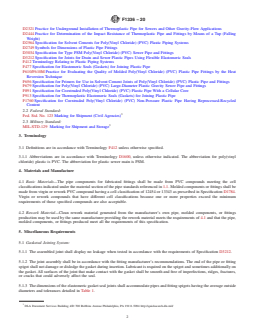
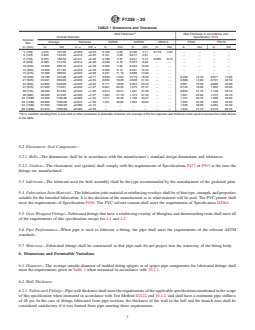
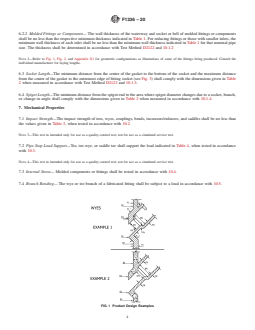
This specification covers the material, dimensional, and mechanical requirements, and associated test methods for fabricated or molded poly(vinyl chloride) (PVC) gasketed sewer fittings manufactured from pipe, or from a combination of pipe and injection molded parts, or from injection molded parts that are suitable for non-pressure drainage of sewage and surface water, as well as applications involving subsurface drainage. The fittings shall adhere to specified values for outside diameter, wall thickness, socket length, and spigot length. When evaluated according to the test procedures provided herein, the fittings shall meet specified requirements for impact strength, pipe stop load support, internal stress, and branch bending. The products shall also undergo referee testing and quality control tests.
SCOPE
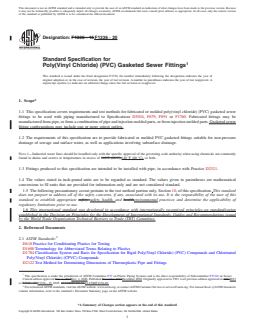
1.1 This specification covers requirements and test methods for fabricated or molded poly(vinyl chloride) (PVC) gasketed sewer fittings to be used with piping manufactured to Specifications D3034, F679, F891 or F1760. Fabricated fittings may be manufactured from pipe, or from a combination of pipe and injection molded parts, or from injection molded parts. Gasketed sewer fitting configurations may include one or more spigot outlets.
1.2 The requirements of this specification are to provide fabricated or molded PVC gasketed fittings suitable for non-pressure drainage of sewage and surface water, as well as applications involving subsurface drainage.
Note 1: Industrial waste lines should be installed only with the specific approval of the governing code authority when using chemicals not commonly found in drains and sewers or temperatures in excess of 140 °F (60 °C), or both.
1.3 Fittings produced to this specification are intended to be installed with pipe, in accordance with Practice D2321.
1.4 The values stated in inch-pound units are to be regarded as standard. The values given in parentheses are mathematical conversions to SI units that are provided for information only and are not considered standard.
1.5 The following precautionary caveat pertains to the test method portion only, Section 10, of this specification. This standard does not purport to address all of the safety concerns, if any, associated with its use. It is the responsibility of the user of this standard to establish appropriate safety, health, and environmental practices and determine the applicability of regulatory limitations prior to use.
1.6 This international standard was developed in accordance with internationally recognized principles on standardization established in the Decision on Principles for the Development of International Standards, Guides and Recommendations issued by the World Trade Organization Technical Barriers to Trade (TBT) Committee.
- Status
- Published
- Publication Date
- 31-Oct-2020
- Technical Committee
- F17 - Plastic Piping Systems
- Drafting Committee
- F17.62 - Sewer
Buy Documents
ASTM F1336-20 - Standard Specification for Poly(Vinyl Chloride) (PVC) Gasketed Sewer Fittings
REDLINE ASTM F1336-20 - Standard Specification for Poly(Vinyl Chloride) (PVC) Gasketed Sewer Fittings
Overview
ASTM F1336-20 is the industry standard specification for fabricated or molded Poly(Vinyl Chloride) (PVC) gasketed sewer fittings. Developed by ASTM International, this standard outlines the essential material, dimensional, and mechanical requirements for PVC sewer fittings designed with elastomeric gaskets. These products are primarily intended for non-pressure drainage applications such as sanitary sewer, stormwater, and subsurface drainage systems. The standard ensures fittings are compatible with specific types of PVC sewer pipes and mandates rigorous testing for durability, fit, and performance, supporting high quality and reliable underground piping systems.
Key Topics
- Material Requirements: Specifies that fittings must be manufactured from approved PVC compounds, meeting criteria set for cell classifications (e.g., per ASTM D1784). Both virgin and properly qualified rework material are permitted, ensuring product homogeneity and long-term performance.
- Dimensional Requirements: Details minimum and maximum tolerances for outside diameter, wall thickness, socket length, and spigot length to guarantee correct fit with mating pipes and joints.
- Mechanical Performance: Sets criteria for impact strength, load support, internal stress, and branch bending requirements, supporting reliability in underground installations.
- Gasketed Joint Performance: Mandates use of elastomeric gaskets that meet ASTM F477 or F913, along with proper assembly methods and physical properties to prevent leakages.
- Quality Control and Testing: Describes referee and quality control tests for verifying product conformance, including detailed sampling, conditioning, and inspection provisions.
- Marking and Packaging: Outlines mandatory marking of fittings with key information (manufacturer, material, size, standard designation) and general packaging guidelines to maintain product traceability and integrity during transport and installation.
Applications
ASTM F1336-20 applies to a wide range of PVC sewer fitting configurations used in modern underground gravity-flow piping systems. Typical applications include:
- Municipal and Residential Sewer Systems: Fittings designed for gravity-fed sanitary sewer lines, ensuring leak-resistant connections and long service life.
- Stormwater and Surface Water Drainage: For effective conveyance and management of rainwater and runoff in urban infrastructure.
- Subsurface Drainage: Used in applications like agricultural drainage or groundwater management systems, where reliable, watertight performance is essential.
- New Construction and Rehabilitation: Suitable for both new installations and replacement or repair of existing non-pressure sewer infrastructure.
The standard ensures fittings are compatible with pipe manufactured to ASTM D3034, F679, F891, or F1760, allowing for versatility across various project specifications while maintaining uniformity and compliance.
Related Standards
Several ASTM standards are referenced within ASTM F1336-20 to ensure comprehensive guidance throughout the piping system:
- ASTM D1784: PVC compound classification.
- ASTM D3034, F679, F891, F1760: Specifications for PVC sewer pipes compatible with the fittings.
- ASTM F477, F913: Elastomeric gasket specifications.
- ASTM D3212: Joint performance standards for plastic pipes with elastomeric seals.
- ASTM D2321: Practice for underground installation of thermoplastic sewer pipe.
- ASTM D2122, D2444, F610, F656, D2564: Methods for measuring dimensions, impact resistance, heat reversion, primer/solvent cement, and other critical performance attributes.
Utilizing ASTM F1336-20 in conjunction with these related standards helps municipalities, contractors, and engineers specify, procure, and install PVC gasketed sewer fittings that will perform reliably under real-world conditions, meeting both regulatory and performance demands.
Keywords: PVC sewer fittings, ASTM F1336, gasketed fittings, underground drainage, non-pressure piping, elastomeric seals, standard specification, municipal sewer systems.
Relations
- Effective Date
- 01-Apr-2024
- Effective Date
- 01-Sep-2023
- Effective Date
- 01-Aug-2020
- Effective Date
- 01-Apr-2020
- Effective Date
- 01-Apr-2020
- Effective Date
- 15-Mar-2020
- Effective Date
- 15-Jan-2020
- Effective Date
- 01-Jan-2019
- Effective Date
- 01-Aug-2018
- Effective Date
- 01-Mar-2018
- Refers
ASTM D1600-18 - Standard Terminology for Abbreviated Terms Relating to Plastics (Withdrawn 2024) - Effective Date
- 01-Jan-2018
- Effective Date
- 15-Nov-2017
- Effective Date
- 01-Aug-2017
- Effective Date
- 01-Feb-2017
- Effective Date
- 15-Nov-2016
Buy Documents
ASTM F1336-20 - Standard Specification for Poly(Vinyl Chloride) (PVC) Gasketed Sewer Fittings
REDLINE ASTM F1336-20 - Standard Specification for Poly(Vinyl Chloride) (PVC) Gasketed Sewer Fittings
Get Certified
Connect with accredited certification bodies for this standard

Institut za varilstvo d.o.o. (Welding Institute)
Slovenia's leading welding institute since 1952. ISO 3834, EN 1090, pressure equipment certification, NDT personnel, welder qualification. Only IIW Au
Sponsored listings
Frequently Asked Questions
ASTM F1336-20 is a technical specification published by ASTM International. Its full title is "Standard Specification for Poly(Vinyl Chloride) (PVC) Gasketed Sewer Fittings". This standard covers: ABSTRACT This specification covers the material, dimensional, and mechanical requirements, and associated test methods for fabricated or molded poly(vinyl chloride) (PVC) gasketed sewer fittings manufactured from pipe, or from a combination of pipe and injection molded parts, or from injection molded parts that are suitable for non-pressure drainage of sewage and surface water, as well as applications involving subsurface drainage. The fittings shall adhere to specified values for outside diameter, wall thickness, socket length, and spigot length. When evaluated according to the test procedures provided herein, the fittings shall meet specified requirements for impact strength, pipe stop load support, internal stress, and branch bending. The products shall also undergo referee testing and quality control tests. SCOPE 1.1 This specification covers requirements and test methods for fabricated or molded poly(vinyl chloride) (PVC) gasketed sewer fittings to be used with piping manufactured to Specifications D3034, F679, F891 or F1760. Fabricated fittings may be manufactured from pipe, or from a combination of pipe and injection molded parts, or from injection molded parts. Gasketed sewer fitting configurations may include one or more spigot outlets. 1.2 The requirements of this specification are to provide fabricated or molded PVC gasketed fittings suitable for non-pressure drainage of sewage and surface water, as well as applications involving subsurface drainage. Note 1: Industrial waste lines should be installed only with the specific approval of the governing code authority when using chemicals not commonly found in drains and sewers or temperatures in excess of 140 °F (60 °C), or both. 1.3 Fittings produced to this specification are intended to be installed with pipe, in accordance with Practice D2321. 1.4 The values stated in inch-pound units are to be regarded as standard. The values given in parentheses are mathematical conversions to SI units that are provided for information only and are not considered standard. 1.5 The following precautionary caveat pertains to the test method portion only, Section 10, of this specification. This standard does not purport to address all of the safety concerns, if any, associated with its use. It is the responsibility of the user of this standard to establish appropriate safety, health, and environmental practices and determine the applicability of regulatory limitations prior to use. 1.6 This international standard was developed in accordance with internationally recognized principles on standardization established in the Decision on Principles for the Development of International Standards, Guides and Recommendations issued by the World Trade Organization Technical Barriers to Trade (TBT) Committee.
ABSTRACT This specification covers the material, dimensional, and mechanical requirements, and associated test methods for fabricated or molded poly(vinyl chloride) (PVC) gasketed sewer fittings manufactured from pipe, or from a combination of pipe and injection molded parts, or from injection molded parts that are suitable for non-pressure drainage of sewage and surface water, as well as applications involving subsurface drainage. The fittings shall adhere to specified values for outside diameter, wall thickness, socket length, and spigot length. When evaluated according to the test procedures provided herein, the fittings shall meet specified requirements for impact strength, pipe stop load support, internal stress, and branch bending. The products shall also undergo referee testing and quality control tests. SCOPE 1.1 This specification covers requirements and test methods for fabricated or molded poly(vinyl chloride) (PVC) gasketed sewer fittings to be used with piping manufactured to Specifications D3034, F679, F891 or F1760. Fabricated fittings may be manufactured from pipe, or from a combination of pipe and injection molded parts, or from injection molded parts. Gasketed sewer fitting configurations may include one or more spigot outlets. 1.2 The requirements of this specification are to provide fabricated or molded PVC gasketed fittings suitable for non-pressure drainage of sewage and surface water, as well as applications involving subsurface drainage. Note 1: Industrial waste lines should be installed only with the specific approval of the governing code authority when using chemicals not commonly found in drains and sewers or temperatures in excess of 140 °F (60 °C), or both. 1.3 Fittings produced to this specification are intended to be installed with pipe, in accordance with Practice D2321. 1.4 The values stated in inch-pound units are to be regarded as standard. The values given in parentheses are mathematical conversions to SI units that are provided for information only and are not considered standard. 1.5 The following precautionary caveat pertains to the test method portion only, Section 10, of this specification. This standard does not purport to address all of the safety concerns, if any, associated with its use. It is the responsibility of the user of this standard to establish appropriate safety, health, and environmental practices and determine the applicability of regulatory limitations prior to use. 1.6 This international standard was developed in accordance with internationally recognized principles on standardization established in the Decision on Principles for the Development of International Standards, Guides and Recommendations issued by the World Trade Organization Technical Barriers to Trade (TBT) Committee.
ASTM F1336-20 is classified under the following ICS (International Classification for Standards) categories: 23.040.45 - Plastics fittings; 23.040.80 - Seals for pipe and hose assemblies. The ICS classification helps identify the subject area and facilitates finding related standards.
ASTM F1336-20 has the following relationships with other standards: It is inter standard links to ASTM F891-24, ASTM F891-23, ASTM D2564-20, ASTM F1760-16(2020), ASTM F412-20, ASTM D2321-20, ASTM D1784-20, ASTM F412-19, ASTM D2564-12(2018), ASTM D2321-18, ASTM D1600-18, ASTM D2444-17, ASTM F412-17a, ASTM F412-17, ASTM F412-16a. Understanding these relationships helps ensure you are using the most current and applicable version of the standard.
ASTM F1336-20 is available in PDF format for immediate download after purchase. The document can be added to your cart and obtained through the secure checkout process. Digital delivery ensures instant access to the complete standard document.
Standards Content (Sample)
This international standard was developed in accordance with internationally recognized principles on standardization established in the Decision on Principles for the
Development of International Standards, Guides and Recommendations issued by the World Trade Organization Technical Barriers to Trade (TBT) Committee.
Designation:F1336 −20
Standard Specification for
Poly(Vinyl Chloride) (PVC) Gasketed Sewer Fittings
This standard is issued under the fixed designation F1336; the number immediately following the designation indicates the year of
original adoption or, in the case of revision, the year of last revision. A number in parentheses indicates the year of last reapproval. A
superscript epsilon (´) indicates an editorial change since the last revision or reapproval.
1. Scope* 2. Referenced Documents
1.1 This specification covers requirements and test methods
2.1 ASTM Standards:
for fabricated or molded poly(vinyl chloride) (PVC) gasketed
D618 Practice for Conditioning Plastics for Testing
sewer fittings to be used with piping manufactured to Specifi-
D1600 Terminology forAbbreviatedTerms Relating to Plas-
cations D3034, F679, F891 or F1760. Fabricated fittings may
tics
be manufactured from pipe, or from a combination of pipe and
D1784 Classification System and Basis for Specification for
injection molded parts, or from injection molded parts. Gas-
Rigid Poly(Vinyl Chloride) (PVC) Compounds and Chlo-
keted sewer fitting configurations may include one or more
rinated Poly(Vinyl Chloride) (CPVC) Compounds
spigot outlets.
D2122 Test Method for Determining Dimensions of Ther-
1.2 The requirements of this specification are to provide
moplastic Pipe and Fittings
fabricated or molded PVC gasketed fittings suitable for non-
D2321 PracticeforUndergroundInstallationofThermoplas-
pressure drainage of sewage and surface water, as well as
tic Pipe for Sewers and Other Gravity-Flow Applications
applications involving subsurface drainage.
D2444 Practice for Determination of the Impact Resistance
of Thermoplastic Pipe and Fittings by Means of a Tup
NOTE 1—Industrial waste lines should be installed only with the
(Falling Weight)
specific approval of the governing code authority when using chemicals
not commonly found in drains and sewers or temperatures in excess of
D2564 Specification for Solvent Cements for Poly(Vinyl
140 °F (60 °C), or both.
Chloride) (PVC) Plastic Piping Systems
1.3 Fittings produced to this specification are intended to be
D2749 Symbols for Dimensions of Plastic Pipe Fittings
installed with pipe, in accordance with Practice D2321.
D3034 Specification for Type PSM Poly(Vinyl Chloride)
(PVC) Sewer Pipe and Fittings
1.4 The values stated in inch-pound units are to be regarded
D3212 Specification for Joints for Drain and Sewer Plastic
as standard. The values given in parentheses are mathematical
Pipes Using Flexible Elastomeric Seals
conversions to SI units that are provided for information only
F412 Terminology Relating to Plastic Piping Systems
and are not considered standard.
F477 Specification for Elastomeric Seals (Gaskets) for Join-
1.5 The following precautionary caveat pertains to the test
ing Plastic Pipe
method portion only, Section 10, of this specification. This
F610/F610M Practice for Evaluating the Quality of Molded
standarddoesnotpurporttoaddressallofthesafetyconcerns,
Poly(Vinyl Chloride) (PVC) Plastic Pipe Fittings by the
ifany,associatedwithitsuse.Itistheresponsibilityoftheuser
Heat Reversion Technique
of this standard to establish appropriate safety, health, and
F656 Specification for Primers for Use in Solvent Cement
environmental practices and determine the applicability of
Joints of Poly(Vinyl Chloride) (PVC) Plastic Pipe and
regulatory limitations prior to use.
Fittings
1.6 This international standard was developed in accor-
F679 Specification for Poly(Vinyl Chloride) (PVC) Large-
dance with internationally recognized principles on standard-
Diameter Plastic Gravity Sewer Pipe and Fittings
ization established in the Decision on Principles for the
F891 Specification for Coextruded Poly(Vinyl Chloride)
Development of International Standards, Guides and Recom-
(PVC) Plastic Pipe With a Cellular Core
mendations issued by the World Trade Organization Technical
F913 Specification for Thermoplastic Elastomeric Seals
Barriers to Trade (TBT) Committee.
(Gaskets) for Joining Plastic Pipe
This specification is under the jurisdiction ofASTM Committee F17 on Plastic
Piping Systems and is the direct responsibility of Subcommittee F17.62 on Sewer. For referenced ASTM standards, visit the ASTM website, www.astm.org, or
Current edition approved Nov. 1, 2020. Published December 2020. Originally contact ASTM Customer Service at service@astm.org. For Annual Book of ASTM
approved in 1991. Last previous edition approved in 2015 as F1336 – 15. DOI: Standards volume information, refer to the standard’s Document Summary page on
10.1520/F1336-20. the ASTM website.
*A Summary of Changes section appears at the end of this standard
Copyright © ASTM International, 100 Barr Harbor Drive, PO Box C700, West Conshohocken, PA 19428-2959. United States
F1336−20
F1760 Specification for Coextruded Poly(Vinyl Chloride) and that the pipe, molded components, or fittings produced
(PVC) Non-Pressure Plastic Pipe Having Reprocessed- meet all the requirements of this specification.
Recycled Content
2.2 Federal Standard: 5. Miscellaneous Requirements
Fed. Std. No. 123 Marking for Shipment (Civil Agencies)
5.1 Gasketed Joining System:
2.3 Military Standard:
3 5.1.1 The assembled joint shall display no leakage when
MIL-STD-129 Marking for Shipment and Storage
tested in accordance with the requirements of Specification
D3212.
3. Terminology
5.1.2 The joint assembly shall be in accordance with the
3.1 Definitions are in accordance with Terminology F412
fittingmanufacturer’srecommendations.Theendofthepipeor
unless otherwise specified.
fitting spigot shall not damage or dislodge the gasket during
3.1.1 Abbreviations are in accordance with Terminology
insertion. Lubricant is required on the spigot and sometimes
D1600, unless otherwise indicated. The abbreviation for poly-
additionally on the gasket. All surfaces of the joint that make
(vinyl chloride) plastic is PVC. The abbreviation for plastic
contact with the gasket shall be smooth and free of
sewer main is PSM.
imperfections, ridges, fractures, or cracks that could adversely
affect the seal.
4. Materials and Manufacture
5.1.3 The dimensions of the elastomeric gasket seal joints
4.1 Basic Materials—The pipe components for fabricated
shall accommodate pipes and fitting spigots having the average
fittings shall be made from PVC compounds meeting the cell
outside diameters and tolerances detailed in Table 1.
classifications indicated under the material section of the pipe
standards referenced in 1.1. Molded components or fittings
5.2 Elastomeric Seal Components :
shall be made from virgin or rework PVC compound having a
5.2.1 Bells—Thedimensionsshallbeinaccordancewiththe
cell classification of 12454 or 13343 as prescribed in Specifi-
manufacturer’s standard design dimensions and tolerances.
cation D1784. Virgin or rework compounds that have different
5.2.2 Gaskets—The elastomeric seal (gasket) shall comply
cell classifications because one or more properties exceed the
with the requirements of Specifications F477 or F913 at the
minimum requirements of those specified compounds are also
time the fittings are manufactured.
acceptable.
5.3 Lubricant—The lubricant used for field assembly shall
4.2 Rework Material—Clean rework material generated
be the type recommended by the manufacturer of the gasketed
from the manufacturer’s own pipe, molded components, or
joint.
fittings production may be used by the same manufacturer
providing the rework material meets the requirements of 4.1
5.4 Fabrication Joint Material—The fabrication joint mate-
rial or reinforcing overlays shall be of that type, strength, and
properties suitable for the intended fabrication. It is the
DLA Document Services Building 4/D 700 Robbins Avenue Philadelphia, PA
decision of the manufacturer as to what material will be used.
19111-5094 http://quicksearch.dla.mil/
TABLE 1 Dimensions and Tolerances
A
Wall Thickness Wall Thickness in accordance with
Outside Diameter Specification F679
Nominal
Average Tolerance SDR35 SDR26 DR23.5 PS46 PS115
Size
in. (mm) in. mm in. ± mm ± in. mm in. mm in. mm in. mm in. mm
4 (100) 4.215 107.06 ±0.009 ±0.23 0.120 3.05 0.162 4.11 0.178 4.52 . . . .
5 (125) 5.640 143.26 ±0.010 ±0.25 0.161 4.09 0.217 5.51 . . . . . .
6 (150) 6.275 159.39 ±0.011 ±0.28 0.180 4.57 0.241 6.13 0.265 6.73 . . . .
8 (200) 8.400 213.36 ±0.012 ±0.30 0.240 6.10 0.323 8.20 . . . . . .
10 (250) 10.500 266.70 ±0.015 ±0.38 0.300 7.62 0.404 10.26 . . . . . .
12 (300) 12.500 317.50 ±0.018 ±0.46 0.360 9.14 0.481 12.22 . . . . . .
15 (375) 15.300 388.62 ±0.023 ±0.58 0.437 11.10 0.588 14.94 . . . . . .
18 (450) 18.700 474.98 ±0.028 ±0.71 0.536 13.61 0.719 18.26 . . 0.499 12.70 0.671 17.00
21 (525) 22.047 559.99 ±0.033 ±0.84 0.632 16.05 0.848 21.54 . . 0.588 14.90 0.791 20.10
24 (600) 24.803 630.00 ±0.037 ±0.94 0.711 18.06 0.954 24.23 . . 0.661 15.50 0.889 22.60
27 (675) 27.953 710.01 ±0.042 ±1.07 0.801 20.35 1.075 27.31 . . 0.745 18.90 1.002 25.50
30 (750) 32.000 813.00 ±0.040 ±1.02 0.914 23.21 1.231 31.26 . . 0.853 21.70 1.148 29.10
36 (900) 38.300 973.00 ±0.050 ±1.27 1.094 27.79 1.473 37.42 . . 1.021 25.90 1.373 34.10
42 (1050) 44.500 1130.00 ±0.060 ±1.52 1.271 32.28 1.740 43.47 . . 1.187 30.10 1.596 40.50
48 (1200) 50.800 1290.00 ±0.075 ±1.90 1.451 36.86 1.954 49.63 . . 1.355 34.40 1.822 46.30
54 (1350) 57.560 1462.00 ±0.085 ±2.15 . . . . . . 1.535 39.00 2.064 52.40
60 (1500) 61.610 1565.00 ±0.090 ±2.30 . . . . . . 1.643 41.70 2.210 56.10
A
10 % variation resulting from a core shift or other processes is allowable; however, the average of the two opposite wall thickness shall equal or exceed the value shown
in the table.
F1336−20
The PVC primer shall meet the requirements of Specification
F656. The PVC solvent cement shall meet the requirements of
Specification D2564.
5.5 Over-Wrapped Fittings—Fabricated fittings that have a
reinforcing overlay of fiberglass and thermosetting resin shall
meet all of the requirements of this specification except for 4.1
and 4.2.
5.6 Pipe Performance—When pipe is used to fabricate a
fitting, the pipe shall meet the requirements of the relevant
ASTM standards.
5.7 Waterway—Fabricated fittings shall be constructed so
that pipe ends do not project into the waterway of the fitting
body.
6. Dimensions and Permissible Variations
6.1 Diameter—The average outside diameter of molded
fitting spigots or of spigot pipe components for fabricated
fittings shall meet the requirements given in Table 1 when
measured in accordance with 10.1.1.
6.2 Wall Thickness:
6.2.1 Fabricated Fittings—Pipe wall thickness shall meet
FIG. 1 Product Design Examples
the requirements of the applicable specifications mentioned in
the scope of this specification when measured in accordance
withTestMethodD2122and10.1.2,andshallhaveaminimum
for use as a simulated service test.
pipe stiffness of 46 psi. In the case of fittings fabricated from
7.2 Pipe Stop Load Support—Tee, tee-wye, or saddle tee
pipe sections, the thickness of the wall in the bell and the
shall support the load indicated in Table 4, when tested in
branch area shall be considered satisfactory if it was formed
accordance with 10.3.
from pipe meeting those requirements.
6.2.2 Molded Fittings or Components— The wall thickness NOTE 4—This test in intended only for use as a quality control test; not
for use as a simulated service test.
of the waterway and socket or bell of molded fittings or
components shall be no less than the respective minimum
7.3 InternalStress—Moldedcomponentsorfittingsshallbe
thickness indicated in Table 1. For reducing fittings or those
tested in accordance with 10.4.
with smaller inlets, the minimum wall thickness of each inlet
7.4 BranchBending—Thewyeorteebranchofafabricated
shall be no less than the minimum wall thickness indicated in
fitting shall be subject to a load in accordance with 10.5.
Table 1 for that nominal pipe size. The thickness shall be
NOTE 5—This is intended only for use as a quality control test; not for
determined in accordance with Test Method D2122 and 10.1.2
use as a simulated service test.
NOTE 2—Refer to Fig. 1, Fig. 2, and Appendix X1 for geometric
configurations as illustrations of some of the fittings being produced.
8. Workmanship, Finish, and Appearance
Consult the individual manufacturer for laying lengths.
8.1 The fittings shall be homogeneous throughout and free
6.3 Socket Length—The minimum distance from the center
fromvisiblecracks,holes,foreigninclusions,orotherinjurious
of the gasket to the bottom of the socket and the maximum
defects. The fittings shall be as uniform as commercially
distance from the center of the gasket to the outermost edge of
practical in color, opacity, density, and other physical proper-
fitting socket (see Fig. 3) shall comply with the dimensions
ties.
given in Table 2 when measured in accordance with Test
Method D2122 and 10.1.3.
9. Sampling and Conditioning
6.4 Spigot Length—The minimum distance from the spigot
9.1 Sampling—The selection of fitting samples shall be as
end to the area where spigot diameter changes due to a socket,
agreed upon between the purchaser and the seller. In case of no
branch, or
...
This document is not an ASTM standard and is intended only to provide the user of an ASTM standard an indication of what changes have been made to the previous version. Because
it may not be technically possible to adequately depict all changes accurately, ASTM recommends that users consult prior editions as appropriate. In all cases only the current version
of the standard as published by ASTM is to be considered the official document.
Designation: F1336 − 15 F1336 − 20
Standard Specification for
Poly(Vinyl Chloride) (PVC) Gasketed Sewer Fittings
This standard is issued under the fixed designation F1336; the number immediately following the designation indicates the year of
original adoption or, in the case of revision, the year of last revision. A number in parentheses indicates the year of last reapproval. A
superscript epsilon (´) indicates an editorial change since the last revision or reapproval.
1. Scope*
1.1 This specification covers requirements and test methods for fabricated or molded poly(vinyl chloride) (PVC) gasketed sewer
fittings to be used with piping manufactured to Specifications D3034, F679, F891 or F1760. Fabricated fittings may be
manufactured from pipe, or from a combination of pipe and injection molded parts, or from injection molded parts. Gasketed sewer
fitting configurations may include one or more spigot outlets.
1.2 The requirements of this specification are to provide fabricated or molded PVC gasketed fittings suitable for non-pressure
drainage of sewage and surface water, as well as applications involving subsurface drainage.
NOTE 1—Industrial waste lines should be installed only with the specific approval of the governing code authority when using chemicals not commonly
found in drains and sewers or temperatures in excess of 140°F (60°C),140 °F (60 °C), or both.
1.3 Fittings produced to this specification are intended to be installed with pipe, in accordance with Practice D2321.
1.4 The values stated in inch-pound units are to be regarded as standard. The values given in parentheses are mathematical
conversions to SI units that are provided for information only and are not considered standard.
1.5 The following precautionary caveat pertains to the test method portion only, Section 10, of this specification. This standard
does not purport to address all of the safety concerns, if any, associated with its use. It is the responsibility of the user of this
standard to establish appropriate safety safety, health, and healthenvironmental practices and determine the applicability of
regulatory limitations prior to use.
1.6 This international standard was developed in accordance with internationally recognized principles on standardization
established in the Decision on Principles for the Development of International Standards, Guides and Recommendations issued
by the World Trade Organization Technical Barriers to Trade (TBT) Committee.
2. Referenced Documents
2.1 ASTM Standards:
D618 Practice for Conditioning Plastics for Testing
D1600 Terminology for Abbreviated Terms Relating to Plastics
D1784 Classification System and Basis for Specification for Rigid Poly(Vinyl Chloride) (PVC) Compounds and Chlorinated
Poly(Vinyl Chloride) (CPVC) Compounds
D2122 Test Method for Determining Dimensions of Thermoplastic Pipe and Fittings
This specification is under the jurisdiction of ASTM Committee F17 on Plastic Piping Systems and is the direct responsibility of Subcommittee F17.62 on Sewer.
Current edition approved Nov. 1, 2015Nov. 1, 2020. Published December 2015December 2020. Originally approved in 1991. Last previous edition approved in 20072015
as F1336 – 07.F1336 – 15. DOI: 10.1520/F1336-15.10.1520/F1336-20.
For referenced ASTM standards, visit the ASTM website, www.astm.org, or contact ASTM Customer Service at service@astm.org. For Annual Book of ASTM Standards
volume information, refer to the standard’s Document Summary page on the ASTM website.
*A Summary of Changes section appears at the end of this standard
Copyright © ASTM International, 100 Barr Harbor Drive, PO Box C700, West Conshohocken, PA 19428-2959. United States
F1336 − 20
D2321 Practice for Underground Installation of Thermoplastic Pipe for Sewers and Other Gravity-Flow Applications
D2444 Practice for Determination of the Impact Resistance of Thermoplastic Pipe and Fittings by Means of a Tup (Falling
Weight)
D2564 Specification for Solvent Cements for Poly(Vinyl Chloride) (PVC) Plastic Piping Systems
D2749 Symbols for Dimensions of Plastic Pipe Fittings
D3034 Specification for Type PSM Poly(Vinyl Chloride) (PVC) Sewer Pipe and Fittings
D3212 Specification for Joints for Drain and Sewer Plastic Pipes Using Flexible Elastomeric Seals
F412 Terminology Relating to Plastic Piping Systems
F477 Specification for Elastomeric Seals (Gaskets) for Joining Plastic Pipe
F610/F610M Practice for Evaluating the Quality of Molded Poly(Vinyl Chloride) (PVC) Plastic Pipe Fittings by the Heat
Reversion Technique
F656 Specification for Primers for Use in Solvent Cement Joints of Poly(Vinyl Chloride) (PVC) Plastic Pipe and Fittings
F679 Specification for Poly(Vinyl Chloride) (PVC) Large-Diameter Plastic Gravity Sewer Pipe and Fittings
F891 Specification for Coextruded Poly(Vinyl Chloride) (PVC) Plastic Pipe With a Cellular Core
F913 Specification for Thermoplastic Elastomeric Seals (Gaskets) for Joining Plastic Pipe
F1760 Specification for Coextruded Poly(Vinyl Chloride) (PVC) Non-Pressure Plastic Pipe Having Reprocessed-Recycled
Content
2.2 Federal Standard:
Fed. Std. No. 123 Marking for Shipment (Civil Agencies)
2.3 Military Standard:
MIL-STD-129 Marking for Shipment and Storage
3. Terminology
3.1 Definitions are in accordance with Terminology F412 unless otherwise specified.
3.1.1 Abbreviations are in accordance with Terminology D1600, unless otherwise indicated. The abbreviation for poly(vinyl
chloride) plastic is PVC. The abbreviation for plastic sewer main is PSM.
4. Materials and Manufacture
4.1 Basic Materials—The pipe components for fabricated fittings shall be made from PVC compounds meeting the cell
classifications indicated under the material section of the pipe standards referenced in 1.1. Molded components or fittings shall be
made from virgin or rework PVC compound having a cell classification of 12454 or 13343 as prescribed in Specification D1784.
Virgin or rework compounds that have different cell classifications because one or more properties exceed the minimum
requirements of those specified compounds are also acceptable.
4.2 Rework Material—Clean rework material generated from the manufacturer’s own pipe, molded components, or fittings
production may be used by the same manufacturer providing the rework material meets the requirements of 4.1 and that the pipe,
molded components, or fittings produced meet all the requirements of this specification.
5. Miscellaneous Requirements
5.1 Gasketed Joining System:
5.1.1 The assembled joint shall display no leakage when tested in accordance with the requirements of Specification D3212.
5.1.2 The joint assembly shall be in accordance with the fitting manufacturer’s recommendations. The end of the pipe or fitting
spigot shall not damage or dislodge the gasket during insertion. Lubricant is required on the spigot and sometimes additionally on
the gasket. All surfaces of the joint that make contact with the gasket shall be smooth and free of imperfections, ridges, fractures,
or cracks that could adversely affect the seal.
5.1.3 The dimensions of the elastomeric gasket seal joints shall accommodate pipes and fitting spigots having the average outside
diameters and tolerances detailed in Table 1.
DLA Document Services Building 4/D 700 Robbins Avenue Philadelphia, PA 19111-5094 http://quicksearch.dla.mil/
F1336 − 20
TABLE 1 Dimensions and Tolerances
A
Wall Thickness Wall Thickness in accordance with
Outside Diameter Specification F679
Nominal
Average Tolerance SDR35 SDR26 DR23.5 PS46 PS115
Size
in. (mm) in. mm in. ± mm ± in. mm in. mm in. mm in. mm in. mm
4 (100) 4.215 107.06 ±0.009 ±0.23 0.120 3.05 0.162 4.11 0.178 4.52 . . . .
5 (125) 5.640 143.26 ±0.010 ±0.25 0.161 4.09 0.217 5.51 . . . . . .
6 (150) 6.275 159.39 ±0.011 ±0.28 0.180 4.57 0.241 6.13 0.265 6.73 . . . .
8 (200) 8.400 213.36 ±0.012 ±0.30 0.240 6.10 0.323 8.20 . . . . . .
10 (250) 10.500 266.70 ±0.015 ±0.38 0.300 7.62 0.404 10.26 . . . . . .
12 (300) 12.500 317.50 ±0.018 ±0.46 0.360 9.14 0.481 12.22 . . . . . .
15 (375) 15.300 388.62 ±0.023 ±0.58 0.437 11.10 0.588 14.94 . . . . . .
18 (450) 18.700 474.98 ±0.028 ±0.71 0.536 13.61 0.719 18.26 . . 0.499 12.70 0.671 17.00
21 (525) 22.047 559.99 ±0.033 ±0.84 0.632 16.05 0.848 21.54 . . 0.588 14.90 0.791 20.10
24 (600) 24.803 630.00 ±0.037 ±0.94 0.711 18.06 0.954 24.23 . . 0.661 15.50 0.889 22.60
27 (675) 27.953 710.01 ±0.042 ±1.07 0.801 20.35 1.075 27.31 . . 0.745 18.90 1.002 25.50
30 (750) 32.000 813.00 ±0.040 ±1.02 0.914 23.21 1.231 31.26 . . 0.853 21.70 1.148 29.10
36 (900) 38.300 973.00 ±0.050 ±1.27 1.094 27.79 1.473 37.42 . . 1.021 25.90 1.373 34.10
42 (1050) 44.500 1130.00 ±0.060 ±1.52 1.271 32.28 1.740 43.47 . . 1.187 30.10 1.596 40.50
48 (1200) 50.800 1290.00 ±0.075 ±1.90 1.451 36.86 1.954 49.63 . . 1.355 34.40 1.822 46.30
54 (1350) 57.560 1462.00 ±0.085 ±2.15 . . . . . . 1.535 39.00 2.064 52.40
60 (1500) 61.610 1565.00 ±0.090 ±2.30 . . . . . . 1.643 41.70 2.210 56.10
A
10 % variation resulting from a core shift or other processes is allowable; however, the average of the two opposite wall thickness shall equal or exceed the value shown
in the table.
5.2 Elastomeric Seal Components :
5.2.1 Bells—The dimensions shall be in accordance with the manufacturer’s standard design dimensions and tolerances.
5.2.2 Gaskets—The elastomeric seal (gasket) shall comply with the requirements of Specifications F477 or F913 at the time the
fittings are manufactured.
5.3 Lubricant—The lubricant used for field assembly shall be the type recommended by the manufacturer of the gasketed joint.
5.4 Fabrication Joint Material—The fabrication joint material or reinforcing overlays shall be of that type, strength, and properties
suitable for the intended fabrication. It is the decision of the manufacturer as to what material will be used. The PVC primer shall
meet the requirements of Specification F656. The PVC solvent cement shall meet the requirements of Specification D2564.
5.5 Over-Wrapped Fittings—Fabricated fittings that have a reinforcing overlay of fiberglass and thermosetting resin shall meet all
of the requirements of this specification except for 4.1 and 4.2.
5.6 Pipe Performance—When pipe is used to fabricate a fitting, the pipe shall meet the requirements of the relevant ASTM
standards.
5.7 Waterway—Fabricated fittings shall be constructed so that pipe ends do not project into the waterway of the fitting body.
6. Dimensions and Permissible Variations
6.1 Diameter—The average outside diameter of molded fitting spigots or of spigot pipe components for fabricated fittings shall
meet the requirements given in Table 1 when measured in accordance with 10.1.1.
6.2 Wall Thickness:
6.2.1 Fabricated Fittings—Pipe wall thickness shall meet the requirements of the applicable specifications mentioned in the scope
of this specification when measured in accordance with Test Method D2122 and 10.1.2, and shall have a minimum pipe stiffness
of 46 psi. In the case of fittings fabricated from pipe sections, the thickness of the wall in the bell and the branch area shall be
considered satisfactory if it was formed from pipe meeting those requirements.
F1336 − 20
6.2.2 Molded Fittings or Components— The wall thickness of the waterway and socket or bell of molded fittings or components
shall be no less than the respective minimum thickness indicated in Table 1. For reducing fittings or those with smaller inlets, the
minimum wall thickness of each inlet shall be no less than the minimum wall thickness indicated in Table 1 for that nominal pipe
size. The thickness shall be determined in accordance with Test Method D2122 and 10.1.2
NOTE 2—Refer to Fig. 1, Fig. 2, and Appendix X1 for geometric configurations as illustrations of some of the fittings being produced. Consult the
individual manufacturer for laying lengths.
6.3 Socket Length—The minimum distance from the center of the gasket to the bottom of the socket and the maximum distance
from the center of the gasket to the outermost edge of fitting socket (see Fig. 3) shall comply with the dimensions given in Table
2 when measured in accordance with Test Method D2122 and 10.1.3.
6.4 Spigot Length—The minimum distance from the spigot end to the area where spigot diameter changes due to a socket, branch,
or change in angle shall comply with the dimensions given in Table 2 when measured in accordance with 10.1.4.
7. Mechanical Properties
7.1 Impact Strength—The impact strength of tees, wyes, couplings, bends, increasers/reducers, and saddles shall be no less than
the values given in Table 3, when tested in accordance with 10.2.
NOTE 3—This test in intended only for use as a quality control test; not for use as a simulated service test.
7.2 Pipe Stop Load Support—Tee, tee-wye, or saddle tee shall support the load indicated in Table 4, when tested in accordance
with 10.3.
NOTE 4—This test in intended only for use as a quality control test; not for use as a simulated service test.
7.3 Internal Stress— Molded components or fittings shall be tested in accordance with 10.4.
7.4 Branch Bending— The wye or tee branch of a fabricated fitting shall be subject to a load in accordance with 10.5.
FIG. 1 Product Design Examples
F1336 − 20
NOTE 1—The asterisk (*) in the examples indicates that the region beyond the intersection of the branch and the main body is considered a transition
area and may vary based on individual manufacturers design.
NOTE 2— Dimensions are identified according to Symbols D2749. Consult the manufacturer for their actual values.
FIG. 2 Product Design Examples (continued)
FIG. 3 Socket/Spigot Descriptions
F1336 − 20
A
TABLE 2 Socket and Spigot Dimensions
Nominal Socket Spigot
Size,
Depth,
...