

ASTM E1032-19
(Practice)Standard Practice for Radiographic Examination of Weldments Using Industrial X-Ray Film
General Information
- Abstract
ABSTRACT
This test method provides a uniform procedure for radiographic examination of weldments using industrial radiographic film. Requirements expressed in this method are intended to control the quality of the radiographic images and are not intended for controlling acceptability or quality of welds. The apparatus shall comprise of a radiation source which may be X-ray or gamma-ray source; film holders and cassettes; intensifying screens such as lead-foil, fluorescent, fluorometallic, or other metallic screens; filters which shall be used whenever the contrast reductions caused by low energy, scattered radiation, or the extent of undercut (edge burn-off) occurring on production radiographs are of significant magnitude to cause difficulty in meeting the quality level or radiographic coverage requirements stipulated by the job order or contract; masking to improve radiographic quality; IQI's or penetrameters; shims, separate blocks, or like sections to facilitate IQI positioning; radiographic location and identification markers; and radiographic density measurement device. The test method shall meet the radiographic coverage, radiographic film quality, radiographic quality level, acceptance level, and radiographic density limitations. Procedures for surface preparation, radiation application and protection, IQI selection and placement, shim utilization, radiograph identification, and single-wall or double-wall radiographic techniques are addressed.
SCOPE
1.1 This practice provides a uniform procedure for radiographic examination of weldments using industrial radiographic film. Requirements expressed in this practice are intended to control the quality of the radiographic images and are not intended for controlling acceptability or quality of welds.
1.2 The radiographic extent, the quality level, and the acceptance criteria to be applied shall be specified in the contract, purchase order, product specification, or drawings.
1.3 The radiographic techniques stated herein provide adequate assurance for defect detectability; however, it is recognized that, for special applications, specific techniques using more or less stringent requirements may be required than those specified. In these cases, the use of alternative radiographic techniques shall be as agreed upon between purchaser and supplier (also see Section 4).
1.4 The values stated in inch-pound units are to be regarded as standard.
1.5 This standard does not purport to address all of the safety concerns, if any, associated with its use. It is the responsibility of the user of this standard to establish appropriate safety, health, and environmental practices and determine the applicability of regulatory limitations prior to use. (For more specific safety precautionary information, see Section 9.)
1.6 This international standard was developed in accordance with internationally recognized principles on standardization established in the Decision on Principles for the Development of International Standards, Guides and Recommendations issued by the World Trade Organization Technical Barriers to Trade (TBT) Committee.
- Status
- Published
- Publication Date
- 31-Jan-2019
- Technical Committee
- E07 - Nondestructive Testing
- Drafting Committee
- E07.01 - Radiography (X and Gamma) Method
Buy Documents
ASTM E1032-19 - Standard Practice for Radiographic Examination of Weldments Using Industrial X-Ray Film
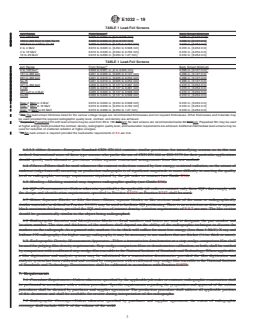
REDLINE ASTM E1032-19 - Standard Practice for Radiographic Examination of Weldments Using Industrial X-Ray Film
Overview
ASTM E1032-19 is the internationally recognized standard practice for conducting radiographic examination of weldments using industrial X-ray film. Developed by ASTM, this standard provides a uniform procedure for capturing and interpreting radiographic images of welds in metallic materials. While ASTM E1032-19 standardizes the technique and quality control for radiographic imaging, it does not prescribe weld acceptance or rejectability criteria; these must be defined elsewhere, such as in purchase orders or product specifications.
The practice is widely adopted in industries requiring highly reliable nondestructive testing (NDT) of welded fabrications, ensuring that the radiographic images produced are clear, consistent, and suitable for revealing internal discontinuities.
Key Topics
Scope and Application
ASTM E1032-19 outlines comprehensive procedures for radiographic examination using both X-ray and gamma-ray sources. It addresses aspects like coverage, quality level, and acceptance criteria, which must be specified contractually.Equipment and Materials
- Use of approved film systems
- Suitable radiation sources (X-ray or gamma-ray)
- Appropriate film holders, cassettes, and intensifying screens
- Filters and masking techniques to manage scattered radiation and improve image contrast
Calibration and Quality Assurance
- Application of image quality indicators (IQIs) and penetrameters to validate detection capability
- Utilization of shims or blocks for proper IQI positioning
- Use of densitometers or step-wedge comparison films to confirm radiographic density within specified limits
Procedure Requirements
- Preparation and approval of detailed written procedures between purchaser and supplier
- Assurance of 100% weld volume coverage unless specified otherwise
Personnel Qualification
- Requirement for NDT personnel qualification per recognized standards (e.g., ANSI/ASNT-CP-189, NAS 410)
- Agency qualification as stipulated by contract
Safety and Regulatory Compliance
- Radiographic practices must comply with applicable national and local safety regulations
- Users are responsible for implementing proper health, safety, and environmental controls
Applications
Adherence to ASTM E1032-19 is essential in various industries that rely on the integrity of welded structures, such as:
- Oil & gas pipelines
Ensures detection of internal weld defects that could compromise system reliability. - Aerospace and defense
Provides high-confidence NDT for critical welded components. - Power generation and nuclear plants
Facilitates reliable inspection of pressure vessels and piping welds. - Shipbuilding and heavy engineering
Guarantees the structural integrity of large fabricated assemblies.
Radiographic examination as defined in ASTM E1032-19 is also central to quality assurance programs, third-party inspection, and compliance with customer or regulatory requirements.
Related Standards
Understanding ASTM E1032-19 is enhanced by familiarity with the following related documents:
- ASTM E94: Guide for radiographic examination using industrial radiographic film
- ASTM E390: Reference radiographs for steel fusion welds
- ASTM E242: Reference radiographs demonstrating effects of parameter variation
- ASTM E543: Specification for the qualification of NDT agencies
- ASTM E747 and E1025: Practices for image quality indicators (IQIs)
- ASTM E999: Film processing quality control
- ASTM E1079: Calibration of densitometers
- ISO 5579: International rules for radiographic examination of metallic materials
- EN 444: European principles for radiographic NDT of metallic materials
Practical Value
Implementing ASTM E1032-19 delivers significant practical value by:
- Standardizing radiographic quality, ensuring test images are reliable and reproducible
- Reducing the risk of overlooked weld flaws by specifying IQI usage and density limits
- Supporting regulatory and client requirements for weld documentation and traceability
- Improving safety and performance in critical applications through enhanced weld quality control
By following ASTM E1032-19, organizations and inspectors can confidently demonstrate adherence to best practices in nondestructive testing of weldments using radiographic film, supporting both operational reliability and regulatory compliance.
Relations
- Effective Date
- 01-Feb-2019
- Effective Date
- 01-Feb-2024
- Effective Date
- 01-Dec-2019
- Effective Date
- 01-Mar-2019
- Effective Date
- 01-Feb-2018
- Effective Date
- 01-Jan-2018
- Effective Date
- 15-Jun-2017
- Effective Date
- 01-Feb-2017
- Effective Date
- 01-Aug-2016
- Effective Date
- 01-Feb-2016
- Effective Date
- 01-Dec-2015
- Effective Date
- 01-Sep-2015
- Refers
ASTM E999-15 - Standard Guide for Controlling the Quality of Industrial Radiographic Film Processing - Effective Date
- 01-Jun-2015
- Effective Date
- 01-Jun-2014
- Effective Date
- 01-Jun-2014
Buy Documents
ASTM E1032-19 - Standard Practice for Radiographic Examination of Weldments Using Industrial X-Ray Film
REDLINE ASTM E1032-19 - Standard Practice for Radiographic Examination of Weldments Using Industrial X-Ray Film
Get Certified
Connect with accredited certification bodies for this standard

DVS-ZERT GmbH
German welding certification society.
CARES (UK Certification Authority for Reinforcing Steels)
UK certification for reinforcing steels and construction.
EWF/IIW (European/International Welding Federation)
International welding personnel certification.
Sponsored listings
Frequently Asked Questions
ASTM E1032-19 is a standard published by ASTM International. Its full title is "Standard Practice for Radiographic Examination of Weldments Using Industrial X-Ray Film". This standard covers: ABSTRACT This test method provides a uniform procedure for radiographic examination of weldments using industrial radiographic film. Requirements expressed in this method are intended to control the quality of the radiographic images and are not intended for controlling acceptability or quality of welds. The apparatus shall comprise of a radiation source which may be X-ray or gamma-ray source; film holders and cassettes; intensifying screens such as lead-foil, fluorescent, fluorometallic, or other metallic screens; filters which shall be used whenever the contrast reductions caused by low energy, scattered radiation, or the extent of undercut (edge burn-off) occurring on production radiographs are of significant magnitude to cause difficulty in meeting the quality level or radiographic coverage requirements stipulated by the job order or contract; masking to improve radiographic quality; IQI's or penetrameters; shims, separate blocks, or like sections to facilitate IQI positioning; radiographic location and identification markers; and radiographic density measurement device. The test method shall meet the radiographic coverage, radiographic film quality, radiographic quality level, acceptance level, and radiographic density limitations. Procedures for surface preparation, radiation application and protection, IQI selection and placement, shim utilization, radiograph identification, and single-wall or double-wall radiographic techniques are addressed. SCOPE 1.1 This practice provides a uniform procedure for radiographic examination of weldments using industrial radiographic film. Requirements expressed in this practice are intended to control the quality of the radiographic images and are not intended for controlling acceptability or quality of welds. 1.2 The radiographic extent, the quality level, and the acceptance criteria to be applied shall be specified in the contract, purchase order, product specification, or drawings. 1.3 The radiographic techniques stated herein provide adequate assurance for defect detectability; however, it is recognized that, for special applications, specific techniques using more or less stringent requirements may be required than those specified. In these cases, the use of alternative radiographic techniques shall be as agreed upon between purchaser and supplier (also see Section 4). 1.4 The values stated in inch-pound units are to be regarded as standard. 1.5 This standard does not purport to address all of the safety concerns, if any, associated with its use. It is the responsibility of the user of this standard to establish appropriate safety, health, and environmental practices and determine the applicability of regulatory limitations prior to use. (For more specific safety precautionary information, see Section 9.) 1.6 This international standard was developed in accordance with internationally recognized principles on standardization established in the Decision on Principles for the Development of International Standards, Guides and Recommendations issued by the World Trade Organization Technical Barriers to Trade (TBT) Committee.
ABSTRACT This test method provides a uniform procedure for radiographic examination of weldments using industrial radiographic film. Requirements expressed in this method are intended to control the quality of the radiographic images and are not intended for controlling acceptability or quality of welds. The apparatus shall comprise of a radiation source which may be X-ray or gamma-ray source; film holders and cassettes; intensifying screens such as lead-foil, fluorescent, fluorometallic, or other metallic screens; filters which shall be used whenever the contrast reductions caused by low energy, scattered radiation, or the extent of undercut (edge burn-off) occurring on production radiographs are of significant magnitude to cause difficulty in meeting the quality level or radiographic coverage requirements stipulated by the job order or contract; masking to improve radiographic quality; IQI's or penetrameters; shims, separate blocks, or like sections to facilitate IQI positioning; radiographic location and identification markers; and radiographic density measurement device. The test method shall meet the radiographic coverage, radiographic film quality, radiographic quality level, acceptance level, and radiographic density limitations. Procedures for surface preparation, radiation application and protection, IQI selection and placement, shim utilization, radiograph identification, and single-wall or double-wall radiographic techniques are addressed. SCOPE 1.1 This practice provides a uniform procedure for radiographic examination of weldments using industrial radiographic film. Requirements expressed in this practice are intended to control the quality of the radiographic images and are not intended for controlling acceptability or quality of welds. 1.2 The radiographic extent, the quality level, and the acceptance criteria to be applied shall be specified in the contract, purchase order, product specification, or drawings. 1.3 The radiographic techniques stated herein provide adequate assurance for defect detectability; however, it is recognized that, for special applications, specific techniques using more or less stringent requirements may be required than those specified. In these cases, the use of alternative radiographic techniques shall be as agreed upon between purchaser and supplier (also see Section 4). 1.4 The values stated in inch-pound units are to be regarded as standard. 1.5 This standard does not purport to address all of the safety concerns, if any, associated with its use. It is the responsibility of the user of this standard to establish appropriate safety, health, and environmental practices and determine the applicability of regulatory limitations prior to use. (For more specific safety precautionary information, see Section 9.) 1.6 This international standard was developed in accordance with internationally recognized principles on standardization established in the Decision on Principles for the Development of International Standards, Guides and Recommendations issued by the World Trade Organization Technical Barriers to Trade (TBT) Committee.
ASTM E1032-19 is classified under the following ICS (International Classification for Standards) categories: 25.160.40 - Welded joints and welds. The ICS classification helps identify the subject area and facilitates finding related standards.
ASTM E1032-19 has the following relationships with other standards: It is inter standard links to ASTM E1032-12, ASTM E1316-24, ASTM E1316-19b, ASTM E1316-19, ASTM E1025-18, ASTM E1316-18, ASTM E1316-17a, ASTM E1316-17, ASTM E1316-16a, ASTM E1316-16, ASTM E1316-15a, ASTM E1316-15, ASTM E999-15, ASTM E1316-14, ASTM E1316-14e1. Understanding these relationships helps ensure you are using the most current and applicable version of the standard.
ASTM E1032-19 is available in PDF format for immediate download after purchase. The document can be added to your cart and obtained through the secure checkout process. Digital delivery ensures instant access to the complete standard document.
Standards Content (Sample)
This international standard was developed in accordance with internationally recognized principles on standardization established in the Decision on Principles for the
Development of International Standards, Guides and Recommendations issued by the World Trade Organization Technical Barriers to Trade (TBT) Committee.
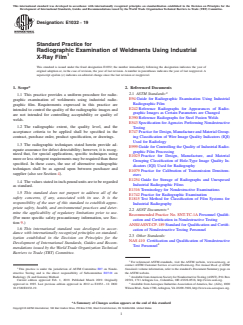
Designation: E1032 − 19
Standard Practice for
Radiographic Examination of Weldments Using Industrial
X-Ray Film
This standard is issued under the fixed designation E1032; the number immediately following the designation indicates the year of
original adoption or, in the case of revision, the year of last revision. A number in parentheses indicates the year of last reapproval. A
superscript epsilon (´) indicates an editorial change since the last revision or reapproval.
1. Scope* 2. Referenced Documents
2.1 ASTM Standards:
1.1 This practice provides a uniform procedure for radio-
E94 Guide for Radiographic Examination Using Industrial
graphic examination of weldments using industrial radio-
Radiographic Film
graphic film. Requirements expressed in this practice are
E242 Reference Radiographs for Appearances of Radio-
intended to control the quality of the radiographic images and
graphic Images as Certain Parameters are Changed
are not intended for controlling acceptability or quality of
E390 Reference Radiographs for Steel Fusion Welds
welds.
E543 Specification for Agencies Performing Nondestructive
1.2 The radiographic extent, the quality level, and the
Testing
acceptance criteria to be applied shall be specified in the
E747 Practice for Design, Manufacture and Material Group-
contract, purchase order, product specification, or drawings. ing Classification of Wire Image Quality Indicators (IQI)
Used for Radiology
1.3 The radiographic techniques stated herein provide ad-
E999 Guide for Controlling the Quality of Industrial Radio-
equate assurance for defect detectability; however, it is recog-
graphic Film Processing
nized that, for special applications, specific techniques using
E1025 Practice for Design, Manufacture, and Material
more or less stringent requirements may be required than those
Grouping Classification of Hole-Type Image Quality In-
specified. In these cases, the use of alternative radiographic
dicators (IQI) Used for Radiography
techniques shall be as agreed upon between purchaser and
E1079 Practice for Calibration of Transmission Densitom-
supplier (also see Section 4).
eters
E1254 Guide for Storage of Radiographs and Unexposed
1.4 The values stated in inch-pound units are to be regarded
Industrial Radiographic Films
as standard.
E1316 Terminology for Nondestructive Examinations
1.5 This standard does not purport to address all of the
E1742 Practice for Radiographic Examination
safety concerns, if any, associated with its use. It is the
E1815 Test Method for Classification of Film Systems for
responsibility of the user of this standard to establish appro-
Industrial Radiography
priate safety, health, and environmental practices and deter-
2.2 ASNT Documents:
mine the applicability of regulatory limitations prior to use.
Recommended Practice No. SNT-TC-1A Personnel Qualifi-
(For more specific safety precautionary information, see Sec-
cation and Certification in Nondestructive Testing
tion 9.)
ANSI/ASNT-CP-189 Standard for Qualification and Certifi-
1.6 This international standard was developed in accor-
cation of Nondestructive Testing Personnel
dance with internationally recognized principles on standard-
2.3 Other Standards:
ization established in the Decision on Principles for the
NAS 410 Certification and Qualification of Nondestructive
Development of International Standards, Guides and Recom-
Test Personnel
mendations issued by the World Trade Organization Technical
Barriers to Trade (TBT) Committee.
For referenced ASTM standards, visit the ASTM website, www.astm.org, or
contact ASTM Customer Service at service@astm.org. For Annual Book of ASTM
This practice is under the jurisdiction of ASTM Committee E07 on Nonde- Standards volume information, refer to the standard’s Document Summary page on
structive Testing and is the direct responsibility of Subcommittee E07.01 on the ASTM website.
Radiology (X and Gamma) Method. AvailablefromAmericanSocietyforNondestructiveTesting(ASNT),P.O.Box
Current edition approved Feb. 1, 2019. Published March 2019. Originally 28518, 1711 Arlingate Ln., Columbus, OH 43228-0518, http://www.asnt.org.
approved in 1985. Last previous edition approved in 2012 as E1032 – 12. DOI: Available fromAerospace IndustriesAssociation ofAmerica, Inc. (AIA), 1000
10.1520/E1032-19. WilsonBlvd.,Suite1700,Arlington,VA22209-3928,http://www.aia-aerospace.org.
*A Summary of Changes section appears at the end of this standard
Copyright © ASTM International, 100 Barr Harbor Drive, PO Box C700, West Conshohocken, PA 19428-2959. United States
E1032 − 19
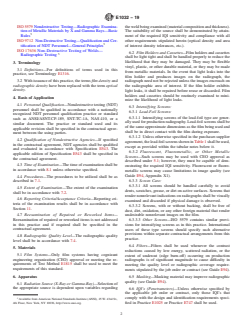
ISO 5579 Nondestructive Testing—Radiographic Examina- theweldbeingexamined(materialcompositionandthickness).
tion of Metallic Materials by X and Gamma Rays—Basic The suitability of the source shall be demonstrated by attain-
Rules ment of the required IQI sensitivity and compliance with all
ISO 9712 Non-Destructive Testing—Qualification and Cer- other requirements stipulated herein (optical density and area
tification of NDT Personnel—General Principles of interest density tolerances, etc.).
ISO 17636 Non-Destructive Testing of Welds—
6.2 Film Holders and Cassettes—Film holders and cassettes
Radiographic Testing
shall be light tight and shall be handled properly to reduce the
likelihood that they may be damaged. They may be flexible
3. Terminology
vinyl, plastic, or other durable material, or they may be made
3.1 Definitions—For definitions of terms used in this
from metallic materials. In the event that light leaks into the
practice, see Terminology E1316.
film holder and produces images on the radiograph, the
3.2 With issuance of this practice, the terms film density and
radiograph need not be rejected unless the images encroach on
radiographic density have been replaced with the term optical
the radiographic area of interest. If the film holder exhibits
density. light leaks, it shall be repaired before reuse or discarded. Film
holders and cassettes should be routinely examined to mini-
4. Basis of Application
mize the likelihood of light leaks.
4.1 Personnel Qualification—Nondestructive testing (NDT)
6.3 Intensifying Screens:
personnel shall be qualified in accordance with a nationally
6.3.1 Lead-Foil Screens:
recognized NDT personnel qualification practice or standard
6.3.1.1 Intensifying screens of the lead-foil type are gener-
such as ANSI/ASNT-CP-189, SNT-TC-1A, NAS 410, or a
allyusedforproductionradiography.Lead-foilscreensshallbe
similar document. The practice or standard used and its
ofthesameapproximatedimensionsasthefilmbeingusedand
applicable revision shall be specified in the contractual agree-
shall be in direct contact with the film during exposure.
ment between the using parties.
6.3.1.2 Unless otherwise specified in the purchaser-supplier
4.2 Qualification of Nondestructive Agencies—If specified
agreement,thelead-foilscreensshowninTable1shallbeused,
in the contractual agreement, NDT agencies shall be qualified
except as provided within the tabular notes below it.
and evaluated in accordance with Specification E543. The
6.3.2 Fluorescent, Fluorometallic, or Other Metallic
applicable edition of Specification E543 shall be specified in
Screens—Such screens may be used with CEO approval as
the contractual agreement.
described under 5.1; however, they must be capable of dem-
4.3 Time of Examination—The time of examination shall be
onstrating the required IQI sensitivity. Fluorescent or fluoro-
in accordance with 8.1 unless otherwise specified.
metallic screens may cause limitations in image quality (see
Guide E94, Appendix X1).
4.4 Procedures—The procedures to be utilized shall be as
6.3.3 Screen Care:
described in 7.1.
6.3.3.1 All screens should be handled carefully to avoid
4.5 Extent of Examination—The extent of the examination
dents, scratches, grease, or dirt on active surfaces. Screens that
shall be in accordance with 7.2.
render nonrelevant indications on radiographs shall be visually
4.6 Reporting Criteria/Acceptance Criteria—Reporting cri-
examined and discarded if physical damage is observed.
teria of the examination results shall be in accordance with
6.3.3.2 Screens, with or without backing, shall be free of
Section 11.
dust, dirt, oxidation, or any other foreign material that render
4.7 Reexamination of Repaired or Reworked Items—
undesirable nonrelevant images on the film.
Reexamination of repaired or reworked items is not addressed 6.3.3.3 Other Screens—ISO 5579 contains similar provi-
in this practice and if required shall be specified in the
sions for intensifying screens as in this practice. International
contractual agreement.
users of these type screens should specify such alternative
provisions within separate contractual arrangements from this
4.8 Radiographic Quality Level—The radiographic quality
practice.
level shall be in accordance with 7.4.
6.4 Filters—Filters shall be used whenever the contrast
5. Materials
reductions caused by low energy, scattered radiation, or the
5.1 Film Systems—Only film systems having cognizant
extent of undercut (edge burn-off) occurring on production
engineering organization (CEO) approval or meeting the re-
radiographs is of significant magnitude to cause difficulty in
quirements of Test Method E1815 shall be used to meet the
meeting the quality level or radiographic coverage require-
requirements of this standard.
ments stipulated by the job order or contract (see Guide E94).
6. Apparatus 6.5 Masking—Masking material may improve radiographic
quality (see Guide E94).
6.1 Radiation Source (X-Ray or Gamma-Ray)—Selection of
the appropriate source is dependent upon variables regarding
6.6 IQI’s (Penetrameters)—Unless otherwise specified by
the applicable job order or contract, only those IQI’s that
comply with the design and identification requirements speci-
Available fromAmerican National Standards Institute (ANSI), 25 W. 43rd St.,
4th Floor, New York, NY 10036, http://www.ansi.org. fied in Practice E1025 or Practice E747 shall be used.
E1032 − 19
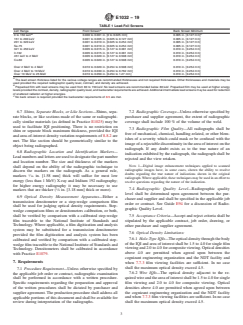
TABLE 1 Lead-Foil Screens
A
keV Range Front Screen Back Screen Minimum
B C
0 to 150 keV 0.000 to 0.001 in. [0 to 0.025 mm] 0.005 in. [0.127 mm]
151 to 200 keV 0.001 to 0.005 in. [0.025 to 0.127 mm] 0.005 in. [0.127 mm]
201 to 320 keV 0.001 to 0.010 in. [0.025 to 0.254 mm] 0.005 in. [0.127 mm]
Se-75 0.001 to 0.010 in. [0.025 to 0.254 mm] 0.005 in. [0.127 mm]
321 to 450 keV 0.005 to 0.015 in. [0.127 to 0.381 mm] 0.010 in. [0.254 mm]
Ir-192 0.005 to 0.015 in. [0.127 to 0.381 mm] 0.010 in. [0.254 mm]
451 keV to 2 MeV 0.005 to 0.020 in. [0.127 to 0.508 mm] 0.010 in. [0.254 mm]
Co-60 0.005 to 0.020 in. [0.127 to 0.508 mm] 0.010 in. [0.254 mm]
Over 2 MeV to 4 MeV 0.010 to 0.020 in. [0.254 to 0.508 mm] 0.010 in. [0.254 mm]
Over 4 MeV to 10 MeV 0.010 to 0.030 in. [0.254 to 0.762 mm] 0.010 in. [0.254 mm]
Over 10 MeV to 25 MeV 0.010 to 0.050 in. [0.254 to 1.27 mm] 0.010 in. [0.254 mm]
A
The lead screen thickness listed for the various voltage ranges are recommended thicknesses and not required thicknesses. Other thicknesses and materials may be
used provided the required radiographic quality level, contrast, and density are achieved.
B
Prepacked film with lead screens may be used from 80 to 150 keV. No lead screens are recommended below 80 keV. Prepacked film may be used at higher energy
levelsprovidedthecontrast,density,radiographicqualitylevel,andbackscatterrequirementsareachieved.Additionalintermediateleadscreensmaybeusedforreduction
of scattered radiation at higher energies.
C
No back screen is required provided the backscatter requirements of 8.5 are met.
6.7 Shims, Separate Blocks, or Like Sections—Shims, sepa- 7.2 Radiographic Coverage—Unless otherwise specified by
rate blocks, or like sections made of the same or radiographi- purchaser and supplier agreement, the extent of radiographic
cally similar materials (as defined in Practice E1025) may be
coverage shall include 100 % of the volume of the weld.
used to facilitate IQI positioning. There is no restriction on
7.3 Radiographic Film Quality—All radiographs shall be
shim or separate block maximum thickness, provided the IQI
free of mechanical, chemical, handling-related, or other blem-
and area-of-interest density variation requirements of 8.8.2 are
ishes of a severity which could mask or be confused with the
met. The like section should be geometrically similar to the
image of a rejectable discontinuity in the area of interest on the
object being radiographed.
radiograph. If any doubt exists as to the true nature of an
6.8 Radiographic Location and Identification Markers—
indication exhibited by the radiograph, the radiograph shall be
Lead numbers and letters are used to designate the part number
rejected and the view retaken.
and location number. The size and thickness of the markers
NOTE 1—Digital image enhancement techniques applied to scanned
shall depend on the ability of the radiographic technique to
radiographic images have, in some cases, shown the ability to resolve
discern the markers on the radiograph. As a general rule,
doubts regarding the true nature of indications shown in the original
markers ⁄16 in. [1.58 mm] thick will suffice for most low
radiograph.Whereapplicable,thesetechniquesmaybeusedinaneffortto
energy (less than 1 MeV) X-ray and Iridium 192 radiography;
resolve questions regarding the nature of the indication.
for higher energy radiography it may be necessary to use
1 7.4 Radiographic Quality Level—Radiographic quality
markers that are thicker ( ⁄8 in. [3.18 mm] thick or more).
level shall be determined upon agreement between the pur-
6.9 Optical Density Measurement Apparatus—Either a
chaser and supplier and shall be specified in the applicable job
transmission densitometer or a step-wedge comparison film
order or contract. See Guide E94 for a discussion of Radio-
shall be used for judging optical density requirements. Step-
graphic Quality Level.
wedge comparison films or densitometers calibration, or both,
shall be verified by comparison with a calibrated step-wedge
7.5 Acceptance Criteria—Accept and reject criteria shall be
film traceable to the National Institute of Standards and stipulated by the applicable contract, job order, drawing, or
Technology. Where applicable, a film digitization and analysis
other purchaser and supplier agreement.
system may be substituted for a transmission densitometer
7.6 Optical Density Limitations:
provided the film digitization and analysis system has been
7.6.1 Hole-Type IQIs—The optical density through the body
calibrated and verified by comparison with a calibrated step-
of the IQI and area of interest shall be 1.5 to 4.0 for single film
wedge film traceable to the National Institute of Standards and
viewingand2.0to4.0forcompositeviewing.Opticaldensities
Technology. Densitometers shall be calibrated in accordance
above 4.0 are permitted when agreed upon between the
with Practice E1079.
cognizant engineering organization and the NDT facility and
7. Requirements
when 7.7.3 film viewing facilities are sufficient. In no case
shall the maximum optical density exceed 4.5.
7.1 Procedure Requirement—Unless otherwise specified by
7.6.2 Wire IQIs—The optical density adjacent to the re-
the applicable job order or contract, radiographic examination
shall be performed in accordance with a written procedure. quiredwireandtheareaof interest shall be1.5to4.0for single
film viewing and 2.0 to 4.0 for composite viewing. Optical
Specific requirements regarding the preparation and approval
of the written procedures shall be dictated by purchaser and densities above 4.0 are permitted when agreed upon between
supplier agreement. The production procedure shall address all the cognizant engineering organization and the NDT facility
applicable portions of this document and shall be available for and when 7.7.3 film viewing facilities are sufficient. In no case
review during interpretation of the radiographs. shall the maximum optical density exceed 4.5.
E1032 − 19
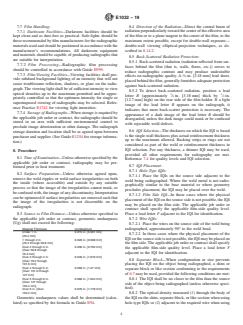
7.7 Film Handling: 8.4 Direction of the Radiation—Direct the central beam of
7.7.1 Darkroom Facilities—Darkroom facilities should be radiationperpendicularlytowardthecenteroftheeffectivearea
kept clean and as dust-free as practical. Safe-lights should be of the film or to a plane tangent to the center of the film, to the
thoserecommendedbyfilmmanufacturersfortheradiographic maximum extent possible, except for double-wall exposure—
materials used and should be positioned in accordance with the double-wall viewing elliptical-projection techniques, as de-
manufacturer’s recommendations. All darkroom equipment scribed in 8.14.2.
and materials should be capable of producing radiographs that
8.5 Back-Scattered Radiation Protection:
are suitable for interpretation.
8.5.1 Back-scattered radiation (radiation reflected from sur-
7.7.2 Film Processing—Radiographic film processing
faces behind the film (that is, walls, floors, etc.)) serves to
should be controlled in accordance with Guide E999.
reduce radiographic contrast and may produce undesirable
7.7.3 Film-Viewing Facilities—Viewing facilities shall pro-
effects on radiographic quality. A ⁄8-in. [3.18 mm] lead sheet,
vide subdued background lighting of an intensity that will not
plac
...
This document is not an ASTM standard and is intended only to provide the user of an ASTM standard an indication of what changes have been made to the previous version. Because
it may not be technically possible to adequately depict all changes accurately, ASTM recommends that users consult prior editions as appropriate. In all cases only the current version
of the standard as published by ASTM is to be considered the official document.
Designation: E1032 − 12 E1032 − 19
Standard Test Method Practice for
Radiographic Examination of Weldments Using Industrial
X-Ray Film
This standard is issued under the fixed designation E1032; the number immediately following the designation indicates the year of
original adoption or, in the case of revision, the year of last revision. A number in parentheses indicates the year of last reapproval. A
superscript epsilon (´) indicates an editorial change since the last revision or reapproval.
1. Scope*
1.1 This test method provides a uniform procedure for radiographic examination of weldments using industrial radiographic
film. Requirements expressed in this method are intended to control the quality of the radiographic images and are not intended
for controlling acceptability or quality of welds.
1.2 The radiographic extent, the quality level, and the acceptance criteria to be applied shall be specified in the contract,
purchase order, product specification, or drawings.
1.3 The radiographic techniques stated herein provide adequate assurance for defect detectability; however, it is recognized that,
for special applications, specific techniques using more or less stringent requirements may be required than those specified. In these
cases, the use of alternative radiographic techniques shall be as agreed upon between purchaser and supplier (also see Section 4).
1.4 The values stated in inch-pound units are to be regarded as standard.
1.5 This standard does not purport to address all of the safety concerns, if any, associated with its use. It is the responsibility
of the user of this standard to establish appropriate safety and health practices and determine the applicability of regulatory
limitations prior to use. (For more specific safety precautionary information, see Section 7.)
2. Referenced Documents
2.1 ASTM Standards:
E94 Guide for Radiographic Examination Using Industrial Radiographic Film
E242 Reference Radiographs for Appearances of Radiographic Images as Certain Parameters are Changed
E390 Reference Radiographs for Steel Fusion Welds
E543 Specification for Agencies Performing Nondestructive Testing
E747 Practice for Design, Manufacture and Material Grouping Classification of Wire Image Quality Indicators (IQI) Used for
Radiology
E999 Guide for Controlling the Quality of Industrial Radiographic Film Processing
E1025 Practice for Design, Manufacture, and Material Grouping Classification of Hole-Type Image Quality Indicators (IQI)
Used for Radiography
E1079 Practice for Calibration of Transmission Densitometers
E1254 Guide for Storage of Radiographs and Unexposed Industrial Radiographic Films
E1316 Terminology for Nondestructive Examinations
E1815 Test Method for Classification of Film Systems for Industrial Radiography
2.2 ASNT Standards:
Recommended Practice No. SNT-TC-1A Personnel Qualification and Certification in Nondestructive Testing
ANSI/ASNT-CP-189 Standard for Qualification and Certification of Nondestructive Testing Personnel
2.3 Other Standards:
NAS 410 National Aerospace Standard Certification and Qualification of Nondestructive Test Personnel
This test method practice is under the jurisdiction of ASTM Committee E07 on Nondestructive Testing and is the direct responsibility of Subcommittee E07.01 on
Radiology (X and Gamma) Method.
Current edition approved June 15, 2012Feb. 1, 2019. Published July 2012March 2019. Originally approved in 1985. Last previous edition approved in 20062012 as
E1032 - 06.E1032 – 12. DOI: 10.1520/E1032-12.10.1520/E1032-19.
For referenced ASTM standards, visit the ASTM website, www.astm.org, or contact ASTM Customer Service at service@astm.org. For Annual Book of ASTM Standards
volume information, refer to the standard’s Document Summary page on the ASTM website.
Available from American Society for Nondestructive Testing (ASNT), P.O. Box 28518, 1711 Arlingate Ln., Columbus, OH 43228-0518, http://www.asnt.org.
Available from Aerospace Industries Association of America, Inc. (AIA), 1000 Wilson Blvd., Suite 1700, Arlington, VA 22209-3928, http://www.aia-aerospace.org.
*A Summary of Changes section appears at the end of this standard
Copyright © ASTM International, 100 Barr Harbor Drive, PO Box C700, West Conshohocken, PA 19428-2959. United States
E1032 − 19
EN 444 Nondestructive Testing—General Principles for Radiographic Examination of Metallic Materials by X and Gamma
Rays—Basic Rules
ISO 5579 Nondestructive Testing—Radiographic Examination of Metallic Materials by X and Gamma Rays—Basic Rules
3. Terminology
3.1 Definitions—For definitions of terms used in this test method, see Terminology E1316.
4. Basis of Application
4.1 Personnel Qualification—Nondestructive testing (NDT) personnel shall be qualified in accordance with a nationally
recognized NDT personnel qualification practice or standard such as ANSI/ASNT-CP-189, SNT-TC-1A, NAS 410 or a similar
document. The practice or standard used and its applicable revision shall be specified in the contractual agreement between the
using parties.
4.2 Qualification of Nondestructive Agencies—If specified in the contractual agreement, NDT agencies shall be qualified and
evaluated in accordance with Practice E543. The applicable edition of Practice E543 shall be specified in the contractual
agreement.
4.3 Time of Examination—The time of examination shall be in accordance with 8.1 unless otherwise specified.
4.4 Procedures—The procedures to be utilized shall be as described in 7.1.
4.5 Extent of Examination—The extent of the examination shall be in accordance with 7.2.
4.6 Reporting Criteria/Acceptance Criteria—Reporting criteria of the examination results shall be in accordance with Section
11.
4.7 Reexamination of Repaired or Reworked Items—Reexamination of repaired or reworked items is not addressed in this test
method and if required shall be specified in the contractual agreement.
4.8 Radiographic Quality Level—The radiographic quality level shall be in accordance with 7.4.
5. Materials
5.1 Film Systems—Only film systems having cognizant engineering organization (CEO) approval or meeting the requirements
of test method E1815 shall be used to meet the requirements of this standard.
6. Apparatus
6.1 Radiation Source (X-Ray or Gamma-Ray)—Selection of the appropriate source is dependent upon variables regarding the
weld being examined (material composition and thickness). The suitability of the source shall be demonstrated by attainment of
the required IQI sensitivity and compliance with all other requirements stipulated herein (film density and area of interest density
tolerances, etc.).
6.2 Film Holders and Cassettes—Film holders and cassettes shall be light tight and shall be handled properly to reduce the
likelihood that they may be damaged. They may be flexible vinyl, plastic, or other durable material, or they may be made from
metallic materials. In the event that light leaks into the film holder and produces images on the radiograph, the radiograph need
not be rejected unless the images encroach on the radiographic area of interest. If the film holder exhibits light leaks, it shall be
repaired before reuse or discarded. Film holders and cassettes should be routinely examined to minimize the likelihood of light
leaks.
6.3 Intensifying Screens:
6.3.1 Lead-Foil Screens:
6.3.1.1 Intensifying screens of the lead-foil type are generally used for production radiography. Lead-foil screens shall be of the
same approximate dimensions as the film being used and shall be in direct contact with the film during exposure.
6.3.1.2 Unless otherwise specified in the purchaser-supplier agreement, the lead-foil screens shown in Table 1 shall be used,
except as provided within the tabular notes below it.
6.3.2 Fluorescent, Fluorometallic, or Other Metallic Screens—Such screens may be used with CEO approval as described under
5.1; however, they must be capable of demonstrating the required IQI sensitivity. Fluorescent or fluorometallic screens may cause
limitations in image quality (see Guide E94, Appendix X1).
6.3.3 Screen Care:
6.3.3.1 All screens should be handled carefully to avoid dents, scratches, grease, or dirt on active surfaces. Screens that render
nonrelevant indications on radiographs shall be visually examined and discarded if physical damage is observed.
6.3.3.2 Screens, with or without backing, shall be free of dust, dirt, oxidation, or any other foreign material that render
undesirable nonrelevant images on the film.
Available from American National Standards Institute (ANSI), 25 W. 43rd St., 4th Floor, New York, NY 10036, http://www.ansi.org.
E1032 − 19
TABLE 1 Lead-Foil Screens
A
KeV Range Front Screen Back Screen Minimum
B C
0 to 150 KeV 0.000 to 0.001 in. [0 to 0.025 mm] 0.005 in. [0.127 mm]
150 to 200 KeV; Ir 192; Se 75 0.000 to 0.005 in. [0 to 0.127 mm] 0.005 in. [0.127 mm]
200 KeV to 2 MeV; Co 60 0.005 to 0.010 in. [0.126 to 0.254 mm] 0.010 in. [0.254 mm]
2 to 4 MeV 0.010 to 0.020 in. [0.254 to 0.508 mm] 0.010 in. [0.254 mm]
4 to 10 MeV 0.010 to 0.030 in. [0.254 to 0.762 mm] 0.010 in. [0.254 mm]
10 to 25 MeV 0.010 to 0.050 in. [0.254 to 1.27 mm] 0.010 in. [0.254 mm]
TABLE 1 Lead-Foil Screens
A
keV Range Front Screen Back Screen Minimum
B C
0 to 150 keV 0.000 to 0.001 in. [0 to 0.025 mm] 0.005 in. [0.127 mm]
151 to 200 keV 0.001 to 0.005 in. [0.025 to 0.127 mm] 0.005 in. [0.127 mm]
201 to 320 keV 0.001 to 0.010 in. [0.025 to 0.254 mm] 0.005 in. [0.127 mm]
Se-75 0.001 to 0.010 in. [0.025 to 0.254 mm] 0.005 in. [0.127 mm]
321 to 450 keV 0.005 to 0.015 in. [0.127 to 0.381 mm] 0.010 in. [0.254 mm]
Ir-192 0.005 to 0.015 in. [0.127 to 0.381 mm] 0.010 in. [0.254 mm]
451 keV to 2 MeV 0.005 to 0.020 in. [0.127 to 0.508 mm] 0.010 in. [0.254 mm]
Co-60 0.005 to 0.020 in. [0.127 to 0.508 mm] 0.010 in. [0.254 mm]
Over 2 MeV to 4 MeV 0.010 to 0.020 in. [0.254 to 0.508 mm] 0.010 in. [0.254 mm]
Over 4 MeV to 10 MeV 0.010 to 0.030 in. [0.254 to 0.762 mm] 0.010 in. [0.254 mm]
Over 10 MeV to 25 MeV 0.010 to 0.050 in. [0.254 to 1.27 mm] 0.010 in. [0.254 mm]
A
The The lead screen thickness listed for the various voltage ranges are recommended thicknesses and not required thicknesses. Other thicknesses and materials may
be used provided the required radiographic quality level, contrast, and density are achieved.
B
Prepacked Prepacked film with lead screens may be used from 80 to 150 KeV.keV. No lead screens are recommended below 80 KeV.keV. Prepacked film may be used
at higher energy levels provided the contrast, density, radiographic quality level, and backscatter requirements are achieved. Additional intermediate lead screens may be
used for reduction of scattered radiation at higher energies.
C
No No back screen is required provided the backscatter requirements of 8.5 are met.
6.3.3.3 Other Screens—European Standard CEN EN 444 contains similar provisions for intensifying screens as in this test
method. International users of these type screens who prefer the use of CEN EN 444 or ISO 5579 for their particular applications
should specify such alternative provisions within separate contractual arrangements from this test method.
6.4 Filters—Filters shall be used whenever the contrast reductions caused by low energy, scattered radiation, or the extent of
undercut (edge burn-off) occurring on production radiographs is of significant magnitude to cause difficulty in meeting the quality
level or radiographic coverage requirements stipulated by the job order or contract (see Guide E94).
6.5 Masking—Masking material may improve radiographic quality (see Guide E94).
6.6 IQI’s (Penetrameters)—Unless otherwise specified by the applicable job order or contract, only those IQI’s that comply with
the design and identification requirements specified in Practice E1025 or Practice E747 shall be used.
6.7 Shims, Separate Blocks, or Like Sections—Shims, separate blocks, or like sections made of the same or radiographically
similar materials (as defined in Practice E1025) may be used to facilitate IQI positioning. There is no restriction on shim or separate
block maximum thickness, provided the IQI and area-of-interest density variation requirements of 8.8.2 are met. The like section
should be geometrically similar to the object being radiographed.
6.8 Radiographic Location and Identification Markers—Lead numbers and letters are used to designate the part number and
location number. The size and thickness of the markers shall depend on the ability of the radiographic technique to discern the
markers on the radiograph. As a general rule, markers ⁄16 in. thick will suffice for most low energy (less than 1 MeV) X ray and
Iridium 192 radiography; for higher energy radiography it may be necessary to use markers that are thicker ( ⁄8 in. thick or more).
6.9 Radiographic Density Measurement Apparatus—Either a transmission densitometer or a step-wedge comparison film shall
be used for judging film-density requirements. Step-wedge comparison films or densitometers calibration, or both, shall be verified
by comparison with a calibrated step-wedge film traceable to the National Institute of Standards and Technology. Where applicable,
a film digitization and analysis system may be substituted for a transmission densitometer provided the film digitization and
analysis system has been calibrated and verified by comparison with a calibrated step-wedge film traceable to the National Institute
of Standards and Technology. Densitometers shall be calibrated in accordance with Practice E1079.
7. Requirements
7.1 Procedure Requirement—Unless otherwise specified by the applicable job order or contract, radiographic examination shall
be performed in accordance with a written procedure. Specific requirements regarding the preparation and approval of the written
procedures shall be dictated by purchaser and supplier agreement. The production procedure shall address all applicable portions
of this document and shall be available for review during interpretation of the radiographs.
7.2 Radiographic Coverage—Unless otherwise specified by purchaser and supplier agreement, the extent of radiographic
coverage shall include 100 % of the volume of the weld.
E1032 − 19
7.3 Radiographic Film Quality—All radiographs shall be free of mechanical, chemical, handling-related, or other blemishes
which could mask or be confused with the image of any discontinuity in the area of interest on the radiograph. If any doubt exists
as to the true nature of an indication exhibited by the film, the radiograph shall be rejected and the view retaken.
NOTE 1—Digital image enhancement techniques applied to scanned radiographic images have, in some cases, shown the ability to resolve doubts
regarding the true nature of indications shown in the original radiograph. Where applicable, these techniques may be used in an effort to resolve questions
regarding the nature of the indication.
7.4 Radiographic Quality Level—Radiographic quality level shall be determined upon agreement between the purchaser and
supplier and shall be specified in the applicable job order or contract.
7.5 Acceptance Level—Accept and reject levels shall be stipulated by the applicable contract, job order, drawing, or other
purchaser and supplier agreement.
7.6 Radiographic Density Limitations—The density through the body of the IQI and area of interest shall be 1.5 to 4.0 for single
film viewing and 2.0 to 4.0 for composite viewing.
7.7 Film Handling:
7.7.1 Darkroom Facilities—Darkroom facilities should be kept clean and as dust-free as practical. Safe-lights should be those
recommended by film manufacturers for the radiographic materials used and should be positioned in accordance with the
manufacturer’s recommendations. All darkroom equipment and materials should be capable of producing radiographs that are
suitable for interpretation.
7.7.2 Film Processing—Radiographic film processing should be controlled in accordance with Guide E999.
7.7.3 Film-Viewing Facilities—Viewing facilities shall provide subdued background lighting of an intensity that will not cause
troublesome reflection, shadows, or glare on the radiograph. The viewing light shall be of sufficient intensity to view densities up
to 4.0 and be appropriately controlled so that the optimum intensity for single or superimposed viewing of radiographs may be
selected.
7.7.4 Storage of Radiographs—When storage is required by the applicable job order or contract, the radiographs should be
stored in an area with sufficient environmental control to preclude image deterioration or other damage. The radiograph storage
duration and location shall be as agreed upon between purchaser and supplier. (See Guide E1254 for storage information.)
8. Procedure
8.1 Time of Examination—Unless otherwise specified by the applicable job order or contract, radiography may be performed
prior to heat treatment.
8.2 Surface Preparation—Unless otherwise agreed upon, remove the weld ripples or weld-surface irregularities on both the
inside (where accessible) and outside by any suitable process so that the image of the irregularities cannot mask, or be confused
with, the image of any discontinuity. Interpretation can be optimized if surface irregularities are removed such that the image of
the irregularities is not discernible on the radiograph.
E1032 − 19
8.3 Source to Film Distance—Unless otherwise specified in the applicable job order or contract, geometric unsharpness (Ug)
shall not exceed the following:
Material Thickness Ug Maximum
Under 1 in. 0.010 in. [0.254 mm]
[25.4 mm]
1 through 2 in. 0.020 in. [0.508 mm]
[25.4 through 50.8 mm]
Over 2 through 3 in. 0.030 in. [0.762 mm]
[Over 50.8 through 76.2
mm]
Over 3 through 4 in. 0.040 in. [1.016 mm]
[Over 76.2 through 101.6
mm]
Greater than 4 in. 0.070 in. [1.778 mm]
[Greater than 101.6 mm]
Geometric unsharpness values shall be determined (calculated) as specified by the formula in Guide E94.
8.4 Direction of the Radiation—Direct the central beam of radiation perpendicularly toward the center of the effective area of
the film or to a plane tangent to the center of the film, to the maximum extent possible, except for double-wall
exposure—double-wall viewing elliptical-projection techniques, as described in 8.14.2.
8.5 Back-Scattered Radiation Protection:
8.5.1 Back-scattered radiation (radiation reflected from surfaces behind the film, (that is, walls, floors, etc.) serves to reduce
radiographic contrast and may produce undesirable effects on radiographic quality. A ⁄8-in. lead sheet, placed behind the film,
generally furnishes adequate protection against back-scattered radiation.
1 1
8.5.2 To detect back-scattered radiation, position a lead letter B (approximately ⁄8 in. thick by ⁄2 in. high) on the rear side of
the film holder. If a light image of the lead letter B appears on the radiograph, it indicates that more back-scatter protection is
necessary. The appearance of a dark image of the lead letter B should be disregarded, unless the dark image could mask or be
confused with rejectable weld defects.
8.6 IQI Selection—The thickness on which the IQI is based is the single-wall thickness plus actual reinforcement thickness up
to the maximum allowed. Backing strips or rings are not considered as part of the weld or reinforcement thickness in IQI selection.
For any thickness, a thinner IQI may be used, provided all other requirements for radiography are met.
8.7 IQI Placement:
8.7.1 Place the IQIs on the source side adjacent to the weld being radiographed. Where the weld metal is not radiographically
similar to the base material or where geometry precludes placement, the IQI may be placed over the weld.
8.7.2 Film Side IQI—In those cases where the physical placement of the IQI on the source side is not possible, the IQI may be
placed on the film side. The applicable job order or contract shall specify the applicable film-side quality level. Place a lead letter
F adjacent to the IQI for identification.
8.8 Separate Block—When configuration or size prevents placing the IQI on the object being radiographed, a shim or separate
block or like section conforming to the requirements of 6.7 may be used, provided the following conditions are met:
8.8.1 The IQI shall be no closer to the film than the source side of the object being radiographed (unless otherwise specified).
8.8.2 The radiographic density measured through the body of the IQI on the shim, separate block, or like section shall not
exceed the density measured in the area of interest by more than 15 %. The penetrameter density may be lighter than the area of
interest density, provided the specified quality level is obtained and the density requirements of 7.6 are met.
8.8.3 The shim, separate block, or like section shall be placed as close as possible to the object being radiographed.
8.8.4 The shim, separate block, or like section dimensions shall exceed the IQI dimensions such that the outline of at least three
sides of the IQI image shall be visible on the radiograph.
8.9 Number of IQIs:
8.9.1 One IQI shall represent an area within which radiographic densities are not less than 15 % from the density measured
through the body of the IQI. At least one IQI per radiograph, exposed simultaneously with the specimen, shall be used except as
noted in 8.9.2 and 8.9.3.
8.9.2 When film density, in the area of interest, is lower by more than 15 % of that measured through the body of the IQI, two
IQIs used in the following manner will be satisfactory: (1) if one IQI shows an acceptable sensitivity at the most dense portion
of the radiograph and (2) the second IQI shows an acceptable sensitivity at the least dense portion of the radiograph. These two
IQIs will then serve to qualify the radiograph technique.
8.9.3 For cylindrical vessels or flat components where one or more film holders and cassettes are used for an exposure, at least
one IQI image shall appear on each radiograph, except where the source is placed on the axis of the object and a complete
circumference or portion of the circumference radiographed with a single exposure. In which case, at least three IQIs shall be
placed approximately equidistant apart. When the source is placed on the axis of the circumference and a portion of that
circumference (four or more continuous film locations) is radiographed during a single exposure, at least three IQIs placed
approximately equidistant apart shall be used. Otherwise, at least one IQI image shall appear on each radiograph. Where portions
E1032 − 19
of longitudinal welds adjoining the circumferential weld are being examined simultaneously with the circumferential weld,
additional IQIs shall be placed on the longitudinal welds at the ends of the sections most remote from the position of the source
used to radiograph the circumferential weld.
8.9.4 Qualifying radiographs, on which one or more IQIs were imaged during exposure, shall always be retained as part of
record to validate required IQI sensitivity and placement.
NOTE 2—For parts of irregular geometry or widely varying thickness, it may be necessary to radiograph the first unit of a given design to determine
proper placement of IQI for subsequent radiography.
8.10 Shim Utilization—When a weld reinforcement or backing ring and strip is not removed, place a shim of material which
is radiographically similar to the backing ring and strip under the IQI to provide approximately the same thickness of material
under the IQI as the average thickness of the weld reinforcement plus the wall thickness and backing ring and strip. There is no
restriction on shim thickness, provided the IQI and area-of-interest density variation requirements are met.
8.10.1 Shim Dimensions and Location—The shim dimension and location shall exceed the IQI dimensions by at least ⁄8 in. on
at least three sides. At least three sides of the IQI shall be discernible in accordance with 8.8.4 except that only the two ends of
the IQI need to be discernible when located on piping less than 1-in. nominal pipe size. The shim shall be placed so as not to
overlap the weld image including the backing strip or ring.
8.10.2 Shim Image Film Density—The film density of the shim image shall not be greater than 15 % more than the lightest film
density of the area of interest. It may be less dense than the lightest film density of the area of interest.
8.11 Location Markers—Location markers shall be placed outside the weld area. The radiographic image of the location
markers for the coordination of the part with the film shall appear on the film without interfering with the interpretation and with
such an arrangement that it is evident that complete coverage was obtained.
8.11.1 Double-Wall Technique—When using a technique in which radiation passes through two walls and the welds in both
walls are viewed for acceptance, and the entire image of the object being radiographed is shown on the radiograph, only one
location marker is required in the radiograph.
8.11.2 Series of Radiographs—For welds that require a series of radiographs to cover the full length or circumference of the
weld, the complete set of location markers must be applied at one time, wherever possible. A reference or zero position for each
series must be identified on the component. A known feature on the object (for example, keyway, nozzle, and axis line) may also
be used for establishment of a zero position; indicate this feature on the radiographic record.
8.11.3 Similar Welds—On similar type welds on a single component, the sequence and spacing of the location markers must
conform to a uniform system that shall be positively identified in the radiographic procedure or interpretation records. In addition,
reference points on the component will be shown on the sketch to indicate the direction of the numbering system.
8.12 Radiograph Identification—A system of positive identification of the film shall be provided. As a minimum, the following
shall appear on the radiograph: the name or symbol of the company performing radiography, the date, and the weld identification
number traceable to part and contract. Subsequent radiographs made by reasons of a repaired area shall be identified with the letter
R.
8.13 Multiple-Film Techniques—Film techniques with two or more films of equal or different speeds in the same cassette are
allowed, provided prescribed quality level and density requirements stipulated herein are met.
8.14 Radiographic Techniques:
8.14.1 Single-Wall Technique—Except as provided in 8.14.2 and 8.14.3, radiography shall be performed using a technique in
which the radiation passes through only one wall.
8.14.2 Double-Wall Technique for Circumferential Welds—For circumferential welds 3 ⁄2 in. (OD) outside diameter or less, a
technique may be used in which the radiation passes through both walls and both walls are viewed for acceptance on the same film.
Unless otherwise specified, either elliptical or superimposed projections may be used.
8.14.2.1 For elliptical projections, where the weld is not superimposed, at least two views separated by 90° shall be required.
8.14.2.2 Where design or access restricts a practical technique from obtaining 90° separation of views, agreement between
contracting parties must specify necessary weld coverage.
8.14.2.3 For superimposed projections a minimum of three views is required at approximately 0°, 60°, and 120°.
8.14.2.4 For circumferential welds greater than 3 ⁄2 in. outside diameter (OD), a technique shall be used in which only
single-wall viewing is performed. Sufficient exposures shall be taken to ensure complete coverage.
8.14.3 For radiographic techniques which prevent single-wall exposures due to restricted access, such as jacketed pipe or ship
hull, technique should be agreed upon in advance between the purchaser and supplier. It should be recognized that IQI sensitivities
based on single-wall thickness may not be obtainable under some conditions.
9. Safety
9.1 Radiographic procedures shall comply with applicable city, state, and federal regulations.
10. Radiograph Evaluation
10.1 Film Quality—Verify that the radiograph meets the quality requirements specified in 7.3, 7.4, 7.6, 8.5.2, 8.8, 8.9, and 8.10.
E1032 − 19
10.2 Film Evaluation—Determine the acceptance or rejection of the weldment by comparing the radiographic image to the
agreed upon acceptance criteria (see 7.5).
10.3 Reference Radiographs—Graded reference radiographs showing typical indications of various welding defects in graded
levels of severity are useful tools for specifying and evaluating acceptance criteria for weld radiographs. Since severity levels are
typically provided for each of a variety of flaw types, the acceptance criteria may specify different severity levels for the different
conditions. For optimal utility the reference radiographs should be representative of the part to be radiographed in both material
and section thickness. Reference radiographs for steel fusion welds are available in Reference Radiographs E390. Additional
reference radiographs which illustrate the effects of modifying certain radiographic parameters, particularly energy and screen
combinations, are available in Reference Radiographs E242.
11. Records
11.1 The following radiographic records shall be maintained as agreed upon between purchaser and supplier:
11.1.1 Radiographic Standard Shooting Sketch.
11.1.2 Weld Repair Documentation.
11.1.3 Film.
11.1.4 Film interpretation record shall contain as a minimum the following information:
11.1.4.1 Disposition of each radiograph (acceptable or rejectable).
11.1.4.2 If rejectable, cause for rejection (slag, crack, porosity, etc.).
11.1.4.3 Surface indication verified by visual examination (grinding marks, weld ripple, spatter, etc.).
11.1.4.4 Signature of the film interpreter, including certification level.
12. Keywords
12.1 gamma ray; nondestructive testing; radiographic examination; radiography; weldments; X-ray
SUMMARY OF CHANGES
Committee E07 has identified the location of selected changes to this standard since the last issue (E1032 - 06)
that may impact the use of this standard. (June 15, 2012)
(1) Revised 10.1 to include reference to 8.10.
ASTM International takes no position respecting the validity of any patent rights asserted in connection with any item mentioned
in this standard. Users of this standard are expressly advised that determination of the validity of any such patent rights, and the risk
of infringement of such rights, are entirely their own responsibility.
This standard is subject to revision at any time by the responsible technical committee and must be reviewed every five years and
if not revised, either reapproved or withdrawn. Your comments are invited either for revision of this standard or for additional standards
and should be addressed to ASTM International Headquarters. Your comments will receive careful consideration at a meeting of the
responsible technical committee, which you may attend. If you feel that your comments have not received a fair hearing you should
make your views known to the ASTM Committee on Standards, at the address shown below.
This standard is copyrighted by ASTM International, 100 Barr Harbor Drive, PO Box C700, West Conshohocken, PA 19428-2959,
United States. Individual reprints (single or multiple copies) of this standard may be obtained by contacting ASTM at the above
address or at 610-832-9585 (phone), 610-832-9555 (fax), or service@astm.org (e-mail); or through t
...