

ASTM E1105-15(2023)
(Test Method)Standard Test Method for Field Determination of Water Penetration of Installed Exterior Windows, Skylights, Doors, and Curtain Walls, by Uniform or Cyclic Static Air Pressure Difference
General Information
- Abstract
SIGNIFICANCE AND USE
5.1 This test method is a standard procedure for determining the resistance to water penetration under uniform or cyclic static air pressure differences of installed exterior windows, skylights, curtain walls, and doors. The air-pressure differences acting across a building envelope vary greatly. These factors should be considered fully prior to specifying the test pressure difference to be used.
Note 1: In applying the results of tests by this test method, note that the performance of a wall or its components, or both, may be a function of proper installation and adjustment. In service, the performance will also depend on the rigidity of supporting construction and on the resistance of components to deterioration by various causes, vibration, thermal expansion and contraction, and so forth. It is difficult to simulate the identical complex wetting conditions that can be encountered in service, with large wind-blown water drops, increasing water drop impact pressures with increasing wind velocity, and lateral or upward moving air and water. Some designs are more sensitive than others to this upward moving water.
Note 2: This test method does not identify unobservable liquid water which may penetrate into the test specimen.
5.2 Laboratory tests are designed to give an indication of the performance of an assembly. Field performance may vary from laboratory performance since the supporting structure for the test specimen, methods of mounting, and sealing in the laboratory can only simulate the actual conditions that will exist in the building. Shipping, handling, installation, acts of subsequent trades, aging, and other environmental conditions all may have an adverse effect upon the performance of the installed product. This field test procedure provides a means for determining the performance of a product once installed in the building.
5.3 The field test may be made at the time the window, skylight, curtain-wall, or door assemblies are initially installed ...
SCOPE
1.1 This test method covers the determination of the resistance of installed exterior windows, curtain walls, skylights, and doors to water penetration when water is applied to the outdoor face and exposed edges simultaneously with a static air pressure at the outdoor face higher than the pressure at the indoor face.
1.2 This test method is applicable to any curtain-wall area or to windows, skylights, or doors alone. It is intended primarily for determining the resistance to water penetration through such assemblies for compliance with specified performance criteria, but it may also be used to determine the resistance to penetration through the joints between the assemblies and the adjacent construction. Other procedures may be appropriate to identify sources of leakage.
1.3 This test method addresses water penetration through a manufactured assembly. Water that penetrates the assembly, but does not result in a failure as defined herein, may have adverse effects on the performance of contained materials such as sealants and insulating or laminated glass. This test method does not address these issues.
1.4 The proper use of this test method requires a knowledge of the principles of pressure measurement.
1.5 The values stated in inch-pound units are to be regarded as standard. The values given in parentheses are mathematical conversions to SI units that are provided for information only and are not considered standard.
1.6 This standard does not purport to address all of the safety concerns, if any, associated with its use. It is the responsibility of the user of this standard to establish appropriate safety, health, and environmental practices and determine the applicability of regulatory limitations prior to use. For specific hazard statements, see 7.1.
1.7 This international standard was developed in accordance with internationally recognized principles on standardization established in the Decision on...
- Status
- Published
- Publication Date
- 31-Jan-2023
- Technical Committee
- E06 - Performance of Buildings
- Drafting Committee
- E06.51 - Performance of Windows, Doors, Skylights and Curtain Walls
Overview
ASTM E1105-15(2023), Standard Test Method for Field Determination of Water Penetration of Installed Exterior Windows, Skylights, Doors, and Curtain Walls, by Uniform or Cyclic Static Air Pressure Difference is an internationally recognized standard developed by ASTM International. This test method provides procedures for assessing the resistance of installed building envelope components-specifically exterior windows, skylights, doors, and curtain walls-to water penetration when exposed to simulated wind-driven rain conditions and air pressure differentials. The intent is to evaluate performance in real-world scenarios by conducting field tests at the location of actual installations, rather than relying solely on laboratory results.
Key Topics
- Water Penetration Resistance: The standard outlines methods to determine how effectively installed exterior building assemblies prevent water ingress when subjected to specified static air pressures in the field.
- Field Test Procedures: It details the process for creating pressure differentials across the test specimen and uniformly applying water spray to exposed surfaces and edges.
- Uniform and Cyclic Air Pressure Testing: Two test procedures are described-using either a constant (uniform) pressure or varying (cyclic) pressure-to simulate environmental conditions.
- Selection and Preparation of Test Specimens: Guidance is provided on selecting, installing, and preparing assemblies for testing, including observations of physical condition and documentation.
- Reporting Requirements: The standard specifies the essential information to be included in test reports, such as test parameters, specimen identification, environmental conditions, and observed results.
- Significance of Field Testing: Emphasizes that field conditions, installation quality, and environmental exposures may affect performance differently than laboratory tests.
- Safety and Precautions: Highlights the importance of adhering to safety practices and being aware of environmental and health considerations during testing.
Applications
ASTM E1105-15(2023) is widely used by:
- Building Envelope Consultants and Inspectors: To verify the water penetration resistance of newly installed or in-service windows, doors, skylights, and curtain wall assemblies.
- Construction and Quality Assurance Teams: For commissioning of building envelopes, ensuring construction meets specified water resistance requirements before project handover.
- Facility Managers and Building Owners: To investigate reported water leakage problems in existing buildings and assess whether the cause is due to assembly failures, installation defects, or other issues.
- Product Manufacturers: To demonstrate compliance with performance criteria set by designers, specifiers, or code bodies for field installations.
The procedure is suitable for application both during initial installation-facilitating early detection and correction of deficiencies-and after building completion, to diagnose suspected leaks or failures.
Related Standards
- ASTM E331: Test Method for Water Penetration of Exterior Windows, Skylights, Doors, and Curtain Walls by Uniform Static Air Pressure Difference (laboratory testing).
- ASTM E547: Test Method for Water Penetration of Exterior Windows, Skylights, Doors, and Curtain Walls by Cyclic Static Air Pressure Difference (laboratory testing).
- ASTM E631: Terminology of Building Constructions, providing definitions applicable to this standard and others in the building envelope field.
Practical Value
Implementing ASTM E1105-15(2023) adds practical value by enabling reliable, in-situ assessment of water penetration resistance for exterior windows, doors, skylights, and curtain walls. This helps ensure building durability, occupant comfort, and protection of interior finishes. By identifying points and causes of water leakage early, costly repairs and performance issues can be minimized, supporting better construction quality and maintenance of the building envelope.
Keywords: ASTM E1105, field water penetration testing, building envelope, windows, doors, curtain walls, skylights, air pressure difference, leakage, building performance, quality assurance, construction standards.
Relations
- Effective Date
- 01-Aug-2016
- Effective Date
- 01-Mar-2015
- Effective Date
- 01-Nov-2014
- Effective Date
- 01-Feb-2009
- Effective Date
- 01-Feb-2009
- Effective Date
- 01-Jun-2006
- Effective Date
- 10-Oct-2000
- Effective Date
- 10-Oct-2000
- Effective Date
- 28-Jul-2000
Get Certified
Connect with accredited certification bodies for this standard

DIBt (Deutsches Institut für Bautechnik)
German Institute for Building Technology.
DIN CERTCO
DIN Group product certification.

Aboma Certification B.V.
Specialized in construction, metal, and transport sectors.
Sponsored listings
Frequently Asked Questions
ASTM E1105-15(2023) is a standard published by ASTM International. Its full title is "Standard Test Method for Field Determination of Water Penetration of Installed Exterior Windows, Skylights, Doors, and Curtain Walls, by Uniform or Cyclic Static Air Pressure Difference". This standard covers: SIGNIFICANCE AND USE 5.1 This test method is a standard procedure for determining the resistance to water penetration under uniform or cyclic static air pressure differences of installed exterior windows, skylights, curtain walls, and doors. The air-pressure differences acting across a building envelope vary greatly. These factors should be considered fully prior to specifying the test pressure difference to be used. Note 1: In applying the results of tests by this test method, note that the performance of a wall or its components, or both, may be a function of proper installation and adjustment. In service, the performance will also depend on the rigidity of supporting construction and on the resistance of components to deterioration by various causes, vibration, thermal expansion and contraction, and so forth. It is difficult to simulate the identical complex wetting conditions that can be encountered in service, with large wind-blown water drops, increasing water drop impact pressures with increasing wind velocity, and lateral or upward moving air and water. Some designs are more sensitive than others to this upward moving water. Note 2: This test method does not identify unobservable liquid water which may penetrate into the test specimen. 5.2 Laboratory tests are designed to give an indication of the performance of an assembly. Field performance may vary from laboratory performance since the supporting structure for the test specimen, methods of mounting, and sealing in the laboratory can only simulate the actual conditions that will exist in the building. Shipping, handling, installation, acts of subsequent trades, aging, and other environmental conditions all may have an adverse effect upon the performance of the installed product. This field test procedure provides a means for determining the performance of a product once installed in the building. 5.3 The field test may be made at the time the window, skylight, curtain-wall, or door assemblies are initially installed ... SCOPE 1.1 This test method covers the determination of the resistance of installed exterior windows, curtain walls, skylights, and doors to water penetration when water is applied to the outdoor face and exposed edges simultaneously with a static air pressure at the outdoor face higher than the pressure at the indoor face. 1.2 This test method is applicable to any curtain-wall area or to windows, skylights, or doors alone. It is intended primarily for determining the resistance to water penetration through such assemblies for compliance with specified performance criteria, but it may also be used to determine the resistance to penetration through the joints between the assemblies and the adjacent construction. Other procedures may be appropriate to identify sources of leakage. 1.3 This test method addresses water penetration through a manufactured assembly. Water that penetrates the assembly, but does not result in a failure as defined herein, may have adverse effects on the performance of contained materials such as sealants and insulating or laminated glass. This test method does not address these issues. 1.4 The proper use of this test method requires a knowledge of the principles of pressure measurement. 1.5 The values stated in inch-pound units are to be regarded as standard. The values given in parentheses are mathematical conversions to SI units that are provided for information only and are not considered standard. 1.6 This standard does not purport to address all of the safety concerns, if any, associated with its use. It is the responsibility of the user of this standard to establish appropriate safety, health, and environmental practices and determine the applicability of regulatory limitations prior to use. For specific hazard statements, see 7.1. 1.7 This international standard was developed in accordance with internationally recognized principles on standardization established in the Decision on...
SIGNIFICANCE AND USE 5.1 This test method is a standard procedure for determining the resistance to water penetration under uniform or cyclic static air pressure differences of installed exterior windows, skylights, curtain walls, and doors. The air-pressure differences acting across a building envelope vary greatly. These factors should be considered fully prior to specifying the test pressure difference to be used. Note 1: In applying the results of tests by this test method, note that the performance of a wall or its components, or both, may be a function of proper installation and adjustment. In service, the performance will also depend on the rigidity of supporting construction and on the resistance of components to deterioration by various causes, vibration, thermal expansion and contraction, and so forth. It is difficult to simulate the identical complex wetting conditions that can be encountered in service, with large wind-blown water drops, increasing water drop impact pressures with increasing wind velocity, and lateral or upward moving air and water. Some designs are more sensitive than others to this upward moving water. Note 2: This test method does not identify unobservable liquid water which may penetrate into the test specimen. 5.2 Laboratory tests are designed to give an indication of the performance of an assembly. Field performance may vary from laboratory performance since the supporting structure for the test specimen, methods of mounting, and sealing in the laboratory can only simulate the actual conditions that will exist in the building. Shipping, handling, installation, acts of subsequent trades, aging, and other environmental conditions all may have an adverse effect upon the performance of the installed product. This field test procedure provides a means for determining the performance of a product once installed in the building. 5.3 The field test may be made at the time the window, skylight, curtain-wall, or door assemblies are initially installed ... SCOPE 1.1 This test method covers the determination of the resistance of installed exterior windows, curtain walls, skylights, and doors to water penetration when water is applied to the outdoor face and exposed edges simultaneously with a static air pressure at the outdoor face higher than the pressure at the indoor face. 1.2 This test method is applicable to any curtain-wall area or to windows, skylights, or doors alone. It is intended primarily for determining the resistance to water penetration through such assemblies for compliance with specified performance criteria, but it may also be used to determine the resistance to penetration through the joints between the assemblies and the adjacent construction. Other procedures may be appropriate to identify sources of leakage. 1.3 This test method addresses water penetration through a manufactured assembly. Water that penetrates the assembly, but does not result in a failure as defined herein, may have adverse effects on the performance of contained materials such as sealants and insulating or laminated glass. This test method does not address these issues. 1.4 The proper use of this test method requires a knowledge of the principles of pressure measurement. 1.5 The values stated in inch-pound units are to be regarded as standard. The values given in parentheses are mathematical conversions to SI units that are provided for information only and are not considered standard. 1.6 This standard does not purport to address all of the safety concerns, if any, associated with its use. It is the responsibility of the user of this standard to establish appropriate safety, health, and environmental practices and determine the applicability of regulatory limitations prior to use. For specific hazard statements, see 7.1. 1.7 This international standard was developed in accordance with internationally recognized principles on standardization established in the Decision on...
ASTM E1105-15(2023) is classified under the following ICS (International Classification for Standards) categories: 91.060.50 - Doors and windows. The ICS classification helps identify the subject area and facilitates finding related standards.
ASTM E1105-15(2023) has the following relationships with other standards: It is inter standard links to ASTM E547-00(2016), ASTM E631-15, ASTM E631-14, ASTM E331-00(2009), ASTM E547-00(2009), ASTM E631-06, ASTM E547-00, ASTM E331-00, ASTM E631-93a(1998)e1. Understanding these relationships helps ensure you are using the most current and applicable version of the standard.
ASTM E1105-15(2023) is available in PDF format for immediate download after purchase. The document can be added to your cart and obtained through the secure checkout process. Digital delivery ensures instant access to the complete standard document.
Standards Content (Sample)
This international standard was developed in accordance with internationally recognized principles on standardization established in the Decision on Principles for the
Development of International Standards, Guides and Recommendations issued by the World Trade Organization Technical Barriers to Trade (TBT) Committee.
Designation: E1105 − 15 (Reapproved 2023)
Standard Test Method for
Field Determination of Water Penetration of Installed
Exterior Windows, Skylights, Doors, and Curtain Walls, by
Uniform or Cyclic Static Air Pressure Difference
This standard is issued under the fixed designation E1105; the number immediately following the designation indicates the year of
original adoption or, in the case of revision, the year of last revision. A number in parentheses indicates the year of last reapproval. A
superscript epsilon (´) indicates an editorial change since the last revision or reapproval.
1. Scope 1.7 This international standard was developed in accor-
dance with internationally recognized principles on standard-
1.1 This test method covers the determination of the resis-
ization established in the Decision on Principles for the
tance of installed exterior windows, curtain walls, skylights,
Development of International Standards, Guides and Recom-
and doors to water penetration when water is applied to the
mendations issued by the World Trade Organization Technical
outdoor face and exposed edges simultaneously with a static air
Barriers to Trade (TBT) Committee.
pressure at the outdoor face higher than the pressure at the
indoor face.
2. Referenced Documents
1.2 This test method is applicable to any curtain-wall area or
2.1 ASTM Standards:
to windows, skylights, or doors alone. It is intended primarily
E331 Test Method for Water Penetration of Exterior
for determining the resistance to water penetration through
Windows, Skylights, Doors, and Curtain Walls by Uni-
such assemblies for compliance with specified performance
form Static Air Pressure Difference
criteria, but it may also be used to determine the resistance to
E547 Test Method for Water Penetration of Exterior
penetration through the joints between the assemblies and the
Windows, Skylights, Doors, and Curtain Walls by Cyclic
adjacent construction. Other procedures may be appropriate to
Static Air Pressure Difference
identify sources of leakage.
E631 Terminology of Building Constructions
1.3 This test method addresses water penetration through a
3. Terminology
manufactured assembly. Water that penetrates the assembly,
but does not result in a failure as defined herein, may have
3.1 Definitions—For definitions of general terms relating to
adverse effects on the performance of contained materials such
building construction used in this test method, see Terminology
as sealants and insulating or laminated glass. This test method
E631.
does not address these issues.
3.2 Definitions of Terms Specific to This Standard:
3.2.1 specimen, n—the entire assembled unit submitted for
1.4 The proper use of this test method requires a knowledge
test as installed in the exterior wall of a building.
of the principles of pressure measurement.
3.2.1.1 Discussion—The test specimen consists of the major
1.5 The values stated in inch-pound units are to be regarded
components of the assembly, including all joints, cracks, or
as standard. The values given in parentheses are mathematical
openings between such components and any panning,
conversions to SI units that are provided for information only
receptors, extenders, sills, mullions, or other parts or compo-
and are not considered standard.
nents used for assembling any installation. The joints between
1.6 This standard does not purport to address all of the
assemblies and the openings into which they are mounted
safety concerns, if any, associated with its use. It is the
(masonry openings, for example) are not part of the test
responsibility of the user of this standard to establish appro-
specimen. However, these joints may be tested by this proce-
priate safety, health, and environmental practices and deter-
dure.
mine the applicability of regulatory limitations prior to use.
3.2.2 test pressure difference, n—the specified difference in
For specific hazard statements, see 7.1.
static air pressure across the closed and locked or fixed
specimen expressed in lbf/ft (pascals).
This test method is under the jurisdiction of ASTM Committee E06 on
Performance of Buildings and is the direct responsibility of Subcommittee E06.51
on Performance of Windows, Doors, Skylights and Curtain Walls. For referenced ASTM standards, visit the ASTM website, www.astm.org, or
Current edition approved Feb. 1, 2023. Published February 2023. Originally contact ASTM Customer Service at service@astm.org. For Annual Book of ASTM
approved in 1986. Last previous edition approved in 2015 as E1105 – 15. DOI: Standards volume information, refer to the standard’s Document Summary page on
10.1520/E1105-15R23. the ASTM website.
Copyright © ASTM International, 100 Barr Harbor Drive, PO Box C700, West Conshohocken, PA 19428-2959. United States
E1105 − 15 (2023)
3.2.3 water penetration, n—penetration of water beyond a 5.4 The field test may also be made after the building is
plane parallel to the glazing (the vertical plane) intersecting the completed and in service to determine whether or not reported
innermost projection of the test specimen, not including leakage problems are due to the failure of the installed
interior trim and hardware, under the specified conditions of air assemblies to resist water penetration at the specified static air
pressure difference across the specimen. For products with pressure difference. Generally it is possible to conduct tests on
non-planer surfaces (domes, vaults, pyramids, etc.) the plane window, skylight, and door assemblies without too much
defining water penetration is the plane defined by the innermost difficulty, and to identify sources of leakage. A curtain-wall
edges of the unit frame. assembly, on the other hand, may not be accessible from the
inside without the removal of interior finished walls and
4. Summary of Test Method
ceilings. Even with removal of interior walls and ceilings, it
4.1 This test method consists of sealing a chamber to the
may not be possible to observe curtain-wall surfaces behind
interior or exterior face of specimen to be tested, supplying air
spandrel beams. The feasibility of conducting a meaningful
to a chamber mounted on the exterior or exhausting air from a
static air pressure difference water penetration test on an
chamber mounted on the interior, at the rate required to
in-service building must be carefully evaluated before being
maintain the test pressure difference across the specimen while
specified.
spraying water onto the outdoor face of the specimen at the
5.5 Weather conditions can affect the static air pressure
required rate and observing any water penetration.
difference measurements. If wind gusting causes pressure
fluctuation to exceed 610 % from the specified test pressure,
5. Significance and Use
the test should not be conducted.
5.1 This test method is a standard procedure for determining
5.6 Generally it is more convenient to use an interior
the resistance to water penetration under uniform or cyclic
mounted pressure chamber from which air is exhausted to
static air pressure differences of installed exterior windows,
obtain a lower pressure on the interior surface of the specimen.
skylights, curtain walls, and doors. The air-pressure differences
A calibrated rack of nozzles is then used to spray water at the
acting across a building envelope vary greatly. These factors
proper rate on the exterior surface. Under circumstances where
should be considered fully prior to specifying the test pressure
it is desirable to use an exterior-mounted pressure chamber, the
difference to be used.
spray rack must be located in the pressure chamber and air
NOTE 1—In applying the results of tests by this test method, note that
supplied to maintain a higher pressure on the exterior surface.
the performance of a wall or its components, or both, may be a function
Exterior chambers are difficult to attach readily and seal to
of proper installation and adjustment. In service, the performance will also
exterior surfaces.
depend on the rigidity of supporting construction and on the resistance of
components to deterioration by various causes, vibration, thermal expan-
5.7 Even though the equipment requirements are similar,
sion and contraction, and so forth. It is difficult to simulate the identical
this procedure is not intended to measure air infiltration
complex wetting conditions that can be encountered in service, with large
because of the difficulty of isolating the component air leakage
wind-blown water drops, increasing water drop impact pressures with
increasing wind velocity, and lateral or upward moving air and water. from the extraneous leakage through weep holes, mullion
Some designs are more sensitive than others to this upward moving water.
joints, trim, or other surrounding materials.
NOTE 2—This test method does not identify unobservable liquid water
which may penetrate into the test specimen.
6. Apparatus
5.2 Laboratory tests are designed to give an indication of the
6.1 The description of apparatus in this section is general in
performance of an assembly. Field performance may vary from
nature, and any arrangement of equipment capable of perform-
laboratory performance since the supporting structure for the
ing the test procedures within allowable tolerances is permit-
test specimen, methods of mounting, and sealing in the
ted.
laboratory can only simulate the actual conditions that will
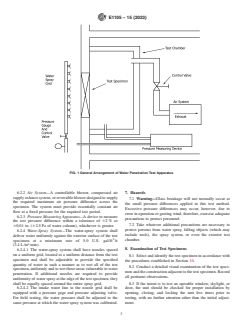
6.2 Major Components (Fig. 1):
exist in the building. Shipping, handling, installation, acts of
6.2.1 Test Chamber—A test chamber or box made of
subsequent trades, aging, and other environmental conditions
plywood, plastic, or other suitable material and sealed against
all may have an adverse effect upon the performance of the
the test specimen. Test chambers mounted on the interior must
installed product. This field test procedure provides a means
be made so that interior surfaces and joints of the specimen can
for determining the performance of a product once installed in
be easily observed for water penetration during the test. No
the building.
part of the testing chamber shall come in contact with or
5.3 The field test may be made at the time the window, restrict any point where water penetration may occur. At least
skylight, curtain-wall, or door assemblies are initially installed one static air pressure tap shall be provided to measure the
and before the interior of the building is finished. At this time, chamber air pressure versus the ambient (interior-exterior) air
it is generally easier to check the interior surfaces of the pressure and shall be so located that the reading is unaffected
assemblies for water penetration and to identify the points of by exterior impinging wind, or by the velocity of air supply to
penetration. The major advantage of testing when assemblies or from the chamber. The air supply opening into or exhaust
are initially installed is that errors in fabrication or installation from the chamber shall be arranged so that air does not impinge
can be readily discovered and corrections made before the directly on the test specimen with any significant velocity. A
entire wall with its component assemblies is completed at means of access into the chamber may be provided to facilitate
which time the expense of corrective work may be increased adjustments and observations after the chamber has been
many times. installed.
E1105 − 15 (2023)
FIG. 1 General Arrangement of Water Penetration Test Apparatus
6.2.2 Air System—A controllable blower, compressed air 7. Hazards
supply exhaust system, or reversible blower designed to supply
7.1 Warning—Glass breakage will not normally occur at
the required maximum air pressure difference across the
the small pressure differences applied in this test method.
specimen. The system must provide essentially constant air
Excessive pressure differences may occur, however, due to
flow at a fixed pressure for the required test period.
error in operation or gusting wind, therefore, exercise adequate
6.2.3 Pressure Measuring Apparatus—A device to measure
precautions to protect personnel.
the test pressure difference within a tolerance of 62 % or
7.2 Take whatever additional precautions are necessary to
60.01 in. (62.5 Pa of water column), whichever is greater.
protect persons from water spray, falling objects (which may
6.2.4 Water-Spray System—The water-spray system shall
include tools), the spray system, or even the exterior test
deliver water uniformly against the exterior surface of the test
chamber.
specimen at a minimum rate of 5.0 U.S. gal/ft ·h
(3.4 L ⁄m ·min).
8. Examination of Test Specimens
6.2.4.1 The water-spray system shall have nozzles spaced
on a uniform grid, located at a uniform distance from the test
8.1 Select and identify the test specimen in accordance with
specimen and shall be adjustable to provide the specified
the procedures established in Section 10.
quantity of water in such a manner as to wet all of the test
8.2 Conduct a detailed visual examination of the test speci-
specimen, uniformly and to wet those areas vu
...