


ASTM D5619-00(2011)
(Test Method)Standard Test Method for Comparing Metal Removal Fluids Using the Tapping Torque Test Machine (Withdrawn 2016)
Standard Test Method for Comparing Metal Removal Fluids Using the Tapping Torque Test Machine (Withdrawn 2016)
SIGNIFICANCE AND USE
The procedures described in this test method can be used to predict more accurately the lubricating properties of a metal removal fluid than previously available laboratory scale tests.
This test method is designed to allow flexibility in the selection of test specimen metal composition, tap alloy or coatings, and machining speeds.
Comparison between various types of fluids can be made, including cutting oils, soluble oils, semi-synthetics, or water soluble synthetics.
SCOPE
1.1 This test method covers a laboratory technique to evaluate the relative performance of metal removal fluids using a non-matrix test protocol using the tapping torque test machine.
1.2 The values stated in SI units are to be regarded as standard. Because the equipment used in this test method is available only in inch-pound units, SI units are omitted when referring to the equipment and the test pieces.
1.3 This test method does not purport to address all of the safety concerns, if any, associated with its use. It is the responsibility of the user of this standard to establish appropriate safety and health practices and determine the applicability of regulatory limitations prior to use.
WITHDRAWN RATIONALE
This test method covers a laboratory technique to evaluate the relative performance of metal removal fluids using a non-matrix test protocol using the tapping torque test machine.
Formerly under the jurisdiction of Committee D02 on Petroleum Products, Liquid Fuels, and Lubricants, this test method was withdrawn in January 2016. This standard was withdrawn without replacement due to lack of interest in supporting the standard with updated/compliant precision information.
General Information
Relations
Standards Content (Sample)
NOTICE: This standard has either been superseded and replaced by a new version or withdrawn.
Contact ASTM International (www.astm.org) for the latest information
Designation: D5619 − 00(Reapproved 2011)
Standard Test Method for
Comparing Metal Removal Fluids Using the Tapping Torque
1
Test Machine
This standard is issued under the fixed designation D5619; the number immediately following the designation indicates the year of
original adoption or, in the case of revision, the year of last revision. A number in parentheses indicates the year of last reapproval. A
superscript epsilon (´) indicates an editorial change since the last revision or reapproval.
1. Scope diameter of the chip curl.Asmall chip curl will flow smoothly
up the flute of the tap and will not affect the torque. However,
1.1 This test method covers a laboratory technique to
a large curl will drag and jam in the flute and will contribute to
evaluatetherelativeperformanceofmetalremovalfluidsusing
the tapping torque.
a non-matrix test protocol using the tapping torque test
If a new tap is utilized, it is necessary to run several tests
machine.
to run-in the tap. This process prepares the cutting edge to
1.2 The values stated in SI units are to be regarded as
receive a characteristic BUE, depending on which cutting
standard. No other units of measurement are included in this
fluid is utilized.
standard.
If a cutting fluid is changed to another cutting fluid during
1.2.1 Exception—Because the equipment used in this test
a test sequence, it is necessary to discard the results from at
method is available only in inch-pound units, SI units are
least the first test of the new fluid since the previous BUE
omitted when referring to the equipment and the test pieces.
must be abraded or modified with the chemistry of the new
1.3 This standard does not purport to address all of the
fluid to form its own characteristic BUE.
safety concerns, if any, associated with its use. It is the The ideal cutting fluid forms a small, stable BUE that
responsibility of the user of this standard to establish appro-
assists in the formation of a small curl.
priate safety and health practices and determine the applica-
3. Summary of Test Method
bility of regulatory limitations prior to use.
3.1 The torque required to tap a thread in a blank specimen
2. Terminology
nutwhilelubricatedwithametalremovalfluidismeasuredand
compared with the torque required to tap a thread in a blank
2.1 Definitions of Terms Specific to This Standard:
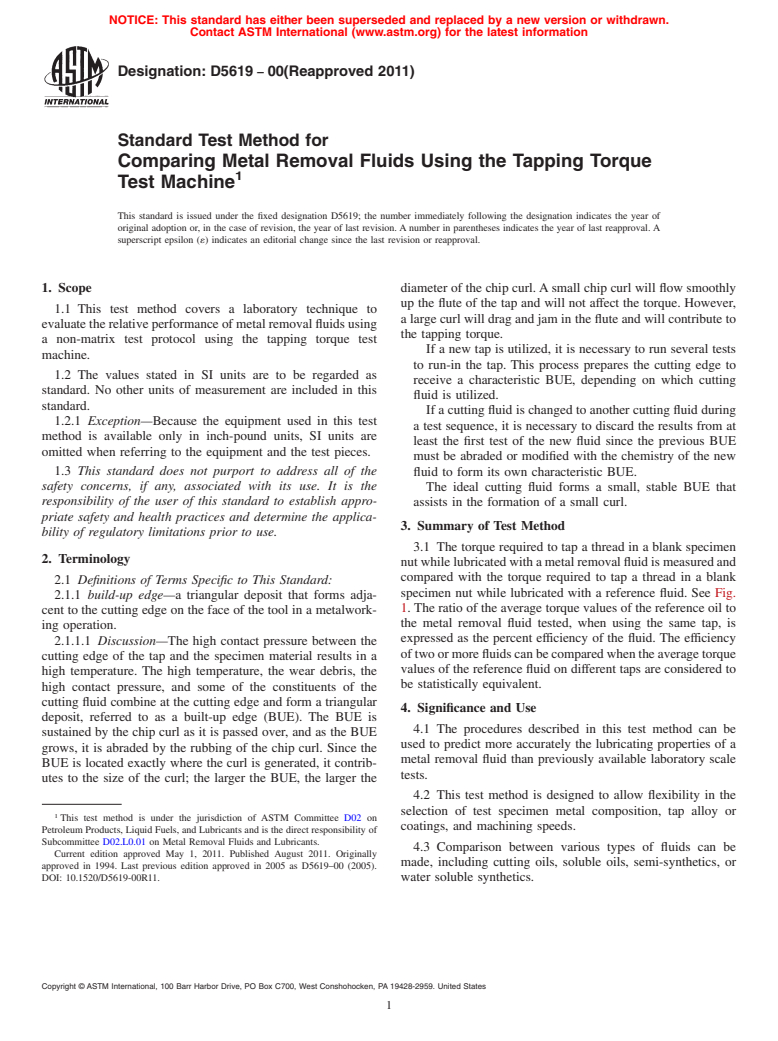
specimen nut while lubricated with a reference fluid. See Fig.
2.1.1 build-up edge—a triangular deposit that forms adja-
1. The ratio of the average torque values of the reference oil to
cent to the cutting edge on the face of the tool in a metalwork-
the metal removal fluid tested, when using the same tap, is
ing operation.
expressed as the percent efficiency of the fluid. The efficiency
2.1.1.1 Discussion—The high contact pressure between the
oftwoormorefluidscanbecomparedwhentheaveragetorque
cutting edge of the tap and the specimen material results in a
values of the reference fluid on different taps are considered to
high temperature. The high temperature, the wear debris, the
be statistically equivalent.
high contact pressure, and some of the constituents of the
cutting fluid combine at the cutting edge and form a triangular
4. Significance and Use
deposit, referred to as a built-up edge (BUE). The BUE is
4.1 The procedures described in this test method can be
sustained by the chip curl as it is passed over, and as the BUE
used to predict more accurately the lubricating properties of a
grows, it is abraded by the rubbing of the chip curl. Since the
metal removal fluid than previously available laboratory scale
BUE is located exactly where the curl is generated, it contrib-
tests.
utes to the size of the curl; the larger the BUE, the larger the
4.2 This test method is designed to allow flexibility in the
selection of test specimen metal composition, tap alloy or
1
This test method is under the jurisdiction of ASTM Committee D02 on
coatings, and machining speeds.
Petroleum Products, Liquid Fuels, and Lubricants and is the direct responsibility of
Subcommittee D02.L0.01 on Metal Removal Fluids and Lubricants.
4.3 Comparison between various types of fluids can be
Current edition approved May 1, 2011. Published August 2011. Originally
made, including cutting oils, soluble oils, semi-synthetics, or
approved in 1994. Last previous edition approved in 2005 as D5619–00 (2005).
DOI: 10.1520/D5619-00R11. water soluble synthetics.
Copyright © ASTM International, 100 Barr Harbor Drive, PO Box C700, West Conshohocken, PA 19428-2959. United States
1
---------------------- Page: 1 ----------------------
D5619 − 00 (2011)
FIG. 1 Tapping Torque Curve (insets show position of tap in specimen blank)
FIG. 2 Falex Tapping Torque Test Machine
2
5. Apparatus 5.3 GO/NO GO Wire Plug Gage , 0.3360/0.3363 in.
2
5.1 Test Machine, the tapping torque test machine as 5.4 Drying Oven, controllable t
...
Questions, Comments and Discussion
Ask us and Technical Secretary will try to provide an answer. You can facilitate discussion about the standard in here.