

ASTM D8110-17
(Test Method)Standard Test Method for Elemental Analysis of Distillate Products by Inductively Coupled Plasma Mass Spectrometry (ICP-MS)
General Information
- Abstract
SIGNIFICANCE AND USE
5.1 Petroleum products may contain elements either in trace concentrations (for example, ng/g (ppb mass)) or in minor to major levels (ppm to mass %). These elements might be characteristic of the crude petroleum or might originate from specific inclusions of additives for beneficial effect in the refined product. Often, such additives have product specifications which control the quality of a product in commerce. Hence, it is important to determine these elements as accurately as possible. Other elements present at trace levels may be harmful to combustion engines causing wear or reduced performance, may cause poisoning of catalysts, or may be of environmental concern as combustion emissions. ICP-MS instrumentation is well-suited for determining these elements and is particularly useful for the determination of the trace level elements that may not be readily achieved by other techniques.
5.2 Various elemental analytical techniques such as atomic absorption spectrometry (AAS), for example, Test Method D3605 and D4628; inductively coupled plasma atomic emission spectrometry (ICP-AES), for example, Test Methods D7111, D4951, and D5185; X-ray fluorescence (XRF), for example, Practice D7343, Test Method D7220, Test Methods D4927, and Test Method D6443; or graphite furnace atomic absorption spectrometry (GFAAS), for example, Test Method D6732 are used for this purpose. This test method is the first example where ICP-MS is used for elemental analysis of petroleum products.
5.3 This test method covers the rapid determination of seven elements in distillate petroleum products. Test times approximate a few minutes per test specimen, and quantification for most elements is in the low to sub ng/g (ppb mass) range. High analysis sensitivity can be achieved for some elements that are difficult to determine by other techniques.
SCOPE
1.1 This test method describes the procedure for the determination of trace elements in light and middle distillate petroleum products using inductively coupled plasma mass spectrometry (ICP-MS).
1.2 This test method should be used by analysts experienced in the use of inductively coupled plasma mass spectrometry (ICP-MS) with knowledge of interpretation of spectral, isobaric, polyatomic, and matrix interferences, as well as procedures for their correction or reduction.
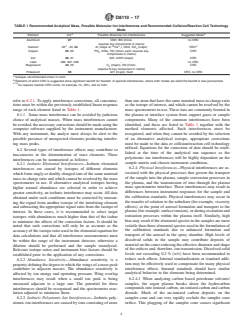
1.3 The table in 6.1 lists elements for which the test method applies along with recommended isotope. Actual working detection limits are sample dependent and, as the sample matrix varies, these detection limits may also vary.
1.4 The concentration range of this test method is typically from low to sub ng/g (ppb mass) to 1000 ng/g (ppb mass), however the precision and bias statement is specified for a smaller concentration range based on test samples analyzed in the ILS, see the table in Section 18. The test method may be used for concentrations outside of this range; however, the precision statements may not be applicable.
1.4.1 This test method shall be further developed to extend that table to include additional elements.
1.5 This test method uses metallo-organic standards (organometallic or organosoluble metal complex) for calibration and does not purport to quantitatively determine insoluble particulates. Analytical results are particle size dependent, and low results are obtained for particles larger than a few micrometers as these particles may settle out in the sample container and are not effectively transported through the sample introduction system.
1.6 Elements present at concentrations above the upper limit of the calibration curves can be determined with additional, appropriate dilutions and with no degradation of precision.
1.7 The values stated in SI units are to be regarded as standard. No other units of measurement are included in this standard.
1.8 This standard does not purport to address all of the safety concerns, if any, associated with its use. It is the r...
- Status
- Published
- Publication Date
- 30-Apr-2017
- Technical Committee
- D02 - Petroleum Products, Liquid Fuels, and Lubricants
- Drafting Committee
- D02.03 - Elemental Analysis
Overview
ASTM D8110-17, titled Standard Test Method for Elemental Analysis of Distillate Products by Inductively Coupled Plasma Mass Spectrometry (ICP-MS), is an international standard established by ASTM International. This standard provides a detailed procedure for the determination of trace elemental content in light and middle distillate petroleum products using ICP-MS instrumentation. The reliable detection of elements at extremely low levels (down to sub-ng/g or ppb mass) ensures better quality control, supports regulatory compliance, and helps protect both engines and the environment from harmful impurities or excessive additive content.
Key Topics
- Elemental Analysis in Petroleum Products: The standard addresses the need to accurately quantify elements that may be present either naturally in crude sources or added during refinement as performance enhancers.
- ICP-MS Technology: ICP-MS is favored for its high sensitivity and ability to determine trace elements more effectively than traditional methods such as atomic absorption spectrometry (AAS) or ICP atomic emission spectrometry (ICP-AES).
- Interference Management: Analysts must account for potential spectral, isobaric, and polyatomic interferences, as well as matrix effects and physical sample anomalies, to ensure measurement accuracy.
- Analytical Scope: The method offers rapid multi-element analysis (typically covering seven key elements), achieving detection in the low ng/g range within minutes.
- Sample Handling and Calibration: The test method uses metallo-organic standards for calibration, emphasizing the need for well-homogenized, particle-size managed samples and strict contamination control.
Applications
The ASTM D8110-17 standard is essential for:
- Quality Control in Petroleum Refineries: Ensures trace and minor elements remain within product specification to protect engines and meet commercial standards.
- Additive Monitoring: Helps verify levels of performance-enhancing or environmentally sensitive additives such as metals in fuels and lubricants.
- Contaminant Detection: Identifies elements that can cause wear in engines, reduce performance, poison catalysts, or raise environmental concerns due to emissions.
- Regulatory Compliance: Supports adherence to international and regional environmental and fuel quality regulations, particularly where limits for elemental content are stringent.
- Laboratory Analysis: Provides guidance to analysts with experience in advanced ICP-MS instrumentation, including recommendations for calibration, interference correction, and precision maintenance.
Related Standards
ASTM D8110-17 references and complements several other established methods, including:
- ASTM D3605: Trace metals in gas turbine fuels by AAS
- ASTM D4628: Analysis of Barium, Calcium, Magnesium, and Zinc in lubricating oils by AAS
- ASTM D7111: Trace elements in middle distillate fuels by ICP-AES
- ASTM D5185: Multielement determination in lubricating oils by ICP-AES
- ASTM D7343 and D7220: Elemental analysis in fuels by X-ray fluorescence (XRF)
- ASTM D6732: Copper in jet fuels by graphite furnace AAS
- ASTM D4057 / D4177: Manual and automatic sampling of petroleum products
Practical Value
Implementing ASTM D8110-17 improves data accuracy and analytical reliability for petroleum laboratories and refineries. The use of ICP-MS as described in this standard enables:
- Detection of a broad concentration range - from very low (ppb) to higher levels (up to 1000 ng/g)
- Reduced analysis time - suitable for high-throughput environments
- Improved sensitivity over older methods - critical for modern product specifications
- Mitigation of costly engine wear and catalyst damage
- Support for product innovation and compliance in competitive markets
This standard is a foundational resource for any laboratory or facility engaged in petroleum product testing, environmental monitoring, or regulatory reporting where trace elemental content is critical.
Keywords: ASTM D8110-17, elemental analysis, distillate petroleum products, ICP-MS, trace elements in fuels, petroleum quality control, additive monitoring, interference correction, ASTM standards, laboratory best practices.
Relations
- Effective Date
- 01-Mar-2024
- Refers
ASTM D4175-23a - Standard Terminology Relating to Petroleum Products, Liquid Fuels, and Lubricants - Effective Date
- 15-Dec-2023
- Effective Date
- 01-Dec-2023
- Effective Date
- 01-Dec-2023
- Effective Date
- 01-Nov-2023
- Effective Date
- 01-Oct-2023
- Refers
ASTM D4175-23e1 - Standard Terminology Relating to Petroleum Products, Liquid Fuels, and Lubricants - Effective Date
- 01-Jul-2023
- Effective Date
- 01-May-2020
- Effective Date
- 01-Dec-2019
- Effective Date
- 01-May-2019
- Effective Date
- 01-Apr-2018
- Effective Date
- 15-Dec-2017
- Effective Date
- 15-Nov-2017
- Effective Date
- 01-Jun-2017
- Effective Date
- 01-Jan-2017
Get Certified
Connect with accredited certification bodies for this standard

Element Materials Technology
Materials testing and product certification.

ABS Group Brazil
ABS Group certification services in Brazil.

ABS Quality Evaluations Inc.
American Bureau of Shipping quality certification.
Sponsored listings
Frequently Asked Questions
ASTM D8110-17 is a standard published by ASTM International. Its full title is "Standard Test Method for Elemental Analysis of Distillate Products by Inductively Coupled Plasma Mass Spectrometry (ICP-MS)". This standard covers: SIGNIFICANCE AND USE 5.1 Petroleum products may contain elements either in trace concentrations (for example, ng/g (ppb mass)) or in minor to major levels (ppm to mass %). These elements might be characteristic of the crude petroleum or might originate from specific inclusions of additives for beneficial effect in the refined product. Often, such additives have product specifications which control the quality of a product in commerce. Hence, it is important to determine these elements as accurately as possible. Other elements present at trace levels may be harmful to combustion engines causing wear or reduced performance, may cause poisoning of catalysts, or may be of environmental concern as combustion emissions. ICP-MS instrumentation is well-suited for determining these elements and is particularly useful for the determination of the trace level elements that may not be readily achieved by other techniques. 5.2 Various elemental analytical techniques such as atomic absorption spectrometry (AAS), for example, Test Method D3605 and D4628; inductively coupled plasma atomic emission spectrometry (ICP-AES), for example, Test Methods D7111, D4951, and D5185; X-ray fluorescence (XRF), for example, Practice D7343, Test Method D7220, Test Methods D4927, and Test Method D6443; or graphite furnace atomic absorption spectrometry (GFAAS), for example, Test Method D6732 are used for this purpose. This test method is the first example where ICP-MS is used for elemental analysis of petroleum products. 5.3 This test method covers the rapid determination of seven elements in distillate petroleum products. Test times approximate a few minutes per test specimen, and quantification for most elements is in the low to sub ng/g (ppb mass) range. High analysis sensitivity can be achieved for some elements that are difficult to determine by other techniques. SCOPE 1.1 This test method describes the procedure for the determination of trace elements in light and middle distillate petroleum products using inductively coupled plasma mass spectrometry (ICP-MS). 1.2 This test method should be used by analysts experienced in the use of inductively coupled plasma mass spectrometry (ICP-MS) with knowledge of interpretation of spectral, isobaric, polyatomic, and matrix interferences, as well as procedures for their correction or reduction. 1.3 The table in 6.1 lists elements for which the test method applies along with recommended isotope. Actual working detection limits are sample dependent and, as the sample matrix varies, these detection limits may also vary. 1.4 The concentration range of this test method is typically from low to sub ng/g (ppb mass) to 1000 ng/g (ppb mass), however the precision and bias statement is specified for a smaller concentration range based on test samples analyzed in the ILS, see the table in Section 18. The test method may be used for concentrations outside of this range; however, the precision statements may not be applicable. 1.4.1 This test method shall be further developed to extend that table to include additional elements. 1.5 This test method uses metallo-organic standards (organometallic or organosoluble metal complex) for calibration and does not purport to quantitatively determine insoluble particulates. Analytical results are particle size dependent, and low results are obtained for particles larger than a few micrometers as these particles may settle out in the sample container and are not effectively transported through the sample introduction system. 1.6 Elements present at concentrations above the upper limit of the calibration curves can be determined with additional, appropriate dilutions and with no degradation of precision. 1.7 The values stated in SI units are to be regarded as standard. No other units of measurement are included in this standard. 1.8 This standard does not purport to address all of the safety concerns, if any, associated with its use. It is the r...
SIGNIFICANCE AND USE 5.1 Petroleum products may contain elements either in trace concentrations (for example, ng/g (ppb mass)) or in minor to major levels (ppm to mass %). These elements might be characteristic of the crude petroleum or might originate from specific inclusions of additives for beneficial effect in the refined product. Often, such additives have product specifications which control the quality of a product in commerce. Hence, it is important to determine these elements as accurately as possible. Other elements present at trace levels may be harmful to combustion engines causing wear or reduced performance, may cause poisoning of catalysts, or may be of environmental concern as combustion emissions. ICP-MS instrumentation is well-suited for determining these elements and is particularly useful for the determination of the trace level elements that may not be readily achieved by other techniques. 5.2 Various elemental analytical techniques such as atomic absorption spectrometry (AAS), for example, Test Method D3605 and D4628; inductively coupled plasma atomic emission spectrometry (ICP-AES), for example, Test Methods D7111, D4951, and D5185; X-ray fluorescence (XRF), for example, Practice D7343, Test Method D7220, Test Methods D4927, and Test Method D6443; or graphite furnace atomic absorption spectrometry (GFAAS), for example, Test Method D6732 are used for this purpose. This test method is the first example where ICP-MS is used for elemental analysis of petroleum products. 5.3 This test method covers the rapid determination of seven elements in distillate petroleum products. Test times approximate a few minutes per test specimen, and quantification for most elements is in the low to sub ng/g (ppb mass) range. High analysis sensitivity can be achieved for some elements that are difficult to determine by other techniques. SCOPE 1.1 This test method describes the procedure for the determination of trace elements in light and middle distillate petroleum products using inductively coupled plasma mass spectrometry (ICP-MS). 1.2 This test method should be used by analysts experienced in the use of inductively coupled plasma mass spectrometry (ICP-MS) with knowledge of interpretation of spectral, isobaric, polyatomic, and matrix interferences, as well as procedures for their correction or reduction. 1.3 The table in 6.1 lists elements for which the test method applies along with recommended isotope. Actual working detection limits are sample dependent and, as the sample matrix varies, these detection limits may also vary. 1.4 The concentration range of this test method is typically from low to sub ng/g (ppb mass) to 1000 ng/g (ppb mass), however the precision and bias statement is specified for a smaller concentration range based on test samples analyzed in the ILS, see the table in Section 18. The test method may be used for concentrations outside of this range; however, the precision statements may not be applicable. 1.4.1 This test method shall be further developed to extend that table to include additional elements. 1.5 This test method uses metallo-organic standards (organometallic or organosoluble metal complex) for calibration and does not purport to quantitatively determine insoluble particulates. Analytical results are particle size dependent, and low results are obtained for particles larger than a few micrometers as these particles may settle out in the sample container and are not effectively transported through the sample introduction system. 1.6 Elements present at concentrations above the upper limit of the calibration curves can be determined with additional, appropriate dilutions and with no degradation of precision. 1.7 The values stated in SI units are to be regarded as standard. No other units of measurement are included in this standard. 1.8 This standard does not purport to address all of the safety concerns, if any, associated with its use. It is the r...
ASTM D8110-17 is classified under the following ICS (International Classification for Standards) categories: 75.160.20 - Liquid fuels. The ICS classification helps identify the subject area and facilitates finding related standards.
ASTM D8110-17 has the following relationships with other standards: It is inter standard links to ASTM D6300-24, ASTM D4175-23a, ASTM D6299-23a, ASTM D6300-23a, ASTM D6792-23c, ASTM D6792-23b, ASTM D4175-23e1, ASTM D6732-04(2020), ASTM D6300-19a, ASTM D6443-14(2019)e1, ASTM D5185-18, ASTM D6299-17b, ASTM D6299-17a, ASTM D7343-12(2017), ASTM D6299-17. Understanding these relationships helps ensure you are using the most current and applicable version of the standard.
ASTM D8110-17 is available in PDF format for immediate download after purchase. The document can be added to your cart and obtained through the secure checkout process. Digital delivery ensures instant access to the complete standard document.
Standards Content (Sample)
This international standard was developed in accordance with internationally recognized principles on standardization established in the Decision on Principles for the
Development of International Standards, Guides and Recommendations issued by the World Trade Organization Technical Barriers to Trade (TBT) Committee.
Designation: D8110 − 17
Standard Test Method for
Elemental Analysis of Distillate Products by Inductively
Coupled Plasma Mass Spectrometry (ICP-MS)
This standard is issued under the fixed designation D8110; the number immediately following the designation indicates the year of
original adoption or, in the case of revision, the year of last revision.Anumber in parentheses indicates the year of last reapproval.A
superscript epsilon (´) indicates an editorial change since the last revision or reapproval.
INTRODUCTION
Certain elements present in distillate petroleum can either adversely or constructively affect the
performanceoftheproductandthusimpactsitsutilityandmarketvalue.Theindustryhastraditionally
relied on inductively coupled plasma atomic emission spectrometry (ICP-AES) or atomic absorption
spectrometry (AAS) to determine the concentration of these elements present in the product. As
specifications have become more stringent, a need to extend these measurements to lower
concentrations by employing more sensitive measurement technologies has arisen. Inductively
coupled plasma mass spectrometry is ideal for this application for most distillate petroleum products.
By applying ICP-MS for elemental analysis of these products, the concentration range of detectable
elements can be extended from low to sub ng/g (ppb mass) to 1000 ng/g (ppb mass) for some
elements.
1. Scope 1.4.1 This test method shall be further developed to extend
that table to include additional elements.
1.1 This test method describes the procedure for the deter-
1.5 This test method uses metallo-organic standards (orga-
mination of trace elements in light and middle distillate
nometallicororganosolublemetalcomplex)forcalibrationand
petroleum products using inductively coupled plasma mass
does not purport to quantitatively determine insoluble particu-
spectrometry (ICP-MS).
lates. Analytical results are particle size dependent, and low
1.2 Thistestmethodshouldbeusedbyanalystsexperienced
results are obtained for particles larger than a few micrometers
in the use of inductively coupled plasma mass spectrometry
astheseparticlesmaysettleoutinthesamplecontainerandare
(ICP-MS) with knowledge of interpretation of spectral,
not effectively transported through the sample introduction
isobaric, polyatomic, and matrix interferences, as well as
system.
procedures for their correction or reduction.
1.6 Elementspresentatconcentrationsabovetheupperlimit
1.3 Thetablein6.1listselementsforwhichthetestmethod
of the calibration curves can be determined with additional,
applies along with recommended isotope. Actual working
appropriate dilutions and with no degradation of precision.
detection limits are sample dependent and, as the sample
1.7 The values stated in SI units are to be regarded as
matrix varies, these detection limits may also vary.
standard. No other units of measurement are included in this
1.4 The concentration range of this test method is typically
standard.
from low to sub ng/g (ppb mass) to 1000 ng/g (ppb mass),
1.8 This standard does not purport to address all of the
however the precision and bias statement is specified for a
safety concerns, if any, associated with its use. It is the
smaller concentration range based on test samples analyzed in
responsibility of the user of this standard to establish appro-
the ILS, see the table in Section 18. The test method may be
priate safety and health practices and determine the applica-
used for concentrations outside of this range; however, the
bility of regulatory limitations prior to use. Specific warning
precision statements may not be applicable.
statements are given in 8.2, 8.7, and Section 9.
1.9 This international standard was developed in accor-
dance with internationally recognized principles on standard-
This test method is under the jurisdiction of ASTM Committee D02 on
ization established in the Decision on Principles for the
Petroleum Products, Liquid Fuels, and Lubricants and is the direct responsibility of
Development of International Standards, Guides and Recom-
Subcommittee D02.03 on Elemental Analysis.
mendations issued by the World Trade Organization Technical
Current edition approved May 1, 2017. Published May 2017. DOI: 10.1520/
D8110-17. Barriers to Trade (TBT) Committee.
Copyright © ASTM International, 100 Barr Harbor Drive, PO Box C700, West Conshohocken, PA 19428-2959. United States
D8110 − 17
2. Referenced Documents Products and Lubricants
2 D7778Guide for Conducting an Interlaboratory Study to
2.1 ASTM Standards:
Determine the Precision of a Test Method
D3605Test Method for Trace Metals in Gas Turbine Fuels
byAtomicAbsorption and Flame Emission Spectroscopy
3. Terminology
D4057Practice for Manual Sampling of Petroleum and
3.1 Definitions—For definitions of other terms used in this
Petroleum Products
test method, refer to Terminology D4175.
D4175Terminology Relating to Petroleum Products, Liquid
Fuels, and Lubricants
3.2 Definitions of Terms Specific to This Standard:
D4177Practice for Automatic Sampling of Petroleum and
3.2.1 analyte, n—an element whose concentration is being
Petroleum Products
determined. D5185
D4306Practice for Aviation Fuel Sample Containers for
3.2.2 calibration, n—the determination of the values of the
Tests Affected by Trace Contamination
significant parameters by comparison with values indicated by
D4307Practice for Preparation of Liquid Blends for Use as
a set of reference standards. D7111
Analytical Standards
3.2.3 calibration curve, n—the graphical or mathematical
D4628Test Method for Analysis of Barium, Calcium,
representation of a relationship between the assigned (known)
Magnesium, and Zinc in Unused Lubricating Oils by
values of standards and the measured responses from the
Atomic Absorption Spectrometry
measurement system. D7111
D4927Test Methods for Elemental Analysis of Lubricant
3.2.4 calibration blank, n—a volume of solvent containing
and Additive Components—Barium, Calcium,
the same matrix as the calibration standards (see Section 12).
Phosphorus, Sulfur, and Zinc by Wavelength-Dispersive
X-Ray Fluorescence Spectroscopy
3.2.5 calibration standard, n—a standard having an ac-
D4951TestMethodforDeterminationofAdditiveElements
ceptedvalue(referencevalue)foruseincalibratingameasure-
in Lubricating Oils by Inductively Coupled Plasma
ment instrument or system (see Section 12). D7111
Atomic Emission Spectrometry
3.2.6 calibration stock solution, n—a solution prepared
D5185Test Method for Multielement Determination of
from the stock standard(s) or solution(s) to verify the instru-
Used and Unused Lubricating Oils and Base Oils by
ment response with respect to analyte concentration.
Inductively Coupled Plasma Atomic Emission Spectrom-
3.2.7 concentric nebulizer, n—a device that generates an
etry (ICP-AES)
aerosol by flowing a liquid through a central capillary con-
D6299Practice for Applying Statistical Quality Assurance
tained within a concentric tube through which gas flows at a
and Control Charting Techniques to Evaluate Analytical
high velocity.
Measurement System Performance
3.2.8 inductively-coupled plasma (ICP), n—a high-
D6300Practice for Determination of Precision and Bias
temperature discharge generated by flowing an ionizable gas
Data for Use in Test Methods for Petroleum Products and
through a magnetic field induced by a radio frequency coil
Lubricants
D6443TestMethodforDeterminationofCalcium,Chlorine, surrounding the tubes that carry the gas. D7111
Copper, Magnesium, Phosphorus, Sulfur, and Zinc in
3.2.9 inductively coupled plasma mass spectrometry (ICP-
Unused Lubricating Oils and Additives by Wavelength
MS), n—an analytical technique that that utilizes ICP to
DispersiveX-rayFluorescenceSpectrometry(Mathemati-
generate elemental ions that are then separated and quantitated
cal Correction Procedure)
by mass spectrometry.
D6732Test Method for Determination of Copper in Jet
3.2.10 internal standard, n—chemical standard having an
Fuels by Graphite FurnaceAtomicAbsorption Spectrom-
accepted value (and added to the fuel test specimen and
etry
calibration standard) to determine the emission intensity ratio
D6792Practice for Quality System in Petroleum Products
of an element to the internal standard. D7111
and Lubricants Testing Laboratories
D7111Test Method for Determination of Trace Elements in 3.2.10.1 Discussion—This is used to measure the relative
instrument response to the other analytes that are components
Middle Distillate Fuels by Inductively Coupled Plasma
Atomic Emission Spectrometry (ICP-AES) of the same solution. The internal standards must be analytes
that are not a sample component.
D7220Test Method for Sulfur in Automotive, Heating, and
Jet Fuels by Monochromatic Energy Dispersive X-ray 3.2.11 linear response range, n—the elemental concentra-
tion range over which the calibration curve is a straight line,
Fluorescence Spectrometry
D7343 Practice for Optimization, Sample Handling, within the precision of the test method. D5185
Calibration, and Validation of X-ray Fluorescence Spec-
3.2.12 mass spectrometry, n—theanalyticalprocessofsepa-
trometry Methods for Elemental Analysis of Petroleum
rating and determining ions according to their mass-to-charge
ratio.
3.2.13 method detection limit (MDL), n—the minimum
For referenced ASTM standards, visit the ASTM website, www.astm.org, or
concentration of an analyte that can be identified, measured
contact ASTM Customer Service at service@astm.org. For Annual Book of ASTM
and reported with 99 % confidence that the analyte concentra-
Standards volume information, refer to the standard’s Document Summary page on
the ASTM website. tion is greater than background noise.
D8110 − 17
3.2.13.1 Discussion—This confidence level is determined sensitivity/isotope abundance, interferences (polyatomic and
from analysis of a sample in a given matrix containing the isobaric), quadrupole mass bias, ionization energies (that is,
analyte(s). internal standard versus analyte), soluble/compatible with the
3.2.14 method of standard additions, n—a technique sample matrix and coexistent species, and so forth. The
whereby a known amount of the analyte is added to a portion solutions are introduced to the ICP-MS instrument using a
ofthesampleandmeasuredalongwiththesampleasreceived; peristaltic pump equipped with appropriate solvent resistant
extrapolation of the measurements allows the concentration of tubing, syringe pump, or alternatively by self-aspiration. By
the analyte in the original sample to be calculated. comparing measured m/z peak intensities of elements in the
test specimen with m/z peak intensities measured with the
3.2.15 m/z, n—mass to charge ratio, the measured signal for
standards, the concentrations of elements in the test specimen
an ion determined by mass spectrometry; the charge is typi-
can be calculated.
cally 1, so that the m/z = the mass.
3.2.16 quality control reference solution (QCS), n—a solu-
5. Significance and Use
tion with the certified concentration(s) of the analytes (a
5.1 Petroleumproductsmaycontainelementseitherintrace
reference source that is a secondary source to the calibration
concentrations (for example, ng/g (ppb mass)) or in minor to
standards is preferred) and used for a verification of the
major levels (ppm to mass %). These elements might be
instrument’s calibration.
characteristic of the crude petroleum or might originate from
3.2.17 radio frequency (RF), n—the range of frequencies
specific inclusions of additives for beneficial effect in the
between 3kHz and 300GHz. D7111
refined product. Often, such additives have product specifica-
3.2.18 reagent blank, n—avolumeofsolventcontainingthe tions which control the quality of a product in commerce.
same matrix as the samples. Hence, it is important to determine these elements as accu-
rately as possible. Other elements present at trace levels may
4. Summary of Test Method be harmful to combustion engines causing wear or reduced
performance, may cause poisoning of catalysts, or may be of
4.1 This test method describes the multi-element determi-
environmental concern as combustion emissions. ICP-MS
nation of trace elements by inductively coupled plasma mass
instrumentation is well-suited for determining these elements
spectrometry (ICP-MS). Sample material in solution is intro-
and is particularly useful for the determination of the trace
ducedbypneumaticnebulizationintoaradiofrequencyplasma
level elements that may not be readily achieved by other
where energy transfer processes cause desolvation,
techniques.
atomization, and ionization. The ions are extracted from the
5.2 Various elemental analytical techniques such as atomic
plasma through a differentially pumped vacuum interface and
absorption spectrometry (AAS), for example, Test Method
separated on the basis of their mass-to-charge ratio (m/z) by a
D3605 and D4628; inductively coupled plasma atomic emis-
mass spectrometer. The ions transmitted through the mass
sion spectrometry (ICP-AES), for example, Test Methods
selector are detected by a dynode electron multiplier assembly
D7111, D4951, and D5185; X-ray fluorescence (XRF), for
and the ion information processed by a data handling system.
example, Practice D7343, Test Method D7220, Test Methods
Interferences relating to the technique must be recognized and
D4927, and Test Method D6443; or graphite furnace atomic
acorrectionfactorappliedortheinterferencesmustbereduced
absorption spectrometry (GFAAS), for example, Test Method
through the use of collision/reaction cell technology or alter-
natively through mass spectrometers utilizing high resolution D6732 are used for this purpose. This test method is the first
example where ICP-MS is used for elemental analysis of
orMS/MSmodesofoperation(seeSection6oninterferences).
Such corrections must include compensation for isobaric petroleum products.
elementalinterferencesandinterferencesfrompolyatomicions
5.3 Thistestmethodcoverstherapiddeterminationofseven
derivedfromtheplasmagas,reagents,samplematrix,peristal-
elements in distillate petroleum products. Test times approxi-
tic pump tubing, sample introduction system, cones, etc.
mate a few minutes per test specimen, and quantification for
Internal standardization or the method of standard additions
mostelementsisinthelowtosubng/g(ppbmass)range.High
must be used to correct for instrumental drift as well as
analysis sensitivity can be achieved for some elements that are
suppressions or enhancements of instrument response caused
difficult to determine by other techniques.
by the sample matrix.
6. Interferences
4.2 A weighed portion (approximately 1g is typical) of a
thoroughly homogenized light or middle distillate petroleum 6.1 Mass—Several analyte elements in Table 1 are subject
sample is diluted, by mass with o-xylene, or other suitable to polyatomic interferences from plasma or matrix sources.
solvent (10× to 100× is typical) to bring the sample analytes The use of collision/reaction cell (CRC) technology on qua-
within the measurement range or when necessary or desired. drupolebasedspectrometersshouldbeappliedappropriatelyin
Standards are prepared in the same manner. Internal Standards order to minimize these interferences. Follow the manufactur-
suchasthoselistedin8.6maybeaddedtothesolutionsandthe er’s operating guide to develop and apply appropriate cell
method of standard addition may be used to compensate for conditions to compensate for the interferences. In the case
variations in test specimen introduction efficiency and element where a collision/reaction cell is unavailable, mathematical
ionization efficiency in the plasma. In choosing an internal correction may be applied to correct for interferences or
standard, one should consider purity (freedom from analyte), alternatively high resolution mass spectrometers may be used,
D8110 − 17
TABLE 1 Recommended Analytical Mass, Possible Molecular Ion Interferences and Recommended Collision/Reaction Cell Technology
Mode
A B
Element m/z Possible Molecular Ion Interferences Suggested Mode
Aluminum 27 CNH, BO (minor, no CRC
requires key components in matrix)
C 40 A C
Calcium 40 , 43, 44 Ar (major at Ca ), CNO, CO (major) CRC
Copper 63,65 PO , ArNa, TiO (minor, each requires key CRC
components in matrix)
Iron 56, 57 ArO, ArOH (major) CRC
Lead 206, 207, 208 . no CRC
Magnesium 24,25 C (major), CN (minor, CRC
requires N key component in matrix)
Potassium 39 ArH (major), NaO CRC, no CRC
A
Isotopes recommended shown in bold.
B
Elements of which CRC is suggested show significant benefit for freedom of spectral interferences, where both modes are listed the benefit is less pronounced.
C 40
Ca requires reaction CRC mode, for example, H ,NH , and so forth.
2 3
refer to 6.2.1. To apply interference corrections, all concentra- thanoneatomthathavethesamenominalmass-to-chargeratio
tions must be within the previously established linear response as the isotope of interest, and which cannot be resolved by the
range of each element listed in Table 1. mass spectrometer in use.These ions are commonly formed in
6.1.1 Some mass interference can be avoided by judicious the plasma or interface system from support gases or sample
choice of analytical masses. When mass interferences cannot components. Many of the common interferences have been
beavoided,thenecessarycorrectionsshouldbemadeusingthe identified, and these are listed in Table 1 together with the
computer software supplied by the instrument manufacturer. method elements affected. Such interferences must be
With any instrument, the analyst must always be alert to the recognized, and when they cannot be avoided by the selection
possible presence of unexpected elements producing interfer- of an alternative analytical isotope, appropriate corrections
ing mass peaks. must be made to the data or collision/reaction cell technology
utilized. Equations for the correction of data should be estab-
6.2 Several types of interference effects may contribute to
lished at the time of the analytical run sequence as the
inaccuracies in the determination of trace elements. These
polyatomic ion interferences will be highly dependent on the
interferences can be summarized as follows:
sample matrix and chosen instrument conditions.
6.2.1 Isobaric Elemental Interferences—Isobaric elemental
6.2.4 Physical Interferences—Physical interferences are as-
interferences are caused by isotopes of different elements
sociated with the physical processes that govern the transport
whichformsinglyordoublychargedionsofthesamenominal
of the sample into the plasma, sample conversion processes in
mass-to-chargeratioandwhichcannotberesolvedbythemass
the plasma, and the transmission of ions through the plasma
spectrometer in use. If alternative analytical isotopes having
mass spectrometer interface. These interferences may result in
higher natural abundance are selected in order to achieve
differences between instrument responses for the sample and
greater sensitivity, an isobaric interference may occur.All data
the calibration standards. Physical interferences may occur in
obtained under such conditions must be corrected by measur-
the transfer of solution to the nebulizer (for example, viscosity
ing the signal from another isotope of the interfering element
effects), at the point of aerosol formation and transport to the
and subtracting the appropriate signal ratio from the isotope of
plasma(forexample,surfacetension),orduringexcitationand
interest. In these cases, it is recommended to select target
ionization processes within the plasma itself. Similarly, high
isotopes with abundances much higher than that of the isobar
biasmayresultiftheelementalspeciesinthesamplesaremore
to minimize the effects of the correction factors. It should be
volatilethanthoseelementalspeciesusedintheformulationof
noted that such corrections will only be as accurate as the
the calibration standards due to enhanced formation and
accuracyoftheisotoperatiousedintheelementalequationfor
transport of the aerosol in the spray chamber. High levels of
data calculations and that all interference measurements must
dissolved solids in the sample may contribute deposits of
be within the range of the instrument detector, otherwise a
materialontheconesreducingtheeffectivediameterandshape
dilution should be performed and the sample reanalyzed.
of the orifices and, therefore, ion transmission. Dissolved solid
Relevant isotope ratios and instrument bias factors should be
levels not exceeding 0.2% (w/v) have been recommended to
established prior to the application of any corrections.
reduce such effects. Internal standardization or standard addi-
6.2.2 Abundance Sensitivity—Abundance sensitivity is a
tion may be effectively used to compensate for many physical
propertydefiningthedegreetowhichthewingsofamasspeak
interference effects. Internal standards should have similar
contribute to adjacent masses. The abundance sensitivity is
analytical behavior to the elements being determined.
affected by ion energy and operating pressure. Wing overlap
interferences may result when a small ion peak is being 6.2.4.1 When analyzing carbon based petroleum solvents/
measured adjacent to a large one. The potential for these samples, the argon plasma breaks down the hydrocarbon
interferences should be recognized and the spectrometer reso- compounds into ionized carbon, un-ionized carbon and carbon
lution adjusted to minimize them. dioxide. Much of the un-ionized carbon deposits on the
6.2.3 Isobaric Polyatomic Ion Interferences—Isobaric poly- sampler cone and can very rapidly occlude the sampler cone
atomic ion interferences are caused by ions consisting of more orifice. This plugging of the sampler cone causes significant
D8110 − 17
signal drift and more importantly will cause the instrument to tionduringstandard/samplepreparation,prepareallaliquotsin
shut down or a complete loss of signal. It is necessary to either PP (polypropylene) or FEP/PFApre-cleaned containers.
introduce oxygen into the aerosol to encourage the formation The sample introduction system should be cleaned and main-
of carbon dioxide which will not deposit on the sampler cone. tained periodically based on sample volume and analyte
concentration to minimize background contamination. The
Oxygen is generally introduced into the spray chamber or
transfer line between the spray chamber and the plasma. Refer quantification of low level analytes will not be possible if the
background for that particular analyte is elevated. The certifi-
to instrument manufacturer recommendations for details on
specific oxygen flow rates and introduction techniques. cateofanalysisforeachreagentanddilutionsolventshouldbe
evaluated to determine if the inherent background concentra-
6.2.5 Memory Interferences—Memory interferences result
tions are sufficiently low enough for use. Certified concentra-
when isotopes of elements in a previous sample contribute to
tionsfortargetanalytescanvarygreatlyfromlotnumbertolot
the signals measured in a subsequently analyzed sample.
number.
Memory effects can result from sample deposition on the
sampler and skimmer cones and from the buildup of sample
7. Apparatus
material in the plasma torch and sample introduction system.
7.1 Balance, top loading or analytical, with automatic tare,
The site where these effects occur is dependent on the element
capable of weighing to 0.0001 g, with sufficient capacity to
and can be minimized by flushing the system with a solvent
weigh prepared solutions.
rinse blank between samples. The possibility of memory
7.2 Inductively Coupled Plasma Mass Spectrometer (ICP-
interferencesshouldberecognizedwithinananalyticalrunand
MS)—The spectrometer system must be capable of scanning
suitable rinse times should be used to reduce them.
the mass range of the elements to be analyzed. Instrument
Additionally, blanks should be analyzed periodically to dem-
should be capable of scanning the mass range 6amu to 208
onstrate freedom from memory effects. The rinse times neces-
amu with a minimum resolution capability of 1amu peak
sary for a particular element should be estimated prior to
width at 5% peak height. Instrument may be fitted with a
analysis. This may be achieved by aspirating a standard
conventionalorextendeddynamicrangedetectionsystem.See
representing the highest concentration estimated to be present
manufacturers’ instruction manual for installation and opera-
in the test samples or the highest calibration standard, which-
tion.
everishigherforanormalsampleanalysisperiod,followedby
7.2.1 The instrument should be configured with a nebulizer,
analysisoftherinseblankatdesignatedintervals.Thelengthof
aspraychamberandconnectortube.Sampleuptakeisdoneby
time required to reduce analyte signals to within 10% of the
self-aspiration, syringe pump, or with a peristaltic pump. A
reporting limit should be noted. Memory interferences may
samplingconeandaskimmerconemadeofplatinumshouldbe
also be assessed within an analytical run by using a minimum
used. The use of oxygen addition to the carrier gas to control
of three replicate integrations for data acquisition. If the
carbon deposits on the cones can cause serious damage to
integrated signal values drop consecutively, the analyst should
nickelconesifused.Suggestedmassesforthedeterminationof
be alerted to the possibility of a memory effect, and should
the elements in the light and middle distillate petroleum
examine the analyte concentration in the previous sample to
samples are given in Table 1.
identifyifthiswashigh.Ifamemoryinterferenceissuspected,
the sample should be re-analyzed after a long rinse period.
7.3 Spray Chamber—Many solvents have vapor pressures
6.2.6 Viscosity Effects—Differences in the viscosities of test much higher than that of the aqueous based liquids for which
specimen solutions and standard solutions can cause differ- many generic ICP-MS spray chambers are designed. The
ences in the uptake rates if self-aspiration is used. These volatility or high vapor pressure of many solvents can extin-
differences can adversely affect the accuracy of the analysis. guish the argon plasma due to vapor load.Also, the nebulizers
The effects can be reduced by using a peristaltic pump to can create a more efficient aerosol with volatile solvents than
deliver solutions to the nebulizer and by the use of internal withaqueousliquids.Basically,theplasmamaynothandlethe
standardization or standard addition. load placed on it from solvents. The vapor pressure of the
solvent can be reduced by cooling the spray chamber in which
6.2.7 Particulates—Particulates can plug the nebulizer
the aerosol is created. Typically, these cooled spray chambers
thereby causing low results. Use of a high-solids nebulizer
are cold water jacketed or Peltier-cooled. A cooled spray
helps to minimize this effect. Also, the sample introduction
chamber is necessary for analysis of more volatile solvents
system can limit the transport of particulates, and the plasma
suchasxyleneandgasolinebutmaynotbenecessarywithless
can incompletely atomize particulates, thereby causing low
volatilesolventssuchasdieselfuelandkerosene.Also,theuse
results.
of a spray chamber designed to limit the transfer of aerosol,
6.2.8 Contamination and Background Control—
such as a Scott double-pass or baffled cyclonic spray chamber,
Contamination is a common occurrence in the analytical
can limit the vapor load and may be adequate for the analysis
laboratory, and can be difficult to control unless proper
oflessvolatilesolvents.Alternatively,alow-flow,heated,total
precautions are taken. Xylene, and other diluent solvents such
consumptive sample introduction system may be used to
as kerosene, are incompatible with a variety of plastics. Color
minimize plasma loading and to eliminate the possibility of
isaddedtoplasticlabwarebytheadditionofmetallicpigment.
elemental species bias.
Tinted labware should be avoided. When possible, all lab
plasticware should be replaced with FEP (fluorinated ethylene 7.4 Nebulizer—A concentric nebulizer is recommended for
propylene) or PFA(perfluoroalkoxy). To minimize contamina- thisanalysis.Alternatively, ahigh-solidsnebulizercanbeused
D8110 − 17
if the sample is introduced by means of peristaltic pumping. 8.4.1 Metallo-organic Standards—Multi-element standards
This type of nebulizer reduces the possibility of clogging and canbepurchasedorpreparedfromtheindividualconcentrates.
minimizes aerosol particle effects. Refer to Practice D4307 for a procedure for preparation of
multicomponent liquid blends. When preparing multi-element
7.5 MassFlowControllers—Amass-flowcontrollertoregu-
standards, be certain that proper mixing is achieved. An
late the nebulizer gas may be used as recommended by the
ultrasonic bath is recommended.
instrument manufacturer.
8.4.2 Mixed Standard Solutions—Prepare mixed standard
7.6 Peristaltic Pump—The use of a variable speed peristal-
solutions by combining appropriate masses of the stock solu-
tic pump for delivering sample solution to the nebulizer is
tions(seeNote1).Priortopreparingmixedstandardsolutions,
highly recommended. The flow rate is typically in the range
each stock solution that is not commercially prepared and
0.05mL⁄min to 0.1 mL/min.The pump tubing must be able to
certified needs to be analyzed separately to identify possible
withstand exposure to the diluent solvent for the entire run
interferences with other analytes or to detect the presence of
time. Fluoropolymer elastomer (for example, Viton) tubing is
impurities. Care needs to be taken when preparing the mixed
typically used with hydrocarbon solvents, and poly-vinyl
standard solutions to ensure that the elements are compatible
chloride tubing is typically used with methyl isobutyl ketone.
and stable.
The disadvantage to peristaltic pumping is that many solvent
NOTE 1—Mixed calibration standards will vary, depending on the
resistant polymers are not sufficiently clean to achieve the best
number of elements being determined. Commercially prepared mixed
possible detection limits for some elements.
calibration standards of appropriate quality may be used. In addition, it
should be noted that the stability of commercial standards is only
7.7 Specimen Solution Containers,ofappropriatesize,glass
applicable to the standard as provided. Once the standard is diluted into a
or plastic vials or bottles, with screw caps. Glass containers
solvent, the stability is no longer assured by the manufacturer. The
may contribute to contamination issues for some elements.
stabilityofcommercialstandardsisgenerallyaccomplishedwithadditives
PTFE vials are recommended since some of the other plastics
and these get diluted out when standards are diluted. Stabilizing agents
interact with the hydrocarbons to cause nebulizer clogging. can also be purchased. It is the responsibility of the user to determine the
stability and shelf life of diluted standards.
Vials should be pre-cleaned to remove contaminates, dust,
fibers, and so forth that can clog tubing or nebulizers. See
8.5 Blank Solution—This solution must contain all the
Practice D4306.
reagents and be the same volume as used in the processing of
the samples. Carry blank solution through the complete proce-
7.8 Ultrasonic Homogenizer, (Recommended)—Abath-type
dure.
or probe-type ultrasonic homogenizer to homogenize the
sample is sometimes useful.
8.6 Internal Standards—Internal standards are used to cor-
rect for instrument drift and physical interferences. A list of
7.9 Membrane Filter, 47 mm diameter, 0.8 µm or 1.0 µm
some acceptable internal standards is provided in Table 2.
pore size.
Other elements may be used as required. Add internal stan-
7.10 Membrane Filter Holder Assembly, for 47 mm diam-
dards to blanks, samples, and standards in a like manner.
eter filters, with filtration flask.
8.6.1 The internal standards should be added in sufficient
concentration to provide a strong and stable signal after any
8. Reagents and Materials
suppression that might be caused by sample matrices. The
8.1 Purity of Reagents—At a minimum, reagent grade or
actual concentration is not critical but the concentration must
better chemicals shall be used in all tests. Unless otherwise
be consistent among all samples and standards. It may be
indicated, it is intended that reagents shall conform to the
desirable to include higher concentrations for those internal
specifications of the committee on analytical reagents of the
standard elements with high ionization potentials such as
American Chemical Society, where such specifications are
germanium. Where possible, it is more desirable to keep the
available. The high sensitivity of inductively coupled plasma
internal standard signal within the pulse mode of the discrete
mass spectrometry will require reagents of higher purity for
dynode detector. If it is necessary for the internal standard
trace level analyses at the low range noted in the scope.
concentration to be in the analog mode of the detector, make
sure that the signal strength is well into the analog mode and
8.2 Argon—High purity grade (99.99%) (Warning—Argon
thatthesignaldoesnotdriftbackandforthbetweenthemodes
may be a compressed gas under high pressure.).
8.3 Dilution Solvent—o-xylene, HPLC grade or better or
other appropriate solvent.
TABLE 2 Possible Internal Standards and Limitations of Use
A
8.4 ICP-MS Calibration Standards—Organic multi-element Internal Standard m/z Cautionary Possible Limitation
Beryllium 9 .
solutions made up in appropriate solvents are used for calibra-
Scandium 45 Molecular ion interference (CO H)
tion of ICP-MS.
Gallium/Yttrium 69 May be present in samples
Yttrium 89 May be present in samples
Indium 115 Isobaric interference by Sn
Lanthanum 139 .
Reagent Chemicals, American Chemical Society Specifications, American
Cerium 140 .
Chemical Society, Washington, DC. For suggestions on the testing of reagents not
Bismuth 209 May be present in samples
listed by the American Chemical Society, see Analar Standards for Laboratory
A
Chemicals, BDH Ltd., Poole, Dorset, U.K., and the United States Pharmacopeia
It is strongly recommended when analyzing a new sample matrix that a scan for
and National Formulary, U.S. Pharmacopeial Convention, Inc. (USPC), Rockville,
the presence of internal standards be performed.
MD.
D8110 − 17
resulting in increased signal error. The actual concentration of elements can be determined. Parameters to be included are
internalstandardscanvaryagreatdealandrangesfrom2ng⁄g element, mass, integration time, CRC mode if used, and
to 100 ng/g (ppb mass) are typical. internal standard correction if used. A minimum of three
replicate measurements, reported as an average with a maxi-
8.7 Oxygen Gas, 99.999% minimum purity. (Warning—
mum relative standard deviation (RSD) of 20% for analytes
Strong oxidizer; promotes combustion.)
reported within the calibration range, are required for each
8.8 Isopropyl Alcohol, Reagent grade or better.
measurement, and the total integration time is typically 1s or
8.9 Quality Control (QC) Samples, preferably are portions 2s.
of one or more distillate products that are stable and represen-
11. Sample Handling
tativeofthesamplesofinterest.TheseQCsamplescanbeused
to check the validity of the testing process as described in 11.1 Samples shall be taken in accordance with procedures
Appendix X1. If a suitable QC sample is not available, use a described in Practice D4057 or D4177. Suitable sample con-
stablestandardsolution,anddiluteitwiththeblanksolutionto tainers for aviation fuels are described in Practice D4306.
the trace level required as described in 12.4 on the day of the
11.2 Homogenization—It is extremely important to homog-
QC check. Use plastic bottles to contain concentrated metallo-
enize samples in the sample container in order to obtain a
organic solutions.
representative test sample.
NOTE 2—HDPE can allow lighter materials such as naphtha to migrate 11.2.1 Hand Shaking—Vigorously shake the sample con-
into the polymer thereby reducing the sample volume and potentially
tainerforabout30simmediatelypriortotakingthealiquotfor
concentrating the analytes over time.
analysis.
11.2.2 Ultrasonic Homogenization—Place the sample (in
9. Hazards
the sample container) into the ultrasonic bath. Leave the
9.1 The toxicity or carcinogenicity of each reagent used in
sample in the bath until immediately before dilution.
this test method has not been precisely defined; however, each
11.3 If particulate matter is observed in the sample, filter it
chemical should be treated as a potential health hazard.
through a 0.45 µm, 0.8 µm, or 1.0 µm (nylon, TFE-
Adequateprecautionsshouldbetakentominimizeexposureof
fluorocarbon, cellulose acetate/cellulose nitrate, or other com-
personnel to chemicals used in this test method.
patiblematerial)membranefilterintoanacid-cleanedflaskand
9.2 Gases under high pressure are used in this test method.
retain the filtrate for analysis. Follow the same filtration
Use only apparatus rated for handling the high gas pressures
procedure for the blank solution used for the analysis of these
that occur in this test method.
samples.
10. Preparation of Apparatus 12. Preparation of Test Samples and Standards
10.1 Instrument—Consult the manufacturer’s instructions 12.1 External Calibration Standard Solution—On an ana-
for operating the instrument with organic solvents. Set up the lytical balance, tare a clean, appropriately sized container for
instrument for use with the particular dilution solvent chosen. dilution of calibration standards to cover the range needed for
Most lens parameters may be optimized by the auto-tuning the samples to be analyzed. Weigh approximately one gram of
function of the instrument. thecalibrationstandardintothecontainerandrecordthemass.
Addsufficientdilutionsolventtobringtheconcentrationofthe
10.2 Peristaltic Pump—Ifaperistalticpumpisused,inspect
elements to the highest level expected for the samples and
the pump tubing and replace it, if necessary, before starting
record this mass. Seal the container and mix the solution well.
each day. Verify the solution uptake rate and adjust it to the
Calculatetheelementconcentrationsasshownin12.2.3.Make
desired rate.
further dilutions in the same manner as required. The stability
10.3 ICP Excitation Source—Plasma is ignited with isopro-
of the calibration standard solution should be determined in
pyl alcohol (IPA), o-xylene, or appropriate solvent. A tuning
order define the useful life of the solutions.
solution is typically used for optimization of plasma and ion
12.1.1 Internal Standard Stock Selection—The analyst’s
lens parameters. Initiate the plasma source at least 30 min
selectionoftheinternalstandardelement(s)maybeinfluenced
before performing analysis. During this warm up period,
by the capabilities (mass availability, sensitivity) of the ICP
nebulize dilution solvent. Inspect the torch and sampling cone
instrument available. The element(s) chosen for the internal
for carbon buildup during the warm up period. If carbon
standard should not be a component of the test specimen or
buildup occurs, replace the torch immediately and consult the
calibration standard (see Table 1 and Table 2). In addition,
manufacturer’s operating guide to take proper steps to remedy
elements selected for internal standards should reflect both the
the situation.
massandionizationpotentialofthetargetelements.Whileitis
NOTE 3—Select oxygen injection flow, gas flows, power, sample
notalwayspractical,itissuggestedtotryandkeeptheinternal
introduction temperature, and other parameters so as to minimize carbon
standard within approximately 30amu of the target isotopes.
build up on torch, cones, and inside of spectrometer with the particular
12.1.2 Internal Standard Stock Solution—Weigh a sufficient
sample and solvent to be analyzed.
NOTE 4—Some manufacturers recommend even longer warm-up peri-
amount of internal standard concentrate solution into an
ods to minimize changes in the slopes of calibration curves.
appropriately sized tared container to last for approximately
10.4 Operating Parameters—Assign the appropriate oper- one week. Add a sufficient amount of dilution solvent so that
ating parameters to the instrument task file so that the desired the concentration of the internal standard will be at least 100×
D8110 − 17
its detection limit when added to the test specimen solution. 12.3 Check Standards—Prepare instrument check standards
Prepare fresh, at least weekly, and store this solution in a in the same manner as the calibration standards such that the
tightly capped container. concentrationsofelementsinthecheckstandardsaresimilarto
the expected concentrations of elements in the specimens. It is
NOTE 5—Cleaned plastic containers are preferred to avoid contamina-
advisable to prepare the check standard from an alternative
tion issues.
source of certified organometallic standard. (Performance cri-
12.1.3 MethodofStandardAddition—Thistechnique,where
terion are noted in Section 16, Data Validation.)
the standard is added directly to the aliquots of analyzed
12.4 Test Samples using Internal Standard—Weigh a por-
sample,maybeusedasanalternativetoexternalstandards(see
tion of the well-homogenized sample into a suitable container.
12.1). The procedure involves preparing several solutions
Add internal standard stock solution as described in 8.6.1 and
containing the same amount of the sample, but different
reweigh. Add o-xylene, or other suitable solvent to bring the
amounts of standard. The total concentration of the analyte is
sampleanalyteswithinthemeasurementrange(10×to100×is
then the combination of the unknown quantity in the sample
typical) and reweigh. (Performance criterion are noted in
plus the quantity added by the standard. If the signal response
Section 16, Data Validation.)
is linear over the concentration range, extrapolation of the line
formed by the measurements to the xaxis intercept will be the
12.5 Test Samples using Standard Additions—Weigh equal
unknown concentration.
portions of the well-homogenized sample into two or more
suitable containers depending on the number of calibration
12.2 Calibration Standards:
points to be used. Add varying amounts of the calibration
12.2.1 Calibration Stock Solution—The calibration stock
solutiontoeachcontainerexceptthefirstoneandreweigh.Add
standard is prepared from the stock standard(s) or solutions(s)
o-xylene,orothersuitablesolventtobringthesampleanalytes
(see Section 8). The calibration intermediate stock standard is
within the measurement range (10× to 100× is typical) and
prepared by weighing one gram of a thoroughly homogenized
reweigh.
stock standard(s) or solutions(s) into the container and record
12.5.1 Calculate the concentrations of each element in the
the mass. Add sufficient dilution solvent to bring the concen-
sample by extrapolating the m/z intensities for each element in
tration of the elements to the highest level needed to prepare
each solution versus the known amounts of that element added
calibration standards for the samples and record this mass. to
to the sample from the calibration solution to the x-axis
be prepared as often as determined by the lab, after determin-
intercept which will be the concentration in the sample. A
ing the stability of the standards. (See X2.4.)
spreadsheet template is often used for this purpose. The
12.2.2 Calibration Standard Solutions—On an analytical
minimum precision for the calibration must have r ≥ 0.995.
balance, tare a clean, appropriately sized container for dilution
The calibration must be repeated if this acceptance criterion is
of calibration standards to cover the range needed for the
notfulfilled.Orusetheinstrumentvendorsoftwaretocalculate
samples to be analyzed. Weigh needed amount of the calibra-
concentrations.
tion stock standard into the container and record the mass. If
12.5.2 To use a single curve for multiple samples of similar
usinginternalstandardmethod,youwillneedtospikethesame
matrix type, convert the standard calibration curve to an
amount of internal standard stock solution as you plan to add
external calibration. Use the external calibration curve for
to your samples. Add sufficient dilution solvent to bring the
analysis of the diluted samples and corresponding sample with
concentration of the elements
...