

ASTM F2721-09(2023)
(Guide)Standard Guide for Preclinical in vivo Evaluation in Critical-Size Segmental Bone Defects
General Information
- Abstract
SIGNIFICANCE AND USE
4.1 This guide is aimed at providing a range of in vivo models to aid in preclinical research and development of tissue-engineered medical products (TEMPs) intended for the clinical repair or regeneration of bone.
4.2 This guide includes a description of the animal models, surgical considerations, and tissue processing as well as the qualitative and quantitative analysis of tissue specimens.
4.3 The user is encouraged to use appropriate ASTM and other guidelines to conduct cytotoxicity and biocompatibility tests on materials, TEMPs, or both, prior to assessment of the in vivo models described herein.
4.4 It is recommended that safety testing be in accordance with the provisions of the FDA Good Laboratory Practices Regulations 21 CFR 58.
4.5 Safety and effectiveness studies to support regulatory submissions (for example, Investigational Device Exemption (IDE), Premarket Approval (PMA), 510K, Investigational New Drug (IND), or Biologics License Application (BLA) submissions in the U.S.) should conform to appropriate guidelines of the regulatory bodies for development of medical devices, biologics, or drugs, respectively.
4.6 Animal model outcomes are not necessarily predictive of human results and should, therefore, be interpreted cautiously with respect to potential applicability to human conditions.
SCOPE
1.1 This guide covers general guidelines for the in vivo assessment of tissue-engineered medical products (TEMPs) intended to repair or regenerate bone. TEMPs included in this guide may be composed of natural or synthetic biomaterials (biocompatible and biodegradable) or composites thereof, and may contain cells or biologically active agents such as growth factors, synthetic peptides, plasmids, or cDNA. The models described in this guide are segmental critical size defects which, by definition, will not fill with viable tissue without treatment. Thus, these models represent a stringent test of a material’s ability to induce or augment bone growth.
1.2 Guidelines include a description and rationale of various animal models including rat (murine), rabbit (leporine), dog (canine), goat (caprine), and sheep (ovine). Outcome measures based on radiographic, histologic, and mechanical analyses are described briefly and referenced. The user should refer to specific test methods for additional detail.
1.3 This guide is not intended to include the testing of raw materials, preparation of biomaterials, sterilization, or packaging of the product. ASTM standards for these steps are available in the Referenced Documents (Section 2).
1.4 The use of any of the methods included in this guide may not produce a result that is consistent with clinical performance in one or more specific applications.
1.5 Other preclinical methods may also be appropriate and this guide is not meant to exclude such methods. The material must be suitable for its intended purpose. Additional biological testing in this regard would be required.
1.6 The values stated in SI units are to be regarded as standard. No other units of measurement are included in this standard.
1.7 This standard does not purport to address all of the safety concerns, if any, associated with its use. It is the responsibility of the user of this standard to establish appropriate safety, health, and environmental practices and determine the applicability of regulatory limitations prior to use.
1.8 This international standard was developed in accordance with internationally recognized principles on standardization established in the Decision on Principles for the Development of International Standards, Guides and Recommendations issued by the World Trade Organization Technical Barriers to Trade (TBT) Committee.
- Status
- Published
- Publication Date
- 28-Feb-2023
- Technical Committee
- F04 - Medical and Surgical Materials and Devices
- Drafting Committee
- F04.44 - Assessment for TEMPs
Overview
ASTM F2721-09(2023), published by ASTM International, is a standard guide providing methodologies for the preclinical in vivo evaluation of tissue-engineered medical products (TEMPs) used in the repair or regeneration of critical-size segmental bone defects. This guide is an essential resource for the preclinical assessment of TEMPs, including both natural and synthetic biomaterials, and those incorporating cells or biologically active agents. By focusing on animal models and detailed study designs, it supports research aimed at translating innovative bone repair solutions to clinical applications.
Critical-size segmental defects are challenging bone injuries that will not heal without medical intervention, establishing a stringent and clinically relevant benchmark for evaluating the effectiveness of new bone regenerative materials.
Key Topics
- Animal Models: The guide outlines the use of various animal species-rat, rabbit, dog, sheep, and goat-to model critical-size bone defects. The choice of species and defect site depends on factors such as anatomical similarity to humans, age, skeletal maturity, and intended clinical application.
- Surgical Considerations: Recommendations are made for surgical techniques, defect creation, periosteum management, fixation methods, and post-operative care, ensuring reproducibility and animal welfare.
- Study Design and Controls: Guidance is provided on cohort selection, chromosomal sex, sample sizes, dietary considerations, pathology models, and the importance of including empty-control groups to verify defect criticality.
- Outcome Analysis: The guide briefly describes outcome measures, including radiographic, histologic, and mechanical analysis to assess bone repair and regeneration.
- Regulatory Compliance: Emphasis is placed on following FDA Good Laboratory Practice (GLP) Regulations (21 CFR 58), biocompatibility and cytotoxicity testing standards, and relevant regulatory guidelines for devices, biologics, and drugs.
Applications
ASTM F2721-09(2023) applies to:
- Medical Device Development: Assisting manufacturers and researchers in generating robust preclinical data that supports regulatory submissions for bone repair products.
- Tissue Engineering Research: Providing a foundation for evaluating novel TEMPs, including biomaterial scaffolds with or without added cells, growth factors, or gene therapies.
- Comparative Studies: Facilitating head-to-head comparisons between new bone repair technologies and established standards such as autografts.
- Regulatory Submissions: Data generated in accordance with this guide can be used for FDA Investigational Device Exemption (IDE), Premarket Approval (PMA), 510(k) clearances, as well as biologics and drug applications (IND and BLA).
- Academic Research: Supporting methodical, reproducible animal research in bone regeneration, enabling better translation from preclinical findings to human clinical practice.
Related Standards
For a comprehensive and compliant preclinical bone evaluation program, ASTM F2721-09(2023) references several related standards and guidelines, including:
- ASTM F561: Practice for Retrieval and Analysis of Medical Devices, and Associated Tissues and Fluids
- ASTM F565: Practice for Care and Handling of Orthopedic Implants and Instruments
- ASTM F895: Test Method for Agar Diffusion Cell Culture Screening for Cytotoxicity
- ASTM F981: Practice for Assessment of Compatibility of Biomaterials for Surgical Implants
- ASTM F1983: Practice for Assessment of Selected Tissue Effects of Absorbable Biomaterials
- ASTM F2150: Guide for Characterization and Testing of Biomaterial Scaffolds Used in Regenerative Medicine
- 21 CFR Part 58: Good Laboratory Practice for Nonclinical Laboratory Studies
- 21 CFR 610.12: General Biological Products Standards-Sterility
Practical Value
By following ASTM F2721-09(2023):
- Researchers gain a well-documented protocol for the challenging in vivo assessment of bone regeneration.
- Product developers speed up the pathway from innovation to the clinic by adhering to recognized animal models and regulatory expectations.
- Regulatory submissions are strengthened with standardized, high-quality preclinical data.
- The comparability and reliability of results across studies and institutions are enhanced.
Keywords: bone regeneration, tissue-engineered medical products, in vivo models, animal studies, critical-size defect, bone repair, preclinical testing, biocompatibility, bone healing, ASTM standards.
Relations
- Effective Date
- 01-Oct-2019
- Effective Date
- 01-Jan-2019
- Refers
ASTM F895-11(2016) - Standard Test Method for Agar Diffusion Cell Culture Screening for Cytotoxicity - Effective Date
- 01-Apr-2016
- Effective Date
- 01-Oct-2013
- Refers
ASTM F565-04(2013) - Standard Practice for Care and Handling of Orthopedic Implants and Instruments - Effective Date
- 01-Oct-2013
- Effective Date
- 01-Sep-2013
- Refers
ASTM F895-11 - Standard Test Method for Agar Diffusion Cell Culture Screening for Cytotoxicity - Effective Date
- 01-Oct-2011
- Effective Date
- 01-Sep-2010
- Effective Date
- 01-Jun-2010
- Refers
ASTM F565-04(2009) - Standard Practice for Care and Handling of Orthopedic Implants and Instruments - Effective Date
- 01-Apr-2009
- Effective Date
- 01-Apr-2009
- Effective Date
- 01-Aug-2008
- Effective Date
- 01-Dec-2007
- Refers
ASTM F895-84(2006) - Standard Test Method for Agar Diffusion Cell Culture Screening for Cytotoxicity - Effective Date
- 01-Mar-2006
- Effective Date
- 01-Oct-2005
Get Certified
Connect with accredited certification bodies for this standard

BSI Group
BSI (British Standards Institution) is the business standards company that helps organizations make excellence a habit.

TÜV Rheinland
TÜV Rheinland is a leading international provider of technical services.

TÜV SÜD
TÜV SÜD is a trusted partner of choice for safety, security and sustainability solutions.
Sponsored listings
Frequently Asked Questions
ASTM F2721-09(2023) is a guide published by ASTM International. Its full title is "Standard Guide for Preclinical <emph type="ital">in vivo</emph> Evaluation in Critical-Size Segmental Bone Defects". This standard covers: SIGNIFICANCE AND USE 4.1 This guide is aimed at providing a range of in vivo models to aid in preclinical research and development of tissue-engineered medical products (TEMPs) intended for the clinical repair or regeneration of bone. 4.2 This guide includes a description of the animal models, surgical considerations, and tissue processing as well as the qualitative and quantitative analysis of tissue specimens. 4.3 The user is encouraged to use appropriate ASTM and other guidelines to conduct cytotoxicity and biocompatibility tests on materials, TEMPs, or both, prior to assessment of the in vivo models described herein. 4.4 It is recommended that safety testing be in accordance with the provisions of the FDA Good Laboratory Practices Regulations 21 CFR 58. 4.5 Safety and effectiveness studies to support regulatory submissions (for example, Investigational Device Exemption (IDE), Premarket Approval (PMA), 510K, Investigational New Drug (IND), or Biologics License Application (BLA) submissions in the U.S.) should conform to appropriate guidelines of the regulatory bodies for development of medical devices, biologics, or drugs, respectively. 4.6 Animal model outcomes are not necessarily predictive of human results and should, therefore, be interpreted cautiously with respect to potential applicability to human conditions. SCOPE 1.1 This guide covers general guidelines for the in vivo assessment of tissue-engineered medical products (TEMPs) intended to repair or regenerate bone. TEMPs included in this guide may be composed of natural or synthetic biomaterials (biocompatible and biodegradable) or composites thereof, and may contain cells or biologically active agents such as growth factors, synthetic peptides, plasmids, or cDNA. The models described in this guide are segmental critical size defects which, by definition, will not fill with viable tissue without treatment. Thus, these models represent a stringent test of a material’s ability to induce or augment bone growth. 1.2 Guidelines include a description and rationale of various animal models including rat (murine), rabbit (leporine), dog (canine), goat (caprine), and sheep (ovine). Outcome measures based on radiographic, histologic, and mechanical analyses are described briefly and referenced. The user should refer to specific test methods for additional detail. 1.3 This guide is not intended to include the testing of raw materials, preparation of biomaterials, sterilization, or packaging of the product. ASTM standards for these steps are available in the Referenced Documents (Section 2). 1.4 The use of any of the methods included in this guide may not produce a result that is consistent with clinical performance in one or more specific applications. 1.5 Other preclinical methods may also be appropriate and this guide is not meant to exclude such methods. The material must be suitable for its intended purpose. Additional biological testing in this regard would be required. 1.6 The values stated in SI units are to be regarded as standard. No other units of measurement are included in this standard. 1.7 This standard does not purport to address all of the safety concerns, if any, associated with its use. It is the responsibility of the user of this standard to establish appropriate safety, health, and environmental practices and determine the applicability of regulatory limitations prior to use. 1.8 This international standard was developed in accordance with internationally recognized principles on standardization established in the Decision on Principles for the Development of International Standards, Guides and Recommendations issued by the World Trade Organization Technical Barriers to Trade (TBT) Committee.
SIGNIFICANCE AND USE 4.1 This guide is aimed at providing a range of in vivo models to aid in preclinical research and development of tissue-engineered medical products (TEMPs) intended for the clinical repair or regeneration of bone. 4.2 This guide includes a description of the animal models, surgical considerations, and tissue processing as well as the qualitative and quantitative analysis of tissue specimens. 4.3 The user is encouraged to use appropriate ASTM and other guidelines to conduct cytotoxicity and biocompatibility tests on materials, TEMPs, or both, prior to assessment of the in vivo models described herein. 4.4 It is recommended that safety testing be in accordance with the provisions of the FDA Good Laboratory Practices Regulations 21 CFR 58. 4.5 Safety and effectiveness studies to support regulatory submissions (for example, Investigational Device Exemption (IDE), Premarket Approval (PMA), 510K, Investigational New Drug (IND), or Biologics License Application (BLA) submissions in the U.S.) should conform to appropriate guidelines of the regulatory bodies for development of medical devices, biologics, or drugs, respectively. 4.6 Animal model outcomes are not necessarily predictive of human results and should, therefore, be interpreted cautiously with respect to potential applicability to human conditions. SCOPE 1.1 This guide covers general guidelines for the in vivo assessment of tissue-engineered medical products (TEMPs) intended to repair or regenerate bone. TEMPs included in this guide may be composed of natural or synthetic biomaterials (biocompatible and biodegradable) or composites thereof, and may contain cells or biologically active agents such as growth factors, synthetic peptides, plasmids, or cDNA. The models described in this guide are segmental critical size defects which, by definition, will not fill with viable tissue without treatment. Thus, these models represent a stringent test of a material’s ability to induce or augment bone growth. 1.2 Guidelines include a description and rationale of various animal models including rat (murine), rabbit (leporine), dog (canine), goat (caprine), and sheep (ovine). Outcome measures based on radiographic, histologic, and mechanical analyses are described briefly and referenced. The user should refer to specific test methods for additional detail. 1.3 This guide is not intended to include the testing of raw materials, preparation of biomaterials, sterilization, or packaging of the product. ASTM standards for these steps are available in the Referenced Documents (Section 2). 1.4 The use of any of the methods included in this guide may not produce a result that is consistent with clinical performance in one or more specific applications. 1.5 Other preclinical methods may also be appropriate and this guide is not meant to exclude such methods. The material must be suitable for its intended purpose. Additional biological testing in this regard would be required. 1.6 The values stated in SI units are to be regarded as standard. No other units of measurement are included in this standard. 1.7 This standard does not purport to address all of the safety concerns, if any, associated with its use. It is the responsibility of the user of this standard to establish appropriate safety, health, and environmental practices and determine the applicability of regulatory limitations prior to use. 1.8 This international standard was developed in accordance with internationally recognized principles on standardization established in the Decision on Principles for the Development of International Standards, Guides and Recommendations issued by the World Trade Organization Technical Barriers to Trade (TBT) Committee.
ASTM F2721-09(2023) is classified under the following ICS (International Classification for Standards) categories: 11.100.10 - In vitro diagnostic test systems. The ICS classification helps identify the subject area and facilitates finding related standards.
ASTM F2721-09(2023) has the following relationships with other standards: It is inter standard links to ASTM F2150-19, ASTM F561-19, ASTM F895-11(2016), ASTM F2150-13, ASTM F565-04(2013), ASTM F561-13, ASTM F895-11, ASTM F561-05a(2010), ASTM F981-04(2010), ASTM F565-04(2009), ASTM F565-04(2009)e1, ASTM F1983-99(2008), ASTM F2150-07, ASTM F895-84(2006), ASTM F561-05a. Understanding these relationships helps ensure you are using the most current and applicable version of the standard.
ASTM F2721-09(2023) is available in PDF format for immediate download after purchase. The document can be added to your cart and obtained through the secure checkout process. Digital delivery ensures instant access to the complete standard document.
Standards Content (Sample)
This international standard was developed in accordance with internationally recognized principles on standardization established in the Decision on Principles for the
Development of International Standards, Guides and Recommendations issued by the World Trade Organization Technical Barriers to Trade (TBT) Committee.
Designation: F2721 − 09 (Reapproved 2023)
Standard Guide for
Preclinical in vivo Evaluation in Critical-Size Segmental Bone
Defects
This standard is issued under the fixed designation F2721; the number immediately following the designation indicates the year of
original adoption or, in the case of revision, the year of last revision. A number in parentheses indicates the year of last reapproval. A
superscript epsilon (´) indicates an editorial change since the last revision or reapproval.
1. Scope responsibility of the user of this standard to establish appro-
priate safety, health, and environmental practices and deter-
1.1 This guide covers general guidelines for the in vivo
mine the applicability of regulatory limitations prior to use.
assessment of tissue-engineered medical products (TEMPs)
1.8 This international standard was developed in accor-
intended to repair or regenerate bone. TEMPs included in this
dance with internationally recognized principles on standard-
guide may be composed of natural or synthetic biomaterials
ization established in the Decision on Principles for the
(biocompatible and biodegradable) or composites thereof, and
Development of International Standards, Guides and Recom-
may contain cells or biologically active agents such as growth
mendations issued by the World Trade Organization Technical
factors, synthetic peptides, plasmids, or cDNA. The models
Barriers to Trade (TBT) Committee.
described in this guide are segmental critical size defects
which, by definition, will not fill with viable tissue without
2. Referenced Documents
treatment. Thus, these models represent a stringent test of a
material’s ability to induce or augment bone growth. 2.1 ASTM Standards:
F561 Practice for Retrieval and Analysis of Medical
1.2 Guidelines include a description and rationale of various
Devices, and Associated Tissues and Fluids
animal models including rat (murine), rabbit (leporine), dog
F565 Practice for Care and Handling of Orthopedic Implants
(canine), goat (caprine), and sheep (ovine). Outcome measures
and Instruments
based on radiographic, histologic, and mechanical analyses are
F895 Test Method for Agar Diffusion Cell Culture Screening
described briefly and referenced. The user should refer to
for Cytotoxicity
specific test methods for additional detail.
F981 Practice for Assessment of Compatibility of Biomate-
1.3 This guide is not intended to include the testing of raw
rials for Surgical Implants with Respect to Effect of
materials, preparation of biomaterials, sterilization, or packag-
Materials on Muscle and Insertion into Bone
ing of the product. ASTM standards for these steps are
F1983 Practice for Assessment of Selected Tissue Effects of
available in the Referenced Documents (Section 2).
Absorbable Biomaterials for Implant Applications
1.4 The use of any of the methods included in this guide F2150 Guide for Characterization and Testing of Biomate-
rial Scaffolds Used in Regenerative Medicine and Tissue-
may not produce a result that is consistent with clinical
performance in one or more specific applications. Engineered Medical Products
2.2 Other Documents:
1.5 Other preclinical methods may also be appropriate and
21 CFR Part 58 Good Laboratory Practice for Nonclinical
this guide is not meant to exclude such methods. The material
Laboratory Studies
must be suitable for its intended purpose. Additional biological
21 CFR 610.12 General Biological Products Standards—
testing in this regard would be required.
Sterility
1.6 The values stated in SI units are to be regarded as
standard. No other units of measurement are included in this
3. Terminology
standard.
3.1 Definitions:
1.7 This standard does not purport to address all of the
safety concerns, if any, associated with its use. It is the
For referenced ASTM standards, visit the ASTM website, www.astm.org, or
This guide is under the jurisdiction of ASTM Committee F04 on Medical and contact ASTM Customer Service at service@astm.org. For Annual Book of ASTM
Surgical Materials and Devices and is the direct responsibility of Subcommittee Standards volume information, refer to the standard’s Document Summary page on
F04.44 on Assessment for TEMPs. the ASTM website.
Current edition approved March 1, 2023. Published March 2023. Originally Available from U.S. Government Printing Office Superintendent of Documents,
approved in 2008. Last previous edition approved in 2014 as F2721 – 09 (2014). 732 N. Capitol St., NW, Mail Stop: SDE, Washington, DC 20401, http://
DOI: 10.1520/F2721-09R23. www.access.gpo.gov.
Copyright © ASTM International, 100 Barr Harbor Drive, PO Box C700, West Conshohocken, PA 19428-2959. United States
F2721 − 09 (2023)
3.1.1 bone regeneration—the formation of bone that has 3.1.15 skeletal maturity—the age at which the epiphyseal
histologic, biochemical, and mechanical properties similar to plates are fused.
that of native bone. 3.1.15.1 Discussion—In rodents, skeletally mature animals
are characterized by defined gonads.
3.1.2 bone repair—the process of healing injured bone
3.1.16 trabecular bone—ossified bony connective tissue
through cell proliferation and synthesis of new extracellular
matrix. characterized by spicules surrounded by marrow space.
3.1.17 weight-bearing versus non-weight bearing models—
3.1.3 compact bone—classification of ossified bony connec-
tive tissue characterized by the presence of osteon-containing weight bearing is the amount of weight a patient or experimen-
tal animal puts on the leg on which surgery has been
lamellar bone. Lamellar bone is highly organized in concentric
sheets. performed, generally described as a percentage of the body
weight.
3.1.4 cortical bone—one of the two main types of osseous
3.1.17.1 Discussion—Non-weight bearing means the leg
tissue. Cortical bone is dense and forms the surface of bones.
must not touch the floor (i.e., supports 0 % of the body weight).
3.1.5 critical size defect—a bone defect, either naturally
3.1.17.2 Discussion—Full weight bearing means the leg can
occurring or artificially created, which will not heal without
carry 100 % of the body weight on a step.
intervention. In the clinical setting, this term applies to
exceeding a healing period of approximately six months (in
4. Significance and Use
otherwise healthy adults).
4.1 This guide is aimed at providing a range of in vivo
3.1.6 diaphyseal—pertaining to the mid-section of long
models to aid in preclinical research and development of
bones.
tissue-engineered medical products (TEMPs) intended for the
clinical repair or regeneration of bone.
3.1.7 endochondral ossification—one of the two main types
of bone formation, where a cartilaginous matrix forms first and
4.2 This guide includes a description of the animal models,
is subsequently replaced by osseous tissue.
surgical considerations, and tissue processing as well as the
3.1.7.1 Discussion—Endochondral ossification is respon-
qualitative and quantitative analysis of tissue specimens.
sible for much of the bone growth in vertebrate skeletons,
4.3 The user is encouraged to use appropriate ASTM and
especially in long bones.
other guidelines to conduct cytotoxicity and biocompatibility
3.1.7.2 Discussion—The other main mechanism for bone
tests on materials, TEMPs, or both, prior to assessment of the
formation is intramembraneous ossification, where osseous
in vivo models described herein.
tissue is formed directly, without cartilaginous precursor;
4.4 It is recommended that safety testing be in accordance
occurs mainly in the formation of flat bones (skull).
with the provisions of the FDA Good Laboratory Practices
3.1.8 growth plate—the anatomic location within the epi-
Regulations 21 CFR 58.
physeal region of long bones corresponding to the site of
4.5 Safety and effectiveness studies to support regulatory
growth of bone through endochondral ossification.
submissions (for example, Investigational Device Exemption
3.1.8.1 Discussion—The growth plate in skeletally mature
(IDE), Premarket Approval (PMA), 510K, Investigational New
animals is fused.
Drug (IND), or Biologics License Application (BLA) submis-
3.1.9 long bone—bone that is longer than it is wide, and
sions in the U.S.) should conform to appropriate guidelines of
grows primarily by elongation of the diaphysis. The long bones
the regulatory bodies for development of medical devices,
include the femurs, tibias, and fibulas of the legs; the humeri,
biologics, or drugs, respectively.
radii, and ulnas of the arms; the metacarpals and metatarsals of
4.6 Animal model outcomes are not necessarily predictive
the hands and feet; and the phalanges of the fingers and toes.
of human results and should, therefore, be interpreted cau-
3.1.10 marrow—soft, gelatinous tissue that fills the cavities
tiously with respect to potential applicability to human condi-
of the bones. It is either red or yellow, depending upon the
tions.
preponderance of hematopoietic (red) or fatty (yellow) tissue.
3.1.10.1 Discussion—Red marrow is also called myeloid
5. Animal Models
tissue.
NOTE 1—This section provides a description of the options to consider
in determining the appropriate animal model and bone defect size and
3.1.11 matrix—either the exogenous implanted scaffold or
location.
the endogenous extracelluar substance (otherwise known as
NOTE 2—Research using these models needs to be conducted in
extracellular matrix) derived from the host.
accordance with governmental regulations and guidelines appropriate to
the locale for the care and use of laboratory animals. Study protocols
3.1.12 metaphyseal—pertaining to the dense end-section of
should be developed after consultation with the institutional attending
long bones.
veterinarian, and need appropriate review and approval by the institutional
3.1.13 remodeling—a life-long process where old bone is
animal care and use committee prior to study initiation.
removed from the skeleton (bone resorption) and new bone is
5.1 Defect Size:
added (bone formation).
5.1.1 A high proportion of fracture injuries in humans occur
3.1.14 residence time—the time at which an implanted in long bones. Accordingly, defects created in long bones are
material (synthetic or natural) can no longer be detected in the commonly used for assessing bone repair/regeneration in
host tissue. animal models.
F2721 − 09 (2023)
5.1.2 In principle, critical-size defects may be achieved in the model is very well characterized, the use of historical data
both metaphyseal and diaphyseal locations. For the purpose of instead of actual control animals should be considered, in order
this guide, only defects created in the diaphyseal section of to save on animal numbers, unless this would compromise the
long bones will be described. objectives of the study. For example, in pivotal preclinical
5.1.3 Significant variability exists between animal species proof-of-concept studies, concurrent controls are likely to be
with respect to the size and weight of the animal, anatomy, and appropriate.
gait thereby influencing kinetics, range of motion, and me-
5.1.11 The use of unilateral defect models is generally
chanical forces on defects. These factors influence bone
recommended. This is especially true for weight-bearing loca-
architecture and structure. These factors play a significant role
tions in animals that use all four limbs for weight bearing
in the response to injury or disease of bone. The user should
(especially goats, sheep, and horses).
consider carefully the animal model that is appropriate for the
5.2 Handling:
stage of investigation of an implanted TEMP.
5.2.1 Exposure of implants to extreme and highly variable
5.1.4 Mechanical load has been shown to affect bone repair.
mechanical forces as a result of jumping and running can lead
Amongst the mechanobiological factors, intermittent hydro-
to increased variability in outcome measures.
static pressure and load-bearing stresses play an important role
in modulating bone development and maintenance, as well as 5.2.2 Potential differences in outcome when using weight-
bearing versus non-weight bearing models should be carefully
bone degeneration. The impact of mechanical load extent or
duration on the implanted TEMP, and surrounding native bone, considered.
varies depending on the anatomic site. The defect site chosen
5.3 Chromosomal Sex:
to evaluate implants should, therefore, factor the impact of
5.3.1 Due to the impact of circulating steroids on cartilage
mechanical load on the performance of the implant.
and bone metabolism and regeneration, the choice of chromo-
5.1.5 It is recommended that an appropriate species and
somal sex should be considered. Animals in lactation should
anatomic site be chosen, that have dimensions sufficiently large
not be used. For some purposes, the use of aged or ovariecto-
to adequately investigate and optimize the formulation, design,
mized females (especially rats) may be indicated to simulate
dimensions, and associated instrumentation envisaged for hu-
osteoporotic conditions.
man use, especially in late stages of development.
5.3.2 It is recommended that the chromosomal sex be the
5.1.6 Larger animals may be more appropriate for studying
same within the cohort, and that needs to be reported. The
repair in defects and locations that more closely approximate
investigator should be aware that variances can occur between
those in humans.
sexes and that appropriate statistical power needs to be
5.1.7 Larger defect dimensions generally require a method
instituted.
of fixation to secure the implant and thereby reduce implant
dislocation. The method of implant immobilization can nega-
5.4 Age:
tively impact both the surrounding host tissue and repair tissue.
5.4.1 Bone undergoes dynamic changes in metabolism and
Accordingly, the difference in the design of the test TEMP in
remodeling during growth. Due to the impact of these physi-
models which generally do not require fixation should be
ologic processes on tissue repair, skeletally mature animals
factored into the interpretation of results with respect to
should be used. The cohorts should have fused epiphyseal
predictability of outcomes in larger animal models and humans
growth plates. Skeletal maturity varies between species and
requiring fixation.
can be determined radiographically if necessary.
5.1.8 For each species, a critical size defect is defined as the
5.4.2 Older animals have a greater propensity for osteopenia
minimum defect dimension that the animal is incapable of
and have a decreased capacity to repair bone defects. If specific
repairing without intervention. The dimensions of critical
conditions are considered important for the intended TEMP
defects generally differ for each species and should be consid-
assessment, then an appropriate model should be used.
ered carefully when designing the implant dimensions and
5.4.3 The mesenchymal stem cell pool, growth factor
method of fixation. As an empirical rule, the length of the
responsiveness, and metabolic activity of cells generally de-
defect (created by ostectomy) should at least be equal to 1.5
crease with age. Thus, reparative processes that are dependent
times the diameter of the selected bone (1, 2). Some authors
on the number and activity of native cells may be partially
recommend at least two times the diameter of the selected bone
compromised in older animals.
(3).
5.1.9 Whether or not the periosteum from the resected
5.5 Diet or Concurrent Pathology:
segment of bone is still present can influence healing within the
5.5.1 In general, studies are performed with healthy animals
bone defect. The periosteum is typically removed in most
under normal diet conditions. However, the addition of
studies of segmental critical-size defects. Whether or not the
fluoride, as well as deprivation of vitamin D and/or calcium,
periosteum has been removed should be stated when reporting
have been reported to mimic specific bone disease states. In
results.
situations where treatment of patients with systemic conditions
5.1.10 Each study should include an empty-defect control
that may affect bone repair is contemplated, non-clinical
group to confirm that the model is a critical-size defect. If/once
models that mimic the disease or conditions under consider-
ation may be appropriate.
The boldface numbers in parentheses refer to the list of references at the end of
this standard. 5.6 Study Duration:
F2721 − 09 (2023)
5.6.1 The length of the study depends on the stage of TEMP bility of different constructs), and the variability of the treat-
development, the species used, the size of the defect, and the ment (for example, load of cells/factors, implant dimensions).
composition and design of the implant. The group size can be determined from existing data if the
5.6.2 In rats and rabbits, small defects implanted for eight to respective model is well established (literature or results from
twelve weeks provide information regarding the residence time
preliminary studies). For a pilot study, a group size of six to
of the implant and fixation of the TEMP as well as the type of eight is likely appropriate for histologic and mechanical testing
repair.
as evaluation methods (3). For group sizes reported in the
5.6.3 Using larger animals (dogs, sheep, goats), study peri- literature, see Appendix X1.
ods of eight to twelve weeks are limited to providing informa-
5.8 Rat Model:
tion regarding the biocompatibility, early cellular
5.8.1 Rats are among the most commonly used species for
responsiveness, and the persistence and condition of the
early-phase development, due to relatively low cost, housing
implant within the defect.
space, and ease of maintenance. The most commonly used
5.6.4 Periods of more than three months are generally
model is a femoral defect (3).
necessary to gain confidence in the extent of success in the
repair or regeneration of bone based on histologic outcome 5.8.2 Since the femur is a load-bearing location, the defect
measures. must be stabilized by internal or external fixation. Due to the
5.6.5 Depending on the study objective, it might be advis- small size of the animal, the fixation system may have to be
able to evaluate one or more cohorts in the study before full custom made. Plates (polymer, or metal) have been used with
healing occurs. This may be of interest when comparing a new screws, K-wires/pins, and/or cerclage wire. Alternatively, ex-
material with a standard material like autograft, where the
ternal fixators have been described.
difference between treatment groups may reach a transient
5.8.3 The typical defect size is 5 mm, created by a mid-
maximum and then diminish over time. In general, it is
diaphyseal ostectomy using a saw or dental burr. Care has to be
necessary to match the claim and study end, taking into
taken to not injure the sciatic nerve during the procedure, as
consideration the statistical power.
disuse of the operated leg can lead to delayed healing of the
defect. For more details, see Appendix X1.
5.7 Number of Animals:
5.7.1 A statistically significant number of animals per group
5.9 Rabbit Model:
needs to be used. The required number depends on the intrinsic
5.9.1 The use of rabbits is generally more economical
variability among the animals being used, the consistency of
compared to larger species (dogs, sheep, or goats).
the surgical procedure which will be performed, the accuracy
5.9.2 The thickness of cortical bone in rabbits is relatively
of the evaluation methods, the anticipated attrition rate of
less than in other species included in bone defect evaluations.
animals during the study, and the statistical techniques which
will be used to analyze the data (3). Another important factor 5.9.3 The rabbit radius is tubular, which may make it
preferable for radiographic, histological, and mechanical
may be the objective of the study (for example, general
feasibility/efficacy compared to an empty defect, or compara- evaluation.
A
TABLE 1 Most Common Animal Model Parameters for the Assessment of Bone Repair in Critical Size Defects
Typical Critical
Breed Age of Defect Sites
Size Defect Method of Typical End
Species Commonly Adult Commonly Evaluations
Dimensions Fixation Time-points
Used Equivalency Used
(mm)
B
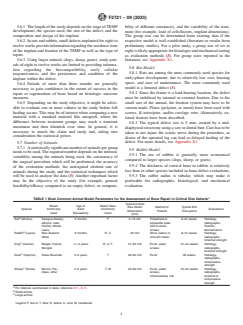
Rat (Murine) Sprague-Dawley, 6 months F 5–10 mm Polyethylene/ 8–24 weeks Histology,
athymic nude, polyacetal plate radiographs/
Fischer, Wistar, with K-wires/ Faxitron,
Lewis screws biomechanics
B
Rabbit (Lepus) New Zealand 9 months R, U 20 mm None (radius or 8–12 weeks Histology,
White ulna left intact) radiographs,
torsional strength
C
Dog (Canine) Beagle, Hound, >1–2 years R, U, F 21–25 mm Ex-fix, plate/ 12–24 weeks Histology,
Mongrel screws radiographs,
torsional strength
C
Goat (Caprine) Swiss Mountain 2–3 years T 26–35 mm Ex-fix 26 weeks Histology,
radiographs,
compressive
strength
C
Sheep (Ovine) Merino, Pre- 2–3 years T, M 25–50 mm Ex-fix, plate/ 16–24 weeks Histology,
Alpes, other screws, radiographs,
intramedullary nail torsional or
compressive
strength
A
For citations summarized in table, reference 5.7 – 5.11.
B
Small animal.
C
Large animal.
Legend: F, femur; T, tibia; R, radius; U, ulna; M, metatarsal
F2721 − 09 (2023)
5.9.4 A segmental critical size defect in either the ulna or the 7. Considerations for Defect Type, Implant Fixation, and
radius does not require a fixation, since the other bone will act Joint Immobilization
as a stabilizer.
7.1 Joint Loading and Immobilization:
5.9.5 The typical defect size is 15 to 20 mm. Some studies
7.1.1 The animal joint anatomy and joint size as well as gait
caution that 15 mm is not large enough.
should be taken into account to determine the appropriate
5.9.6 Adult rabbits with closed growth plates are preferred
immobilization modality.
(more than approximately 20 weeks old). In younger animals,
7.1.2 Splints, external fixators, and casts can be used to
the intact bone of the operated leg can be overloaded, resulting
reduce joint motion and loading for variable periods following
in slipping of the growth plate and consequently exclusion
surgery. There should be a point when the joint is restored to
from the study.
normal activity and exhibits unrestricted motion for an appro-
5.9.7 There is a certain risk in the rabbit ulna model that the
priate period of time.
radius can become attached to the defect area (fusion), which
7.1.3 The impact of disuse atrophy and potentially negative
has to be considered if mechanical testing is one of the
consequences to the bone should be considered when choosing
outcome measures. The axis of rotation for torsion testing
the period of immobilization.
becomes difficult to reproduce, and cross-sectional area mea-
7.1.4 Continuous passive motion has been shown to provide
surements are also difficult to make.
some level of benefit to the regenerative process following
bone injury in humans and animals. Implementation of similar
5.10 Dog Model:
therapeutic modalities in animal models is less feasible and has
5.10.1 Canines, such as medium-sized (for example, mean
not been widely accepted.
10 to 15 kg) mongrels, beagles, and hounds have been used in
7.1.5 The impact of limited access to surgical incision sites
critical-size defect models (1, 2, 4-6).
associated with the use of casts and splints should be factored
5.10.2 Long bones studied in canines have historically
into the postoperative care regime.
included the ulna, radius, and femur (1, 2, 4-6).
5.11 Sheep Model:
8. Test Procedures
5.11.1 Sheep are commonly used for the study of bone
8.1 Implant Preparation:
healing in critical-size long-bone defects in large species
8.1.1 All materials to be implanted into animals should be
animals.
verified to be non-cytotoxic and biocompatible. Implant com-
5.11.2 The most common sites in the sheep are the mid-
ponents can be sterilized and prepared aseptically or end-point
diaphyseal region of the metatarsal (7-11) and tibia (12-18).
sterilized by methods known to be acceptable to the implant
5.11.3 Defects are typically 2 to 5 cm in the ovine tibia
composition and function.
(7-11) and approximately 2.5 cm in the ovine metatarsal
8.1.2 Bioburden or sterility testing, as appropriate, should
(12-18).
be completed on representative test articles. Note that for
5.11.4 Defects in the sheep model are typically created
TEMPs regulated as biologics in the United States, each lot
unilaterally. Bilateral segmental diaphyseal defects in sheep are
must be tested for sterility in accordance with 21 CFR 610.12.
strongly discouraged.
8.1.3 See Guide F2150, Practices F1983, F981, F565, and
Test Method F895. Practice F1983 covers the assessment of
5.12 Goat Model:
compatibility of absorbable biomaterials for implant applica-
5.12.1 In comparison to sheep, goats are generally less
tions.
averse to human interaction and are therefore easier to handle.
8.2 Defect Generation:
5.12.2 Goats should be screened by blood test for caprine
8.2.1 The defect should be created in a standard and
encephalitis prior to inclusion in the cohort.
reproducible manner.
5.12.3 Critical-size defects in goats have been created
8.2.2 Templates or other sizing tools should be considered,
unilaterally in the tibia (19). Bilateral segmental diaphyseal
where feasible, for preparation of consistently sized defects.
defects in goats are strongly discouraged.
8.2.3 Defects in all animals within a study should be created
with the same type of tools and instruments.
6. Considerations for Defect Site
8.3 Test TEMP Implantation and Fixation:
6.1 The focus of this guide is on mid-diaphyseal segmental
8.3.1 The test TEMP should be implanted in a standard and
defects in long bones.
reproducible manner.
6.2 Typical bones for the creation of mid-diaphyseal defects
8.3.2 Care should be exercised to ensure that the surround-
are the ulna, radius, tibia, fibula, and femur. Not all sites have
ing bone is not excessively damaged and that the TEMP is in
been reported for all species.
contact with the adjacent walls of the defect.
6.3 Considerations should also include the level of difficulty 8.3.3 The defect should be fixed in a standard and repro-
of performing the surgical procedure and fixation. ducible manner.
8.4 Recovery and Husbandry:
6.4 Bilateral models of critical size segmental defects are
generally considered contraindicated due to humane reasons 8.4.1 Recovery conditions should be designed to reduce the
and also possible effects on data integrity. potential for stress and excessive motion. For goats, sheep, and
F2721 − 09 (2023)
horses, recovery pens that are sized to reduce excessive range 9.1.1.2 For assessment of TEMP performance, a scoring
of mobility for a period of two to three days are recommended. system should be used to determine several aspects such as the
following: callus formation, new bone formation in the defect
8.4.2 All housing conditions should be approved by the
United States Department of Agriculture (USDA), or the (mineralized/non-mineralized), resorption of bone graft, cortex
remodeling, marrow changes, union (distal, proximal) (for
respective governmental agency of the country where the study
is conducted. example, Ref (3)). In addition, fibrous connective tissue should
be evaluated with regard to inflammation.
8.4.3 Animals should be monitored frequently and observa-
tions recorded to ascertain appropriate health and physical 9.1.1.3 Histomorphometric analyses can be used to measure
condition. histologic parameters such as thickness, integration, cell
8.4.4 A veterinarian should approve the health condition of number, and surface quality.
animals prior to returning them to larger groups or herds. 9.1.1.4 Time points of less than six months do not neces-
sarily reflect the long-term outcome due to the potential for
8.5 In-Life Period:
changes in the biochemical composition and organization of
8.5.1 The use of splints rather than standard dressings can
repair tissue over time.
reduce joint motion and loading; however, the impact of disuse
9.1.1.5 Short-term histologic evaluation can be used for
atrophy and potentially negative consequence to the bone
screening and optimization. Long-term assessment should be
healing should be considered when choosing the length of
based on histologic and mechanical measures.
treatment.
8.5.2 Radiographs should be used as appropriate for a given
9.2 Radiography:
study to assess placement of the implants.
9.2.1 Radiographs are important to evaluate the amount and
8.5.3 Following recovery, large animals should be contained
quality of the new bone forming during the in-life portion of
within protected stalls for a minimum of nine days. After this
the study, as well as at the endpoint.
period the animals can either remain in protected stalls or be
9.2.2 Typically, radiographs should be taken in two orthogo-
allowed to roam freely in group herds.
nal planes to allow assessment of proper alignment and a
8.5.4 A qualified veterinarian should examine animals rou-
quasi-three-dimensional view.
tinely for any gross abnormalities or signs of discomfort.
9.2.3 Radiographic healing may be one of the decisive
8.5.5 Survival time should be designated based on the
factors to terminate a study. It should be used in conjunction
objective of the study. Typically, an early timepoint (for
with other indicators, for example, clinical signs of full weight
example, to examine the effect on early healing, including, for
bearing.
example, acceleration of healing), and one or two later time-
9.2.4 Various radiographic scoring systems which take into
point(s) (for example, when full or nearly full healing is
consideration callus formation, bridging or union (proximal,
anticipated) are chosen. Historically used in-life periods are
distal), appearance of graft, and remodeling have been pub-
listed in the tables in Appendix X1.
lished (3). The scoring system should be specified.
8.6 Necropsy: 9.2.5 Inclusion of a metal wedge in the picture may help to
8.6.1 Animals should be euthanized in a humane manner normalize radiographs.
according to accepted practices of the Animal Welfare Act (in
9.2.6 Radiopaque implants and fixation materials may have
the U.S.) or other applicable local statutes.
an impact on the ability to assess healing from radiographs.
8.6.2 The implanted site should be removed along with the
9.3 Computer Tomography:
surrounding cartilage and bone.
9.3.1 Computer tomography (CT) has been evolving in
8.6.3 Retrieved tissue should be placed in a solution con-
recent years as a useful tool for 3D imaging of bone regenera-
sistent with intended outcome measures
...