

ASTM A102-04(2019)
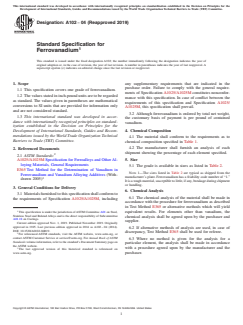
(Specification)Standard Specification for Ferrovanadium
General Information
- Abstract
ABSTRACT
This specification covers different sizes of one grade of ferrovanadium. The material shall undergo chemical analysis and shall conform to the requirements as to composition of the following chemical elements: vanadium, carbon, silicon, aluminum, sulfur, and phosphorus.
SCOPE
1.1 This specification covers one grade of ferrovanadium.
1.2 The values stated in inch-pound units are to be regarded as standard. The values given in parentheses are mathematical conversions to SI units that are provided for information only and are not considered standard.
1.3 This international standard was developed in accordance with internationally recognized principles on standardization established in the Decision on Principles for the Development of International Standards, Guides and Recommendations issued by the World Trade Organization Technical Barriers to Trade (TBT) Committee.
- Status
- Published
- Publication Date
- 31-Oct-2019
- Technical Committee
- A01 - Steel, Stainless Steel and Related Alloys
- Drafting Committee
- A01.18 - Castings


Overview
ASTM A102-04(2019) - Standard Specification for Ferrovanadium defines the requirements for one grade of ferrovanadium, an important ferroalloy used as a vanadium source in steelmaking. Developed by ASTM International, this specification covers chemical composition, sizing, analysis, and testing methods to ensure consistent quality and global compliance.
Ferrovanadium, combining iron and vanadium along with controlled levels of other elements, is essential for enhancing the strength, toughness, and corrosion resistance of steel products. Compliance with ASTM A102 helps producers, buyers, and users maintain reliability and uniformity in manufacturing processes worldwide.
Key Topics
Primary Content Areas in ASTM A102-04(2019):
- Chemical Composition:
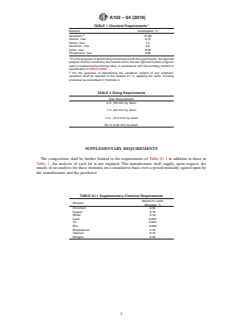
The standard stipulates requirements for key elements:- Vanadium: 75–85%
- Maximum Carbon: 0.75%
- Maximum Silicon: 1.5%
- Maximum Aluminum: 2.0%
- Maximum Sulfur: 0.08%
- Maximum Phosphorus: 0.08%
- Supplementary Elements:
Limits for additional elements, such as chromium, copper, nickel, lead, tin, zinc, molybdenum, titanium, and nitrogen, may be specified upon agreement between manufacturer and purchaser. - Sizing Requirements:
Ferrovanadium is available in several size ranges (e.g., 2 in. by down, 1 in. by down, ½ in. by down, and No. 8 by down) to accommodate different applications and ease of handling. - Testing and Analysis:
Chemical analysis must follow specified procedures, ensuring conformity. Test Method E365 or mutually agreed alternatives are referenced for vanadium content determination. - Purchase and Delivery:
Material is typically ordered by net weight, though payment is based on contained vanadium. Compliance with both ASTM A102 and general requirements from ASTM A1025/A1025M is necessary for conformance.
Applications
Practical Uses of ASTM A102 Ferrovanadium:
- Steel and Alloy Production:
Ferrovanadium is primarily added to steel during production to improve hardness, tensile strength, and wear resistance, especially in high-strength low-alloy (HSLA) steels. - Construction Industry:
Used in reinforcing bars, structural beams, and high-rise building components, supporting enhanced durability. - Automotive and Machinery Manufacturing:
Crucial for parts requiring superior impact resistance and performance such as gears, axles, and crankshafts. - Energy Sector:
Essential in pipelines, drilling equipment, and power plant components where strength and corrosion resistance are vital.
Using ferrovanadium certified to ASTM A102 ensures reliable performance and meets international market expectations for quality and safety.
Related Standards
Other ASTM and Industry Standards Relevant to Ferrovanadium:
- ASTM A1025/A1025M - Specification for Ferroalloys and Other Alloying Materials, General Requirements:
Provides the underlying general delivery and testing requirements referenced by ASTM A102. - ASTM E365 - Test Method for Determination of Vanadium in Ferrovanadium and Vanadium Alloying Additives:
Specifies analytical procedures for accurate vanadium quantification. - ISO Ferroalloy Standards:
Various international standards also regulate ferroalloy chemical and physical properties for global trade.
Note: Conformance to ASTM A102-04(2019) supports manufacturers and suppliers in meeting both regulatory obligations and end-user expectations in the global steel supply chain. By adhering to this specification, stakeholders ensure product quality, consistency, and competitive advantage in demanding applications.
Relations
- Effective Date
- 01-Nov-2019
- Effective Date
- 01-Nov-2015
- Effective Date
- 01-Oct-2010
- Effective Date
- 10-Dec-1999
- Effective Date
- 01-Nov-2019
- Effective Date
- 01-Nov-2019
Get Certified
Connect with accredited certification bodies for this standard

Element Materials Technology
Materials testing and product certification.

Inštitut za kovinske materiale in tehnologije
Institute of Metals and Technology. Materials testing, metallurgical analysis, NDT.
Sponsored listings
Frequently Asked Questions
ASTM A102-04(2019) is a technical specification published by ASTM International. Its full title is "Standard Specification for Ferrovanadium". This standard covers: ABSTRACT This specification covers different sizes of one grade of ferrovanadium. The material shall undergo chemical analysis and shall conform to the requirements as to composition of the following chemical elements: vanadium, carbon, silicon, aluminum, sulfur, and phosphorus. SCOPE 1.1 This specification covers one grade of ferrovanadium. 1.2 The values stated in inch-pound units are to be regarded as standard. The values given in parentheses are mathematical conversions to SI units that are provided for information only and are not considered standard. 1.3 This international standard was developed in accordance with internationally recognized principles on standardization established in the Decision on Principles for the Development of International Standards, Guides and Recommendations issued by the World Trade Organization Technical Barriers to Trade (TBT) Committee.
ABSTRACT This specification covers different sizes of one grade of ferrovanadium. The material shall undergo chemical analysis and shall conform to the requirements as to composition of the following chemical elements: vanadium, carbon, silicon, aluminum, sulfur, and phosphorus. SCOPE 1.1 This specification covers one grade of ferrovanadium. 1.2 The values stated in inch-pound units are to be regarded as standard. The values given in parentheses are mathematical conversions to SI units that are provided for information only and are not considered standard. 1.3 This international standard was developed in accordance with internationally recognized principles on standardization established in the Decision on Principles for the Development of International Standards, Guides and Recommendations issued by the World Trade Organization Technical Barriers to Trade (TBT) Committee.
ASTM A102-04(2019) is classified under the following ICS (International Classification for Standards) categories: 77.100 - Ferroalloys. The ICS classification helps identify the subject area and facilitates finding related standards.
ASTM A102-04(2019) has the following relationships with other standards: It is inter standard links to ASTM A102-04(2014), ASTM A1025/A1025M-10(2015), ASTM A1025/A1025M-10, ASTM E365-99, ASTM A1025/A1025M-10(2020), ASTM F860-07(2018)e1. Understanding these relationships helps ensure you are using the most current and applicable version of the standard.
ASTM A102-04(2019) is available in PDF format for immediate download after purchase. The document can be added to your cart and obtained through the secure checkout process. Digital delivery ensures instant access to the complete standard document.
Standards Content (Sample)
This international standard was developed in accordance with internationally recognized principles on standardization established in the Decision on Principles for the
Development of International Standards, Guides and Recommendations issued by the World Trade Organization Technical Barriers to Trade (TBT) Committee.
Designation: A102 −04 (Reapproved 2019)
Standard Specification for
Ferrovanadium
This standard is issued under the fixed designation A102; the number immediately following the designation indicates the year of
original adoption or, in the case of revision, the year of last revision. A number in parentheses indicates the year of last reapproval. A
superscript epsilon (´) indicates an editorial change since the last revision or reapproval.
1. Scope any supplementary requirements that are indicated in the
purchase order. Failure to comply with the general require-
1.1 This specification covers one grade of ferrovanadium.
ments of Specification A1025/A1025M constitutes nonconfor-
1.2 The values stated in inch-pound units are to be regarded
mance with this specification. In case of conflict between the
as standard. The values given in parentheses are mathematical
requirements of this specification and Specification A1025/
conversions to SI units that are provided for information only
A1025M, this specification shall prevail.
and are not considered standard.
3.2 Although ferrovanadium is ordered by total net weight,
1.3 This international standard was developed in accor-
the customary basis of payment is per pound of contained
dance with internationally recognized principles on standard-
vanadium.
ization established in the Decision on Principles for the
4. Chemical Composition
Development of International Standards, Guides and Recom-
mendations issued by the World Trade Organization Technical
4.1 The material shall conform to the requirements as to
Barriers to Trade (TBT) Committee.
chemical composition specified in Table 1.
4.2 The manufacturer shall furnish an analysis of each
2. Referenced Documents
shipment showing the percentage of each element specified.
2.1 ASTM Standards:
5. Size
A1025/A1025M Specification for Ferroalloys and Other Al-
loying Materials, General Requirements
5.1 The grade is available in sizes as listed in Table 2.
E365 Test Method for the Determination of Vanadium in
NOTE 1—The sizes listed in Table 2 are typical as shipped from the
Ferrovanadium and Vanadium Alloying Additives (With-
manufacturer’s plant. Ferrovanadium has a friability code number of “1.”
drawn 2005)
Itisatoughmaterial,susceptibletolittle,ifany,breakageduringshipment
or handling.
3. General Conditions for Delivery
6. Chemical Analysis
3.1 Materialsfurnishedtothisspecificationshallconformto
6.1 The chemical analysis of the material shall be made in
the requirements of Specification A1025/A1025M, including
accordance with the procedure for ferrovanadium as described
in Test Method E365 or alternative methods which will yield
This specification is under the jurisdiction of ASTM Committee A01 on Steel, equivalent results. For elements other than vanadium, the
Stainless Steel and Related Alloys and is the direct responsibility of Subcommittee
chemical analysis shall be agreed upon by the purchaser and
A01.18 on Castings.
supplier.
Current edition approved Nov. 1, 2019. Published November 2019. Originally
approved in 1925. Last previous edition approved in 2014 as A102 – 04 (2014).
6.2 If alternative methods of analysis are used, in case of
DOI: 10.1520/A0102-04R19.
discrepancy, Test Method E365 shall be used for referee.
For referenced ASTM standards, visit the AS
...