

ASTM D6326-22
(Practice)Standard Practice for Selection of Maximum Transit-Rate Ratios and Depths for the U.S. Series of Isokinetic Suspended-Sediment Samplers
General Information
- Abstract
SIGNIFICANCE AND USE
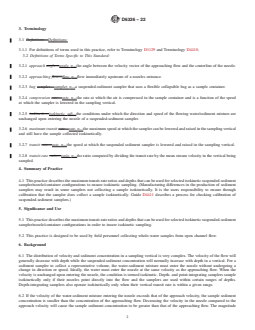
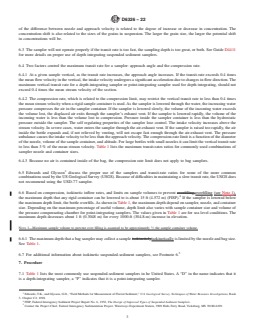
5.1 This practice describes the maximum transit-rate ratios and depths that can be used for selected isokinetic suspended-sediment sampler/nozzle/container configurations in order to insure isokinetic sampling.
5.2 This practice is designed to be used by field personnel collecting whole-water samples from open channel flow.
SCOPE
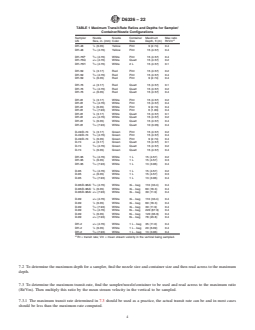
1.1 This practice covers the maximum transit-rate ratios and depths for selected suspended-sediment sampler-nozzle-container configurations.
1.2 This practice explains the reasons for limiting the transit-rate ratio and depths that suspended-sediment samplers can be correctly used.
1.3 This practice give maximum transit-rate ratios and depths for selected isokinetic suspended-sediment sampler/nozzle/container size for samplers developed by the Federal Interagency Sedimentation Project.
1.4 Throughout this practice, a samplers lowering rate is assumed to be equal to its raising rate.
1.5 The values stated in inch-pound units are to be regarded as standard. The values given in parentheses are mathematical conversions to SI units that are provided for information only and are not considered standard.
1.6 This standard does not purport to address all of the safety concerns, if any, associated with its use. It is the responsibility of the user of this standard to establish appropriate safety, health, and environmental practices and determine the applicability of regulatory limitations prior to use.
1.7 This international standard was developed in accordance with internationally recognized principles on standardization established in the Decision on Principles for the Development of International Standards, Guides and Recommendations issued by the World Trade Organization Technical Barriers to Trade (TBT) Committee.
- Status
- Published
- Publication Date
- 30-Apr-2022
- Technical Committee
- D19 - Water
- Drafting Committee
- D19.07 - Sediments, Geomorphology, and Open-Channel Flow
Buy Documents

ASTM D6326-22 - Standard Practice for Selection of Maximum Transit-Rate Ratios and Depths for the U.S. Series of Isokinetic Suspended-Sediment Samplers
REDLINE ASTM D6326-22 - Standard Practice for Selection of Maximum Transit-Rate Ratios and Depths for the U.S. Series of Isokinetic Suspended-Sediment Samplers
Overview
ASTM D6326-22: Standard Practice for Selection of Maximum Transit-Rate Ratios and Depths for the U.S. Series of Isokinetic Suspended-Sediment Samplers provides essential guidance for ensuring accurate collection of whole-water suspended-sediment samples in open-channel flow. Developed by ASTM International and based on the work of the Federal Interagency Sedimentation Project, this standard addresses the selection of maximum transit-rate ratios and sampling depths for various isokinetic sampler, nozzle, and container configurations.
Precise suspended-sediment sampling is crucial for reliable hydrological, environmental, and engineering studies. ASTM D6326-22 helps field personnel choose the correct operating parameters to maintain isokinetic conditions, thus supporting valid and reproducible data collection across varied field scenarios.
Key Topics
- Isokinetic Sampling: The standard emphasizes the importance of ensuring the velocity and direction of the water-sediment mixture remains unchanged as it enters the sampler nozzle, a condition known as isokinetic sampling. This is vital for the representativeness of the sediment data.
- Transit-Rate Ratio: Defined as the ratio of the sampler's vertical movement speed (transit rate) to the mean stream velocity in the sampling vertical. ASTM D6326-22 provides maximum allowable values to avoid artificial increases or decreases in sample sediment concentration.
- Sampler and Container Configurations: Covers a range of suspended-sediment samplers and their compatible nozzle and container sizes, mainly those developed by the Federal Interagency Sedimentation Project (FISP). The standard associates each configuration with specific maximum depth and transit-rate ratio limits.
- Operational Guidance:
- Maximum transit-rate ratios generally should not exceed 0.4 times the mean stream velocity, though this can be more restrictive based on container rigidity and nozzle size.
- Maximum permissible sampling depths vary by sampler and are influenced by factors such as container size, nozzle diameter, and altitude.
- Bag samplers are not bound by compression rate limits, a key distinction for field operations at greater depths.
- Importance of Calibration: Users must ensure through proper calibration that their samplers operate isokinetically to meet the accuracy requirements outlined in the standard.
Applications
ASTM D6326-22 is intended for use by field personnel who collect suspended-sediment samples in open-channel flows, particularly in riverine and hydrological monitoring projects. Typical applications include:
- Water Resource Management: Supporting the design and assessment of sediment transport in river engineering, dredging, and ecological restoration.
- Hydrological and Environmental Studies: Facilitating accurate monitoring of sediment loads, which is critical for understanding watershed health, sediment budgets, and pollutant transport.
- Regulatory Compliance: Ensuring consistent sampling techniques for sediment studies required under environmental regulations and for reporting to federal and state agencies.
- Research and Development: Providing a standardized framework for sediment data collection in academic and government research.
Related Standards
To further support accurate suspended-sediment sampling and data interpretation, practitioners should reference additional ASTM standards:
- ASTM D1129: Terminology Relating to Water
- ASTM D4410: Terminology for Fluvial Sediment
- ASTM D4411: Guide for Sampling Fluvial Sediment in Motion
These related standards provide foundational terminology and broader guidance for effective sediment measurement and analysis.
Keywords: isokinetic sampling, suspended-sediment samplers, transit-rate ratio, sediment sampling, open channel flow, ASTM D6326-22, water quality monitoring, sediment data collection, hydrological studies
Relations
- Effective Date
- 01-May-2020
- Effective Date
- 01-Nov-2019
- Effective Date
- 01-Jan-2016
- Effective Date
- 01-Jan-2014
- Effective Date
- 01-Jan-2014
- Effective Date
- 01-Mar-2010
- Effective Date
- 01-Feb-2010
- Effective Date
- 01-Oct-2008
- Effective Date
- 01-Sep-2006
- Effective Date
- 01-Sep-2006
- Effective Date
- 15-Feb-2006
- Effective Date
- 01-Mar-2004
- Effective Date
- 01-Mar-2004
- Effective Date
- 10-Aug-2003
- Effective Date
- 10-Aug-2003
Buy Documents
ASTM D6326-22 - Standard Practice for Selection of Maximum Transit-Rate Ratios and Depths for the U.S. Series of Isokinetic Suspended-Sediment Samplers
REDLINE ASTM D6326-22 - Standard Practice for Selection of Maximum Transit-Rate Ratios and Depths for the U.S. Series of Isokinetic Suspended-Sediment Samplers
Get Certified
Connect with accredited certification bodies for this standard

CIS Institut d.o.o.
Personal Protective Equipment (PPE) certification body. Notified Body NB-2890 for EU Regulation 2016/425 PPE.

Kiwa BDA Testing
Building and construction product certification.
Kmetijski inštitut Slovenije
Agricultural Institute of Slovenia. Soil testing, plant health, agricultural product analysis.
Sponsored listings
Frequently Asked Questions
ASTM D6326-22 is a standard published by ASTM International. Its full title is "Standard Practice for Selection of Maximum Transit-Rate Ratios and Depths for the U.S. Series of Isokinetic Suspended-Sediment Samplers". This standard covers: SIGNIFICANCE AND USE 5.1 This practice describes the maximum transit-rate ratios and depths that can be used for selected isokinetic suspended-sediment sampler/nozzle/container configurations in order to insure isokinetic sampling. 5.2 This practice is designed to be used by field personnel collecting whole-water samples from open channel flow. SCOPE 1.1 This practice covers the maximum transit-rate ratios and depths for selected suspended-sediment sampler-nozzle-container configurations. 1.2 This practice explains the reasons for limiting the transit-rate ratio and depths that suspended-sediment samplers can be correctly used. 1.3 This practice give maximum transit-rate ratios and depths for selected isokinetic suspended-sediment sampler/nozzle/container size for samplers developed by the Federal Interagency Sedimentation Project. 1.4 Throughout this practice, a samplers lowering rate is assumed to be equal to its raising rate. 1.5 The values stated in inch-pound units are to be regarded as standard. The values given in parentheses are mathematical conversions to SI units that are provided for information only and are not considered standard. 1.6 This standard does not purport to address all of the safety concerns, if any, associated with its use. It is the responsibility of the user of this standard to establish appropriate safety, health, and environmental practices and determine the applicability of regulatory limitations prior to use. 1.7 This international standard was developed in accordance with internationally recognized principles on standardization established in the Decision on Principles for the Development of International Standards, Guides and Recommendations issued by the World Trade Organization Technical Barriers to Trade (TBT) Committee.
SIGNIFICANCE AND USE 5.1 This practice describes the maximum transit-rate ratios and depths that can be used for selected isokinetic suspended-sediment sampler/nozzle/container configurations in order to insure isokinetic sampling. 5.2 This practice is designed to be used by field personnel collecting whole-water samples from open channel flow. SCOPE 1.1 This practice covers the maximum transit-rate ratios and depths for selected suspended-sediment sampler-nozzle-container configurations. 1.2 This practice explains the reasons for limiting the transit-rate ratio and depths that suspended-sediment samplers can be correctly used. 1.3 This practice give maximum transit-rate ratios and depths for selected isokinetic suspended-sediment sampler/nozzle/container size for samplers developed by the Federal Interagency Sedimentation Project. 1.4 Throughout this practice, a samplers lowering rate is assumed to be equal to its raising rate. 1.5 The values stated in inch-pound units are to be regarded as standard. The values given in parentheses are mathematical conversions to SI units that are provided for information only and are not considered standard. 1.6 This standard does not purport to address all of the safety concerns, if any, associated with its use. It is the responsibility of the user of this standard to establish appropriate safety, health, and environmental practices and determine the applicability of regulatory limitations prior to use. 1.7 This international standard was developed in accordance with internationally recognized principles on standardization established in the Decision on Principles for the Development of International Standards, Guides and Recommendations issued by the World Trade Organization Technical Barriers to Trade (TBT) Committee.
ASTM D6326-22 is classified under the following ICS (International Classification for Standards) categories: 13.080.05 - Examination of soils in general. The ICS classification helps identify the subject area and facilitates finding related standards.
ASTM D6326-22 has the following relationships with other standards: It is inter standard links to ASTM D1129-13(2020)e2, ASTM D4411-03(2019), ASTM D4410-16, ASTM D4411-03(2014), ASTM D4411-03(2014)e1, ASTM D1129-10, ASTM D4410-10, ASTM D4411-03(2008), ASTM D1129-06a, ASTM D1129-06ae1, ASTM D1129-06, ASTM D1129-04e1, ASTM D1129-04, ASTM D4410-03, ASTM D1129-03a. Understanding these relationships helps ensure you are using the most current and applicable version of the standard.
ASTM D6326-22 is available in PDF format for immediate download after purchase. The document can be added to your cart and obtained through the secure checkout process. Digital delivery ensures instant access to the complete standard document.
Standards Content (Sample)
This international standard was developed in accordance with internationally recognized principles on standardization established in the Decision on Principles for the
Development of International Standards, Guides and Recommendations issued by the World Trade Organization Technical Barriers to Trade (TBT) Committee.
Designation: D6326 − 22
Standard Practice for
Selection of Maximum Transit-Rate Ratios and Depths for
the U.S. Series of Isokinetic Suspended-Sediment Samplers
This standard is issued under the fixed designation D6326; the number immediately following the designation indicates the year of
original adoption or, in the case of revision, the year of last revision. A number in parentheses indicates the year of last reapproval. A
superscript epsilon (´) indicates an editorial change since the last revision or reapproval.
1. Scope D4410 Terminology for Fluvial Sediment
D4411 Guide for Sampling Fluvial Sediment in Motion
1.1 This practice covers the maximum transit-rate ratios and
depths for selected suspended-sediment sampler-nozzle-
3. Terminology
container configurations.
3.1 Definitions:
1.2 This practice explains the reasons for limiting the
3.1.1 For definitions of terms used in this practice, refer to
transit-rate ratio and depths that suspended-sediment samplers
Terminology D1129 and Terminology D4410.
can be correctly used.
3.2 Definitions of Terms Specific to This Standard:
1.3 This practice give maximum transit-rate ratios and
3.2.1 approach angle, n—the angle between the velocity
depths for selected isokinetic suspended-sediment sampler/
vector of the approaching flow and the centerline of the nozzle.
nozzle/container size for samplers developed by the Federal
3.2.2 approaching flow, n—flow immediately upstream of a
Interagency Sedimentation Project.
nozzles entrance.
1.4 Throughout this practice, a samplers lowering rate is
3.2.3 bag sampler, n—a suspended-sediment sampler that
assumed to be equal to its raising rate.
uses a flexible collapsible bag as a sample container.
1.5 The values stated in inch-pound units are to be regarded
3.2.4 compression rate, n—the rate at which the air is
as standard. The values given in parentheses are mathematical
compressed in the sample container and is a function of the
conversions to SI units that are provided for information only
speed at which the sampler is lowered in the sampling vertical.
and are not considered standard.
3.2.5 isokinetic, adj—the conditions under which the direc-
1.6 This standard does not purport to address all of the
tion and speed of the flowing water/sediment mixture are
safety concerns, if any, associated with its use. It is the
unchanged upon entering the nozzle of a suspended-sediment
responsibility of the user of this standard to establish appro-
sampler.
priate safety, health, and environmental practices and deter-
3.2.6 maximum transit rate, n—the maximum speed at
mine the applicability of regulatory limitations prior to use.
which the sampler can be lowered and raised in the sampling
1.7 This international standard was developed in accor-
vertical and still have the sample collected isokinetically.
dance with internationally recognized principles on standard-
3.2.7 transit rate, n—the speed at which the suspended
ization established in the Decision on Principles for the
sediment sampler is lowered and raised in the sampling
Development of International Standards, Guides and Recom-
vertical.
mendations issued by the World Trade Organization Technical
Barriers to Trade (TBT) Committee. 3.2.8 transit-rate ratio, n—the ratio computed by dividing
thetransitratebythemeanstreamvelocityintheverticalbeing
2. Referenced Documents
sampled.
2.1 ASTM Standards:
4. Summary of Practice
D1129 Terminology Relating to Water
4.1 This practice describes the maximum transit-rate ratios
This practice is under the jurisdiction of ASTM Committee D19 on Water and
and depths that can be used for selected isokinetic suspended-
the direct responsibility of Subcommittee D19.07 on Sediments, Geomorphology,
sediment sampler/nozzle/container configurations to ensure
and Open-Channel Flow.
isokinetic sampling. (Manufacturing differences in the produc-
Current edition approved May 1, 2022. Published June 2022. Originally
tion of sediment samplers may result in some samplers not
approved in 1998. Last previous edition approved in 2014 as D6326 – 08 (2014).
DOI: 10.1520/D6326-22.
collecting a sample isokinetically. It is the users responsibility
For referenced ASTM standards, visit the ASTM website, www.astm.org, or
to ensure through calibration that the sampler does collect a
contact ASTM Customer Service at service@astm.org. For Annual Book of ASTM
sample isokinetically. Guide D4411 describes a process for
Standards volume information, refer to the standard’s Document Summary page on
the ASTM website. checking calibration of suspended-sediment samplers.)
Copyright © ASTM International, 100 Barr Harbor Drive, PO Box C700, West Conshohocken, PA 19428-2959. United States
D6326 − 22
5. Significance and Use rapidly, the volume of the incoming water is less than the
volume lost to compression. Pressure inside the sampler
5.1 This practice describes the maximum transit-rate ratios
container is less than the hydrostatic pressure outside the
and depths that can be used for selected isokinetic suspended-
sampler. The self regulating properties of the sampler lose
sediment sampler/nozzle/container configurations in order to
control. The intake velocity increases above the stream veloc-
insure isokinetic sampling.
ity. In severe cases, water enters the sampler through the
5.2 This practice is designed to be used by field personnel
air-exhaust vent. If the sampler is raised too rapidly, the air
collecting whole-water samples from open channel flow.
inside the bottle expands and, if not relieved by venting, will
not escape fast enough through the air-exhaust vent. The
6. Background
pressure unbalance causes the intake velocity to be less than
6.1 The distribution of velocity and sediment concentration
the approach velocity. The compression-rate limit is a function
inasamplingverticalisverycomplex.Thevelocityoftheflow
of the diameter of the nozzle, volume of the sample container,
will generally decrease with depth while the suspended-
andaltitude.Forlargebottleswithsmallnozzlesitcanlimitthe
sediment concentration will normally increase with depth in a
vertical transit rate to less than 3 % of the mean stream
vertical. For a sediment sampler to collect a representative
velocity. Table 1 lists the maximum transit-rates ratios for
volume, the water-sediment mixture must enter the nozzle
commonly used combinations of sampler nozzle and container
without undergoing a change in direction or speed. Ideally, the
sizes.
water must enter the nozzle at the same velocity as the
6.4.3 Because no air is contained inside of the bag, the
approaching flow. When the velocity is unchanged upon
compression rate limit does not apply to bag samplers.
entering the nozzle, the condition is termed isokinetic. Depth-
6.5 Edwards and Glysson discuss the proper use of the
and point-integrating samplers sample isokinetically only if
samplers and transit-rate ratios for some of the more common
their nozzles point directly into the flow and the samplers are
combinations used by the US Geological Survey (USGS).
used within certain ranges of depths. Depth-integrating sam-
Because of difficulties in maintaining a slow transit rate, the
plers also operate isokinetically only when their vertical transit
USGS does not recommend using the USD-77 sampler.
rate is within a given range.
6.6 Based on compression, isokinetic inflow rates, and
6.2 If the velocity of the water-sediment mixture entering
limits on sample volumes to prevent overfilling (see Note 1),
the nozzle exceeds that of the approach velocity, the sample
the maximum depth that any rigid container can be lowered to
sediment concentration is smaller than the concentration of the
is about 15 ft (4.5
...
This document is not an ASTM standard and is intended only to provide the user of an ASTM standard an indication of what changes have been made to the previous version. Because
it may not be technically possible to adequately depict all changes accurately, ASTM recommends that users consult prior editions as appropriate. In all cases only the current version
of the standard as published by ASTM is to be considered the official document.
Designation: D6326 − 08 (Reapproved 2014) D6326 − 22
Standard Practice for
The Selection of Maximum Transit-Rate Ratios and Depths
for the U.S. Series of Isokinetic Suspended-Sediment
Samplers
This standard is issued under the fixed designation D6326; the number immediately following the designation indicates the year of
original adoption or, in the case of revision, the year of last revision. A number in parentheses indicates the year of last reapproval. A
superscript epsilon (´) indicates an editorial change since the last revision or reapproval.
1. Scope
1.1 This practice covers the maximum transit-rate ratios and depths for selected suspended-sediment sampler-nozzle-container
configurations.
1.2 This practice explains the reasons for limiting the transit-rate ratio and depths that suspended-sediment samplers can be
correctly used.
1.3 This practice give maximum transit-rate ratios and depths for selected isokinetic suspended-sediment sampler/nozzle/container
size for samplers developed by the Federal Interagency Sedimentation Project.
1.4 Throughout this practice, a samplers lowering rate is assumed to be equal to its raising rate.
1.5 The values stated in inch-pound units are to be regarded as standard. The values given in parentheses are mathematical
conversions to SI units that are provided for information only and are not considered standard.
1.6 This standard does not purport to address all of the safety concerns, if any, associated with its use. It is the responsibility
of the user of this standard to establish appropriate safety safety, health, and healthenvironmental practices and determine the
applicability of regulatory limitations prior to use.
1.7 This international standard was developed in accordance with internationally recognized principles on standardization
established in the Decision on Principles for the Development of International Standards, Guides and Recommendations issued
by the World Trade Organization Technical Barriers to Trade (TBT) Committee.
2. Referenced Documents
2.1 ASTM Standards:
D1129 Terminology Relating to Water
D4410 Terminology for Fluvial Sediment
D4411 Guide for Sampling Fluvial Sediment in Motion
This practice is under the jurisdiction of ASTM Committee D19 on Water and the direct responsibility of Subcommittee D19.07 on Sediments, Geomorphology, and
Open-Channel Flow.
Current edition approved Jan. 1, 2014May 1, 2022. Published March 2014June 2022. Originally approved in 1998. Last previous edition approved in 20082014 as
D6326 – 08.D6326 – 08 (2014). DOI: 10.1520/D6326-08R14.10.1520/D6326-22.
For referenced ASTM standards, visit the ASTM website, www.astm.org, or contact ASTM Customer Service at service@astm.org. For Annual Book of ASTM Standards
volume information, refer to the standard’s Document Summary page on the ASTM website.
Copyright © ASTM International, 100 Barr Harbor Drive, PO Box C700, West Conshohocken, PA 19428-2959. United States
D6326 − 22
3. Terminology
3.1 Definitions—Definitions:
3.1.1 For definitions of terms used in this practice, refer to Terminology D1129 and Terminology D4410.
3.2 Definitions of Terms Specific to This Standard:
3.2.1 approach angle—angle, n—the angle between the velocity vector of the approaching flow and the centerline of the nozzle.
3.2.2 approaching flow—flow, n—flow immediately upstream of a nozzles entrance.
3.2.3 bag sampler—sampler, n—a suspended-sediment sampler that uses a flexible collapsible bag as a sample container.
3.2.4 compression rate—rate, n—the rate at which the air is compressed in the sample container and is a function of the speed
at which the sampler is lowered in the sampling vertical.
3.2.5 isokinetic—isokinetic, adj—the conditions under which the direction and speed of the flowing water/sediment mixture are
unchanged upon entering the nozzle of a suspended-sediment sampler.
3.2.6 maximum transit rate—rate, n—the maximum speed at which the sampler can be lowered and raised in the sampling vertical
and still have the sample collected isokinetically.
3.2.7 transit rate—rate, n—the speed at which the suspended sediment sampler is lowered and raised in the sampling vertical.
3.2.8 transit-rate ratio—ratio, n—the ratio computed by dividing the transit rate by the mean stream velocity in the vertical being
sampled.
4. Summary of Practice
4.1 This practice describes the maximum transit-rate ratios and depths that can be used for selected isokinetic suspended-sediment
sampler/nozzle/container configurations to ensure isokinetic sampling. (Manufacturing differences in the production of sediment
samplers may result in some samplers not collecting a sample isokinetically. It is the users responsibility to ensure through
calibration that the sampler does collect a sample isokinetically. Guide D4411 describes a process for checking calibration of
suspended-sediment samplers.)
5. Significance and Use
5.1 This practice describes the maximum transit-rate ratios and depths that can be used for selected isokinetic suspended-sediment
sampler/nozzle/container configurations in order to insure isokinetic sampling.
5.2 This practice is designed to be used by field personnel collecting whole-water samples from open channel flow.
6. Background
6.1 The distribution of velocity and sediment concentration in a sampling vertical is very complex. The velocity of the flow will
generally decrease with depth while the suspended-sediment concentration will normally increase with depth in a vertical. For a
sediment sampler to collect a representative volume, the water-sediment mixture must enter the nozzle without undergoing a
change in direction or speed. Ideally, the water must enter the nozzle at the same velocity as the approaching flow. When the
velocity is unchanged upon entering the nozzle, the condition is termed isokinetic. Depth- and point-integrating samplers sample
isokinetically only if their nozzles point directly into the flow and the samplers are used within certain ranges of depths.
Depth-integrating samplers also operate isokinetically only when their vertical transit rate is within a given range.
6.2 If the velocity of the water-sediment mixture entering the nozzle exceeds that of the approach velocity, the sample sediment
concentration is smaller than the concentration of the approaching flow. Decreasing the velocity in the nozzle compared to the
approach velocity will cause the sample sediment concentration to be greater than that of the approaching flow. The magnitude
D6326 − 22
of the difference between nozzle and approach velocity is related to the degree of increase or decrease in concentration. The
concentration shift is also related to the sizes of the grains in suspension. The larger the grain size, the larger the potential shift
in concentrations will be.
6.3 The sampler will not operate properly if the transit rate is too fast, the sampling depth is too great, or both. See Guide D4411
for more details on proper use of depth integrating suspended sediment samplers.
6.4 Two factors control the maximum transit rate for a sampler: approach angle and the compression rate.
6.4.1 At a given sample vertical, as the transit rate increases, the approach angle increases. If the transit-rate exceeds 0.4 times
the mean flow velocity in the vertical, the intake velocity undergoes a significant acceleration due to changes in flow direction. The
maximum vertical transit rate for a depth-integrating sampler or point-integrating sampler used for depth integrating, should not
exceed 0.4 times the mean stream velocity of the section.
6.4.2 The compression rate, which is related to the compression limit, may restrict the vertical transit rate to less than 0.4 times
the mean stream velocity when a rigid sample container is used. As the sampler is lowered through the water, the increasing w
...