

ASTM D6080-18a
(Practice)Standard Practice for Defining the Viscosity Characteristics of Hydraulic Fluids
General Information
- Abstract
SIGNIFICANCE AND USE
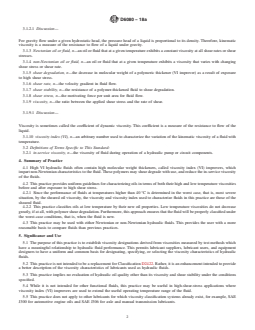
5.1 The purpose of this practice is to establish viscosity designations derived from viscosities measured by test methods which have a meaningful relationship to hydraulic fluid performance. This permits lubricant suppliers, lubricant users, and equipment designers to have a uniform and common basis for designating, specifying, or selecting the viscosity characteristics of hydraulic fluids.
5.2 This practice is not intended to be a replacement for Classification D2422. Rather, it is an enhancement intended to provide a better description of the viscosity characteristics of lubricants used as hydraulic fluids.
5.3 This practice implies no evaluation of hydraulic oil quality other than its viscosity and shear stability under the conditions specified.
5.4 While it is not intended for other functional fluids, this practice may be useful in high-shear-stress applications where viscosity index (VI) improvers are used to extend the useful operating temperature range of the fluid.
5.5 This practice does not apply to other lubricants for which viscosity classification systems already exist, for example, SAE J300 for automotive engine oils and SAE J306 for axle and manual transmission lubricants.
SCOPE
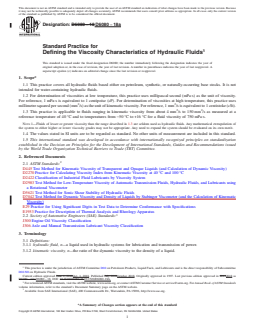
1.1 This practice covers all hydraulic fluids based either on petroleum, synthetic, or naturally-occurring base stocks. It is not intended for water-containing hydraulic fluids.
1.2 For determination of viscosities at low temperature, this practice uses millipascal·second (mPa·s) as the unit of viscosity. For reference, 1 mPa·s is equivalent to 1 centipoise (cP). For determination of viscosities at high temperature, this practice uses millimetre squared per second (mm2/s) as the unit of kinematic viscosity. For reference, 1 mm2/s is equivalent to 1 centistoke (cSt).
1.3 This practice is applicable to fluids ranging in kinematic viscosity from about 4 mm2/s to 150 mm2/s as measured at a reference temperature of 40 °C and to temperatures from −50 °C to +16 °C for a fluid viscosity of 750 mPa·s.
Note 1: Fluids of lesser or greater viscosity than the range described in 1.3 are seldom used as hydraulic fluids. Any mathematical extrapolation of the system to either higher or lower viscosity grades may not be appropriate. Any need to expand the system should be evaluated on its own merit.
1.4 The values stated in SI units are to be regarded as standard. No other units of measurement are included in this standard.
1.5 This international standard was developed in accordance with internationally recognized principles on standardization established in the Decision on Principles for the Development of International Standards, Guides and Recommendations issued by the World Trade Organization Technical Barriers to Trade (TBT) Committee.
- Status
- Published
- Publication Date
- 30-Sep-2018
- Technical Committee
- D02 - Petroleum Products, Liquid Fuels, and Lubricants
- Drafting Committee
- D02.N0 - Hydraulic Fluids
Buy Documents
ASTM D6080-18a - Standard Practice for Defining the Viscosity Characteristics of Hydraulic Fluids
REDLINE ASTM D6080-18a - Standard Practice for Defining the Viscosity Characteristics of Hydraulic Fluids
Overview
ASTM D6080-18a: Standard Practice for Defining the Viscosity Characteristics of Hydraulic Fluids provides a systematic method for designating and specifying the viscosity properties of hydraulic fluids. Developed by ASTM International, this standard creates a uniform approach to classify the viscosity of petroleum-based, synthetic, or naturally-derived hydraulic fluids, enhancing industry consistency and facilitating proper fluid selection for hydraulic system design and maintenance.
The standard establishes viscosity designations based on measured values that directly relate to hydraulic fluid performance. By providing a clear framework for viscosity classification, equipment designers, lubricant suppliers, and end users gain a practical and reliable basis for selecting and labeling hydraulic fluids for various applications, especially those requiring defined performance over a range of operating temperatures.
Key Topics
- Viscosity Measurement:
- Dynamic viscosity at low temperatures is measured in millipascal-seconds (mPa·s).
- Kinematic viscosity at higher temperatures is measured in millimetre squared per second (mm²/s).
- Shear Stability:
- Accounts for viscosity reduction in fluids containing viscosity index (VI) improvers under high shear conditions, reflecting real-world operational changes.
- Classification System:
- Defines viscosity grades for hydraulic fluids based on performance at both low and high temperatures after shear exposure.
- Introduces nomenclature combining ISO viscosity grades, low temperature performance (Lxx), high temperature shear viscosity, and VI designation (e.g., ISO VG 46 L32-40 (150)).
- Applicability:
- Applies to hydraulic fluids within the typical range of 4 mm²/s to 150 mm²/s at 40°C.
- Not intended for water-containing hydraulic fluids or lubricants covered by other specific viscosity classification systems such as SAE J300 or J306.
- Uniform Basis for Selection:
- Enables more accurate comparisons and specifications by focusing on the actual operational viscosity characteristics relevant to equipment demands.
Applications
ASTM D6080-18a is practical for a wide array of industries and roles:
- Equipment and System Design:
Designers can select hydraulic fluids with confidence, ensuring they maintain optimal viscosity during operation and at startup under various temperatures. - Lubricant Suppliers:
Suppliers can label and market hydraulic products consistently, meeting internationally recognized viscosity standards for ease of customer selection. - Maintenance and Operations:
Plant engineers or technicians use viscosity designations to match hydraulic fluids with manufacturer equipment recommendations, optimizing system protection and performance. - High Shear Applications:
Particularly useful where high-shear-stress is anticipated, such as high-pressure or high-speed hydraulic equipment, and where fluids use VI improvers to extend operating temperature ranges. - Global Trade and Compliance:
Supports international equipment compatibility and facilitates procurement by adhering to WTO TBT Committee criteria.
This standard does not evaluate other aspects of hydraulic oil quality, such as oxidation resistance or additive performance, focusing solely on viscosity and shear stability.
Related Standards
Referenced and Related Standards:
- ASTM D445: Test Method for Kinematic Viscosity of Transparent and Opaque Liquids.
- ASTM D2270: Practice for Calculating Viscosity Index from Kinematic Viscosity at 40°C and 100°C.
- ASTM D2422: Classification of Industrial Fluid Lubricants by Viscosity System.
- ASTM D2983: Low-Temperature Viscosity Testing for Hydraulic Fluids and Lubricants.
- ASTM D5621: Test Method for Sonic Shear Stability of Hydraulic Fluids.
- ASTM D7042: Dynamic Viscosity and Density of Liquids by Stabinger Viscometer.
- ASTM E29: Practice for Significant Digits in Test Data.
- ASTM E1953: Practice for Thermal Analysis and Rheology Apparatus.
- SAE J300: Engine Oil Viscosity Classification (not applicable to this standard).
- SAE J306: Axle and Manual Transmission Lubricant Viscosity Classification (not applicable to this standard).
Keywords: hydraulic fluid viscosity, ASTM D6080, viscosity classification, shear stability, hydraulic oil performance, hydraulic fluid selection, VI improvers, international hydraulic standards
By adopting ASTM D6080-18a, organizations ensure hydraulic fluid selection aligns with globally recognized criteria, supporting reliable hydraulic system operation across industries.
Relations
- Replaces
ASTM D6080-18 - Standard Practice for Defining the Viscosity Characteristics of Hydraulic Fluids - Effective Date
- 01-Oct-2018
- Effective Date
- 01-Apr-2024
- Effective Date
- 01-Nov-2023
- Effective Date
- 01-Nov-2023
- Effective Date
- 01-May-2020
- Effective Date
- 15-Mar-2020
- Effective Date
- 01-Jun-2019
- Effective Date
- 15-Dec-2016
- Effective Date
- 15-Dec-2016
- Effective Date
- 01-Jul-2014
- Effective Date
- 01-Jul-2014
- Effective Date
- 01-May-2014
- Effective Date
- 01-Mar-2014
- Effective Date
- 01-Oct-2013
- Refers
ASTM D2422-97(2013) - Standard Classification of Industrial Fluid Lubricants by Viscosity System - Effective Date
- 01-May-2013
Buy Documents
ASTM D6080-18a - Standard Practice for Defining the Viscosity Characteristics of Hydraulic Fluids
REDLINE ASTM D6080-18a - Standard Practice for Defining the Viscosity Characteristics of Hydraulic Fluids
Get Certified
Connect with accredited certification bodies for this standard

Element Materials Technology
Materials testing and product certification.

ABS Group Brazil
ABS Group certification services in Brazil.

ABS Quality Evaluations Inc.
American Bureau of Shipping quality certification.
Sponsored listings
Frequently Asked Questions
ASTM D6080-18a is a standard published by ASTM International. Its full title is "Standard Practice for Defining the Viscosity Characteristics of Hydraulic Fluids". This standard covers: SIGNIFICANCE AND USE 5.1 The purpose of this practice is to establish viscosity designations derived from viscosities measured by test methods which have a meaningful relationship to hydraulic fluid performance. This permits lubricant suppliers, lubricant users, and equipment designers to have a uniform and common basis for designating, specifying, or selecting the viscosity characteristics of hydraulic fluids. 5.2 This practice is not intended to be a replacement for Classification D2422. Rather, it is an enhancement intended to provide a better description of the viscosity characteristics of lubricants used as hydraulic fluids. 5.3 This practice implies no evaluation of hydraulic oil quality other than its viscosity and shear stability under the conditions specified. 5.4 While it is not intended for other functional fluids, this practice may be useful in high-shear-stress applications where viscosity index (VI) improvers are used to extend the useful operating temperature range of the fluid. 5.5 This practice does not apply to other lubricants for which viscosity classification systems already exist, for example, SAE J300 for automotive engine oils and SAE J306 for axle and manual transmission lubricants. SCOPE 1.1 This practice covers all hydraulic fluids based either on petroleum, synthetic, or naturally-occurring base stocks. It is not intended for water-containing hydraulic fluids. 1.2 For determination of viscosities at low temperature, this practice uses millipascal·second (mPa·s) as the unit of viscosity. For reference, 1 mPa·s is equivalent to 1 centipoise (cP). For determination of viscosities at high temperature, this practice uses millimetre squared per second (mm2/s) as the unit of kinematic viscosity. For reference, 1 mm2/s is equivalent to 1 centistoke (cSt). 1.3 This practice is applicable to fluids ranging in kinematic viscosity from about 4 mm2/s to 150 mm2/s as measured at a reference temperature of 40 °C and to temperatures from −50 °C to +16 °C for a fluid viscosity of 750 mPa·s. Note 1: Fluids of lesser or greater viscosity than the range described in 1.3 are seldom used as hydraulic fluids. Any mathematical extrapolation of the system to either higher or lower viscosity grades may not be appropriate. Any need to expand the system should be evaluated on its own merit. 1.4 The values stated in SI units are to be regarded as standard. No other units of measurement are included in this standard. 1.5 This international standard was developed in accordance with internationally recognized principles on standardization established in the Decision on Principles for the Development of International Standards, Guides and Recommendations issued by the World Trade Organization Technical Barriers to Trade (TBT) Committee.
SIGNIFICANCE AND USE 5.1 The purpose of this practice is to establish viscosity designations derived from viscosities measured by test methods which have a meaningful relationship to hydraulic fluid performance. This permits lubricant suppliers, lubricant users, and equipment designers to have a uniform and common basis for designating, specifying, or selecting the viscosity characteristics of hydraulic fluids. 5.2 This practice is not intended to be a replacement for Classification D2422. Rather, it is an enhancement intended to provide a better description of the viscosity characteristics of lubricants used as hydraulic fluids. 5.3 This practice implies no evaluation of hydraulic oil quality other than its viscosity and shear stability under the conditions specified. 5.4 While it is not intended for other functional fluids, this practice may be useful in high-shear-stress applications where viscosity index (VI) improvers are used to extend the useful operating temperature range of the fluid. 5.5 This practice does not apply to other lubricants for which viscosity classification systems already exist, for example, SAE J300 for automotive engine oils and SAE J306 for axle and manual transmission lubricants. SCOPE 1.1 This practice covers all hydraulic fluids based either on petroleum, synthetic, or naturally-occurring base stocks. It is not intended for water-containing hydraulic fluids. 1.2 For determination of viscosities at low temperature, this practice uses millipascal·second (mPa·s) as the unit of viscosity. For reference, 1 mPa·s is equivalent to 1 centipoise (cP). For determination of viscosities at high temperature, this practice uses millimetre squared per second (mm2/s) as the unit of kinematic viscosity. For reference, 1 mm2/s is equivalent to 1 centistoke (cSt). 1.3 This practice is applicable to fluids ranging in kinematic viscosity from about 4 mm2/s to 150 mm2/s as measured at a reference temperature of 40 °C and to temperatures from −50 °C to +16 °C for a fluid viscosity of 750 mPa·s. Note 1: Fluids of lesser or greater viscosity than the range described in 1.3 are seldom used as hydraulic fluids. Any mathematical extrapolation of the system to either higher or lower viscosity grades may not be appropriate. Any need to expand the system should be evaluated on its own merit. 1.4 The values stated in SI units are to be regarded as standard. No other units of measurement are included in this standard. 1.5 This international standard was developed in accordance with internationally recognized principles on standardization established in the Decision on Principles for the Development of International Standards, Guides and Recommendations issued by the World Trade Organization Technical Barriers to Trade (TBT) Committee.
ASTM D6080-18a is classified under the following ICS (International Classification for Standards) categories: 75.120 - Hydraulic fluids. The ICS classification helps identify the subject area and facilitates finding related standards.
ASTM D6080-18a has the following relationships with other standards: It is inter standard links to ASTM D6080-18, ASTM D445-24, ASTM D445-23, ASTM D2983-23, ASTM D5621-20, ASTM E1953-20, ASTM D5621-19, ASTM D2983-16, ASTM D445-16, ASTM D445-14e1, ASTM D445-14, ASTM D7042-14, ASTM E1953-14, ASTM D5621-07(2013), ASTM D2422-97(2013). Understanding these relationships helps ensure you are using the most current and applicable version of the standard.
ASTM D6080-18a is available in PDF format for immediate download after purchase. The document can be added to your cart and obtained through the secure checkout process. Digital delivery ensures instant access to the complete standard document.
Standards Content (Sample)
This international standard was developed in accordance with internationally recognized principles on standardization established in the Decision on Principles for the
Development of International Standards, Guides and Recommendations issued by the World Trade Organization Technical Barriers to Trade (TBT) Committee.
Designation:D6080 −18a
Standard Practice for
Defining the Viscosity Characteristics of Hydraulic Fluids
This standard is issued under the fixed designation D6080; the number immediately following the designation indicates the year of
original adoption or, in the case of revision, the year of last revision.Anumber in parentheses indicates the year of last reapproval.A
superscript epsilon (´) indicates an editorial change since the last revision or reapproval.
1. Scope* and Opaque Liquids (and Calculation of DynamicViscos-
ity)
1.1 This practice covers all hydraulic fluids based either on
D2270Practice for Calculating Viscosity Index from Kine-
petroleum, synthetic, or naturally-occurring base stocks. It is
matic Viscosity at 40°C and 100°C
not intended for water-containing hydraulic fluids.
D2422Classification of Industrial Fluid Lubricants by Vis-
1.2 For determination of viscosities at low temperature, this
cosity System
practice uses millipascal·second (mPa·s) as the unit of viscos-
D2983Test Method for Low-Temperature Viscosity of Au-
ity. For reference, 1mPa·s is equivalent to 1 centipoise (cP).
tomaticTransmissionFluids,HydraulicFluids,andLubri-
For determination of viscosities at high temperature, this
cants using a Rotational Viscometer
practiceusesmillimetresquaredpersecond(mm /s)astheunit
D5621Test Method for Sonic Shear Stability of Hydraulic
of kinematic viscosity. For reference, 1mm /s is equivalent to
Fluids
1 centistoke (cSt).
D7042Test Method for Dynamic Viscosity and Density of
1.3 Thispracticeisapplicabletofluidsranginginkinematic Liquids by Stabinger Viscometer (and the Calculation of
2 2
Kinematic Viscosity)
viscosity from about 4mm /s to 150mm /s as measured at a
reference temperature of 40 °C and to temperatures E29Practice for Using Significant Digits in Test Data to
Determine Conformance with Specifications
from−50°C to+16°C for a fluid viscosity of 750mPa·s.
E1953Practice for Description of Thermal Analysis and
NOTE 1—Fluids of lesser or greater viscosity than the range described
Rheology Apparatus
in1.3areseldomusedashydraulicfluids.Anymathematicalextrapolation
of the system to either higher or lower viscosity grades may not be
2.2 Society of Automotive Engineers (SAE) Standards:
appropriate. Any need to expand the system should be evaluated on its
J300Engine Oil Viscosity Classification
own merit.
J306Axle and Manual Transmission Lubricant Viscosity
1.4 The values stated in SI units are to be regarded as
Classification
standard. No other units of measurement are included in this
standard.
3. Terminology
1.5 This international standard was developed in accor-
3.1 Definitions:
dance with internationally recognized principles on standard-
3.1.1 hydraulic fluid, n—a liquid used in hydraulic systems
ization established in the Decision on Principles for the
for lubrication and transmission of power.
Development of International Standards, Guides and Recom-
3.1.2 kinematic viscosity, n—the ratio of the dynamic vis-
mendations issued by the World Trade Organization Technical
cosity to the density of a liquid.
Barriers to Trade (TBT) Committee.
3.1.2.1 Discussion—For gravity flow under a given hydro-
static head, the pressure head of a liquid is proportional to its
2. Referenced Documents
density. Therefore, kinematic viscosity is a measure of the
2.1 ASTM Standards:
resistance to flow of a liquid under gravity.
D445Test Method for Kinematic Viscosity of Transparent
3.1.3 Newtonian oil or fluid, n—anoilorfluidthatatagiven
temperature exhibits a constant viscosity at all shear rates or
1 shear stresses.
This practice is under the jurisdiction ofASTM Committee D02 on Petroleum
Products, Liquid Fuels, and Lubricants and is the direct responsibility of Subcom-
3.1.4 non-Newtonian oil or fluid, n—an oil or fluid that at a
mittee D02.N0 on Hydraulic Fluids.
given temperature exhibits a viscosity that varies with chang-
Current edition approved Oct. 1, 2018. Published October 2018. Originally
approved in 1997. Last previous edition approved in 2018 as D6080–18. DOI: ing shear stress or shear rate.
10.1520/D6080-18A.
For referenced ASTM standards, visit the ASTM website, www.astm.org, or
contact ASTM Customer Service at service@astm.org. For Annual Book of ASTM
Standards volume information, refer to the standard’s Document Summary page on AvailablefromSAEInternational(SAE),400CommonwealthDr.,Warrendale,
the ASTM website. PA 15096, http://www.sae.org.
*A Summary of Changes section appears at the end of this standard
Copyright © ASTM International, 100 Barr Harbor Drive, PO Box C700, West Conshohocken, PA 19428-2959. United States
D6080−18a
3.1.5 shear degradation, n—the decrease in molecular provide a better description of the viscosity characteristics of
weight of a polymeric thickener (VI improver) as a result of lubricants used as hydraulic fluids.
exposure to high shear stress.
5.3 This practice implies no evaluation of hydraulic oil
3.1.6 shear rate, n—the velocity gradient in fluid flow.
quality other than its viscosity and shear stability under the
conditions specified.
3.1.7 shear stability, n—the resistance of a polymer-
thickened fluid to shear degradation.
5.4 While it is not intended for other functional fluids, this
practice may be useful in high-shear-stress applications where
3.1.8 shear stress, n—the motivating force per unit area for
viscosity index (VI) improvers are used to extend the useful
fluid flow.
operating temperature range of the fluid.
3.1.9 viscosity, n—the ratio between the applied shear stress
5.5 This practice does not apply to other lubricants for
and the rate of shear.
which viscosity classification systems already exist, for
3.1.9.1 Discussion—Viscosity is sometimes called the coef-
example, SAE J300 for automotive engine oils and SAE J306
ficientofdynamicviscosity.Thiscoefficientisameasureofthe
for axle and manual transmission lubricants.
resistance to flow of the liquid.
3.1.10 viscosity index (VI), n—an arbitrary number used to
6. Procedure
characterize the variation of the kinematic viscosity of a fluid
6.1 The low temperature viscosity grade of a fluid is based
with temperature.
on the viscosity of new oil measured using a rotational
3.2 Definitions of Terms Specific to This Standard:
viscometer (see Practice E1953), Test Method D2983.
3.2.1 in-service viscosity, n—the viscosity of fluid during
6.1.1 Theviscosityshallbeinterpolatedfrommeasurements
operation of a hydraulic pump or circuit components.
at three temperatures spanning the temperature at which the
viscosity is 750mPa·s. A smooth graph of these data (log
4. Summary of Practice
viscosity versus temperature) determines the temperature at
which the oil has a viscosity of 750mPa·s.
4.1 High VI hydraulic fluids often contain high molecular
6.1.2 The temperature determined in 6.1.1 shall be rounded
weight thickeners, called viscosity index (VI) improvers,
to a whole number in accordance with Practice E29.
whichimpartnon-Newtoniancharacteristicstothefluid.These
6.1.3 The low temperature viscosity grade is determined by
polymers may shear degrade with use, and reduce the in-
matchingthetemperaturedeterminedin6.1.2withtherequire-
service viscosity of the fluids.
ments shown in Table 1.
4.2 This practice provides uniform guidelines for character-
6.2 The high temperature viscosity designation of a fluid is
izing oils in terms of both their high and low temperature
the 40°C kinematic viscosity (Test Methods D445 or D7042)
viscosities before and after exposure to high shear stress.
of a fluid which has been sheared using Test Method D5621.
4.2.1 Sincetheperformanceoffluidsattemperatureshigher
6.2.1 The kinematic viscosity determined in 6.2 shall be
than 40°C is determined in the worst case, that is, most severe
rounded to a whole number in accordance with Practice E29.
situation, by the sheared oil viscosity, the viscosity and
6.2.2 For a fluid known to contain no polymeric compo-
viscosity index used to characterize fluids in this practice are
nents which will shear degrade, the high temperature viscosity
those of the sheared fluid.
designation is the 40°C kinematic viscosity (Test Methods
4.2.2 Thispracticeclassifiesoilsatlowtemperaturebytheir
D445 or D7042) (see Note 2) of the new fluid, rounded per
new oil properties. Low temperature viscosities do not de-
6.2.1.
crease greatly, if at all, with polymer shear degradation.
Furthermore, this approach ensures that the fluid will be
properly classified under the worst-case conditions, that is,
when the fluid is new.
TABLE 1 Low Temperature Viscosity Grades for Hydraulic Fluid
4.3 This practice may be used with either Newtonian or
Classifications
non-Newtonian hydraulic fluids. This provides the user with a
Temperature, °C, for Rotational Viscosity
A
more reasonable basis to compare fluids than previous prac- of 750 mPa·s
Viscosity Grade
tices. min max
L5 . −50
L7 −49 −42
5. Significance and Use
L10 −41 −33
L15 −32 −23
5.1 The purpose of this practice is to establish viscosity
L22 −22 −15
designations derived from viscosities measured by test meth-
L32 −14 −8
ods which have a meaningful relationship to hydraulic fluid
L46 −7 −2
L68 −1 4
performance. This permits lubricant suppliers, lubricant users,
L100 5 10
and equipment designers to have a uniform and common basis
L150 11 16
for designating, specifying, or selecting the viscosity charac-
A
The temperature range for a given L-grade is approximately equivalent to that for
teristics of hydraulic fluids.
an ISO grade of the same numerical designation and having a viscosity index of
100, that is, the temperature range for the L10 grade is approximately the same as
5.2 This practice is not intended to be a replacement for
that for an ISO VG 10 grade with a viscosity index of 100.
Classification D2422. Rather, it is an enhancement intended to
D6080−18a
NOTE 2—Test Method D7042 results shall be bias-corrected by the
designation may still be used, and the use of any other
correction for formulated oils. D445 is the referee method.
descriptors for the new oil is at the discretion of the fluid
6.2.3 If the 40°C kinematic viscosity from 6.2.1 fails to marketer.
meet the same designation consistently (for example, it varies 6.4.2 Examples of use of this practice are shown in Table 3.
becauseofspreadinbasestockorcomponentspecifications,or
6.5 An oil blender may use any manufacturing control that
variability in kinematic viscosity or shear stability
seems appropriate to his operation. However, it is the respon-
measurements), the lower designation must be used to ensure
sibility of the blender to ensure that all production fully meets
conformance with 6.5 below.
the requirements for the viscosity designation on the container.
6.3 The viscosity index designation of the fluid is based on
the viscosity index as determined using Practice D2270 on
7. Interpretation of Results
fluid which has been sheared using Test Method D5621.
7.1 The designation determined for a hydraulic fluid as
6.3.1 Theviscosityindexdeterminedin6.3shallberounded
described in 6.4 may be used in combination with a manufac-
to the nearest ten units in accordance with Practice E29. This
turer’s viscosity recommendations for specific equipment to
value is the viscosity index designation.
estimate an acceptable temperature range over which that fluid
6.3.2 For fluids which do not contain polymeric
may be used in that equipment.
components,theviscosityindexisdeterminedonthenewfluid
7.2 The low temperature grade determined in 6.1, Lyy,
using Practice D2270. The viscosity index designation for the
definesthelowestrecommendedfluidtemperatureatwhichthe
fluid is established by rounding this viscosity index to the
fluidmaybeusedinequipmentwithastart-up,underloadlimit
nearest ten units in accordance with Practice E29.
of 750mPa·s, max.
NOTE 3—The guidelines for rounding viscosity in 6.2.1 and 6.2.2 and
7.2.1 Thelowtemperaturelimitisdeterminedbycomparing
viscosity index in 6.3.1 and 6.3.2 are specific to this practice and should
the Lyy designation with the corresponding temperature in
not be confused with the larger number of significant figures that can be
Table 1.
reported when Test Methods D445, D2270, and D7042 are used for other
purposes.
7.2.2 Example 1a—For an oil with the designation:
ISO VG 46
6.3.3 If the viscosity index fails to meet the same designa-
L32-40 ,
tion consisten
...
This document is not an ASTM standard and is intended only to provide the user of an ASTM standard an indication of what changes have been made to the previous version. Because
it may not be technically possible to adequately depict all changes accurately, ASTM recommends that users consult prior editions as appropriate. In all cases only the current version
of the standard as published by ASTM is to be considered the official document.
Designation: D6080 − 18 D6080 − 18a
Standard Practice for
Defining the Viscosity Characteristics of Hydraulic Fluids
This standard is issued under the fixed designation D6080; the number immediately following the designation indicates the year of
original adoption or, in the case of revision, the year of last revision. A number in parentheses indicates the year of last reapproval. A
superscript epsilon (´) indicates an editorial change since the last revision or reapproval.
1. Scope*
1.1 This practice covers all hydraulic fluids based either on petroleum, synthetic, or naturally-occurring base stocks. It is not
intended for water-containing hydraulic fluids.
1.2 For determination of viscosities at low temperature, this practice uses millipascal·second (mPa·s) as the unit of viscosity.
For reference, 1 mPa·s is equivalent to 1 centipoise (cP). For determination of viscosities at high temperature, this practice uses
2 2
millimetre squared per second (mm /s) as the unit of kinematic viscosity. For reference, 1 mm /s is equivalent to 1 centistoke (cSt).
2 2
1.3 This practice is applicable to fluids ranging in kinematic viscosity from about 4 mm /s to 150 mm /s as measured at a
reference temperature of 40 °C and to temperatures from −50 °C to +16 °C for a fluid viscosity of 750 mPa·s.
NOTE 1—Fluids of lesser or greater viscosity than the range described in 1.3 are seldom used as hydraulic fluids. Any mathematical extrapolation of
the system to either higher or lower viscosity grades may not be appropriate. Any need to expand the system should be evaluated on its own merit.
1.4 The values stated in SI units are to be regarded as standard. No other units of measurement are included in this standard.
1.5 This international standard was developed in accordance with internationally recognized principles on standardization
established in the Decision on Principles for the Development of International Standards, Guides and Recommendations issued
by the World Trade Organization Technical Barriers to Trade (TBT) Committee.
2. Referenced Documents
2.1 ASTM Standards:
D445 Test Method for Kinematic Viscosity of Transparent and Opaque Liquids (and Calculation of Dynamic Viscosity)
D2270 Practice for Calculating Viscosity Index from Kinematic Viscosity at 40 °C and 100 °C
D2422 Classification of Industrial Fluid Lubricants by Viscosity System
D2983 Test Method for Low-Temperature Viscosity of Automatic Transmission Fluids, Hydraulic Fluids, and Lubricants using
a Rotational Viscometer
D5621 Test Method for Sonic Shear Stability of Hydraulic Fluids
D7042 Test Method for Dynamic Viscosity and Density of Liquids by Stabinger Viscometer (and the Calculation of Kinematic
Viscosity)
E29 Practice for Using Significant Digits in Test Data to Determine Conformance with Specifications
E1953 Practice for Description of Thermal Analysis and Rheology Apparatus
2.2 Society of Automotive Engineers (SAE) Standards:
J300 Engine Oil Viscosity Classification
J306 Axle and Manual Transmission Lubricant Viscosity Classification
3. Terminology
3.1 Definitions:
3.1.1 hydraulic fluid, n—a liquid used in hydraulic systems for lubrication and transmission of power.
3.1.2 kinematic viscosity, n—the ratio of the dynamic viscosity to the density of a liquid.
This practice is under the jurisdiction of ASTM Committee D02 on Petroleum Products, Liquid Fuels, and Lubricants and is the direct responsibility of Subcommittee
D02.N0 on Hydraulic Fluids.
Current edition approved June 1, 2018Oct. 1, 2018. Published July 2018October 2018. Originally approved in 1997. Last previous edition approved in 20122018 as
D6080 – 12a.D6080 – 18. DOI: 10.1520/D6080-18.10.1520/D6080-18A.
For referenced ASTM standards, visit the ASTM website, www.astm.org, or contact ASTM Customer Service at service@astm.org. For Annual Book of ASTM Standards
volume information, refer to the standard’s Document Summary page on the ASTM website.
Available from SAE International (SAE), 400 Commonwealth Dr., Warrendale, PA 15096, http://www.sae.org.
*A Summary of Changes section appears at the end of this standard
Copyright © ASTM International, 100 Barr Harbor Drive, PO Box C700, West Conshohocken, PA 19428-2959. United States
D6080 − 18a
3.1.2.1 Discussion—
For gravity flow under a given hydrostatic head, the pressure head of a liquid is proportional to its density. Therefore, kinematic
viscosity is a measure of the resistance to flow of a liquid under gravity.
3.1.3 Newtonian oil or fluid, n—an oil or fluid that at a given temperature exhibits a constant viscosity at all shear rates or shear
stresses.
3.1.4 non-Newtonian oil or fluid, n—an oil or fluid that at a given temperature exhibits a viscosity that varies with changing
shear stress or shear rate.
3.1.5 shear degradation, n—the decrease in molecular weight of a polymeric thickener (VI improver) as a result of exposure
to high shear stress.
3.1.6 shear rate, n—the velocity gradient in fluid flow.
3.1.7 shear stability, n—the resistance of a polymer-thickened fluid to shear degradation.
3.1.8 shear stress, n—the motivating force per unit area for fluid flow.
3.1.9 viscosity, n—the ratio between the applied shear stress and the rate of shear.
3.1.9.1 Discussion—
Viscosity is sometimes called the coefficient of dynamic viscosity. This coefficient is a measure of the resistance to flow of the
liquid.
3.1.10 viscosity index (VI), n—an arbitrary number used to characterize the variation of the kinematic viscosity of a fluid with
temperature.
3.2 Definitions of Terms Specific to This Standard:
3.2.1 in-service viscosity, n—the viscosity of fluid during operation of a hydraulic pump or circuit components.
4. Summary of Practice
4.1 High VI hydraulic fluids often contain high molecular weight thickeners, called viscosity index (VI) improvers, which
impart non-Newtonian characteristics to the fluid. These polymers may shear degrade with use, and reduce the in-service viscosity
of the fluids.
4.2 This practice provides uniform guidelines for characterizing oils in terms of both their high and low temperature viscosities
before and after exposure to high shear stress.
4.2.1 Since the performance of fluids at temperatures higher than 40 °C is determined in the worst case, that is, most severe
situation, by the sheared oil viscosity, the viscosity and viscosity index used to characterize fluids in this practice are those of the
sheared fluid.
4.2.2 This practice classifies oils at low temperature by their new oil properties. Low temperature viscosities do not decrease
greatly, if at all, with polymer shear degradation. Furthermore, this approach ensures that the fluid will be properly classified under
the worst-case conditions, that is, when the fluid is new.
4.3 This practice may be used with either Newtonian or non-Newtonian hydraulic fluids. This provides the user with a more
reasonable basis to compare fluids than previous practices.
5. Significance and Use
5.1 The purpose of this practice is to establish viscosity designations derived from viscosities measured by test methods which
have a meaningful relationship to hydraulic fluid performance. This permits lubricant suppliers, lubricant users, and equipment
designers to have a uniform and common basis for designating, specifying, or selecting the viscosity characteristics of hydraulic
fluids.
5.2 This practice is not intended to be a replacement for Classification D2422. Rather, it is an enhancement intended to provide
a better description of the viscosity characteristics of lubricants used as hydraulic fluids.
5.3 This practice implies no evaluation of hydraulic oil quality other than its viscosity and shear stability under the conditions
specified.
5.4 While it is not intended for other functional fluids, this practice may be useful in high-shear-stress applications where
viscosity index (VI) improvers are used to extend the useful operating temperature range of the fluid.
5.5 This practice does not apply to other lubricants for which viscosity classification systems already exist, for example, SAE
J300 for automotive engine oils and SAE J306 for axle and manual transmission lubricants.
D6080 − 18a
6. Procedure
6.1 The low temperature viscosity grade of a fluid is based on the viscosity of new oil measured using a rotational viscometer
(see Practice E1953), Test Method D2983.
6.1.1 The viscosity shall be interpolated from measurements at three temperatures spanning the temperature at which the
viscosity is 750 mPa·s. A smooth graph of these data (log viscosity versus temperature) determines the temperature at which the
oil has a viscosity of 750 mPa·s.
6.1.2 The temperature determined in 6.1.1 shall be rounded to a whole number in accordance with Practice E29.
6.1.3 The low temperature viscosity grade is determined by matching the temperature determined in 6.1.2 with the requirements
shown in Table 1.
6.2 The high temperature viscosity designation of a fluid is the 40 °C kinematic viscosity (Test MethodMethods D445 or
D7042) of a fluid which has been sheared using Test Method D5621.
6.2.1 The kinematic viscosity determined in 6.2 shall be rounded to a whole number in accordance with Practice E29.
6.2.2 For a fluid known to contain no polymeric components which will shear degrade, the high temperature viscosity
designation is the 40 °C kinematic viscosity (Test MethodMethods D445 or D7042) (see Note 2) of the new fluid, rounded per
6.2.1.
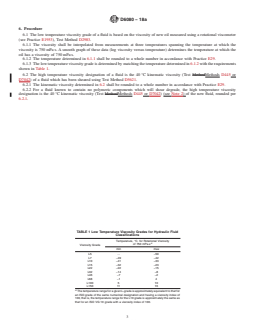
TABLE 1 Low Temperature Viscosity Grades for Hydraulic Fluid
Classifications
Temperature, °C, for Rotational Viscosity
A
of 750 mPa·s
Viscosity Grade
min max
L5 . −50
L7 −49 −42
L10 −41 −33
L15 −32 −23
L22 −22 −15
L32 −14 −8
L46 −7 −2
L68 −1 4
L100 5 10
L150 11 16
A
The temperature range for a given L-grade is approximately equivalent to that for
an ISO grade of the same numerical designation and having a viscosity index of
100, that is, the temperature range for the L10 grade is approximately the same as
that for an ISO VG 10 grade with a viscosity index of 100.
D6080 − 18a
NOTE 2—Test Method D7042 results shall be bias-corrected by the correction for formulated oils. D445 is the referee method.
6.2.3 If the 40 °C kinematic viscosity from 6.2.1 fails to meet the same designation consistently (for example, it varies because
of spread in base stock or component specifications, or variability in kinematic viscosity or shear stability measurements), the
lower designation must be used to ensure conformance with 6.5 below.
6.3 The viscosity index designation of the fluid is based on the viscosity index as determined using Practice D2270 on fluid
which has been sheared using Test Method D5621.
6.3.1 The viscosity index determined in 6.3 shall be rounded to the nearest ten units in accordance with Practice E29. This value
is the viscosity index designation.
6.3.2 For fluids which do not contain polymeric components, the viscosity index is determined on the new fluid using Practice
D2270. The viscosity index designation for the fluid is established by rounding this viscosity index to the nearest ten units in
accordance with Practice E29.
NOTE 3—The guidelines for rounding viscosity in 6.2.1 and 6.2.2 and viscosity index in 6.3.1 and 6.3.2 are specific to this practice and should not be
confused with the larger number of significant figures that can be reported when Test Methods D445, D2270and, D2270and D7042 are used for other
purposes.
6.3.3 If the viscosity index fails to meet the same designation consistently, that is, it varies between the lower values for one
designation and the higher values for the next lower designation (for example, it varies because of spread in base stock or
component specifications, or variability in kinematic viscosity or shear stability measurements), the lower designation must be used
to ensure conformance with 6.5 below.
6.4 For the sake of uniformity of nomenclature in identifying the viscosity characteristics of hydraulic fluids, the following
designation shall be used:
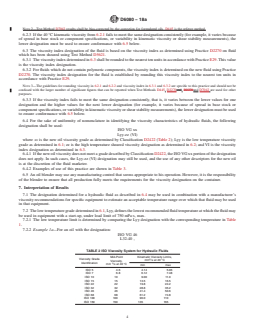
ISO VG xx
Lyy-zz (VI)
where xx is the new oil viscosity grade as determined by Classification D2422 (Table 2); Lyy is the low temperature viscosity
grade as determined in 6.1; zz is the high temperature sheared viscosity designation as determined in 6.2; and VI is the viscosity
index designation as determined in 6.3.
6.4.1 If the new oil viscosity does not meet a grade described by Classification D2422, the ISO VG xx portion of the designation
does not apply. In such cases, the Lyy-zz (VI) designation may still be used, and the use of any other descriptors for the new oil
is at the
...